lights PONTIAC VIBE 2004 User Guide
[x] Cancel search | Manufacturer: PONTIAC, Model Year: 2004, Model line: VIBE, Model: PONTIAC VIBE 2004Pages: 370, PDF Size: 2.68 MB
Page 122 of 370

Reading Lamp
If you have a sunroof, you will have a reading lamp
near the sunroof switch. Press the button to turn
the lamp on and press it again to turn it off.If you do not have a sunroof, your vehicle's inside
rearview mirror may be equipped with reading lamps.
If your vehicle is equipped with reading lamps, there are
two buttons located on the bottom of the mirror. Press
the buttons to turn the lamps on and press them again to
turn the lamps off.
To prevent the battery from draining, the lamps will
automatically turn off when the key is in the ACC
or LOCK positions or if the key is removed for 20
minutes or more. The lights will come on when any of
the doors are opened or if the key is turned to the
ON position.
3-16
Page 131 of 370
Warning Lights, Gages and
Indicators
This part describes the warning lights and gages that
may be on your vehicle. The pictures will help you
locate them.
Warning lights and gages can signal that something is
wrong before it becomes serious enough to cause
an expensive repair or replacement. Paying attention to
your warning lights and gages could also save you
or others from injury.
Warning lights come on when there may be or is a
problem with one of your vehicle's functions. As you will
see in the details on the next few pages, some
warning lights come on brie¯y when you start the
engine just to let you know they're working. If you are
familiar with this section, you should not be alarmed
when this happens.Gages can indicate when there may be or is a problem
with one of your vehicle's functions. Often gages
and warning lights work together to let you know when
there's a problem with your vehicle.
When one of the warning lights comes on and stays on
when you are driving, or when one of the gages shows
there may be a problem, check the section that tells you
what to do about it. Please follow this manual's advice.
Waiting to do repairs can be costly- and even dangerous.
So please get to know your warning lights and gages.
They're a big help.
3-25
Page 186 of 370

You can be temporarily blinded by approaching
headlamps. It can take a second or two, or even several
seconds, for your eyes to readjust to the dark. When
you are faced with severe glare (as from a driver
who doesn't lower the high beams, or a vehicle with
misaimed headlamps), slow down a little. Avoid staring
directly into the approaching headlamps.
Keep your windshield and all the glass on your vehicle
clean Ð inside and out. Glare at night is made much
worse by dirt on the glass. Even the inside of the glass
can build up a ®lm caused by dust. Dirty glass makes
lights dazzle and ¯ash more than clean glass would,
making the pupils of your eyes contract repeatedly.
Remember that your headlamps light up far less of a
roadway when you are in a turn or curve. Keep
your eyes moving; that way, it's easier to pick out dimly
lighted objects. Just as your headlamps should be
checked regularly for proper aim, so should your eyes
be examined regularly. Some drivers suffer from
night blindness Ð the inability to see in dim light Ð and
aren't even aware of it.Driving in Rain and on Wet Roads
Rain and wet roads can mean driving trouble. On a wet
road, you can't stop, accelerate or turn as well
because your tire-to-road traction isn't as good as on
dry roads. And, if your tires don't have much tread left,
you'll get even less traction. It's always wise to go
slower and be cautious if rain starts to fall while you are
driving. The surface may get wet suddenly when your
re¯exes are tuned for driving on dry pavement.
4-16
Page 237 of 370

When to Check and What to Use
Refer to the Maintenance
Schedule to determine
how often you should
check the ¯uid level in your
master cylinder reservoir
and for the proper
¯uid. See
Part B: Owner
Checks and Services
on page 6-19
andPart D:
Recommended Fluids
and Lubricants on
page 6-26
.
How to Check and Add Fluid
Check to make sure that the ¯uid level is at or above
the MIN mark. If the level is below the MIN mark,
see the instructions on the reservoir cap.
Engine Coolant
The following explains your cooling system and how to
add coolant when it is low. If you have a problem
with engine overheating, see
Engine Overheating on
page 5-30.
A 50/50 mixture of clean, drinkable water and the proper
coolant will:
·Give freezing protection down to-34ÉF (-37ÉC).
·Give boiling protection up to 265ÉF (129ÉC).
·Protect against rust and corrosion.
·Help keep the proper engine temperature.
·Let the warning lights and gages work as they
should.
5-27
Page 309 of 370
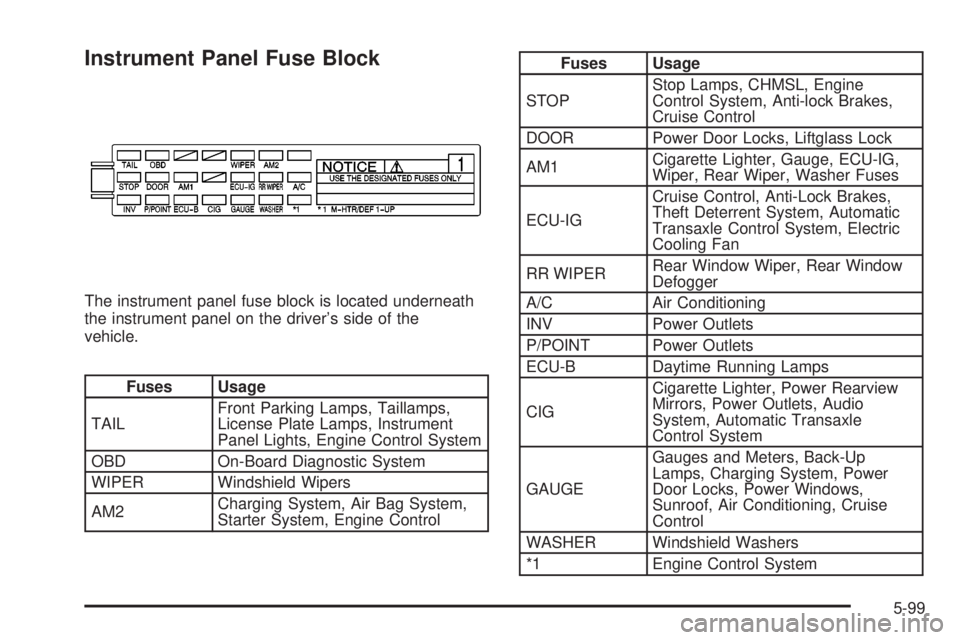
Instrument Panel Fuse Block
The instrument panel fuse block is located underneath
the instrument panel on the driver's side of the
vehicle.
Fuses Usage
TAILFront Parking Lamps, Taillamps,
License Plate Lamps, Instrument
Panel Lights, Engine Control System
OBD On-Board Diagnostic System
WIPER Windshield Wipers
AM2Charging System, Air Bag System,
Starter System, Engine Control
Fuses Usage
STOPStop Lamps, CHMSL, Engine
Control System, Anti-lock Brakes,
Cruise Control
DOOR Power Door Locks, Liftglass Lock
AM1Cigarette Lighter, Gauge, ECU-IG,
Wiper, Rear Wiper, Washer Fuses
ECU-IGCruise Control, Anti-Lock Brakes,
Theft Deterrent System, Automatic
Transaxle Control System, Electric
Cooling Fan
RR WIPERRear Window Wiper, Rear Window
Defogger
A/C Air Conditioning
INV Power Outlets
P/POINT Power Outlets
ECU-B Daytime Running Lamps
CIGCigarette Lighter, Power Rearview
Mirrors, Power Outlets, Audio
System, Automatic Transaxle
Control System
GAUGEGauges and Meters, Back-Up
Lamps, Charging System, Power
Door Locks, Power Windows,
Sunroof, Air Conditioning, Cruise
Control
WASHER Windshield Washers
*1 Engine Control System
5-99
Page 310 of 370
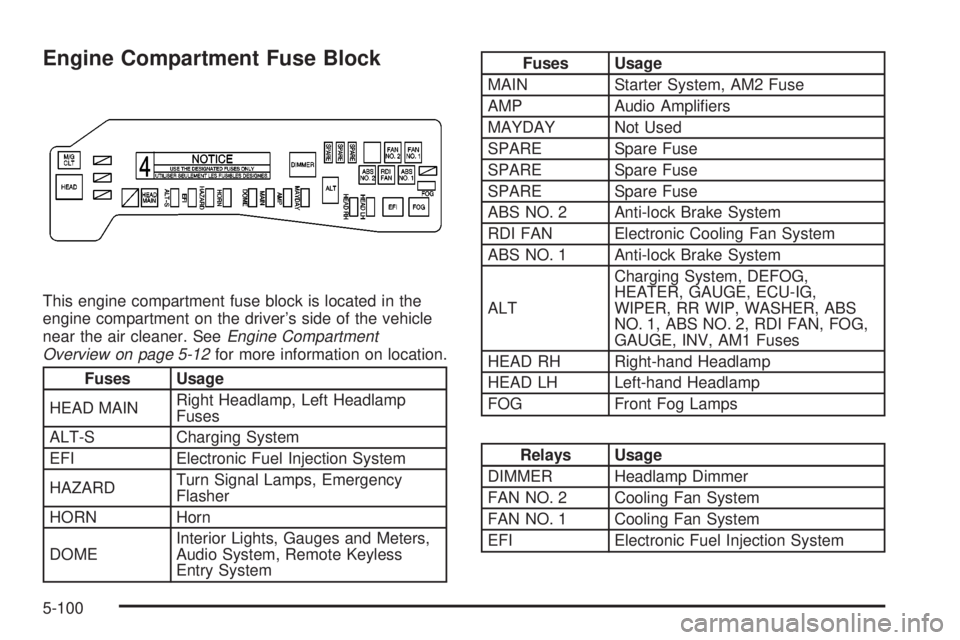
Engine Compartment Fuse Block
This engine compartment fuse block is located in the
engine compartment on the driver's side of the vehicle
near the air cleaner. See
Engine Compartment
Overview on page 5-12for more information on location.
Fuses Usage
HEAD MAINRight Headlamp, Left Headlamp
Fuses
ALT-S Charging System
EFI Electronic Fuel Injection System
HAZARDTurn Signal Lamps, Emergency
Flasher
HORN Horn
DOMEInterior Lights, Gauges and Meters,
Audio System, Remote Keyless
Entry System
Fuses Usage
MAIN Starter System, AM2 Fuse
AMP Audio Ampli®ers
MAYDAY Not Used
SPARE Spare Fuse
SPARE Spare Fuse
SPARE Spare Fuse
ABS NO. 2 Anti-lock Brake System
RDI FAN Electronic Cooling Fan System
ABS NO. 1 Anti-lock Brake System
ALTCharging System, DEFOG,
HEATER, GAUGE, ECU-IG,
WIPER, RR WIP, WASHER, ABS
NO. 1, ABS NO. 2, RDI FAN, FOG,
GAUGE, INV, AM1 Fuses
HEAD RH Right-hand Headlamp
HEAD LH Left-hand Headlamp
FOG Front Fog Lamps
Relays Usage
DIMMER Headlamp Dimmer
FAN NO. 2 Cooling Fan System
FAN NO. 1 Cooling Fan System
EFI Electronic Fuel Injection System
5-100
Page 370 of 370

W
Warning Lights, Gages and Indicators................3-25
Warnings......................................................... 3-4
Hazard Warning Flashers............................... 3-4
Other Warning Devices.................................. 3-4
Safety and Symbols......................................... iii
Vehicle Damage.............................................. iv
Washer Fluid, Low Warning Light......................3-39
Washing Your Vehicle......................................5-92
Weatherstrip Lubrication...................................6-20
Weight of the Trailer Tongue.............................4-36
Weight of the Trailer........................................4-35
What Kind of Engine Oil to Use........................5-18
What to Do with Used Oil................................5-21
What to Use..................................5-28, 5-38, 5-39
Wheels..........................................................5-73
Alignment and Tire Balance..........................5-73
Replacement...............................................5-74
When to Add Engine Oil..................................5-17
When to Change Engine Oil.............................5-20
When to Check......................................5-25, 5-68
When to Check and Change............................5-23
When to Check and What to Use.....................5-27
When to Check Power Steering Fluid................5-38
When You Are Ready to Leave After Parking
on a Hill.....................................................4-40Where to Put the Restraint...............................1-36
Why Safety Belts Work....................................1-10
Windows.......................................................2-11
Manual......................................................2-11
Power........................................................2-12
Windshield, Backglass and Wiper Blades...........5-93
Windshield Washer........................................... 3-8
Fluid..........................................................5-39
Windshield Washer Fluid Level Check................6-19
Windshield Wiper............................................5-60
Blade Replacement......................................5-60
Fuses........................................................5-98
Windshield Wipers............................................ 3-7
Winter Driving................................................4-24
Wiper Blade Check.........................................6-20
X
XMŸ Radio Satellite Service (USA Only)...........3-42
XMŸ Satellite Radio Antenna System................3-64
XMŸ Satellite Radio Service (USA Only)...........3-64
Y
Your Vehicle and the Environment....................... 6-2
14