tow PONTIAC VIBE 2004 User Guide
[x] Cancel search | Manufacturer: PONTIAC, Model Year: 2004, Model line: VIBE, Model: PONTIAC VIBE 2004Pages: 370, PDF Size: 2.68 MB
Page 92 of 370
Shifting Into Park (P)
{CAUTION:
It can be dangerous to get out of your vehicle
if the shift lever is not fully in PARK (P) with
the parking brake ®rmly set. Your vehicle can
roll. If you have left the engine running, the
vehicle can move suddenly. You or others
could be injured. To be sure your vehicle won't
move, even when you're on fairly level ground,
use the steps that follow. If you're pulling a
trailer, see ªTowing a Trailerº in the Index.
If you have an automatic transaxle do the following:
1. Hold the brake pedal down with your right foot and
set the parking brake by pulling up on the parking
brake lever.
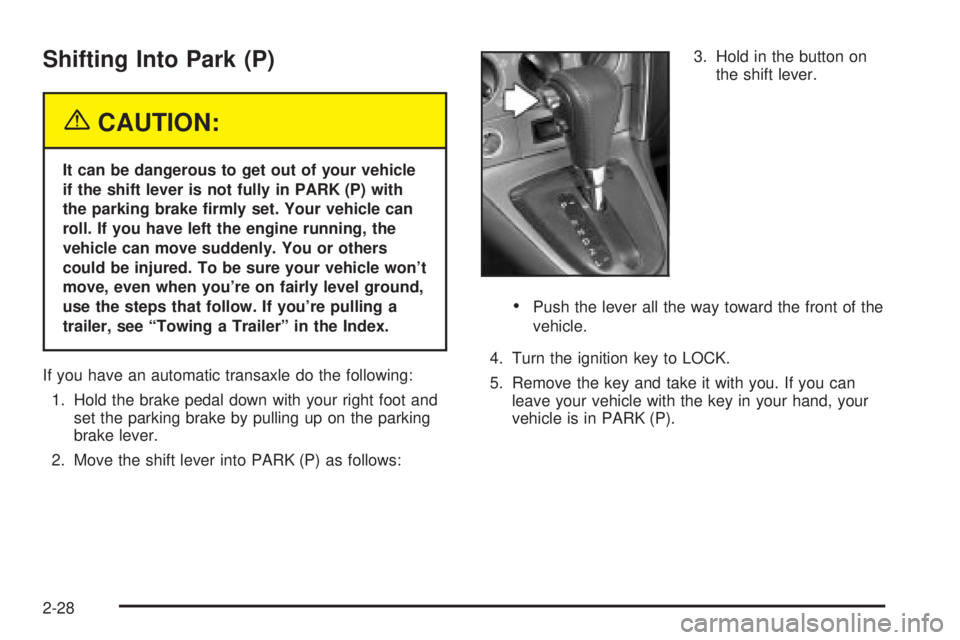
2. Move the shift lever into PARK (P) as follows:3. Hold in the button on
the shift lever.
·Push the lever all the way toward the front of the
vehicle.
4. Turn the ignition key to LOCK.
5. Remove the key and take it with you. If you can
leave your vehicle with the key in your hand, your
vehicle is in PARK (P).
2-28
Page 93 of 370

Leaving Your Vehicle With the Engine
Running
{CAUTION:
It can be dangerous to leave your vehicle with
the engine running. Your vehicle could move
suddenly if the shift lever is not fully in
PARK (P) with the parking brake ®rmly set.
And, if you leave the vehicle with the engine
running, it could overheat and even catch ®re.
You or others could be injured. Don't leave
your vehicle with the engine running.If you have to leave your automatic transaxle vehicle
with the engine running, be sure your vehicle is in
PARK (P) and your parking brake is ®rmly set before
you leave it. After you've moved the shift lever into
PARK (P), hold the regular brake pedal down. Then, see
if you can move the shift lever away from PARK (P)
without ®rst pulling it toward you. If you can, it means
that the shift lever wasn't fully locked into PARK (P).
2-29
Page 95 of 370
If you ever hold the brake pedal down but still can't shift
out of PARK (P), try this:
1. Turn the ignition to LOCK. Make sure the parking
brake is applied.
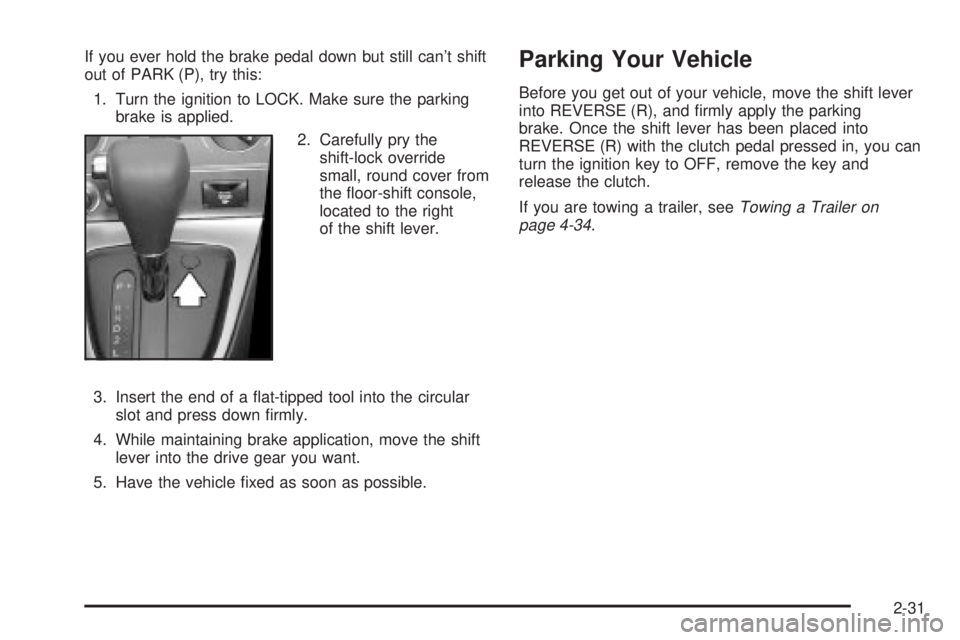
2. Carefully pry the
shift-lock override
small, round cover from
the ¯oor-shift console,
located to the right
of the shift lever.
3. Insert the end of a ¯at-tipped tool into the circular
slot and press down ®rmly.
4. While maintaining brake application, move the shift
lever into the drive gear you want.
5. Have the vehicle ®xed as soon as possible.Parking Your Vehicle
Before you get out of your vehicle, move the shift lever
into REVERSE (R), and ®rmly apply the parking
brake. Once the shift lever has been placed into
REVERSE (R) with the clutch pedal pressed in, you can
turn the ignition key to OFF, remove the key and
release the clutch.
If you are towing a trailer, see
Towing a Trailer on
page 4-34.
2-31
Page 98 of 370

Running Your Engine While You
Are Parked
It's better not to park with the engine running. But if you
ever have to, here are some things to know.
{CAUTION:
Idling the engine with the climate control
system off could allow dangerous exhaust into
your vehicle. See the earlier Caution under
ªEngine Exhaust.º
Also, idling in a closed-in place can let deadly
carbon monoxide (CO) into your vehicle even if
the climate control fan is at the highest setting.
One place this can happen is a garage.
Exhaust Ð with CO Ð can come in easily.
NEVER park in a garage with the engine
running.
Another closed-in place can be a blizzard.
See ªWinter Drivingº in the Index.
{CAUTION:
It can be dangerous to get out of your vehicle
if the shift lever is not fully in PARK (P) with
the parking brake ®rmly set. Your vehicle can
roll. Don't leave your vehicle when the engine
is running unless you have to. If you've left the
engine running, the vehicle can move
suddenly. You or others could be injured.
To be sure your vehicle won't move, even
when you're on fairly level ground, always set
your parking brake and move the shift lever to
PARK (P).
Follow the proper steps to be sure your vehicle won't
move. See
Shifting Into Park (P) on page 2-28.
If you are parking on a hill and if you're pulling a trailer,
also see
Towing a Trailer on page 4-34.
2-34
Page 101 of 370
Storage Areas
Glove Box
To open the glove box door, lift the latch. Always keep
the glove box door closed while driving.
Cupholder(s)
There are two ®xed cupholders located in the console
area between the two front seats. There are also
two cupholders that fold out of the rear of the console
storage unit.
Coinholder(s)
Your instrument panel has a coinholder located to the
left of the steering wheel.
Instrument Panel Storage Area
There are storage compartments located on the
instrument panel in two places. They are below the
interior/instrument panel brightness dial and below the
shift lever. Pull the top of the door toward you to open it
or for the compartment below the shift lever, push the
button to open it.
Center Console Storage Area
A storage area is located in the console between the
seats which can hold CDs, cassettes or a cell phone.
There is also an accessory power outlet located in
the storage area.
To access the upper tray of the storage area, raise the
console box lid without touching the lock release
lever. To access the lower storage area, pull up the lock
release lever while raising the lid.
Floor Mats
Your vehicle's ¯oor mat is specially designed to remain
in position under your feet and out of reach of the
accelerator pedal. The driver's side ¯oor mat is held in
place by two locator hooks.
Be sure the driver's side ¯oor mat is properly placed on
the ¯oor so that it does not block the movement of
the accelerator pedal.
2-37
Page 112 of 370
Turn and Lane-Change Signals
The turn signal has an upward (for right) and a
downward (for left) position. These positions allow you
to signal a turn or a lane change.
To signal a turn, move the lever all the way up or down.
When the turn is ®nished, the lever will return
automatically.
To signal a lane change, raise or lower the lever until
the arrow starts to ¯ash. Hold it there until you complete
your lane change. The lever will return by itself when
you release it.
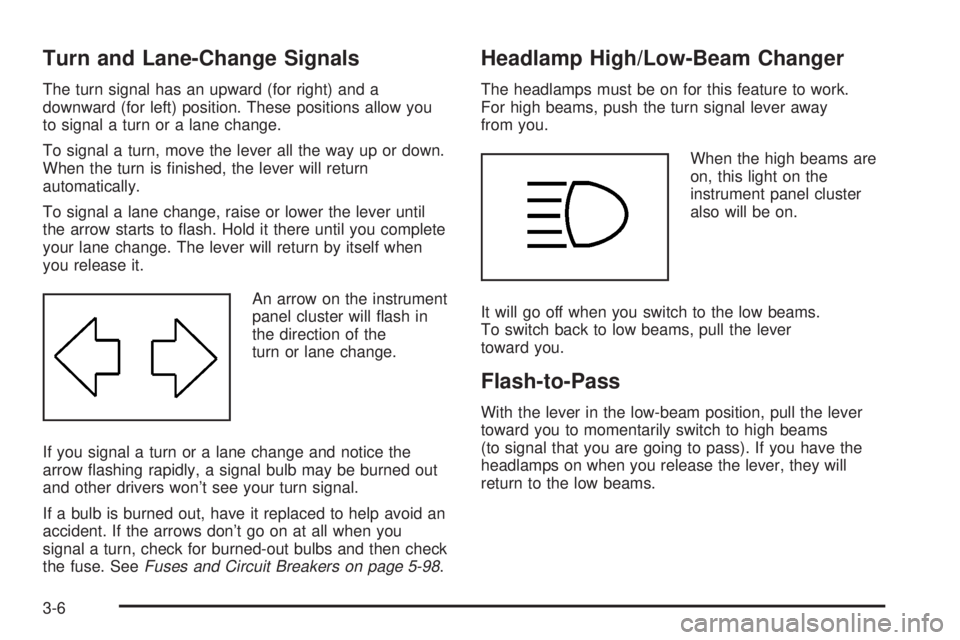
An arrow on the instrument
panel cluster will ¯ash in
the direction of the
turn or lane change.
If you signal a turn or a lane change and notice the
arrow ¯ashing rapidly, a signal bulb may be burned out
and other drivers won't see your turn signal.
If a bulb is burned out, have it replaced to help avoid an
accident. If the arrows don't go on at all when you
signal a turn, check for burned-out bulbs and then check
the fuse. See
Fuses and Circuit Breakers on page 5-98.
Headlamp High/Low-Beam Changer
The headlamps must be on for this feature to work.
For high beams, push the turn signal lever away
from you.
When the high beams are
on, this light on the
instrument panel cluster
also will be on.
It will go off when you switch to the low beams.
To switch back to low beams, pull the lever
toward you.
Flash-to-Pass
With the lever in the low-beam position, pull the lever
toward you to momentarily switch to high beams
(to signal that you are going to pass). If you have the
headlamps on when you release the lever, they will
return to the low beams.
3-6
Page 114 of 370

Windshield Washer
Pull the lever toward you to spray washer ¯uid on the
windshield. The spray will continue until you release the
lever. The wipers will run a few times. See
Windshield
Washer Fluid on page 5-39.
To squirt washer ¯uid on the rear window, twist the knob
upward and downward as far as it will go. The knob
automatically returns from these positions after you
release it. You can twist the lever downward to create a
large ¯ow of water on the rear window, then twist the
lever back up to wipe the window. This feature is helpful
to quickly clear the rear liftglass when very dirty.
{CAUTION:
In freezing weather, don't use your washer
until the windshield is warmed. Otherwise the
washer ¯uid can form ice on the windshield,
blocking your vision.
Cruise Control
The cruise control lever is located on the right side of
the steering wheel.
3-8
Page 117 of 370
Reducing Speed While Using Cruise
Control
There are two ways to reduce your speed while using
cruise control:
·Push and hold the lever to SET/COAST until you
reach the lower speed you want, then release it.
·To slow down in very small amounts, push the lever
down brie¯y. Each time you do this, you'll go about
1 mph (1.6 km/h) slower.
Passing Another Vehicle While Using
Cruise Control
Use the accelerator pedal to increase your speed.
When you take your foot off the pedal, your vehicle will
slow down to the cruise control speed you set earlier.
Using Cruise Control on Hills
How well your cruise control will work on hills depends
upon your speed, load and the steepness of the hills.
When going up steep hills, you may have to step on the
accelerator pedal to maintain your speed.When going downhill, you may have to brake or shift to
a lower gear to keep your speed down. Of course,
applying the brake or downshifting to SECOND (2) or
LOW (L) takes you out of cruise control. Many
drivers ®nd this to be too much trouble and don't use
cruise control on steep hills.
Ending Cruise Control
There are several ways to turn off the cruise control:
·Step lightly on the brake pedal or push the
clutch pedal, if you have a manual transaxle.
·Press the CRUISE ON-OFF button again.
·Pull the cruise control lever toward you.
Erasing Speed Memory
When you turn off the cruise control or the ignition, your
cruise control set speed memory is erased. The set
speed memory is also erased when the vehicle speed is
less than 25 mph (40 km/h).
3-11
Page 125 of 370

Ashtrays and Cigarette Lighter
Notice:Don't put papers or other ¯ammable items
into your ashtrays. Hot cigarettes or other smoking
materials could ignite them, causing a damaging ®re.
To use the lighter, push the lighter in all the way
and let go. When it's ready, it will pop back
out by itself. If the engine is not running, the key
must be in ACC to use the lighter.
It is not recommended to use the cigarette lighter to
plug in auxiliary electrical equipment. Use the accessory
power outlet for phones and other electrical equipment.
See
Accessory Power Outlets on page 3-17orPower
Outlet 115 Volt Alternating Current on page 3-18.
Notice:Don't hold a cigarette lighter in with your
hand while it is heating. If you do, it won't be able to
back away from the heating element when it's
ready. That can make it overheat, damaging the
lighter and the heating element.
Your vehicle has a removable ashtray that sits in your
front cupholder in the center console storage area.
Climate Controls
Climate Control System
With this system you can control the heating, cooling
and ventilation for your vehicle.
Operation
9
(Fan):Turn the center knob away from OFF to turn
the system on. Turn the knob toward HI to increase
fan speed.
If the air¯ow seems low when the fan is at the highest
setting, the passenger compartment air ®lter may
need to be replaced. For more information, see
Passenger Compartment Air Filter on page 3-23andShort Trip/City Scheduled Maintenance on page 6-7.
3-19
Page 129 of 370
Passenger Compartment Air Filter
Passenger compartment air, both outside and
recirculated air, is routed through a passenger
compartment air ®lter. The ®lter removes certain
contaminants from the air, including pollen and dust
particles. Reductions in air¯ow, which may occur more
quickly in dusty areas, indicate that the ®lter needs
to be replaced early. An air ®lter is available through
your dealer. For how often to change the air ®lter,
see
Short Trip/City Scheduled Maintenance on page 6-7.The access panel for the air ®lter is behind the glove
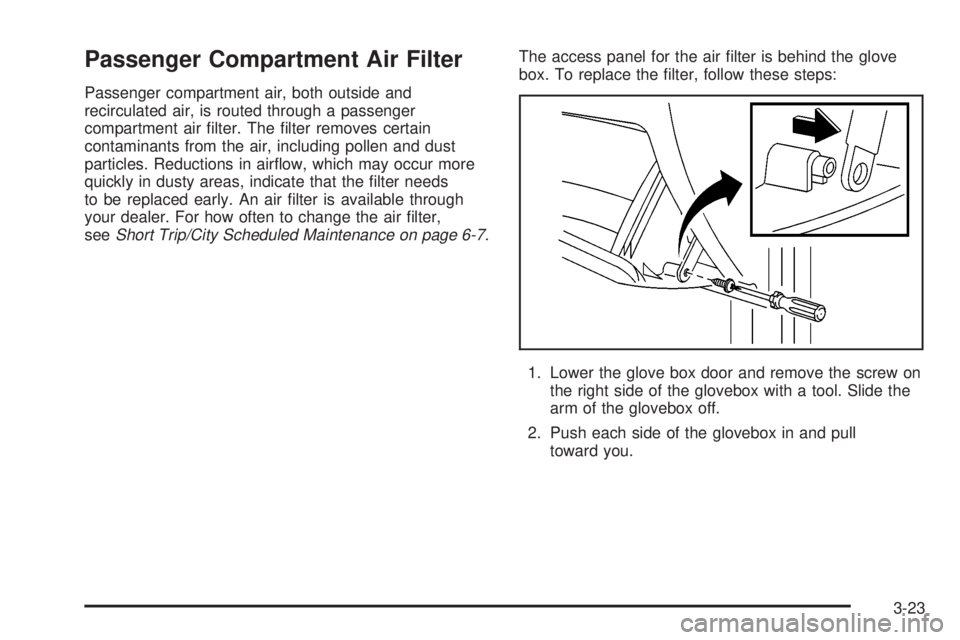
box. To replace the ®lter, follow these steps:
1. Lower the glove box door and remove the screw on
the right side of the glovebox with a tool. Slide the
arm of the glovebox off.
2. Push each side of the glovebox in and pull
toward you.
3-23