ECU PONTIAC VIBE 2004 Owner's Manual
[x] Cancel search | Manufacturer: PONTIAC, Model Year: 2004, Model line: VIBE, Model: PONTIAC VIBE 2004Pages: 370, PDF Size: 2.68 MB
Page 103 of 370
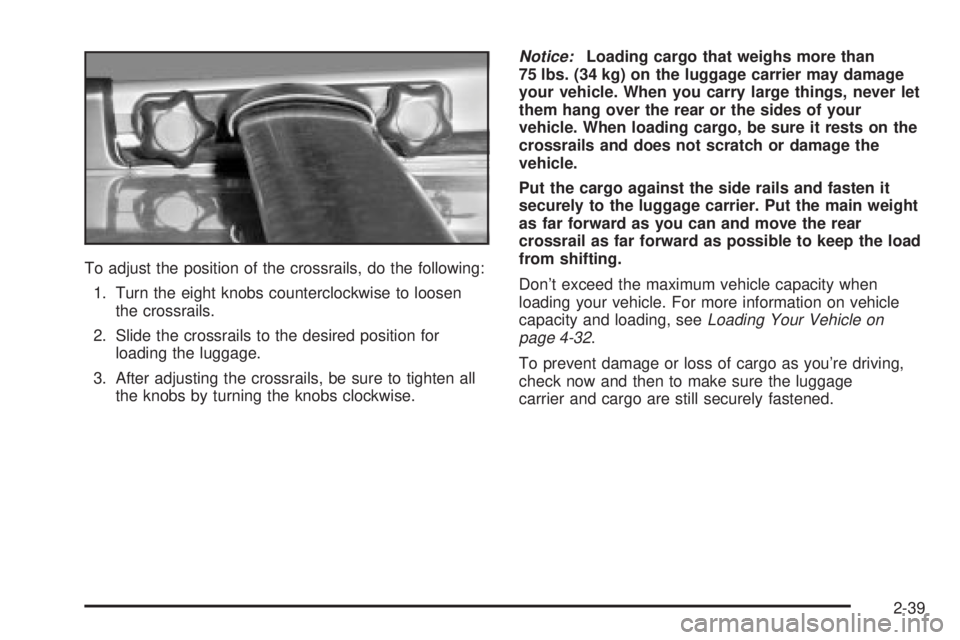
To adjust the position of the crossrails, do the following:
1. Turn the eight knobs counterclockwise to loosen
the crossrails.
2. Slide the crossrails to the desired position for
loading the luggage.
3. After adjusting the crossrails, be sure to tighten all
the knobs by turning the knobs clockwise.
Notice:Loading cargo that weighs more than
75 lbs. (34 kg) on the luggage carrier may damage
your vehicle. When you carry large things, never let
them hang over the rear or the sides of your
vehicle. When loading cargo, be sure it rests on the
crossrails and does not scratch or damage the
vehicle.
Put the cargo against the side rails and fasten it
securely to the luggage carrier. Put the main weight
as far forward as you can and move the rear
crossrail as far forward as possible to keep the load
from shifting.
Don't exceed the maximum vehicle capacity when
loading your vehicle. For more information on vehicle
capacity and loading, see
Loading Your Vehicle on
page 4-32.
To prevent damage or loss of cargo as you're driving,
check now and then to make sure the luggage
carrier and cargo are still securely fastened.
2-39
Page 104 of 370
Rear Storage Area
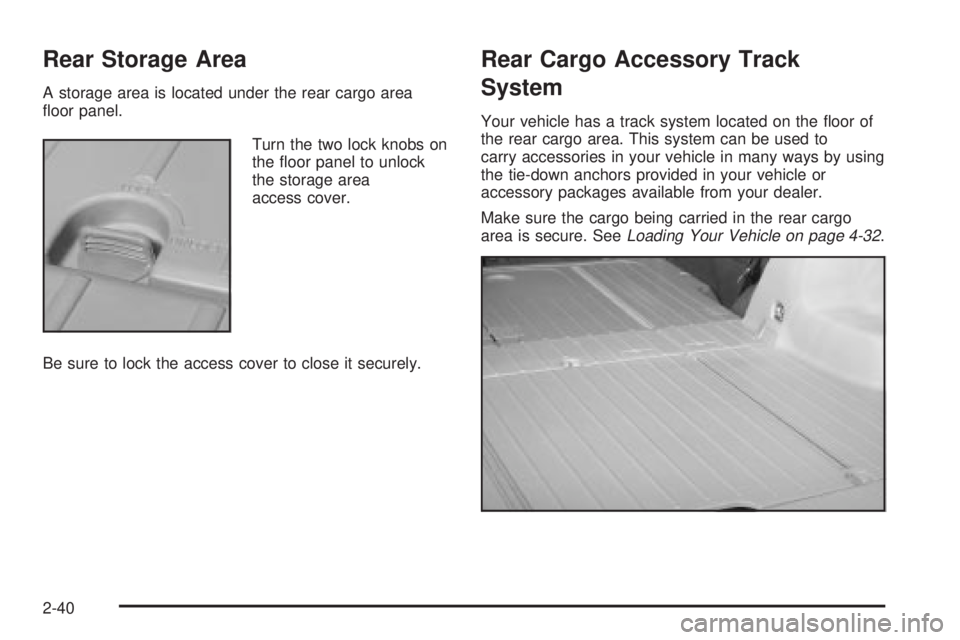
A storage area is located under the rear cargo area
¯oor panel.
Turn the two lock knobs on
the ¯oor panel to unlock
the storage area
access cover.
Be sure to lock the access cover to close it securely.
Rear Cargo Accessory Track
System
Your vehicle has a track system located on the ¯oor of
the rear cargo area. This system can be used to
carry accessories in your vehicle in many ways by using
the tie-down anchors provided in your vehicle or
accessory packages available from your dealer.
Make sure the cargo being carried in the rear cargo
area is secure. See
Loading Your Vehicle on page 4-32.
2-40
Page 105 of 370

Cargo Cover
To use the cargo cover, attach the side hooks of the
cargo cover to the upper tie down hooks located along
both sides of the rear cargo area.
{CAUTION:
An improperly stored cargo cover could be
thrown about the vehicle during a collision or
sudden maneuver. You or others could be
injured. If you remove the cover, always store
it in the proper storage location. When you put
it back, always be sure that it is securely
reattached.
Cargo Tie Downs
The tire tie-down belts are designed to secure the ¯at
tire. You can also use the belts and hooks to secure
your luggage.
There are eight tie-down hooks located in the rear of
the vehicle. The belts are located under the cargo area
¯oor panel. To use the belts, hook the ends to the
lower tie-down hooks in a criss-cross pattern across the
cargo. Pull on the belts at the buckle to tighten the
belt as needed.
2-41
Page 109 of 370

The main components of your instrument panel are the
following:
A. Air Outlets. See
Outlet Adjustment on page 3-22.
B. Instrument Panel Cluster. See
Instrument Panel
Cluster on page 3-26.
C. Hazard Warning Flasher Button. See
Hazard
Warning Flashers on page 3-4.
D. Audio System. See
Audio System(s) on page 3-41.
E. Rear Window Defogger Button. See ªRear Window
Defoggerº under
Climate Control System on
page 3-19.
F. Front Passenger Safety Belt Reminder Light. See
Safety Belt Reminder Light on page 3-28.
G. Climate Control System. See
Climate Control
System on page 3-19.
H. Power Remote Control Mirror Button. See
Outside
Remote Control Mirrors on page 2-36.
I. Instrument Panel Brightness Control. See
ªInstrument Panel Brightnessº under
Interior Lamps
on page 3-14.
J. Rear Liftglass Release Button. See
Liftgate/Liftglass
on page 2-9.
K. Coinholder. See
Coinholder(s) on page 2-37.
L. Content Theft-Deterrent Security Light. See
Content
Theft-Deterrent on page 2-13.M. Storage Compartment. See
Instrument Panel
Storage Area on page 2-37.
N. Turn Signal/Multifunction Lever. See
Turn
Signal/Multifunction Lever on page 3-5.
O. Hood Release. See
Hood Release on page 5-10.
P. Tilt Lever. See
Tilt Wheel on page 3-5.
Q. Horn. See
Horn on page 3-5.
R. Cruise Control Lever (Option). See ªCruise Controlº
under
Turn Signal/Multifunction Lever on page 3-5.
S. Ignition Switch. See
Ignition Positions on page 2-16.
T. Windshield Wiper Lever. See ªWindshield Wipersº
under
Turn Signal/Multifunction Lever on page 3-5.
U. Cigarette Lighter. See
Ashtrays and Cigarette Lighter
on page 3-19.
V. Shift Lever. See
Shifting Into Park (P) on page 2-28.
W. Power Outlet. See
Power Outlet 115 Volt Alternating
Current on page 3-18.
X. Parking Brake. See
Parking Brake on page 2-27.
Y. Center Console Storage Area. See
Center Console
Storage Area on page 2-37.
Z. Glove Box. See
Glove Box on page 2-37.
3-3
Page 155 of 370
XMŸ Radio Messages (cont'd)
Radio Display
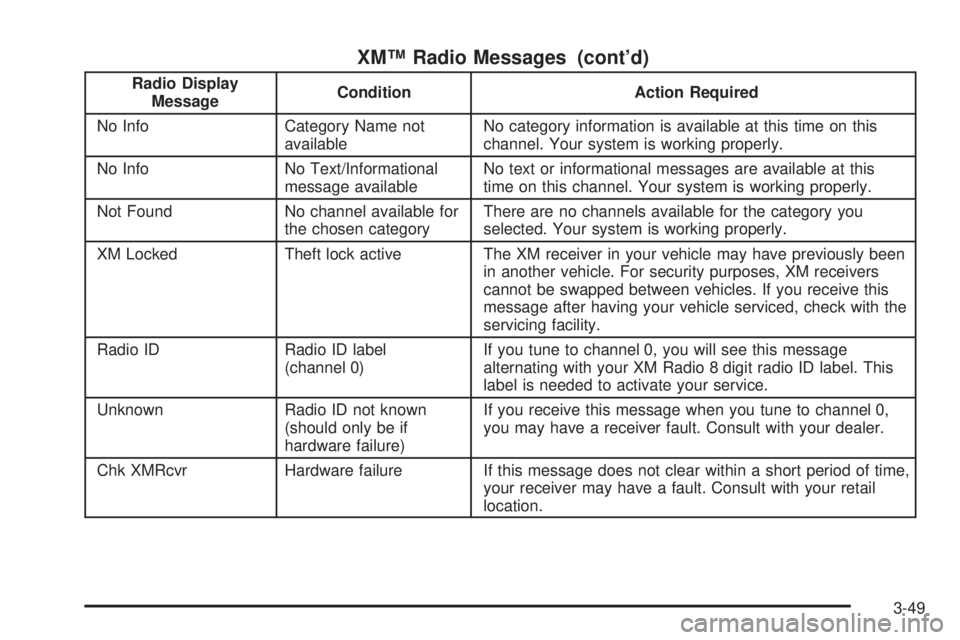
MessageCondition Action Required
No Info Category Name not
availableNo category information is available at this time on this
channel. Your system is working properly.
No Info No Text/Informational
message availableNo text or informational messages are available at this
time on this channel. Your system is working properly.
Not Found No channel available for
the chosen categoryThere are no channels available for the category you
selected. Your system is working properly.
XM Locked Theft lock active The XM receiver in your vehicle may have previously been
in another vehicle. For security purposes, XM receivers
cannot be swapped between vehicles. If you receive this
message after having your vehicle serviced, check with the
servicing facility.
Radio ID Radio ID label
(channel 0)If you tune to channel 0, you will see this message
alternating with your XM Radio 8 digit radio ID label. This
label is needed to activate your service.
Unknown Radio ID not known
(should only be if
hardware failure)If you receive this message when you tune to channel 0,
you may have a receiver fault. Consult with your dealer.
Chk XMRcvr Hardware failure If this message does not clear within a short period of time,
your receiver may have a fault. Consult with your retail
location.
3-49
Page 194 of 370
Winter DrivingHere are some tips for winter driving:
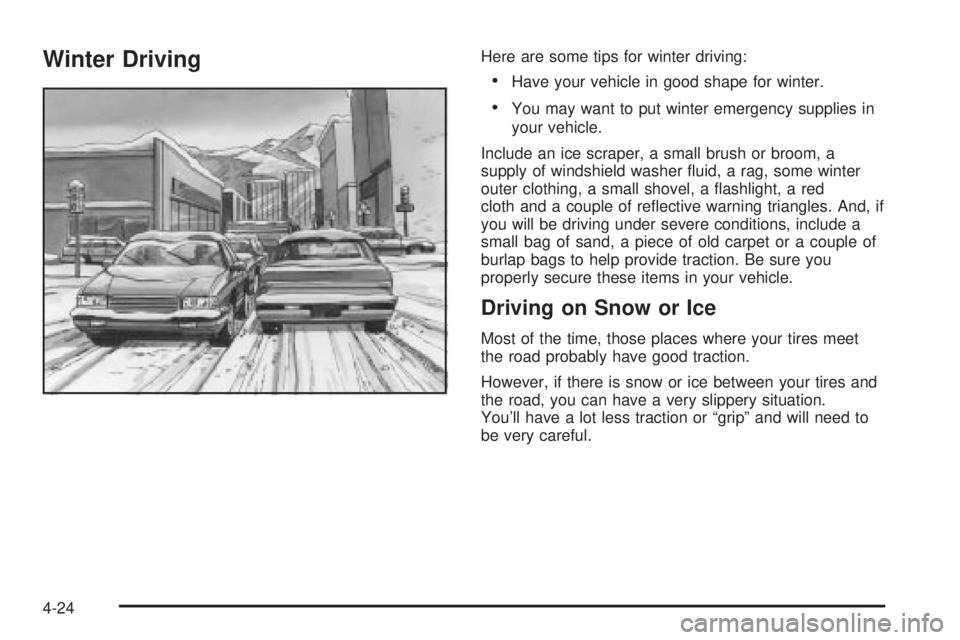
·Have your vehicle in good shape for winter.
·You may want to put winter emergency supplies in
your vehicle.
Include an ice scraper, a small brush or broom, a
supply of windshield washer ¯uid, a rag, some winter
outer clothing, a small shovel, a ¯ashlight, a red
cloth and a couple of re¯ective warning triangles. And, if
you will be driving under severe conditions, include a
small bag of sand, a piece of old carpet or a couple of
burlap bags to help provide traction. Be sure you
properly secure these items in your vehicle.
Driving on Snow or Ice
Most of the time, those places where your tires meet
the road probably have good traction.
However, if there is snow or ice between your tires and
the road, you can have a very slippery situation.
You'll have a lot less traction or ªgripº and will need to
be very careful.
4-24
Page 203 of 370
This is an example of what your vehicle's Tire-Loading
Information/Certi®cation label might look like. It is
located in the glovebox and shows how much weight
your vehicle may properly carry. The label tells you the
proper size, and recommended in¯ation pressures
for the tires on your vehicle. It also gives you important
information about the number of people that can be
in your vehicle and the total weight that you can carry.
This weight is called the Vehicle Capacity Weight,
and includes the weight of all occupants, cargo and all
nonfactory-installed options.
{CAUTION:
Do not load your vehicle any heavier than the
GVWR, or either the maximum front or rear
GAWR. If you do, parts on your vehicle can
break, and it can change the way your vehicle
handles. These could cause you to lose
control and crash. Also, overloading can
shorten the life of your vehicle.
{CAUTION:
Things you put inside your vehicle can strike
and injure people in a sudden stop or turn, or
in a crash.
·Put things in the rear area of your vehicle.
Try to spread the weight evenly. If you
have fold-down rear seats, you'll ®nd four
anchors on the back wall of your trunk.
You can use these anchors to tie down
lighter loads. They're not strong enough
for heavy things, however, so put them
as far forward as you can in the trunk or
rear area.
·Never stack heavier things, like suitcases,
inside the vehicle so that some of them
are above the tops of the seats.
·Don't leave an unsecured child restraint in
your vehicle.
·When you carry something inside the
vehicle, secure it whenever you can.
·Don't leave a seat folded down unless
you need to.
4-33
Page 208 of 370
Driving with a Trailer
Towing a trailer requires a certain amount of experience.
Before setting out for the open road, you'll want to get
to know your rig. Acquaint yourself with the feel of
handling and braking with the added weight of the trailer.
And always keep in mind that the vehicle you are
driving is now a good deal longer and not nearly as
responsive as your vehicle is by itself.
Before you start, check the trailer hitch, platform and
attachments, safety chains, electrical connector, lamps,
tires and mirror adjustment. If the trailer has electric
brakes, start your vehicle and trailer moving and then
apply the trailer brake controller by hand to be sure
the brakes are working. This lets you check your
electrical connection at the same time.
During your trip, check occasionally to be sure that the
load is secure, and that the lamps and any trailer
brakes are still working.
Following Distance
Stay at least twice as far behind the vehicle ahead as
you would when driving your vehicle without a trailer.
This can help you avoid situations that require
heavy braking and sudden turns.
Passing
You'll need more passing distance up ahead when
you're towing a trailer. And, because you're a good deal
longer, you'll need to go much farther beyond the
passed vehicle before you can return to your lane.
Backing Up
Hold the bottom of the steering wheel with one hand.
Then, to move the trailer to the left, just move that hand
to the left. To move the trailer to the right, move your
hand to the right. Always back up slowly and, if possible,
have someone guide you.
Making Turns
Notice:Making very sharp turns while trailering
could cause the trailer to come in contact with the
vehicle. Your vehicle could be damaged. Avoid
making very sharp turns while trailering.
When you're turning with a trailer, make wider turns
than normal. Do this so your trailer won't strike
soft shoulders, curbs, road signs, trees or other objects.
Avoid jerky or sudden maneuvers. Signal well in
advance.
4-38
Page 285 of 370
Used Replacement Wheels
{CAUTION:
Putting a used wheel on your vehicle is
dangerous. You can't know how it's been used
or how far it's been driven. It could fail
suddenly and cause a crash. If you have to
replace a wheel, use a new GM original
equipment wheel.
Tire Chains
Notice:Use tire chains only where legal and only
when you must. Use only SAE Class ªSº type chains
that are the proper size for your tires. Install them
on the front tires for front-wheel-drive vehicles.
If your vehicle has all-wheel-drive, install the
tire chains on the front or all four tires but never on
the rear tires only. Tighten them as tightly as
possible with the ends securely fastened. Drive
slowly and follow the chain manufacturer's
instructions. If you can hear the chains contacting
your vehicle, stop and retighten them. If the contact
continues, slow down until it stops. Driving too
fast or spinning the wheels with chains on will
damage your vehicle.
5-75
Page 295 of 370
Storing the Flat Tire and Tools
{CAUTION:
Storing a jack, a tire, or other equipment in the
passenger compartment of the vehicle could
cause injury. In a sudden stop or collision,
loose equipment could strike someone. Store
all these in the proper place.
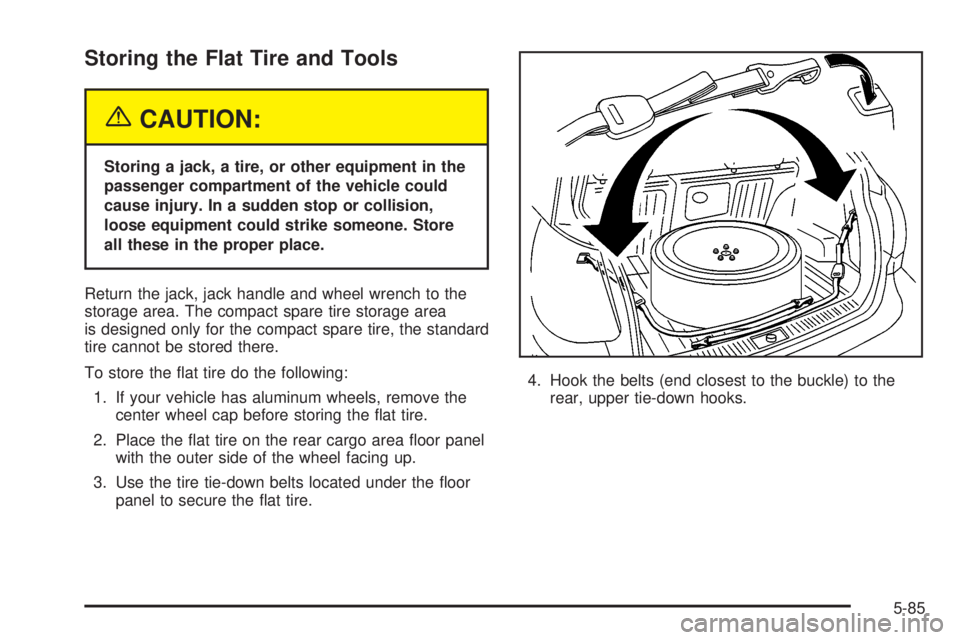
Return the jack, jack handle and wheel wrench to the
storage area. The compact spare tire storage area
is designed only for the compact spare tire, the standard
tire cannot be stored there.
To store the ¯at tire do the following:
1. If your vehicle has aluminum wheels, remove the
center wheel cap before storing the ¯at tire.
2. Place the ¯at tire on the rear cargo area ¯oor panel
with the outer side of the wheel facing up.
3. Use the tire tie-down belts located under the ¯oor
panel to secure the ¯at tire.4. Hook the belts (end closest to the buckle) to the
rear, upper tie-down hooks.
5-85