engine oil PONTIAC VIBE 2004 Owner's Manual
[x] Cancel search | Manufacturer: PONTIAC, Model Year: 2004, Model line: VIBE, Model: PONTIAC VIBE 2004Pages: 370, PDF Size: 2.68 MB
Page 242 of 370

Cooling System
When you decide it's safe to lift the hood, here's what
you'll see:
A. Electric Engine Cooling Fan
B. Engine Coolant Recovery Tank
C. Radiator Pressure Cap{CAUTION:
An electric engine cooling fan under the hood
can start up even when the engine is not
running and can injure you. Keep hands,
clothing and tools away from any underhood
electric fan.
If the coolant inside the coolant recovery tank is boiling,
don't do anything else until it cools down. The vehicle
should be parked on a level surface.
5-32
Page 244 of 370

How to Add Coolant to the Coolant
Recovery Tank
If you haven't found a problem yet, but the coolant level
isn't at or above the FULL mark, add a 50/50 mixture
of
clean, drinkable waterand a proper coolant at
the coolant recovery tank. SeeEngine Coolant on
page 5-27for more information about the proper coolant
mixture.
{CAUTION:
Adding only plain water to your cooling
system can be dangerous. Plain water, or
some other liquid such as alcohol, can boil
before the proper coolant mixture will. Your
vehicle's coolant warning system is set for the
proper coolant mixture. With plain water or the
wrong mixture, your engine could get too hot
but you wouldn't get the overheat warning.
Your engine could catch ®re and you or others
could be burned. Use a 50/50 mixture of clean,
drinkable water and a proper coolant.
Notice:In cold weather, water can freeze and crack
the engine, radiator, heater core and other parts.
Use the recommended coolant and the proper
coolant mixture.
5-34
Page 252 of 370

What to Add
When you do need brake ¯uid, use only DOT-3 brake
¯uid. Use new brake ¯uid from a sealed container
only. See
Part D: Recommended Fluids and Lubricants
on page 6-26.
Always clean the brake ¯uid reservoir cap and the area
around the cap before removing it. This will help
keep dirt from entering the reservoir.
{CAUTION:
With the wrong kind of ¯uid in your brake
system, your brakes may not work well, or
they may not even work at all. This could
cause a crash. Always use the proper
brake ¯uid.
Notice:
·Using the wrong ¯uid can badly damage brake
system parts. For example, just a few drops of
mineral-based oil, such as engine oil, in your
brake system can damage brake system
parts so badly that they will have to be replaced.
Do not let someone put in the wrong kind of
¯uid.
·If you spill brake ¯uid on your vehicle's painted
surfaces, the paint ®nish can be damaged. Be
careful not to spill brake ¯uid on your vehicle. If
you do, wash it off immediately. See
Appearance
Care on page 5-89.
5-42
Page 311 of 370
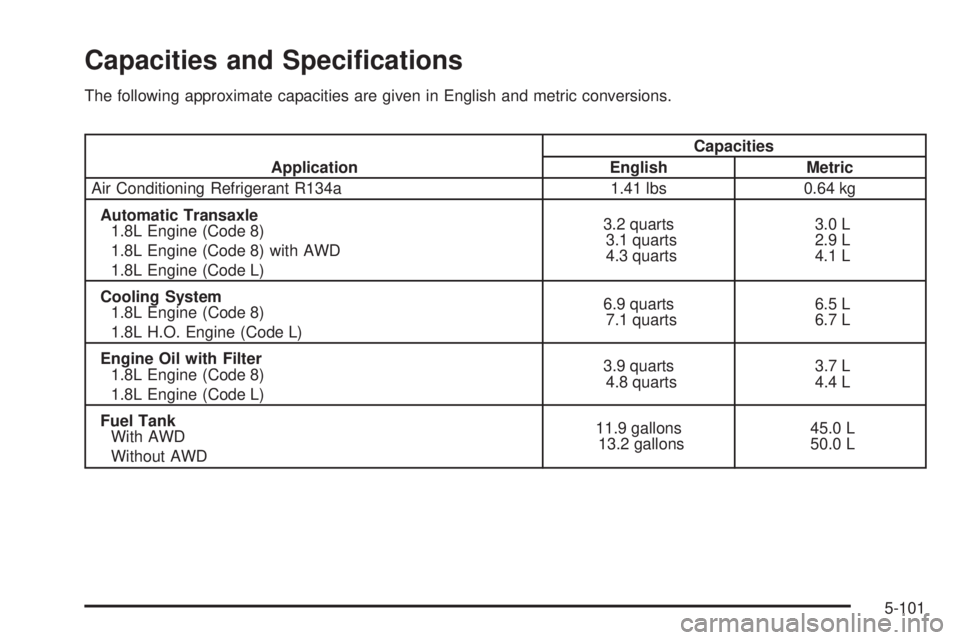
Capacities and Speci®cations
The following approximate capacities are given in English and metric conversions.
ApplicationCapacities
English Metric
Air Conditioning Refrigerant R134a 1.41 lbs 0.64 kg
Automatic Transaxle
1.8L Engine (Code 8)
1.8L Engine (Code 8) with AWD
1.8L Engine (Code L)3.2 quarts
3.1 quarts
4.3 quarts3.0 L
2.9 L
4.1 L
Cooling System
1.8L Engine (Code 8)
1.8L H.O. Engine (Code L)6.9 quarts
7.1 quarts6.5 L
6.7 L
Engine Oil with Filter
1.8L Engine (Code 8)
1.8L Engine (Code L)3.9 quarts
4.8 quarts3.7 L
4.4 L
Fuel Tank
With AWD
Without AWD11.9 gallons
13.2 gallons45.0 L
50.0 L
5-101
Page 313 of 370

Normal Maintenance Replacement Parts
Part Number
BatteryACDelcožPart No. 19001602
Engine Air Cleaner/Filter GM Part No. 88969107
Engine Oil Filter
Engine Oil Filter (Code 8)
Engine Oil Filter (Code L)GM Part No. 88971573
GM Part No. 88969580
Passenger Compartment Air Filter GM Part No. 88970273
PCV Valve
PCV Valve (Code 8 base model)
PCV Valve (Code 8 AWD Model)
PCV Valve (Code L)GM Part No. 94859406
GM Part No. 94859404
GM Part No. 88969512
Spark Plugs
1.8 L Engine (Code 8)
1.8 L Engine (Code L)DENSO SK16R11, NGK IFR5A11
or GM Part No. 94859448
DENSO SK20R11,
NGK IFR6A11 or
GM Part No. 88969637
*Your engine is ®tted with iridium-tipped spark plugs. Use only iridium-tipped spark plugs for better engine
performance.
5-103
Page 316 of 370

Maintenance Schedule
Introduction
Important: Keep engine oil at the proper level and
change as recommended.
Have you purchased the GM Protection Plan? The Plan
supplements your new vehicle warranties. See your
Warranty and Owner Assistance booklet or your dealer
for details.
Maintenance Requirements
Maintenance intervals, checks, inspections and
recommended ¯uids and lubricants as prescribed in this
manual are necessary to keep your vehicle in good
working condition. Any damage caused by failure
to follow scheduled maintenance may not be covered by
warranty.
Your Vehicle and the Environment
Proper vehicle maintenance not only helps to keep your
vehicle in good working condition, but also helps the
environment. Improper vehicle maintenance can
even affect the quality of the air we breathe. Improper
¯uid levels or the wrong tire in¯ation can increase
the level of emissions from your vehicle. To help protect
our environment, and to keep your vehicle in good
condition, be sure to maintain your vehicle properly.
6-2
Page 319 of 370
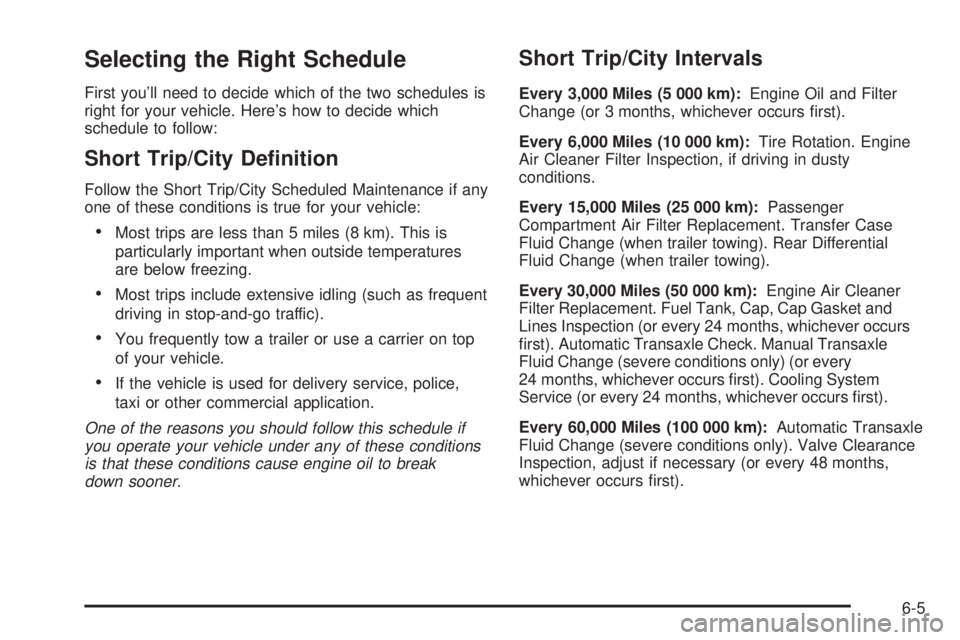
Selecting the Right Schedule
First you'll need to decide which of the two schedules is
right for your vehicle. Here's how to decide which
schedule to follow:
Short Trip/City De®nition
Follow the Short Trip/City Scheduled Maintenance if any
one of these conditions is true for your vehicle:
·Most trips are less than 5 miles (8 km). This is
particularly important when outside temperatures
are below freezing.
·Most trips include extensive idling (such as frequent
driving in stop-and-go traffic).
·You frequently tow a trailer or use a carrier on top
of your vehicle.
·If the vehicle is used for delivery service, police,
taxi or other commercial application.
One of the reasons you should follow this schedule if
you operate your vehicle under any of these conditions
is that these conditions cause engine oil to break
down sooner.
Short Trip/City Intervals
Every 3,000 Miles (5 000 km):Engine Oil and Filter
Change (or 3 months, whichever occurs ®rst).
Every 6,000 Miles (10 000 km):Tire Rotation. Engine
Air Cleaner Filter Inspection, if driving in dusty
conditions.
Every 15,000 Miles (25 000 km):Passenger
Compartment Air Filter Replacement. Transfer Case
Fluid Change (when trailer towing). Rear Differential
Fluid Change (when trailer towing).
Every 30,000 Miles (50 000 km):Engine Air Cleaner
Filter Replacement. Fuel Tank, Cap, Cap Gasket and
Lines Inspection (or every 24 months, whichever occurs
®rst). Automatic Transaxle Check. Manual Transaxle
Fluid Change (severe conditions only) (or every
24 months, whichever occurs ®rst). Cooling System
Service (or every 24 months, whichever occurs ®rst).
Every 60,000 Miles (100 000 km):Automatic Transaxle
Fluid Change (severe conditions only). Valve Clearance
Inspection, adjust if necessary (or every 48 months,
whichever occurs ®rst).
6-5
Page 320 of 370
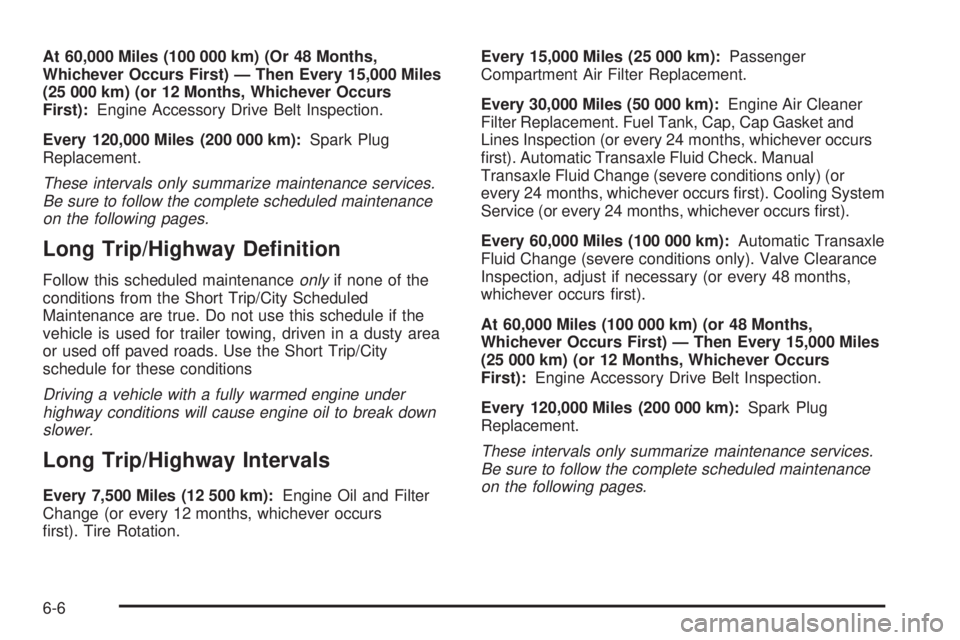
At 60,000 Miles (100 000 km) (Or 48 Months,
Whichever Occurs First) Ð Then Every 15,000 Miles
(25 000 km) (or 12 Months, Whichever Occurs
First):Engine Accessory Drive Belt Inspection.
Every 120,000 Miles (200 000 km):Spark Plug
Replacement.
These intervals only summarize maintenance services.
Be sure to follow the complete scheduled maintenance
on the following pages.
Long Trip/Highway De®nition
Follow this scheduled maintenanceonlyif none of the
conditions from the Short Trip/City Scheduled
Maintenance are true. Do not use this schedule if the
vehicle is used for trailer towing, driven in a dusty area
or used off paved roads. Use the Short Trip/City
schedule for these conditions
Driving a vehicle with a fully warmed engine under
highway conditions will cause engine oil to break down
slower.
Long Trip/Highway Intervals
Every 7,500 Miles (12 500 km):Engine Oil and Filter
Change (or every 12 months, whichever occurs
®rst). Tire Rotation.Every 15,000 Miles (25 000 km):Passenger
Compartment Air Filter Replacement.
Every 30,000 Miles (50 000 km):Engine Air Cleaner
Filter Replacement. Fuel Tank, Cap, Cap Gasket and
Lines Inspection (or every 24 months, whichever occurs
®rst). Automatic Transaxle Fluid Check. Manual
Transaxle Fluid Change (severe conditions only) (or
every 24 months, whichever occurs ®rst). Cooling System
Service (or every 24 months, whichever occurs ®rst).
Every 60,000 Miles (100 000 km):Automatic Transaxle
Fluid Change (severe conditions only). Valve Clearance
Inspection, adjust if necessary (or every 48 months,
whichever occurs ®rst).
At 60,000 Miles (100 000 km) (or 48 Months,
Whichever Occurs First) Ð Then Every 15,000 Miles
(25 000 km) (or 12 Months, Whichever Occurs
First):Engine Accessory Drive Belt Inspection.
Every 120,000 Miles (200 000 km):Spark Plug
Replacement.
These intervals only summarize maintenance services.
Be sure to follow the complete scheduled maintenance
on the following pages.
6-6
Page 321 of 370

Short Trip/City Scheduled
Maintenance
The services shown in this schedule up to 100,000 miles
(166 000 km) should be repeated after 100,000 miles
(166 000 km) at the same intervals for the life of
this vehicle. The service shown at 120,000 miles
(200 000 km) should be repeated at the same interval
after 120,000 miles (200 000 km) for the life of this
vehicle.
See
Part B: Owner Checks and Services on page 6-19andPart C: Periodic MaintenanceInspections on
page 6-24.
Footnotes
²The U.S. Environmental Protection Agency or the
California Air Resources Board has determined that the
failure to perform this maintenance item will not nullify
the emission warranty or limit recall liability prior to
the completion of the vehicle's useful life. We, however,
urge that all recommended maintenance services be
performed at the indicated intervals and the
maintenance be recorded.
+A good time to check your brakes is during tire
rotation. See Brake System Inspection on page 6-25.
3,000 Miles (5 000 km)
qChange engine oil and ®lter (or every 3 months,
whichever occurs ®rst).An Emission Control Service.
6,000 Miles (10 000 km)
qChange engine oil and ®lter (or every 3 months,
whichever occurs ®rst).An Emission Control Service.
qRotate tires. SeeTire Inspection and Rotation
on page 5-68for proper rotation pattern and
additional information.(See footnote +.)
qInspect engine air cleaner ®lter if you are driving
in dusty conditions. Replace ®lter if necessary.
An Emission Control Service. (See footnote ².)
9,000 Miles (15 000 km)
qChange engine oil and ®lter (or every 3 months,
whichever occurs ®rst).An Emission Control Service.
12,000 Miles (20 000 km)
qChange engine oil and ®lter (or every 3 months,
whichever occurs ®rst).An Emission Control Service.
qRotate tires. SeeTire Inspection and Rotation
on page 5-68for proper rotation pattern and
additional information.(See footnote +.)
qInspect engine air cleaner ®lter if you are driving
in dusty conditions. Replace ®lter if necessary.
An Emission Control Service. (See footnote ².)
6-7
Page 322 of 370
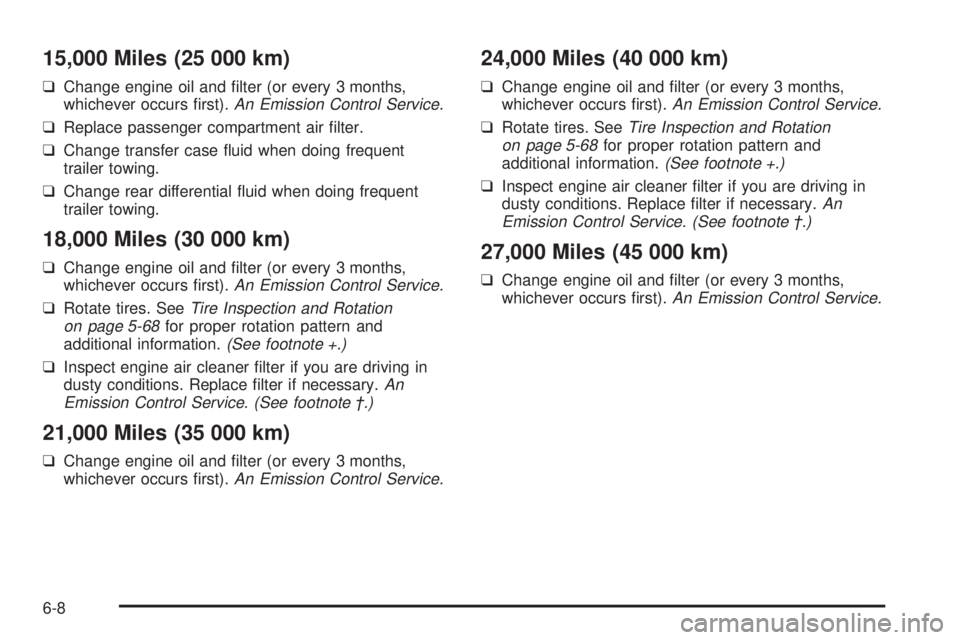
15,000 Miles (25 000 km)
qChange engine oil and ®lter (or every 3 months,
whichever occurs ®rst).An Emission Control Service.
qReplace passenger compartment air ®lter.
qChange transfer case ¯uid when doing frequent
trailer towing.
qChange rear differential ¯uid when doing frequent
trailer towing.
18,000 Miles (30 000 km)
qChange engine oil and ®lter (or every 3 months,
whichever occurs ®rst).An Emission Control Service.
qRotate tires. SeeTire Inspection and Rotation
on page 5-68for proper rotation pattern and
additional information.(See footnote +.)
qInspect engine air cleaner ®lter if you are driving in
dusty conditions. Replace ®lter if necessary.An
Emission Control Service. (See footnote ².)
21,000 Miles (35 000 km)
qChange engine oil and ®lter (or every 3 months,
whichever occurs ®rst).An Emission Control Service.
24,000 Miles (40 000 km)
qChange engine oil and ®lter (or every 3 months,
whichever occurs ®rst).An Emission Control Service.
qRotate tires. SeeTire Inspection and Rotation
on page 5-68for proper rotation pattern and
additional information.(See footnote +.)
qInspect engine air cleaner ®lter if you are driving in
dusty conditions. Replace ®lter if necessary.An
Emission Control Service. (See footnote ².)
27,000 Miles (45 000 km)
qChange engine oil and ®lter (or every 3 months,
whichever occurs ®rst).An Emission Control Service.
6-8