radiator cap PONTIAC VIBE 2004 Owners Manual
[x] Cancel search | Manufacturer: PONTIAC, Model Year: 2004, Model line: VIBE, Model: PONTIAC VIBE 2004Pages: 370, PDF Size: 2.68 MB
Page 211 of 370
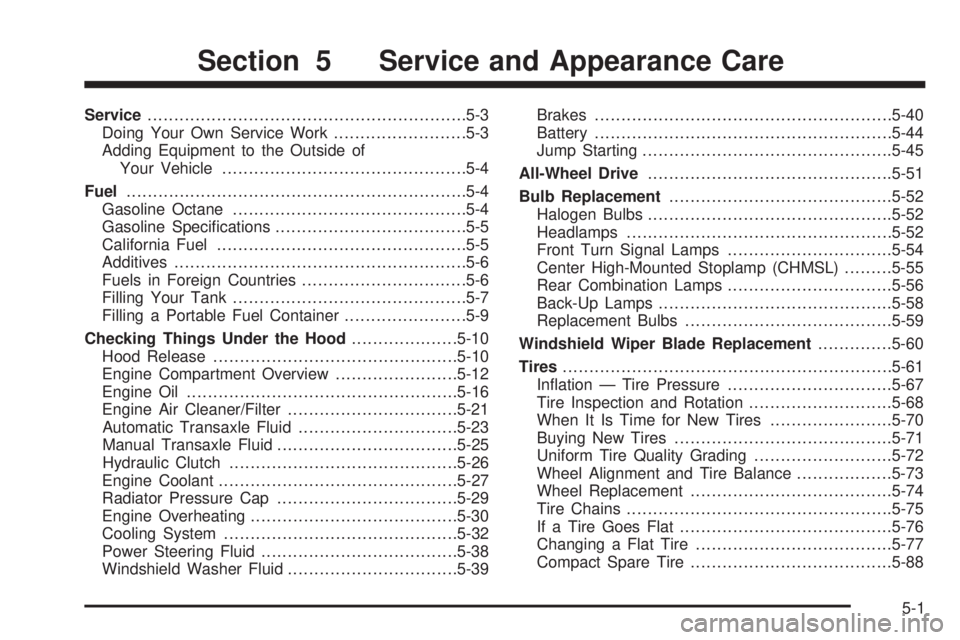
Service............................................................5-3
Doing Your Own Service Work.........................5-3
Adding Equipment to the Outside of
Your Vehicle..............................................5-4
Fuel................................................................5-4
Gasoline Octane............................................5-4
Gasoline Speci®cations....................................5-5
California Fuel...............................................5-5
Additives.......................................................5-6
Fuels in Foreign Countries...............................5-6
Filling Your Tank............................................5-7
Filling a Portable Fuel Container.......................5-9
Checking Things Under the Hood....................5-10
Hood Release..............................................5-10
Engine Compartment Overview.......................5-12
Engine Oil...................................................5-16
Engine Air Cleaner/Filter................................5-21
Automatic Transaxle Fluid..............................5-23
Manual Transaxle Fluid..................................5-25
Hydraulic Clutch...........................................5-26
Engine Coolant.............................................5-27
Radiator Pressure Cap..................................5-29
Engine Overheating.......................................5-30
Cooling System............................................5-32
Power Steering Fluid.....................................5-38
Windshield Washer Fluid................................5-39Brakes........................................................5-40
Battery........................................................5-44
Jump Starting...............................................5-45
All-Wheel Drive..............................................5-51
Bulb Replacement..........................................5-52
Halogen Bulbs..............................................5-52
Headlamps..................................................5-52
Front Turn Signal Lamps...............................5-54
Center High-Mounted Stoplamp (CHMSL).........5-55
Rear Combination Lamps...............................5-56
Back-Up Lamps............................................5-58
Replacement Bulbs.......................................5-59
Windshield Wiper Blade Replacement..............5-60
Tires..............................................................5-61
In¯ation Ð Tire Pressure...............................5-67
Tire Inspection and Rotation...........................5-68
When It Is Time for New Tires.......................5-70
Buying New Tires.........................................5-71
Uniform Tire Quality Grading..........................5-72
Wheel Alignment and Tire Balance..................5-73
Wheel Replacement......................................5-74
Tire Chains..................................................5-75
If a Tire Goes Flat........................................5-76
Changing a Flat Tire.....................................5-77
Compact Spare Tire......................................5-88
Section 5 Service and Appearance Care
5-1
Page 223 of 370
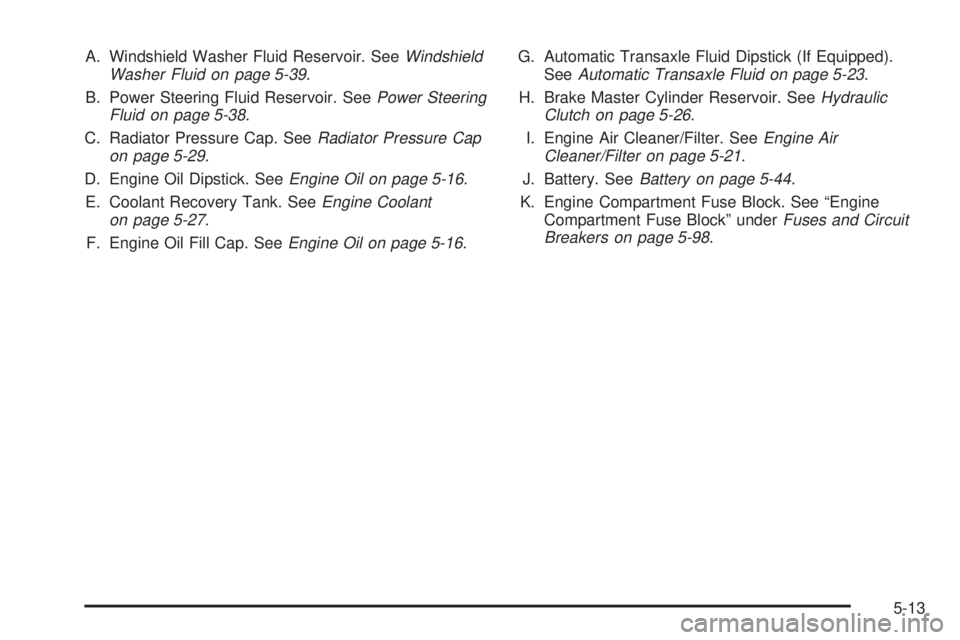
A. Windshield Washer Fluid Reservoir. SeeWindshield
Washer Fluid on page 5-39.
B. Power Steering Fluid Reservoir. See
Power Steering
Fluid on page 5-38.
C. Radiator Pressure Cap. See
Radiator Pressure Cap
on page 5-29.
D. Engine Oil Dipstick. See
Engine Oil on page 5-16.
E. Coolant Recovery Tank. See
Engine Coolant
on page 5-27.
F. Engine Oil Fill Cap. See
Engine Oil on page 5-16.G. Automatic Transaxle Fluid Dipstick (If Equipped).
See
Automatic Transaxle Fluid on page 5-23.
H. Brake Master Cylinder Reservoir. See
Hydraulic
Clutch on page 5-26.
I. Engine Air Cleaner/Filter. See
Engine Air
Cleaner/Filter on page 5-21.
J. Battery. See
Battery on page 5-44.
K. Engine Compartment Fuse Block. See ªEngine
Compartment Fuse Blockº under
Fuses and Circuit
Breakers on page 5-98.
5-13
Page 225 of 370
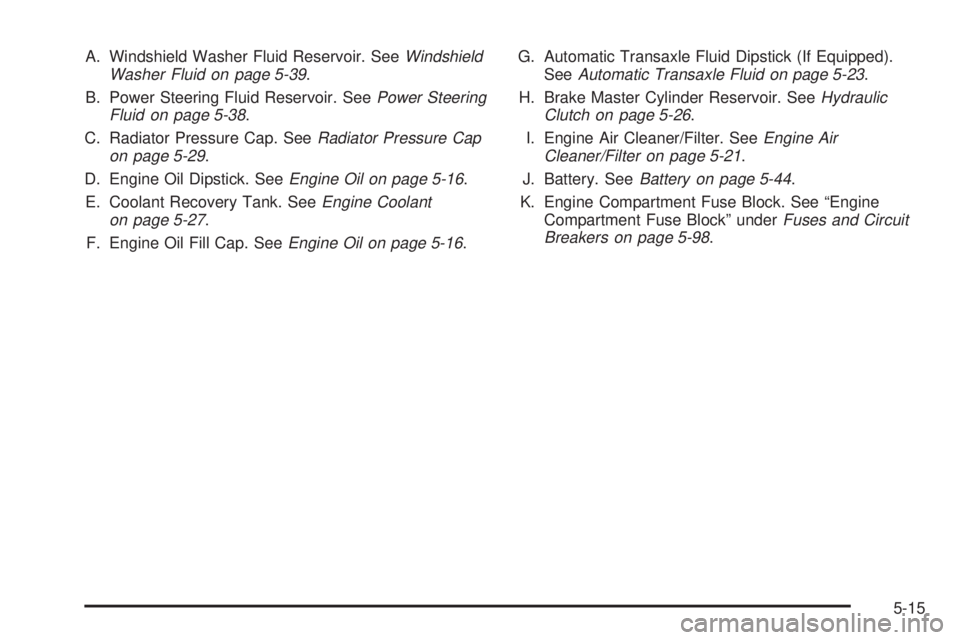
A. Windshield Washer Fluid Reservoir. SeeWindshield
Washer Fluid on page 5-39.
B. Power Steering Fluid Reservoir. See
Power Steering
Fluid on page 5-38.
C. Radiator Pressure Cap. See
Radiator Pressure Cap
on page 5-29.
D. Engine Oil Dipstick. See
Engine Oil on page 5-16.
E. Coolant Recovery Tank. See
Engine Coolant
on page 5-27.
F. Engine Oil Fill Cap. See
Engine Oil on page 5-16.G. Automatic Transaxle Fluid Dipstick (If Equipped).
See
Automatic Transaxle Fluid on page 5-23.
H. Brake Master Cylinder Reservoir. See
Hydraulic
Clutch on page 5-26.
I. Engine Air Cleaner/Filter. See
Engine Air
Cleaner/Filter on page 5-21.
J. Battery. See
Battery on page 5-44.
K. Engine Compartment Fuse Block. See ªEngine
Compartment Fuse Blockº under
Fuses and Circuit
Breakers on page 5-98.
5-15
Page 239 of 370

Adding Coolant
If you need more coolant, add the proper coolant
mixtureat the coolant recovery tank,but be careful not
to spill it.
{CAUTION:
Turning the radiator pressure cap when the
engine and radiator are hot can allow steam
and scalding liquids to blow out and burn you
badly. With the coolant recovery tank, you will
almost never have to add coolant at the
radiator. Never turn the radiator pressure
cap Ð even a little Ð when the engine and
radiator are hot.
{CAUTION:
You can be burned if you spill coolant on hot
engine parts. Coolant contains ethylene glycol,
and it will burn if the engine parts are hot
enough. Don't spill coolant on a hot engine.
Occasionally check the coolant level in the radiator. For
information on how to add coolant to the radiator,
see
Cooling System on page 5-32.
Radiator Pressure Cap
Notice:Your radiator cap is a 15.6 psi (110 kPa)
pressure-type cap and must be tightly installed
to prevent coolant loss and possible engine damage
from overheating. Be sure the arrows on the cap
line up with the over¯ow tube on the radiator ®ller.
See
Engine Compartment Overview on page 5-12for more information on location.
5-29
Page 242 of 370

Cooling System
When you decide it's safe to lift the hood, here's what
you'll see:
A. Electric Engine Cooling Fan
B. Engine Coolant Recovery Tank
C. Radiator Pressure Cap{CAUTION:
An electric engine cooling fan under the hood
can start up even when the engine is not
running and can injure you. Keep hands,
clothing and tools away from any underhood
electric fan.
If the coolant inside the coolant recovery tank is boiling,
don't do anything else until it cools down. The vehicle
should be parked on a level surface.
5-32
Page 243 of 370

The coolant level should
be at or above the FULL
mark. If it isn't, you
may have a leak at the
pressure cap or in
the radiator hoses, heater
hoses, radiator, water
pump or somewhere else
in the cooling system.
{CAUTION:
Heater and radiator hoses, and other engine
parts, can be very hot. Do not touch them. If
you do, you can be burned.
Do not run the engine if there is a leak. If you
run the engine, it could lose all coolant. That
could cause an engine ®re, and you could be
burned. Get any leak ®xed before you drive the
vehicle.
If there seems to be no leak, with the engine on, check
to see if the electric engine cooling fan is running. If
the engine is overheating, the fan should be running. If
it isn't, your vehicle needs service.
Notice:Engine damage from running your engine
without coolant isn't covered by your warranty.
5-33
Page 245 of 370

{CAUTION:
You can be burned if you spill coolant on hot
engine parts. Coolant contains ethylene glycol
and it will burn if the engine parts are hot
enough. Do not spill coolant on a hot engine.
When the coolant in the coolant recovery tank is at the
FULL mark, start your vehicle.
If the overheat warning continues, there's one more
thing you can try. You can add the proper coolant
mixture directly to the radiator but be sure the cooling
system is cool before you do it.
{CAUTION:
Steam and scalding liquids from a hot cooling
system can blow out and burn you badly. They
are under pressure, and if you turn the radiator
pressure cap -- even a little -- they can come
CAUTION: (Continued)
CAUTION: (Continued)
out at high speed. Never turn the cap when the
cooling system, including the radiator pressure
cap, is hot. Wait for the cooling system and
radiator pressure cap to cool if you ever have
to turn the pressure cap.
5-35
Page 246 of 370

How to Add Coolant to the Radiator
1. You can remove the radiator pressure cap when
the cooling system, including the radiator pressure
cap and upper radiator hose, is no longer hot.
Turn the pressure cap slowly counterclockwise until
it ®rst stops. (Don't press down while turning the
pressure cap.)
If you hear a hiss, wait for that to stop. A hiss
means there is still some pressure left.
2. Then keep turning the pressure cap, but now push
down as you turn it. Remove the pressure cap.3. Fill the radiator with the proper coolant mixture, up
to the base of the ®ller neck. SeeEngine Coolant
on page 5-27for more information about the proper
coolant mixture.
5-36
Page 247 of 370

4. Then ®ll the coolant recovery tank to the
FULL mark.
5. Put the cap back on the coolant recovery tank,
but leave the radiator pressure cap off.6. Start the engine and let it run until you can feel the
upper radiator hose getting hot. Watch out for the
engine cooling fan.
7. By this time, the coolant level inside the radiator
®ller neck may be lower. If the level is lower, add
more of the proper coolant mixture through the
®ller neck until the level reaches the base of the
®ller neck.
8. Then replace the pressure cap. At any time during
this procedure if coolant begins to ¯ow out of the
®ller neck, reinstall the pressure cap. Be sure
the ears on the pressure cap are in line with the
vent tube.
5-37
Page 323 of 370

30,000 Miles (50 000 km)
qChange engine oil and ®lter (or every 3 months,
whichever occurs ®rst).An Emission Control Service.
qReplace passenger compartment air ®lter.
qReplace engine air cleaner ®lter (or every 24 months,
whichever occurs ®rst).
An Emission Control Service.
qInspect fuel tank, cap, cap gasket and lines for
damage or leaks (or every 24 months, whichever
occurs ®rst). Replace parts as needed.
An Emission
Control Service. (See footnote ².)
qRotate tires. SeeTire Inspection and Rotation on
page 5-68for proper rotation pattern and additional
information.(See footnote +.)
qDrain, ¯ush and re®ll cooling system (or every
24 months, whichever occurs ®rst). SeeEngine
Coolant on page 5-27for what to use. Inspect hoses.
Clean radiator, condenser, pressure cap and neck.
Pressure test cooling system and pressure cap.
An Emission Control Service. (See footnote ².)
qChange manual transaxle ¯uid every 30,000 miles
(50 000 km) only if your vehicle is used to tow a
trailer.qCheck automatic transaxle ¯uid.
qChange transfer case ¯uid when doing frequent
trailer towing.
qChange rear differential ¯uid when doing frequent
trailer towing.
33,000 Miles (55 000 km)
qChange engine oil and ®lter (or every 3 months,
whichever occurs ®rst).An Emission Control Service.
36,000 Miles (60 000 km)
qChange engine oil and ®lter (or every 3 months,
whichever occurs ®rst).An Emission Control Service.
qRotate tires. SeeTire Inspection and Rotation
on page 5-68for proper rotation pattern and
additional information.(See footnote +.)
qInspect engine air cleaner ®lter if you are driving
in dusty conditions. Replace ®lter if necessary.
An Emission Control Service. (See footnote ².)
6-9