key PONTIAC VIBE 2005 Owner's Manual
[x] Cancel search | Manufacturer: PONTIAC, Model Year: 2005, Model line: VIBE, Model: PONTIAC VIBE 2005Pages: 374, PDF Size: 2.49 MB
Page 90 of 374

Starting Your Engine
1. With your foot off the accelerator pedal, turn your
ignition key to START. When the engine starts,
let go of the key. The idle speed will go down as
your engine gets warm.
Notice:Holding your key in START for longer than
15 seconds at a time will cause your battery to
be drained much sooner. And the excessive heat
can damage your starter motor. Wait about
15 seconds between each try to help avoid
draining your battery or damaging your starter.
2. If it does not start, wait about 15 seconds and
try again to start the engine by turning the
ignition key to START. Wait about 15 seconds
between each try.
When your engine has run about 10 seconds to
warm up, your vehicle is ready to be driven. Do not
run your engine at high speed when it is cold.
If the weather is below freezing (32°F or 0°C),
let the engine run for a few minutes to warm up.3. If your engine still will not start, or starts but then
stops, it could be ooded with too much gasoline.
Try pushing your accelerator pedal all the way to the
oor and holding it there as you hold the key in
START for about three seconds. If the vehicle starts
briey but then stops again, do the same thing,
but this time keep the pedal down for ve or
six seconds. This clears the extra gasoline from
the engine.
Notice:Your engine is designed to work with the
electronics in your vehicle. If you add electrical
parts or accessories, you could change the way the
engine operates. Before adding electrical equipment,
check with your dealer. If you do not, your engine
might not perform properly.
2-20
Page 92 of 374

Automatic Transaxle Operation
There are several
different positions for
your shift lever.
PARK (P):This position locks your front wheels. It is
the best position to use when you start your engine
because your vehicle cannot move easily.{CAUTION:
It is dangerous to get out of your vehicle if the
shift lever is not fully in PARK (P) with the
parking brake rmly set. Your vehicle can roll.
Do not leave your vehicle when the engine is
running unless you have to. If you have left the
engine running, the vehicle can move suddenly.
You or others could be injured. To be sure your
vehicle will not move, even when you are on
fairly level ground, always set your parking
brake and move the shift lever to PARK (P).
SeeShifting Into Park (P) (Automatic Transaxle)
on page 2-28. If you are pulling a trailer,
seeTowing a Trailer on page 4-40.
Ensure that the shift lever is fully in PARK (P) before
starting the engine. Your vehicle has an automatic
transaxle shift lock control system. You have to
fully apply your regular brakes before you can shift
from PARK (P) when the ignition key is in ON.
2-22
Page 99 of 374
To shift into PARK (P), do the following:
1. Hold the brake pedal down with your right foot and
set the parking brake by pulling up on the parking
brake lever.
2. Move the shift lever into PARK (P) by holding in the
button on the shift lever and pushing the lever all
the way toward the front of the vehicle.
3. Turn the ignition key to LOCK.
4. Remove the key and take it with you. If you can
leave your vehicle with the key in your hand, your
vehicle is in PARK (P).Leaving Your Vehicle With the Engine
Running (Automatic Transaxle)
{CAUTION:
It can be dangerous to leave your vehicle with
the engine running. Your vehicle could move
suddenly if the shift lever is not fully in
PARK (P) with the parking brake rmly set.
And, if you leave the vehicle with the engine
running, it could overheat and even catch re.
You or others could be injured. Do not leave
your vehicle with the engine running.
If you have to leave your automatic transaxle vehicle
with the engine running, be sure your vehicle is in
PARK (P) and your parking brake is rmly set before
you leave it. After you have moved the shift lever
into PARK (P), hold the regular brake pedal down. Then,
see if you can move the shift lever away from PARK (P)
without rst pulling it toward you. If you can, it means
that the shift lever was not fully locked into PARK (P).
2-29
Page 101 of 374
Shift Lock Release
If you ever hold the brake pedal down but still cannot
shift out of PARK (P), try this:
1. Turn the ignition to LOCK. Make sure the parking
brake is applied.
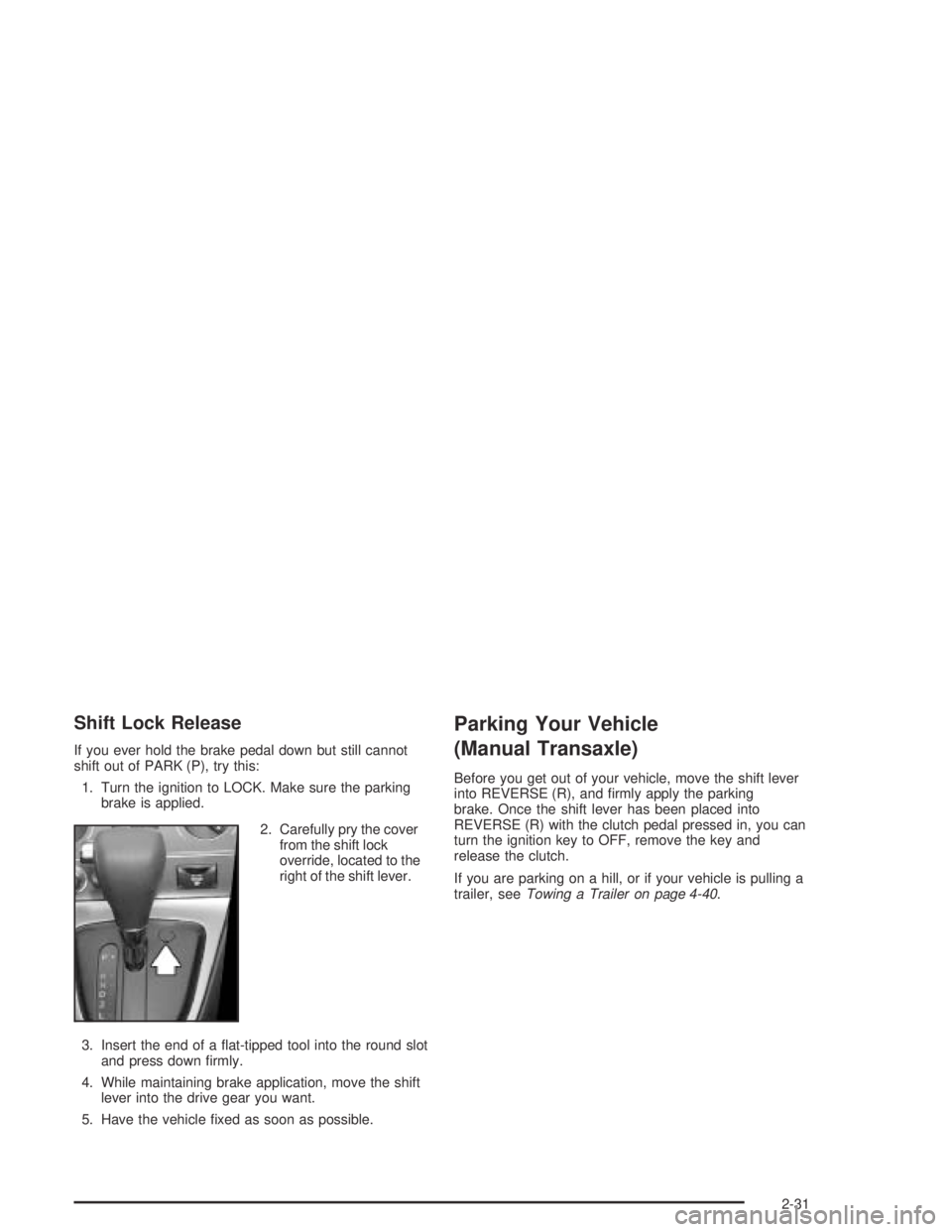
2. Carefully pry the cover
from the shift lock
override, located to the
right of the shift lever.
3. Insert the end of a at-tipped tool into the round slot
and press down rmly.
4. While maintaining brake application, move the shift
lever into the drive gear you want.
5. Have the vehicle xed as soon as possible.
Parking Your Vehicle
(Manual Transaxle)
Before you get out of your vehicle, move the shift lever
into REVERSE (R), and rmly apply the parking
brake. Once the shift lever has been placed into
REVERSE (R) with the clutch pedal pressed in, you can
turn the ignition key to OFF, remove the key and
release the clutch.
If you are parking on a hill, or if your vehicle is pulling a
trailer, seeTowing a Trailer on page 4-40.
2-31
Page 116 of 374
Y. Power Outlet. SeePower Outlet 115 Volt Alternating
Current on page 3-18.
Z. Parking Brake. SeeParking Brake on page 2-28.
AA. Center Console Storage Area. SeeCenter Console
Storage Area on page 2-37.
AB. Glove Box. SeeGlove Box on page 2-37.
Hazard Warning Flashers
Your hazard warning ashers let you warn others. They
also let police know you have a problem. Your front
and rear turn signal lamps will ash on and off.
The hazard warning
asher button is located
near the center of the
instrument panel.
Your hazard warning ashers work no matter what
position your key is in, and even if the key is not in.Press the button to make the front and rear turn signal
lamps ash on and off. Press the button again to
turn the ashers off.
When the hazard warning ashers are on, your turn
signals will not work.
Other Warning Devices
If you carry reective triangles, you can set them up at
the side of the road about 300 feet (100 m) behind
your vehicle.
Horn
Press near or on the horn symbols on your steering
wheel pad to sound the horn.
3-6
Page 126 of 374
Interior Lamps Control
Turn the wheel on the right of the control to one of the
following positions:
OFF:This position turns the light off.
ON:This position keeps the light on all the time.
6(Door):This position turns the light on when any
door, the liftgate or the liftglass is opened. The light
goes off when all the side doors, the liftgate and
the liftglass are closed.
Entry Lighting
While the instrument panel brightness control is in the
door position, the light will come on when any side door,
the liftgate or the liftglass is opened. After all the
doors, liftgate and liftglass are closed, and the key is
out of the ignition, in LOCK or ACC, the light will remain
on for about 15 seconds and then go out except
under the following conditions:
The ignition is turned to ACC or ON after all the
doors, the liftgate and the liftglass are closed.
All the doors and liftgate are locked when the
liftglass is closed and the light is still on.
When any door is unlocked with the key or remote
keyless entry system transmitter, the light comes on for
15 seconds, even if the door is not opened.
To prevent the battery from draining, the lamps will
automatically turn off when the key is in the ACC
or LOCK positions or if the key is removed for
20 minutes or more.
3-16
Page 127 of 374

Reading Lamps
If you have a sunroof, you will have a reading lamp
near the sunroof switch. Press the button to turn
the lamp on and press it again to turn it off.If you do not have a sunroof, your vehicle’s inside
rearview mirror may be equipped with reading lamps.
If your vehicle is equipped with reading lamps, there are
two buttons located on the bottom of the mirror. Press
the buttons to turn the lamps on and press them again to
turn the lamps off.
To prevent the battery from draining on vehicles with
power door locks, the lamps will automatically turn
off when the key is in the ACC or LOCK positions or if
the key is removed for 20 minutes or more. The lights
will come on when any of the doors are opened
or if the key is turned to the ON position.
3-17
Page 129 of 374

The power outlet is located near the center of the
instrument panel. Before using the outlet, turn on the
ignition and press the button next to the outlet.
An indicator light in the button will come on. After using
the outlet, press the button again to turn it off.
The power outlet is not designed for the following
electrical equipment and they may not work properly:
Equipment with high initial peak wattage:
cathode-ray tube type televisions,
compressor-driven refrigerators, electric
power tools.
Other equipment requiring an extremely stable
power supply: microcomputer-controlled electric
blankets, touch sensor lamps, etc.
Ashtrays and Cigarette Lighter
Notice:If you put papers or other ammable items
in the ashtray, hot cigarettes or other smoking
materials could ignite them and possibly damage
your vehicle. Never put ammable items in
the ashtray.
To use the lighter, if your vehicle has one, push the
lighter in all the way and let go. When it’s ready, it will
pop back out by itself. If the engine is not running,
the key must be in ACC to use the lighter.
It is not recommended to use the cigarette lighter to
plug in auxiliary electrical equipment. Use the accessory
power outlet for phones and other electrical equipment.
SeeAccessory Power Outlets on page 3-18orPower
Outlet 115 Volt Alternating Current on page 3-18.
Notice:Holding a cigarette lighter in while it is
heating will not allow the lighter to back away from
the heating element when it is hot. Damage from
overheating may occur to the lighter or heating
element, or a fuse could be blown. Do not hold a
cigarette lighter in while it is heating. Do not
use anything other than the cigarette lighter in the
heating element.
Your vehicle may have a removable ashtray that sits in
your front cupholder in the center console storage area.
3-19
Page 138 of 374

Temperature Display
The outside air temperature is displayed on the center
of the instrument panel, within the speedometer.
The display will show the outside air temperature in
Fahrenheit with a range from−22°F to 122°F
(−30°C to 50°C).
Safety Belt Reminder Light
When the key is turned to ON or START, a chime will
come on for several seconds to remind people to fasten
their safety belts, unless the driver’s safety belt is
already buckled.
The safety belt light will
also ash until the driver’s
belt is buckled. If the
driver’s belt is already
buckled, neither the chime
nor the light will come on.
Your vehicle also has a safety belt reminder light for the
right front passenger position.This light is located on the
center of the instrument
panel, above the audio
system.
When the key is turned to ON or START, this light will
come on as a reminder for the right front passenger
to fasten the safety belt. The safety belt light will ash
until the right front passenger’s safety belt is buckled.
The passenger’s safety belt reminder light will not
illuminate if the right front passenger’s belt is already
buckled or if a sensor does not detect the weight
of a passenger in that seat.
If something is placed on the right front passenger’s seat,
the sensors in the seat may detect that object and cause
the right front passenger’s safety belt reminder light to
come on. If this ever happens, move the object to the rear
seat or place it in a rear storage area, if at all possible.
3-28
Page 139 of 374

Airbag Readiness Light
There is an airbag readiness light on the instrument
panel, which shows the airbag symbol. The system
checks the airbag’s electrical system for malfunctions.
The light tells you if there is an electrical problem.
The system check includes the airbag sensors, the
airbag modules, the wiring and the diagnostic module.
For more information on the airbag system, see
Airbag System on page 1-46.
This light will come on for
about seven seconds
when you start your
vehicle. Then the light
should go out. This means
the system is ready.
If the airbag readiness light stays on after you start the
vehicle or comes on when you are driving, your
airbag system may not work properly. Have your vehicle
serviced right away.{CAUTION:
If the airbag readiness light stays on or keeps
ashing after you start your vehicle, it means
the airbag system and safety belt pretension
system may not be working properly.
The airbags in your vehicle may not inate in
a crash, or they could even inate without a
crash. To help avoid injury to yourself or
others, have your vehicle serviced right away if
the airbag readiness light stays on after you
start your vehicle.
The airbag readiness light should come on for about
seven seconds when you turn the ignition key to
ON. If the light doesn’t come on then, have it xed so it
will be ready to warn you if there is a problem.
3-29