checking oil PONTIAC VIBE 2005 Owners Manual
[x] Cancel search | Manufacturer: PONTIAC, Model Year: 2005, Model line: VIBE, Model: PONTIAC VIBE 2005Pages: 374, PDF Size: 2.49 MB
Page 223 of 374

Service............................................................5-3
Doing Your Own Service Work.........................5-4
Adding Equipment to the Outside of
Your Vehicle..............................................5-5
Fuel................................................................5-5
Gasoline Octane............................................5-5
Gasoline Specications....................................5-6
California Fuel...............................................5-6
Additives.......................................................5-6
Fuels in Foreign Countries...............................5-7
Filling Your Tank............................................5-7
Filling a Portable Fuel Container.......................5-9
Checking Things Under the Hood....................5-10
Hood Release..............................................5-10
Engine Compartment Overview.......................5-12
Engine Oil...................................................5-16
Engine Air Cleaner/Filter................................5-21
Automatic Transaxle Fluid..............................5-23
Manual Transaxle Fluid..................................5-26
Hydraulic Clutch...........................................5-27
Engine Coolant.............................................5-28
Radiator Pressure Cap..................................5-30
Engine Overheating.......................................5-30
Cooling System............................................5-32Power Steering Fluid.....................................5-37
Windshield Washer Fluid................................5-38
Brakes........................................................5-39
Battery........................................................5-42
Jump Starting...............................................5-43
All-Wheel Drive..............................................5-48
Bulb Replacement..........................................5-49
Halogen Bulbs..............................................5-49
Headlamps, Front Turn Signal, and
Parking Lamps..........................................5-49
Center High-Mounted Stoplamp (CHMSL).........5-51
Taillamps, Turn Signal, and Stoplamps............5-53
Back-Up Lamps............................................5-54
Replacement Bulbs.......................................5-55
Windshield Wiper Blade Replacement..............5-56
Tires..............................................................5-57
Tire Sidewall Labelling...................................5-58
Tire Terminology and Denitions.....................5-61
Ination - Tire Pressure.................................5-64
Tire Pressure Monitor System.........................5-65
Tire Inspection and Rotation...........................5-68
When It Is Time for New Tires.......................5-69
Buying New Tires.........................................5-70
Section 5 Service and Appearance Care
5-1
Page 232 of 374
Checking Things Under
the Hood
{CAUTION:
An electric fan under the hood can start up
and injure you even when the engine is not
running. Keep hands, clothing and tools away
from any underhood electric fan.
{CAUTION:
Things that burn can get on hot engine parts
and start a re. These include liquids like fuel,
oil, coolant, brake uid, windshield washer and
other uids, and plastic or rubber. You or
others could be burned. Be careful not to drop
or spill things that will burn onto a hot engine.
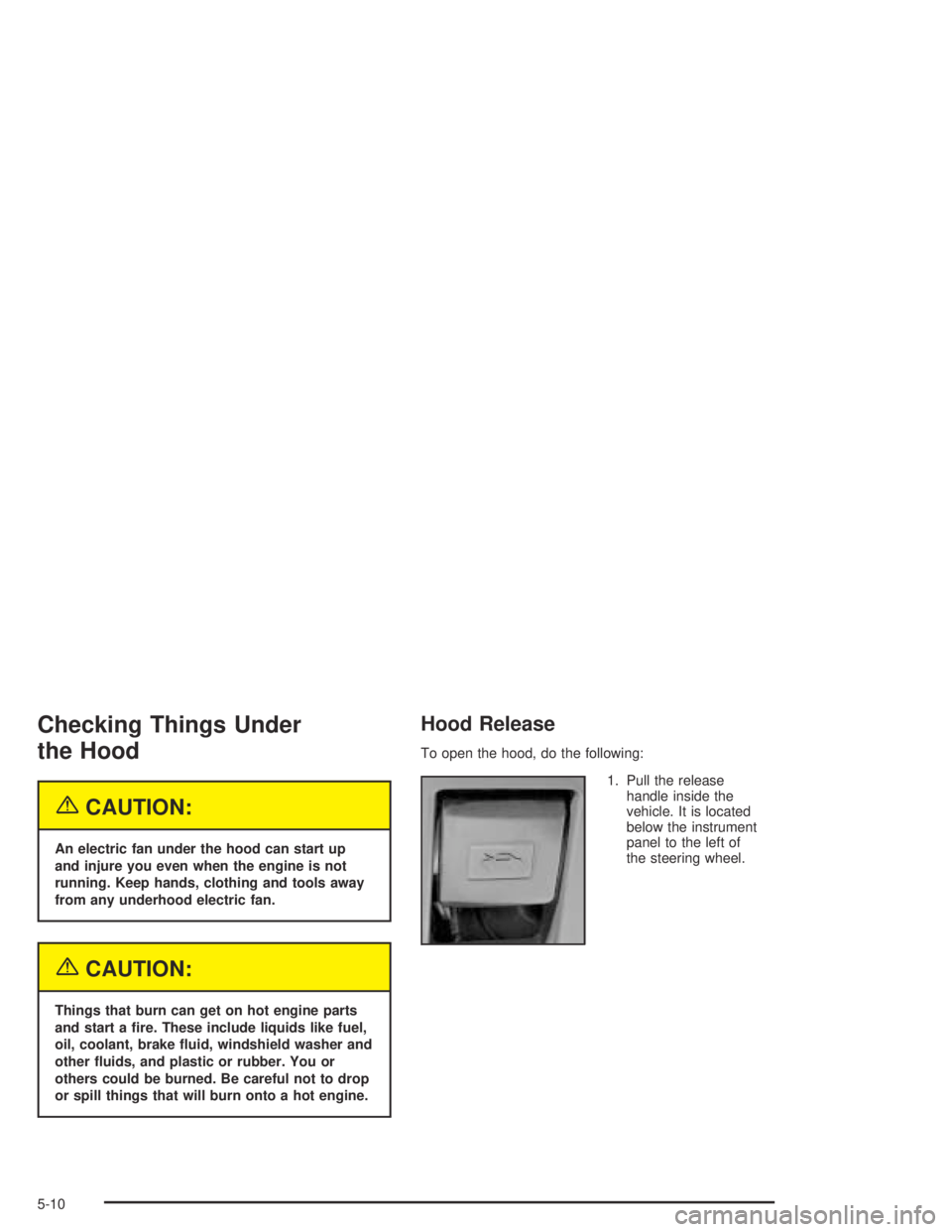
Hood Release
To open the hood, do the following:
1. Pull the release
handle inside the
vehicle. It is located
below the instrument
panel to the left of
the steering wheel.
5-10
Page 235 of 374
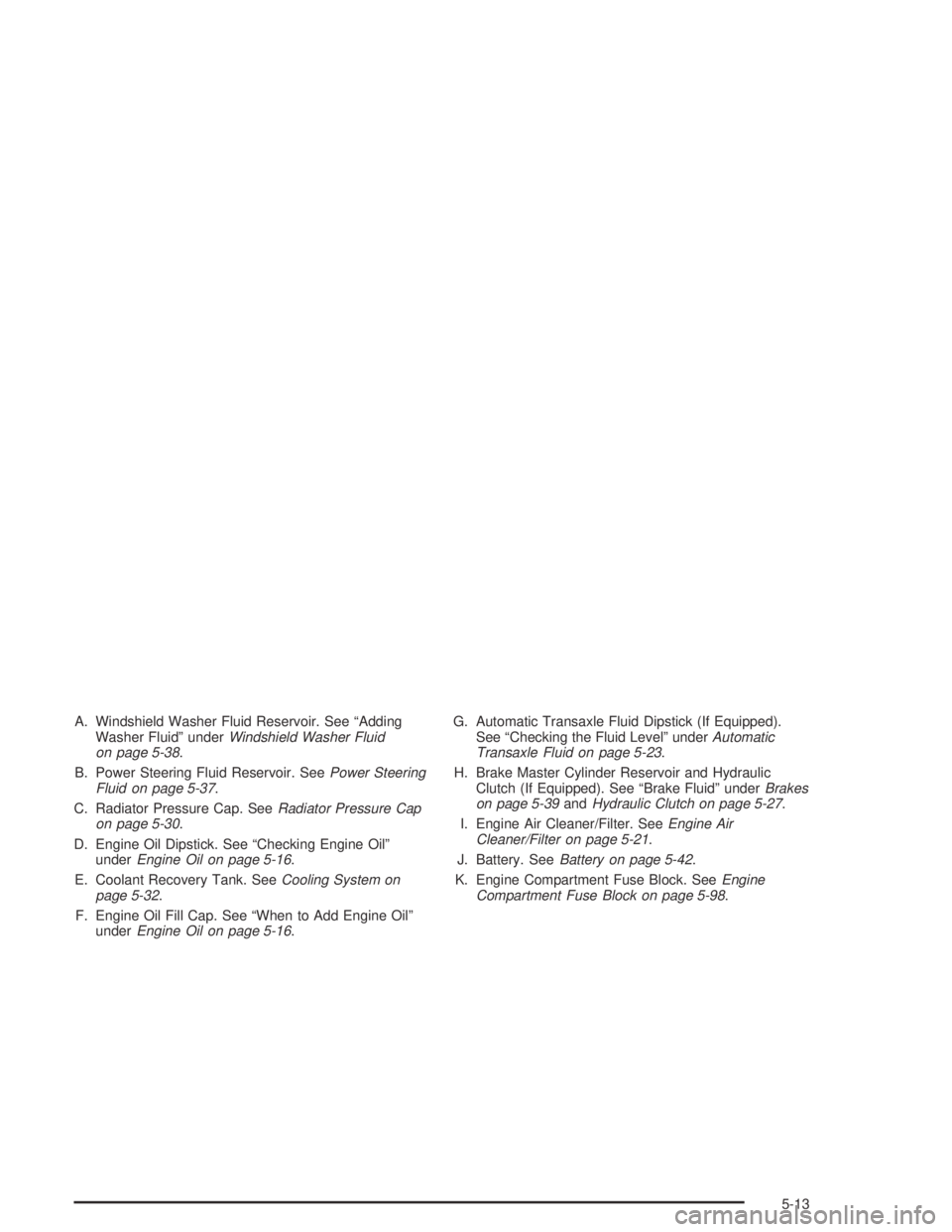
A. Windshield Washer Fluid Reservoir. See “Adding
Washer Fluid” underWindshield Washer Fluid
on page 5-38.
B. Power Steering Fluid Reservoir. SeePower Steering
Fluid on page 5-37.
C. Radiator Pressure Cap. SeeRadiator Pressure Cap
on page 5-30.
D. Engine Oil Dipstick. See “Checking Engine Oil”
underEngine Oil on page 5-16.
E. Coolant Recovery Tank. SeeCooling System on
page 5-32.
F. Engine Oil Fill Cap. See “When to Add Engine Oil”
underEngine Oil on page 5-16.G. Automatic Transaxle Fluid Dipstick (If Equipped).
See “Checking the Fluid Level” underAutomatic
Transaxle Fluid on page 5-23.
H. Brake Master Cylinder Reservoir and Hydraulic
Clutch (If Equipped). See “Brake Fluid” underBrakes
on page 5-39andHydraulic Clutch on page 5-27.
I. Engine Air Cleaner/Filter. SeeEngine Air
Cleaner/Filter on page 5-21.
J. Battery. SeeBattery on page 5-42.
K. Engine Compartment Fuse Block. SeeEngine
Compartment Fuse Block on page 5-98.
5-13
Page 237 of 374

A. Windshield Washer Fluid Reservoir. See “Adding
Washer Fluid” underWindshield Washer Fluid
on page 5-38.
B. Power Steering Fluid Reservoir. SeePower Steering
Fluid on page 5-37.
C. Radiator Pressure Cap. SeeRadiator Pressure Cap
on page 5-30.
D. Engine Oil Dipstick. See “Checking Engine Oil”
underEngine Oil on page 5-16.
E. Coolant Recovery Tank. SeeCooling System on
page 5-32.
F. Engine Oil Fill Cap. See “When to Add Engine Oil”
underEngine Oil on page 5-16.G. Automatic Transaxle Fluid Dipstick (If Equipped).
See “Checking the Fluid Level” underAutomatic
Transaxle Fluid on page 5-23.
H. Brake Master Cylinder Reservoir and Hydraulic
Clutch (If Equipped). See “Brake Fluid” underBrakes
on page 5-39andHydraulic Clutch on page 5-27.
I. Engine Air Cleaner/Filter. SeeEngine Air
Cleaner/Filter on page 5-21.
J. Battery. SeeBattery on page 5-42.
K. Engine Compartment Fuse Block. SeeEngine
Compartment Fuse Block on page 5-98.
5-15
Page 238 of 374
Engine Oil
If the engine oil pressure
light appears on the
instrument cluster,
it means you need to
check your engine oil level
right away.
For more information, seeOil Pressure Light on
page 3-38.
You should check your engine oil level regularly; this is
an added reminder.
Checking Engine Oil
It is a good idea to check your engine oil every time you
get fuel. In order to get an accurate reading, the oil
must be warm and the vehicle must be on level ground.
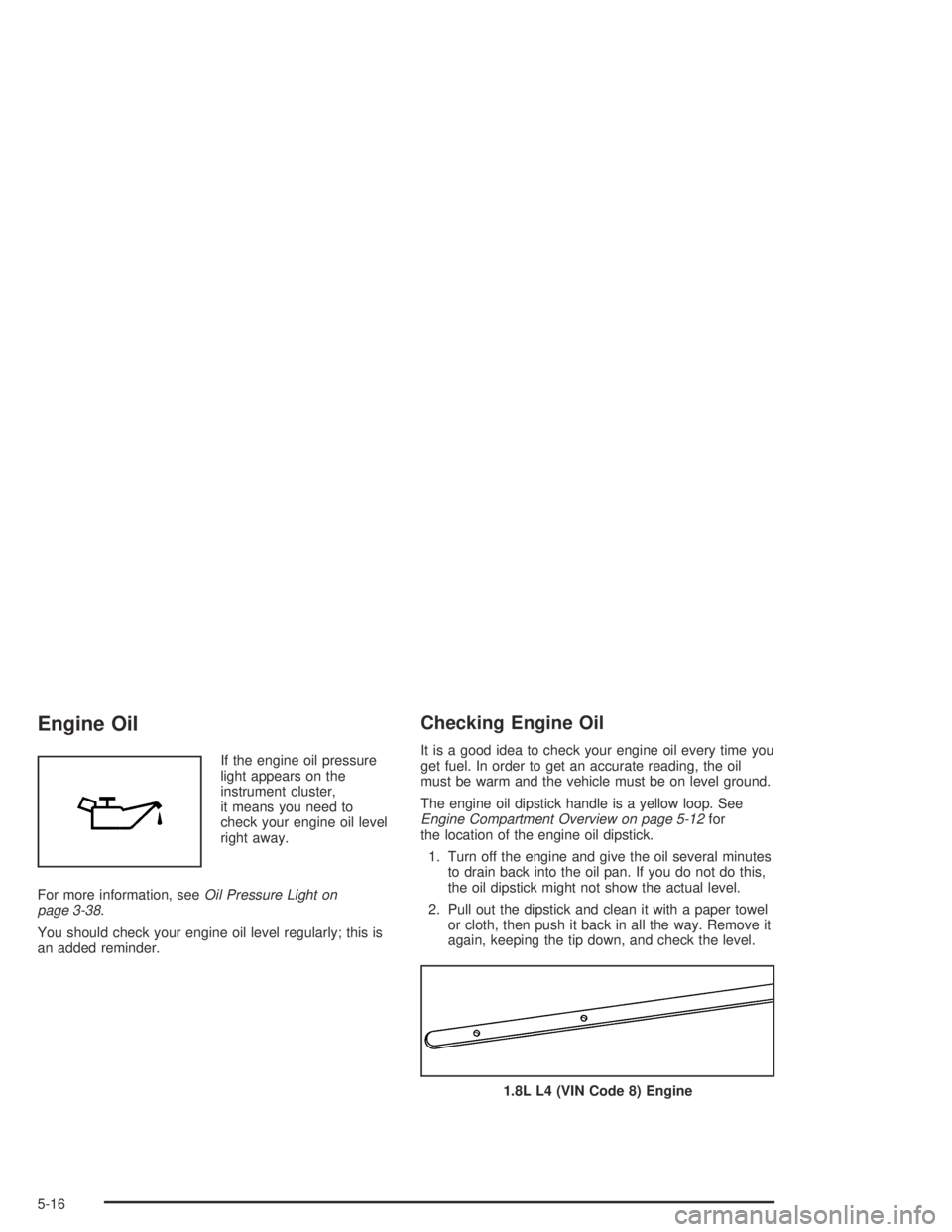
The engine oil dipstick handle is a yellow loop. See
Engine Compartment Overview on page 5-12for
the location of the engine oil dipstick.
1. Turn off the engine and give the oil several minutes
to drain back into the oil pan. If you do not do this,
the oil dipstick might not show the actual level.
2. Pull out the dipstick and clean it with a paper towel
or cloth, then push it back in all the way. Remove it
again, keeping the tip down, and check the level.
1.8L L4 (VIN Code 8) Engine
5-16
Page 245 of 374

Automatic Transaxle Fluid
When to Check and Change
A good time to check your automatic transaxle uid
level is when the engine oil is changed.
Check the uid in the transaxle and differential every
30,000 miles (48 000 km). Change the uid every
60,000 miles (100 000 km) if the vehicle is mainly driven
under one or more of these conditions:
In heavy city traffic where the outside temperature
regularly reaches 90°F (32°C) or higher.
In hilly or mountainous terrain.
When doing frequent trailer towing.
Uses such as found in taxi, police or delivery
service.
SeePart A: Scheduled Maintenance Services on
page 6-4.
How to Check
Because this operation can be a little difficult, you may
choose to have this done at the dealership service
department.If you do it yourself, be sure to follow all the instructions
here, or you could get a false reading on the dipstick.
Notice:Too much or too little uid can damage the
transaxle. Too much can mean that some of the uid
could come out and fall on hot engine or exhaust
system parts, starting a re. Too little uid could
cause the transaxle to overheat. Be sure to get an
accurate reading if you check the transaxle uid.
Wait at least 30 minutes before checking the transaxle
uid level if you have been driving:
When outside temperatures are above 90°F (32°C).
At high speed for quite a while.
In heavy traffic — especially in hot weather.
While pulling a trailer.
To get the right reading, the uid should be at normal
operating temperature, which is 158°F to 176°F
(70°C to 80°C).
Get the vehicle warmed up by driving about
15 miles (24 km) when outside temperatures are
above 50°F (10°C). If it is colder than 50°F (10°C),
you may have to drive longer.
5-23