clutch PONTIAC VIBE 2005 Owners Manual
[x] Cancel search | Manufacturer: PONTIAC, Model Year: 2005, Model line: VIBE, Model: PONTIAC VIBE 2005Pages: 374, PDF Size: 2.49 MB
Page 89 of 374

(B) ACC (ACCESSORY):This position operates some
of your electrical accessories, such as the radio, but
not the ventilation fan. It unlocks the steering wheel and
ignition. To move the key from ACC to LOCK, push in
the key and then turn it to LOCK.
(C) ON:This is the position the switch returns to after
you start your engine and release the switch. The switch
stays in the ON position when the engine is running.
But even when the ignition is not running, you can use
ON to operate your electrical accessories, including
the ventilation fan and 115 volt power outlet, and
to display some warning and indicator lights.
(D) START:This position starts the engine. When the
engine starts, release the key. The ignition switch
will return to ON for normal driving.
When the engine is not running, ACC and ON allow you
to operate some of your electrical accessories.
A warning tone will sound if you open the driver’s door
when the ignition is still in ACC or LOCK and the
key is in the ignition.Starting Your Engine
Automatic Transaxle
Move your shift lever to PARK (P) or NEUTRAL (N).
Your engine will not start in any other position — that is
a safety feature. To restart when you are already
moving, use NEUTRAL (N) only.
Notice:Shifting into PARK (P) with the vehicle
moving could damage the transaxle. Shift into
PARK (P) only when your vehicle is stopped.
Manual Transaxle
The shift lever should be in NEUTRAL and the parking
brake engaged. Hold the clutch pedal to the oor
and start the engine. Your vehicle will not start if the
clutch pedal is not all the way down — that is a
safety feature.
2-19
Page 95 of 374
Manual Transaxle Operation
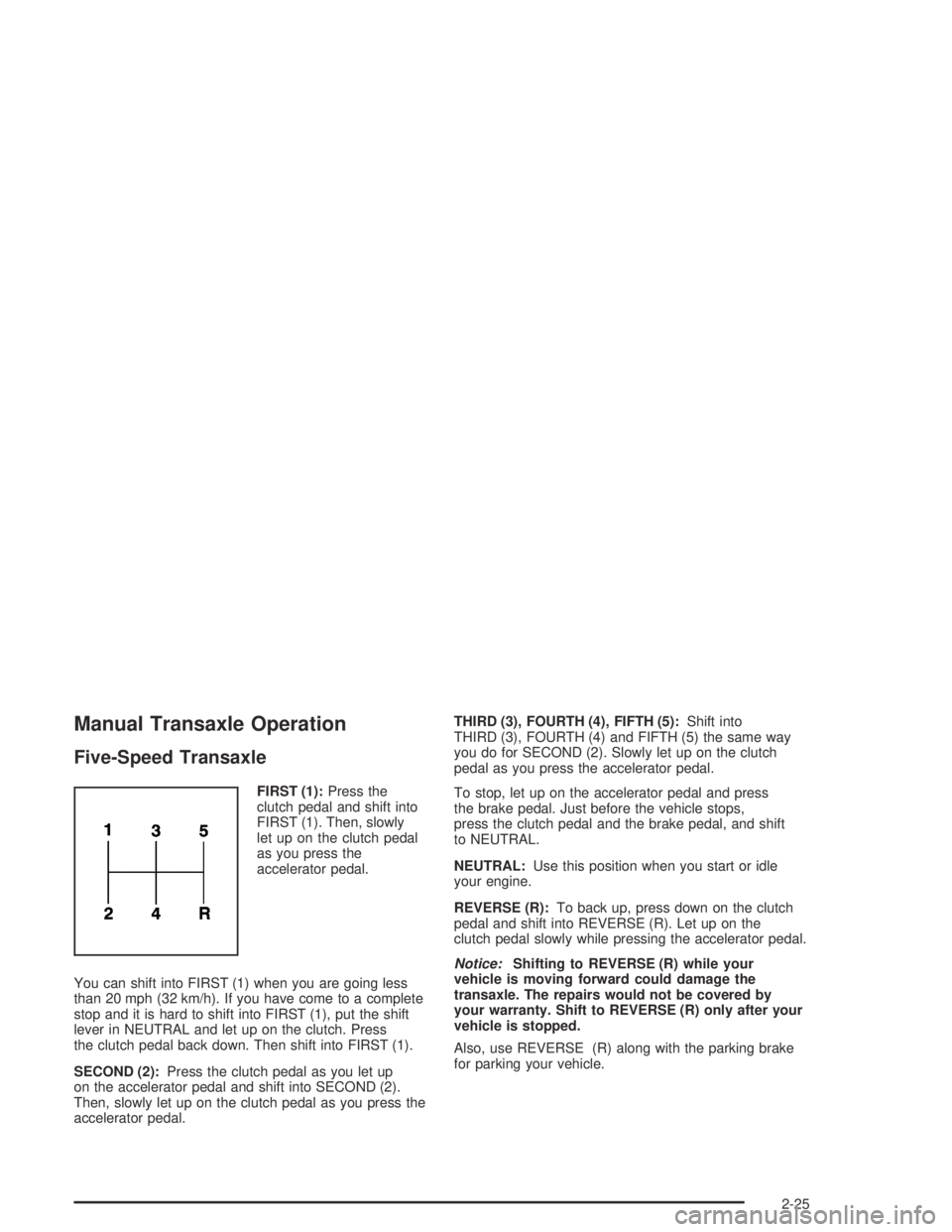
Five-Speed Transaxle
FIRST (1):Press the
clutch pedal and shift into
FIRST (1). Then, slowly
let up on the clutch pedal
as you press the
accelerator pedal.
You can shift into FIRST (1) when you are going less
than 20 mph (32 km/h). If you have come to a complete
stop and it is hard to shift into FIRST (1), put the shift
lever in NEUTRAL and let up on the clutch. Press
the clutch pedal back down. Then shift into FIRST (1).
SECOND (2):Press the clutch pedal as you let up
on the accelerator pedal and shift into SECOND (2).
Then, slowly let up on the clutch pedal as you press the
accelerator pedal.THIRD (3), FOURTH (4), FIFTH (5):Shift into
THIRD (3), FOURTH (4) and FIFTH (5) the same way
you do for SECOND (2). Slowly let up on the clutch
pedal as you press the accelerator pedal.
To stop, let up on the accelerator pedal and press
the brake pedal. Just before the vehicle stops,
press the clutch pedal and the brake pedal, and shift
to NEUTRAL.
NEUTRAL:Use this position when you start or idle
your engine.
REVERSE (R):To back up, press down on the clutch
pedal and shift into REVERSE (R). Let up on the
clutch pedal slowly while pressing the accelerator pedal.
Notice:Shifting to REVERSE (R) while your
vehicle is moving forward could damage the
transaxle. The repairs would not be covered by
your warranty. Shift to REVERSE (R) only after your
vehicle is stopped.
Also, use REVERSE (R) along with the parking brake
for parking your vehicle.
2-25
Page 96 of 374
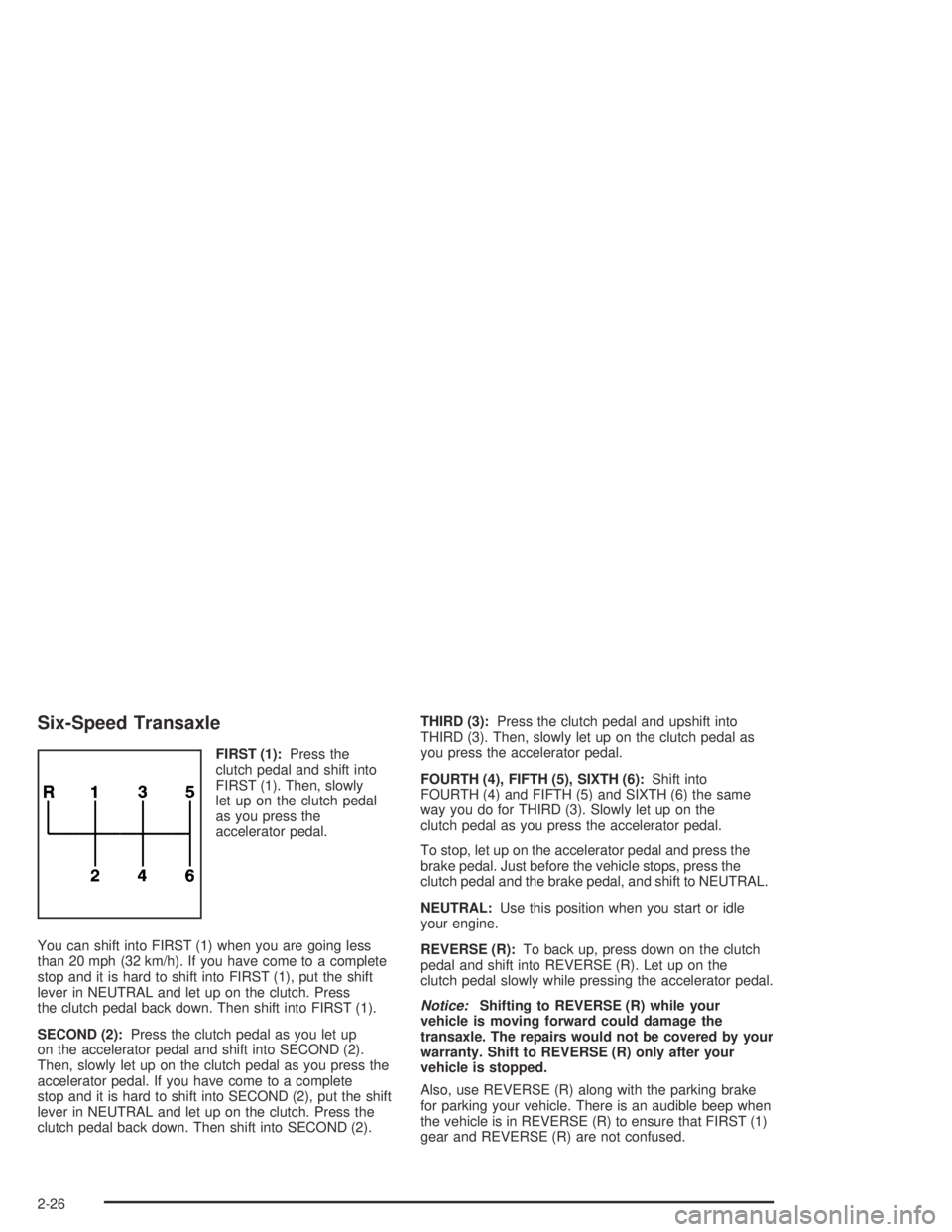
Six-Speed Transaxle
FIRST (1):Press the
clutch pedal and shift into
FIRST (1). Then, slowly
let up on the clutch pedal
as you press the
accelerator pedal.
You can shift into FIRST (1) when you are going less
than 20 mph (32 km/h). If you have come to a complete
stop and it is hard to shift into FIRST (1), put the shift
lever in NEUTRAL and let up on the clutch. Press
the clutch pedal back down. Then shift into FIRST (1).
SECOND (2):Press the clutch pedal as you let up
on the accelerator pedal and shift into SECOND (2).
Then, slowly let up on the clutch pedal as you press the
accelerator pedal. If you have come to a complete
stop and it is hard to shift into SECOND (2), put the shift
lever in NEUTRAL and let up on the clutch. Press the
clutch pedal back down. Then shift into SECOND (2).THIRD (3):Press the clutch pedal and upshift into
THIRD (3). Then, slowly let up on the clutch pedal as
you press the accelerator pedal.
FOURTH (4), FIFTH (5), SIXTH (6):Shift into
FOURTH (4) and FIFTH (5) and SIXTH (6) the same
way you do for THIRD (3). Slowly let up on the
clutch pedal as you press the accelerator pedal.
To stop, let up on the accelerator pedal and press the
brake pedal. Just before the vehicle stops, press the
clutch pedal and the brake pedal, and shift to NEUTRAL.
NEUTRAL:Use this position when you start or idle
your engine.
REVERSE (R):To back up, press down on the clutch
pedal and shift into REVERSE (R). Let up on the
clutch pedal slowly while pressing the accelerator pedal.
Notice:Shifting to REVERSE (R) while your
vehicle is moving forward could damage the
transaxle. The repairs would not be covered by your
warranty. Shift to REVERSE (R) only after your
vehicle is stopped.
Also, use REVERSE (R) along with the parking brake
for parking your vehicle. There is an audible beep when
the vehicle is in REVERSE (R) to ensure that FIRST (1)
gear and REVERSE (R) are not confused.
2-26
Page 101 of 374
Shift Lock Release
If you ever hold the brake pedal down but still cannot
shift out of PARK (P), try this:
1. Turn the ignition to LOCK. Make sure the parking
brake is applied.
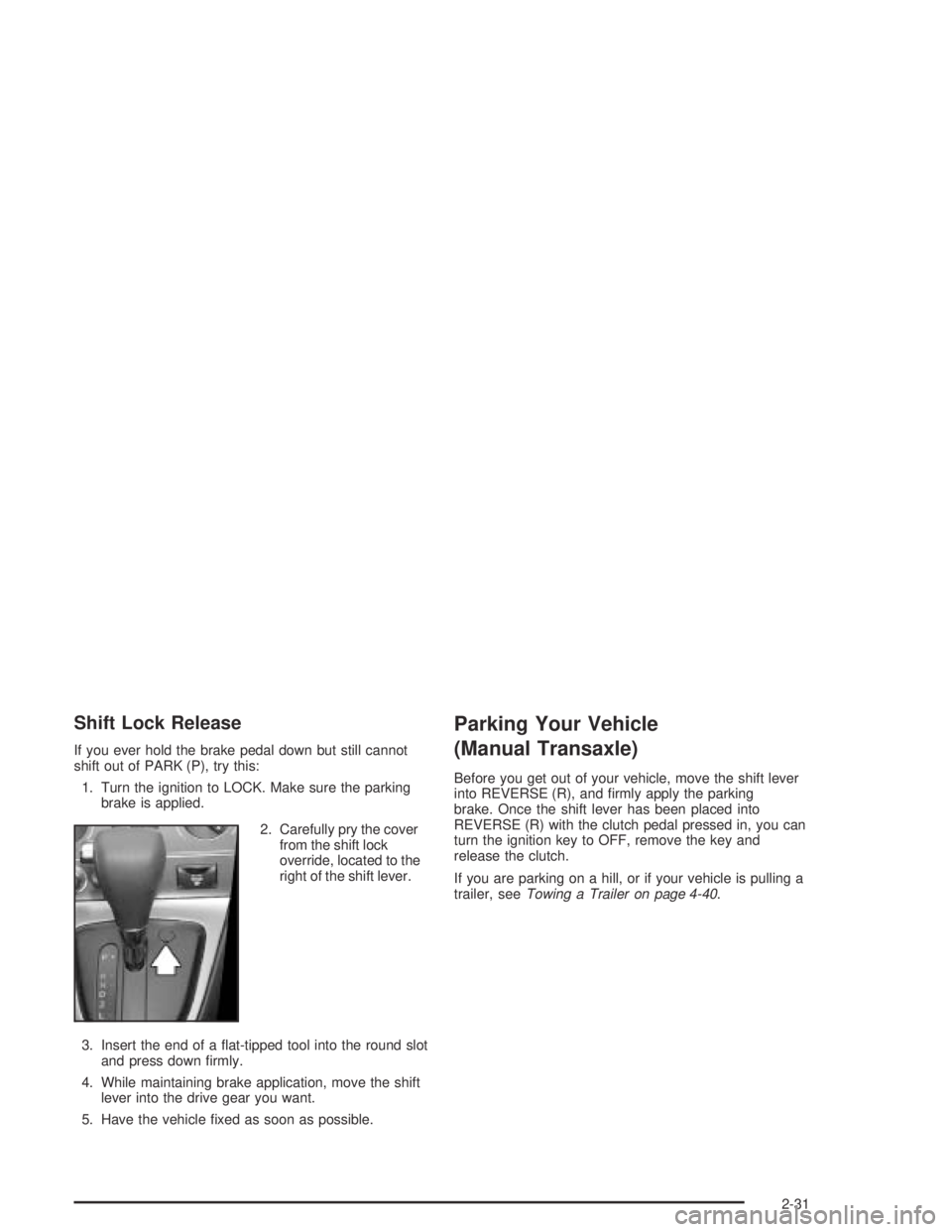
2. Carefully pry the cover
from the shift lock
override, located to the
right of the shift lever.
3. Insert the end of a at-tipped tool into the round slot
and press down rmly.
4. While maintaining brake application, move the shift
lever into the drive gear you want.
5. Have the vehicle xed as soon as possible.
Parking Your Vehicle
(Manual Transaxle)
Before you get out of your vehicle, move the shift lever
into REVERSE (R), and rmly apply the parking
brake. Once the shift lever has been placed into
REVERSE (R) with the clutch pedal pressed in, you can
turn the ignition key to OFF, remove the key and
release the clutch.
If you are parking on a hill, or if your vehicle is pulling a
trailer, seeTowing a Trailer on page 4-40.
2-31
Page 122 of 374
Increasing Speed While Using
Cruise Control
There are two ways to go to a higher speed:
Use the accelerator pedal to get to the higher
speed. Move the lever down to SET/COAST.
Release the lever and the accelerator pedal.
You’ll now cruise at the higher speed.
Move the cruise lever up to RES/ACC. Hold it there
until you get up to the speed you want, and then
release the lever.
To increase your speed in very small amounts,
move the lever to RES/ACC briey and then release
it. Each time you do this, your vehicle will go
about 1 mph (1.6 km/h) faster.
Reducing Speed While Using
Cruise Control
There are two ways to reduce your speed while using
cruise control:
Push and hold the lever to SET/COAST until you
reach the lower speed you want, then release it.
To slow down in very small amounts, push the lever
down briey. Each time you do this, you’ll go about
1 mph (1.6 km/h) slower.
Passing Another Vehicle While Using
Cruise Control
Use the accelerator pedal to increase your speed.
When you take your foot off the pedal, your vehicle will
slow down to the cruise control speed you set earlier.
Using Cruise Control on Hills
How well your cruise control will work on hills depends
upon your speed, load and the steepness of the hills.
When going up steep hills, you may have to step on the
accelerator pedal to maintain your speed.
When going downhill, you may have to brake or shift to a
lower gear to keep your speed down. Of course, applying
the brake or downshifting to SECOND (2) or LOW (L)
takes you out of cruise control. Many drivers nd this to
be too much trouble and don’t use cruise control on
steep hills.
Ending Cruise Control
There are several ways to turn off the cruise control:
Step lightly on the brake pedal or push the
clutch pedal, if you have a manual transaxle.
Press the CRUISE ON-OFF button again.
Pull the cruise control lever toward you.
3-12
Page 223 of 374

Service............................................................5-3
Doing Your Own Service Work.........................5-4
Adding Equipment to the Outside of
Your Vehicle..............................................5-5
Fuel................................................................5-5
Gasoline Octane............................................5-5
Gasoline Specications....................................5-6
California Fuel...............................................5-6
Additives.......................................................5-6
Fuels in Foreign Countries...............................5-7
Filling Your Tank............................................5-7
Filling a Portable Fuel Container.......................5-9
Checking Things Under the Hood....................5-10
Hood Release..............................................5-10
Engine Compartment Overview.......................5-12
Engine Oil...................................................5-16
Engine Air Cleaner/Filter................................5-21
Automatic Transaxle Fluid..............................5-23
Manual Transaxle Fluid..................................5-26
Hydraulic Clutch...........................................5-27
Engine Coolant.............................................5-28
Radiator Pressure Cap..................................5-30
Engine Overheating.......................................5-30
Cooling System............................................5-32Power Steering Fluid.....................................5-37
Windshield Washer Fluid................................5-38
Brakes........................................................5-39
Battery........................................................5-42
Jump Starting...............................................5-43
All-Wheel Drive..............................................5-48
Bulb Replacement..........................................5-49
Halogen Bulbs..............................................5-49
Headlamps, Front Turn Signal, and
Parking Lamps..........................................5-49
Center High-Mounted Stoplamp (CHMSL).........5-51
Taillamps, Turn Signal, and Stoplamps............5-53
Back-Up Lamps............................................5-54
Replacement Bulbs.......................................5-55
Windshield Wiper Blade Replacement..............5-56
Tires..............................................................5-57
Tire Sidewall Labelling...................................5-58
Tire Terminology and Denitions.....................5-61
Ination - Tire Pressure.................................5-64
Tire Pressure Monitor System.........................5-65
Tire Inspection and Rotation...........................5-68
When It Is Time for New Tires.......................5-69
Buying New Tires.........................................5-70
Section 5 Service and Appearance Care
5-1
Page 235 of 374
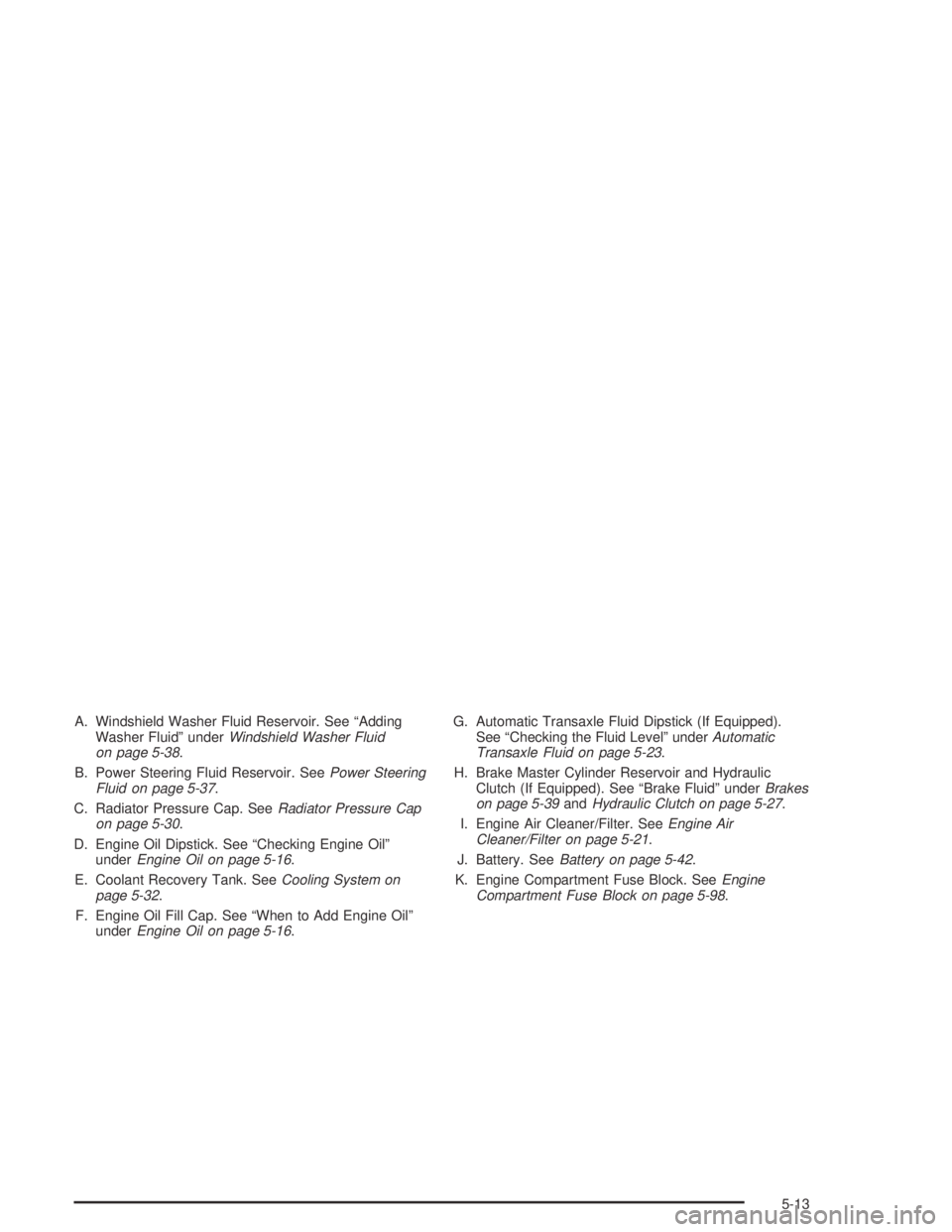
A. Windshield Washer Fluid Reservoir. See “Adding
Washer Fluid” underWindshield Washer Fluid
on page 5-38.
B. Power Steering Fluid Reservoir. SeePower Steering
Fluid on page 5-37.
C. Radiator Pressure Cap. SeeRadiator Pressure Cap
on page 5-30.
D. Engine Oil Dipstick. See “Checking Engine Oil”
underEngine Oil on page 5-16.
E. Coolant Recovery Tank. SeeCooling System on
page 5-32.
F. Engine Oil Fill Cap. See “When to Add Engine Oil”
underEngine Oil on page 5-16.G. Automatic Transaxle Fluid Dipstick (If Equipped).
See “Checking the Fluid Level” underAutomatic
Transaxle Fluid on page 5-23.
H. Brake Master Cylinder Reservoir and Hydraulic
Clutch (If Equipped). See “Brake Fluid” underBrakes
on page 5-39andHydraulic Clutch on page 5-27.
I. Engine Air Cleaner/Filter. SeeEngine Air
Cleaner/Filter on page 5-21.
J. Battery. SeeBattery on page 5-42.
K. Engine Compartment Fuse Block. SeeEngine
Compartment Fuse Block on page 5-98.
5-13
Page 237 of 374

A. Windshield Washer Fluid Reservoir. See “Adding
Washer Fluid” underWindshield Washer Fluid
on page 5-38.
B. Power Steering Fluid Reservoir. SeePower Steering
Fluid on page 5-37.
C. Radiator Pressure Cap. SeeRadiator Pressure Cap
on page 5-30.
D. Engine Oil Dipstick. See “Checking Engine Oil”
underEngine Oil on page 5-16.
E. Coolant Recovery Tank. SeeCooling System on
page 5-32.
F. Engine Oil Fill Cap. See “When to Add Engine Oil”
underEngine Oil on page 5-16.G. Automatic Transaxle Fluid Dipstick (If Equipped).
See “Checking the Fluid Level” underAutomatic
Transaxle Fluid on page 5-23.
H. Brake Master Cylinder Reservoir and Hydraulic
Clutch (If Equipped). See “Brake Fluid” underBrakes
on page 5-39andHydraulic Clutch on page 5-27.
I. Engine Air Cleaner/Filter. SeeEngine Air
Cleaner/Filter on page 5-21.
J. Battery. SeeBattery on page 5-42.
K. Engine Compartment Fuse Block. SeeEngine
Compartment Fuse Block on page 5-98.
5-15
Page 249 of 374
Hydraulic Clutch
The hydraulic clutch linkage in your vehicle is
self-adjusting. The master cylinder reservoir is lled with
DOT-3 brake uid.
It is not necessary to regularly check the uid unless
you suspect there is a leak in the system. Adding uid
will not correct a leak.
The hydraulic clutch and brake master cylinder use the
same reservoir.
A uid loss in this system could indicate a problem.
Have the system inspected and repaired.
When to Check and What to Use
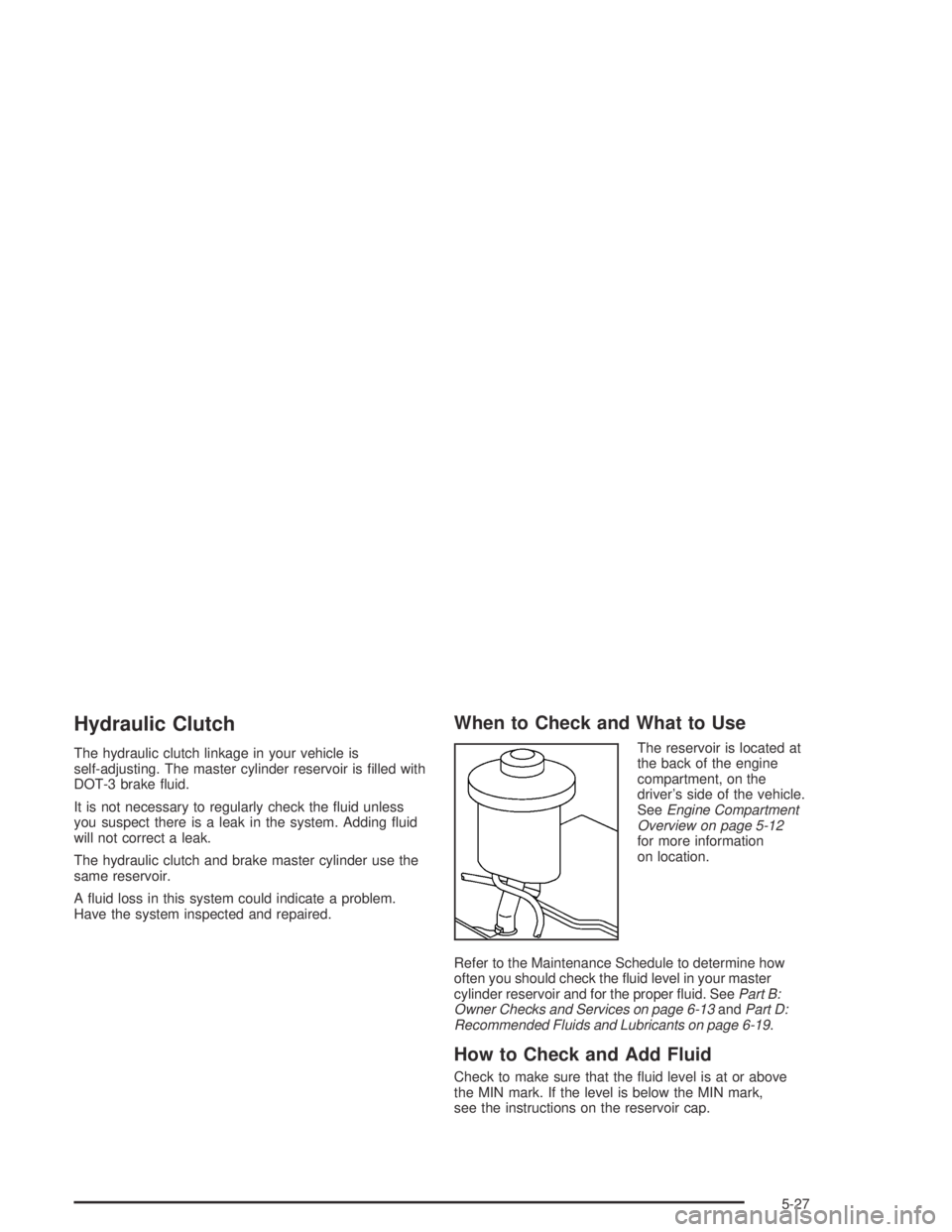
The reservoir is located at
the back of the engine
compartment, on the
driver’s side of the vehicle.
SeeEngine Compartment
Overview on page 5-12
for more information
on location.
Refer to the Maintenance Schedule to determine how
often you should check the uid level in your master
cylinder reservoir and for the proper uid. SeePart B:
Owner Checks and Services on page 6-13andPart D:
Recommended Fluids and Lubricants on page 6-19.
How to Check and Add Fluid
Check to make sure that the uid level is at or above
the MIN mark. If the level is below the MIN mark,
see the instructions on the reservoir cap.
5-27
Page 261 of 374
Brakes
Brake Fluid
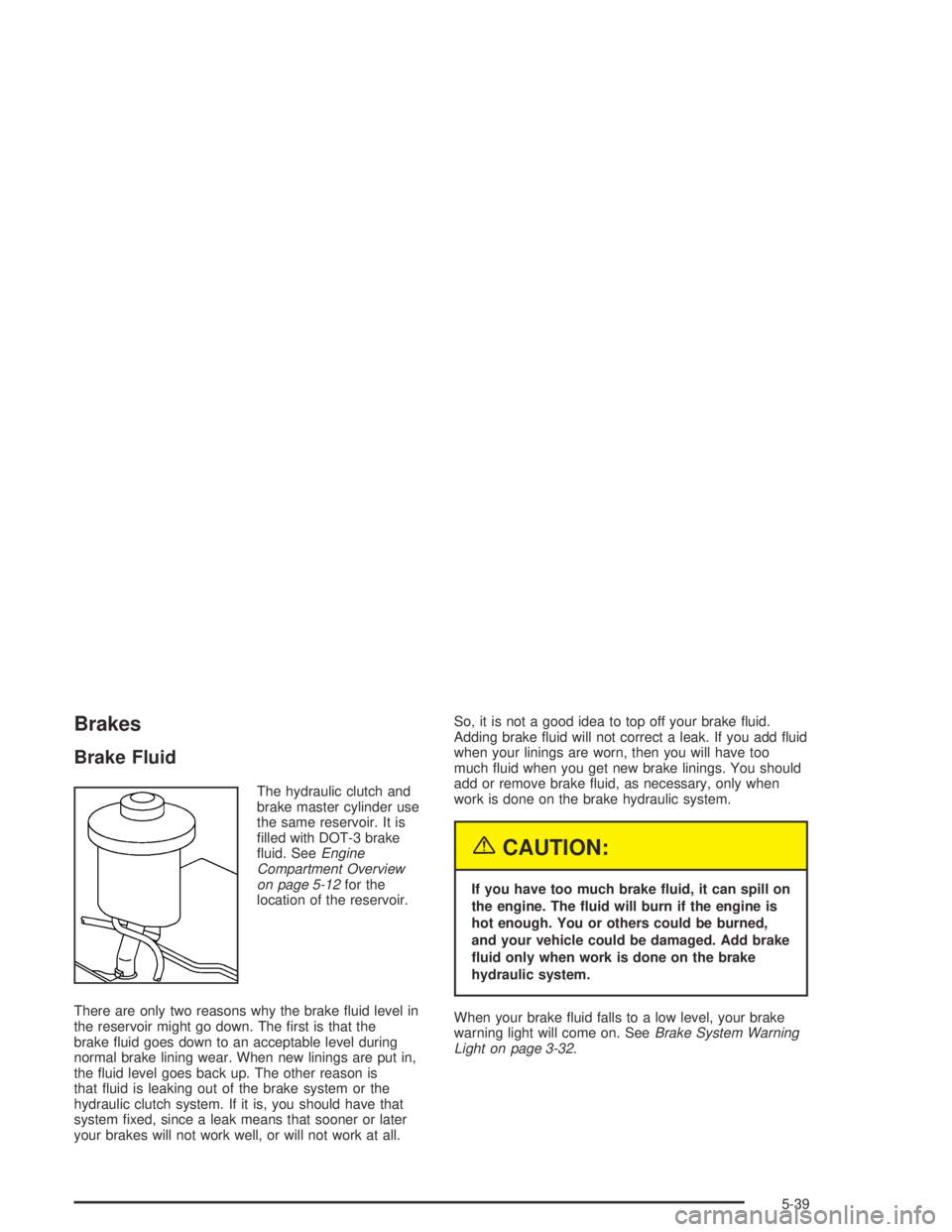
The hydraulic clutch and
brake master cylinder use
the same reservoir. It is
lled with DOT-3 brake
uid. SeeEngine
Compartment Overview
on page 5-12for the
location of the reservoir.
There are only two reasons why the brake uid level in
the reservoir might go down. The rst is that the
brake uid goes down to an acceptable level during
normal brake lining wear. When new linings are put in,
the uid level goes back up. The other reason is
that uid is leaking out of the brake system or the
hydraulic clutch system. If it is, you should have that
system xed, since a leak means that sooner or later
your brakes will not work well, or will not work at all.So, it is not a good idea to top off your brake uid.
Adding brake uid will not correct a leak. If you add uid
when your linings are worn, then you will have too
much uid when you get new brake linings. You should
add or remove brake uid, as necessary, only when
work is done on the brake hydraulic system.
{CAUTION:
If you have too much brake uid, it can spill on
the engine. The uid will burn if the engine is
hot enough. You or others could be burned,
and your vehicle could be damaged. Add brake
uid only when work is done on the brake
hydraulic system.
When your brake uid falls to a low level, your brake
warning light will come on. SeeBrake System Warning
Light on page 3-32.
5-39