lock PONTIAC VIBE 2007 Manual Online
[x] Cancel search | Manufacturer: PONTIAC, Model Year: 2007, Model line: VIBE, Model: PONTIAC VIBE 2007Pages: 432, PDF Size: 2.54 MB
Page 283 of 432
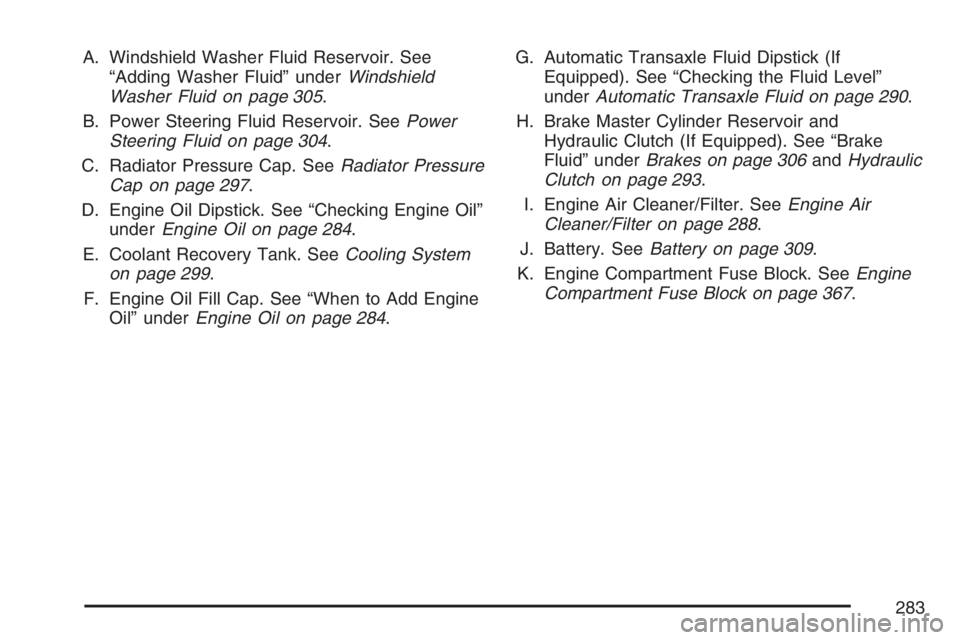
A. Windshield Washer Fluid Reservoir. See
“Adding Washer Fluid” underWindshield
Washer Fluid on page 305.
B. Power Steering Fluid Reservoir. SeePower
Steering Fluid on page 304.
C. Radiator Pressure Cap. SeeRadiator Pressure
Cap on page 297.
D. Engine Oil Dipstick. See “Checking Engine Oil”
underEngine Oil on page 284.
E. Coolant Recovery Tank. SeeCooling System
on page 299.
F. Engine Oil Fill Cap. See “When to Add Engine
Oil” underEngine Oil on page 284.G. Automatic Transaxle Fluid Dipstick (If
Equipped). See “Checking the Fluid Level”
underAutomatic Transaxle Fluid on page 290.
H. Brake Master Cylinder Reservoir and
Hydraulic Clutch (If Equipped). See “Brake
Fluid” underBrakes on page 306andHydraulic
Clutch on page 293.
I. Engine Air Cleaner/Filter. SeeEngine Air
Cleaner/Filter on page 288.
J. Battery. SeeBattery on page 309.
K. Engine Compartment Fuse Block. SeeEngine
Compartment Fuse Block on page 367.
283
Page 291 of 432

Checking the Fluid Level
Prepare your vehicle as follows:
1. Park your vehicle on a level place. Keep the
engine running.
2. With the parking brake applied, place the shift
lever in PARK (P).
3. With your foot on the brake pedal, move the
shift lever through each gear range, pausing
for about three seconds in each range.
Then, position the shift lever in PARK (P).
4. Let the engine run at idle for three to
ve minutes.Then, without shutting off the engine, follow
these steps:
The automatic transaxle dipstick has an orange
handle and is located near the front of the engine
compartment. SeeEngine Compartment Overview
on page 282for more information on location.
1. Release the tab and pull out the dipstick and
wipe it with a clean rag or paper towel.
2. Push it back in all the way, wait three seconds
and then pull it back out again.
3. Check both sides of the dipstick, and read the
lower level. The uid level must be between
the two dimples in the hot range.
4. If the uid level is in the acceptable range,
push the dipstick back in all the way; then
press the tab down to lock the dipstick in place.
291
Page 292 of 432

How to Add Automatic Transaxle Fluid
Refer to the Maintenance Schedule to
determine what kind of transaxle uid to use.
SeePart D: Recommended Fluids and Lubricants
on page 394.
If the uid level is low, add only enough of the
proper uid to bring the level into the area between
dimples on the dipstick.
1. Pull out the dipstick.
2. Using a long-neck funnel, add enough uid at
the dipstick hole to bring it to the proper level.
It does not take much uid, generally less
than one pint (0.5 L). Do not overll.
Notice:Use of the incorrect automatic
transaxle uid may damage your vehicle, and
the damages may not be covered by your
warranty. Always use the automatic transaxle
uid listed inPart D: Recommended Fluids
and Lubricants on page 394.
3. After adding uid, recheck the uid level as
described under “How to Check Automatic
Transaxle Fluid,” earlier in this section.4. When the correct uid level is obtained, push
the dipstick back in all the way; then press the
tab down to lock the dipstick in place.
Manual Transaxle Fluid
When to Check
A good time to have your manual transaxle uid
level checked is when the engine oil is changed.
However, the uid in your manual transaxle
does not require changing.
How to Check
Because this operation can be difficult, you may
choose to have this done at your Pontiac
dealership service department.
If you do it yourself, be sure to follow all the
instructions here, or you could get a false reading.
Notice:Too much or too little uid can damage
the transaxle. Too much can mean that some of
the uid could come out and fall on hot engine
or exhaust system parts, starting a re. Too
little uid could cause the transaxle to overheat.
Be sure to get an accurate reading if you check
the transaxle uid.
292
Page 302 of 432
How to Add Coolant to the Radiator
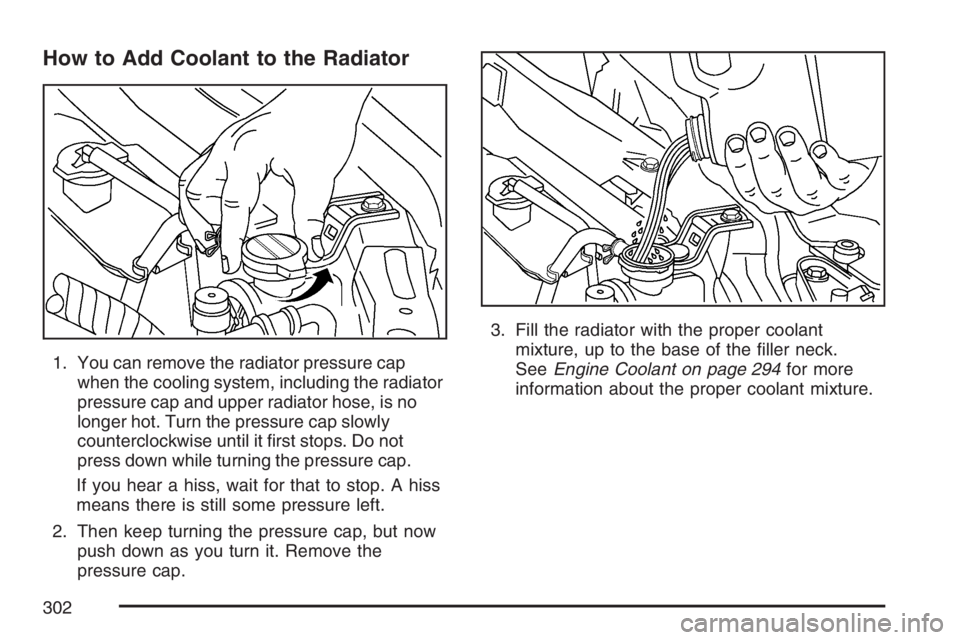
1. You can remove the radiator pressure cap
when the cooling system, including the radiator
pressure cap and upper radiator hose, is no
longer hot. Turn the pressure cap slowly
counterclockwise until it rst stops. Do not
press down while turning the pressure cap.
If you hear a hiss, wait for that to stop. A hiss
means there is still some pressure left.
2. Then keep turning the pressure cap, but now
push down as you turn it. Remove the
pressure cap.3. Fill the radiator with the proper coolant
mixture, up to the base of the ller neck.
SeeEngine Coolant on page 294for more
information about the proper coolant mixture.
302
Page 317 of 432
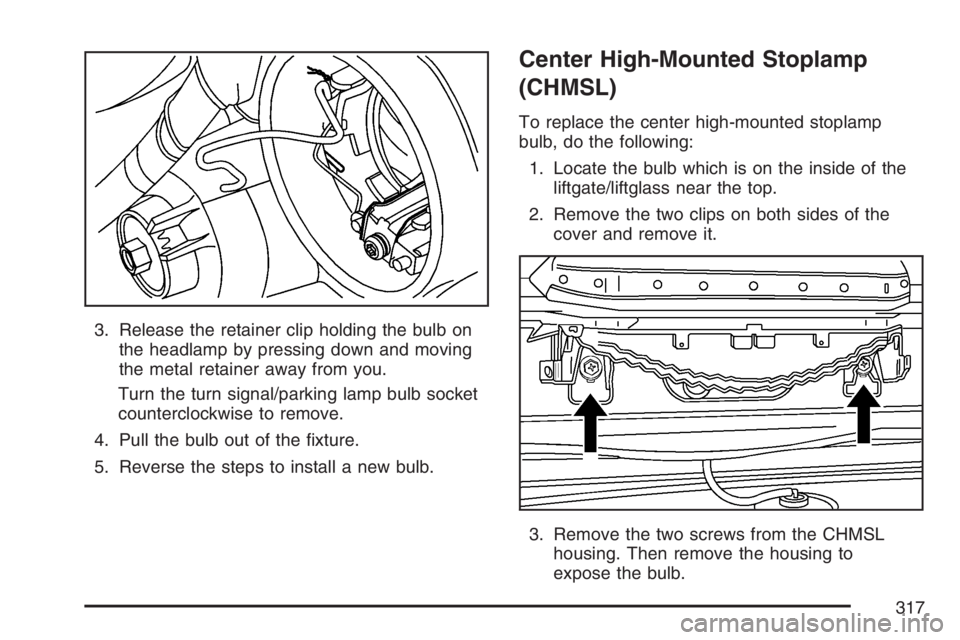
3. Release the retainer clip holding the bulb on
the headlamp by pressing down and moving
the metal retainer away from you.
Turn the turn signal/parking lamp bulb socket
counterclockwise to remove.
4. Pull the bulb out of the xture.
5. Reverse the steps to install a new bulb.
Center High-Mounted Stoplamp
(CHMSL)
To replace the center high-mounted stoplamp
bulb, do the following:
1. Locate the bulb which is on the inside of the
liftgate/liftglass near the top.
2. Remove the two clips on both sides of the
cover and remove it.
3. Remove the two screws from the CHMSL
housing. Then remove the housing to
expose the bulb.
317
Page 318 of 432
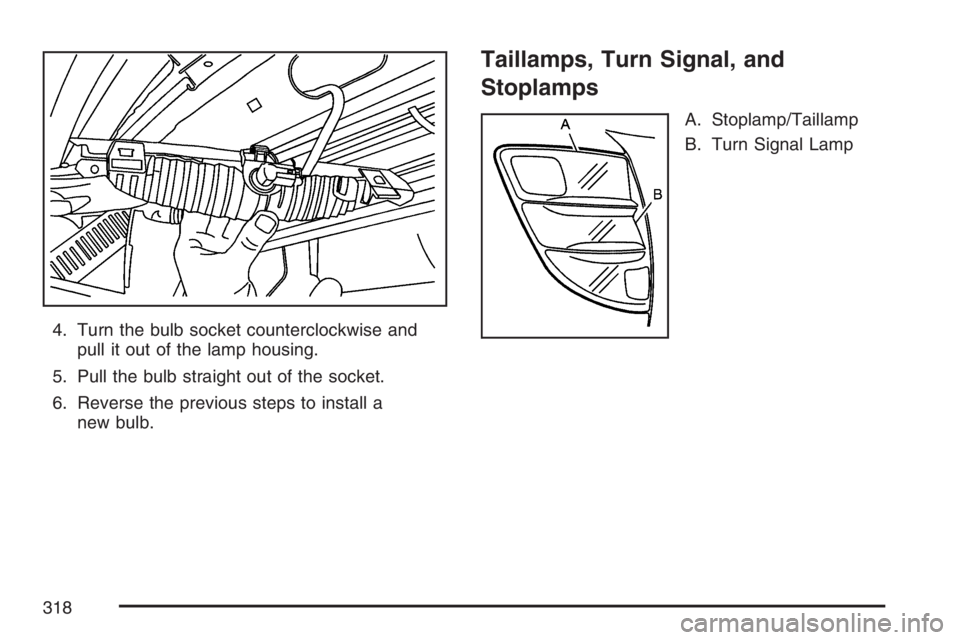
4. Turn the bulb socket counterclockwise and
pull it out of the lamp housing.
5. Pull the bulb straight out of the socket.
6. Reverse the previous steps to install a
new bulb.
Taillamps, Turn Signal, and
Stoplamps
A. Stoplamp/Taillamp
B. Turn Signal Lamp
318
Page 319 of 432
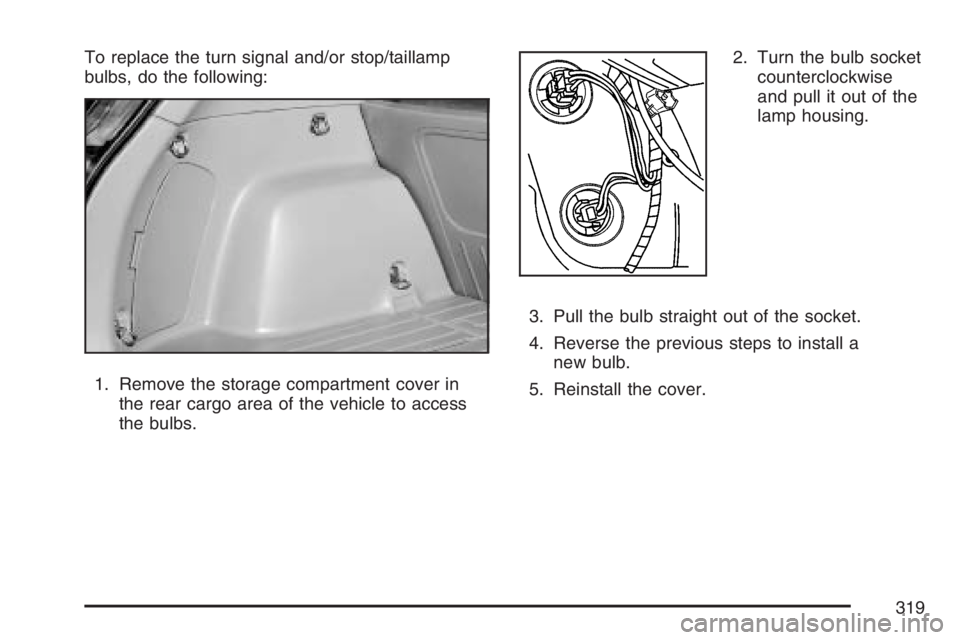
To replace the turn signal and/or stop/taillamp
bulbs, do the following:
1. Remove the storage compartment cover in
the rear cargo area of the vehicle to access
the bulbs.2. Turn the bulb socket
counterclockwise
and pull it out of the
lamp housing.
3. Pull the bulb straight out of the socket.
4. Reverse the previous steps to install a
new bulb.
5. Reinstall the cover.
319
Page 320 of 432
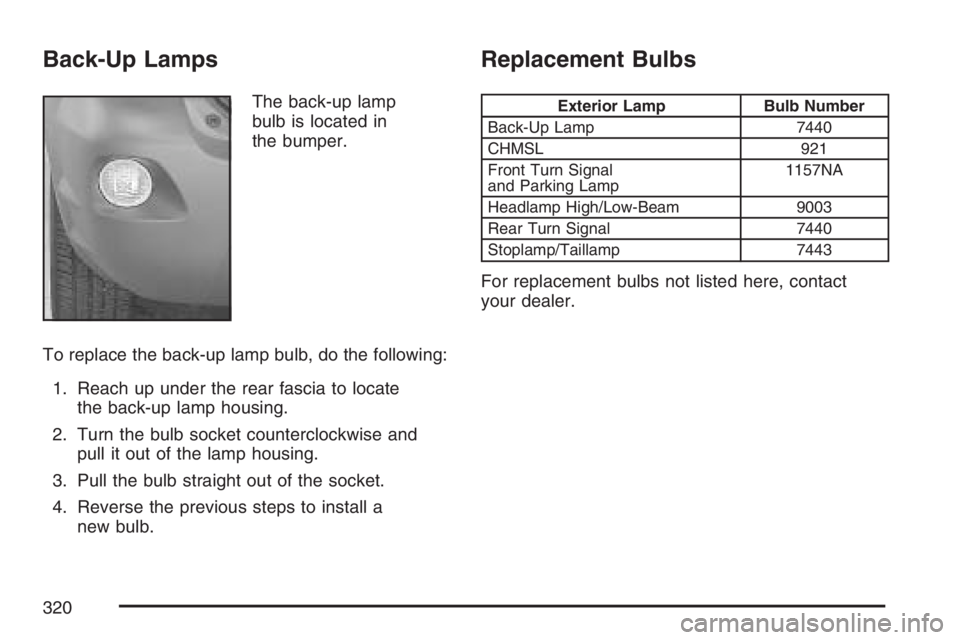
Back-Up Lamps
The back-up lamp
bulb is located in
the bumper.
To replace the back-up lamp bulb, do the following:
1. Reach up under the rear fascia to locate
the back-up lamp housing.
2. Turn the bulb socket counterclockwise and
pull it out of the lamp housing.
3. Pull the bulb straight out of the socket.
4. Reverse the previous steps to install a
new bulb.
Replacement Bulbs
Exterior Lamp Bulb Number
Back-Up Lamp 7440
CHMSL 921
Front Turn Signal
and Parking Lamp1157NA
Headlamp High/Low-Beam 9003
Rear Turn Signal 7440
Stoplamp/Taillamp 7443
For replacement bulbs not listed here, contact
your dealer.
320
Page 337 of 432
Your vehicle’s original equipment tires are listed
on the Tire and Loading Information Label.
This label is attached to the vehicle’s center pillar
(B-pillar). SeeLoading Your Vehicle on page 253,
for more information about the Tire and Loading
Information Label.
Different Size Tires and Wheels
If you add wheels or tires that are a different size
than your original equipment wheels and tires,
this may affect the way your vehicle performs,
including its braking, ride and handling
characteristics, stability, and resistance to rollover.
Additionally, if your vehicle has electronic
systems such as, anti-lock brakes, traction control,
and electronic stability control, the performance
of these systems can be affected.
{CAUTION:
If you add different sized wheels, your
vehicle may not provide an acceptable
level of performance and safety if tires not
recommended for those wheels are
selected. You may increase the chance
that you will crash and suffer serious
injury. Only use GM specic wheel and
tire systems developed for your vehicle,
and have them properly installed by a GM
certied technician.
SeeBuying New Tires on page 336and
Accessories and Modications on page 272for
additional information.
337
Page 343 of 432
Changing a Flat Tire
If a tire goes at, avoid further tire and wheel
damage by driving slowly to a level place. Turn on
your hazard warning ashers.
{CAUTION:
Changing a tire can be dangerous. The
vehicle can slip off the jack and roll over
or fall on you or other people. You and
they could be badly injured or even killed.
Find a level place to change your tire. To
help prevent the vehicle from moving:
1. Set the parking brake rmly.
2. Put an automatic transaxle shift lever
in PARK (P), or shift a manual
transaxle to FIRST (1) or REVERSE (R).
3. Turn off the engine and do not restart
while the vehicle is raised.
4. Do not allow passengers to remain in
the vehicle.
CAUTION: (Continued)
CAUTION: (Continued)
To be even more certain the vehicle will
not move, you should put blocks at the
front and rear of the tire farthest away
from the one being changed. That would
be the tire on the other side, at the
opposite end of the vehicle.
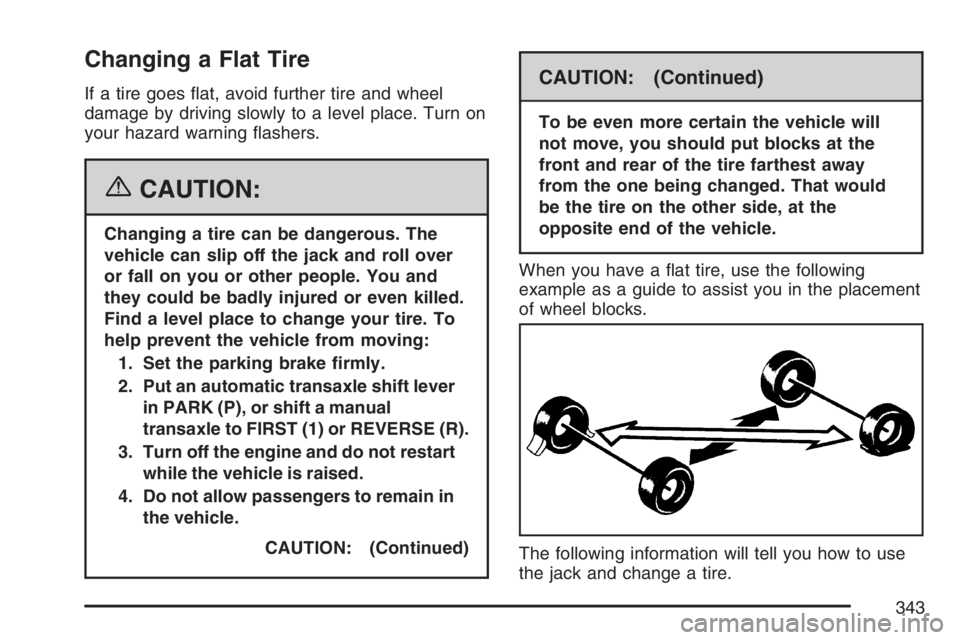
When you have a at tire, use the following
example as a guide to assist you in the placement
of wheel blocks.
The following information will tell you how to use
the jack and change a tire.
343