tires PONTIAC VIBE 2008 User Guide
[x] Cancel search | Manufacturer: PONTIAC, Model Year: 2008, Model line: VIBE, Model: PONTIAC VIBE 2008Pages: 368, PDF Size: 5.7 MB
Page 196 of 368

Accelerate gently. Try not to break the fragile traction.
If you accelerate too fast, the drive wheels will spin and
polish the surface under the tires even more.
Unless your vehicle has the Antilock Brake
System (ABS), you want to brake very gently, too.
If you do have ABS, seeAntilock Brake System (ABS)
on page 4-4. ABS improves your vehicle’s stability when
you make a hard stop on a slippery road. Whether your
vehicle has ABS or not, begin stopping sooner than you
would on dry pavement. Without ABS, if you feel your
vehicle begin to slide, let up on the brakes a little. Push
the brake pedal down steadily to get the most traction
you can.
Remember, unless your vehicle has ABS, if you brake so
hard that the wheels stop rolling, you will just slide. Brake
so the wheels always keep rolling and you can still steer.
Whatever your vehicle’s braking system, allow
greater distance on any slippery road.
Watch for slippery spots. The road might be ne
until you hit a spot that is covered with ice. On an
otherwise clear road, ice patches can appear in
shaded areas where the sun cannot reach, such as
around clumps of trees, behind buildings, or underbridges. Sometimes the surface of a curve or an
overpass can remain icy when the surrounding roads
are clear. If you see a patch of ice ahead of you,
brake before you are on it. Try not to brake while you
are actually on the ice, and avoid sudden steering
maneuvers.
If You Are Caught in a Blizzard
If you are stopped by heavy snow, you could be in a
serious situation. You should probably stay with your
vehicle unless you know for sure that you are near help
and you can hike through the snow. Here are some things
to do to summon help and keep yourself and your
passengers safe:
Turn on the hazard warning ashers.
Tie a red cloth to your vehicle to alert police that you
have been stopped by the snow.
Put on extra clothing or wrap a blanket around you.
If you do not have blankets or extra clothing, make
body insulators from newspapers, burlap bags, rags,
oor mats — anything you can wrap around yourself
or tuck under your clothing to keep warm.
4-16
Page 198 of 368

Then, shut the engine off and close the window almost all
the way to preserve the heat. Start the engine again and
repeat this only when you feel really uncomfortable from
the cold. But do it as little as possible. Preserve the fuel
as long as you can. To help keep warm, you can get out
of the vehicle and do some fairly vigorous exercises
every half hour or so until help comes.
If Your Vehicle is Stuck in Sand,
Mud, Ice, or Snow
Slowly and cautiously spin the wheels to free your
vehicle when stuck in sand, mud, ice, or snow. See
Rocking Your Vehicle to Get It Out on page 4-19.
If your vehicle has a traction system, it can often help
to free a stuck vehicle. Refer to your vehicle’s traction
system in the Index. If the stuck condition is too
severe for the traction system to free the vehicle, turn
the traction system off and use the rocking method.
{CAUTION:
If you let your vehicle’s tires spin at high
speed, they can explode, and you or others
could be injured. The vehicle can overheat,
causing an engine compartment re or other
damage. Spin the wheels as little as possible
and avoid going above 35 mph (55 km/h) as
shown on the speedometer.
For information about using tire chains on your vehicle,
seeTire Chains on page 5-68.
4-18
Page 200 of 368

Tire and Loading Information Label
A vehicle specic Tire and Loading Information
label is attached to the vehicle’s center pillar
(B-pillar). With the driver’s door open you will nd
the label attached below the door lock post (striker).The Tire and Loading Information label shows the
number of occupant seating positions (A), and the
maximum vehicle capacity weight (B) in kilograms
and pounds. This weight includes the weight of all
occupants, cargo, and all nonfactory-installed
options.
The Tire and Loading Information label also shows
the tire size of the original equipment tires (C), and
the recommended cold tire ination pressures (D).
For more information on tires and ination see
Tires on page 5-49andInflation - Tire Pressure
on page 5-55.
There is also important loading information on the
Certication label. It tells you the Gross Vehicle
Weight Rating (GVWR) and the Gross Axle Weight
Rating (GAWR) for the front and rear axle.
See “Certication Label” later in this section.
Label Example
4-20
Page 208 of 368

That’s the reason for this part. In it are many time-tested,
important trailering tips and safety rules. Many of these
are important for your safety and that of your passengers.
So please read this section carefully before you pull a
trailer.
Load-pulling components such as the engine, transaxle,
wheel assemblies and tires are forced to work harder
against the drag of the added weight. The engine is
required to operate at relatively higher speeds and under
greater loads, generating extra heat. What’s more, the
trailer adds considerably to wind resistance, increasing
the pulling requirements.
If You Do Decide To Pull A Trailer
If you do, here are some important points:
There are many different laws, including speed limit
restrictions, having to do with trailering. Make sure
your rig will be legal, not only where you live but
also where you’ll be driving. A good source for this
information can be state or provincial police.
Consider using a sway control. You can ask a hitch
dealer about sway controls.
Don’t tow a trailer at all during the rst 1,000 miles
(1 600 km) your new vehicle is driven. Your engine,
axle or other parts could be damaged.
Then, during the rst 500 miles (800 km) that you tow
a trailer, don’t drive over 50 mph (80 km/h) and don’t
make starts at full throttle. This helps your engine
and other parts of your vehicle wear in at the
heavier loads.
Obey speed limit restrictions when towing a trailer.
Don’t drive faster than the maximum posted speed
for trailers, or no more than 55 mph (90 km/h), to
save wear on your vehicle’s parts.
Three important considerations have to do with weight:
the weight of the trailer
the weight of the trailer tongue
and the total weight on your vehicle’s tires
4-28
Page 210 of 368

Total Weight on Your Vehicle’s Tires
Be sure your vehicle’s tires are inated to the upper limit
for cold tires. You’ll nd these numbers on the Tire and
Loading Information label located on the vehicle’s center
pillar (B-pillar). SeeLoading Your Vehicle on page 4-19.
Then be sure you do not go over the GVW limit for your
vehicle, including the weight of the trailer tongue.
Hitches
It’s important to have the correct hitch equipment.
Crosswinds, large trucks going by and rough roads
are a few reasons why you’ll need the right hitch.
Here are some rules to follow:
Don’t let the steel in a hitch contact the aluminum on
your bumper. If you do, the two will corrode. You can
use something like paint or plastic tape to separate
the steel and aluminum. The same steel to aluminum
problem can happen with fasteners too.
Will you have to make any holes in the body of your
vehicle when you install a trailer hitch? If you do,
then be sure to seal the holes later when you remove
the hitch. If you don’t seal them, deadly carbon
monoxide (CO) from your exhaust can get into your
vehicle. SeeEngine Exhaust on page 2-32. Dirt and
water can too.
Safety Chains
You should always attach chains between your vehicle
and your trailer. Cross the safety chains under the tongue
of the trailer so that the tongue will not drop to the road if
it becomes separated from the hitch. Instructions about
safety chains may be provided by the hitch manufacturer
or by the trailer manufacturer. Follow the manufacturer’s
recommendation for attaching safety chains and do not
attach them to the bumper. Always leave just enough
slack so you can turn with your rig. And, never allow
safety chains to drag on the ground.
Trailer Brakes
Does your trailer have its own brakes?
Be sure to read and follow the instructions for the trailer
brakes so you’ll be able to install, adjust and maintain
them properly. And, if you have anti-lock brakes, do not
try to tap into your vehicle’s brake system. If you do,
both systems won’t work well, or at all.
4-30
Page 211 of 368

Driving with a Trailer
Towing a trailer requires a certain amount of experience.
Before setting out for the open road, you’ll want to get
to know your rig. Acquaint yourself with the feel of
handling and braking with the added weight of the trailer.
And always keep in mind that the vehicle you are
driving is now a good deal longer and not nearly
as responsive as your vehicle is by itself.
Before you start, check the trailer hitch, platform and
attachments, safety chains, electrical connector, lamps,
tires and mirror adjustment. If the trailer has electric
brakes, start your vehicle and trailer moving and then
apply the trailer brake controller by hand to be sure
the brakes are working. This lets you check your
electrical connection at the same time.
During your trip, check occasionally to be sure that
the load is secure, and that the lamps and any trailer
brakes are still working.
Following Distance
Stay at least twice as far behind the vehicle ahead as
you would when driving your vehicle without a trailer.
This can help you avoid situations that require
heavy braking and sudden turns.
Passing
You’ll need more passing distance up ahead when
you’re towing a trailer. And, because you’re a good
deal longer, you’ll need to go much farther beyond the
passed vehicle before you can return to your lane.
Backing Up
Hold the bottom of the steering wheel with one hand.
Then, to move the trailer to the left, just move that hand
to the left. To move the trailer to the right, move your
hand to the right. Always back up slowly and, if possible,
have someone guide you.
Making Turns
Notice:Making very sharp turns while trailering
could cause the trailer to come in contact with the
vehicle. Your vehicle could be damaged. Avoid
making very sharp turns while trailering.
When you’re turning with a trailer, make wider turns than
normal. Do this so your trailer won’t strike soft shoulders,
curbs, road signs, trees or other objects. Avoid jerky or
sudden maneuvers. Signal well in advance.
4-31
Page 215 of 368
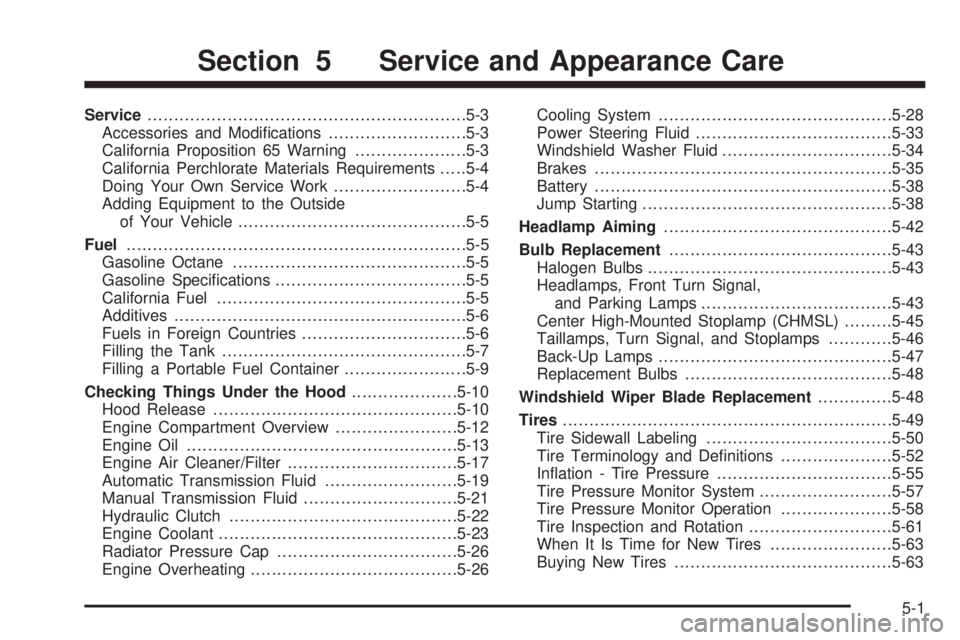
Service............................................................5-3
Accessories and Modications..........................5-3
California Proposition 65 Warning.....................5-3
California Perchlorate Materials Requirements.....5-4
Doing Your Own Service Work.........................5-4
Adding Equipment to the Outside
of Your Vehicle...........................................5-5
Fuel................................................................5-5
Gasoline Octane............................................5-5
Gasoline Specications....................................5-5
California Fuel...............................................5-5
Additives.......................................................5-6
Fuels in Foreign Countries...............................5-6
Filling the Tank..............................................5-7
Filling a Portable Fuel Container.......................5-9
Checking Things Under the Hood....................5-10
Hood Release..............................................5-10
Engine Compartment Overview.......................5-12
Engine Oil...................................................5-13
Engine Air Cleaner/Filter................................5-17
Automatic Transmission Fluid.........................5-19
Manual Transmission Fluid.............................5-21
Hydraulic Clutch...........................................5-22
Engine Coolant.............................................5-23
Radiator Pressure Cap..................................5-26
Engine Overheating.......................................5-26Cooling System............................................5-28
Power Steering Fluid.....................................5-33
Windshield Washer Fluid................................5-34
Brakes........................................................5-35
Battery........................................................5-38
Jump Starting...............................................5-38
Headlamp Aiming...........................................5-42
Bulb Replacement..........................................5-43
Halogen Bulbs
..............................................5-43
Headlamps, Front Turn Signal,
and Parking Lamps....................................5-43
Center High-Mounted Stoplamp (CHMSL).........5-45
Taillamps, Turn Signal, and Stoplamps............5-46
Back-Up Lamps............................................5-47
Replacement Bulbs.......................................5-48
Windshield Wiper Blade Replacement..............5-48
Tires..............................................................5-49
Tire Sidewall Labeling...................................5-50
Tire Terminology and Denitions.....................5-52
Ination - Tire Pressure.................................5-55
Tire Pressure Monitor System.........................5-57
Tire Pressure Monitor Operation.....................5-58
Tire Inspection and Rotation...........................5-61
When It Is Time for New Tires.......................5-63
Buying New Tires.........................................5-63
Section 5 Service and Appearance Care
5-1
Page 216 of 368

Different Size Tires and Wheels......................5-65
Uniform Tire Quality Grading..........................5-65
Wheel Alignment and Tire Balance..................5-67
Wheel Replacement......................................5-67
Tire Chains..................................................5-68
If a Tire Goes Flat........................................5-69
Changing a Flat Tire.....................................5-70
Removing the Spare Tire and Tools................5-71
Removing the Flat Tire and Installing
the Spare Tire..........................................5-73
Storing a Flat or Spare Tire and Tools............5-79
Compact Spare Tire......................................5-81
Appearance Care............................................5-82
Interior Cleaning...........................................5-82
Fabric/Carpet...............................................5-83
Leather.......................................................5-84
Instrument Panel, Vinyl, and Other
Plastic Surfaces........................................5-84
Care of Safety Belts......................................5-85
Weatherstrips...............................................5-85
Washing Your Vehicle...................................5-85
Cleaning Exterior Lamps/Lenses.....................5-86
Finish Care..................................................5-86
Windshield, Backglass, and
Wiper Blades............................................5-87Aluminum Wheels.........................................5-87
Tires...........................................................5-88
Sheet Metal Damage.....................................5-88
Finish Damage.............................................5-88
Underbody Maintenance................................5-88
Chemical Paint Spotting.................................5-88
Vehicle Care/Appearance Materials..................5-89
Vehicle Identication......................................5-90
Vehicle Identication Number (VIN).................5-90
Service Parts Identication Label.....................5-90
Electrical System...........................................
.5-90
Add-On Electrical Equipment..........................5-90
Headlamp Wiring..........................................5-91
Windshield Wiper Fuses................................5-91
Power Windows and Other
Power Options..........................................5-91
Fuses and Circuit Breakers............................5-91
Instrument Panel Fuse Block..........................5-92
Engine Compartment Fuse Block....................5-93
Capacities and Specications..........................5-95
Maintenance Replacement Parts......................5-96
Engine Drive Belt Routing..............................5-97
Section 5 Service and Appearance Care
5-2
Page 251 of 368

Some driving conditions or climates can cause a brake
squeal when the brakes are rst applied or lightly
applied. This does not mean something is wrong with
the brakes.
Properly torqued wheel nuts are necessary to help
prevent brake pulsation. When tires are rotated,
inspect brake pads for wear and evenly tighten wheel
nuts in the proper sequence to torque specications
inCapacities and Specifications on page 5-95.
Rear drum brakes do not have wear indicators, but if
you ever hear a rear brake rubbing noise, have the
rear brake linings inspected immediately. Also, the rear
brake drums should be removed and inspected each
time the tires are removed for rotation or changing.
When you have the front brake pads replaced, have
the rear brakes inspected, too.
Brake linings should always be replaced as complete
axle sets.
SeeBrake System Inspection on page 6-18.
Brake Pedal Travel
See your dealer/retailer if the brake pedal does not
return to normal height, or if there is a rapid increase in
pedal travel. This could be a sign that brake service
might be required.
Brake Adjustment
Every time you make a moderate brake stop, the disc
brakes adjust for wear. If you rarely make a moderate
or heavier stop, the brakes might not adjust correctly.
If you drive in that way, then — very carefully — make
a few moderate brake stops about every 1,000 miles
(1 600 km), so the brakes will adjust properly.
Replacing Brake System Parts
The braking system on a vehicle is complex. Its many
parts have to be of top quality and work well together if
the vehicle is to have really good braking. Your vehicle
was designed and tested with top-quality brake parts.
When you replace parts of the braking system — for
example, when the brake linings wear down and you
need new ones put in — be sure you get new approved
replacement parts. If you do not, the brakes might not
work properly. For example, if someone puts in brake
linings that are wrong for your vehicle, the balance
between the front and rear brakes can change — for
the worse. The braking performance you have come
to expect can change in many other ways if someone
puts in the wrong replacement brake parts.
5-37
Page 263 of 368
Tires
Your new vehicle comes with high-quality tires
made by a leading tire manufacturer. If you
ever have questions about your tire warranty
and where to obtain service, see your vehicle
Warranty booklet for details.
{CAUTION:
Poorly maintained and improperly used
tires are dangerous.
Overloading your vehicle’s tires can
cause overheating as a result of too
much exing. You could have an
air-out and a serious accident. See
Loading Your Vehicle on page 4-19.
Underinated tires pose the same
danger as overloaded tires. The
resulting accident could cause serious
injury. Check all tires frequently to
maintain the recommended pressure.
CAUTION: (Continued)
CAUTION: (Continued)
Tire pressure should be checked when
your vehicle’s tires are cold. See
Inflation - Tire Pressure on page 5-55.
Overinated tires are more likely to
be cut, punctured, or broken by a
sudden impact — such as when
you hit a pothole. Keep tires at the
recommended pressure.
Worn, old tires can cause accidents.
If the tire’s tread is badly worn,
or if your vehicle’s tires have been
damaged, replace them.
5-49