windows PONTIAC VIBE 2008 User Guide
[x] Cancel search | Manufacturer: PONTIAC, Model Year: 2008, Model line: VIBE, Model: PONTIAC VIBE 2008Pages: 368, PDF Size: 5.7 MB
Page 89 of 368

Testing the Alarm
To test the alarm:
1. Open all the windows.
2. Set the system as described in the previous
procedure. The doors and liftgate should be locked
with the key or RKE transmitter. Be sure to wait
until the security light starts ashing.
3. Unlock the driver’s door from the inside.
The system should activate the alarm.
4. Stop the alarm as described in the disarming
procedure following.
5. Repeat this operation for the other doors.
Also check that the system is activated when
the battery terminal is disconnected and then
reconnected.
If the system does not work properly, have it
checked by your dealer/retailer.
How the System Alarm is Activated
The system will activate the alarm:
If the driver’s or front passenger’s door is unlocked
without using the key or RKE transmitter.
If any door or the liftgate/liftglass is forcibly opened
without the key or RKE transmitter.
If the battery terminal is disconnected and then
reconnected.
If the ignition is hot-wired.
If the side window glass is broken or damaged.
The security light will come on when the system
is activated.
If the driver’s or front passenger’s doors are unlocked
without using the key or RKE transmitter, the other doors
and the liftgate will be automatically locked again.
After one minute the alarm will automatically stop and
the security light will start ashing again.
2-17
Page 104 of 368
Engine Exhaust
{CAUTION:
Engine exhaust can kill. It contains the gas
carbon monoxide (CO), which you cannot see or
smell. It can cause unconsciousness and death.
You might have exhaust coming in if:
The exhaust system sounds strange or
different.
Your vehicle gets rusty underneath.
Your vehicle was damaged in a collision.
Your vehicle was damaged when driving
over high points on the road or over road
debris.
Repairs were not done correctly.
Your vehicle or the exhaust system has
been modied improperly.
If you ever suspect exhaust is coming into your
vehicle:
Drive it only with all the windows down to
blow out any CO; and
Have your vehicle xed immediately.
Running the Engine While Parked
It is better not to park with the engine running. But if you
ever have to, here are some things to know.
{CAUTION:
Idling the engine with the climate control
system off could allow dangerous exhaust into
your vehicle. See the earlier caution under
Engine Exhaust on page 2-32.
Also, idling in a closed-in place can let deadly
carbon monoxide (CO) into your vehicle even if
the climate control fan is at the highest setting.
One place this can happen is a garage.
Exhaust — with CO — can come in easily.
NEVER park in a garage with the engine
running.
Another closed-in place can be a blizzard.
SeeWinter Driving on page 4-15.
2-32
Page 136 of 368
Climate Controls
Climate Control System
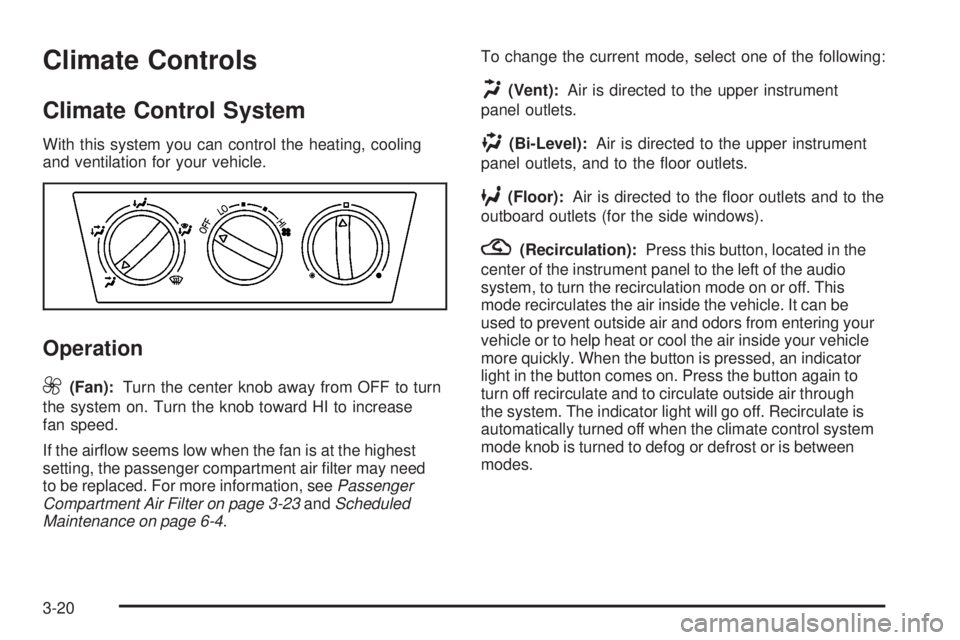
With this system you can control the heating, cooling
and ventilation for your vehicle.
Operation
9
(Fan):Turn the center knob away from OFF to turn
the system on. Turn the knob toward HI to increase
fan speed.
If the airow seems low when the fan is at the highest
setting, the passenger compartment air lter may need
to be replaced. For more information, seePassenger
Compartment Air Filter on page 3-23andScheduled
Maintenance on page 6-4.To change the current mode, select one of the following:
H(Vent):Air is directed to the upper instrument
panel outlets.
)(Bi-Level):Air is directed to the upper instrument
panel outlets, and to the oor outlets.
6(Floor):Air is directed to the oor outlets and to the
outboard outlets (for the side windows).
?(Recirculation):Press this button, located in the
center of the instrument panel to the left of the audio
system, to turn the recirculation mode on or off. This
mode recirculates the air inside the vehicle. It can be
used to prevent outside air and odors from entering your
vehicle or to help heat or cool the air inside your vehicle
more quickly. When the button is pressed, an indicator
light in the button comes on. Press the button again to
turn off recirculate and to circulate outside air through
the system. The indicator light will go off. Recirculate is
automatically turned off when the climate control system
mode knob is turned to defog or defrost or is between
modes.
3-20
Page 137 of 368
Temperature Control:Turn the right knob clockwise
or counterclockwise to increase or decrease the
temperature inside the vehicle.
A/C (Air Conditioning):Press this button, located in
the center of the instrument panel to the left of the audio
system, to turn the air-conditioning system on or off.
When A/C is pressed, an indicator light in the button
comes on to let you know that the air conditioning
is activated.
MAX A/C (Maximum Air Conditioning):Press the A/C
and recirculation buttons at the same time to select
MAX A/C.
On hot days, open the windows to let hot inside air
escape; then close them. This helps to reduce the time
it takes for the vehicle to cool down. It also helps the
system to operate more efficiently.
The air-conditioning system removes moisture from
the air, so you might notice a small amount of water
dripping underneath your vehicle while idling or
after turning off the engine. This is normal.Defogging and Defrosting
Fog on the inside of windows is a result of high humidity
(moisture) condensing on the cool window glass. This
can be minimized if the climate control system is used
properly. There are two modes to clear fog or frost from
the windshield. Use the defog mode to clear the inside
of the windshield of fog or moisture and warm the
passengers. Use the defrost mode to remove fog or
frost from the outside of the windshield more quickly.
-(Defog):Air is directed between the windshield,
side windows, instrument panel outlets and the
oor outlets. The air-conditioning compressor will
run automatically in this setting without pressing
A/C, unless the outside temperature is at or
below 32°F (0°C).
1(Defrost):Air is directed to the windshield,
instrument panel outlets and the side windows.
The air-conditioning compressor will run automatically
in this setting without pressing A/C, unless the
outside temperature is at or below 32°F (0°C).
Do not drive the vehicle until all the windows are clear.
3-21
Page 193 of 368
Hydroplaning
Hydroplaning is dangerous. Water can build up under
your vehicle’s tires so they actually ride on the water.
This can happen if the road is wet enough and you are
going fast enough. When your vehicle is hydroplaning,
it has little or no contact with the road.
There is no hard and fast rule about hydroplaning.
The best advice is to slow down when the road is wet.
Other Rainy Weather Tips
Besides slowing down, other wet weather driving tips
include:
Allow extra following distance.
Pass with caution.
Keep windshield wiping equipment in good shape.
Keep the windshield washer uid reservoir lled.
Have good tires with proper tread depth.
SeeTires on page 5-49.
Before Leaving on a Long Trip
To prepare your vehicle for a long trip, consider having
it serviced by your dealer/retailer before departing.
Things to check on your own include:
Windshield Washer Fluid:Reservoir full? Windows
clean — inside and outside?
Wiper Blades:In good shape?
Fuel, Engine Oil, Other Fluids:All levels checked?
Lamps:Do they all work and are lenses clean?
Tires:Are treads good? Are tires inated to
recommended pressure?
Weather and Maps:Safe to travel? Have up-to-date
maps?
Highway Hypnosis
Always be alert and pay attention to your surroundings
while driving. If you become tired or sleepy, nd a
safe place to park your vehicle and rest.
Other driving tips include:
Keep the vehicle well ventilated.
Keep interior temperature cool.
Keep your eyes moving — scan the road ahead
and to the sides.
Check the rearview mirror and vehicle instruments
often.
4-13
Page 216 of 368

Different Size Tires and Wheels......................5-65
Uniform Tire Quality Grading..........................5-65
Wheel Alignment and Tire Balance..................5-67
Wheel Replacement......................................5-67
Tire Chains..................................................5-68
If a Tire Goes Flat........................................5-69
Changing a Flat Tire.....................................5-70
Removing the Spare Tire and Tools................5-71
Removing the Flat Tire and Installing
the Spare Tire..........................................5-73
Storing a Flat or Spare Tire and Tools............5-79
Compact Spare Tire......................................5-81
Appearance Care............................................5-82
Interior Cleaning...........................................5-82
Fabric/Carpet...............................................5-83
Leather.......................................................5-84
Instrument Panel, Vinyl, and Other
Plastic Surfaces........................................5-84
Care of Safety Belts......................................5-85
Weatherstrips...............................................5-85
Washing Your Vehicle...................................5-85
Cleaning Exterior Lamps/Lenses.....................5-86
Finish Care..................................................5-86
Windshield, Backglass, and
Wiper Blades............................................5-87Aluminum Wheels.........................................5-87
Tires...........................................................5-88
Sheet Metal Damage.....................................5-88
Finish Damage.............................................5-88
Underbody Maintenance................................5-88
Chemical Paint Spotting.................................5-88
Vehicle Care/Appearance Materials..................5-89
Vehicle Identication......................................5-90
Vehicle Identication Number (VIN).................5-90
Service Parts Identication Label.....................5-90
Electrical System...........................................
.5-90
Add-On Electrical Equipment..........................5-90
Headlamp Wiring..........................................5-91
Windshield Wiper Fuses................................5-91
Power Windows and Other
Power Options..........................................5-91
Fuses and Circuit Breakers............................5-91
Instrument Panel Fuse Block..........................5-92
Engine Compartment Fuse Block....................5-93
Capacities and Specications..........................5-95
Maintenance Replacement Parts......................5-96
Engine Drive Belt Routing..............................5-97
Section 5 Service and Appearance Care
5-2
Page 241 of 368

If No Steam Is Coming From
Your Engine
If you get an engine overheat warning but see or
hear no steam, the problem may not be too serious.
Sometimes the engine can get a little too hot
when you:
Climb a long hill on a hot day.
Stop after high-speed driving.
Idle for long periods in traffic.
Tow a trailer.
If you get the overheat warning with no sign of steam,
try this for a minute or so:
1. In heavy traffic, let the engine idle in NEUTRAL (N)
while stopped. If it is safe to do so, pull off the
road, shift to PARK (P) or NEUTRAL (N) and let
the engine idle.
2. Turn on your heater to full hot at the highest fan
speed and open the windows as necessary.If you no longer have the overheat warning, you can
drive. Just to be safe, drive slower for about 10 minutes.
If the warning does not come back on, you can drive
normally.
If the warning continues and you have not stopped,
pull over, stop, and park your vehicle right away.
If there is still no sign of steam, you can idle the engine
for three minutes while you are parked. If you still
have the warning, turn off the engine and get everyone
out of the vehicle until it cools down.
You may decide not to lift the hood but to get service
help right away.
5-27
Page 266 of 368
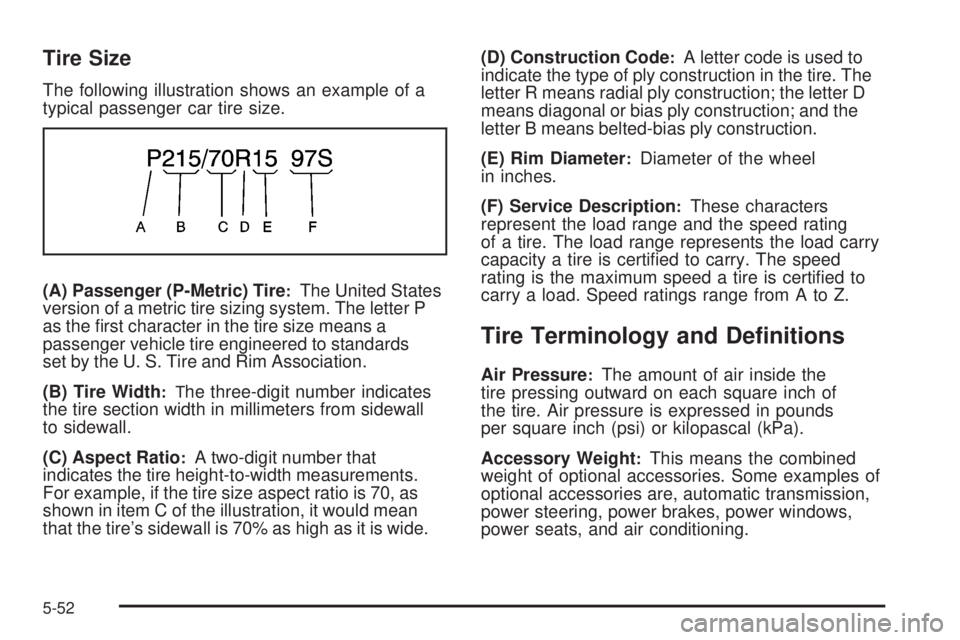
Tire Size
The following illustration shows an example of a
typical passenger car tire size.
(A) Passenger (P-Metric) Tire
:The United States
version of a metric tire sizing system. The letter P
as the rst character in the tire size means a
passenger vehicle tire engineered to standards
set by the U. S. Tire and Rim Association.
(B) Tire Width
:The three-digit number indicates
the tire section width in millimeters from sidewall
to sidewall.
(C) Aspect Ratio
:A two-digit number that
indicates the tire height-to-width measurements.
For example, if the tire size aspect ratio is 70, as
shown in item C of the illustration, it would mean
that the tire’s sidewall is 70% as high as it is wide.(D) Construction Code
:A letter code is used to
indicate the type of ply construction in the tire. The
letter R means radial ply construction; the letter D
means diagonal or bias ply construction; and the
letter B means belted-bias ply construction.
(E) Rim Diameter
:Diameter of the wheel
in inches.
(F) Service Description
:These characters
represent the load range and the speed rating
of a tire. The load range represents the load carry
capacity a tire is certied to carry. The speed
rating is the maximum speed a tire is certied to
carry a load. Speed ratings range from A to Z.
Tire Terminology and Denitions
Air Pressure:The amount of air inside the
tire pressing outward on each square inch of
the tire. Air pressure is expressed in pounds
per square inch (psi) or kilopascal (kPa).
Accessory Weight
:This means the combined
weight of optional accessories. Some examples of
optional accessories are, automatic transmission,
power steering, power brakes, power windows,
power seats, and air conditioning.
5-52
Page 296 of 368
Appearance Care
Interior Cleaning
Your vehicle’s interior will continue to look its best if it
is cleaned often. Although not always visible, dust
and dirt can accumulate on your upholstery. Dirt can
damage carpet, fabric, leather, and plastic surfaces.
Regular vacuuming is recommended to remove
particles from your upholstery. It is important to keep
your upholstery from becoming and remaining heavily
soiled. Soils should be removed as quickly as possible.
Your vehicle’s interior may experience extremes of
heat that could cause stains to set rapidly.
Lighter colored interiors may require more frequent
cleaning. Use care because newspapers and garments
that transfer color to your home furnishings may also
transfer color to your vehicle’s interior.
When cleaning your vehicle’s interior, only use cleaners
specically designed for the surfaces being cleaned.
Permanent damage may result from using cleaners on
surfaces for which they were not intended. Use glass
cleaner only on glass. Remove any accidental over-spray
from other surfaces immediately. To prevent over-spray,
apply cleaner directly to the cleaning cloth.Notice:If you use abrasive cleaners when cleaning
glass surfaces on your vehicle, you could scratch
the glass and/or cause damage to the rear window
defogger. When cleaning the glass on your
vehicle, use only a soft cloth and glass cleaner.
Many cleaners contain solvents that may become
concentrated in your vehicle’s breathing space.
Before using cleaners, read and adhere to all safety
instructions on the label. While cleaning your vehicle’s
interior, maintain adequate ventilation by opening
your vehicle’s doors and windows.
Dust may be removed from small buttons and knobs
using a small brush with soft bristles.
Your dealer/retailer has a product for cleaning your
vehicle’s glass. Should it become necessary, you
can also obtain a product from your dealer/retailer to
remove odors from your vehicle’s upholstery.
Do not clean your vehicle using the following cleaners
or techniques:
Never use a knife or any other sharp object to
remove a soil from any interior surface.
Never use a stiff brush. It can cause damage to
your vehicle’s interior surfaces.
Never apply heavy pressure or rub aggressively
with a cleaning cloth. Use of heavy pressure
can damage your interior and does not improve
the effectiveness of soil removal.
5-82
Page 305 of 368
Headlamp Wiring
The headlamp wiring is protected by a circuit breaker.
An electrical overload will cause the lamps to go on
and off, or in some cases to remain off. If this happens,
have your headlamp wiring checked right away.
Windshield Wiper Fuses
The windshield wiper motor is protected by a circuit
breaker and a fuse. If the motor overheats due to heavy
snow or ice, the wiper will stop until the motor cools.
If the overload is caused by some electrical problem,
and not snow or ice, be sure to get it xed.
Power Windows and Other
Power Options
Circuit breakers in the fuse block protect the power
windows and other power accessories. When the
current load is too heavy, the circuit breaker opens
and closes, protecting the circuit until the problem is
xed or goes away.
Fuses and Circuit Breakers
The wiring circuits in your vehicle are protected from
short circuits by a combination of fuses, circuit breakers
and fusible thermal links. This greatly reduces the
chance of res caused by electrical problems.
Look at the silver-colored band inside the fuse. If the
band is broken or melted, replace the fuse. Be sure you
replace a bad fuse with a new one of the identical
size and rating.
If you ever have a problem on the road and don’t
have a spare fuse, you can borrow one that has the
same amperage. Just pick some feature of your
vehicle that you can get along without – like the radio
or cigarette lighter – and use its fuse, if it is the
correct amperage. Replace it as soon as you can.
5-91