light PONTIAC VIBE 2008 Owner's Manual
[x] Cancel search | Manufacturer: PONTIAC, Model Year: 2008, Model line: VIBE, Model: PONTIAC VIBE 2008Pages: 368, PDF Size: 5.7 MB
Page 106 of 368

Automatic Dimming Rearview Mirror
While sitting in a comfortable driving position, adjust
the mirror so you can see clearly behind your vehicle.
Hold the mirror in the center to move it up or down
and side to side.
The mirror may have an automatic dimming feature that
darkens gradually to reduce the glare of headlamps from
behind. When the ignition key is inserted and turned
on, the inside rear view mirror always turns on in the
automatic function mode.An indicator light located on
the mirror will come on to show you that the function
is on. When the inside air temperature is low, it may take
a little longer for the mirror to darken in response to the
detection of headlights.
Press the AUTO button located in the lower center of
the mirror to turn automatic dimming on and the
((off)
button located next to the AUTO button to turn automatic
dimming off.
One photocell on the front of the mirror senses when it
is becoming dark outside. Another photocell, facing
rearward, senses headlamps behind you.
To keep the photocells operating well, occasionally
clean them with a cotton swab and glass cleaner.
Outside Remote Control Mirrors
Your vehicle has outside power adjustable mirrors.
The controls are located
to the left of the steering
wheel on the instrument
panel.
To adjust either mirror, push the button labeled L (left) or
R (right). Use the arrows on the control pad to adjust the
direction of the mirror. Once both mirrors have been
adjusted, move the selector switch back to the center.
This prevents the mirrors from being moved once they
have been adjusted.
2-34
Page 110 of 368

How OnStar Service Works
In order to provide you with OnStar services, your
vehicle’s OnStar system has the capability of recording
and transmitting vehicle information. This information is
automatically sent to an OnStar Call Center at the time
of an OnStar button press, Emergency button press or
if your airbags or AACN system deploys. The vehicle
information usually includes your GPS location and, in
the event of a crash, additional information regarding the
accident that your vehicle has been involved in (e.g. the
direction from which your vehicle was hit). When you use
the Virtual Advisor feature of OnStar Hands-Free Calling,
your vehicle also sends OnStar your GPS location so that
we can provide you with location-based services.
OnStar service cannot work unless your vehicle is in a
place where OnStar has an agreement with a wireless
service provider for service in that area. OnStar service
also cannot work unless you are in a place where the
wireless service provider OnStar has hired for that area
has coverage, network capacity and reception when the
service is needed, and technology that is compatible
with the OnStar service. Not all services are available
everywhere, particularly in remote or enclosed areas,
or at all times.OnStar service that involves location information about
your vehicle cannot work unless GPS satellite signals
are unobstructed and available in that place as well.
Your vehicle must have a working electrical system
(including adequate battery power) for the OnStar
equipment to operate. There are other problems OnStar
cannot control that may prevent OnStar from providing
OnStar service to you at any particular time or place.
Some examples are damage to important parts of your
vehicle in an accident, hills, tall buildings, tunnels,
weather or wireless phone network congestion.
Your Responsibility
You may need to increase the volume of your radio to
hear the OnStar advisor. If the light next to the OnStar
buttons is red, this means that your system is not
functioning properly and should be checked by a dealer.
If the light appears clear (no light is appearing), your
OnStar subscription has expired. You can always press
the blue OnStar button to conrm that your OnStar
equipment is active.
2-38
Page 117 of 368
Instrument Panel Overview...............................3-4
Hazard Warning Flashers................................3-6
Other Warning Devices...................................3-6
Horn.............................................................3-6
Tilt Wheel.....................................................3-7
Turn Signal/Multifunction Lever.........................3-7
Turn and Lane-Change Signals........................3-8
Headlamp High/Low-Beam Changer..................3-8
Flash-to-Pass.................................................3-8
Windshield Wipers..........................................3-9
Windshield Washer.......................................3-10
Rear Window Wiper/Washer...........................3-10
Cruise Control..............................................3-11
Exterior Lamps.............................................3-14
Headlamps on Reminder................................3-15
Daytime Running Lamps (DRL).......................3-15
Automatic Headlamp System..........................3-16
Fog Lamps..................................................3-16
Instrument Panel Brightness...........................3-16
Interior Lamps Control...................................3-17
Entry Lighting...............................................3-17
Reading Lamps............................................3-17
Accessory Power Outlet(s).............................3-18Power Outlet 115 Volt Alternating Current........3-18
Ashtray(s) and Cigarette Lighter......................3-19
Climate Controls............................................3-20
Climate Control System.................................3-20
Outlet Adjustment.........................................3-22
Passenger Compartment Air Filter...................3-23
Warning Lights, Gages, and Indicators............3-25
Instrument Panel Cluster................................3-26
Speedometer and Odometer...........................3-27
Trip Odometers............................................3-27
Tachometer................................................
.3-28
Safety Belt Reminders...................................3-28
Airbag Readiness Light..................................3-29
Passenger Airbag Status Indicator...................3-30
Charging System Light..................................3-32
Brake System Warning Light..........................3-32
Antilock Brake System Warning Light...............3-33
Low Tire Pressure Warning Light....................3-34
Traction Control System (TCS)
Warning Light...........................................3-34
StabiliTrak
®Indicator Light..............................3-35
Engine Coolant Temperature Gage..................3-35
Section 3 Instrument Panel
3-1
Page 118 of 368

Malfunction Indicator Lamp.............................3-36
Oil Pressure Light.........................................3-38
Lights On Reminder......................................3-39
Taillamp Indicator Light..................................3-39
Cruise Control Light......................................3-39
Overdrive Off Light........................................3-39
Highbeam On Light.......................................3-40
Low Washer Fluid Warning Light.....................3-40
Door Ajar Light.............................................3-40
Fuel Gage...................................................3-41
Low Fuel Warning Light.................................3-42Audio System(s).............................................3-42
Setting the Time...........................................3-43
Radio(s)......................................................3-44
Using an MP3..............................................3-58
XM Radio Messages.....................................3-63
Radio Reception...........................................3-63
Fixed Mast Antenna......................................3-64
XM™ Satellite Radio Antenna System.............3-64
Section 3 Instrument Panel
3-2
Page 121 of 368
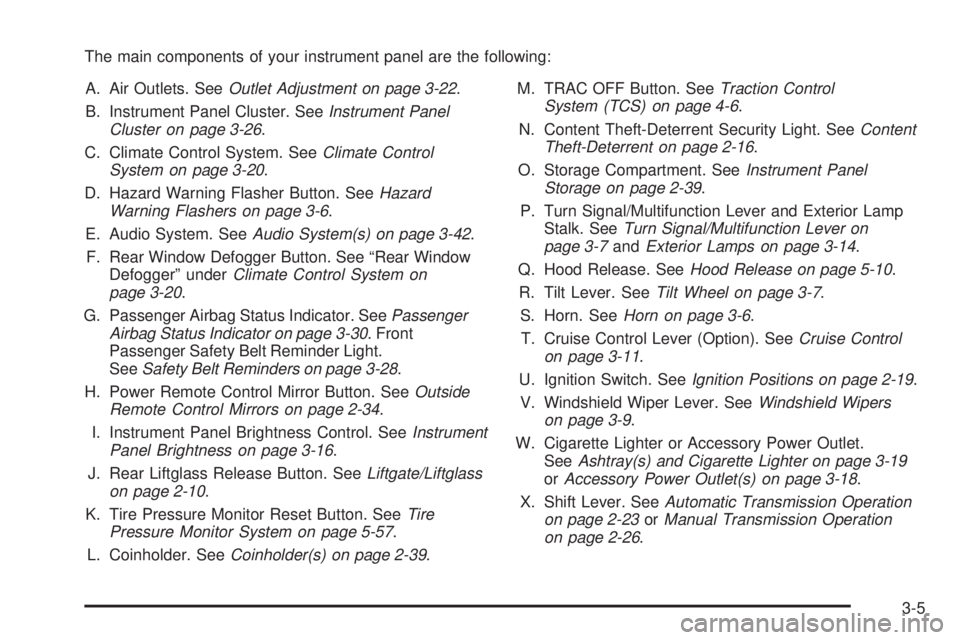
The main components of your instrument panel are the following:
A. Air Outlets. SeeOutlet Adjustment on page 3-22.
B. Instrument Panel Cluster. SeeInstrument Panel
Cluster on page 3-26.
C. Climate Control System. SeeClimate Control
System on page 3-20.
D. Hazard Warning Flasher Button. SeeHazard
Warning Flashers on page 3-6.
E. Audio System. SeeAudio System(s) on page 3-42.
F. Rear Window Defogger Button. See “Rear Window
Defogger” underClimate Control System on
page 3-20.
G. Passenger Airbag Status Indicator. SeePassenger
Airbag Status Indicator on page 3-30. Front
Passenger Safety Belt Reminder Light.
SeeSafety Belt Reminders on page 3-28.
H. Power Remote Control Mirror Button. SeeOutside
Remote Control Mirrors on page 2-34.
I. Instrument Panel Brightness Control. SeeInstrument
Panel Brightness on page 3-16.
J. Rear Liftglass Release Button. SeeLiftgate/Liftglass
on page 2-10.
K. Tire Pressure Monitor Reset Button. SeeTire
Pressure Monitor System on page 5-57.
L. Coinholder. SeeCoinholder(s) on page 2-39.M. TRAC OFF Button. SeeTraction Control
System (TCS) on page 4-6.
N. Content Theft-Deterrent Security Light. SeeContent
Theft-Deterrent on page 2-16.
O. Storage Compartment. SeeInstrument Panel
Storage on page 2-39.
P. Turn Signal/Multifunction Lever and Exterior Lamp
Stalk. SeeTurn Signal/Multifunction Lever on
page 3-7andExterior Lamps on page 3-14.
Q. Hood Release. SeeHood Release on page 5-10.
R. Tilt Lever. SeeTilt Wheel on page 3-7.
S. Horn. SeeHorn on page 3-6.
T. Cruise Control Lever (Option). SeeCruise Control
on page 3-11.
U. Ignition Switch. SeeIgnition Positions on page 2-19.
V. Windshield Wiper Lever. SeeWindshield Wipers
on page 3-9.
W. Cigarette Lighter or Accessory Power Outlet.
SeeAshtray(s) and Cigarette Lighter on page 3-19
orAccessory Power Outlet(s) on page 3-18.
X. Shift Lever. SeeAutomatic Transmission Operation
on page 2-23orManual Transmission Operation
on page 2-26
.
3-5
Page 124 of 368

Turn and Lane-Change Signals
The turn signal has an upward (for right) and a
downward (for left) position. These positions allow
you to signal a turn or a lane change.
To signal a turn, move the lever all the way up or
down. When the turn is nished, the lever will return
automatically.
To signal a lane change, raise or lower the lever until
the arrow starts to ash. Hold it there until you complete
your lane change. The lever will return by itself when
you release it.
An arrow on the instrument
panel cluster will ash in
the direction of the turn or
lane change.
If you signal a turn or a lane change and notice the
arrow ashing rapidly, a signal bulb may be burned
out and other drivers will not see your turn signal.
If a bulb is burned out, have it replaced to help avoid an
accident. If the arrows do not go on at all when you signal
a turn, check for burned-out bulbs and then check the
fuse. SeeFuses and Circuit Breakers on page 5-91.
Headlamp High/Low-Beam Changer
The headlamps must be on for this feature to work.
For high beams, push the turn signal lever away
from you.
When the high beams
are on, this light on the
instrument panel cluster
also will be on.
It will go off when you switch to the low beams.
To switch back to low beams, pull the lever toward you.
Flash-to-Pass
With the lever in the low-beam position, pull the lever
toward you to momentarily switch to high beams
(to signal that you are going to pass). If you have the
headlamps on when you release the lever, they will
return to the low beams.
3-8
Page 125 of 368
Windshield Wipers
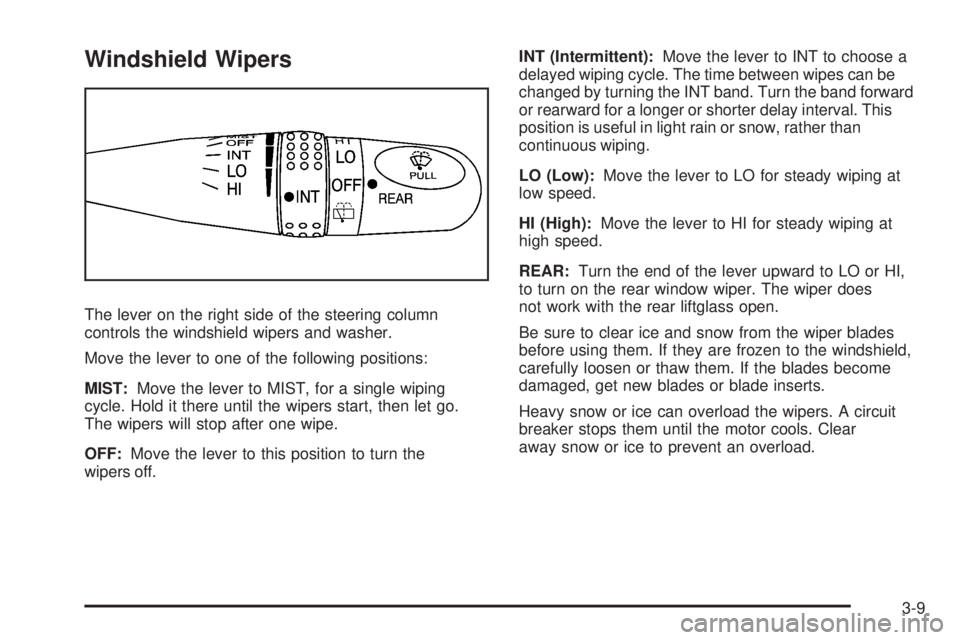
The lever on the right side of the steering column
controls the windshield wipers and washer.
Move the lever to one of the following positions:
MIST:Move the lever to MIST, for a single wiping
cycle. Hold it there until the wipers start, then let go.
The wipers will stop after one wipe.
OFF:Move the lever to this position to turn the
wipers off.INT (Intermittent):Move the lever to INT to choose a
delayed wiping cycle. The time between wipes can be
changed by turning the INT band. Turn the band forward
or rearward for a longer or shorter delay interval. This
position is useful in light rain or snow, rather than
continuous wiping.
LO (Low):Move the lever to LO for steady wiping at
low speed.
HI (High):Move the lever to HI for steady wiping at
high speed.
REAR:Turn the end of the lever upward to LO or HI,
to turn on the rear window wiper. The wiper does
not work with the rear liftglass open.
Be sure to clear ice and snow from the wiper blades
before using them. If they are frozen to the windshield,
carefully loosen or thaw them. If the blades become
damaged, get new blades or blade inserts.
Heavy snow or ice can overload the wipers. A circuit
breaker stops them until the motor cools. Clear
away snow or ice to prevent an overload.
3-9
Page 128 of 368
Setting Cruise Control
{CAUTION:
If you leave your cruise control on when you
are not using cruise, you might hit a button
and go into cruise when you do not want to.
You could be startled and even lose control.
Keep the cruise control switch off until you
want to use cruise control.
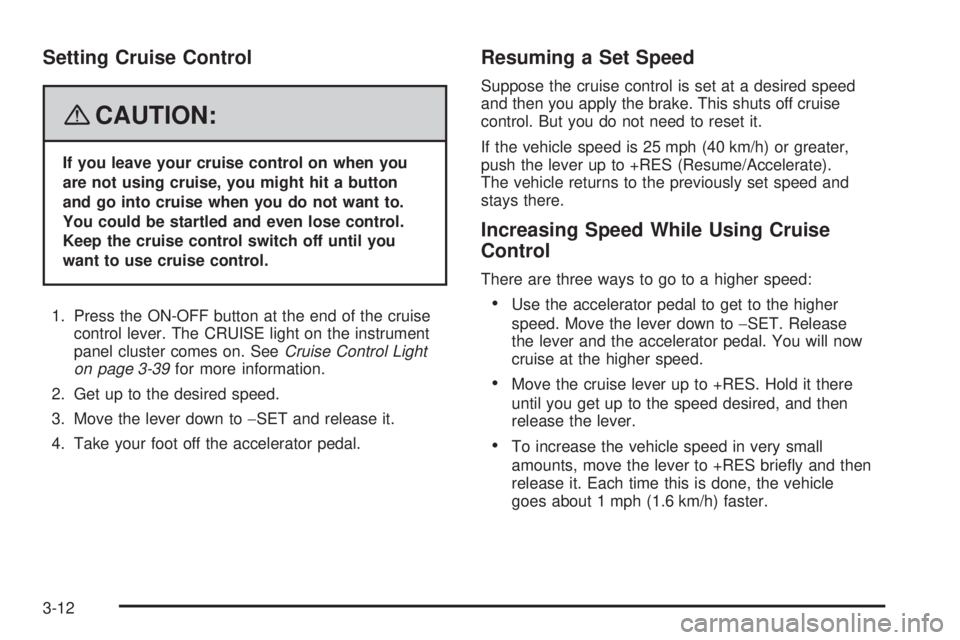
1. Press the ON-OFF button at the end of the cruise
control lever. The CRUISE light on the instrument
panel cluster comes on. SeeCruise Control Light
on page 3-39for more information.
2. Get up to the desired speed.
3. Move the lever down to−SET and release it.
4. Take your foot off the accelerator pedal.
Resuming a Set Speed
Suppose the cruise control is set at a desired speed
and then you apply the brake. This shuts off cruise
control. But you do not need to reset it.
If the vehicle speed is 25 mph (40 km/h) or greater,
push the lever up to +RES (Resume/Accelerate).
The vehicle returns to the previously set speed and
stays there.
Increasing Speed While Using Cruise
Control
There are three ways to go to a higher speed:
Use the accelerator pedal to get to the higher
speed. Move the lever down to−SET. Release
the lever and the accelerator pedal. You will now
cruise at the higher speed.
Move the cruise lever up to +RES. Hold it there
until you get up to the speed desired, and then
release the lever.
To increase the vehicle speed in very small
amounts, move the lever to +RES briey and then
release it. Each time this is done, the vehicle
goes about 1 mph (1.6 km/h) faster.
3-12
Page 129 of 368
Reducing Speed While Using Cruise
Control
There are two ways to reduce your speed while using
cruise control:
Push and hold the lever to−SET until you reach the
lower speed desired, then release it.
To slow down in very small amounts, push the lever
down briey. Each time this is done, the vehicle will
go about 1 mph (1.6 km/h) slower.
Passing Another Vehicle While Using
Cruise Control
Use the accelerator pedal to increase the vehicle speed.
When you take your foot off the pedal, the vehicle
slows down to the cruise control speed you set earlier.
Using Cruise Control on Hills
How well the cruise control works on hills depends upon
the vehicle speed, load, and the steepness of the hills.
When going up steep hills, you might have to step on
the accelerator pedal to maintain the vehicle speed.When going downhill, you might have to brake or shift to
a lower gear to keep the vehicle speed down. Of course,
applying the brake or downshifting to SECOND (2) or
LOW (L) turns off the cruise control. Many drivers nd this
to be too much trouble and do not use cruise control on
steep hills.
Ending Cruise Control
There are several ways to turn off the cruise control:
Step lightly on the brake pedal or push the
clutch pedal, if you have a manual transaxle.
Press the ON-OFF button again.
Pull the cruise control lever toward you.
Erasing Speed Memory
When you turn off the cruise control or the ignition, the
cruise control set speed memory is erased.
3-13
Page 130 of 368

Exterior Lamps
The lever on the left side of the steering column
operates the exterior lamps.
O(Exterior Lamps):Turn the outside part of the
lever with the symbol on it, to operate the lamps.
For vehicles sold in the U. S., this symbol will appear
on the instrument panel cluster when your exterior lamps
are on.The exterior lamp switch has three positions:
OFF:Turning the switch to this position turns off all
lamps, except the Daytime Running Lamps (DRL).
O(Parking Lamps):Turning the switch to this position
turns on the parking lamps together with the following:
Sidemarker Lamps
Taillamps
License Plate Lamp
Instrument Panel Lights
A symbol will appear on the instrument panel cluster
when your parking lamps are on. SeeLights On
Reminder on page 3-39andTaillamp Indicator Light
on page 3-39for additional information.
3(Headlamps):Turning the switch to this position
turns on the headlamps, together with the previously
listed lamps and lights.
3-14