tire pressure reset PONTIAC VIBE 2008 Owners Manual
[x] Cancel search | Manufacturer: PONTIAC, Model Year: 2008, Model line: VIBE, Model: PONTIAC VIBE 2008Pages: 368, PDF Size: 5.7 MB
Page 121 of 368
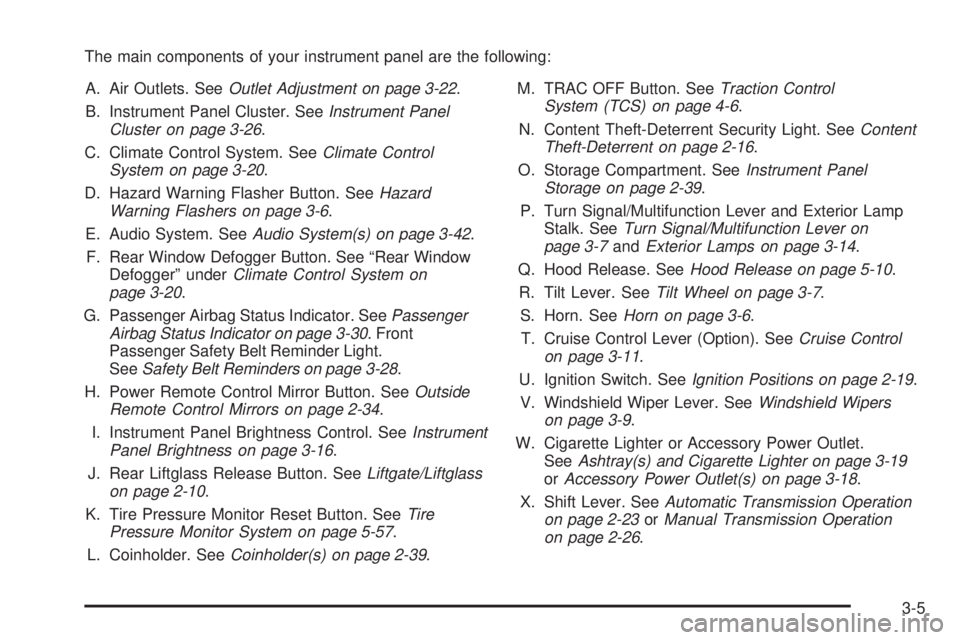
The main components of your instrument panel are the following:
A. Air Outlets. SeeOutlet Adjustment on page 3-22.
B. Instrument Panel Cluster. SeeInstrument Panel
Cluster on page 3-26.
C. Climate Control System. SeeClimate Control
System on page 3-20.
D. Hazard Warning Flasher Button. SeeHazard
Warning Flashers on page 3-6.
E. Audio System. SeeAudio System(s) on page 3-42.
F. Rear Window Defogger Button. See “Rear Window
Defogger” underClimate Control System on
page 3-20.
G. Passenger Airbag Status Indicator. SeePassenger
Airbag Status Indicator on page 3-30. Front
Passenger Safety Belt Reminder Light.
SeeSafety Belt Reminders on page 3-28.
H. Power Remote Control Mirror Button. SeeOutside
Remote Control Mirrors on page 2-34.
I. Instrument Panel Brightness Control. SeeInstrument
Panel Brightness on page 3-16.
J. Rear Liftglass Release Button. SeeLiftgate/Liftglass
on page 2-10.
K. Tire Pressure Monitor Reset Button. SeeTire
Pressure Monitor System on page 5-57.
L. Coinholder. SeeCoinholder(s) on page 2-39.M. TRAC OFF Button. SeeTraction Control
System (TCS) on page 4-6.
N. Content Theft-Deterrent Security Light. SeeContent
Theft-Deterrent on page 2-16.
O. Storage Compartment. SeeInstrument Panel
Storage on page 2-39.
P. Turn Signal/Multifunction Lever and Exterior Lamp
Stalk. SeeTurn Signal/Multifunction Lever on
page 3-7andExterior Lamps on page 3-14.
Q. Hood Release. SeeHood Release on page 5-10.
R. Tilt Lever. SeeTilt Wheel on page 3-7.
S. Horn. SeeHorn on page 3-6.
T. Cruise Control Lever (Option). SeeCruise Control
on page 3-11.
U. Ignition Switch. SeeIgnition Positions on page 2-19.
V. Windshield Wiper Lever. SeeWindshield Wipers
on page 3-9.
W. Cigarette Lighter or Accessory Power Outlet.
SeeAshtray(s) and Cigarette Lighter on page 3-19
orAccessory Power Outlet(s) on page 3-18.
X. Shift Lever. SeeAutomatic Transmission Operation
on page 2-23orManual Transmission Operation
on page 2-26
.
3-5
Page 273 of 368

This light also comes on for a few seconds and then
goes off when you turn the ignition to ON/RUN.
This indicates the TPMS is functioning properly.
If the low-tire pressure warning light comes on while
driving your vehicle, the system may have detected a
low-tire condition. You need to stop as soon as possible
and check the tires.
The low tire pressure warning light may come on in cool
weather when the vehicle is rst started, and then
turn off as you start to drive. This could be an early
indicator that the air pressure in the tire(s) are getting
low and need to be inated to the proper pressure.
A Tire and Loading Information label, attached to your
vehicle, shows the size of your vehicle’s original
equipment tires and the correct ination pressure for
your vehicle’s tires when they are cold. SeeLoading
Your Vehicle on page 4-19, for an example of the
Tire and Loading Information label and its location
on your vehicle. Also seeInflation - Tire Pressure
on page 5-55.
Your vehicle’s TPMS can warn you about a low tire
pressure condition but it does not replace normal
tire maintenance. SeeTire Inspection and Rotation
on page 5-61andTires on page 5-49.TPMS Malfunction Light
The TPMS will not function properly if one or more of
the TPMS sensors are missing or inoperable. When
the system detects a malfunction, the low tire warning
light ashes for about one minute and then stays
on for the remainder of the ignition cycle. The low tire
warning light comes on at each ignition cycle until
the problem is corrected. Some of the conditions that
can cause the malfunction light to come on are:
One of the road tires has been replaced with the
spare tire. The spare tire does not have a TPMS
sensor. The TPMS malfunction light and DIC
message should go off once you re-install the
road tire containing the TPMS sensor.
The initialization (reset) procedure was not
performed correctly after replacing or rotating tires
or wheels. See “TPMS Reset” later in this section.
One or more TPMS sensors are missing or
damaged. The DIC message and the TPMS
malfunction light should go off when the TPMS
sensors are installed and the sensor matching
process is performed successfully. See your
dealer/retailer for service.
5-59
Page 274 of 368

Replacement tires or wheels do not match your
vehicle’s original equipment tires or wheels. Tires
and wheels other than those recommended for your
vehicle could prevent the TPMS from functioning
properly. SeeBuying New Tires on page 5-63.
Operating electronic devices or being near facilities
using radio wave frequencies similar to the TPMS
could cause the TPMS sensors to malfunction.
If tire chains are installed on the vehicle.
If there is a lot of snow or ice around the wheels
or wheel housings.
If a window tint that affects the radio wave signals
is installed.
If the TPMS is not functioning it cannot detect or
signal a low tire condition. See your dealer/retailer
for service if the TPMS malfunction light comes on
and stays on.
TPMS Reset
In order for the tire pressure monitoring system to work
properly you need to reset (initialize) the tire pressure
monitoring system. Any time you repair or replace a tire
or wheel, or rotate the tires the tire pressure monitor
system needs to be reset.
Do not reset (initialize) the system without rst correcting
the cause of the low-tire condition. If the system is reset
when the tire pressures are incorrect, the system will
not function properly and might not alert you when a
tire is low.
When initializing the system, the present tire ination
pressure is stored as standard. The tire pressure warning
system determines decreased air pressure by comparing
the present and the standard tire ination pressures.
When you change the set tire ination pressure, it is
necessary to initialize the tire pressure warning system.
To reset (initialize) the system:
1. Park the vehicle at a safe place and apply the
parking brake. Turn the engine off.
2. Turn the ignition to ACC/ACCESSORY or
LOCK/OFF.
3. Adjust the tire pressure of all the installed tires
to the specied cold tire ination pressure level.
4. Turn the ignition to ON/RUN with the engine off.
5-60
Page 275 of 368
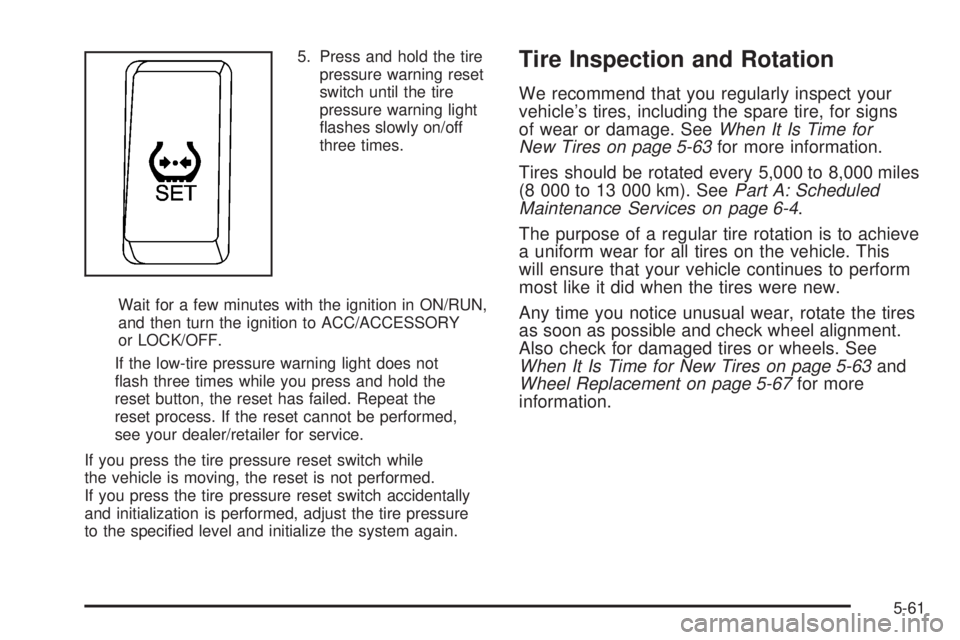
5. Press and hold the tire
pressure warning reset
switch until the tire
pressure warning light
ashes slowly on/off
three times.
Wait for a few minutes with the ignition in ON/RUN,
and then turn the ignition to ACC/ACCESSORY
or LOCK/OFF.
If the low-tire pressure warning light does not
ash three times while you press and hold the
reset button, the reset has failed. Repeat the
reset process. If the reset cannot be performed,
see your dealer/retailer for service.
If you press the tire pressure reset switch while
the vehicle is moving, the reset is not performed.
If you press the tire pressure reset switch accidentally
and initialization is performed, adjust the tire pressure
to the specied level and initialize the system again.Tire Inspection and Rotation
We recommend that you regularly inspect your
vehicle’s tires, including the spare tire, for signs
of wear or damage. SeeWhen It Is Time for
New Tires on page 5-63for more information.
Tires should be rotated every 5,000 to 8,000 miles
(8 000 to 13 000 km). SeePart A: Scheduled
Maintenance Services on page 6-4.
The purpose of a regular tire rotation is to achieve
a uniform wear for all tires on the vehicle. This
will ensure that your vehicle continues to perform
most like it did when the tires were new.
Any time you notice unusual wear, rotate the tires
as soon as possible and check wheel alignment.
Also check for damaged tires or wheels. See
When It Is Time for New Tires on page 5-63and
Wheel Replacement on page 5-67for more
information.
5-61
Page 276 of 368
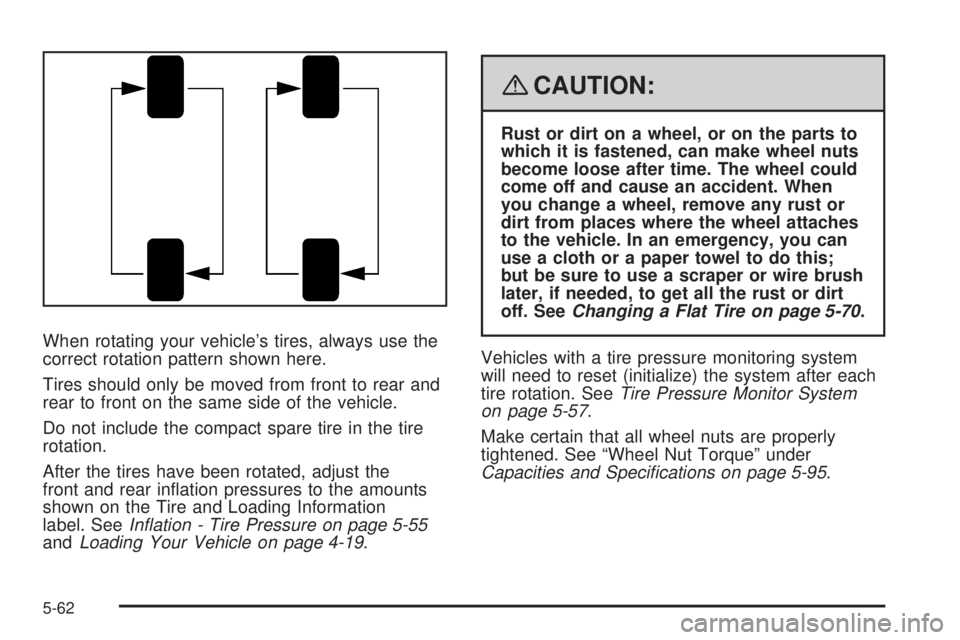
When rotating your vehicle’s tires, always use the
correct rotation pattern shown here.
Tires should only be moved from front to rear and
rear to front on the same side of the vehicle.
Do not include the compact spare tire in the tire
rotation.
After the tires have been rotated, adjust the
front and rear ination pressures to the amounts
shown on the Tire and Loading Information
label. SeeInflation - Tire Pressure on page 5-55
andLoading Your Vehicle on page 4-19.
{CAUTION:
Rust or dirt on a wheel, or on the parts to
which it is fastened, can make wheel nuts
become loose after time. The wheel could
come off and cause an accident. When
you change a wheel, remove any rust or
dirt from places where the wheel attaches
to the vehicle. In an emergency, you can
use a cloth or a paper towel to do this;
but be sure to use a scraper or wire brush
later, if needed, to get all the rust or dirt
off. SeeChanging a Flat Tire on page 5-70.
Vehicles with a tire pressure monitoring system
will need to reset (initialize) the system after each
tire rotation. SeeTire Pressure Monitor System
on page 5-57.
Make certain that all wheel nuts are properly
tightened. See “Wheel Nut Torque” under
Capacities and Specifications on page 5-95.
5-62