maintenance schedule PONTIAC VIBE 2009 User Guide
[x] Cancel search | Manufacturer: PONTIAC, Model Year: 2009, Model line: VIBE, Model: PONTIAC VIBE 2009Pages: 318, PDF Size: 1.53 MB
Page 225 of 318
Tire Inspection and
Rotation
We recommend that you
regularly inspect the vehicle’s
tires, including the spare tire, for
signs of wear or damage. See
When It Is Time for New Tires on
page 9-54for more information.
Tires should be rotated every
5,000 to 8,000 miles (8 000 to
13 000 km). SeePart A:
Scheduled Maintenance
Services on page 11-3.
The purpose of a regular tire
rotation is to achieve a uniform
wear for all tires on the vehicle.
This will ensure that the vehicle
continues to perform most like it
did when the tires were new.
Any time you notice unusual
wear, rotate the tires as soon
as possible and check wheel
alignment. Also check for
damaged tires or wheels.
SeeWhen It Is Time for NewTires on page 9-54andWheel
Replacement on page 9-59for
more information.
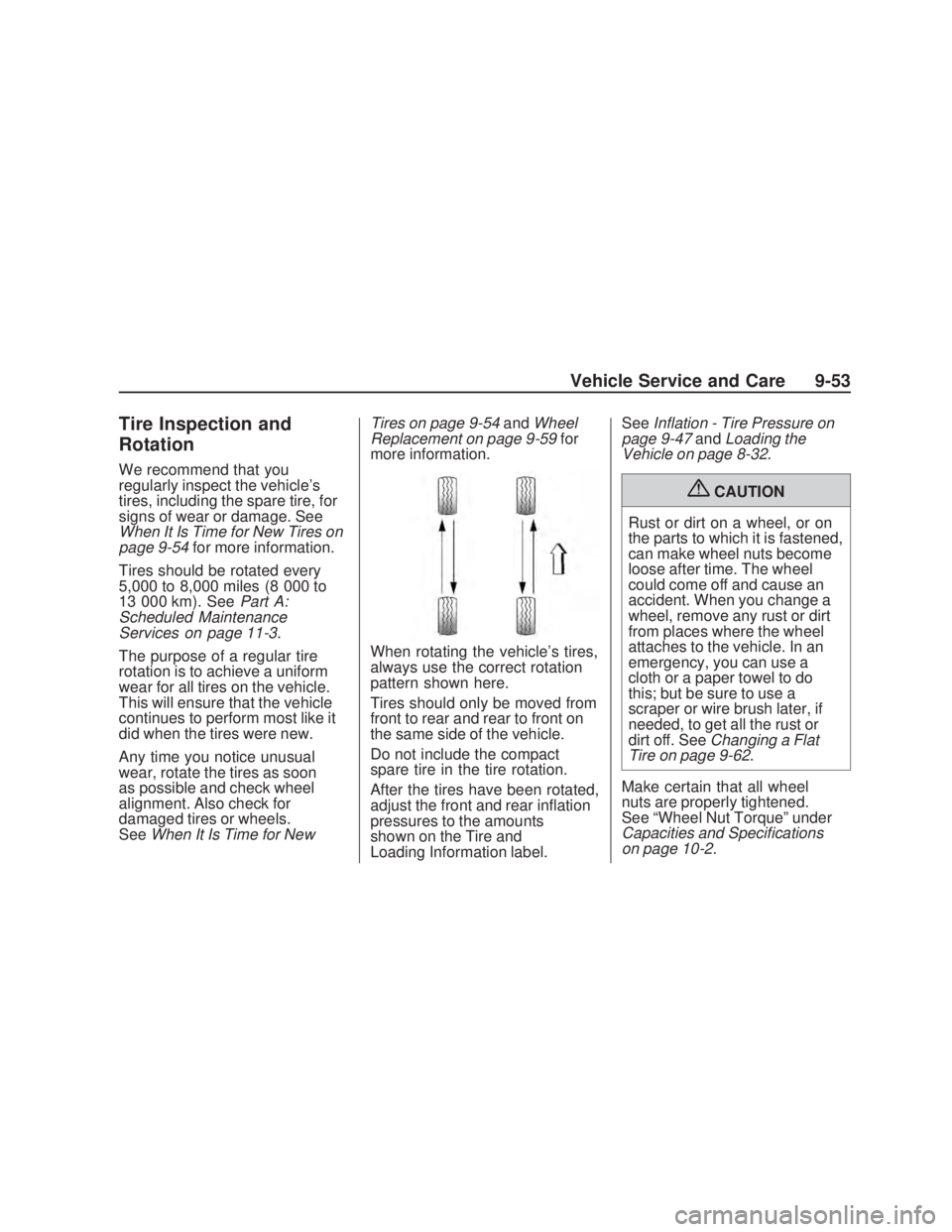
When rotating the vehicle’s tires,
always use the correct rotation
pattern shown here.
Tires should only be moved from
front to rear and rear to front on
the same side of the vehicle.
Do not include the compact
spare tire in the tire rotation.
After the tires have been rotated,
adjust the front and rear ination
pressures to the amounts
shown on the Tire and
Loading Information label.SeeInflation - Tire Pressure on
page 9-47andLoading the
Vehicle on page 8-32.
{CAUTION
Rust or dirt on a wheel, or on
the parts to which it is fastened,
can make wheel nuts become
loose after time. The wheel
could come off and cause an
accident. When you change a
wheel, remove any rust or dirt
from places where the wheel
attaches to the vehicle. In an
emergency, you can use a
cloth or a paper towel to do
this; but be sure to use a
scraper or wire brush later, if
needed, to get all the rust or
dirt off. SeeChanging a Flat
Tire on page 9-62.
Make certain that all wheel
nuts are properly tightened.
See “Wheel Nut Torque” under
Capacities and Specifications
on page 10-2.
Vehicle Service and Care 9-53
2009 - Pontiac Vibe Owner Manual
Page 254 of 318
Parking on Hills
{CAUTION
Parking the vehicle on a hill
with the trailer attached can be
dangerous. If something goes
wrong, the rig could start to move.
People can be injured, and both
the vehicle and the trailer can be
damaged. When possible, always
park the rig on a at surface.
To park your rig on a hill:
1. Apply your regular brakes, but
do not shift into P (Park) for an
automatic transmission or into
gear for a manual transmission,
yet. When parking uphill, turn
your wheels away from the curb.
When parking downhill, turn your
wheels into the curb.
2. Have someone place chocks
under the trailer wheels.3. When the chocks are in place,
release the regular brakes until
the chocks absorb the load.
4. Reapply the regular brakes.
Then apply your parking
brake and shift into P (Park)
for an automatic transmission
or R (Reverse) for a manual
transmission.
5. Release the regular brakes.
When You Are Ready to Leave
After Parking on a Hill
1. Apply your regular brakes and
hold the pedal down while you:
start your engine
shift the transmission
into gear
release the parking brake
2. Let up on the brake pedal.
3. Drive slowly until the trailer is
clear of the chocks.
4. Stop and have someone pick up
and store the chocks.
Maintenance When Trailer
Towing
Your vehicle will need service more
often when you are pulling a trailer.
See the Maintenance Schedule
for more on this. Things that are
especially important in trailer
operation are automatic transmission
uid (do not overll), engine oil, drive
belt, cooling system and brake
system. Each of these is covered in
this manual, and the Index will help
nd them quickly. If you are trailering,
it is a good idea to review this
information before starting your trip.
Check periodically to see that all
hitch nuts and bolts are tight.
Engine Cooling When Trailer
Towing
The cooling system could
temporarily overheat during severe
operating conditions. SeeEngine
Overheating on page 9-22.
9-82 Vehicle Service and Care
2009 - Pontiac Vibe Owner Manual
Page 269 of 318

Service and
Maintenance
Service and Maintenance
Introduction.......................11-1
Maintenance
Requirements..................11-2
Your Vehicle and the
Environment....................11-2
How This Section is
Organized.......................11-2
Part A: Scheduled
Maintenance Services......11-3
Using the Maintenance
Schedule.........................11-3
Scheduled Maintenance. . . .11-4
Part B: Owner Checks
and Services.................11-12
At Each Fuel Fill.............11-12
At Least Once a Month. . .11-13
At Least Twice a Year. . . .11-13
At Least Once a Year.....11-13
Part C: Periodic
Maintenance
Inspections
....................11-16
Steering, Suspension and
Front Drive Axle Boot
and Seal Inspection
.......11-16
Exhaust System
Inspection......................11-16
Fuel System Inspection. . .11-16
Engine Cooling System
Inspection......................11-17
Throttle System
Inspection......................11-17
Brake System
Inspection......................11-17
Part D: Recommended
Fluids and Lubricants. . . .11-18
Part E: Maintenance
Record..........................11-20
Service and
Maintenance
Introduction
Important: Keep engine oil at
the proper level and change as
recommended.
Have you purchased the GM
Protection Plan? The Plan
supplements the vehicle warranties.
See the Warranty and Owner
Assistance booklet or your
dealer/retailer for details.
Service and Maintenance 11-1
2009 - Pontiac Vibe Owner Manual
Page 270 of 318
Maintenance
Requirements
Maintenance intervals, checks,
inspections and recommended uids
and lubricants as prescribed in this
manual are necessary to keep this
vehicle in good working condition.
Any damage caused by failure to
follow scheduled maintenance
may not be covered by the vehicle
warranty.
Your Vehicle and the
Environment
Proper vehicle maintenance not only
helps to keep the vehicle in good
working condition, but also helps
the environment. Improper vehicle
maintenance can even affect the
quality of the air we breathe.
Improper uid levels or the wrong tire
ination can increase the level of
emissions from the vehicle. To help
protect the environment, and to keep
the vehicle in good condition, be sure
to maintain the vehicle properly.
How This Section is
Organized
This maintenance schedule is
divided into ve parts:
“Part A: Scheduled Maintenance
Services”explains what to have
done and how often. Some of
these services can be complex,
so unless you are technically
qualied and have the necessary
equipment, you should let your
dealer/retailer do these jobs.
Your dealer/retailer has trained
and supported service people
that will perform the work using
genuine parts.
{CAUTION
Performing maintenance work
on a vehicle can be dangerous.
In trying to do some jobs, you can
be seriously injured. Do your own
maintenance work only if you
have the required know-how and
the proper tools and equipment
for the job. If you have any doubt,
have a qualied technician do the
work. SeeDoing Your Own
Service Work on page 9-4.
To purchase service information,
seeService Publications Ordering
Information on page 12-16.
“Part B: Owner Checks and
Services”tells what should be
checked and when. It also explains
what can easily be done to help
keep the vehicle in good condition.
11-2 Service and Maintenance
2009 - Pontiac Vibe Owner Manual
Page 271 of 318
“Part C: Periodic Maintenance
Inspections”explains important
inspections that your dealer/retailer
can perform for you.
“Part D: Recommended Fluids
and Lubricants”lists some
recommended products necessary
to help keep the vehicle properly
maintained. These products, or
their equivalents, should be used
whether you do the work yourself
or have it done.
“Part E: Maintenance Record”is a
place to record and keep track of
the maintenance performed on
the vehicle. Keep the maintenance
receipts. They may be needed
to qualify the vehicle for warranty
repairs.Part A: Scheduled
Maintenance Services
In this part are scheduled
maintenance services which are
to be performed at the mileage
intervals specied.
Using the Maintenance
Schedule
We want to help keep this vehicle in
good working condition. But we do
not know exactly how you will drive it.
You might drive short distances only
a few times a week. Or you might
drive long distances all the time in
very hot, dusty weather. You might
use the vehicle in making deliveries.
Or you might drive it to work, to do
errands, or in many other ways.Because of the different ways
people use their vehicles,
maintenance needs vary. You might
need more frequent checks and
replacements. So please read the
following and note how you drive.
If you have questions on how to keep
the vehicle in good condition, see
your dealer/retailer.
This part tells you the maintenance
services that should be done
and when to schedule them.
When you go to your dealer/retailer
for service, trained and supported
service people will perform the work
using genuine parts.
Service and Maintenance 11-3
2009 - Pontiac Vibe Owner Manual
Page 272 of 318
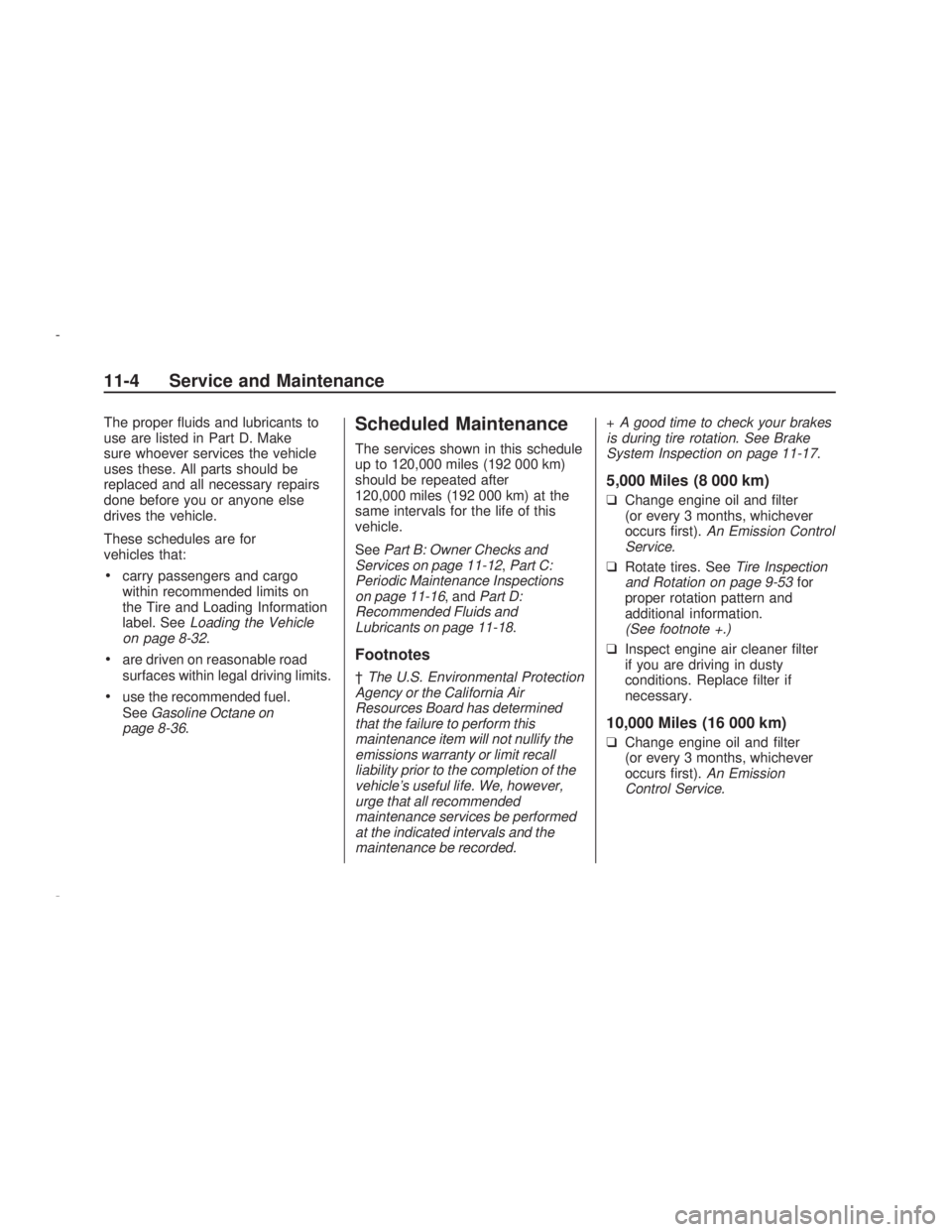
The proper uids and lubricants to
use are listed in Part D. Make
sure whoever services the vehicle
uses these. All parts should be
replaced and all necessary repairs
done before you or anyone else
drives the vehicle.
These schedules are for
vehicles that:
carry passengers and cargo
within recommended limits on
the Tire and Loading Information
label. SeeLoading the Vehicle
on page 8-32.
are driven on reasonable road
surfaces within legal driving limits.
use the recommended fuel.
SeeGasoline Octane on
page 8-36.
Scheduled Maintenance
The services shown in this schedule
up to 120,000 miles (192 000 km)
should be repeated after
120,000 miles (192 000 km) at the
same intervals for the life of this
vehicle.
SeePart B: Owner Checks and
Services on page 11-12,Part C:
Periodic Maintenance Inspections
on page 11-16, andPart D:
Recommended Fluids and
Lubricants on page 11-18.
Footnotes
†The U.S. Environmental Protection
Agency or the California Air
Resources Board has determined
that the failure to perform this
maintenance item will not nullify the
emissions warranty or limit recall
liability prior to the completion of the
vehicle’s useful life. We, however,
urge that all recommended
maintenance services be performed
at the indicated intervals and the
maintenance be recorded.+A good time to check your brakes
is during tire rotation. See Brake
System Inspection on page 11-17.
5,000 Miles (8 000 km)
❑Change engine oil and lter
(or every 3 months, whichever
occurs rst).An Emission Control
Service.
❑Rotate tires. SeeTire Inspection
and Rotation on page 9-53for
proper rotation pattern and
additional information.
(See footnote +.)
❑Inspect engine air cleaner lter
if you are driving in dusty
conditions. Replace lter if
necessary.
10,000 Miles (16 000 km)
❑Change engine oil and lter
(or every 3 months, whichever
occurs rst).An Emission
Control Service.
11-4 Service and Maintenance
2009 - Pontiac Vibe Owner Manual
Page 288 of 318

Part E: Maintenance Record
After the scheduled services are performed, record the date, odometer reading, and who performed the service and
any additional information from “Owner Checks and Services” or “Periodic Maintenance” on the following record
pages. Also, you should retain all maintenance receipts.
Maintenance Record
DateOdometer
Reading Serviced By
Maintenance Record
11-20 Service and Maintenance
2009 - Pontiac Vibe Owner Manual
Page 293 of 318
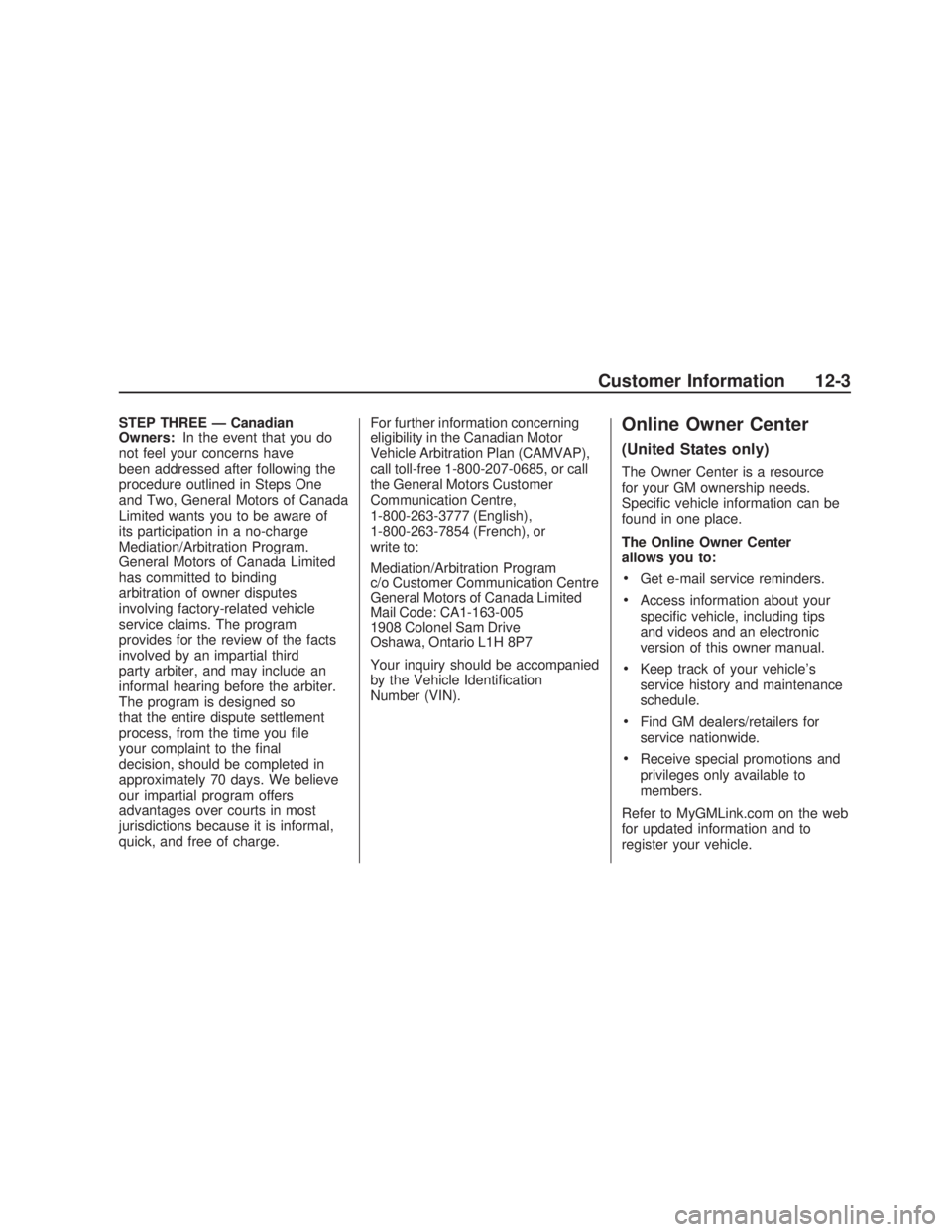
STEP THREE — Canadian
Owners:In the event that you do
not feel your concerns have
been addressed after following the
procedure outlined in Steps One
and Two, General Motors of Canada
Limited wants you to be aware of
its participation in a no-charge
Mediation/Arbitration Program.
General Motors of Canada Limited
has committed to binding
arbitration of owner disputes
involving factory-related vehicle
service claims. The program
provides for the review of the facts
involved by an impartial third
party arbiter, and may include an
informal hearing before the arbiter.
The program is designed so
that the entire dispute settlement
process, from the time you le
your complaint to the nal
decision, should be completed in
approximately 70 days. We believe
our impartial program offers
advantages over courts in most
jurisdictions because it is informal,
quick, and free of charge.For further information concerning
eligibility in the Canadian Motor
Vehicle Arbitration Plan (CAMVAP),
call toll-free 1-800-207-0685, or call
the General Motors Customer
Communication Centre,
1-800-263-3777 (English),
1-800-263-7854 (French), or
write to:
Mediation/Arbitration Program
c/o Customer Communication Centre
General Motors of Canada Limited
Mail Code: CA1-163-005
1908 Colonel Sam Drive
Oshawa, Ontario L1H 8P7
Your inquiry should be accompanied
by the Vehicle Identication
Number (VIN).Online Owner Center
(United States only)
The Owner Center is a resource
for your GM ownership needs.
Specic vehicle information can be
found in one place.
The Online Owner Center
allows you to:
Get e-mail service reminders.
Access information about your
specic vehicle, including tips
and videos and an electronic
version of this owner manual.
Keep track of your vehicle’s
service history and maintenance
schedule.
Find GM dealers/retailers for
service nationwide.
Receive special promotions and
privileges only available to
members.
Refer to MyGMLink.com on the web
for updated information and to
register your vehicle.
Customer Information 12-3
2009 - Pontiac Vibe Owner Manual
Page 306 of 318
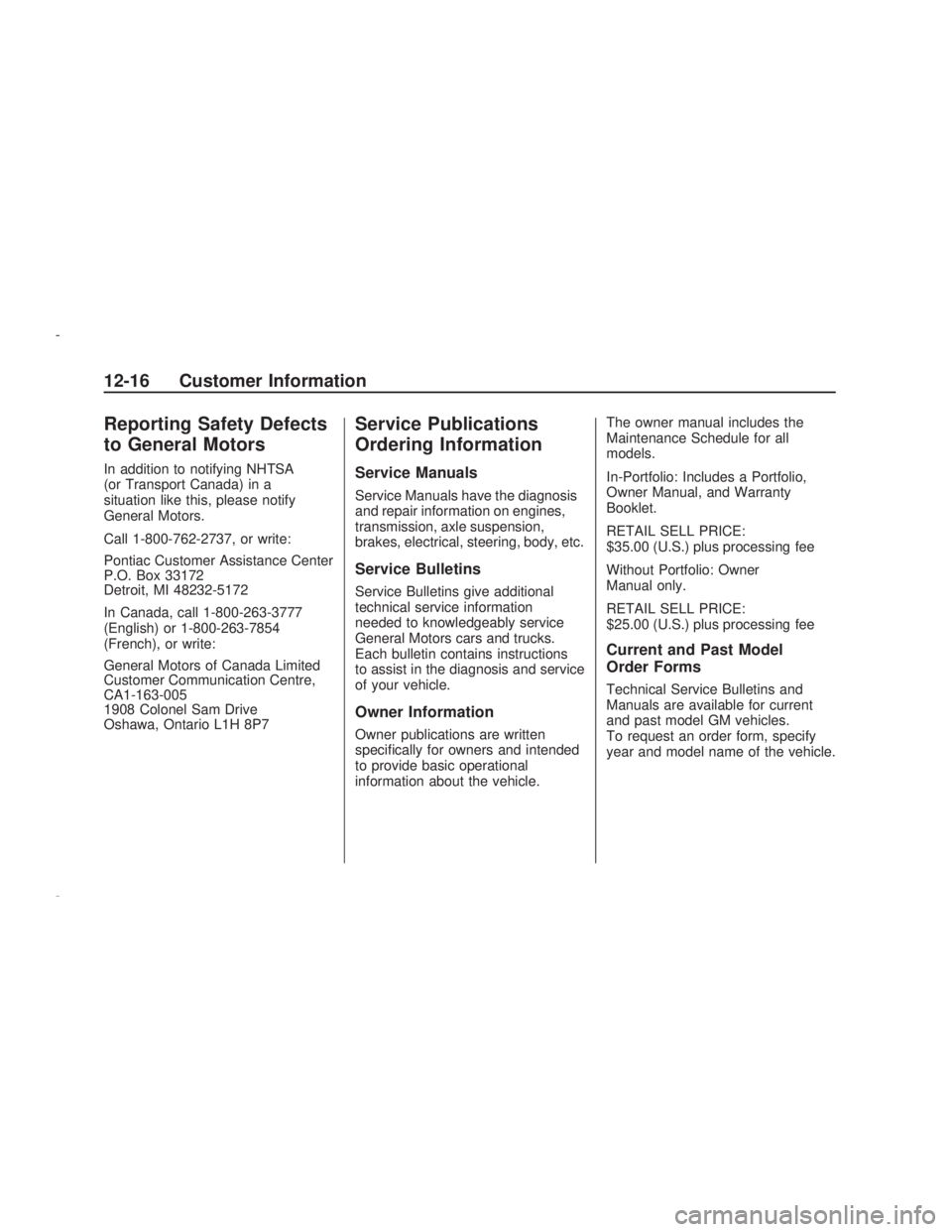
Reporting Safety Defects
to General Motors
In addition to notifying NHTSA
(or Transport Canada) in a
situation like this, please notify
General Motors.
Call 1-800-762-2737, or write:
Pontiac Customer Assistance Center
P.O. Box 33172
Detroit, MI 48232-5172
In Canada, call 1-800-263-3777
(English) or 1-800-263-7854
(French), or write:
General Motors of Canada Limited
Customer Communication Centre,
CA1-163-005
1908 Colonel Sam Drive
Oshawa, Ontario L1H 8P7
Service Publications
Ordering Information
Service Manuals
Service Manuals have the diagnosis
and repair information on engines,
transmission, axle suspension,
brakes, electrical, steering, body, etc.
Service Bulletins
Service Bulletins give additional
technical service information
needed to knowledgeably service
General Motors cars and trucks.
Each bulletin contains instructions
to assist in the diagnosis and service
of your vehicle.
Owner Information
Owner publications are written
specically for owners and intended
to provide basic operational
information about the vehicle.The owner manual includes the
Maintenance Schedule for all
models.
In-Portfolio: Includes a Portfolio,
Owner Manual, and Warranty
Booklet.
RETAIL SELL PRICE:
$35.00 (U.S.) plus processing fee
Without Portfolio: Owner
Manual only.
RETAIL SELL PRICE:
$25.00 (U.S.) plus processing fee
Current and Past Model
Order Forms
Technical Service Bulletins and
Manuals are available for current
and past model GM vehicles.
To request an order form, specify
year and model name of the vehicle.
12-16 Customer Information
2009 - Pontiac Vibe Owner Manual
Page 314 of 318

Lights
Exterior Lamps................... 5-1
Flash-to-Pass..................... 4-7
High/Low Beam Changer..... 4-7
Loading Your Vehicle............8-32
Locks
Door ................................. 2-6
Power Door ....................... 2-7
Rear Door Security Locks.... 2-7
Loss of Control....................8-25
Low Fuel Warning Light........4-25
Low Washer Fluid Warning
Light...............................4-23
Lower Anchors and Tethers
for Children......................1-44
Luggage Carrier.................... 3-2
M
Maintenance Schedule
At Each Fuel Fill.............11-12
At Least Once a Month . . . 11-13
At Least Once a Year......11-13
At Least Twice a Year.....11-13
Brake System
Inspection...................11-17
Engine Cooling System
Inspection...................11-17Maintenance Schedule (cont.)
Exhaust System
Inspection...................11-16
Fuel System Inspection....11-16
How This Section is
Organized....................11-2
Introduction......................11-1
Maintenance Replacement
Parts...........................10-4
Maintenance
Requirements...............11-2
Part A - Scheduled
Maintenance Services....11-3
PartB-Owner Checks
and Services...............11-12
Part C - Periodic
Maintenance
Inspections.................11-16
PartD-Recommended
Fluids and Lubricants . . . 11-18
PartE-Maintenance
Record.......................11-20
Scheduled Maintenance.....11-4
Steering, Suspension and
Front Drive Axle Boot
and Seal Inspection.....11-16Maintenance Schedule (cont.)
Throttle System
Inspection...................11-17
Using..............................11-3
Your Vehicle and the
Environment.................11-2
Malfunction Indicator Lamp....4-20
Manual Seats........................ 1-2
Manual Transmission
Fluid...............................9-16
Operation........................8-11
Mirrors
Manual Rearview Mirror.....2-13
Outside Power Mirrors.......2-14
MP3 .................................... 6-9
MyGMLink.com....................12-3
N
Navigation System,
Privacy..........................12-18
New Vehicle Break-In............. 8-2
Notices and Cautions............... iii
Notication
Service Airbag Message....4-16
i-6 INDEX
2009 - Pontiac Vibe Owner Manual