fuel PONTIAC VIBE 2009 Owner's Manual
[x] Cancel search | Manufacturer: PONTIAC, Model Year: 2009, Model line: VIBE, Model: PONTIAC VIBE 2009Pages: 318, PDF Size: 1.53 MB
Page 176 of 318
Doing Your Own
Service Work
{CAUTION
You can be injured and the
vehicle could be damaged if you
try to do service work on a vehicle
without knowing enough about it.
Be sure you have sufficient
knowledge, experience, the
proper replacement parts, and
tools before attempting any
vehicle maintenance task.
Be sure to use the proper
nuts, bolts, and other
fasteners. English and
metric fasteners can be
easily confused. If the wrong
fasteners are used, parts
can later break or fall off.
You could be hurt.If doing some of your own service
work, use the proper service manual.
It tells you much more about how to
service the vehicle than this manual
can. To order the proper service
manual, seeService Publications
Ordering Information on page 12-16.
This vehicle has an airbag system.
Before attempting to do your
own service work, seeServicing
Your Airbag-Equipped Vehicle
on page 1-33.
Keep a record with all parts receipts
and list the mileage and the date
of any service work performed.
SeePart E: Maintenance Record
on page 11-20.
Adding Equipment to the
Outside of the Vehicle
Things added to the outside of
the vehicle can affect the airow
around it. This can cause wind noise
and can affect fuel economy and
windshield washer performance.
Check with your dealer/retailer
before adding equipment to
the outside of the vehicle.
9-4 Vehicle Service and Care
2009 - Pontiac Vibe Owner Manual
Page 177 of 318
Owner Checks
{CAUTION
An electric fan under the hood
can start up and injure you even
when the engine is not running.
Keep hands, clothing, and tools
away from any underhood
electric fan.
{CAUTION
Things that burn can get on hot
engine parts and start a re. These
include liquids like fuel, oil, coolant,
brake uid, windshield washer and
other uids, and plastic or rubber.
You or others could be burned.
Be careful not to drop or spill
things that will burn onto a hot
engine.
Hood Release
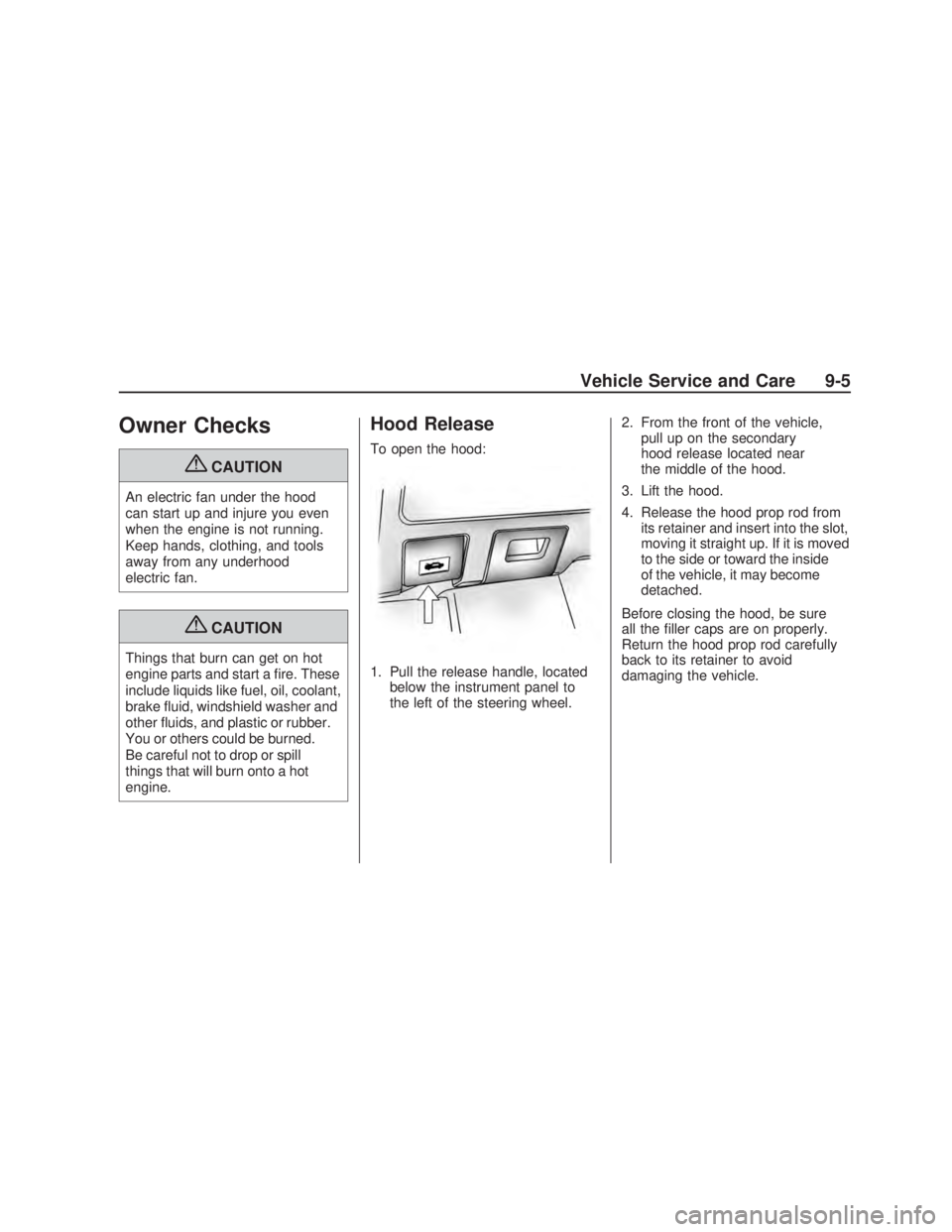
To open the hood:
1. Pull the release handle, located
below the instrument panel to
the left of the steering wheel.2. From the front of the vehicle,
pull up on the secondary
hood release located near
the middle of the hood.
3. Lift the hood.
4. Release the hood prop rod from
its retainer and insert into the slot,
moving it straight up. If it is moved
to the side or toward the inside
of the vehicle, it may become
detached.
Before closing the hood, be sure
all the ller caps are on properly.
Return the hood prop rod carefully
back to its retainer to avoid
damaging the vehicle.
Vehicle Service and Care 9-5
2009 - Pontiac Vibe Owner Manual
Page 181 of 318
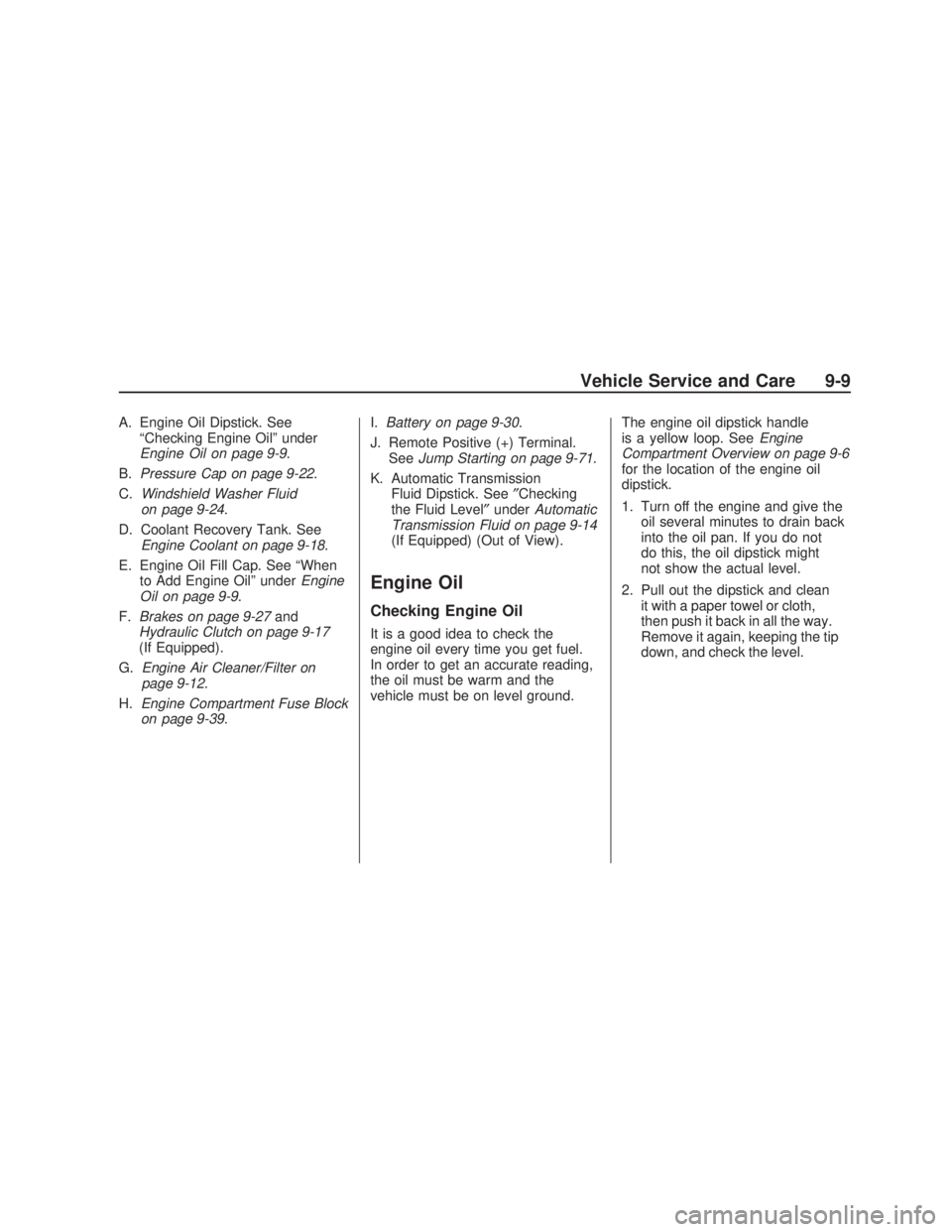
A. Engine Oil Dipstick. See
“Checking Engine Oil” under
Engine Oil on page 9-9.
B.Pressure Cap on page 9-22.
C.Windshield Washer Fluid
on page 9-24.
D. Coolant Recovery Tank. See
Engine Coolant on page 9-18.
E. Engine Oil Fill Cap. See “When
to Add Engine Oil” underEngine
Oil on page 9-9.
F.Brakes on page 9-27and
Hydraulic Clutch on page 9-17
(If Equipped).
G.Engine Air Cleaner/Filter on
page 9-12.
H.Engine Compartment Fuse Block
on page 9-39.I.Battery on page 9-30.
J. Remote Positive (+) Terminal.
SeeJump Starting on page 9-71.
K. Automatic Transmission
Fluid Dipstick. See″Checking
the Fluid Level″underAutomatic
Transmission Fluid on page 9-14
(If Equipped) (Out of View).
Engine Oil
Checking Engine Oil
It is a good idea to check the
engine oil every time you get fuel.
In order to get an accurate reading,
the oil must be warm and the
vehicle must be on level ground.The engine oil dipstick handle
is a yellow loop. SeeEngine
Compartment Overview on page 9-6
for the location of the engine oil
dipstick.
1. Turn off the engine and give the
oil several minutes to drain back
into the oil pan. If you do not
do this, the oil dipstick might
not show the actual level.
2. Pull out the dipstick and clean
it with a paper towel or cloth,
then push it back in all the way.
Remove it again, keeping the tip
down, and check the level.
Vehicle Service and Care 9-9
2009 - Pontiac Vibe Owner Manual
Page 209 of 318
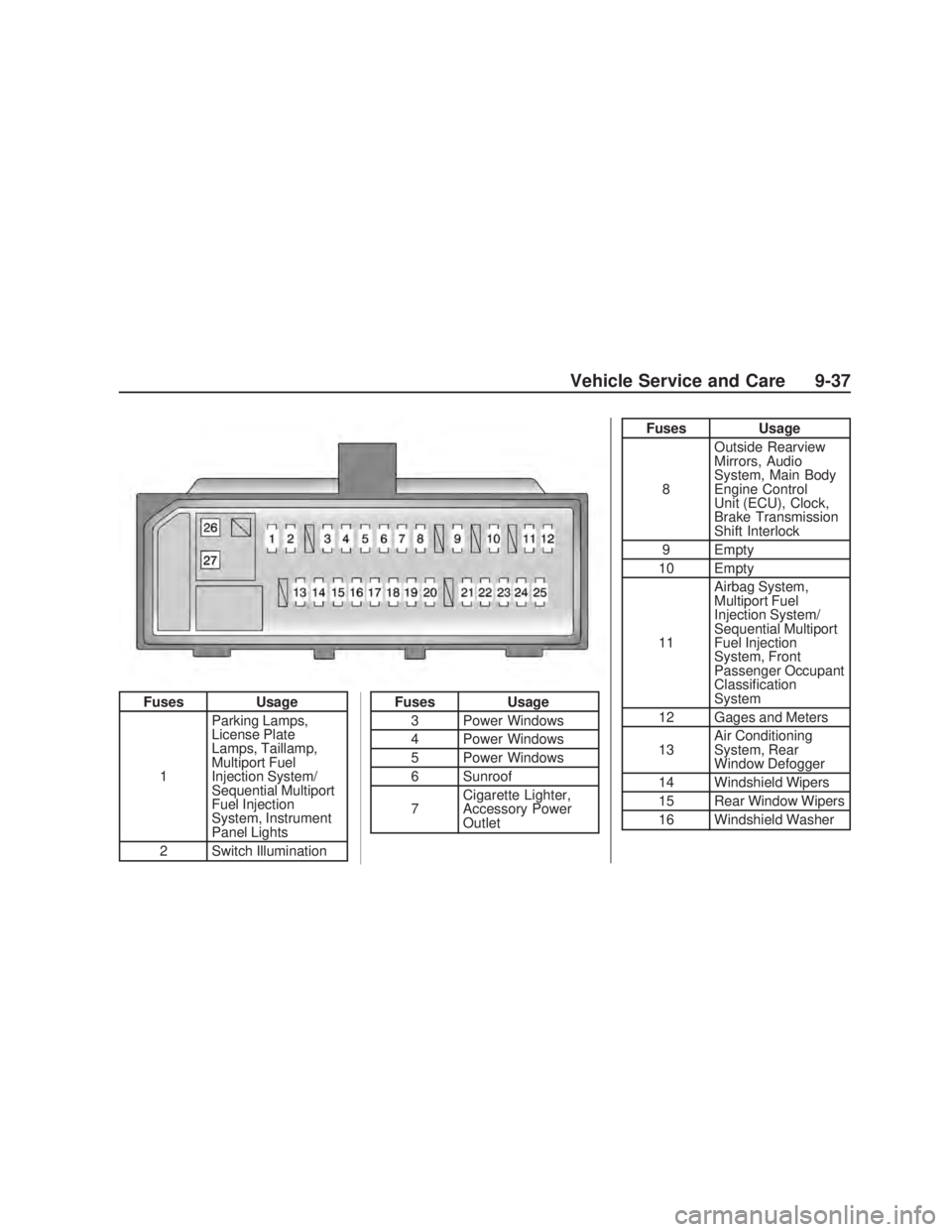
FusesUsage
1 Parking Lamps,
License Plate
Lamps, Taillamp,
Multiport Fuel
Injection System/
Sequential Multiport
Fuel Injection
System, Instrument
Panel Lights
2 Switch IlluminationFuses Usage
3 Power Windows
4 Power Windows
5 Power Windows
6 Sunroof
7 Cigarette Lighter,
Accessory Power
Outlet
Fuses
Usage
8 Outside Rearview
Mirrors, Audio
System, Main Body
Engine Control
Unit (ECU), Clock,
Brake Transmission
Shift Interlock
9 Empty
10 Empty
11 Airbag System,
Multiport Fuel
Injection System/
Sequential Multiport
Fuel Injection
System, Front
Passenger Occupant
Classication
System
12 Gages and Meters
13 Air Conditioning
System, Rear
Window Defogger
14 Windshield Wipers
15 Rear Window Wipers
16 Windshield Washer
Vehicle Service and Care 9-37
2009 - Pontiac Vibe Owner Manual
Page 210 of 318
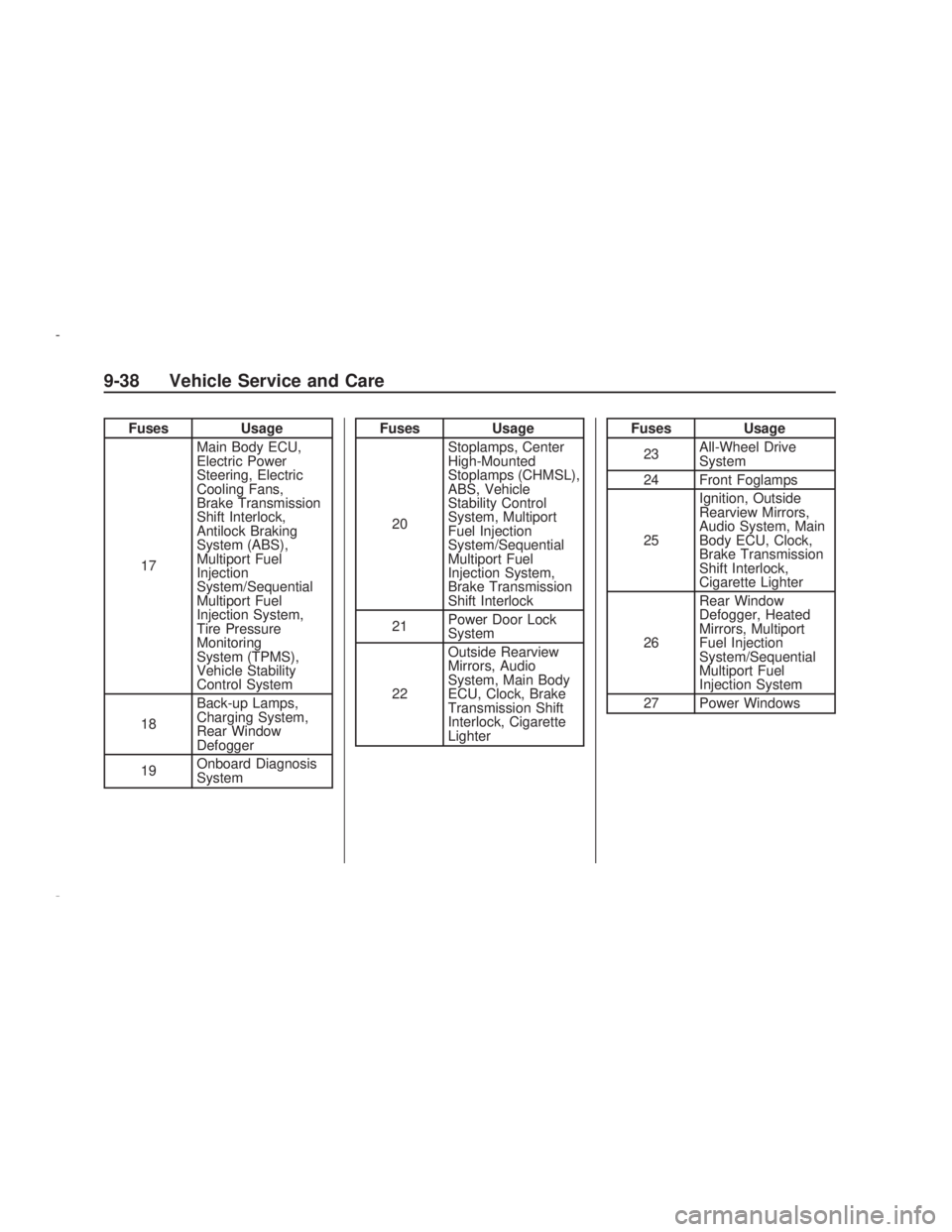
Fuses Usage
17Main Body ECU,
Electric Power
Steering, Electric
Cooling Fans,
Brake Transmission
Shift Interlock,
Antilock Braking
System (ABS),
Multiport Fuel
Injection
System/Sequential
Multiport Fuel
Injection System,
Tire Pressure
Monitoring
System (TPMS),
Vehicle Stability
Control System
18Back-up Lamps,
Charging System,
Rear Window
Defogger
19Onboard Diagnosis
SystemFuses Usage
20Stoplamps, Center
High-Mounted
Stoplamps (CHMSL),
ABS, Vehicle
Stability Control
System, Multiport
Fuel Injection
System/Sequential
Multiport Fuel
Injection System,
Brake Transmission
Shift Interlock
21Power Door Lock
System
22Outside Rearview
Mirrors, Audio
System, Main Body
ECU, Clock, Brake
Transmission Shift
Interlock, Cigarette
LighterFuses Usage
23All-Wheel Drive
System
24 Front Foglamps
25Ignition, Outside
Rearview Mirrors,
Audio System, Main
Body ECU, Clock,
Brake Transmission
Shift Interlock,
Cigarette Lighter
26Rear Window
Defogger, Heated
Mirrors, Multiport
Fuel Injection
System/Sequential
Multiport Fuel
Injection System
27 Power Windows
9-38 Vehicle Service and Care
2009 - Pontiac Vibe Owner Manual
Page 212 of 318
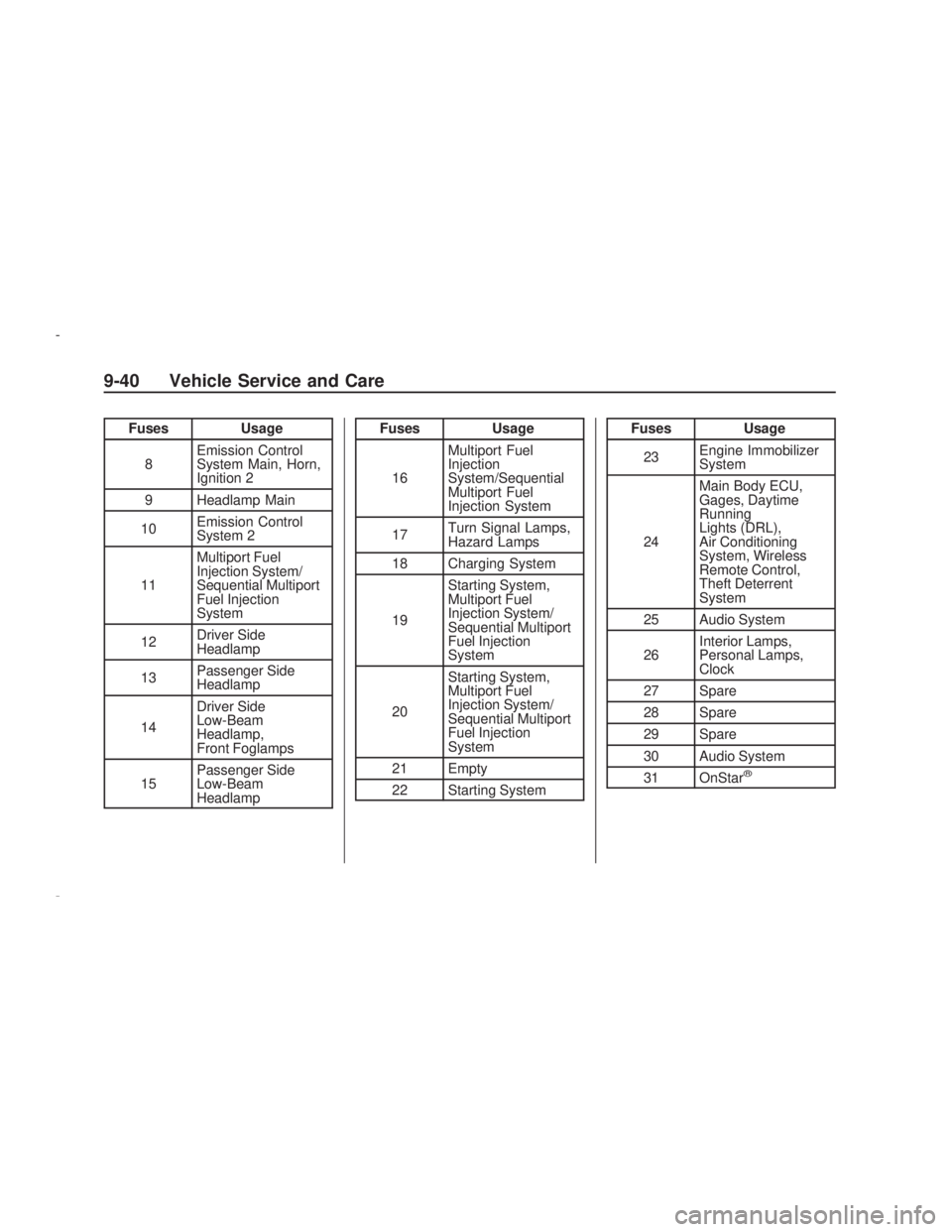
Fuses Usage
8Emission Control
System Main, Horn,
Ignition 2
9 Headlamp Main
10Emission Control
System 2
11Multiport Fuel
Injection System/
Sequential Multiport
Fuel Injection
System
12Driver Side
Headlamp
13Passenger Side
Headlamp
14Driver Side
Low-Beam
Headlamp,
Front Foglamps
15Passenger Side
Low-Beam
HeadlampFuses Usage
16Multiport Fuel
Injection
System/Sequential
Multiport Fuel
Injection System
17Turn Signal Lamps,
Hazard Lamps
18 Charging System
19Starting System,
Multiport Fuel
Injection System/
Sequential Multiport
Fuel Injection
System
20Starting System,
Multiport Fuel
Injection System/
Sequential Multiport
Fuel Injection
System
21 Empty
22 Starting SystemFuses Usage
23Engine Immobilizer
System
24Main Body ECU,
Gages, Daytime
Running
Lights (DRL),
Air Conditioning
System, Wireless
Remote Control,
Theft Deterrent
System
25 Audio System
26Interior Lamps,
Personal Lamps,
Clock
27 Spare
28 Spare
29 Spare
30 Audio System
31 OnStar
®
9-40 Vehicle Service and Care
2009 - Pontiac Vibe Owner Manual
Page 213 of 318
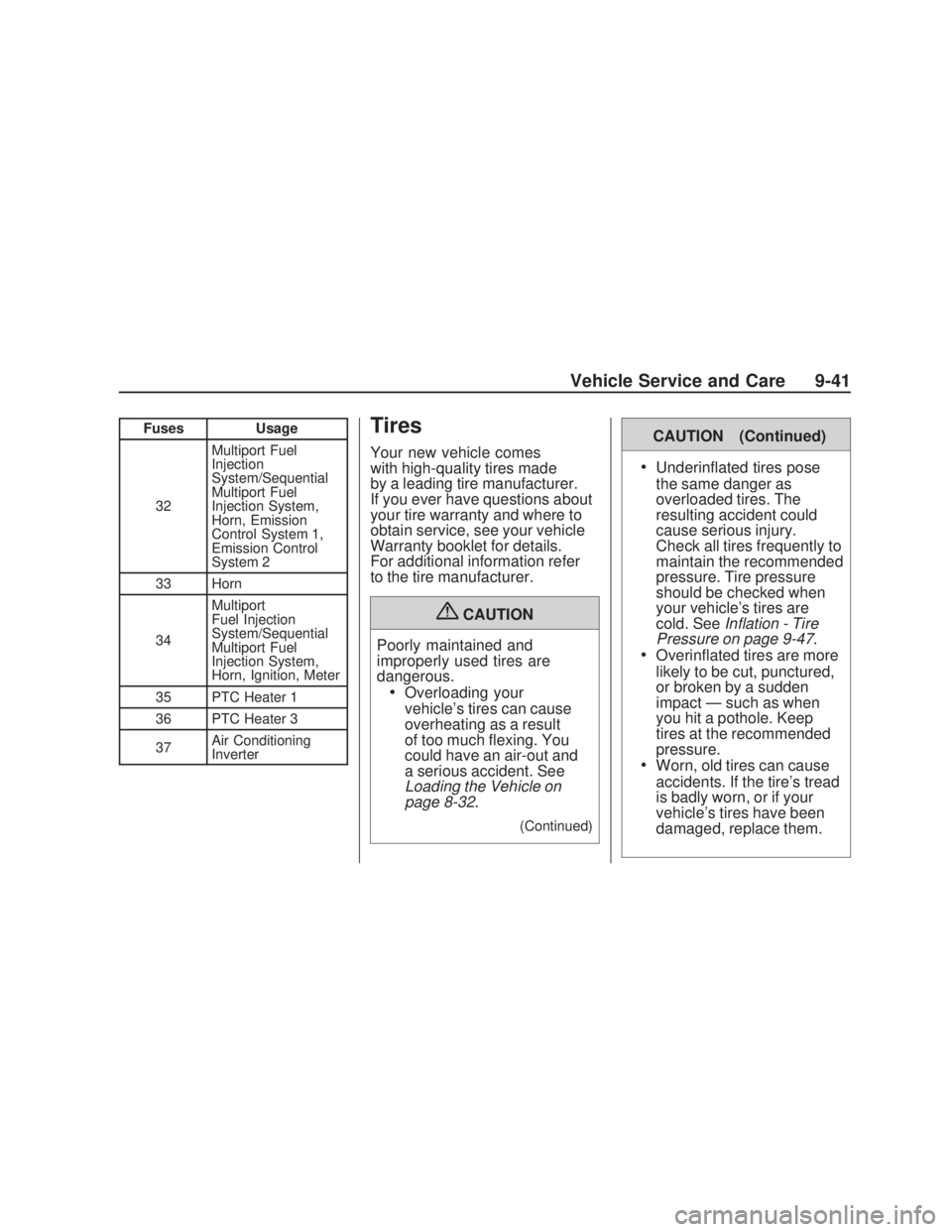
Fuses Usage
32Multiport Fuel
Injection
System/Sequential
Multiport Fuel
Injection System,
Horn, Emission
Control System 1,
Emission Control
System 2
33 Horn
34Multiport
Fuel Injection
System/Sequential
Multiport Fuel
Injection System,
Horn, Ignition, Meter
35 PTC Heater 1
36 PTC Heater 3
37Air Conditioning
InverterTires
Your new vehicle comes
with high-quality tires made
by a leading tire manufacturer.
If you ever have questions about
your tire warranty and where to
obtain service, see your vehicle
Warranty booklet for details.
For additional information refer
to the tire manufacturer.
{CAUTION
Poorly maintained and
improperly used tires are
dangerous.
Overloading your
vehicle’s tires can cause
overheating as a result
of too much exing. You
could have an air-out and
a serious accident. See
Loading the Vehicle on
page 8-32.
(Continued)
CAUTION (Continued)
Underinated tires pose
the same danger as
overloaded tires. The
resulting accident could
cause serious injury.
Check all tires frequently to
maintain the recommended
pressure. Tire pressure
should be checked when
your vehicle’s tires are
cold. SeeInflation - Tire
Pressure on page 9-47.
Overinated tires are more
likely to be cut, punctured,
or broken by a sudden
impact — such as when
you hit a pothole. Keep
tires at the recommended
pressure.
Worn, old tires can cause
accidents. If the tire’s tread
is badly worn, or if your
vehicle’s tires have been
damaged, replace them.
Vehicle Service and Care 9-41
2009 - Pontiac Vibe Owner Manual
Page 217 of 318
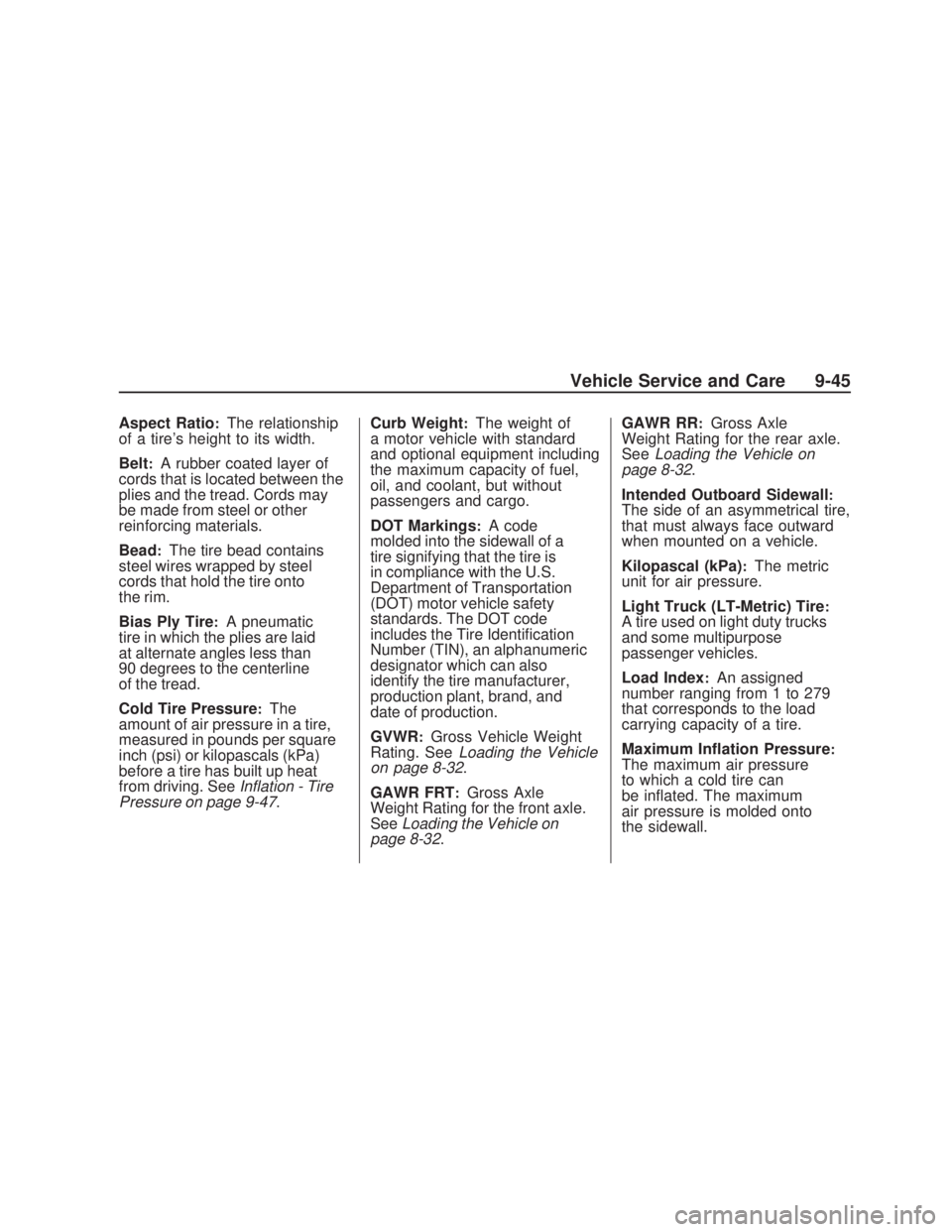
Aspect Ratio:The relationship
of a tire’s height to its width.
Belt
:A rubber coated layer of
cords that is located between the
plies and the tread. Cords may
be made from steel or other
reinforcing materials.
Bead
:The tire bead contains
steel wires wrapped by steel
cords that hold the tire onto
the rim.
Bias Ply Tire
:A pneumatic
tire in which the plies are laid
at alternate angles less than
90 degrees to the centerline
of the tread.
Cold Tire Pressure
:The
amount of air pressure in a tire,
measured in pounds per square
inch (psi) or kilopascals (kPa)
before a tire has built up heat
from driving. SeeInflation - Tire
Pressure on page 9-47.Curb Weight
:The weight of
a motor vehicle with standard
and optional equipment including
the maximum capacity of fuel,
oil, and coolant, but without
passengers and cargo.
DOT Markings
:A code
molded into the sidewall of a
tire signifying that the tire is
in compliance with the U.S.
Department of Transportation
(DOT) motor vehicle safety
standards. The DOT code
includes the Tire Identication
Number (TIN), an alphanumeric
designator which can also
identify the tire manufacturer,
production plant, brand, and
date of production.
GVWR
:Gross Vehicle Weight
Rating. SeeLoading the Vehicle
on page 8-32.
GAWR FRT
:Gross Axle
Weight Rating for the front axle.
SeeLoading the Vehicle on
page 8-32.GAWR RR
:Gross Axle
Weight Rating for the rear axle.
SeeLoading the Vehicle on
page 8-32.
Intended Outboard Sidewall
:The side of an asymmetrical tire,
that must always face outward
when mounted on a vehicle.
Kilopascal (kPa)
:The metric
unit for air pressure.
Light Truck (LT-Metric) Tire
:A tire used on light duty trucks
and some multipurpose
passenger vehicles.
Load Index
:An assigned
number ranging from 1 to 279
that corresponds to the load
carrying capacity of a tire.
Maximum Ination Pressure
:The maximum air pressure
to which a cold tire can
be inated. The maximum
air pressure is molded onto
the sidewall.
Vehicle Service and Care 9-45
2009 - Pontiac Vibe Owner Manual
Page 219 of 318
Vehicle Capacity Weight:The number of designated
seating positions multiplied
by 150 lbs (68 kg) plus the rated
cargo load. SeeLoading the
Vehicle on page 8-32.
Vehicle Maximum Load on the
Tire
:Load on an individual tire
due to curb weight, accessory
weight, occupant weight, and
cargo weight.
Vehicle Placard
:A label
permanently attached to
a vehicle showing the vehicle’s
capacity weight and the
original equipment tire size
and recommended ination
pressure. See “Tire and
Loading Information Label”
underLoading the Vehicle
on page 8-32.
Ination - Tire Pressure
Tires need the correct amount
of air pressure to operate
effectively.
Notice:Do not let anyone tell
you that under-ination or
over-ination is all right. It is
not. If your tires do not have
enough air (under-ination),
you can get the following:
Too much exing
Too much heat
Tire overloading
Premature or irregular wear
Poor handling
Reduced fuel economy
If your tires have too much air
(over-ination), you can get
the following:
Unusual wear
Poor handling
Rough ride
Needless damage from road
hazardsA vehicle specic Tire and
Loading Information label is
attached to your vehicle. This
label shows your vehicle’s
original equipment tires and the
correct ination pressures for
your tires when they are cold.
The recommended cold tire
ination pressure, shown on the
label, is the minimum amount of
air pressure needed to support
your vehicle’s maximum load
carrying capacity.
For additional information
regarding how much weight
your vehicle can carry, and an
example of the Tire and Loading
Information label, seeLoading
the Vehicle on page 8-32.
How you load your vehicle
affects vehicle handling and
ride comfort. Never load your
vehicle with more weight than
it was designed to carry.
Vehicle Service and Care 9-47
2009 - Pontiac Vibe Owner Manual
Page 221 of 318

As an added safety feature, your
vehicle has been equipped with
a tire pressure monitoring system
(TPMS) that illuminates a low
tire pressure telltale when one or
more of your tires is signicantly
under-inated.
Accordingly, when the low tire
pressure telltale illuminates, you
should stop and check your tires as
soon as possible, and inate them
to the proper pressure. Driving on
a signicantly under-inated tire
causes the tire to overheat and can
lead to tire failure. Under-ination
also reduces fuel efficiency and
tire tread life, and may affect the
vehicle’s handling and stopping
ability.
Please note that the TPMS is
not a substitute for proper tire
maintenance, and it is the driver’s
responsibility to maintain correct
tire pressure, even if under-ination
has not reached the level to trigger
illumination of the TPMS low tire
pressure telltale.Your vehicle has also been
equipped with a TPMS malfunction
indicator to indicate when the system
is not operating properly. The TPMS
malfunction indicator is combined
with the low tire pressure telltale.
When the system detects a
malfunction, the telltale will ash
for approximately one minute and
then remain continuously illuminated.
This sequence will continue upon
subsequent vehicle start-ups as
long as the malfunction exists.
When the malfunction indicator is
illuminated, the system may not be
able to detect or signal low tire
pressure as intended. TPMS
malfunctions may occur for a variety
of reasons, including the installation
of replacement or alternate tires or
wheels on the vehicle that prevent
the TPMS from functioning properly.
Always check the TPMS malfunction
telltale after replacing one or more
tires or wheels on your vehicle to
ensure that the replacement oralternate tires and wheels allow the
TPMS to continue to function
properly.
SeeTire Pressure Monitor
Operation on page 9-50for
additional information.
Federal Communications
Commission (FCC) and
Industry and Science Canada
The Tire Pressure Monitor
System (TPMS) operates on
a radio frequency and complies
with Part 15 of the FCC Rules.
Operation is subject to the
following two conditions:
1. This device may not cause
harmful interference.
2. This device must accept any
interference received, including
interference that may cause
undesired operation.
Vehicle Service and Care 9-49
2009 - Pontiac Vibe Owner Manual