steering wheel PONTIAC VIBE 2009 Owner's Manual
[x] Cancel search | Manufacturer: PONTIAC, Model Year: 2009, Model line: VIBE, Model: PONTIAC VIBE 2009Pages: 318, PDF Size: 1.53 MB
Page 163 of 318

To save fuel, run the engine for only
short periods as needed to warm the
vehicle and then shut the engine off
and close the window most of the
way to save heat. Repeat this until
help arrives but only when you feel
really uncomfortable from the cold.
Moving about to keep warm also
helps.
If it takes some time for help to
arrive, now and then when you run
the engine, push the accelerator
pedal slightly so the engine runs
faster than the idle speed. This
keeps the battery charged to restart
the vehicle and to signal for help with
the headlamps. Do this as little as
possible to save fuel.If Your Vehicle is Stuck
in Sand, Mud, Ice,
or Snow
Slowly and cautiously spin the
wheels to free the vehicle when
stuck in sand, mud, ice, or snow.
SeeRocking Your Vehicle to Get It
Out on page 8-31.
{CAUTION
If you let your vehicle’s tires spin
at high speed, they can explode,
and you or others could be
injured. The vehicle can overheat,
causing an engine compartment
re or other damage. Spin the
wheels as little as possible and
avoid going above 35 mph
(55 km/h) as shown on the
speedometer.
For information about using tire
chains on the vehicle, seeTire
Chains on page 9-60.
Rocking Your Vehicle to
Get It Out
Turn the steering wheel left and right
to clear the area around the front
wheels. Turn off any traction or
stability system. Shift back and forth
between R (Reverse) and a forward
gear, or with a manual transmission,
between 1 (First) or 2 (Second) and
R (Reverse), spinning the wheels
as little as possible. To prevent
transmission wear, wait until the
wheels stop spinning before shifting
gears. Release the accelerator pedal
while shifting, and press lightly on
the accelerator pedal when the
transmission is in gear. Slowly
spinning the wheels in the forward
and reverse directions causes a
rocking motion that could free the
vehicle. If that does not get the
vehicle out after a few tries, it might
need to be towed out. If the vehicle
does need to be towed out, see
Towing Your Vehicle on page 9-75.
Driving and Operating 8-31
2009 - Pontiac Vibe Owner Manual
Page 177 of 318
Owner Checks
{CAUTION
An electric fan under the hood
can start up and injure you even
when the engine is not running.
Keep hands, clothing, and tools
away from any underhood
electric fan.
{CAUTION
Things that burn can get on hot
engine parts and start a re. These
include liquids like fuel, oil, coolant,
brake uid, windshield washer and
other uids, and plastic or rubber.
You or others could be burned.
Be careful not to drop or spill
things that will burn onto a hot
engine.
Hood Release
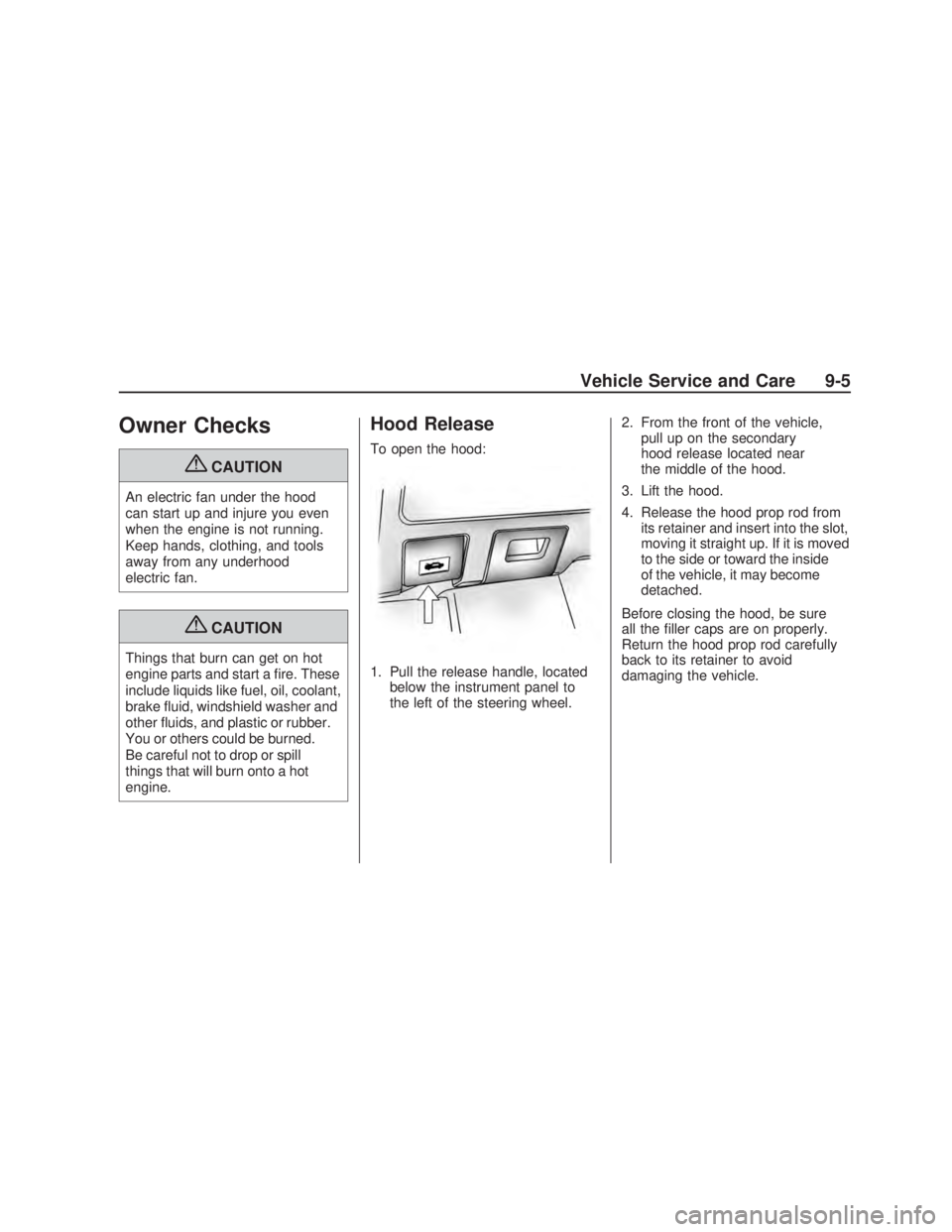
To open the hood:
1. Pull the release handle, located
below the instrument panel to
the left of the steering wheel.2. From the front of the vehicle,
pull up on the secondary
hood release located near
the middle of the hood.
3. Lift the hood.
4. Release the hood prop rod from
its retainer and insert into the slot,
moving it straight up. If it is moved
to the side or toward the inside
of the vehicle, it may become
detached.
Before closing the hood, be sure
all the ller caps are on properly.
Return the hood prop rod carefully
back to its retainer to avoid
damaging the vehicle.
Vehicle Service and Care 9-5
2009 - Pontiac Vibe Owner Manual
Page 210 of 318
Fuses Usage
17Main Body ECU,
Electric Power
Steering, Electric
Cooling Fans,
Brake Transmission
Shift Interlock,
Antilock Braking
System (ABS),
Multiport Fuel
Injection
System/Sequential
Multiport Fuel
Injection System,
Tire Pressure
Monitoring
System (TPMS),
Vehicle Stability
Control System
18Back-up Lamps,
Charging System,
Rear Window
Defogger
19Onboard Diagnosis
SystemFuses Usage
20Stoplamps, Center
High-Mounted
Stoplamps (CHMSL),
ABS, Vehicle
Stability Control
System, Multiport
Fuel Injection
System/Sequential
Multiport Fuel
Injection System,
Brake Transmission
Shift Interlock
21Power Door Lock
System
22Outside Rearview
Mirrors, Audio
System, Main Body
ECU, Clock, Brake
Transmission Shift
Interlock, Cigarette
LighterFuses Usage
23All-Wheel Drive
System
24 Front Foglamps
25Ignition, Outside
Rearview Mirrors,
Audio System, Main
Body ECU, Clock,
Brake Transmission
Shift Interlock,
Cigarette Lighter
26Rear Window
Defogger, Heated
Mirrors, Multiport
Fuel Injection
System/Sequential
Multiport Fuel
Injection System
27 Power Windows
9-38 Vehicle Service and Care
2009 - Pontiac Vibe Owner Manual
Page 216 of 318
Tire Size
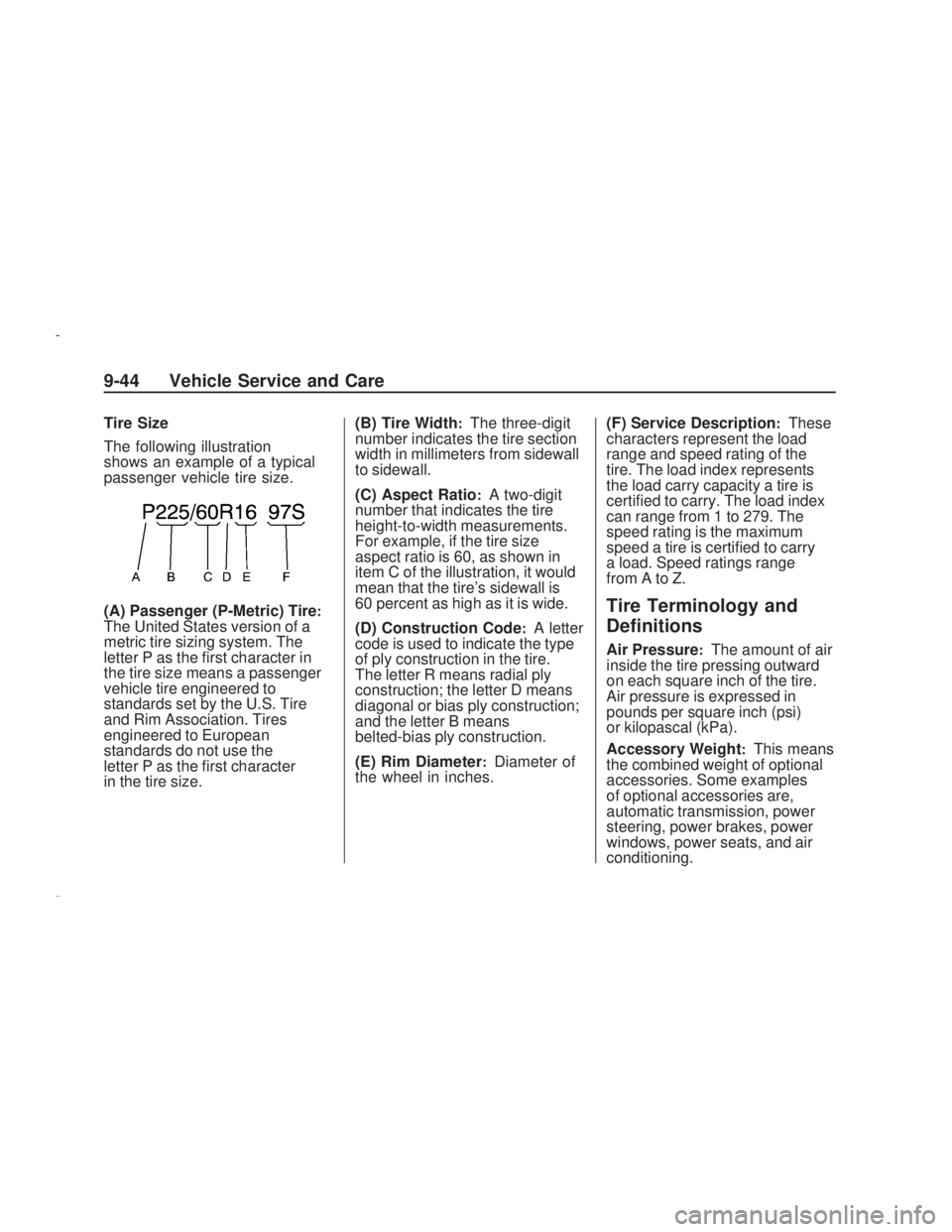
The following illustration
shows an example of a typical
passenger vehicle tire size.
(A) Passenger (P-Metric) Tire
:The United States version of a
metric tire sizing system. The
letter P as the rst character in
the tire size means a passenger
vehicle tire engineered to
standards set by the U.S. Tire
and Rim Association. Tires
engineered to European
standards do not use the
letter P as the rst character
in the tire size.(B) Tire Width
:The three-digit
number indicates the tire section
width in millimeters from sidewall
to sidewall.
(C) Aspect Ratio
:A two-digit
number that indicates the tire
height-to-width measurements.
For example, if the tire size
aspect ratio is 60, as shown in
item C of the illustration, it would
mean that the tire’s sidewall is
60 percent as high as it is wide.
(D) Construction Code
:A letter
code is used to indicate the type
of ply construction in the tire.
The letter R means radial ply
construction; the letter D means
diagonal or bias ply construction;
and the letter B means
belted-bias ply construction.
(E) Rim Diameter
:Diameter of
the wheel in inches.(F) Service Description
:These
characters represent the load
range and speed rating of the
tire. The load index represents
the load carry capacity a tire is
certied to carry. The load index
can range from 1 to 279. The
speed rating is the maximum
speed a tire is certied to carry
a load. Speed ratings range
fromAtoZ.
Tire Terminology and
Denitions
Air Pressure:The amount of air
inside the tire pressing outward
on each square inch of the tire.
Air pressure is expressed in
pounds per square inch (psi)
or kilopascal (kPa).
Accessory Weight
:This means
the combined weight of optional
accessories. Some examples
of optional accessories are,
automatic transmission, power
steering, power brakes, power
windows, power seats, and air
conditioning.
9-44 Vehicle Service and Care
2009 - Pontiac Vibe Owner Manual
Page 233 of 318
Tire Changing
If a Tire Goes Flat
It is unusual for a tire to blowout
while you are driving, especially if
you maintain your vehicle’s tires
properly. If air goes out of a tire, it is
much more likely to leak out slowly.
But if you should ever have a
blowout, here are a few tips about
what to expect and what to do:
If a front tire fails, the at tire
creates a drag that pulls the vehicle
toward that side. Take your foot off
the accelerator pedal and grip thesteering wheel rmly. Steer to
maintain lane position, and then
gently brake to a stop well out of
the traffic lane.
A rear blowout, particularly on a
curve, acts much like a skid and
may require the same correction
you would use in a skid. In any
rear blowout remove your foot
from the accelerator pedal. Get the
vehicle under control by steering the
way you want the vehicle to go. It
may be very bumpy and noisy, but
you can still steer. Gently brake to a
stop, well off the road if possible.
{CAUTION
Lifting a vehicle and getting under
it to do maintenance or repairs is
dangerous without the appropriate
safety equipment and training. If a
jack is provided with the vehicle, it
is designed only for changing a
at tire. If it is used for anything
else, you or others could be badly
injured or killed if the vehicle slips
off the jack. If a jack is provided
with the vehicle, only use it for
changing a at tire.
If a tire goes at, the next part
shows how to use the jacking
equipment to change a at tire
safely.
Vehicle Service and Care 9-61
2009 - Pontiac Vibe Owner Manual
Page 248 of 318
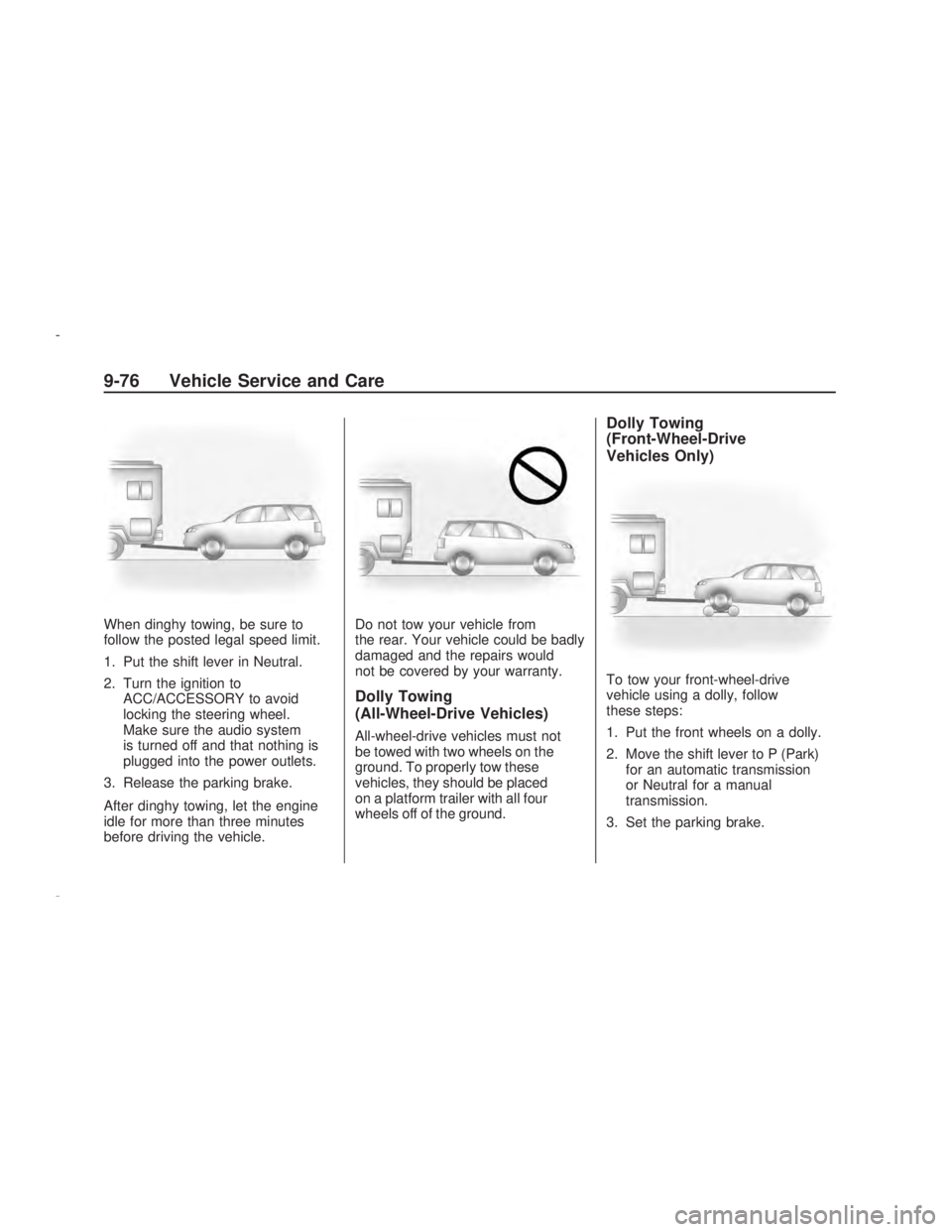
When dinghy towing, be sure to
follow the posted legal speed limit.
1. Put the shift lever in Neutral.
2. Turn the ignition to
ACC/ACCESSORY to avoid
locking the steering wheel.
Make sure the audio system
is turned off and that nothing is
plugged into the power outlets.
3. Release the parking brake.
After dinghy towing, let the engine
idle for more than three minutes
before driving the vehicle.Do not tow your vehicle from
the rear. Your vehicle could be badly
damaged and the repairs would
not be covered by your warranty.
Dolly Towing
(All-Wheel-Drive Vehicles)
All-wheel-drive vehicles must not
be towed with two wheels on the
ground. To properly tow these
vehicles, they should be placed
on a platform trailer with all four
wheels off of the ground.
Dolly Towing
(Front-Wheel-Drive
Vehicles Only)
To tow your front-wheel-drive
vehicle using a dolly, follow
these steps:
1. Put the front wheels on a dolly.
2. Move the shift lever to P (Park)
for an automatic transmission
or Neutral for a manual
transmission.
3. Set the parking brake.
9-76 Vehicle Service and Care
2009 - Pontiac Vibe Owner Manual
Page 249 of 318
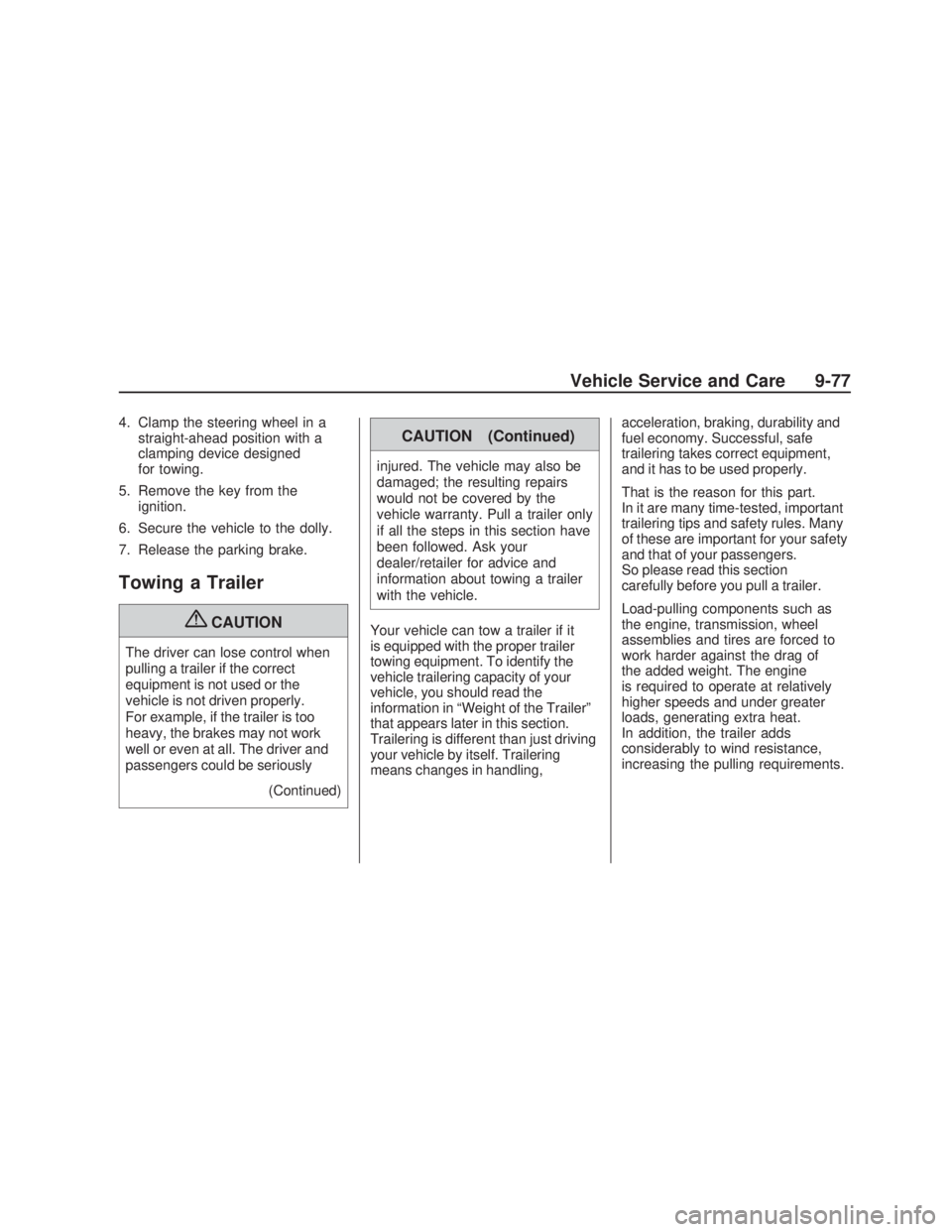
4. Clamp the steering wheel in a
straight-ahead position with a
clamping device designed
for towing.
5. Remove the key from the
ignition.
6. Secure the vehicle to the dolly.
7. Release the parking brake.
Towing a Trailer
{CAUTION
The driver can lose control when
pulling a trailer if the correct
equipment is not used or the
vehicle is not driven properly.
For example, if the trailer is too
heavy, the brakes may not work
well or even at all. The driver and
passengers could be seriously
(Continued)
CAUTION (Continued)
injured. The vehicle may also be
damaged; the resulting repairs
would not be covered by the
vehicle warranty. Pull a trailer only
if all the steps in this section have
been followed. Ask your
dealer/retailer for advice and
information about towing a trailer
with the vehicle.
Your vehicle can tow a trailer if it
is equipped with the proper trailer
towing equipment. To identify the
vehicle trailering capacity of your
vehicle, you should read the
information in “Weight of the Trailer”
that appears later in this section.
Trailering is different than just driving
your vehicle by itself. Trailering
means changes in handling,acceleration, braking, durability and
fuel economy. Successful, safe
trailering takes correct equipment,
and it has to be used properly.
That is the reason for this part.
In it are many time-tested, important
trailering tips and safety rules. Many
of these are important for your safety
and that of your passengers.
So please read this section
carefully before you pull a trailer.
Load-pulling components such as
the engine, transmission, wheel
assemblies and tires are forced to
work harder against the drag of
the added weight. The engine
is required to operate at relatively
higher speeds and under greater
loads, generating extra heat.
In addition, the trailer adds
considerably to wind resistance,
increasing the pulling requirements.
Vehicle Service and Care 9-77
2009 - Pontiac Vibe Owner Manual
Page 253 of 318
Following Distance
Stay at least twice as far behind the
vehicle ahead as you would when
driving your vehicle without a trailer.
This can help you avoid situations
that require heavy braking and
sudden turns.
Passing
More distance in front is needed to
pass when towing a trailer. And,
because the tow vehicle and trailer
are longer, you will need to go
farther beyond the passed vehicle
before you can return to your lane.
Backing Up
Hold the bottom of the steering
wheel with one hand. Then, to move
the trailer to the left, just move that
hand to the left. To move the trailer
to the right, move your hand to the
right. Always back up slowly and, if
possible, have someone guide you.
Making Turns
Notice:Making very sharp turns
while trailering could cause
the trailer to come in contact with
the vehicle. The vehicle could
be damaged. Avoid making very
sharp turns while trailering.
When you are turning with a trailer,
make wider turns than normal.
Do this so your trailer will not strike
soft shoulders, curbs, road signs,
trees or other objects. Avoid jerky or
sudden maneuvers. Signal well in
advance.
Turn Signals When Towing a
Trailer
When you tow a trailer, your vehicle
may need a different turn signal
asher and/or extra wiring. Check
with your dealer/retailer. The arrows
on the instrument panel ash
whenever you signal a turn or lane
change. Properly hooked up, the
trailer lamps also ash, telling other
drivers you are about to turn, change
lanes or stop.When towing a trailer, the arrows
on the instrument panel will ash for
turns even if the bulbs on the trailer
are burned out. Thus, you may think
drivers behind you are seeing your
signal when they are not. It is
important to check occasionally to be
sure the trailer bulbs are still working.
Driving On Grades
Reduce speed and shift to a lower
gearbeforeyou start down a long or
steep downgrade. If you do not shift
down, you might have to use your
brakes so much that they would get
hot and no longer work well.
On a long uphill grade, shift down
and reduce your speed to around
45 mph (70 km/h) to reduce the
possibility of the engine and the
transmission overheating.
Vehicle Service and Care 9-81
2009 - Pontiac Vibe Owner Manual
Page 309 of 318

A
Accessories and
Modications...................... 9-3
Accessory Power Outlets........ 4-9
Adding Equipment to Your
Airbag-Equipped Vehicle....1-34
Additives, Fuel.....................8-37
Add-On Electrical
Equipment.......................9-35
Air Cleaner/Filter, Engine.......9-12
Air Conditioning..................... 7-1
Airbag
Passenger Status
Indicator.......................4-15
Readiness Light................4-14
System, Replacing Parts
After a Crash................1-35
Airbag System.....................1-21
Adding Equipment to
Your Airbag-Equipped
Vehicle........................1-34
Check.............................1-35
How Does an Airbag
Restrain?.....................1-26Airbag System (cont.)
Passenger Sensing
System........................1-28
Servicing Your
Airbag-Equipped
Vehicle........................1-33
What Makes an Airbag
Inate?........................1-26
What Will You See After
an Airbag Inates?........1-26
When Should an Airbag
Inate?........................1-24
Where Are the Airbags?.....1-23
All-Wheel-Drive (AWD)
System...........................8-22
All-Wheel-Drive Service
Light...............................4-24
Antenna, Fixed Mast............6-14
Antenna, XM™ Satellite
Radio Antenna System......6-14
Antilock Brake
System (ABS)..................8-20
Antilock Brake, System
Warning Light...................4-18Appearance Care
Chemical Paint Spotting.....9-90
Exterior Cleaning..............9-86
Finish Damage.................9-89
Interior Cleaning...............9-83
Sheet Metal Damage........9-89
Underbody Maintenance....9-90
Appointments, Scheduling
Service...........................12-8
Ashtray(s)...........................4-10
Audio System........................ 6-1
Audio Steering Wheel
Controls.......................6-13
Fixed Mast Antenna..........6-14
Radio Reception...............6-14
Setting the Clock................ 6-2
XM™ Satellite Radio
Antenna System............6-14
Audio System(s).................... 6-3
Automatic Headlamp System . . . 5-2
Automatic Transmission
Fluid...............................9-14
Operation....................8-6, 8-8
INDEX i-1
2009 - Pontiac Vibe Owner Manual
Page 313 of 318

I
Ignition Positions................... 8-2
Immobilizer........................... 2-9
Immobilizer Operation............. 2-9
Infants and Young Children,
Restraints........................1-38
Ination - Tire Pressure.........9-47
Inspection
Brake System.................11-17
Engine Cooling System....11-17
Exhaust System..............11-16
Fuel System...................11-16
Part C - Periodic
Maintenance...............11-16
Steering, Suspension and
Front Drive Axle Boot
and Seal....................11-16
Throttle System..............11-17
Instrument Panel
Brightness......................... 5-3
Cluster............................4-12
Overview........................... 4-2
J
Jump Starting......................9-71
K
Keyless Entry System............ 2-3
Keys.................................... 2-2
L
Labeling, Tire Sidewall..........9-42
Lamp
Malfunction Indicator.........4-20
Lamps
Dome ............................... 5-3
Reading............................ 5-4
Lap-Shoulder Belt................1-16
LATCH System
Replacing Parts After a
Crash..........................1-49
LATCH System for Child
Restraints........................1-44
License Plate Lamps............9-34
Liftgate
Carbon Monoxide............... 2-8
Light
Airbag Readiness.............4-14
Antilock Brake System
(ABS) Warning..............4-18
Brake System Warning......4-17
Charging System..............4-16Light (cont.)
Cruise Control..................4-23
Door Ajar.........................4-24
Fog Lamp ........................4-23
Highbeam On...................4-24
Lights On Reminder..........4-23
Low Fuel Warning.............4-25
Low Tire Pressure
Warning Light...............4-18
Low Washer Fluid
Warning.......................4-23
Oil Pressure.....................4-22
Passenger Airbag Status
Indicator.......................4-15
Safety Belt Reminders.......4-14
Security...........................4-22
Service All-Wheel-Drive......4-24
Speed Sensitive Power
Steering (SSPS)
Warning Light...............4-18
StabiliTrak
®Indicator.........4-19
Taillamp Indicator..............4-23
TCS Warning Light...........4-19
Traction Control System
(TCS) Warning..............4-19
Lighting
Entry................................ 5-3
INDEX i-5
2009 - Pontiac Vibe Owner Manual