light PONTIAC VIBE 2009 Service Manual
[x] Cancel search | Manufacturer: PONTIAC, Model Year: 2009, Model line: VIBE, Model: PONTIAC VIBE 2009Pages: 318, PDF Size: 1.53 MB
Page 116 of 318
Setting Preset Stations
FAV (Favorites):Press to select
up to six pages of favorites.
Each page contains six favorite
stations, and each page of favorites
can contain any combination of
AM, FM, or XM™ stations.
For vehicles without XM, only
four pages of favorites are available.
To setup the number of favorites
pages:
1. Press the MENU button to
display the radio setup menu.
2. Press the button located below
the FAV 1-6 label.
3. Select the desired number of
favorites pages by pressing
the button located below
the displayed page numbers.
4. Press the FAV button, or let the
menu time out, to return to the
radio screen.To store a radio station as a favorite:
1. Tune to the desired radio station.
2. Press the FAV button to
display the page where it can
be stored.
3. Press and hold one of the
six buttons until a beep sounds.
4. Repeat the steps to store another
radio station.
Setting the Tone
(Bass/Midrange/Treble)
To adjust the bass, midrange, and
treble:
1. Press the TUNE ADJ knob.
2. Turn the TUNE ADJ knob, or
press the button below BASS,
MID, or TREB so it is highlighted.
3. Press the TUNE ADJ knob
to select BASS, MID, or TREB.
4. Turn the TUNE ADJ knob
to adjust the level.
5. Press the TUNE ADJ knob to set
the adjustment.EQ (Equalization):To select
customized equalization settings:
1. Press EQ.
2. Press the button below the label:
POP, ROCK, COUNTRY, TALK,
JAZZ, and CLASSICAL.
Adjusting the Speakers
(Balance/Fade)
To adjust the balance or fade,
perform the following steps:
1. Press the TUNE ADJ knob.
2. Turn the TUNE ADJ knob
or press the button below BAL
FADE so it is highlighted.
3. Press the TUNE ADJ knob to
select the tone to adjust.
4. Turn the TUNE ADJ knob to
adjust the audio balance to
the right or the left speakers
and the fade to adjust the audio
volume to the front or rear
speakers.
5. Press the TUNE ADJ knob to set
the adjustment.
6-4 Infotainment
2009 - Pontiac Vibe Owner Manual
Page 120 of 318
Care of CDs
The sound quality of the CD player
can be reduced because of:
The CD-R quality.
The method of recording
the CD-R.
The quality of the music that has
been recorded on the CD-R.
The way the CD-R has been
handled.
Store CD-R(s) in their original cases
or other protective cases and
away from dust and direct sunlight.
The CD player scans the bottom
surface of the disc. If the surface
of a CD is damaged, such as
cracked, broken, or scratched, the
CD may not play properly or at
all. Do not touch the bottom side of
a CD while handling it; this could
damage the surface. Pick up CDs
by grasping the outer edges or
the edge of the hole and the
outer edge.To clean a CD, use a soft lint free
cloth, or dampen a clean soft cloth
in a mild neutral detergent solution
mixed with water. Wipe the CD from
the center to the edge.
Care of The CD Player
Use a marking pen to identify CDs,
do not add labels.
Do not use CD lens cleaners; they
could damage the CD player.
Notice:If a label is added to a CD,
or more than one CD is inserted
into the slot at a time, or an
attempt is made to play scratched
or damaged CDs, the CD player
could be damaged. While using
the CD player, use only CDs in
good condition without any label,
load one CD at a time, and keep
the CD player and the loading slot
free of foreign materials, liquids,
and debris.
If an error displays, see “CD
Messages” later in this section.
Playing an MP3 CD-R Disc
Radios with the MP3 feature are
capable of playing an MP3 CD-R
disc. For more information on how to
play an MP3 CD-R disc, see Using
an MP3 later in this section.
CD Messages
If the CD ejects, it could be for
one of the following reasons:
The CD player is very hot.
When the temperature returns to
normal, the CD should play.
The road is very rough. When
the road becomes smoother,
the CD should play.
The CD is dirty, scratched, wet,
or upside down.
The air is very humid. If so, wait
about an hour and try again.
The format of the CD might not
be compatible. See Using an
MP3 later in this section.
6-8 Infotainment
2009 - Pontiac Vibe Owner Manual
Page 126 of 318
Radio Reception
Frequency interference and static
can occur during normal radio
reception if items such as cell phone
chargers, vehicle convenience
accessories, and external electronic
devices are plugged into the
accessory power outlet. If there is
interference or static, unplug the item
from the accessory power outlet.
AM
The range for most AM stations is
greater than for FM, especially at
night. The longer range can cause
station frequencies to interfere
with each other. For better radio
reception, most AM radio stations
boost the power levels during the
day, and then reduce these levels
during the night. Static can also
occur when things like storms and
power lines interfere with radio
reception. When this happens, try
reducing the treble on the radio.
FM Stereo
FM stereo gives the best sound,
but FM signals only reach about
10 to 40 miles (16 to 65 km).
Tall buildings or hills can interfere
with FM signals, causing the
sound to fade in and out.
XM™ Satellite Radio Service
XM Satellite Radio Service gives
digital radio reception from
coast-to-coast in the 48 contiguous
United States, and in Canada. Just
as with FM, tall buildings or hills can
interfere with satellite radio signals,
causing the sound to fade in and out.
In addition, traveling or standing
under heavy foliage, bridges,
garages, or through tunnels could
cause loss of the XM signal for a
period of time. The radio may
display NO XM SIGNAL to indicate
interference.
Fixed Mast Antenna
The xed mast antenna can
withstand most car washes without
being damaged. If the mast should
ever become slightly bent, straighten
it out by hand. If the mast is badly
bent, replace it.
Check occasionally to make sure
the mast is still tightened to the
antenna base located on the roof
of the vehicle. If tightening is
required, tighten by hand.
XM™ Satellite Radio
Antenna System
The XM Satellite Radio antenna is
located on the roof of the vehicle.
Keep this antenna clear of snow and
ice build up for clear radio reception.
If the vehicle has a sunroof, the
performance of the XM system may
be affected if the sunroof is open.
Loading items onto the roof of
the vehicle can interfere with the
performance of the XM system.
Make sure the XM Satellite Radio
antenna is not obstructed.
6-14 Infotainment
2009 - Pontiac Vibe Owner Manual
Page 128 of 318
Temperature Control
Turn the right knob clockwise or
counterclockwise to increase or
decrease the temperature inside
the vehicle.
Air Delivery Mode Control
Turn the left knob to select from the
following modes:
H(Vent):Air is directed to the
upper instrument panel outlets.
)(Bi-Level):Air is directed to
the upper instrument panel outlets
and the oor outlets.
6(Floor):Air is directed to the
oor and side window outlets.
-(Defog):Air is directed between
the windshield, side windows,
instrument panel outlets and the
oor outlets.Use the defog mode to clear the
inside of the windshield of fog
or moisture and to warm the
passengers. The air conditioning
compressor runs automatically
in this setting without pressing A/C,
unless the outside temperature
is at or below 32°F (0°C).
1(Defrost):Air is directed to
the windshield, instrument panel
outlets and the side windows.
Use the defrost mode to remove
fog or frost from the outside of the
windshield more quickly. The air
conditioning compressor runs
automatically in this setting without
pressing A/C, unless the outside
temperature is at or below
32°F (0°C).
Do not drive the vehicle until all the
windows are clear.
Air Conditioning
For vehicles with this feature, there
will be the following controls:
A/C (Air Conditioning):Press to
turn the air conditioning system
on or off. An indicator light shows
that it is on.
MAX A/C (Maximum Air
Conditioning):Press the A/C and
recirculation buttons at the same
time to select MAX A/C.
On hot days, open the windows to
let hot inside air escape; then close
them. The vehicle will cool quicker
and the A/C system operates more
efficiently.
Because the A/C system removes
moisture from the air, it is normal
for a small amount of water to
drip under the vehicle while idling
or just after turning the engine off.
7-2 Climate Controls
2009 - Pontiac Vibe Owner Manual
Page 129 of 318
Recirculation
?(Recirculation):Press to
turn the recirculation mode on or off.
An indicator light shows that it is on.
This mode recirculates the air inside
the vehicle and helps to heat or cool
the air more quickly. It can be used to
prevent outside air and odors from
entering the vehicle.
Press the button again to turn
the recirculation mode off and the
outside air mode on. Recirculation
is automatically turned off when the
climate control system mode knob
is turned to defog, defrost, or is
positioned between modes.
Rear Window Defogger
The rear window defogger uses a
warming grid to clear fog from
the rear window. It will only work
when the ignition is in the ON/RUN
position.
=(Rear Defogger):Press to turn
the rear window defogger on or off.
An indicator light shows that it is on.
The rear window defogger stays on
until it is manually turned off. Clear
any snow from the rear window.
If the ignition is turned off, while
the rear window defogger is on, the
defogger turns back on automatically
when the ignition is in the ON/RUN
position again.
Notice:Do not use a razor blade
or sharp object to clear the inside
rear window. Do not adhere
anything to the defogger grid lines
in the rear glass. These actions
may damage the rear defogger.
Repairs would not be covered
by your warranty.
Outlet Adjustment
Use the air outlets located in
the center and outboard sides of
the instrument panel, to change the
direction of the air owing through
the vents.
Operation Tips
Clear away any ice, snow or
leaves from the outside air
inlets at the base of the
windshield.
Use of non-GM approved hood
deectors can adversely affect
the performance of the system.
Keep the area under the
front seats clear of objects for
more effective air circulation.
If the airow seems low when
the fan is at the highest setting,
the passenger compartment air
lter might need to be replaced.
For more information, see
Passenger Compartment Air
Filter later in this section.
Climate Controls 7-3
2009 - Pontiac Vibe Owner Manual
Page 135 of 318

LOCK/OFF:This is the only position
from which you can remove the key.
This locks the steering wheel,
ignition and automatic transmission.
Push in the ignition switch as you
turn the key toward you.
On vehicles with an automatic
transmission, the shift lever must be
in P (Park) to turn the ignition switch
to the LOCK/OFF position.
A warning tone will sound if the driver
door is opened with the key in the
ignition.
The ignition switch can bind in the
LOCK/OFF position with your wheels
turned off center. If this happens,
move the steering wheel from right
to left while turning the key to
ACC/ACCESSORY. If this doesn’t
work, then the vehicle needs service.{CAUTION
On manual transmission vehicles,
turning the key to LOCK/OFF and
removing it will lock the steering
column and result in a loss of
ability to steer the vehicle.
This could cause a collision.
If you need to turn the engine
off while the vehicle is moving,
turn the key only to ACC/
ACCESSORY. Do not push the
key in while the vehicle is moving.
ACC/ACCESSORY:This position
provides power to some of the
electrical accessories. It unlocks the
steering wheel and ignition. To move
the key from ACC/ACCESSORY to
LOCK/OFF, push in the key and then
turn it to LOCK/OFF.
A warning tone will sound when
the driver door is opened when the
ignition is still in ACC/ACCESSORY
or LOCK/OFF and the key is in the
ignition.ON/RUN:The ignition switch stays
in this position when the engine is
running. This position can be used to
operate the electrical accessories,
including the ventilation fan and
115 volt power outlet, as well as to
display some warning and indicator
lights. The transmission is also
unlocked in this position on
automatic transmission vehicles.
The battery could be drained
if you leave the key in the ACC/
ACCESSORY or ON/RUN position
with the engine off. You may not be
able to start the vehicle if the battery
is allowed to drain for an extended
period of time.
START:This position starts the
engine. When the engine starts,
release the key. The ignition switch
will return to ON/RUN for normal
driving.
Driving and Operating 8-3
2009 - Pontiac Vibe Owner Manual
Page 144 of 318
Shift Speeds
{CAUTION
If you skip a gear when you
downshift, you could lose control
of your vehicle. You could injure
yourself or others. Do not shift
down more than one gear at a
time when you downshift.
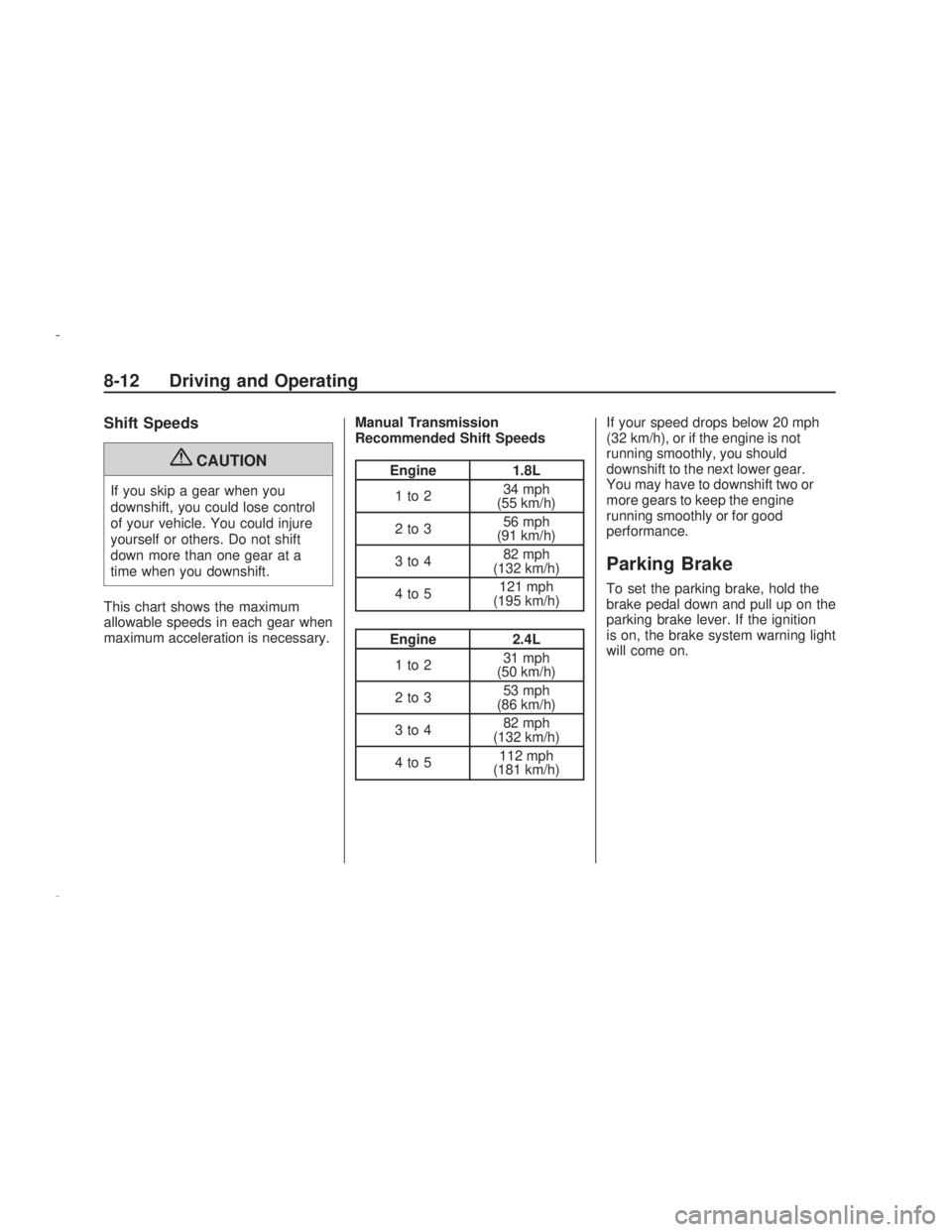
This chart shows the maximum
allowable speeds in each gear when
maximum acceleration is necessary.Manual Transmission
Recommended Shift Speeds
Engine 1.8L
1to234 mph
(55 km/h)
2to356 mph
(91 km/h)
3to482 mph
(132 km/h)
4to5121 mph
(195 km/h)
Engine 2.4L
1to231 mph
(50 km/h)
2to353 mph
(86 km/h)
3to482 mph
(132 km/h)
4to5112 mph
(181 km/h)If your speed drops below 20 mph
(32 km/h), or if the engine is not
running smoothly, you should
downshift to the next lower gear.
You may have to downshift two or
more gears to keep the engine
running smoothly or for good
performance.
Parking Brake
To set the parking brake, hold the
brake pedal down and pull up on the
parking brake lever. If the ignition
is on, the brake system warning light
will come on.
8-12 Driving and Operating
2009 - Pontiac Vibe Owner Manual
Page 145 of 318
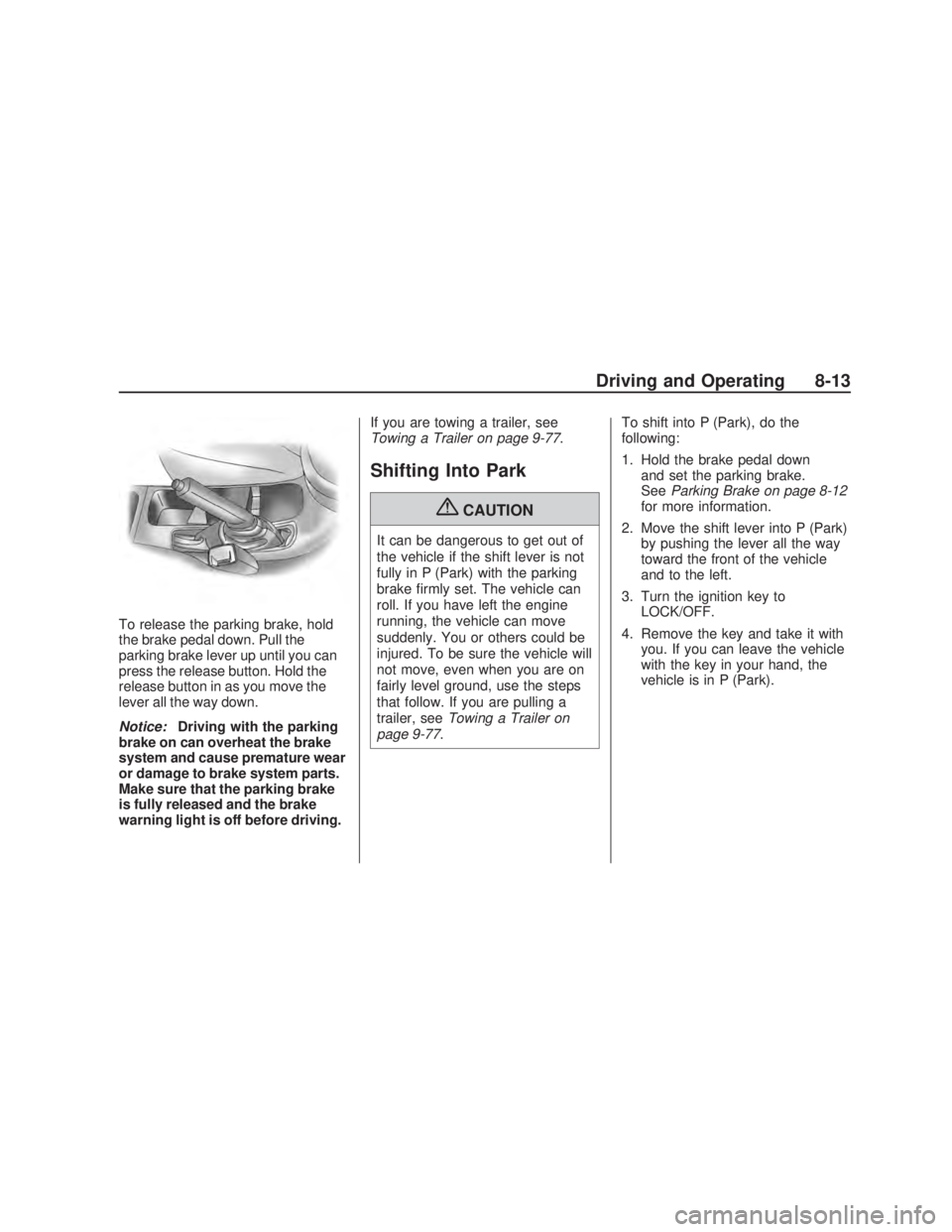
To release the parking brake, hold
the brake pedal down. Pull the
parking brake lever up until you can
press the release button. Hold the
release button in as you move the
lever all the way down.
Notice:Driving with the parking
brake on can overheat the brake
system and cause premature wear
or damage to brake system parts.
Make sure that the parking brake
is fully released and the brake
warning light is off before driving.If you are towing a trailer, see
Towing a Trailer on page 9-77.
Shifting Into Park
{CAUTION
It can be dangerous to get out of
the vehicle if the shift lever is not
fully in P (Park) with the parking
brake rmly set. The vehicle can
roll. If you have left the engine
running, the vehicle can move
suddenly. You or others could be
injured. To be sure the vehicle will
not move, even when you are on
fairly level ground, use the steps
that follow. If you are pulling a
trailer, seeTowing a Trailer on
page 9-77.To shift into P (Park), do the
following:
1. Hold the brake pedal down
and set the parking brake.
SeeParking Brake on page 8-12
for more information.
2. Move the shift lever into P (Park)
by pushing the lever all the way
toward the front of the vehicle
and to the left.
3. Turn the ignition key to
LOCK/OFF.
4. Remove the key and take it with
you. If you can leave the vehicle
with the key in your hand, the
vehicle is in P (Park).
Driving and Operating 8-13
2009 - Pontiac Vibe Owner Manual
Page 151 of 318
Braking
SeeBrake System Warning Light on
page 4-17.
Braking action involves perception
time and reaction time. First, you
have to decide to push on the brake
pedal. That is perception time. Then
you have to bring up your foot and do
it. That is reaction time.
Average reaction time is about
three-fourths of a second. But that
is only an average. It might be less
with one driver and as long as two or
three seconds or more with another.
Age, physical condition, alertness,
coordination, and eyesight all play
a part. So do alcohol, drugs, and
frustration. But even in three-fourths
of a second, a vehicle moving at
60 mph (100 km/h) travels 66 feet
(20 m). That could be a lot of
distance in an emergency, so
keeping enough space between
your vehicle and others is important.And, of course, actual stopping
distances vary greatly with the
surface of the road, whether it is
pavement or gravel; the condition of
the road, whether it is wet, dry, or icy;
tire tread; the condition of the brakes;
the weight of the vehicle; and the
amount of brake force applied.
Avoid needless heavy
braking. Some people drive
in spurts — heavy acceleration
followed by heavy braking — rather
than keeping pace with traffic.
This is a mistake. The brakes might
not have time to cool between hard
stops. The brakes will wear out much
faster if you do a lot of heavy braking.
If you keep pace with the traffic
and allow realistic following
distances, you will eliminate a lot of
unnecessary braking. That means
better braking and longer brake life.If your vehicle’s engine ever stops
while you are driving, brake normally
but do not pump the brakes. If you
do, the pedal could get harder to
push down. If the engine stops, you
will still have some power brake
assist. But you will use it when you
brake. Once the power assist is used
up, it can take longer to stop and the
brake pedal will be harder to push.
Adding non-dealer/non-retailer
accessories can affect your vehicle’s
performance. SeeAccessories
and Modifications on page 9-3.
Driving and Operating 8-19
2009 - Pontiac Vibe Owner Manual
Page 152 of 318
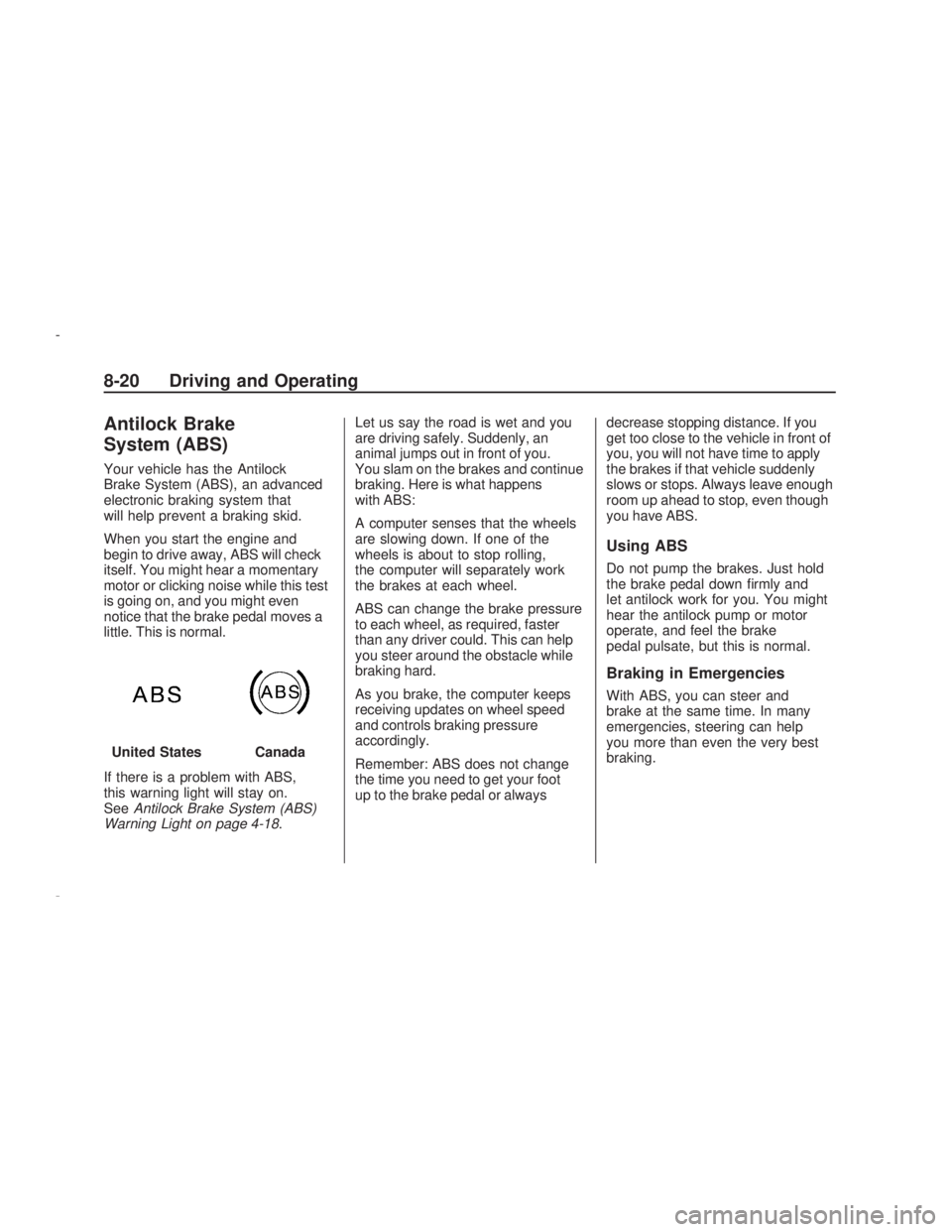
Antilock Brake
System (ABS)
Your vehicle has the Antilock
Brake System (ABS), an advanced
electronic braking system that
will help prevent a braking skid.
When you start the engine and
begin to drive away, ABS will check
itself. You might hear a momentary
motor or clicking noise while this test
is going on, and you might even
notice that the brake pedal moves a
little. This is normal.
If there is a problem with ABS,
this warning light will stay on.
SeeAntilock Brake System (ABS)
Warning Light on page 4-18.Let us say the road is wet and you
are driving safely. Suddenly, an
animal jumps out in front of you.
You slam on the brakes and continue
braking. Here is what happens
with ABS:
A computer senses that the wheels
are slowing down. If one of the
wheels is about to stop rolling,
the computer will separately work
the brakes at each wheel.
ABS can change the brake pressure
to each wheel, as required, faster
than any driver could. This can help
you steer around the obstacle while
braking hard.
As you brake, the computer keeps
receiving updates on wheel speed
and controls braking pressure
accordingly.
Remember: ABS does not change
the time you need to get your foot
up to the brake pedal or alwaysdecrease stopping distance. If you
get too close to the vehicle in front of
you, you will not have time to apply
the brakes if that vehicle suddenly
slows or stops. Always leave enough
room up ahead to stop, even though
you have ABS.
Using ABS
Do not pump the brakes. Just hold
the brake pedal down rmly and
let antilock work for you. You might
hear the antilock pump or motor
operate, and feel the brake
pedal pulsate, but this is normal.
Braking in Emergencies
With ABS, you can steer and
brake at the same time. In many
emergencies, steering can help
you more than even the very best
braking. United States
Canada
8-20 Driving and Operating
2009 - Pontiac Vibe Owner Manual