ECU PONTIAC VIBE 2009 Workshop Manual
[x] Cancel search | Manufacturer: PONTIAC, Model Year: 2009, Model line: VIBE, Model: PONTIAC VIBE 2009Pages: 318, PDF Size: 1.53 MB
Page 249 of 318
4. Clamp the steering wheel in a
straight-ahead position with a
clamping device designed
for towing.
5. Remove the key from the
ignition.
6. Secure the vehicle to the dolly.
7. Release the parking brake.
Towing a Trailer
{CAUTION
The driver can lose control when
pulling a trailer if the correct
equipment is not used or the
vehicle is not driven properly.
For example, if the trailer is too
heavy, the brakes may not work
well or even at all. The driver and
passengers could be seriously
(Continued)
CAUTION (Continued)
injured. The vehicle may also be
damaged; the resulting repairs
would not be covered by the
vehicle warranty. Pull a trailer only
if all the steps in this section have
been followed. Ask your
dealer/retailer for advice and
information about towing a trailer
with the vehicle.
Your vehicle can tow a trailer if it
is equipped with the proper trailer
towing equipment. To identify the
vehicle trailering capacity of your
vehicle, you should read the
information in “Weight of the Trailer”
that appears later in this section.
Trailering is different than just driving
your vehicle by itself. Trailering
means changes in handling,acceleration, braking, durability and
fuel economy. Successful, safe
trailering takes correct equipment,
and it has to be used properly.
That is the reason for this part.
In it are many time-tested, important
trailering tips and safety rules. Many
of these are important for your safety
and that of your passengers.
So please read this section
carefully before you pull a trailer.
Load-pulling components such as
the engine, transmission, wheel
assemblies and tires are forced to
work harder against the drag of
the added weight. The engine
is required to operate at relatively
higher speeds and under greater
loads, generating extra heat.
In addition, the trailer adds
considerably to wind resistance,
increasing the pulling requirements.
Vehicle Service and Care 9-77
2009 - Pontiac Vibe Owner Manual
Page 251 of 318
Maximum trailer weight is calculated
assuming only the driver is in the tow
vehicle and it has all the required
trailering equipment. The weight
of additional optional equipment,
passengers and cargo in the tow
vehicle must be subtracted from
the maximum trailer weight.
You can ask your dealer/retailer for
our trailering information or advice,
or you can write us at our Customer
Assistance Offices. SeeCustomer
Assistance Offices on page 12-4for
more information.
Weight of the Trailer Tongue
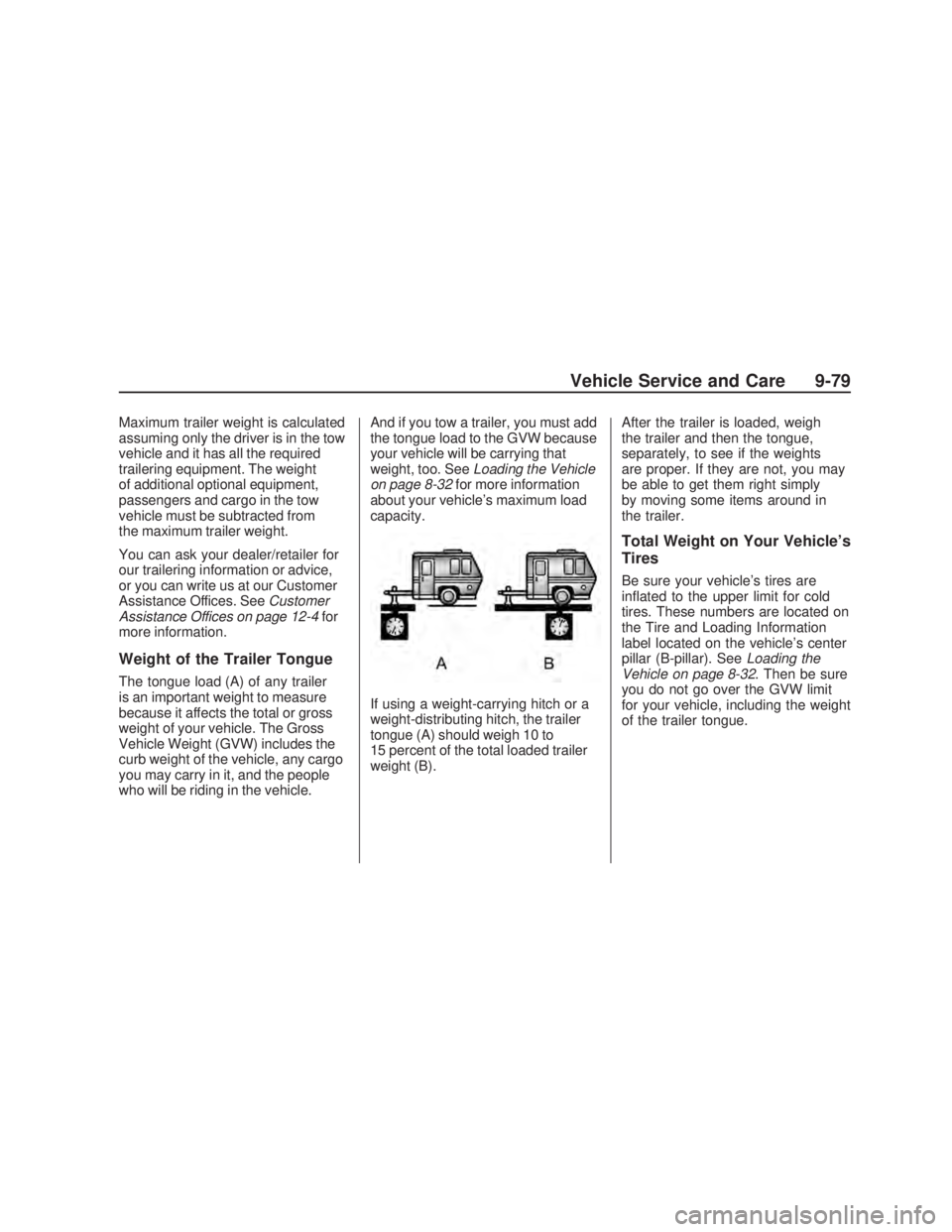
The tongue load (A) of any trailer
is an important weight to measure
because it affects the total or gross
weight of your vehicle. The Gross
Vehicle Weight (GVW) includes the
curb weight of the vehicle, any cargo
you may carry in it, and the people
who will be riding in the vehicle.And if you tow a trailer, you must add
the tongue load to the GVW because
your vehicle will be carrying that
weight, too. SeeLoading the Vehicle
on page 8-32for more information
about your vehicle’s maximum load
capacity.
If using a weight-carrying hitch or a
weight-distributing hitch, the trailer
tongue (A) should weigh 10 to
15 percent of the total loaded trailer
weight (B).After the trailer is loaded, weigh
the trailer and then the tongue,
separately, to see if the weights
are proper. If they are not, you may
be able to get them right simply
by moving some items around in
the trailer.
Total Weight on Your Vehicle’s
Tires
Be sure your vehicle’s tires are
inated to the upper limit for cold
tires. These numbers are located on
the Tire and Loading Information
label located on the vehicle’s center
pillar (B-pillar). SeeLoading the
Vehicle on page 8-32. Then be sure
you do not go over the GVW limit
for your vehicle, including the weight
of the trailer tongue.
Vehicle Service and Care 9-79
2009 - Pontiac Vibe Owner Manual
Page 252 of 318
Hitches
It is important to have the correct
hitch equipment. Crosswinds,
large trucks going by and rough
roads are a few reasons why
you will need the right hitch.
Here are some rules to follow:
Do not let the steel in a hitch
contact the aluminum on your
bumper because it can corrode.
Use something like paint or plastic
tape to separate the steel and
aluminum. The same steel to
aluminum problem can happen
with fasteners too.
Will you have to make any holes
in the body of your vehicle when
you install a trailer hitch? If you
do, then be sure to seal the holes
later when you remove the hitch.
If you do not seal them, deadly
carbon monoxide (CO) from the
exhaust can get into your vehicle.
See “Engine Exhaust” in the
Index. Dirt and water can too.
Safety Chains
You should always attach chains
between your vehicle and your
trailer. Cross the safety chains
under the tongue of the trailer
so that the tongue will not drop
to the road if it becomes separated
from the hitch. Instructions about
safety chains may be provided
by the hitch manufacturer or by
the trailer manufacturer. Follow the
manufacturer’s recommendation for
attaching safety chains and do not
attach them to the bumper. Leave
sufficient slack in the chain for turns.
Never allow safety chains to drag on
the ground.
Trailer Brakes
Does your trailer have its own
brakes?
Be sure to read and follow the
instructions for the trailer brakes so
you will be able to install, adjust and
maintain them properly. If you have
antilock brakes, do not tap into your
vehicle’s brake system. If you do,
both systems will not work well,
or at all.
Driving with a Trailer
Towing a trailer requires a certain
amount of experience. Get to know
the rig before setting out for the open
road. Acquaint yourself with the feel
of handling and braking with the
added weight of the trailer. And
always keep in mind that the vehicle
you are driving is now a good deal
longer and not nearly as responsive
as your vehicle is by itself.
Before you start, check the trailer
hitch, platform and attachments,
safety chains, electrical connector,
lamps, tires and mirror adjustment.
If the trailer has electric brakes, start
your vehicle and trailer moving and
then apply the trailer brake controller
by hand to be sure the brakes
are working. This lets you check
your electrical connection at the
same time.
During your trip, check occasionally
to be sure that the load is secure,
and that the lamps and any
trailer brakes are still working.
9-80 Vehicle Service and Care
2009 - Pontiac Vibe Owner Manual
Page 296 of 318
Calling for Assistance
When calling Roadside Assistance,
have the following information ready:
Your name, home address, and
home telephone number
Telephone number of your
location
Location of the vehicle
Model, year, color, and license
plate number of the vehicle
Odometer reading, Vehicle
Identication Number (VIN), and
delivery date of the vehicle
Description of the problem
Coverage
Services are provided up to
5 years/100,000 miles (160 000 km),
whichever comes rst.
In the U.S., anyone driving the
vehicle is covered. In Canada, a
person driving the vehicle without
permission from the owner is not
covered.Roadside Assistance is not a part of
the New Vehicle Limited Warranty.
Pontiac and General Motors of
Canada Limited reserve the right to
make any changes or discontinue
the Roadside Assistance program at
any time without notication.
Pontiac and General Motors of
Canada Limited reserve the right to
limit services or payment to an owner
or driver if they decide the claims are
made too often, or the same type of
claim is made many times.
Services Provided
Emergency Fuel Delivery:
Delivery of enough fuel
for the vehicle to get to the
nearest service station.
Lock-Out Service:Service is
provided to unlock the vehicle if
you are locked out. A remote
unlock may be available if you
have OnStar
®. For security
reasons, the driver must present
identication before this service
is given.
Emergency Tow From a Public
Road or Highway:Tow to the
nearest Pontiac dealer for
warranty service, or if the vehicle
was in a crash and cannot be
driven. Assistance is also given
when the vehicle is stuck in sand,
mud, or snow.
Flat Tire Change:Service is
provided to change a at tire with
the spare tire. The spare tire,
if equipped, must be in good
condition and properly inated.
It is the owner’s responsibility for
the repair or replacement of the
tire if it is not covered by the
warranty.
Battery Jump Start:Service is
provided to jump start a dead
battery.
12-6 Customer Information
2009 - Pontiac Vibe Owner Manual
Page 308 of 318

This data can help provide a better
understanding of the circumstances
in which crashes and injuries occur.
Important:EDR data is recorded
by your vehicle only if a non-trivial
crash situation occurs; no data
is recorded by the EDR under
normal driving conditions and no
personal data (e.g., name, gender,
age, and crash location) is
recorded. However, other parties,
such as law enforcement, could
combine the EDR data with the type
of personally identifying data
routinely acquired during a crash
investigation.
To read data recorded by an EDR,
special equipment is required,
and access to the vehicle or the
EDR is needed. In addition to
the vehicle manufacturer, other
parties, such as law enforcement,
that have the special equipment, can
read the information if they have
access to the vehicle or the EDR.GM will not access this data or
share it with others except: with the
consent of the vehicle owner or,
if the vehicle is leased, with the
consent of the lessee; in response
to an official request of police or
similar government office; as part of
GM’s defense of litigation through
the discovery process; or, as
required by law. Data that GM
collects or receives may also be
used for GM research needs or may
be made available to others for
research purposes, where a need is
shown and the data is not tied to
a specic vehicle or vehicle owner.
OnStar®
If your vehicle has OnStar and you
subscribe to the OnStar services,
please refer to the OnStar Terms and
Conditions for information on data
collection and use.
Navigation System
If your vehicle has a navigation
system, use of the system may result
in the storage of destinations,
addresses, telephone numbers, and
other trip information. Refer to the
navigation system operating manual
for information on stored data and for
deletion instructions.
Radio Frequency
Identication (RFID)
RFID technology is used in some
vehicles for functions such as
tire pressure monitoring and ignition
system security, as well as in
connection with conveniences such
as key fobs for remote door
locking/unlocking and starting, and
in-vehicle transmitters for garage
door openers. RFID technology in
GM vehicles does not use or record
personal information or link with
any other GM system containing
personal information.
12-18 Customer Information
2009 - Pontiac Vibe Owner Manual
Page 310 of 318
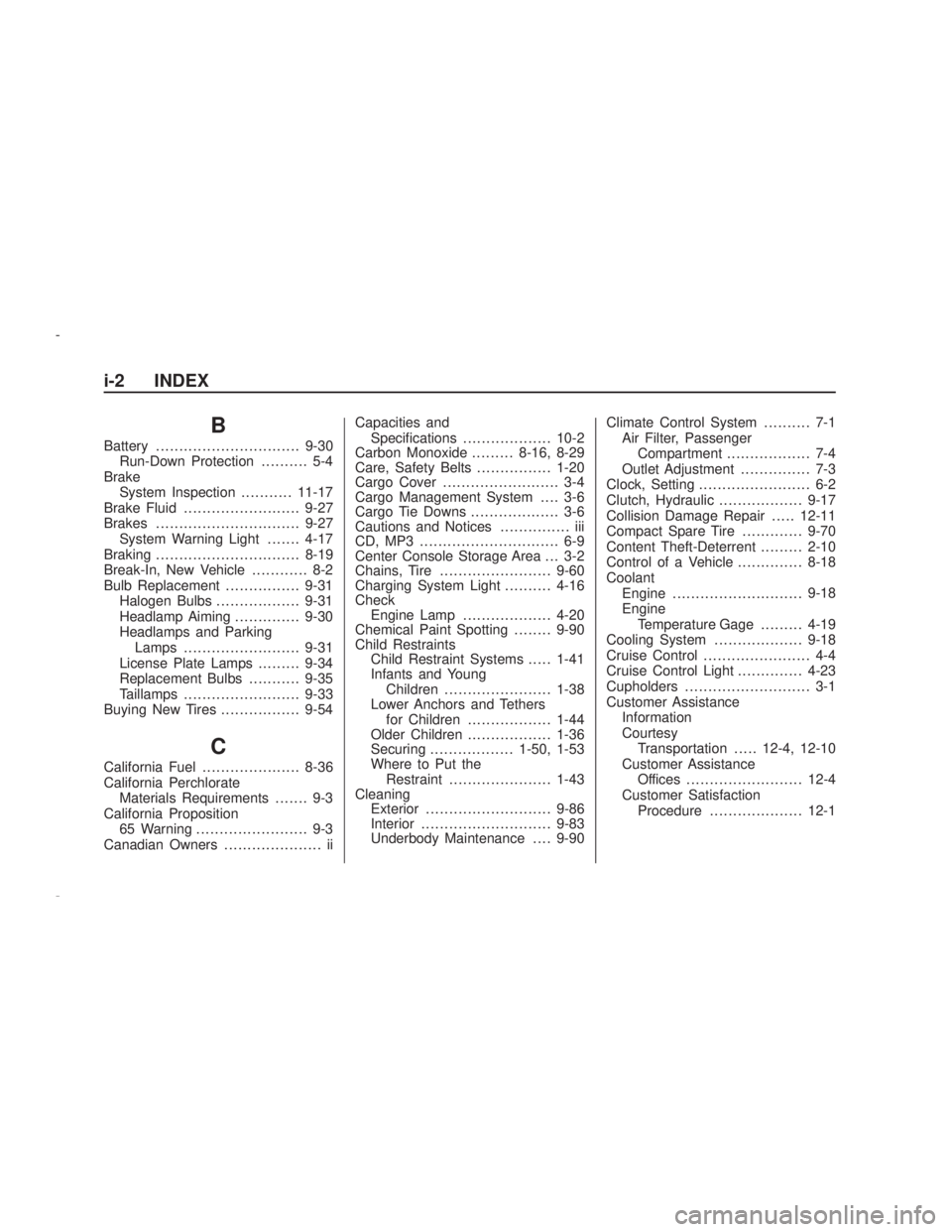
B
Battery...............................9-30
Run-Down Protection.......... 5-4
Brake
System Inspection...........11-17
Brake Fluid.........................9-27
Brakes...............................9-27
System Warning Light.......4-17
Braking...............................8-19
Break-In, New Vehicle............ 8-2
Bulb Replacement................9-31
Halogen Bulbs..................9-31
Headlamp Aiming..............9-30
Headlamps and Parking
Lamps .........................9-31
License Plate Lamps.........9-34
Replacement Bulbs...........9-35
Taillamps.........................9-33
Buying New Tires.................9-54
C
California Fuel.....................8-36
California Perchlorate
Materials Requirements....... 9-3
California Proposition
65 Warning........................ 9-3
Canadian Owners..................... iiCapacities and
Specications...................10-2
Carbon Monoxide.........8-16, 8-29
Care, Safety Belts................1-20
Cargo Cover......................... 3-4
Cargo Management System.... 3-6
Cargo Tie Downs................... 3-6
Cautions and Notices............... iii
CD, MP3 .............................. 6-9
Center Console Storage Area . . . 3-2
Chains, Tire........................9-60
Charging System Light..........4-16
Check
Engine Lamp...................4-20
Chemical Paint Spotting........9-90
Child Restraints
Child Restraint Systems.....1-41
Infants and Young
Children.......................1-38
Lower Anchors and Tethers
for Children..................1-44
Older Children..................1-36
Securing..................1-50, 1-53
Where to Put the
Restraint......................1-43
Cleaning
Exterior...........................9-86
Interior............................9-83
Underbody Maintenance....9-90Climate Control System.......... 7-1
Air Filter, Passenger
Compartment.................. 7-4
Outlet Adjustment............... 7-3
Clock, Setting........................ 6-2
Clutch, Hydraulic..................9-17
Collision Damage Repair.....12-11
Compact Spare Tire.............9-70
Content Theft-Deterrent.........2-10
Control of a Vehicle..............8-18
Coolant
Engine............................
9-18
Engine
Temperature Gage.........4-19
Cooling System...................9-18
Cruise Control....................... 4-4
Cruise Control Light..............4-23
Cupholders........................... 3-1
Customer Assistance
Information
Courtesy
Transportation.....12-4, 12-10
Customer Assistance
Offices.........................12-4
Customer Satisfaction
Procedure....................12-1
i-2 INDEX
2009 - Pontiac Vibe Owner Manual
Page 311 of 318
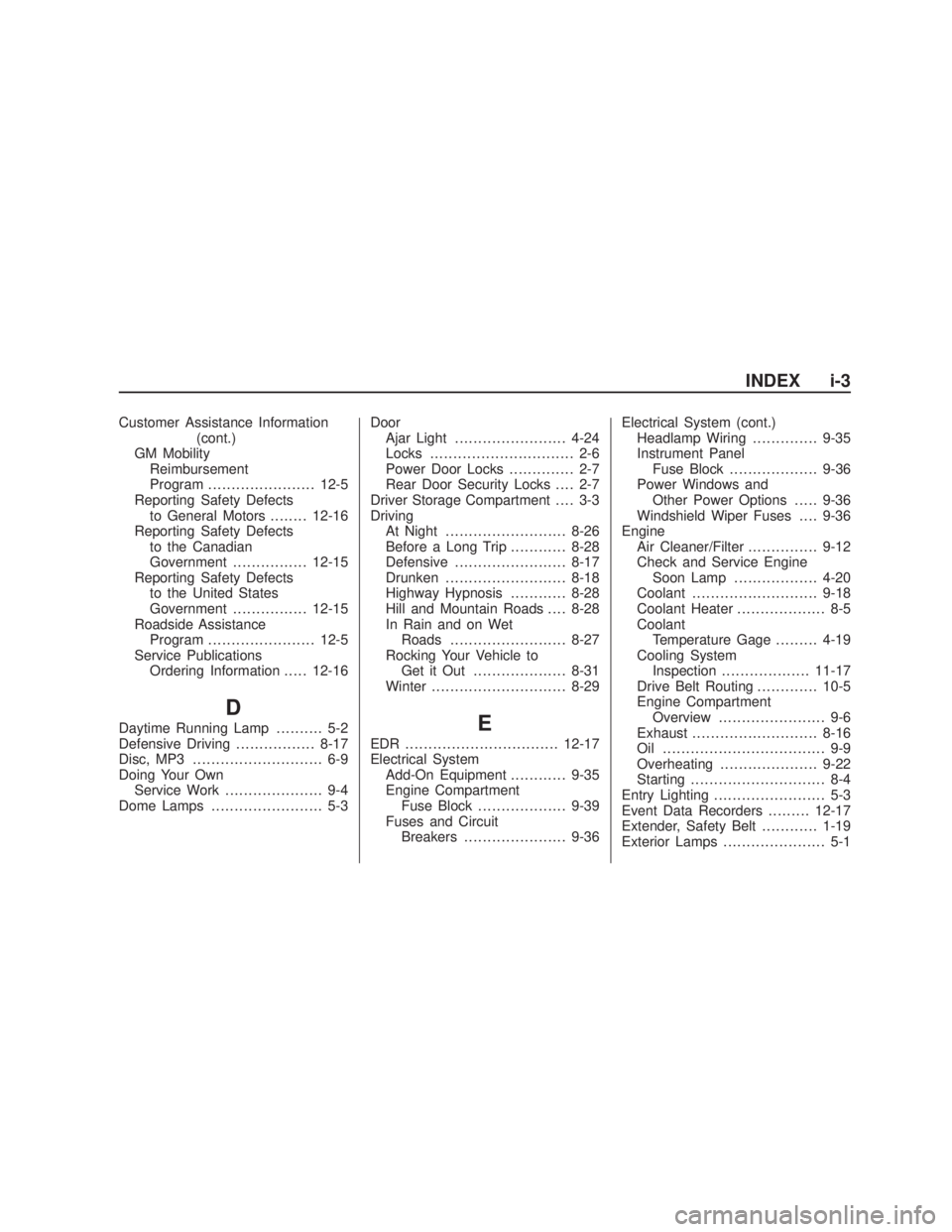
Customer Assistance Information
(cont.)
GM Mobility
Reimbursement
Program.......................12-5
Reporting Safety Defects
to General Motors........12-16
Reporting Safety Defects
to the Canadian
Government................12-15
Reporting Safety Defects
to the United States
Government................12-15
Roadside Assistance
Program.......................12-5
Service Publications
Ordering Information.....12-16
D
Daytime Running Lamp.......... 5-2
Defensive Driving.................8-17
Disc, MP3............................ 6-9
Doing Your Own
Service Work..................... 9-4
Dome Lamps ........................ 5-3Door
Ajar Light........................4-24
Locks............................... 2-6
Power Door Locks.............. 2-7
Rear Door Security Locks.... 2-7
Driver Storage Compartment.... 3-3
Driving
At Night..........................8-26
Before a Long Trip............8-28
Defensive........................8-17
Drunken..........................8-18
Highway Hypnosis............8-28
Hill and Mountain Roads....8-28
In Rain and on Wet
Roads.........................8-27
Rocking Your Vehicle to
Get it Out ....................8-31
Winter.............................8-29E
EDR .................................12-17
Electrical System
Add-On Equipment............9-35
Engine Compartment
Fuse Block...................9-39
Fuses and Circuit
Breakers......................9-36Electrical System (cont.)
Headlamp Wiring..............9-35
Instrument Panel
Fuse Block...................9-36
Power Windows and
Other Power Options.....9-36
Windshield Wiper Fuses....9-36
Engine
Air Cleaner/Filter...............9-12
Check and Service Engine
Soon Lamp..................4-20
Coolant...........................9-18
Coolant Heater................... 8-5
Coolant
Temperature Gage.........4-19
Cooling System
Inspection...................11-17
Drive Belt Routing.............10-5
Engine Compartment
Overview....................... 9-6
Exhaust...........................8-16
Oil ................................... 9-9
Overheating.....................9-22
Starting............................. 8-4
Entry Lighting........................ 5-3
Event Data Recorders.........12-17
Extender, Safety Belt............1-19
Exterior Lamps...................... 5-1
INDEX i-3
2009 - Pontiac Vibe Owner Manual
Page 313 of 318

I
Ignition Positions................... 8-2
Immobilizer........................... 2-9
Immobilizer Operation............. 2-9
Infants and Young Children,
Restraints........................1-38
Ination - Tire Pressure.........9-47
Inspection
Brake System.................11-17
Engine Cooling System....11-17
Exhaust System..............11-16
Fuel System...................11-16
Part C - Periodic
Maintenance...............11-16
Steering, Suspension and
Front Drive Axle Boot
and Seal....................11-16
Throttle System..............11-17
Instrument Panel
Brightness......................... 5-3
Cluster............................4-12
Overview........................... 4-2
J
Jump Starting......................9-71
K
Keyless Entry System............ 2-3
Keys.................................... 2-2
L
Labeling, Tire Sidewall..........9-42
Lamp
Malfunction Indicator.........4-20
Lamps
Dome ............................... 5-3
Reading............................ 5-4
Lap-Shoulder Belt................1-16
LATCH System
Replacing Parts After a
Crash..........................1-49
LATCH System for Child
Restraints........................1-44
License Plate Lamps............9-34
Liftgate
Carbon Monoxide............... 2-8
Light
Airbag Readiness.............4-14
Antilock Brake System
(ABS) Warning..............4-18
Brake System Warning......4-17
Charging System..............4-16Light (cont.)
Cruise Control..................4-23
Door Ajar.........................4-24
Fog Lamp ........................4-23
Highbeam On...................4-24
Lights On Reminder..........4-23
Low Fuel Warning.............4-25
Low Tire Pressure
Warning Light...............4-18
Low Washer Fluid
Warning.......................4-23
Oil Pressure.....................4-22
Passenger Airbag Status
Indicator.......................4-15
Safety Belt Reminders.......4-14
Security...........................4-22
Service All-Wheel-Drive......4-24
Speed Sensitive Power
Steering (SSPS)
Warning Light...............4-18
StabiliTrak
®Indicator.........4-19
Taillamp Indicator..............4-23
TCS Warning Light...........4-19
Traction Control System
(TCS) Warning..............4-19
Lighting
Entry................................ 5-3
INDEX i-5
2009 - Pontiac Vibe Owner Manual
Page 314 of 318

Lights
Exterior Lamps................... 5-1
Flash-to-Pass..................... 4-7
High/Low Beam Changer..... 4-7
Loading Your Vehicle............8-32
Locks
Door ................................. 2-6
Power Door ....................... 2-7
Rear Door Security Locks.... 2-7
Loss of Control....................8-25
Low Fuel Warning Light........4-25
Low Washer Fluid Warning
Light...............................4-23
Lower Anchors and Tethers
for Children......................1-44
Luggage Carrier.................... 3-2
M
Maintenance Schedule
At Each Fuel Fill.............11-12
At Least Once a Month . . . 11-13
At Least Once a Year......11-13
At Least Twice a Year.....11-13
Brake System
Inspection...................11-17
Engine Cooling System
Inspection...................11-17Maintenance Schedule (cont.)
Exhaust System
Inspection...................11-16
Fuel System Inspection....11-16
How This Section is
Organized....................11-2
Introduction......................11-1
Maintenance Replacement
Parts...........................10-4
Maintenance
Requirements...............11-2
Part A - Scheduled
Maintenance Services....11-3
PartB-Owner Checks
and Services...............11-12
Part C - Periodic
Maintenance
Inspections.................11-16
PartD-Recommended
Fluids and Lubricants . . . 11-18
PartE-Maintenance
Record.......................11-20
Scheduled Maintenance.....11-4
Steering, Suspension and
Front Drive Axle Boot
and Seal Inspection.....11-16Maintenance Schedule (cont.)
Throttle System
Inspection...................11-17
Using..............................11-3
Your Vehicle and the
Environment.................11-2
Malfunction Indicator Lamp....4-20
Manual Seats........................ 1-2
Manual Transmission
Fluid...............................9-16
Operation........................8-11
Mirrors
Manual Rearview Mirror.....2-13
Outside Power Mirrors.......2-14
MP3 .................................... 6-9
MyGMLink.com....................12-3
N
Navigation System,
Privacy..........................12-18
New Vehicle Break-In............. 8-2
Notices and Cautions............... iii
Notication
Service Airbag Message....4-16
i-6 INDEX
2009 - Pontiac Vibe Owner Manual
Page 315 of 318

O
Odometer...........................4-13
Odometers, Trip...................4-13
Off-Road Recovery...............8-24
Oil
Engine.............................. 9-9
Pressure Light..................4-22
Older Children, Restraints......1-36
Online Owner Center............12-3
OnStar, Privacy..................12-18
OnStar
®System, see
OnStar®Manual...............4-25
Outlet Adjustment.................. 7-3
Outlets
Accessory Power................ 4-9
Outside
Power Mirrors..................2-14
Overhead Console................. 3-2
Owner Checks, Service.......... 9-5
Owners, Canadian.................... ii
P
Paint, Damage.....................9-89
Park
Shifting Into.....................8-13
Shifting Out of..................8-14
Park Brake..........................8-12Parking
Over Things That Burn......8-16
Parking Your Vehicle............8-15
Part A - Scheduled
Maintenance Services........11-3
Part B - Owner Checks
and Services..................11-12
Part C - Periodic Maintenance
Inspections.....................11-16
PartD-Recommended
Fluids and Lubricants......11-18
PartE-Maintenance
Record..........................11-20
Passenger Airbag Status
Indicator..........................4-15
Passenger Compartment
Air Filter............................ 7-4
Passenger Sensing System . . . 1-28
Passing..............................8-25
Perchlorate Materials
Requirements, California...... 9-3
Power
Door Locks........................ 2-7
Electrical System..............9-36
Outlet 115 Volt Alternating
Current........................4-10
Retained Accessory............ 8-4
Steering Fluid...................9-24
Windows.........................2-12Pressure Cap......................9-22
Privacy.............................12-17
Event Data Recorders.....12-17
Navigation System..........12-18
OnStar..........................12-18
Radio Frequency
Identication................12-18
R
Radio Frequency Identication
(RFID), Privacy...............12-18
Radio(s)............................... 6-3
Radios
Reception........................6-14
Setting the Clock................ 6-2
Reading Lamps..................... 5-4
Rear Door Security Locks....... 2-7
Rear Seat Operation.............. 1-7
Rear Windshield Washer/
Wiper............................... 4-8
Rearview Mirrors..................2-13
Reclining Seatbacks............... 1-3
Recreational Vehicle Towing . . . 9-75
Remote Keyless Entry (RKE)
System............................. 2-3
Remote Keyless Entry (RKE)
System, Operation.............. 2-4
INDEX i-7
2009 - Pontiac Vibe Owner Manual