belt PONTIAC VIBE 2009 Workshop Manual
[x] Cancel search | Manufacturer: PONTIAC, Model Year: 2009, Model line: VIBE, Model: PONTIAC VIBE 2009Pages: 318, PDF Size: 1.53 MB
Page 227 of 318
GM recommends replacing tires
in sets of four. This is because
uniform tread depth on all tires will
help keep the vehicle performing
most like it did when the tires were
new. Replacing less than a full set
of tires can affect the braking and
handling performance of the vehicle.
SeeTire Inspection and Rotation on
page 9-53.
{CAUTION
Mixing tires could cause you to
lose control while driving. If you
mix tires of different sizes,
brands, or types (radial and
bias-belted tires), the vehicle
may not handle properly, and
you could have a crash. Using
tires of different sizes, brands,
or types may also cause
(Continued)
CAUTION (Continued)
damage to the vehicle.
Be sure to use the correct
size, brand, and type of tires
on all wheels. It is all right
to drive with the compact
spare temporarily, as it was
developed for use on the
vehicle. SeeCompact
Spare Tire on page 9-70.
{CAUTION
If you use bias-ply tires on the
vehicle, the wheel rim anges
could develop cracks after
many miles of driving. A tire
and/or wheel could fail
suddenly, causing a crash.
Use only radial-ply tires with
the wheels on the vehicle.
Vehicles that have a tire pressure
monitoring system could give
an inaccurate low-pressure warning
if tires not recommended for the
vehicle are installed. Tires that do
not match the original equipment
tires could give a low-pressure
warning that is higher or lower
than the proper warning level you
would get with original equipment
tires. SeeTire Pressure Monitor
System on page 9-48.
The vehicle’s original equipment
tires are listed on the Tire and
Loading Information Label. See
Loading the Vehicle on page 8-32,
for more information about the
Tire and Loading Information label
and its location on the vehicle.
Vehicle Service and Care 9-55
2009 - Pontiac Vibe Owner Manual
Page 254 of 318
Parking on Hills
{CAUTION
Parking the vehicle on a hill
with the trailer attached can be
dangerous. If something goes
wrong, the rig could start to move.
People can be injured, and both
the vehicle and the trailer can be
damaged. When possible, always
park the rig on a at surface.
To park your rig on a hill:
1. Apply your regular brakes, but
do not shift into P (Park) for an
automatic transmission or into
gear for a manual transmission,
yet. When parking uphill, turn
your wheels away from the curb.
When parking downhill, turn your
wheels into the curb.
2. Have someone place chocks
under the trailer wheels.3. When the chocks are in place,
release the regular brakes until
the chocks absorb the load.
4. Reapply the regular brakes.
Then apply your parking
brake and shift into P (Park)
for an automatic transmission
or R (Reverse) for a manual
transmission.
5. Release the regular brakes.
When You Are Ready to Leave
After Parking on a Hill
1. Apply your regular brakes and
hold the pedal down while you:
start your engine
shift the transmission
into gear
release the parking brake
2. Let up on the brake pedal.
3. Drive slowly until the trailer is
clear of the chocks.
4. Stop and have someone pick up
and store the chocks.
Maintenance When Trailer
Towing
Your vehicle will need service more
often when you are pulling a trailer.
See the Maintenance Schedule
for more on this. Things that are
especially important in trailer
operation are automatic transmission
uid (do not overll), engine oil, drive
belt, cooling system and brake
system. Each of these is covered in
this manual, and the Index will help
nd them quickly. If you are trailering,
it is a good idea to review this
information before starting your trip.
Check periodically to see that all
hitch nuts and bolts are tight.
Engine Cooling When Trailer
Towing
The cooling system could
temporarily overheat during severe
operating conditions. SeeEngine
Overheating on page 9-22.
9-82 Vehicle Service and Care
2009 - Pontiac Vibe Owner Manual
Page 263 of 318
Technical Data
Vehicle Identication
Vehicle Identication
Number (VIN)..................10-1
Service Parts
Identication Label...........10-1
Capacities and
Specications
Capacities and
Specications..................10-2
Normal Maintenance
Replacement Parts
Maintenance
Replacement Parts..........10-4
Engine Drive Belt
Routing...........................10-5
Vehicle Identication
Vehicle Identication
Number (VIN)
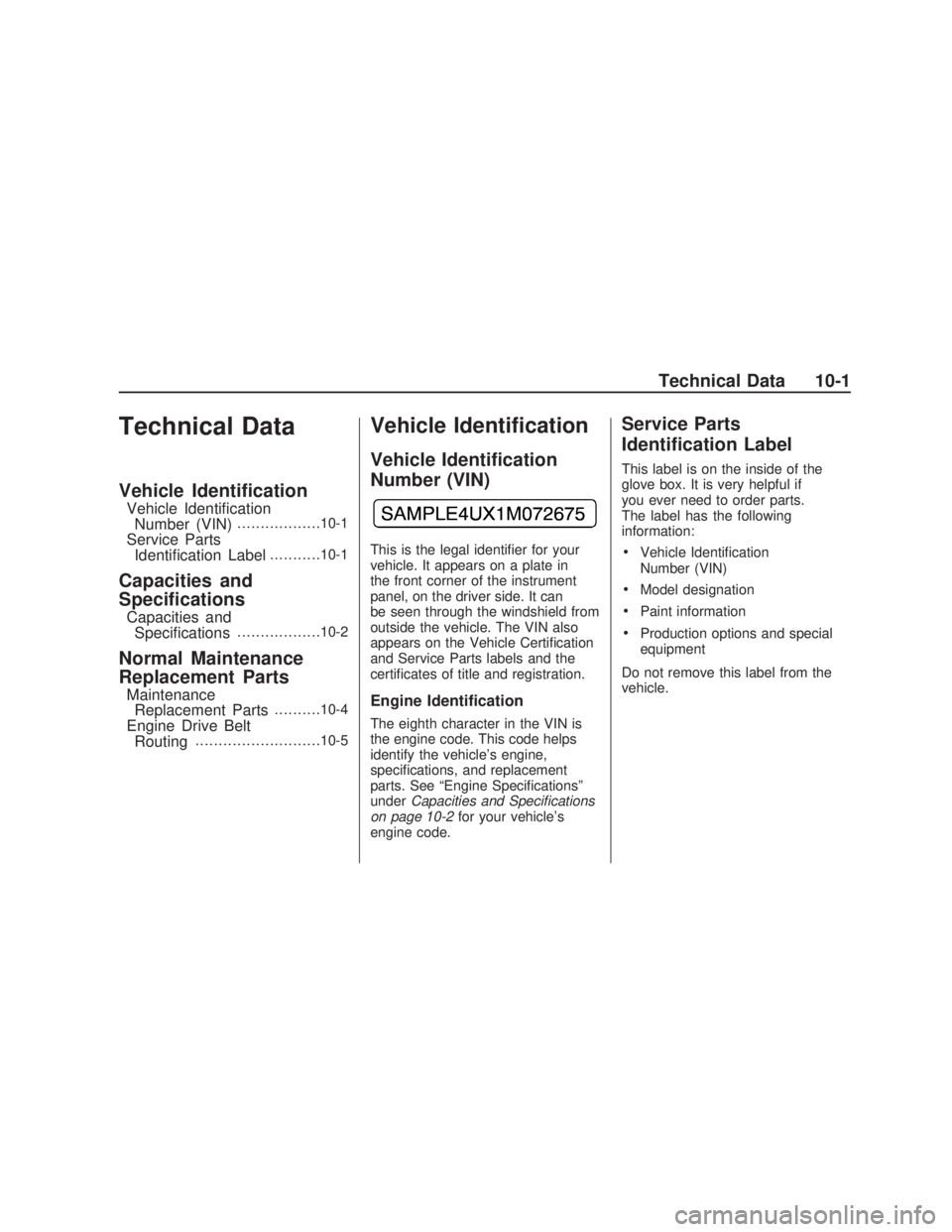
This is the legal identier for your
vehicle. It appears on a plate in
the front corner of the instrument
panel, on the driver side. It can
be seen through the windshield from
outside the vehicle. The VIN also
appears on the Vehicle Certication
and Service Parts labels and the
certicates of title and registration.
Engine Identication
The eighth character in the VIN is
the engine code. This code helps
identify the vehicle’s engine,
specications, and replacement
parts. See “Engine Specications”
underCapacities and Specifications
on page 10-2for your vehicle’s
engine code.
Service Parts
Identication Label
This label is on the inside of the
glove box. It is very helpful if
you ever need to order parts.
The label has the following
information:
Vehicle Identication
Number (VIN)
Model designation
Paint information
Production options and special
equipment
Do not remove this label from the
vehicle.
Technical Data 10-1
2009 - Pontiac Vibe Owner Manual
Page 267 of 318
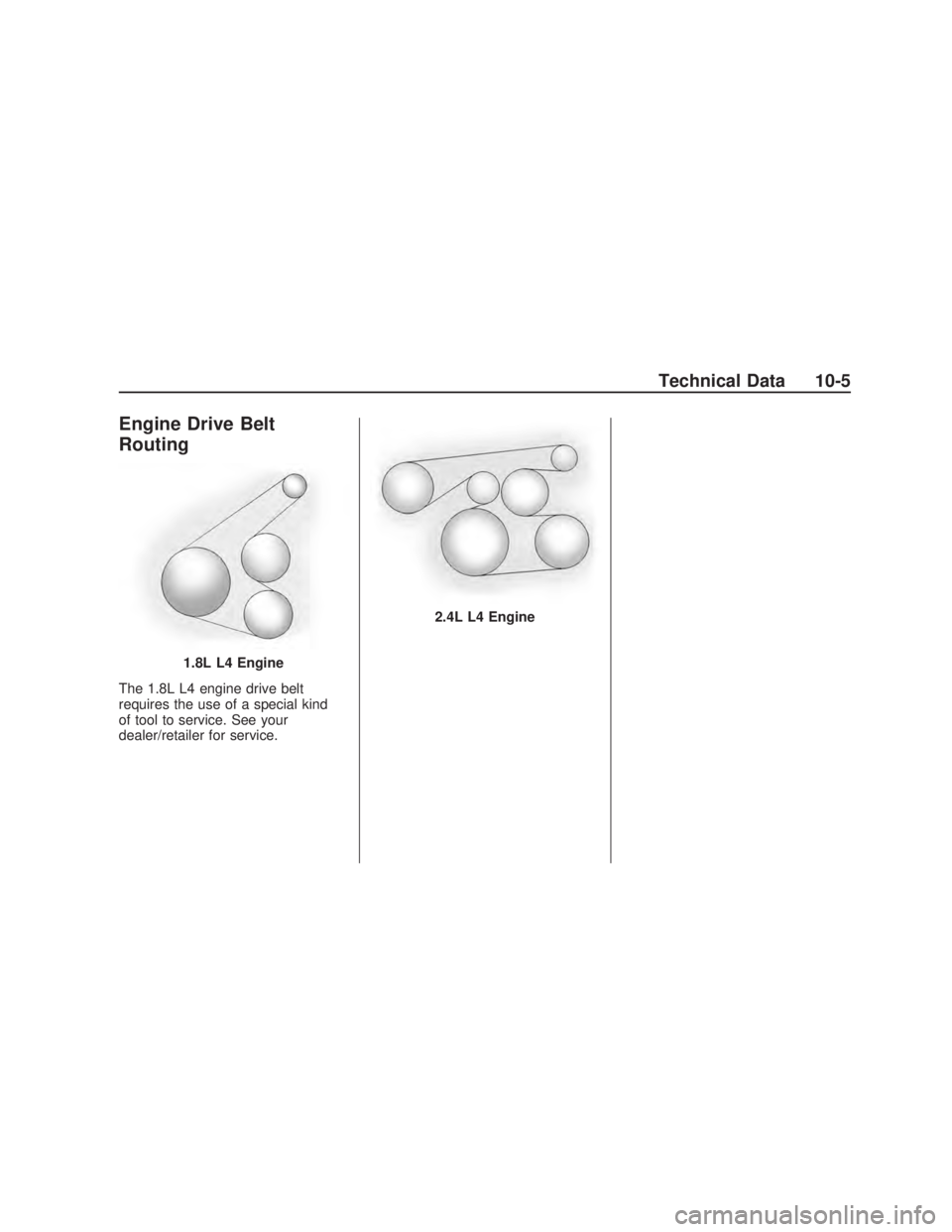
Engine Drive Belt
Routing
The 1.8L L4 engine drive belt
requires the use of a special kind
of tool to service. See your
dealer/retailer for service.1.8L L4 Engine
2.4L L4 Engine
Technical Data 10-5
2009 - Pontiac Vibe Owner Manual
Page 274 of 318
❑Check restraint system. Make
sure the safety belt reminder
light and safety belt assemblies
are working properly. Look for
any other loose or damaged
safety belt system parts. If you
see anything that might keep
a safety belt system from
doing its job, have it repaired.
Have any torn or frayed safety
belts replaced. Also see
Airbag System Check on
page 1-35.
❑Replace passenger compartment
air lter.
❑Inspect fuel tank, cap, cap
gasket, and lines for damage
or leaks (or every 24 months,
whichever occurs rst). Replace
parts as needed.An Emission
Control Service. (See footnote †.)
❑Change manual transmission
uid every 30,000 miles
(48 000 km) only if your vehicle
is used to tow a trailer.35,000 Miles (56 000 km)
❑Change engine oil and lter
(or every 3 months, whichever
occurs rst).An Emission
Control Service.
❑Rotate tires. SeeTire Inspection
and Rotation on page 9-53for
proper rotation pattern and
additional information.
(See footnote +.)
❑Inspect engine air cleaner lter
if you are driving in dusty
conditions. Replace lter if
necessary.
40,000 Miles (64 000 km)
❑Change engine oil and lter
(or every 3 months, whichever
occurs rst).An Emission
Control Service.
❑Rotate tires. SeeTire Inspection
and Rotation on page 9-53for
proper rotation pattern and
additional information.
(See footnote +.)❑Inspect engine air cleaner lter
if you are driving in dusty
conditions. Replace lter if
necessary.
45,000 Miles (72 000 km)
❑Change engine oil and lter
(or every 3 months, whichever
occurs rst).An Emission
Control Service.
❑Rotate tires. SeeTire Inspection
and Rotation on page 9-53for
proper rotation pattern and
additional information.
(See footnote +.)
❑Inspect engine air cleaner lter
if you are driving in dusty
conditions. Replace lter if
necessary.
❑Inspect passenger compartment
air lter.
50,000 Miles (80 000 km)
❑Change engine oil and lter
(or every 3 months, whichever
occurs rst).An Emission
Control Service.
11-6 Service and Maintenance
2009 - Pontiac Vibe Owner Manual
Page 275 of 318
❑Rotate tires. SeeTire Inspection
and Rotation on page 9-53for
proper rotation pattern and
additional information.
(See footnote +.)
❑Inspect engine air cleaner lter
if you are driving in dusty
conditions. Replace lter if
necessary.
55,000 Miles (88 000 km)
❑Change engine oil and lter
(or every 3 months, whichever
occurs rst).An Emission
Control Service.
❑Rotate tires. SeeTire Inspection
and Rotation on page 9-53for
proper rotation pattern and
additional information.
(See footnote +.)
❑Inspect engine air cleaner lter
if you are driving in dusty
conditions. Replace lter if
necessary.
60,000 Miles (96 000 km)
❑Change engine oil and lter
(or every 3 months, whichever
occurs rst).An Emission
Control Service.
❑Rotate tires. SeeTire Inspection
and Rotation on page 9-53for
proper rotation pattern and
additional information.
(See footnote +.)
❑Replace engine air cleaner lter
(or every 24 months, whichever
occurs rst). SeeEngine Air
Cleaner/Filter on page 9-12
for more information.
❑Check restraint system. Make
sure the safety belt reminder
light and safety belt assemblies
are working properly. Look for
any other loose or damaged
safety belt system parts. If you
see anything that might keep
a safety belt system from
doing its job, have it repaired.
Have any torn or frayed safety
belts replaced. Also seeAirbag
System Check on page 1-35.❑Replace passenger compartment
air lter.
❑Inspect engine accessory drive
belts (or every 48 months,
whichever occurs rst). Visually
inspect belt for fraying, excessive
cracks, or obvious damage.
Replace belt if necessary.
An Emission Control Service.
❑Inspect for tappet noise and
engine vibration. Adjust valve
clearance to factory specications
if necessary (or every 48 months,
whichever occurs rst).
An Emission Control Service.
❑Inspect fuel tank, cap, cap gasket,
and lines for damage or leaks
(or every 24 months, whichever
occurs rst). Replace parts as
needed.An Emission Control
Service. (See footnote †.)
❑Change manual transmission uid
every 30,000 miles (48 000 km)
only if your vehicle is used to tow
a trailer.
Service and Maintenance 11-7
2009 - Pontiac Vibe Owner Manual
Page 276 of 318

❑Change automatic transmission
uid every 60,000 miles
(96 000 km) if the vehicle is
mainly driven under one or more
of these conditions:
In heavy city traffic where the
outside temperature regularly
reaches 90°F (32°C) or higher.
In hilly or mountainous terrain.
When doing frequent trailer
towing.
Uses such as found in taxi,
police, or delivery service.
If you do not use your vehicle
under any of these conditions, the
fluid does not require changing.
See Part D: Recommended Fluids
and Lubricants on page 11-18
for the proper uid to use.
65,000 Miles 104 000 km)
❑Change engine oil and lter
(or every 3 months, whichever
occurs rst).An Emission
Control Service.❑Rotate tires. SeeTire Inspection
and Rotation on page 9-53for
proper rotation pattern and
additional information.
(See footnote +.)
❑Inspect engine air cleaner lter
if you are driving in dusty
conditions. Replace lter if
necessary.
70,000 Miles (112 000 km)
❑Change engine oil and lter
(or every 3 months, whichever
occurs rst).An Emission
Control Service.
❑Rotate tires. SeeTire Inspection
and Rotation on page 9-53
for proper rotation pattern
and additional information.
(See footnote +.)
❑Inspect engine air cleaner lter
if you are driving in dusty
conditions. Replace lter if
necessary.
75,000 Miles (120 000 km)
❑Change engine oil and lter
(or every 3 months, whichever
occurs rst).An Emission
Control Service.
❑Rotate tires. SeeTire Inspection
and Rotation on page 9-53for
proper rotation pattern and
additional information.
(See footnote +.)
❑Inspect engine air cleaner lter
if you are driving in dusty
conditions. Replace lter if
necessary.
❑Inspect passenger compartment
air lter.
❑Inspect engine accessory drive
belts (or 12 months since last
inspection).An Emission
Control Service.
80,000 Miles (128 000 km)
❑Change engine oil and lter
(or every 3 months, whichever
occurs rst).An Emission
Control Service.
11-8 Service and Maintenance
2009 - Pontiac Vibe Owner Manual
Page 277 of 318
❑Rotate tires. SeeTire Inspection
and Rotation on page 9-53
for proper rotation pattern
and additional information.
(See footnote +.)
❑Inspect engine air cleaner lter
if you are driving in dusty
conditions. Replace lter if
necessary.
85,000 Miles (136 000 km)
❑Change engine oil and lter
(or every 3 months, whichever
occurs rst).An Emission
Control Service.
❑Rotate tires. SeeTire Inspection
and Rotation on page 9-53
for proper rotation pattern
and additional information.
(See footnote +.)
❑Inspect engine air cleaner lter
if you are driving in dusty
conditions. Replace lter if
necessary.
90,000 Miles (144 000 km)
❑Change engine oil and lter
(or every 3 months, whichever
occurs rst).An Emission
Control Service.
❑Rotate tires. SeeTire Inspection
and Rotation on page 9-53for
proper rotation pattern and
additional information.
(See footnote +.)
❑Replace engine air cleaner lter
(or every 24 months, whichever
occurs rst). SeeEngine Air
Cleaner/Filter on page 9-12
for more information.
❑Check restraint system. Make
sure the safety belt reminder
light and safety belt assemblies
are working properly. Look for
any other loose or damaged
safety belt system parts. If you
see anything that might keepa safety belt system from
doing its job, have it repaired.
Have any torn or frayed
safety belts replaced. Also
seeAirbag System Check on
page 1-35.
❑Replace passenger compartment
air lter.
❑Inspect engine accessory drive
belts (or 12 months since last
inspection).An Emission
Control Service.
❑Inspect fuel tank, cap, cap
gasket, and lines for damage
or leaks (or every 24 months,
whichever occurs rst). Replace
parts as needed.An Emission
Control Service. (See footnote †.)
❑Change manual transmission
uid every 30,000 miles
(48 000 km) only if your vehicle
is used to tow a trailer.
Service and Maintenance 11-9
2009 - Pontiac Vibe Owner Manual
Page 278 of 318
95,000 Miles (152 000 km)
❑Change engine oil and lter
(or every 3 months, whichever
occurs rst).An Emission
Control Service.
❑Rotate tires. SeeTire Inspection
and Rotation on page 9-53
for proper rotation pattern
and additional information.
(See footnote +.)
❑Inspect engine air cleaner lter
if you are driving in dusty
conditions. Replace lter if
necessary.
100,000 Miles (160 000 km)
❑Change engine oil and lter
(or every 3 months, whichever
occurs rst).An Emission
Control Service.
❑Rotate tires. SeeTire Inspection
and Rotation on page 9-53
for proper rotation pattern
and additional information.
(See footnote +.)❑Inspect engine air cleaner lter
if you are driving in dusty
conditions. Replace lter if
necessary.
105,000 Miles (168 000 km)
❑Change engine oil and lter
(or every 3 months, whichever
occurs rst).An Emission
Control Service.
❑Rotate tires. SeeTire Inspection
and Rotation on page 9-53
for proper rotation pattern
and additional information.
(See footnote +.)
❑Inspect engine air cleaner lter
if you are driving in dusty
conditions. Replace lter if
necessary.
❑Inspect passenger compartment
air lter.❑Inspect engine accessory drive
belts (or every 48 months,
whichever occurs rst). Visually
inspect belt for fraying, excessive
cracks, or obvious damage.
Replace belt if necessary.
An Emission Control Service.
110,000 Miles (176 000 km)
❑Change engine oil and lter
(or every 3 months, whichever
occurs rst).An Emission
Control Service.
❑Rotate tires. SeeTire Inspection
and Rotation on page 9-53
for proper rotation pattern
and additional information.
(See footnote +.)
❑Inspect engine air cleaner lter
if you are driving in dusty
conditions. Replace lter if
necessary.
11-10 Service and Maintenance
2009 - Pontiac Vibe Owner Manual
Page 279 of 318
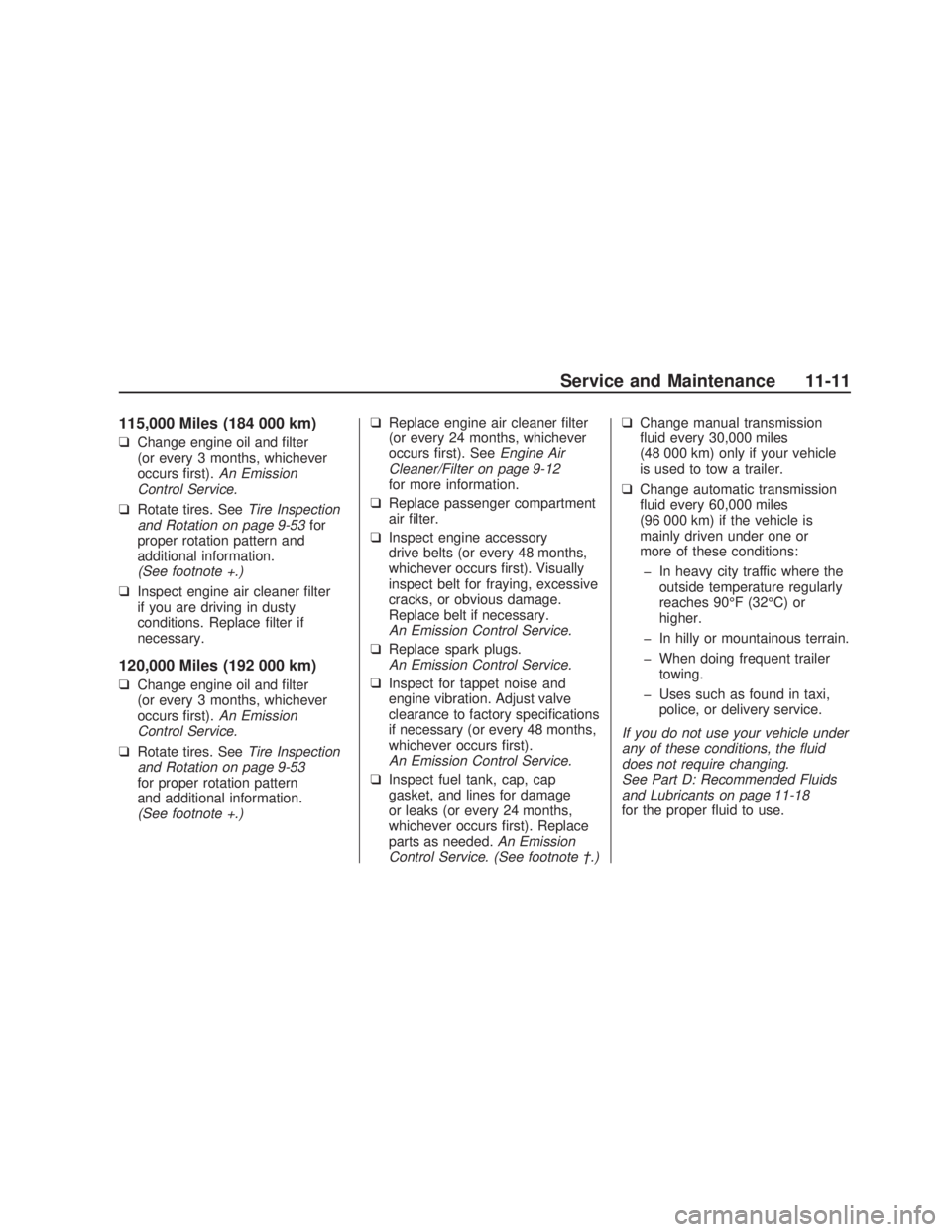
115,000 Miles (184 000 km)
❑Change engine oil and lter
(or every 3 months, whichever
occurs rst).An Emission
Control Service.
❑Rotate tires. SeeTire Inspection
and Rotation on page 9-53for
proper rotation pattern and
additional information.
(See footnote +.)
❑Inspect engine air cleaner lter
if you are driving in dusty
conditions. Replace lter if
necessary.
120,000 Miles (192 000 km)
❑Change engine oil and lter
(or every 3 months, whichever
occurs rst).An Emission
Control Service.
❑Rotate tires. SeeTire Inspection
and Rotation on page 9-53
for proper rotation pattern
and additional information.
(See footnote +.)❑Replace engine air cleaner lter
(or every 24 months, whichever
occurs rst). SeeEngine Air
Cleaner/Filter on page 9-12
for more information.
❑Replace passenger compartment
air lter.
❑Inspect engine accessory
drive belts (or every 48 months,
whichever occurs rst). Visually
inspect belt for fraying, excessive
cracks, or obvious damage.
Replace belt if necessary.
An Emission Control Service.
❑Replace spark plugs.
An Emission Control Service.
❑Inspect for tappet noise and
engine vibration. Adjust valve
clearance to factory specications
if necessary (or every 48 months,
whichever occurs rst).
An Emission Control Service.
❑Inspect fuel tank, cap, cap
gasket, and lines for damage
or leaks (or every 24 months,
whichever occurs rst). Replace
parts as needed.An Emission
Control Service. (See footnote †.)❑Change manual transmission
uid every 30,000 miles
(48 000 km) only if your vehicle
is used to tow a trailer.
❑Change automatic transmission
uid every 60,000 miles
(96 000 km) if the vehicle is
mainly driven under one or
more of these conditions:
In heavy city traffic where the
outside temperature regularly
reaches 90°F (32°C) or
higher.
In hilly or mountainous terrain.
When doing frequent trailer
towing.
Uses such as found in taxi,
police, or delivery service.
If you do not use your vehicle under
any of these conditions, the fluid
does not require changing.
See Part D: Recommended Fluids
and Lubricants on page 11-18
for the proper uid to use.
Service and Maintenance 11-11
2009 - Pontiac Vibe Owner Manual