automatic transmission PONTIAC VIBE 2010 User Guide
[x] Cancel search | Manufacturer: PONTIAC, Model Year: 2010, Model line: VIBE, Model: PONTIAC VIBE 2010Pages: 318, PDF Size: 1.7 MB
Page 163 of 318
The number displayed in the
instrument cluster is the highest
gear that the transmission will
be allowed to operate in. However,
your vehicle can automatically
shift to lower gears as required
by various driving conditions.
This means that all gears below
that number are available.
The display in the instrument cluster
will change from the currently
displayed message to 4 (Fourth)
when you enter S (Shift Control), and
change to indicate the requested
gear range when moving the shift
lever forward or rearward.
While using the DSC feature the
transmission will have firmer shifting
and sportier performance. You can
use this for sport driving or when
climbing hills to stay in gear longer
or to downshift for more power or
engine braking.The transmission will only allow
shifting into gears appropriate
for the vehicles speed and engine
revolutions per minute (RPM):
•The transmission will not
automatically shift to the next
higher gear if the vehicle speed
or engine RPM is too high.
•The transmission will not allow
shifting to the next lower gear if
the vehicle speed or engine RPM
is too high. An audible warning
will sound and the downshift will
not be allowed. The downshift
request will have to be made
again once the vehicle reaches
an acceptable speed.
Downshift
Requested Required
Vehicle Speed
4 (Fourth) to
3 (Third) Below 95 mph
(153 km/h)
3 (Third) to
2 (Second) Below 60 mph
(97 km/h)
2 (Second) to
1 (First) Below 30 mph
(48 km/h)
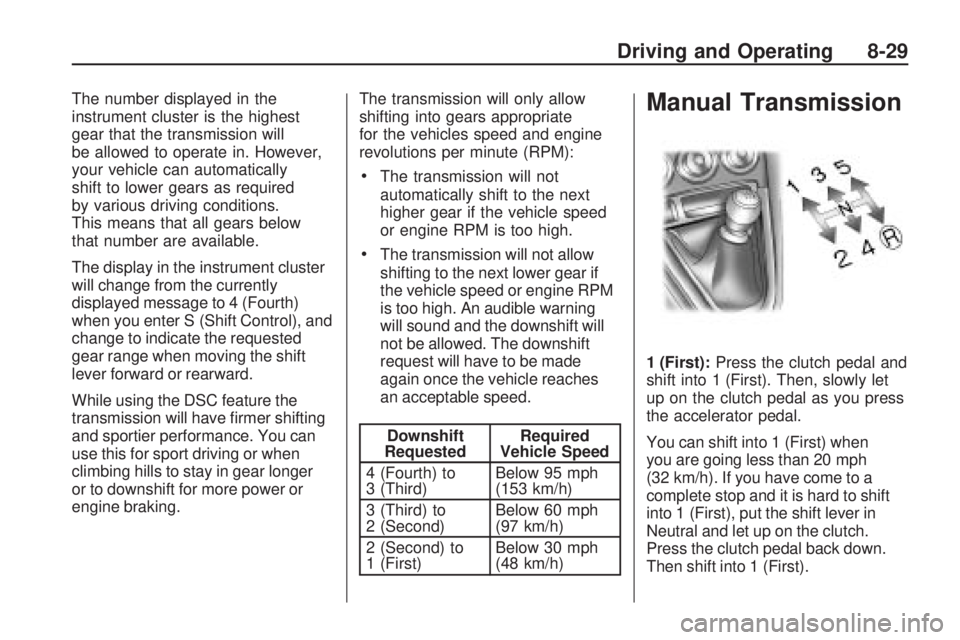
Manual Transmission
1 (First):
Press the clutch pedal and
shift into 1 (First). Then, slowly let
up on the clutch pedal as you press
the accelerator pedal.
You can shift into 1 (First) when
you are going less than 20 mph
(32 km/h). If you have come to a
complete stop and it is hard to shift
into 1 (First), put the shift lever in
Neutral and let up on the clutch.
Press the clutch pedal back down.
Then shift into 1 (First).
Driving and Operating 8-29
Page 165 of 318
Manual Transmission
Recommended Shift Speeds
Engine1.8L
1to2 34 mph
(55 km/h)
2to3 56 mph
(91 km/h)
3to4 82 mph
(132 km/h)
4to5 121 mph
(195 km/h)
Engine 2.4L
1to2 31 mph
(50 km/h)
2to3 53 mph
(86 km/h)
3to4 82 mph
(132 km/h)
4to5 112 mph
(181 km/h)
If vehicle speed drops below 20 mph
(32 km/h), or if the engine is not
running smoothly, you should
downshift to the next lower gear.
You may have to downshift two or
more gears to keep the engine
running smoothly or for good
performance.Drive Systems
All-Wheel Drive
With this feature, engine power is
sent to all four wheels at all times.
This is like four-wheel drive, but there
is no separate lever or switch to
engage or disengage the rear axle.
It is fully automatic, and adjusts itself
as needed for road conditions.
Driving and Operating 8-31
Page 179 of 318
•Vehicles with an automatic
transmission can tow in D (Drive).
Shift the transmission to a lower
gear if the transmission shifts too
often under heavy loads and/or
hilly conditions. For vehicles with
a manual transmission, it is better
not to use the highest gear.
•Use the Sport Shift mode and the
cruise control when towing.
•Obey speed limit restrictions
when towing a trailer. Do not drive
faster than the maximum posted
speed for trailers, or no more than
90 km/h (55 mph), to save wear
on the vehicle’s parts.
Driving with a Trailer
Towing a trailer requires a certain
amount of experience. Get to know
the rig before setting out for the open
road. Get acquainted with the feel of
handling and braking with the added
weight of the trailer. And always keep
in mind that the vehicle you are
driving is now longer and not as
responsive as the vehicle is by itself.Before starting, check all trailer
hitch parts and attachments, safety
chains, electrical connectors, lamps,
tires and mirror adjustments. If the
trailer has electric brakes, start the
vehicle and trailer moving and then
apply the trailer brake controller by
hand to be sure the brakes are
working. This checks the electrical
connection at the same time.
During the trip, check occasionally
to be sure that the load is secure,
and that the lamps and any
trailer brakes are still working.
Towing with StabiliTrak
When towing, the sound of the
StabiliTrak modulator might
be heard. StabiliTrak is reacting to
the vehicle movement caused
by the trailer, which mainly occurs
during cornering. This is normal
when towing heavier trailers.
Following Distance
Stay at least twice as far behind the
vehicle ahead as you would when
driving the vehicle without a trailer.
This can help to avoid situations that
require heavy braking and sudden
turns.
Passing
More passing distance is needed
when towing a trailer. Because the
rig is longer, it is necessary to go
much farther beyond the passed
vehicle before returning to the lane.
Backing Up
Hold the bottom of the steering wheel
with one hand. Then, to move the
trailer to the left, move that hand to
the left. To move the trailer to the
right, move your hand to the right.
Always back up slowly and, if
possible, have someone guide you.
Driving and Operating 8-45
Page 180 of 318
Making Turns
Notice:Making very sharp turns
while trailering could cause the
trailer to come in contact with the
vehicle. The vehicle could be
damaged. Avoid making very
sharp turns while trailering.
When turning with a trailer, make
wider turns than normal. Do this so
the trailer won’t strike soft shoulders,
curbs, road signs, trees or other
objects. Avoid jerky or sudden
maneuvers. Signal well in advance.
Turn Signals When Towing a
Trailer
The arrows on the instrument panel
flash whenever signaling a turn or
lane change. Properly hooked up,
the trailer lamps also flash, telling
other drivers the vehicle is turning,
changing lanes or stopping. When towing a trailer, the arrows on
the instrument panel flash for turns
even if the bulbs on the trailer are
burned out. For this reason you may
think other drivers are seeing the
signal when they are not. It is
important to check occasionally to be
sure the trailer bulbs are still working.
Driving On Grades
Reduce speed and shift to a lower
gear before starting down a long or
steep downgrade. If the transmission
is not shifted down, the brakes
might have to be used so much that
they would get hot and no longer
work well.
Vehicles with an automatic
transmission can tow in D (Drive).
Shift the transmission to a lower gear
if the transmission shifts too often
under heavy loads and/or hilly
conditions. For vehicles with a
manual transmission, it is better
not to use the highest gear.When towing at high altitude on
steep uphill grades, consider the
following: Engine coolant will boil at a
lower temperature than at normal
altitudes. If the engine is turned off
immediately after towing at high
altitude on steep uphill grades, the
vehicle may show signs similar to
engine overheating. To avoid this,
let the engine run while parked,
preferably on level ground, with the
automatic transmission in P (Park)
for a few minutes before turning the
engine off. For vehicles with manual
transmissions, let the engine run
while parked, preferably on level
ground, with the transmission out of
gear and the parking brake applied,
for a few minutes before turning the
engine off. If the overheat warning
comes on, see
Engine Overheating
on page 9-23.
8-46 Driving and Operating
Page 181 of 318
Parking on Hills
{CAUTION
Parking the vehicle on a hill with
the trailer attached can be
dangerous. If something goes
wrong, the rig could start to move.
People can be injured, and both
the vehicle and the trailer can be
damaged. When possible, always
park the rig on a flat surface.
If parking the rig on a hill:
1. Press the brake pedal, but do not shift into P (Park) yet for vehicles
with an automatic transmission,
or into gear for vehicles with a
manual transmission. Turn the
wheels into the curb if facing
downhill or into traffic if facing
uphill.
2. Have someone place chocks under the trailer wheels. 3. When the wheel chocks are in
place, release the brake pedal
until the chocks absorb the load.
4. Reapply the brake pedal. Then apply the parking brake and
shift into P (Park) for vehicles
with an automatic transmission
or into gear for vehicles with
a manual transmission.
5. Release the brake pedal.
Leaving After Parking on
a Hill
1. Apply and hold the brake pedal while you:
•start the engine,
•shift into a gear, and
•release the parking brake.
2. Let up on the brake pedal.
3. Drive slowly until the trailer is clear of the chocks.
4. Stop and have someone pick up and store the chocks.
Maintenance When Trailer
Towing
The vehicle needs service more
often when pulling a trailer. See this
manual’s Maintenance Schedule or
Index for more information. Things
that are especially important in trailer
operation are automatic transmission
fluid, engine oil, axle lubricant, belts,
cooling system and brake system.
It is a good idea to inspect these
before and during the trip.
Check periodically to see that all
hitch nuts and bolts are tight.
Engine Cooling When Trailer
Towing
The cooling system may temporarily
overheat during severe operating
conditions. See Engine Overheating
on page 9-23.
Driving and Operating 8-47
Page 185 of 318
Vehicle Care
General InformationGeneral Information..............
.9-2
California Proposition 65 Warning ........................
.9-2
California Perchlorate Materials Requirements ........9-3
Accessories and Modifications ......................
.9-3
Vehicle ChecksDoing Your Own
Service Work .....................
.9-4
Hood ..................................
.9-5
Engine Compartment Overview ...........................
.9-6
Engine Oil ...........................
.9-9
Automatic Transmission Fluid ...............................
.9-12
Manual Transmission Fluid . . . .9-14
Hydraulic Clutch .................
.9-15
Engine Air Cleaner/Filter .......9-16
Cooling System ..................
.9-19
Engine Coolant ..................
.9-19Engine Overheating
.............9-23
Power Steering Fluid ............9-24
Washer Fluid .....................
.9-24
Brakes ..............................
.9-26
Brake Fluid ........................
.9-27
Battery ..............................
.9-28
All-Wheel Drive ..................
.9-29
Starter Switch Check ............9-30
Wiper Blade Replacement .....9-30
Headlamp AimingHeadlamp Aiming...............
.9-32
Bulb ReplacementBulb Replacement ..............
.9-33
Halogen Bulbs ...................
.9-33
Headlamps and Parking Lamps .............................
.9-33
Taillamps ...........................
.9-35
License Plate Lamp .............9-36
Replacement Bulbs .............
.9-37
Electrical SystemElectrical System Overload . . . .9-37
Fuses and Circuit Breakers . . .9-38
Engine Compartment Fuse Block ..............................
.9-38
Instrument Panel Fuse Block ..............................
.9-41
Wheels and TiresTires.................................
.9-43
Tire Sidewall Labeling ..........9-44
Tire Designations ................
.9-46
Tire Terminology and Definitions ........................
.9-46
Tire Pressure .....................
.9-49
Tire Pressure Monitor System ............................
.9-50
Tire Pressure Monitor Operation .........................
.9-52
Tire Inspection ...................
.9-54
Tire Rotation ......................
.9-55
When It Is Time for New Tires ...............................
.9-56
Buying New Tires ...............
.9-56
Different Size Tires and Wheels ............................
.9-58
Uniform Tire Quality Grading ...........................
.9-58
Wheel Alignment and Tire Balance ...........................
.9-60
Wheel Replacement .............9-60
Tire Chains ........................
.9-61
If a Tire Goes Flat ..............
.9-62
Tire Changing ....................
.9-63
Compact Spare Tire .............9-68
Vehicle Care 9-1
Page 191 of 318
A. Engine Oil Dipstick. See″Checking Engine Oil ″under
Engine Oil on page 9-9 .
B. Engine Coolant on page 9-19 .
C. Washer Fluid on page 9-24 .
D. Coolant Recovery Tank. See Engine Coolant on
page 9-19.
E. Engine Oil Fill Cap. See “When to Add Engine Oil” under Engine
Oil on page 9-9.
F. Engine Air Cleaner/Filter on
page 9-16. G.
Brakes on page 9-26 and
Hydraulic Clutch on page 9-15
(If Equipped).
H. Engine Compartment Fuse Block.
I. Battery on page 9-28 .
J. Remote Positive (+) Terminal. See Jump Starting.
K. Automatic Transmission Fluid Dipstick. See ″Checking the
Fluid Level″ underAutomatic
Transmission Fluid on page 9-12
(If Equipped) (Out of View).
Vehicle Care 9-7
Page 193 of 318
A. Engine Oil Dipstick. See“Checking Engine Oil” under
Engine Oil on page 9-9 .
B. Engine Coolant on page 9-19 .
C. Washer Fluid on page 9-24 .
D. Coolant Recovery Tank. See Engine Coolant on
page 9-19.
E. Engine Oil Fill Cap. See “When to Add Engine Oil” under Engine
Oil on page 9-9.
F. Brakes on page 9-26 and
Hydraulic Clutch on page 9-15
(If Equipped). G.
Engine Air Cleaner/Filter on
page 9-16.
H. Engine Compartment Fuse Block.
I. Battery on page 9-28 .
J. Remote Positive (+) Terminal. See Jump Starting.
K. Automatic Transmission Fluid Dipstick. See ″Checking the
Fluid Level″ underAutomatic
Transmission Fluid on page 9-12
(If Equipped) (Out of View).Engine Oil
Checking Engine Oil
It is a good idea to check the
engine oil level at each fuel fill.
In order to get an accurate reading,
the oil must be warm and the
vehicle must be on level ground.
The engine oil dipstick handle
is a yellow loop. See Engine
Compartment Overview on page 9-6
for the location of the engine oil
dipstick.
1. Turn off the engine and give the oil several minutes to drain back
into the oil pan. If this is not done,
the oil dipstick might not show the
actual level.
2. Pull out the dipstick and clean it with a paper towel or cloth,
then push it back in all the way.
Remove it again, keeping the tip
down, and check the level.
Vehicle Care 9-9
Page 196 of 318
What to Do with Used Oil
Used engine oil contains certain
elements that can be unhealthy for
your skin and could even cause
cancer. Do not let used oil stay on
your skin for very long. Clean your
skin and nails with soap and water,
or a good hand cleaner. Wash or
properly dispose of clothing or rags
containing used engine oil. See the
manufacturer’s warnings about the
use and disposal of oil products.
Used oil can be a threat to the
environment. If you change your own
oil, be sure to drain all the oil from the
filter before disposal. Never dispose
of oil by putting it in the trash, pouring
it on the ground, into sewers, or into
streams or bodies of water. Recycle
it by taking it to a place that collects
used oil.
Automatic Transmission
Fluid
When to Check and Change
Automatic Transmission Fluid
Check the fluid in the transmission
and differential at the intervals listed
inScheduled Maintenance on
page 10-3, and be sure to use
the transmission fluid listed in
Recommended Fluids and
Lubricants on page 10-15 .
How to Check Automatic
Transmission Fluid
This operation can be difficult, you
may choose to have this done at the
dealer/retailer service department.
If you do it yourself, be sure to
follow all the instructions here,
or you could get a false reading
on the dipstick. Wait at least 30 minutes before
checking the transmission fluid level
if you have been driving:
•When outside temperatures are
above 90°F (32°C).
•At high speed for quite a while.
•In heavy traffic — especially
in hot weather.
•While pulling a trailer.
To get the right reading, the fluid
should be at normal operating
temperature, which is 158°F to
176°F (70°C to 80°C).
Get the vehicle warmed up by
driving about 15 miles (24 km)
when outside temperatures
are above 50°F (10°C). If it is
colder than 50°F (10°C), you
may have to drive longer.
9-12 Vehicle Care
Page 197 of 318
Checking the Fluid Level
Prepare your vehicle as follows:
1. Park your vehicle on a levelplace. Keep the engine running.
2. With the parking brake applied, place the shift lever in P (Park).
3. With your foot on the brake pedal, move the shift lever
through each gear range,
pausing for about three seconds
in each range. Then, position
the shift lever in P (Park).
4. Let the engine run at idle for three to five minutes. Then, without shutting off the
engine, follow these steps:
The automatic transmission
dipstick has an orange handle
and is located near the front of the
engine compartment. See
Engine
Compartment Overview on page 9-6
for more information on location.
1. Release the tab and pull out the dipstick and wipe it with a clean
rag or paper towel.
2. Push it back in all the way, wait three seconds and then pull it
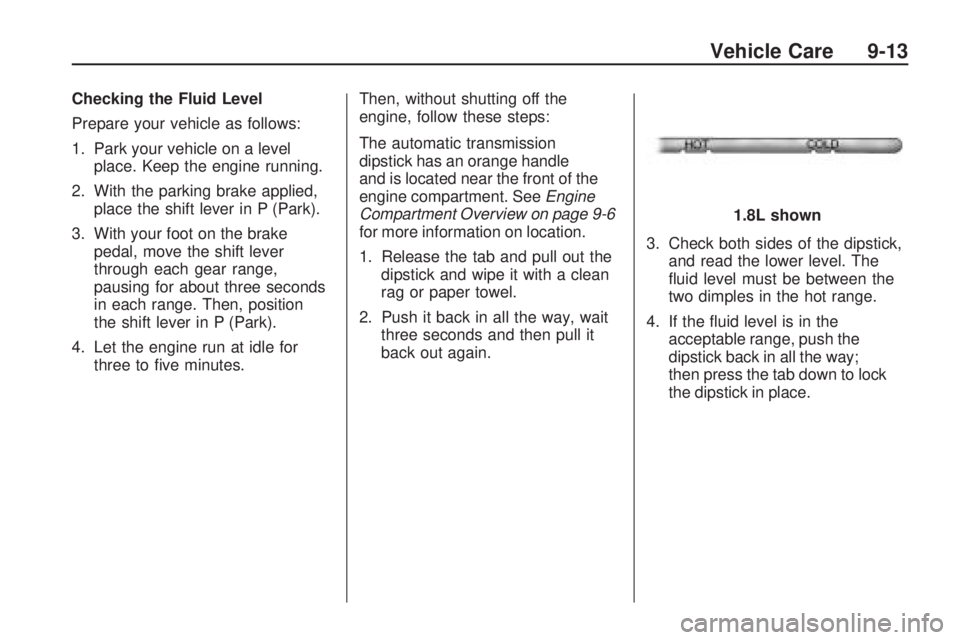
back out again. 3. Check both sides of the dipstick,
and read the lower level. The
fluid level must be between the
two dimples in the hot range.
4. If the fluid level is in the acceptable range, push the
dipstick back in all the way;
then press the tab down to lock
the dipstick in place. 1.8L shown
Vehicle Care 9-13