traction control PONTIAC VIBE 2010 User Guide
[x] Cancel search | Manufacturer: PONTIAC, Model Year: 2010, Model line: VIBE, Model: PONTIAC VIBE 2010Pages: 318, PDF Size: 1.7 MB
Page 167 of 318
Parking Brake
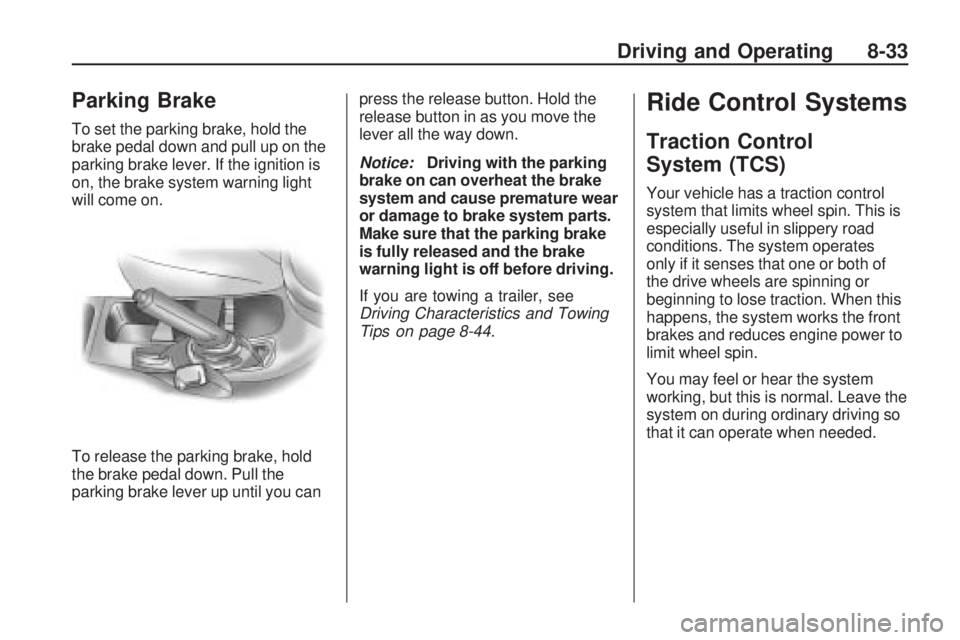
To set the parking brake, hold the
brake pedal down and pull up on the
parking brake lever. If the ignition is
on, the brake system warning light
will come on.
To release the parking brake, hold
the brake pedal down. Pull the
parking brake lever up until you canpress the release button. Hold the
release button in as you move the
lever all the way down.
Notice:
Driving with the parking
brake on can overheat the brake
system and cause premature wear
or damage to brake system parts.
Make sure that the parking brake
is fully released and the brake
warning light is off before driving.
If you are towing a trailer, see
Driving Characteristics and Towing
Tips on page 8-44.
Ride Control Systems
Traction Control
System (TCS)
Your vehicle has a traction control
system that limits wheel spin. This is
especially useful in slippery road
conditions. The system operates
only if it senses that one or both of
the drive wheels are spinning or
beginning to lose traction. When this
happens, the system works the front
brakes and reduces engine power to
limit wheel spin.
You may feel or hear the system
working, but this is normal. Leave the
system on during ordinary driving so
that it can operate when needed.
Driving and Operating 8-33
Page 168 of 318
When the ignition is turned to
ON/RUN, the system automatically
turns on. If the system has been
turned off, it will automatically turn on
at 55 km/h (35 mph). TCS cannot be
turned off above 55 km/h (35 mph).
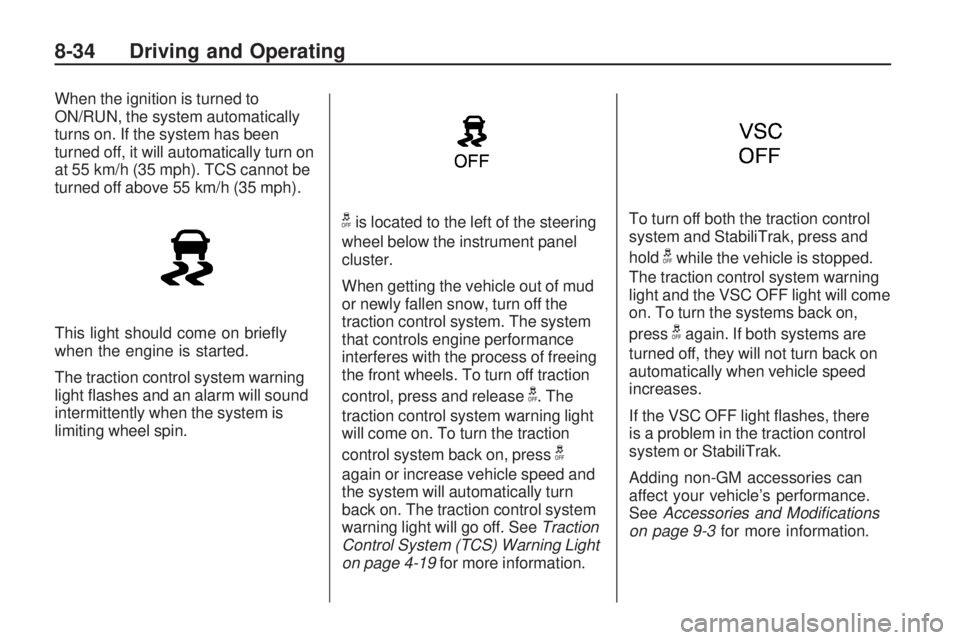
This light should come on briefly
when the engine is started.
The traction control system warning
light flashes and an alarm will sound
intermittently when the system is
limiting wheel spin.
gis located to the left of the steering
wheel below the instrument panel
cluster.
When getting the vehicle out of mud
or newly fallen snow, turn off the
traction control system. The system
that controls engine performance
interferes with the process of freeing
the front wheels. To turn off traction
control, press and release
g. The
traction control system warning light
will come on. To turn the traction
control system back on, press
g
again or increase vehicle speed and
the system will automatically turn
back on. The traction control system
warning light will go off. See Traction
Control System (TCS) Warning Light
on page 4-19 for more information. To turn off both the traction control
system and StabiliTrak, press and
hold
gwhile the vehicle is stopped.
The traction control system warning
light and the VSC OFF light will come
on. To turn the systems back on,
press
gagain. If both systems are
turned off, they will not turn back on
automatically when vehicle speed
increases.
If the VSC OFF light flashes, there
is a problem in the traction control
system or StabiliTrak.
Adding non-GM accessories can
affect your vehicle’s performance.
See Accessories and Modications
on page 9-3 for more information.
8-34 Driving and Operating
Page 169 of 318
StabiliTrak System
The vehicle has the StabiliTrak
system which combines antilock
brake, traction and stability control
systems. This system automatically
controls the brakes and engine to
help prevent the vehicle from
skidding when cornering on a
slippery road surface or turning
the steering wheel abruptly.
This system activates when the
vehicle speed reaches or exceeds
15 km/h (9 mph), and deactivates
when the vehicle speed reduces to
below 15 km/h (9 mph).
A sound may be heard in the engine
compartment for a few seconds
when the engine is started or just
after the vehicle begins to move.
This means that the system is in
the self-check mode, but does not
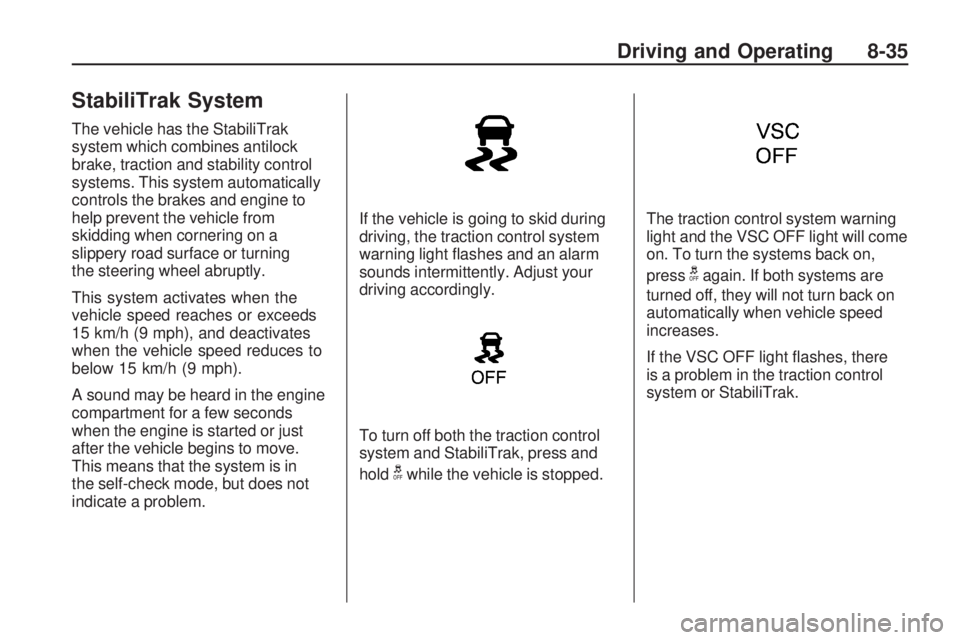
indicate a problem.If the vehicle is going to skid during
driving, the traction control system
warning light flashes and an alarm
sounds intermittently. Adjust your
driving accordingly.
To turn off both the traction control
system and StabiliTrak, press and
hold
gwhile the vehicle is stopped.
The traction control system warning
light and the VSC OFF light will come
on. To turn the systems back on,
press
gagain. If both systems are
turned off, they will not turn back on
automatically when vehicle speed
increases.
If the VSC OFF light flashes, there
is a problem in the traction control
system or StabiliTrak.
Driving and Operating 8-35
Page 170 of 318
Cruise Control
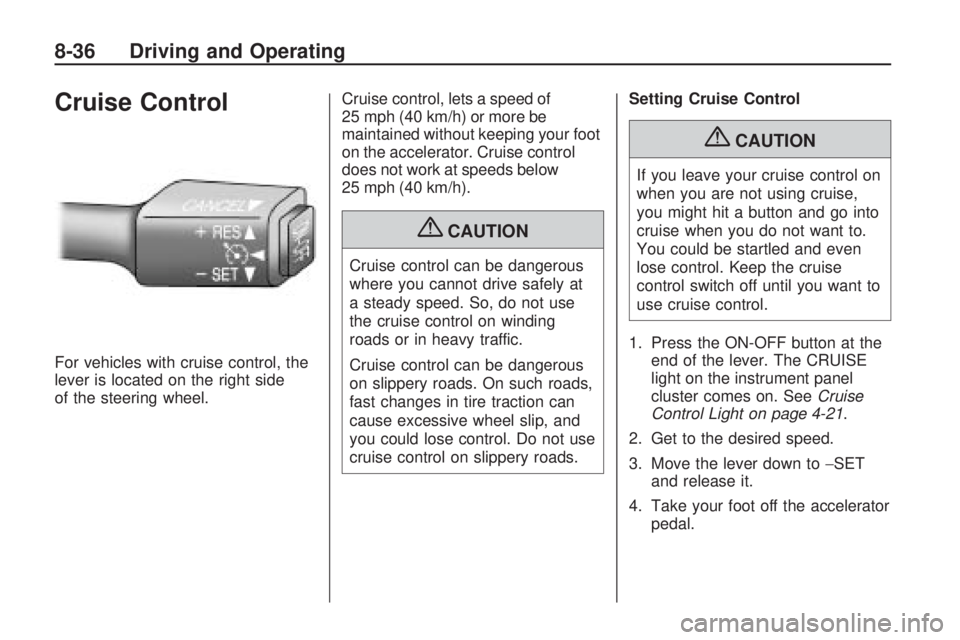
For vehicles with cruise control, the
lever is located on the right side
of the steering wheel.Cruise control, lets a speed of
25 mph (40 km/h) or more be
maintained without keeping your foot
on the accelerator. Cruise control
does not work at speeds below
25 mph (40 km/h).
{CAUTION
Cruise control can be dangerous
where you cannot drive safely at
a steady speed. So, do not use
the cruise control on winding
roads or in heavy traffic.
Cruise control can be dangerous
on slippery roads. On such roads,
fast changes in tire traction can
cause excessive wheel slip, and
you could lose control. Do not use
cruise control on slippery roads.Setting Cruise Control
{CAUTION
If you leave your cruise control on
when you are not using cruise,
you might hit a button and go into
cruise when you do not want to.
You could be startled and even
lose control. Keep the cruise
control switch off until you want to
use cruise control.
1. Press the ON-OFF button at the end of the lever. The CRUISE
light on the instrument panel
cluster comes on. See Cruise
Control Light on page 4-21 .
2. Get to the desired speed.
3. Move the lever down to −SET
and release it.
4. Take your foot off the accelerator pedal.
8-36 Driving and Operating
Page 187 of 318
California Perchlorate
Materials Requirements
Certain types of automotive
applications, such as airbag
initiators, seat belt pretensioners,
and lithium batteries contained
in remote keyless transmitters,
may contain perchlorate materials.
Special handling may be necessary.
For additional information, see
www.dtsc.ca.gov/hazardouswaste/
perchlorate.
Accessories and
Modications
When non-dealer/non-retailer
accessories are added to the vehicle,
they can affect vehicle performance
and safety, including such things
as airbags, braking, stability, ride
and handling, emissions systems,
aerodynamics, durability, and
electronic systems like antilock
brakes, traction control, and stability
control. Some of these accessories
could even cause malfunction or
damage not covered by the vehicle
warranty.Damage to vehicle components
resulting from the installation or use
of non-GM certified parts, including
control module modifications, are
not covered under the terms of the
vehicle warranty and may affect
remaining warranty coverage for
affected parts.
GM Accessories are designed
to complement and function with
other systems on the vehicle.
Your GM dealer/retailer can
accessorize the vehicle using
genuine GM Accessories.
Vehicle Care 9-3
Page 242 of 318
Different Size Tires and
Wheels
If you add wheels or tires that are
a different size than your original
equipment wheels and tires, this
could affect the way your vehicle
performs, including its braking,
ride and handling characteristics,
stability, and resistance to rollover.
Additionally, if your vehicle has
electronic systems such as anti-lock
brakes, traction control, and
electronic stability control, the
performance of these systems
can be affected.
SeeBuying New Tires on page 9-56
and Accessories and Modications
on page 9-3 for additional
information.
Uniform Tire Quality
Grading
Quality grades can be found
where applicable on the tire
sidewall between tread shoulder
and maximum section width.
For example:
Treadwear 200 Traction AA
Temperature A
The following information relates
to the system developed by the
United States National Highway
Traffic Safety Administration
(NHTSA), which grades tires
by treadwear, traction, and
temperature performance.
This applies only to vehicles
sold in the United States. The grades are molded on
the sidewalls of most passenger
car tires. The Uniform Tire
Quality Grading (UTQG) system
does not apply to deep tread,
winter-type snow tires,
space-saver, or temporary
use spare tires, tires with nominal
rim diameters of 10 to 12 inches
(25 to 30 cm), or to some
limited-production tires.
While the tires available on
General Motors passenger
cars and light trucks may vary
with respect to these grades,
they must also conform to
federal safety requirements
and additional General Motors
Tire Performance Criteria (TPC)
standards.
9-58 Vehicle Care
Page 243 of 318
Treadwear
The treadwear grade is a
comparative rating based on the
wear rate of the tire when tested
under controlled conditions on
a specified government test
course. For example, a tire
graded 150 would wear one
and a half (1.5) times as well
on the government course as
a tire graded 100. The relative
performance of tires depends
upon the actual conditions of
their use, however, and may
depart significantly from the
norm due to variations in driving
habits, service practices,
and differences in road
characteristics and climate.Traction – AA, A, B, C
The traction grades, from
highest to lowest, are AA, A, B,
and C. Those grades represent
the tire’s ability to stop on wet
pavement as measured under
controlled conditions on specified
government test surfaces of
asphalt and concrete. A tire
marked C may have poor traction
performance.
Temperature – A, B, C
The temperature grades
are A (the highest), B, and C,
representing the tire’s resistance
to the generation of heat and
its ability to dissipate heat
when tested under controlled
conditions on a specified indoor
laboratory test wheel. Sustained
high temperature can cause thematerial of the tire to degenerate
and reduce tire life, and
excessive temperature can
lead to sudden tire failure.
The grade C corresponds to a
level of performance which all
passenger car tires must meet
under the Federal Motor Vehicle
Safety Standard No. 109.
Grades B and A represent
higher levels of performance
on the laboratory test wheel than
the minimum required by law.
It should be noted that the
temperature grade for this tire
is established for a tire that
is properly inflated and not
overloaded. Excessive speed,
underinflation, or excessive
loading, either separately or in
combination, can cause heat
buildup and possible tire failure.
Vehicle Care 9-59
Page 245 of 318
Used Replacement Wheels
{CAUTION
Putting a used wheel on the
vehicle is dangerous. You cannot
know how it has been used or how
far it has been driven. It could fail
suddenly and cause a crash. If you
have to replace a wheel, use a
new GM original equipment wheel.
Tire Chains
{CAUTION
If the vehicle has P215/45R18
size tires, do not use tire chains.
There is not enough clearance.
Tire chains used on a vehicle
without the proper amount of
clearance can cause damage to(Continued)
CAUTION (Continued)
the brakes, suspension or other
vehicle parts. The area damaged
by the tire chains could cause you
to lose control of the vehicle and
you or others may be injured in a
crash.
Use another type of traction
device only if its manufacturer
recommends it for use on the
vehicle and tire size combination
and road conditions. Follow that
manufacturer’s instructions.
To help avoid damage to the
vehicle, drive slowly, readjust
or remove the device if it is
contacting the vehicle, and
do not spin the wheels.
If you do find traction devices that
will fit, install them on the front
tires. Notice:
If the vehicle has a tire
size other than P215/45R18 size
tires, use tire chains only where
legal and only when you must.
Use only SAE Class “S” type
chains that are the proper size
for the tires. Install them on the
front tires and tighten them as
tightly as possible with the
ends securely fastened. Drive
slowly and follow the chain
manufacturer’s instructions. If you
can hear the chains contacting the
vehicle, stop and retighten them.
If the contact continues, slow
down until it stops. Driving too
fast or spinning the wheels with
chains on will damage the vehicle.
Vehicle Care 9-61
Page 314 of 318
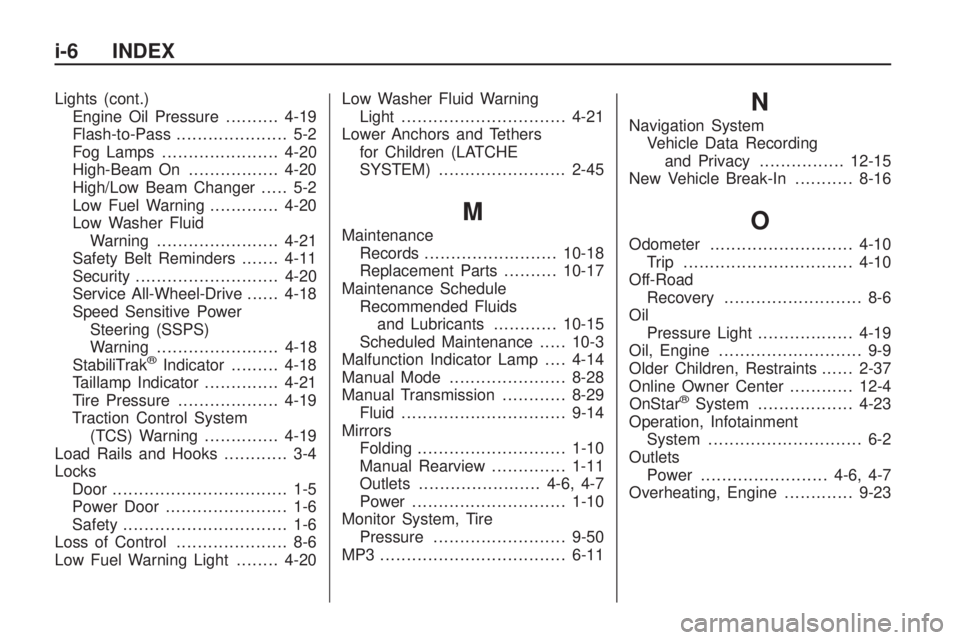
Lights (cont.)Engine Oil Pressure ..........4-19
Flash-to-Pass ..................... 5-2
Fog Lamps ...................... 4-20
High-Beam On .................4-20
High/Low Beam Changer ..... 5-2
Low Fuel Warning .............4-20
Low Washer Fluid Warning ....................... 4-21
Safety Belt Reminders .......4-11
Security ........................... 4-20
Service All-Wheel-Drive ......4-18
Speed Sensitive Power Steering (SSPS)
Warning ....................... 4-18
StabiliTrak
®Indicator .........4-18
Taillamp Indicator ..............4-21
Tire Pressure ................... 4-19
Traction Control System (TCS) Warning ..............4-19
Load Rails and Hooks ............ 3-4
Locks Door ................................. 1-5
Power Door ....................... 1-6
Safety ............................... 1-6
Loss of Control ..................... 8-6
Low Fuel Warning Light ........4-20 Low Washer Fluid Warning
Light ............................... 4-21
Lower Anchors and Tethers for Children (LATCHE
SYSTEM) ........................ 2-45
M
Maintenance
Records ......................... 10-18
Replacement Parts ..........10-17
Maintenance Schedule Recommended Fluidsand Lubricants ............10-15
Scheduled Maintenance .....10-3
Malfunction Indicator Lamp ....4-14
Manual Mode ...................... 8-28
Manual Transmission ............8-29
Fluid ............................... 9-14
Mirrors Folding ............................ 1-10
Manual Rearview ..............1-11
Outlets ....................... 4-6, 4-7
Power ............................. 1-10
Monitor System, Tire Pressure ......................... 9-50
MP3 ................................... 6-11
N
Navigation System
Vehicle Data Recordingand Privacy ................12-15
New Vehicle Break-In ...........8-16
O
Odometer ........................... 4-10
Trip ................................ 4-10
Off-Road Recovery .......................... 8-6
Oil Pressure Light ..................4-19
Oil, Engine ........................... 9-9
Older Children, Restraints ......2-37
Online Owner Center ............12-4
OnStar
®System .................. 4-23
Operation, Infotainment System ............................. 6-2
Outlets Power ........................ 4-6, 4-7
Overheating, Engine .............9-23
i-6 INDEX
Page 317 of 318
T
Tachometer......................... 4-10
Taillamp Indicator Light .........4-21
Taillamps ............................ 9-35
Text Telephone (TTY) Users ....12-4
Theft-Deterrent Systems ......... 1-9
Immobilizer ........................ 1-9
Tire Pressure ......................... 9-49
Tires Buying New Tires .............9-56
Chains ............................ 9-61
Changing ......................... 9-63
Compact Spare ................9-68
Designations .................... 9-46
Different Size ................... 9-58
If a Tire Goes Flat ............9-62
Inflation Monitor System ....9-52
Inspection ........................ 9-54
Pressure Light ..................4-19
Pressure Monitor System . . . 9-50
Rotation .......................... 9-55
Sidewall Labeling ..............9-44
Terminology and Definitions .................... 9-46
Uniform Tire Quality Grading ....................... 9-58Tires (cont.)
Wheel Alignment andTire Balance .................9-60
Wheel Replacement ..........9-60
When It Is Time for New Tires ............................ 9-56
Towing Driving Characteristics .......8-44
Equipment ....................... 8-49
General Information ...........8-43
Recreational Vehicle ..........9-73
Trailer ............................. 8-48
Vehicle ............................ 9-73
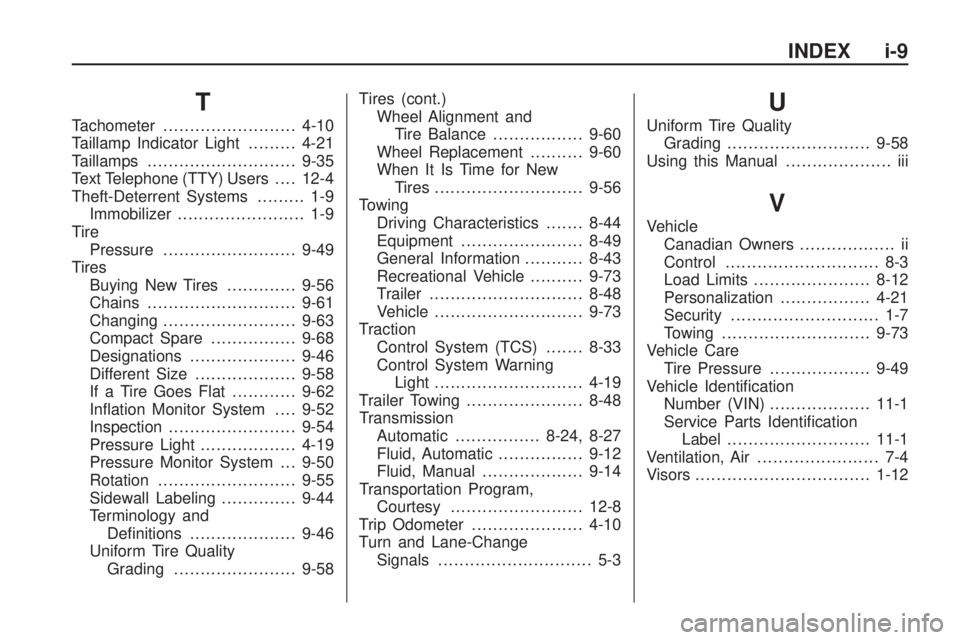
Traction Control System (TCS) .......8-33
Control System Warning Light ............................ 4-19
T
railer Towing ...................... 8-48
Transmission Automatic ................ 8-24, 8-27
Fluid, Automatic ................9-12
Fluid, Manual ................... 9-14
Transportation Program, Courtesy ......................... 12-8
Trip Odometer ..................... 4-10
Turn and Lane-Change Signals ............................. 5-3
U
Uniform Tire Quality
Grading ........................... 9-58
Using this Manual .................... iii
V
Vehicle
Canadian Owners .................. ii
Control ............................. 8-3
Load Limits ...................... 8-12
Personalization .................4-21
Security ............................ 1-7
Towing ............................ 9-73
Vehicle Care Tire Pressure ................... 9-49
Vehicle Identification Number (VIN) ................... 11-1
Service Parts Identification Label ........................... 11-1
Ventilation, Air ....................... 7-4
Visors ................................. 1-12
INDEX i-9