tire pressure PONTIAC VIBE 2010 Owner's Manual
[x] Cancel search | Manufacturer: PONTIAC, Model Year: 2010, Model line: VIBE, Model: PONTIAC VIBE 2010Pages: 318, PDF Size: 1.7 MB
Page 241 of 318
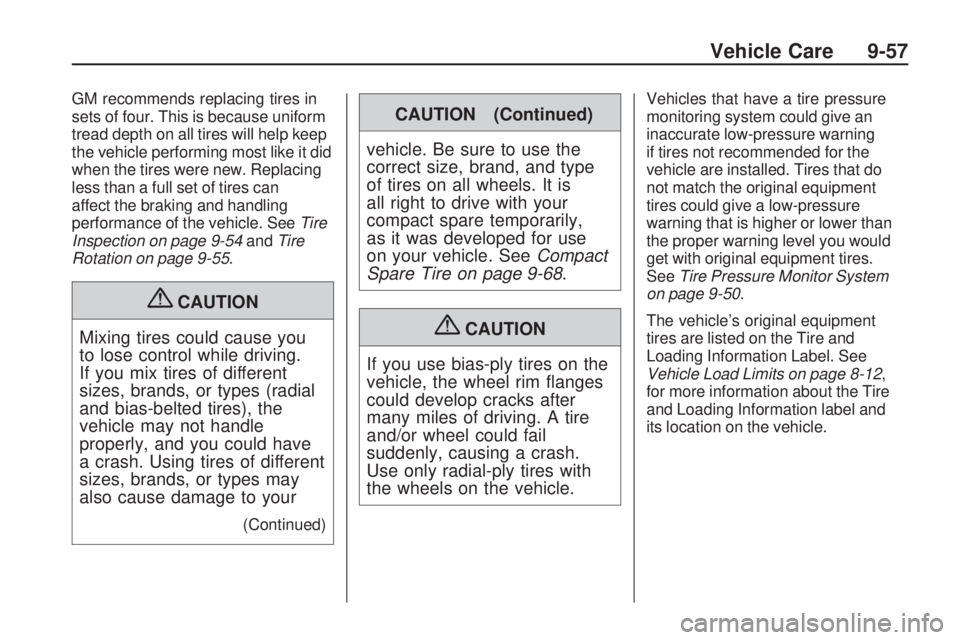
GM recommends replacing tires in
sets of four. This is because uniform
tread depth on all tires will help keep
the vehicle performing most like it did
when the tires were new. Replacing
less than a full set of tires can
affect the braking and handling
performance of the vehicle. SeeTire
Inspection on page 9-54 andTire
Rotation on page 9-55 .
{CAUTION
Mixing tires could cause you
to lose control while driving.
If you mix tires of different
sizes, brands, or types (radial
and bias-belted tires), the
vehicle may not handle
properly, and you could have
a crash. Using tires of different
sizes, brands, or types may
also cause damage to your
(Continued)
CAUTION (Continued)
vehicle. Be sure to use the
correct size, brand, and type
of tires on all wheels. It is
all right to drive with your
compact spare temporarily,
as it was developed for use
on your vehicle. See Compact
Spare Tire on page 9-68.
{CAUTION
If you use bias-ply tires on the
vehicle, the wheel rim flanges
could develop cracks after
many miles of driving. A tire
and/or wheel could fail
suddenly, causing a crash.
Use only radial-ply tires with
the wheels on the vehicle.
Vehicles that have a tire pressure
monitoring system could give an
inaccurate low-pressure warning
if tires not recommended for the
vehicle are installed. Tires that do
not match the original equipment
tires could give a low-pressure
warning that is higher or lower than
the proper warning level you would
get with original equipment tires.
See Tire Pressure Monitor System
on page 9-50.
The vehicle’s original equipment
tires are listed on the Tire and
Loading Information Label. See
Vehicle Load Limits on page 8-12 ,
for more information about the Tire
and Loading Information label and
its location on the vehicle.
Vehicle Care 9-57
Page 252 of 318
Storing the Compact
Spare Tire
{CAUTION
Storing a jack, a tire, or other
equipment in the passenger
compartment of the vehicle could
cause injury. In a sudden stop or
collision, loose equipment could
strike someone. Store all these
in the proper place.
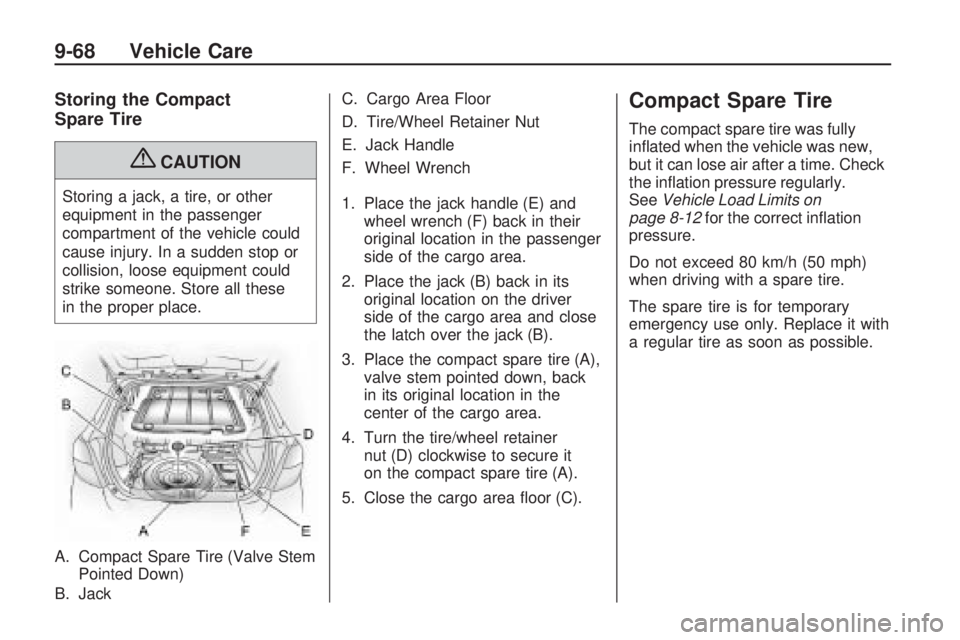
A. Compact Spare Tire (Valve Stem Pointed Down)
B. Jack C. Cargo Area Floor
D. Tire/Wheel Retainer Nut
E. Jack Handle
F. Wheel Wrench
1. Place the jack handle (E) and
wheel wrench (F) back in their
original location in the passenger
side of the cargo area.
2. Place the jack (B) back in its original location on the driver
side of the cargo area and close
the latch over the jack (B).
3. Place the compact spare tire (A), valve stem pointed down, back
in its original location in the
center of the cargo area.
4. Turn the tire/wheel retainer nut (D) clockwise to secure it
on the compact spare tire (A).
5. Close the cargo area floor (C).
Compact Spare Tire
The compact spare tire was fully
inflated when the vehicle was new,
but it can lose air after a time. Check
the inflation pressure regularly.
See Vehicle Load Limits on
page 8-12 for the correct inflation
pressure.
Do not exceed 80 km/h (50 mph)
when driving with a spare tire.
The spare tire is for temporary
emergency use only. Replace it with
a regular tire as soon as possible.
9-68 Vehicle Care
Page 279 of 318

At Each Fuel Fill
It is important to perform these
underhood checks at each fuel ll.
Engine Oil Level Check
Check the engine oil level and
add the proper oil if necessary.
SeeEngine Oil on page 9-9 .
Notice: It is important to check
the engine oil regularly and keep it
at the proper level. Failure to keep
the engine oil at the proper level
can cause damage to the engine
not covered by the vehicle
warranty.
Engine Coolant Level Check
Check the engine coolant level and
add DEX-COOL
®coolant mixture
if necessary. See Engine Coolant
on page 9-19.
Windshield Washer Fluid Level
Check
Check the windshield washer fluid
level in the windshield washer fluid
reservoir and add the proper fluid if
necessary. See Washer Fluid on
page 9-24. Hood Latch Operation Check
Pull the primary hood latch
release handle inside the vehicle.
The secondary latch should keep
the hood from opening all the way
when the primary latch is released.
Make sure the hood closes firmly.
See
Hood on page 9-5.
At Least Once a Month
Tire Ination Check
Inspect the tires and make sure
the tires are inflated to the correct
pressures. Do not forget to check the
spare tire. See Tires on page 9-43.
At Least Twice a Year
Wiper Blade Check
Inspect wiper blades for wear,
cracking, or contamination. Clean
the windshield and wiper blades,
if contaminated. Replace wiper
blades that are worn or damaged.
SeeWiper Blade Replacement on
page 9-30 andExterior Care on
page 9-75 for more information. Weatherstrip Lubrication
Silicone grease on weatherstrips will
make them last longer, seal better,
and not stick or squeak. Apply
silicone grease with a clean cloth.
During very cold, damp weather
more frequent application may be
required. See
Recommended Fluids
and Lubricants on page 10-15 .
Fluid Level Check
Check the power steering pump, rear
axle, transfer case, and automatic
or manual transmission fluid levels
and add as needed. See Automatic
Transmission Fluid on page 9-12
or Manual Transmission Fluid on
page 9-14. Check for leaks. A fluid
loss in these systems could indicate
a problem. Have the system
inspected and repaired at once.
Service and Maintenance 10-11
Page 308 of 318
Radio Frequency
Identication (RFID)
RFID technology is used in some
vehicles for functions such as tire
pressure monitoring and ignition
system security, as well as in
connection with conveniences such
as key fobs for remote door locking/
unlocking and starting, and in-vehicle
transmitters for garage door openers.
RFID technology in GM vehicles
does not use or record personal
information or link with any other
GM system containing personal
information.
Radio Frequency
Statement (US, Can)
This vehicle has systems that
operate on a radio frequency that
comply with Part 15 of the Federal
Communications Commission (FCC)
Rules and with RSS-210/211 of
Industry and Science Canada.
Operation is subject to the following
two conditions:
1. The device may not causeinterference.
2. The device must accept any interference received, including
interference that may cause
undesired operation of the device.
Changes or modifications to any of
these systems by other than an
authorized service facility could void
authorization to use this equipment.
12-16 Customer Information
Page 312 of 318

Engine (cont.)Pressure Light ..................4-19
Running While Parked .......8-24
Starting ........................... 8-18
Entry Lighting ........................ 5-5
Equipment, Towing ...............8-49
Event Data Recorders .........12-14
Extender, Safety Belt ............2-21
Exterior Care ....................... 9-75
Exterior Lamp Controls ........... 5-1
F
Filter
Engine Air Cleaner ............9-16
Flashers, Hazard Warning ....... 5-3
Flash-to-Pass ........................ 5-2
Flat Tire .............................. 9-62
Flat Tire, Changing ...............9-63
Floor Mats .......................... 9-83
Fluid Automatic Transmission .....9-12
Brakes ............................ 9-27
Power Steering .................9-24
Washer ........................... 9-24
Fog Lamps Bulb Replacement .............. 5-4
Light ............................... 4-20Folding Mirrors
....................1-10
Folding Seatback ................... 2-6
Front Seat Position Seats Adjustment ........................ 2-3
Front Seats Adjustment ........................ 2-4
Front Storage ........................ 3-2
Fuel ................................... 8-38
Additives ......................... 8-40
Economy Driving ................ 8-2
Filling a Portable Fuel Container ..................... 8-43
Filling the Tank .................8-41
Fuels in Foreign Countries ..................... 8-40
Gage .............................. 4-10
Gasoline Specifications ......8-39
Low Fuel Warning Light .....4-20
Recommended .................8-39
Requirements, California ....8-39
Fuses Engine Compartment FuseBlock ........................... 9-38
Fuses and Circuit Breakers ...................... 9-38
Instrument Panel Fuse Block ........................... 9-41
G
Gages
Engine CoolantTemperature .................4-11
Fuel ................................ 4-10
Odometer ........................ 4-10
Speedometer ................... 4-10
Tachometer ...................... 4-10
Trip Odometer ..................4-10
Warning Lights and Indicators ....................... 4-8
Gasoline Specifications ................... 8-39
General Information Service and Maintenance . . . 10-1
Towing ............................ 8-43
Vehicle Care ...................... 9-2
Glove Box ............................ 3-1
GM Mobility Reimbursement Program .......................... 12-5
i-4 INDEX
Page 314 of 318
Lights (cont.)Engine Oil Pressure ..........4-19
Flash-to-Pass ..................... 5-2
Fog Lamps ...................... 4-20
High-Beam On .................4-20
High/Low Beam Changer ..... 5-2
Low Fuel Warning .............4-20
Low Washer Fluid Warning ....................... 4-21
Safety Belt Reminders .......4-11
Security ........................... 4-20
Service All-Wheel-Drive ......4-18
Speed Sensitive Power Steering (SSPS)
Warning ....................... 4-18
StabiliTrak
®Indicator .........4-18
Taillamp Indicator ..............4-21
Tire Pressure ................... 4-19
Traction Control System (TCS) Warning ..............4-19
Load Rails and Hooks ............ 3-4
Locks Door ................................. 1-5
Power Door ....................... 1-6
Safety ............................... 1-6
Loss of Control ..................... 8-6
Low Fuel Warning Light ........4-20 Low Washer Fluid Warning
Light ............................... 4-21
Lower Anchors and Tethers for Children (LATCHE
SYSTEM) ........................ 2-45
M
Maintenance
Records ......................... 10-18
Replacement Parts ..........10-17
Maintenance Schedule Recommended Fluidsand Lubricants ............10-15
Scheduled Maintenance .....10-3
Malfunction Indicator Lamp ....4-14
Manual Mode ...................... 8-28
Manual Transmission ............8-29
Fluid ............................... 9-14
Mirrors Folding ............................ 1-10
Manual Rearview ..............1-11
Outlets ....................... 4-6, 4-7
Power ............................. 1-10
Monitor System, Tire Pressure ......................... 9-50
MP3 ................................... 6-11
N
Navigation System
Vehicle Data Recordingand Privacy ................12-15
New Vehicle Break-In ...........8-16
O
Odometer ........................... 4-10
Trip ................................ 4-10
Off-Road Recovery .......................... 8-6
Oil Pressure Light ..................4-19
Oil, Engine ........................... 9-9
Older Children, Restraints ......2-37
Online Owner Center ............12-4
OnStar
®System .................. 4-23
Operation, Infotainment System ............................. 6-2
Outlets Power ........................ 4-6, 4-7
Overheating, Engine .............9-23
i-6 INDEX
Page 317 of 318
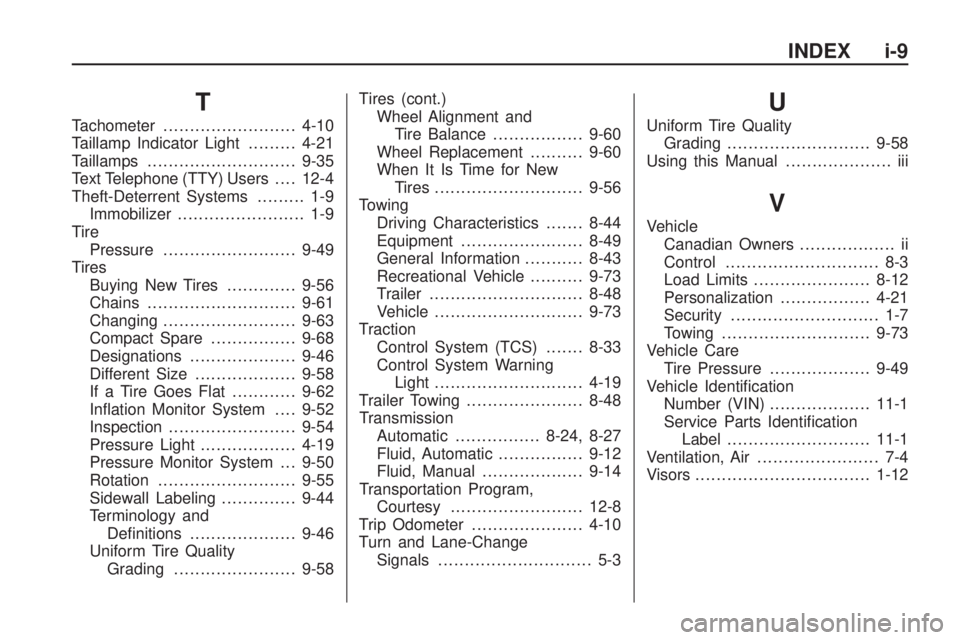
T
Tachometer......................... 4-10
Taillamp Indicator Light .........4-21
Taillamps ............................ 9-35
Text Telephone (TTY) Users ....12-4
Theft-Deterrent Systems ......... 1-9
Immobilizer ........................ 1-9
Tire Pressure ......................... 9-49
Tires Buying New Tires .............9-56
Chains ............................ 9-61
Changing ......................... 9-63
Compact Spare ................9-68
Designations .................... 9-46
Different Size ................... 9-58
If a Tire Goes Flat ............9-62
Inflation Monitor System ....9-52
Inspection ........................ 9-54
Pressure Light ..................4-19
Pressure Monitor System . . . 9-50
Rotation .......................... 9-55
Sidewall Labeling ..............9-44
Terminology and Definitions .................... 9-46
Uniform Tire Quality Grading ....................... 9-58Tires (cont.)
Wheel Alignment andTire Balance .................9-60
Wheel Replacement ..........9-60
When It Is Time for New Tires ............................ 9-56
Towing Driving Characteristics .......8-44
Equipment ....................... 8-49
General Information ...........8-43
Recreational Vehicle ..........9-73
Trailer ............................. 8-48
Vehicle ............................ 9-73
Traction Control System (TCS) .......8-33
Control System Warning Light ............................ 4-19
T
railer Towing ...................... 8-48
Transmission Automatic ................ 8-24, 8-27
Fluid, Automatic ................9-12
Fluid, Manual ................... 9-14
Transportation Program, Courtesy ......................... 12-8
Trip Odometer ..................... 4-10
Turn and Lane-Change Signals ............................. 5-3
U
Uniform Tire Quality
Grading ........................... 9-58
Using this Manual .................... iii
V
Vehicle
Canadian Owners .................. ii
Control ............................. 8-3
Load Limits ...................... 8-12
Personalization .................4-21
Security ............................ 1-7
Towing ............................ 9-73
Vehicle Care Tire Pressure ................... 9-49
Vehicle Identification Number (VIN) ................... 11-1
Service Parts Identification Label ........................... 11-1
Ventilation, Air ....................... 7-4
Visors ................................. 1-12
INDEX i-9