towing PONTIAC VIBE 2010 Owner's Manual
[x] Cancel search | Manufacturer: PONTIAC, Model Year: 2010, Model line: VIBE, Model: PONTIAC VIBE 2010Pages: 318, PDF Size: 1.7 MB
Page 182 of 318
Trailer Towing
Before pulling a trailer, there are
three important considerations that
have to do with weight:
•The weight of the trailer.
•The weight of the trailer tongue.
•The total weight on your
vehicle’s tires.
Weight of the Trailer
How heavy can a trailer safely be?
It should never weigh more than
680 kg (1,500 lbs). But even
that can be too heavy.
It depends on how the rig is used.
For example, speed, altitude, road
grades, outside temperature and
how much the vehicle is used to pull
a trailer are all important. It can
depend on any special equipmenton the vehicle, and the amount of
tongue weight the vehicle can carry.
See “Weight of the Trailer Tongue”
later in this section for more
information.
Maximum trailer weight is calculated
assuming only the driver is in the tow
vehicle and it has all the required
trailering equipment. The weight of
additional optional equipment,
passengers and cargo in the tow
vehicle must be subtracted from the
maximum trailer weight.
Ask your dealer/retailer for our
trailering information or advice, or
you can write us at our Customer
Assistance Offices. See
Customer
Assistance Offices on page 12-3
for more information.
Weight of the Trailer Tongue
The tongue load (A) of any trailer is
an important weight to measure
because it affects the total gross
weight of the vehicle. The Gross
Vehicle Weight (GVW) includes
the curb weight of the vehicle, any
cargo carried in it, and the people
who will be riding in the vehicle. If
there are a lot of options, equipment,
passengers or cargo in the vehicle, it
will reduce the tongue weight the
vehicle can carry, which will also
reduce the trailer weight the vehicle
can tow. If towing a trailer, the
tongue load must be added to the
GVW because the vehicle will be
carrying that weight, too. See Vehicle
Load Limits on page 8-12 for more
information about the vehicle’s
maximum load capacity.
8-48 Driving and Operating
Page 183 of 318
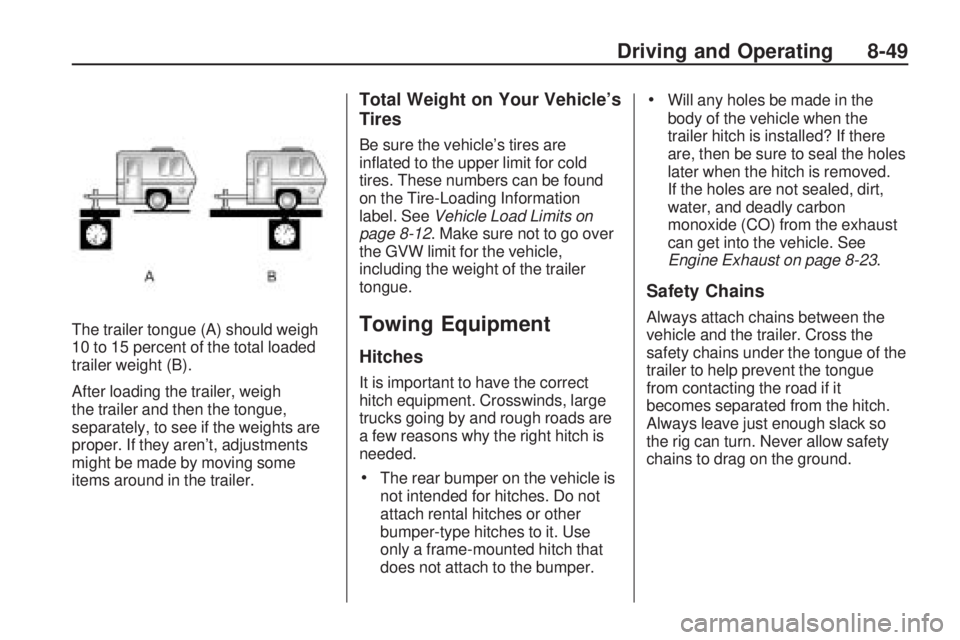
The trailer tongue (A) should weigh
10 to 15 percent of the total loaded
trailer weight (B).
After loading the trailer, weigh
the trailer and then the tongue,
separately, to see if the weights are
proper. If they aren’t, adjustments
might be made by moving some
items around in the trailer.
Total Weight on Your Vehicle’s
Tires
Be sure the vehicle’s tires are
inflated to the upper limit for cold
tires. These numbers can be found
on the Tire-Loading Information
label. SeeVehicle Load Limits on
page 8-12. Make sure not to go over
the GVW limit for the vehicle,
including the weight of the trailer
tongue.
Towing Equipment
Hitches
It is important to have the correct
hitch equipment. Crosswinds, large
trucks going by and rough roads are
a few reasons why the right hitch is
needed.
•The rear bumper on the vehicle is
not intended for hitches. Do not
attach rental hitches or other
bumper-type hitches to it. Use
only a frame-mounted hitch that
does not attach to the bumper.
•Will any holes be made in the
body of the vehicle when the
trailer hitch is installed? If there
are, then be sure to seal the holes
later when the hitch is removed.
If the holes are not sealed, dirt,
water, and deadly carbon
monoxide (CO) from the exhaust
can get into the vehicle. See
Engine Exhaust on page 8-23 .
Safety Chains
Always attach chains between the
vehicle and the trailer. Cross the
safety chains under the tongue of the
trailer to help prevent the tongue
from contacting the road if it
becomes separated from the hitch.
Always leave just enough slack so
the rig can turn. Never allow safety
chains to drag on the ground.
Driving and Operating 8-49
Page 186 of 318
Jump StartingJump Starting....................
.9-69
TowingTowing the Vehicle .............
.9-73
Recreational Vehicle Towing ............................
.9-73
Appearance CareExterior Care.....................
.9-75
Interior Care ......................
.9-80
Floor Mats .........................
.9-83
General Information
For service and parts needs, visit
your dealer/retailer. You will receive
genuine GM parts and GM-trained
and supported service people.
Genuine GM parts have one of
these marks:
California Proposition
65 Warning
Most motor vehicles, including this
one, contain and/or emit chemicals
known to the State of California to
cause cancer and birth defects
or other reproductive harm. Engine
exhaust, many parts and systems
(including some inside the vehicle),
many fluids, and some component
wear by-products contain and/or emit
these chemicals.
9-2 Vehicle Care
Page 257 of 318
To disconnect the jumper cables
from both vehicles, do the following:
1. Disconnect the black negative (−)
cable from the vehicle that had
the dead battery.
2. Disconnect the black negative ( −)
cable from the vehicle with the
good battery.
3. Disconnect the red positive (+) cable from the vehicle with the
good battery.
4. Disconnect the red positive (+) cable from the other vehicle.Towing
Towing the Vehicle
To avoid damage, the disabled
vehicle should be towed with all
four wheels off the ground. Consult
your dealer/retailer or a professional
towing service if the disabled vehicle
must be towed. See Roadside
Assistance Program on page 12-6 .
To tow the vehicle behind
another vehicle for recreational
purposes — such as behind
a motorhome, see Recreational
Vehicle Towing following.
Recreational Vehicle
Towing
Recreational vehicle towing means
towing the vehicle behind another
vehicle – such as behind a
motorhome. The two most common
types of recreational vehicle towing
are known as dinghy towing and
dolly towing. Dinghy towing is towing
the vehicle with all four wheels on
the ground. Dolly towing is towing
the vehicle with two wheels on the
ground and two wheels up on a
device known as a dolly.
Vehicle Care 9-73
Page 258 of 318
Here are some important things
to consider before recreational
vehicle towing:
•What is the towing capacity of the
towing vehicle? Be sure to read
the tow vehicle manufacturer’s
recommendations.
•What is the distance that will be
travelled? Some vehicles have
restrictions on how far and how
long they can tow.
•Is the proper equipment going to
be used? See your dealer/retailer
or trailering professional for
additional advice and equipment
recommendations.
•Is the vehicle ready to be towed?
Just as preparing the vehicle for a
long trip, make sure the vehicle is
prepared to be towed.
Dinghy Towing
If the vehicle has an automatic
transmission, it cannot be dinghy
towed. See “Dolly Towing” for more
information regarding towing the
vehicle.If the vehicle has a manual
transmission, it can be dinghy
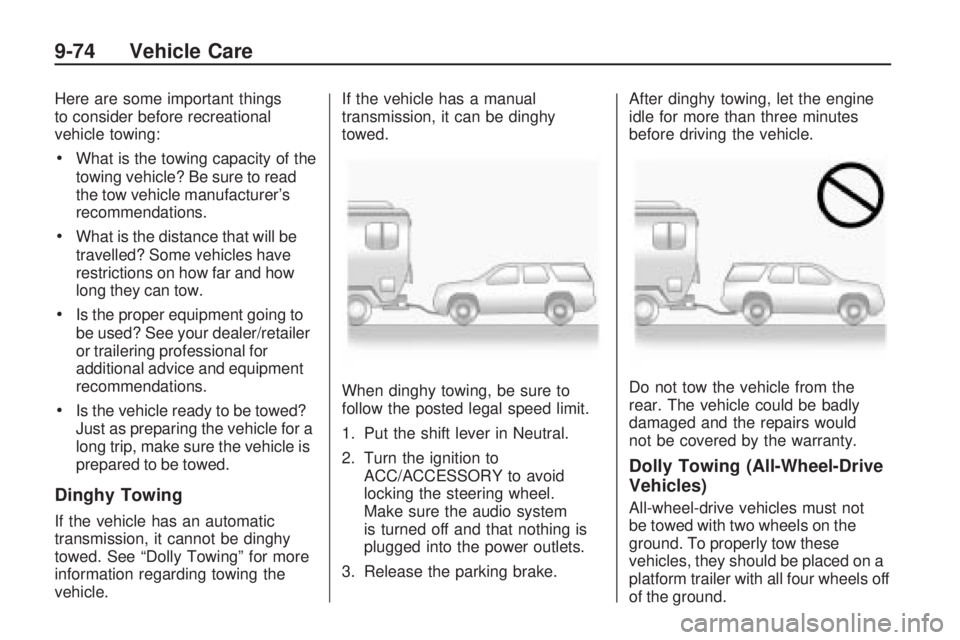
towed.
When dinghy towing, be sure to
follow the posted legal speed limit.
1. Put the shift lever in Neutral.
2. Turn the ignition to
ACC/ACCESSORY to avoid
locking the steering wheel.
Make sure the audio system
is turned off and that nothing is
plugged into the power outlets.
3. Release the parking brake. After dinghy towing, let the engine
idle for more than three minutes
before driving the vehicle.
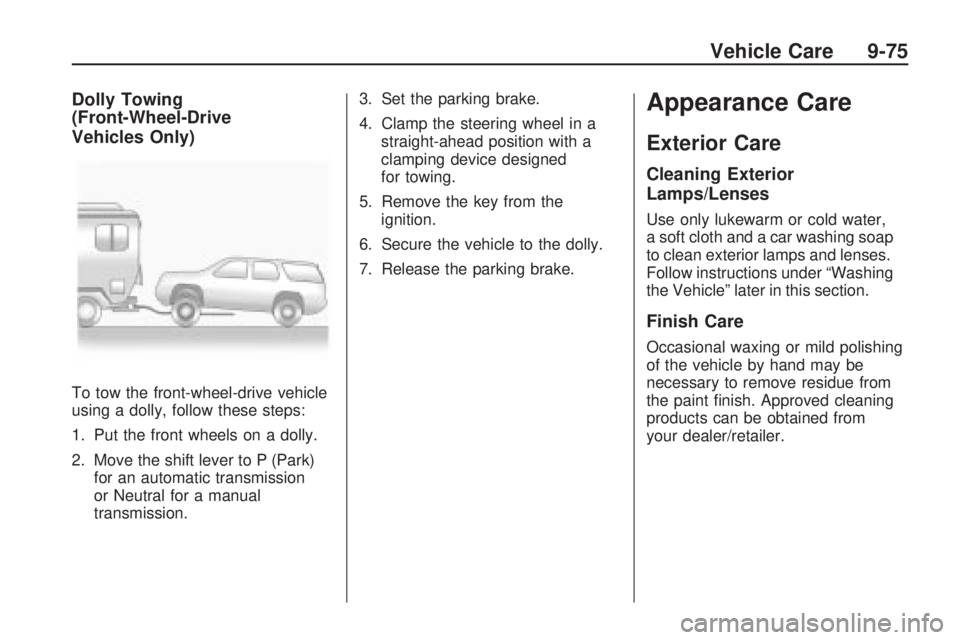
Do not tow the vehicle from the
rear. The vehicle could be badly
damaged and the repairs would
not be covered by the warranty.
Dolly Towing (All-Wheel-Drive
Vehicles)
All-wheel-drive vehicles must not
be towed with two wheels on the
ground. To properly tow these
vehicles, they should be placed on a
platform trailer with all four wheels off
of the ground.
9-74 Vehicle Care
Page 259 of 318
Dolly Towing
(Front-Wheel-Drive
Vehicles Only)
To tow the front-wheel-drive vehicle
using a dolly, follow these steps:
1. Put the front wheels on a dolly.
2. Move the shift lever to P (Park)for an automatic transmission
or Neutral for a manual
transmission. 3. Set the parking brake.
4. Clamp the steering wheel in a
straight-ahead position with a
clamping device designed
for towing.
5. Remove the key from the ignition.
6. Secure the vehicle to the dolly.
7. Release the parking brake.
Appearance Care
Exterior Care
Cleaning Exterior
Lamps/Lenses
Use only lukewarm or cold water,
a soft cloth and a car washing soap
to clean exterior lamps and lenses.
Follow instructions under “Washing
the Vehicle” later in this section.
Finish Care
Occasional waxing or mild polishing
of the vehicle by hand may be
necessary to remove residue from
the paint finish. Approved cleaning
products can be obtained from
your dealer/retailer.
Vehicle Care 9-75
Page 271 of 318
Scheduled
Maintenance
The services shown in this schedule
up to 192 000 km (120,000 miles)
should be repeated after 192 000 km
(120,000 miles) at the same intervals
for the life of this vehicle.
Footnotes
†The U.S. Environmental Protection
Agency or the California Air
Resources Board has determined
that the failure to perform this
maintenance item will not nullify the
emissions warranty or limit recall
liability prior to the completion of the
vehicle’s useful life. We, however,
urge that all recommended
maintenance services be performed
at the indicated intervals and the
maintenance be recorded.
+ A good time to check your brakes
is during tire rotation. See Tire
Rotation on page 9-55 .
8 000 km (5,000 Miles)
❑Change engine oil and filter
(or every 3 months, whichever
occurs first). An Emission Control
Service.
❑ Rotate tires. See Tire Rotation on
page 9-55 for proper rotation
pattern and additional information.
(See footnote +.)
❑ Inspect engine air cleaner filter
if vehicle is driven in dusty
conditions. Replace filter if
necessary.
16 000 km (10,000 Miles)
❑ Change engine oil and filter
(or every 3 months, whichever
occurs first). An Emission Control
Service.
❑ Rotate tires. See Tire Rotation
on page 9-55 for proper rotation
pattern and additional information.
(See footnote +.)
❑ Inspect engine air cleaner filter
if vehicle is driven in dusty
conditions. Replace filter if
necessary.
24 000 km (15,000 Miles)
❑ Change engine oil and filter
(or every 3 months, whichever
occurs first). An Emission Control
Service.
❑ Rotate tires. See Tire Rotation
on page 9-55 for proper rotation
pattern and additional information.
(See footnote +.)
❑ Inspect engine air cleaner filter
if vehicle is driven in dusty
conditions. Replace filter if
necessary.
❑ Inspect passenger compartment
air filter.
❑ Change transfer case fluid when
doing frequent trailer towing.
❑ Change rear differential fluid when
doing frequent trailer towing.
Service and Maintenance 10-3
Page 272 of 318
32 000 km (20,000 Miles)
❑Change engine oil and filter
(or every 3 months, whichever
occurs first). An Emission Control
Service.
❑ Rotate tires. See Tire Rotation
on page 9-55 for proper rotation
pattern and additional information.
(See footnote +.)
❑ Inspect engine air cleaner filter
if vehicle is driven in dusty
conditions. Replace filter if
necessary.
40 000 km (25,000 Miles)
❑ Change engine oil and filter
(or every 3 months, whichever
occurs first). An Emission Control
Service.
❑ Rotate tires. See Tire Rotation
on page 9-55 for proper rotation
pattern and additional information.
(See footnote +.)
❑ Inspect engine air cleaner filter
if vehicle is driven in dusty
conditions. Replace filter if
necessary.
48 000 km (30,000 Miles)
❑ Change engine oil and filter
(or every 3 months, whichever
occurs first). An Emission Control
Service.
❑ Rotate tires. See Tire Rotation
on page 9-55 for proper rotation
pattern and additional information.
(See footnote +.)
❑ Replace engine air cleaner filter
(or every 24 months, whichever
occurs first). See Engine Air
Cleaner/Filter on page 9-16 for
more information.
❑ Check restraint system. Make
sure the safety belt reminder light
and safety belt assemblies are
working properly. Look for any
other loose or damaged safety
belt system parts. If you see
anything that might keep a safety
belt system from doing its job,
have it repaired. Have any torn
or frayed safety belts replaced.
Also see Safety System Check
on page 2-21. ❑
Replace passenger compartment
air filter.
❑ Change transfer case fluid when
doing frequent trailer towing.
❑ Change rear differential fluid when
doing frequent trailer towing.
❑ Inspect fuel tank, cap, cap gasket,
and lines for damage or leaks
(or every 24 months, whichever
occurs first). Replace parts as
needed. An Emission Control
Service. (See footnote †.)
❑ Change manual transmission fluid
every 48 000 km (30,000 miles)
only if your vehicle is used to tow
a trailer.
10-4 Service and Maintenance
Page 273 of 318
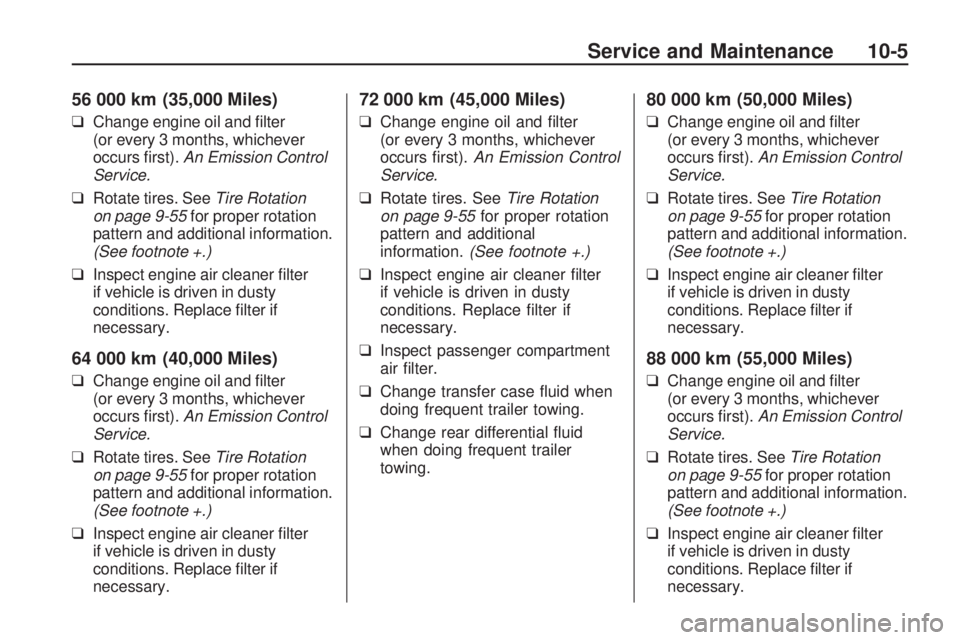
56 000 km (35,000 Miles)
❑Change engine oil and filter
(or every 3 months, whichever
occurs first). An Emission Control
Service.
❑ Rotate tires. See Tire Rotation
on page 9-55 for proper rotation
pattern and additional information.
(See footnote +.)
❑ Inspect engine air cleaner filter
if vehicle is driven in dusty
conditions. Replace filter if
necessary.
64 000 km (40,000 Miles)
❑ Change engine oil and filter
(or every 3 months, whichever
occurs first). An Emission Control
Service.
❑ Rotate tires. See Tire Rotation
on page 9-55 for proper rotation
pattern and additional information.
(See footnote +.)
❑ Inspect engine air cleaner filter
if vehicle is driven in dusty
conditions. Replace filter if
necessary.
72 000 km (45,000 Miles)
❑ Change engine oil and filter
(or every 3 months, whichever
occurs first). An Emission Control
Service.
❑ Rotate tires. See Tire Rotation
on page 9-55 for proper rotation
pattern and additional
information. (See footnote +.)
❑ Inspect engine air cleaner filter
if vehicle is driven in dusty
conditions. Replace filter if
necessary.
❑ Inspect passenger compartment
air filter.
❑ Change transfer case fluid when
doing frequent trailer towing.
❑ Change rear differential fluid
when doing frequent trailer
towing.
80 000 km (50,000 Miles)
❑ Change engine oil and filter
(or every 3 months, whichever
occurs first). An Emission Control
Service.
❑ Rotate tires. See Tire Rotation
on page 9-55 for proper rotation
pattern and additional information.
(See footnote +.)
❑ Inspect engine air cleaner filter
if vehicle is driven in dusty
conditions. Replace filter if
necessary.
88 000 km (55,000 Miles)
❑ Change engine oil and filter
(or every 3 months, whichever
occurs first). An Emission Control
Service.
❑ Rotate tires. See Tire Rotation
on page 9-55 for proper rotation
pattern and additional information.
(See footnote +.)
❑ Inspect engine air cleaner filter
if vehicle is driven in dusty
conditions. Replace filter if
necessary.
Service and Maintenance 10-5
Page 274 of 318
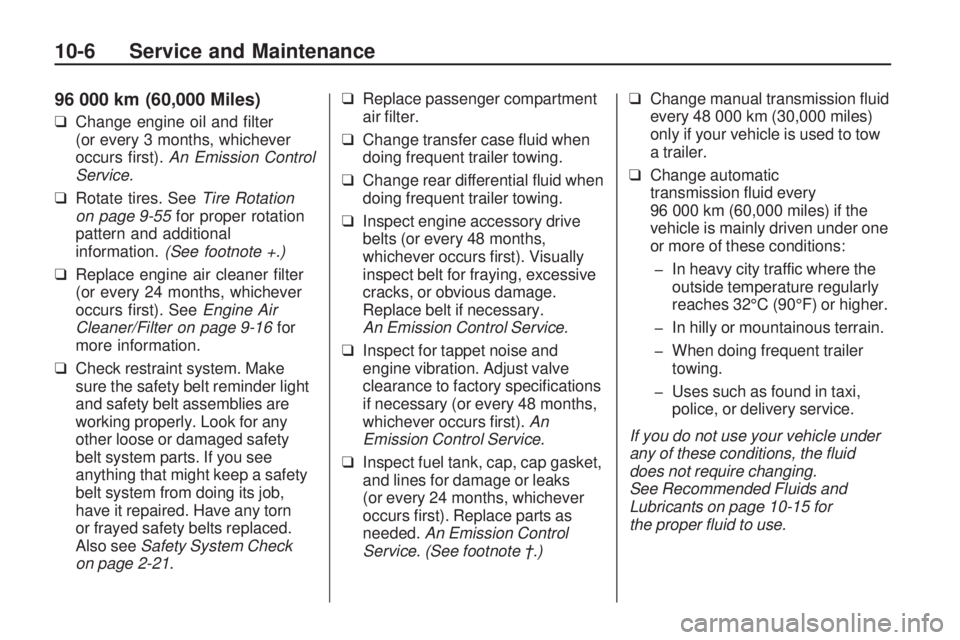
96 000 km (60,000 Miles)
❑Change engine oil and filter
(or every 3 months, whichever
occurs first). An Emission Control
Service.
❑ Rotate tires. See Tire Rotation
on page 9-55 for proper rotation
pattern and additional
information. (See footnote +.)
❑ Replace engine air cleaner filter
(or every 24 months, whichever
occurs first). See Engine Air
Cleaner/Filter on page 9-16 for
more information.
❑ Check restraint system. Make
sure the safety belt reminder light
and safety belt assemblies are
working properly. Look for any
other loose or damaged safety
belt system parts. If you see
anything that might keep a safety
belt system from doing its job,
have it repaired. Have any torn
or frayed safety belts replaced.
Also see Safety System Check
on page 2-21. ❑
Replace passenger compartment
air filter.
❑ Change transfer case fluid when
doing frequent trailer towing.
❑ Change rear differential fluid when
doing frequent trailer towing.
❑ Inspect engine accessory drive
belts (or every 48 months,
whichever occurs first). Visually
inspect belt for fraying, excessive
cracks, or obvious damage.
Replace belt if necessary.
An Emission Control Service.
❑ Inspect for tappet noise and
engine vibration. Adjust valve
clearance to factory specifications
if necessary (or every 48 months,
whichever occurs first). An
Emission Control Service.
❑ Inspect fuel tank, cap, cap gasket,
and lines for damage or leaks
(or every 24 months, whichever
occurs first). Replace parts as
needed. An Emission Control
Service. (See footnote †.) ❑
Change manual transmission fluid
every 48 000 km (30,000 miles)
only if your vehicle is used to tow
a trailer.
❑ Change automatic
transmission fluid every
96 000 km (60,000 miles) if the
vehicle is mainly driven under one
or more of these conditions:
- In heavy city traffic where the outside temperature regularly
reaches 32°C (90°F) or higher.
- In hilly or mountainous terrain.
- When doing frequent trailer towing.
- Uses such as found in taxi, police, or delivery service.
If you do not use your vehicle under
any of these conditions, the uid
does not require changing.
See Recommended Fluids and
Lubricants on page 10-15 for
the proper uid to use.
10-6 Service and Maintenance