seats PONTIAC VIBE 2010 Repair Manual
[x] Cancel search | Manufacturer: PONTIAC, Model Year: 2010, Model line: VIBE, Model: PONTIAC VIBE 2010Pages: 318, PDF Size: 1.7 MB
Page 158 of 318
Running the Vehicle
While Parked
It is better not to park with the
engine running. But if you ever have
to, here are some things to know.
{CAUTION
Idling a vehicle in an enclosed
area with poor ventilation is
dangerous. Engine exhaust may
enter the vehicle. Engine exhaust
contains Carbon Monoxide (CO)
which cannot be seen or smelled.
It can cause unconsciousness
and even death. Never run the
engine in an enclosed area that
has no fresh air ventilation. For
more information, seeEngine
Exhaust on page 8-23 .
{CAUTION
It can be dangerous to get out
of the vehicle if the automatic
transmission shift lever is not fully
in P (Park) with the parking brake
firmly set. The vehicle can roll.
Do not leave the vehicle when the
engine is running unless you have
to. If you have left the engine
running, the vehicle can move
suddenly. You or others could be
injured. To be sure the vehicle will
not move, even when you are on
fairly level ground, always set the
parking brake and move the shift
lever to P (Park).
Follow the proper steps to be
sure the vehicle will not move.
See Shifting Into Park on page 8-20 .
If parking on a hill and pulling a
trailer, see Driving Characteristics
and Towing Tips on page 8-44 .
Automatic
Transmission
Automatic Transmission
(Four Speed Automatic)
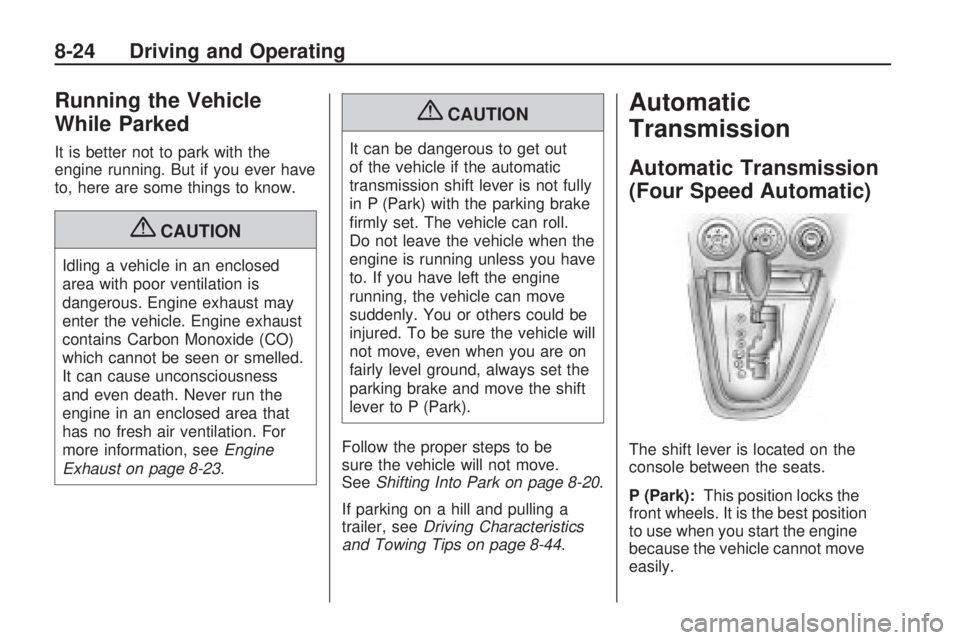
The shift lever is located on the
console between the seats.
P (Park):This position locks the
front wheels. It is the best position
to use when you start the engine
because the vehicle cannot move
easily.
8-24 Driving and Operating
Page 161 of 318
Automatic Transmission
(Five Speed Automatic)
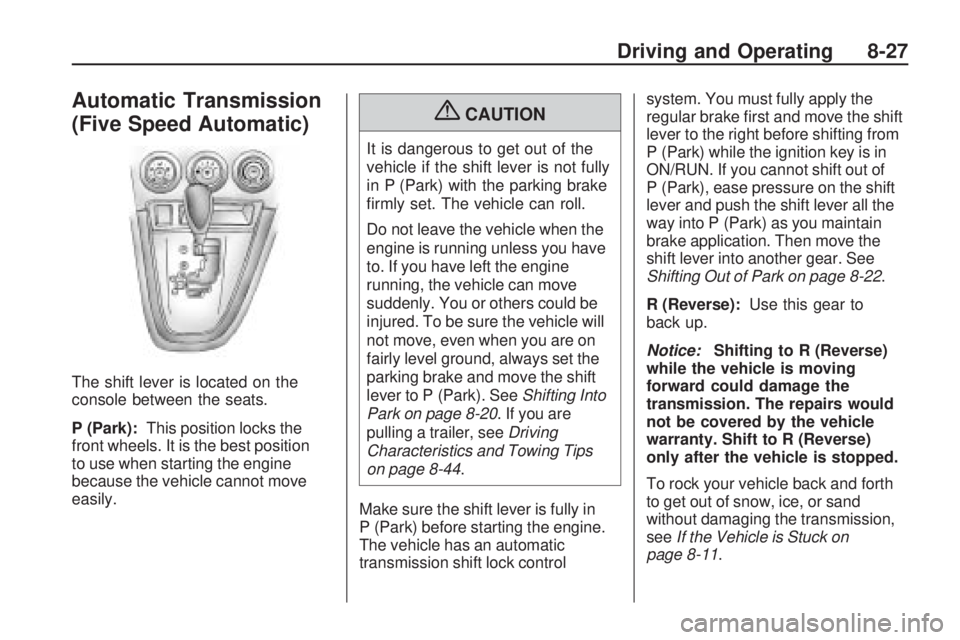
The shift lever is located on the
console between the seats.
P (Park):This position locks the
front wheels. It is the best position
to use when starting the engine
because the vehicle cannot move
easily.
{CAUTION
It is dangerous to get out of the
vehicle if the shift lever is not fully
in P (Park) with the parking brake
firmly set. The vehicle can roll.
Do not leave the vehicle when the
engine is running unless you have
to. If you have left the engine
running, the vehicle can move
suddenly. You or others could be
injured. To be sure the vehicle will
not move, even when you are on
fairly level ground, always set the
parking brake and move the shift
lever to P (Park). See Shifting Into
Park on page 8-20. If you are
pulling a trailer, see Driving
Characteristics and Towing Tips
on page 8-44.
Make sure the shift lever is fully in
P (Park) before starting the engine.
The vehicle has an automatic
transmission shift lock control system. You must fully apply the
regular brake first and move the shift
lever to the right before shifting from
P (Park) while the ignition key is in
ON/RUN. If you cannot shift out of
P (Park), ease pressure on the shift
lever and push the shift lever all the
way into P (Park) as you maintain
brake application. Then move the
shift lever into another gear. See
Shifting Out of Park on page 8-22
.
R (Reverse): Use this gear to
back up.
Notice: Shifting to R (Reverse)
while the vehicle is moving
forward could damage the
transmission. The repairs would
not be covered by the vehicle
warranty. Shift to R (Reverse)
only after the vehicle is stopped.
To rock your vehicle back and forth
to get out of snow, ice, or sand
without damaging the transmission,
see If the Vehicle is Stuck on
page 8-11.
Driving and Operating 8-27
Page 230 of 318
Tire Designations
Tire Size
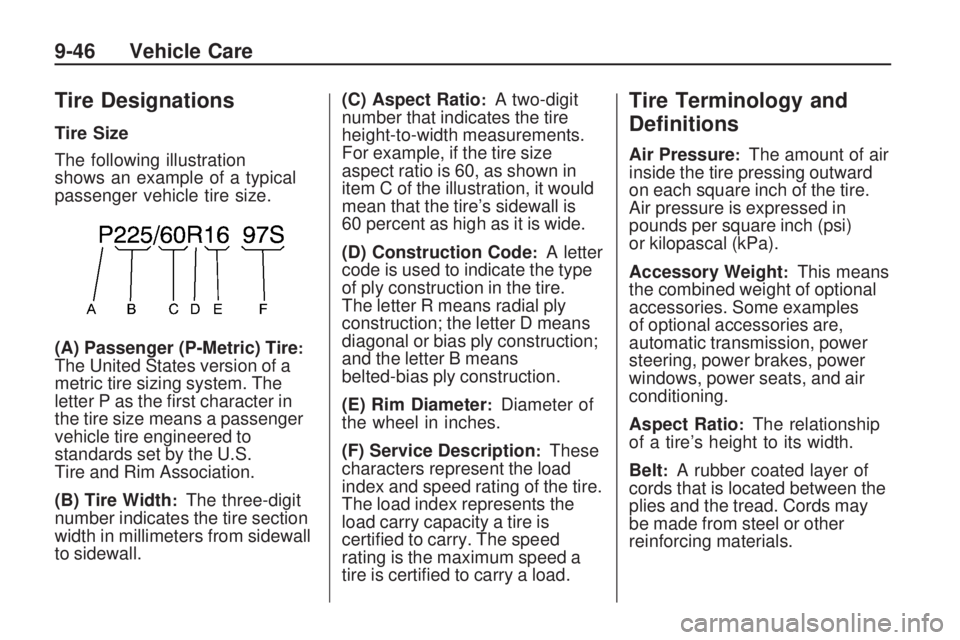
The following illustration
shows an example of a typical
passenger vehicle tire size.
(A) Passenger (P-Metric) Tire
:The United States version of a
metric tire sizing system. The
letter P as the first character in
the tire size means a passenger
vehicle tire engineered to
standards set by the U.S.
Tire and Rim Association.
(B) Tire Width
:The three-digit
number indicates the tire section
width in millimeters from sidewall
to sidewall. (C) Aspect Ratio
:A two-digit
number that indicates the tire
height-to-width measurements.
For example, if the tire size
aspect ratio is 60, as shown in
item C of the illustration, it would
mean that the tire’s sidewall is
60 percent as high as it is wide.
(D) Construction Code
:A letter
code is used to indicate the type
of ply construction in the tire.
The letter R means radial ply
construction; the letter D means
diagonal or bias ply construction;
and the letter B means
belted-bias ply construction.
(E) Rim Diameter
:Diameter of
the wheel in inches.
(F) Service Description
:These
characters represent the load
index and speed rating of the tire.
The load index represents the
load carry capacity a tire is
certified to carry. The speed
rating is the maximum speed a
tire is certified to carry a load.
Tire Terminology and
Denitions
Air Pressure:The amount of air
inside the tire pressing outward
on each square inch of the tire.
Air pressure is expressed in
pounds per square inch (psi)
or kilopascal (kPa).
Accessory Weight
:This means
the combined weight of optional
accessories. Some examples
of optional accessories are,
automatic transmission, power
steering, power brakes, power
windows, power seats, and air
conditioning.
Aspect Ratio
:The relationship
of a tire’s height to its width.
Belt
:A rubber coated layer of
cords that is located between the
plies and the tread. Cords may
be made from steel or other
reinforcing materials.
9-46 Vehicle Care
Page 312 of 318

Engine (cont.)Pressure Light ..................4-19
Running While Parked .......8-24
Starting ........................... 8-18
Entry Lighting ........................ 5-5
Equipment, Towing ...............8-49
Event Data Recorders .........12-14
Extender, Safety Belt ............2-21
Exterior Care ....................... 9-75
Exterior Lamp Controls ........... 5-1
F
Filter
Engine Air Cleaner ............9-16
Flashers, Hazard Warning ....... 5-3
Flash-to-Pass ........................ 5-2
Flat Tire .............................. 9-62
Flat Tire, Changing ...............9-63
Floor Mats .......................... 9-83
Fluid Automatic Transmission .....9-12
Brakes ............................ 9-27
Power Steering .................9-24
Washer ........................... 9-24
Fog Lamps Bulb Replacement .............. 5-4
Light ............................... 4-20Folding Mirrors
....................1-10
Folding Seatback ................... 2-6
Front Seat Position Seats Adjustment ........................ 2-3
Front Seats Adjustment ........................ 2-4
Front Storage ........................ 3-2
Fuel ................................... 8-38
Additives ......................... 8-40
Economy Driving ................ 8-2
Filling a Portable Fuel Container ..................... 8-43
Filling the Tank .................8-41
Fuels in Foreign Countries ..................... 8-40
Gage .............................. 4-10
Gasoline Specifications ......8-39
Low Fuel Warning Light .....4-20
Recommended .................8-39
Requirements, California ....8-39
Fuses Engine Compartment FuseBlock ........................... 9-38
Fuses and Circuit Breakers ...................... 9-38
Instrument Panel Fuse Block ........................... 9-41
G
Gages
Engine CoolantTemperature .................4-11
Fuel ................................ 4-10
Odometer ........................ 4-10
Speedometer ................... 4-10
Tachometer ...................... 4-10
Trip Odometer ..................4-10
Warning Lights and Indicators ....................... 4-8
Gasoline Specifications ................... 8-39
General Information Service and Maintenance . . . 10-1
Towing ............................ 8-43
Vehicle Care ...................... 9-2
Glove Box ............................ 3-1
GM Mobility Reimbursement Program .......................... 12-5
i-4 INDEX
Page 315 of 318
P
ParkShifting Into ..................... 8-20
Shifting Out of ..................8-22
Parking ............................... 8-22
Brake .............................. 8-33
Over Things That Burn ......8-23
Passenger Airbag Status Indicator .......................... 4-13
Passenger Compartment Air Filter ................................ 7-4
Passenger Sensing System . . . 2-29
Perchlorate Materials Requirements, California ...... 9-3
Power Door Locks ........................ 1-6
Mirrors ............................ 1-10
Protection, Battery .............. 5-5
Retained Accessory (RAP) ...........8-18
Steering Fluid ................... 9-24
Windows ......................... 1-12
Power Steering Fluid ............9-24
Pregnancy, Using Safety Belts ............................... 2-20Privacy
Radio FrequencyIdentification (RFID) .....12-16
Program Courtesy Transportation .....12-8
Proposition 65 Warning, California .......................... 9-2
R
Radio Frequency
Identification (RFID) .........12-16
Statement ...................... 12-16
Radios AM-FM Radio .................... 6-4
Reception .......................... 6-8
Satellite ............................ 6-6
Reading Lamps ..................... 5-5
Rear Seats ........................... 2-7
Rear Window Washer/Wiper .... 4-6
Rearview Mirrors ..................1-11
Reclining Seatbacks ............... 2-4
Recommended Fluids and Lubricants ...................... 10-15
Recommended Fuel .............8-39
Records Maintenance ................... 10-18
Recreational Vehicle Towing . . . 9-73 Reimbursement Program, GM
Mobility ........................... 12-5
Remote Keyless Entry (RKE) System ............................. 1-3
Replacement Bulbs ..............9-37
Replacement Parts Airbags ........................... 2-36
Replacement Parts, Maintenance ................... 10-17
Replacing Airbag System ......2-36
Replacing LATCH System Parts After a Crash ...........2-51
Replacing Safety Belt System Parts After a Crash ............2-22
Reporting Safety Defects General Motors ...............12-14
U.S. Government ............12-13
Retained Accessory Power (RAP) .................... 8-18
Roadside Assistance Program .......................... 12-6
Roof Sunroof ........................... 1-13
Roof Rack ............................ 3-5
Rotation, Tires ..................... 9-55
Routing, Engine Drive Belt ....11-4
Running the Vehicle While Parked ............................ 8-24
INDEX i-7
Page 316 of 318
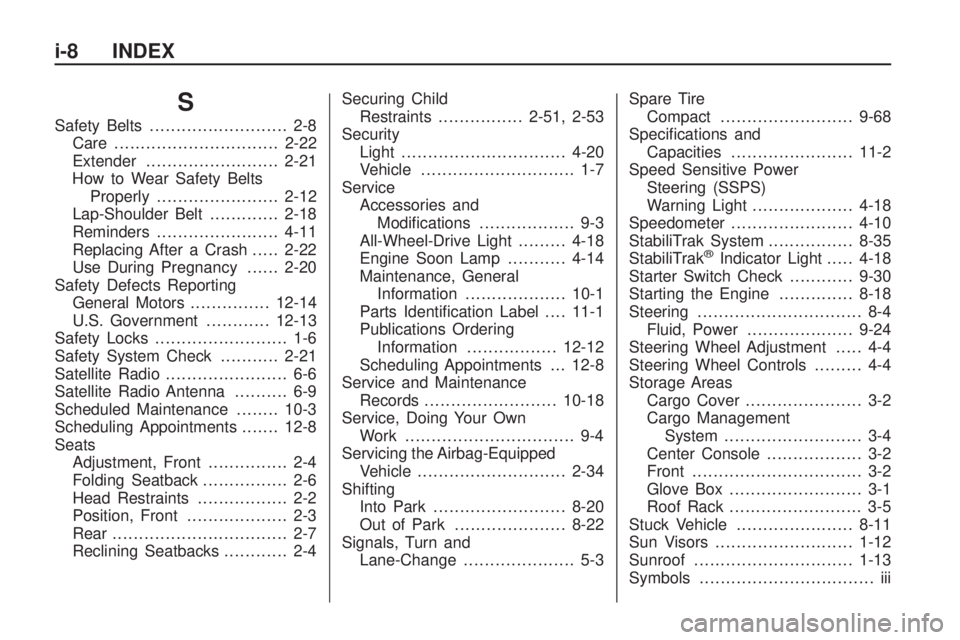
S
Safety Belts.......................... 2-8
Care ............................... 2-22
Extender ......................... 2-21
How to Wear Safety Belts Properly ....................... 2-12
Lap-Shoulder Belt .............2-18
Reminders ....................... 4-11
Replacing After a Crash .....2-22
Use During Pregnancy ......2-20
Safety Defects Reporting General Motors ...............12-14
U.S. Government ............12-13
Safety Locks ......................... 1-6
Safety System Check ...........2-21
Satellite Radio ....................... 6-6
Satellite Radio Antenna .......... 6-9
Scheduled Maintenance ........10-3
Scheduling Appointments .......12-8
Seats Adjustment, Front ............... 2-4
Folding Seatback ................ 2-6
Head Restraints ................. 2-2
Position, Front ................... 2-3
Rear ................................. 2-7
Reclining Seatbacks ............ 2-4Securing Child
Restraints ................ 2-51, 2-53
Security Light ............................... 4-20
Vehicle ............................. 1-7
Service Accessories andModifications .................. 9-3
All-Wheel-Drive Light .........4-18
Engine Soon Lamp ...........4-14
Maintenance, General Information ................... 10-1
Parts Identification Label ....11-1
Publications Ordering Information ................. 12-12
Scheduling Appointments . . . 12-8
Service and Maintenance Records ......................... 10-18
Service, Doing Your Own Work ................................ 9-4
Servicing the Airbag-Equipped Vehicle ............................ 2-34
Shifting Into Park ......................... 8-20
Out
of Park ..................... 8-22
Signals, Turn and Lane-Change ..................... 5-3 Spare Tire
Compact ......................... 9-68
Specifications and Capacities ....................... 11-2
Speed Sensitive Power Steering (SSPS)
Warning Light ................... 4-18
Speedometer ....................... 4-10
StabiliTrak System ................8-35
StabiliTrak
®Indicator Light .....4-18
Starter Switch Check ............9-30
Starting the Engine ..............8-18
Steering ............................... 8-4
Fluid, Power .................... 9-24
Steering Wheel Adjustment ..... 4-4
Steering Wheel Controls ......... 4-4
Storage Areas Cargo Cover ...................... 3-2
Cargo Management System .......................... 3-4
Center Console .................. 3-2
Front ................................ 3-2
Glove Box ......................... 3-1
Roof Rack ......................... 3-5
Stuck Vehicle ...................... 8-11
Sun Visors .......................... 1-12
Sunroof .............................. 1-13
Symbols ................................. iii
i-8 INDEX