charging PONTIAC VIBE 2010 Owners Manual
[x] Cancel search | Manufacturer: PONTIAC, Model Year: 2010, Model line: VIBE, Model: PONTIAC VIBE 2010Pages: 318, PDF Size: 1.7 MB
Page 5 of 318
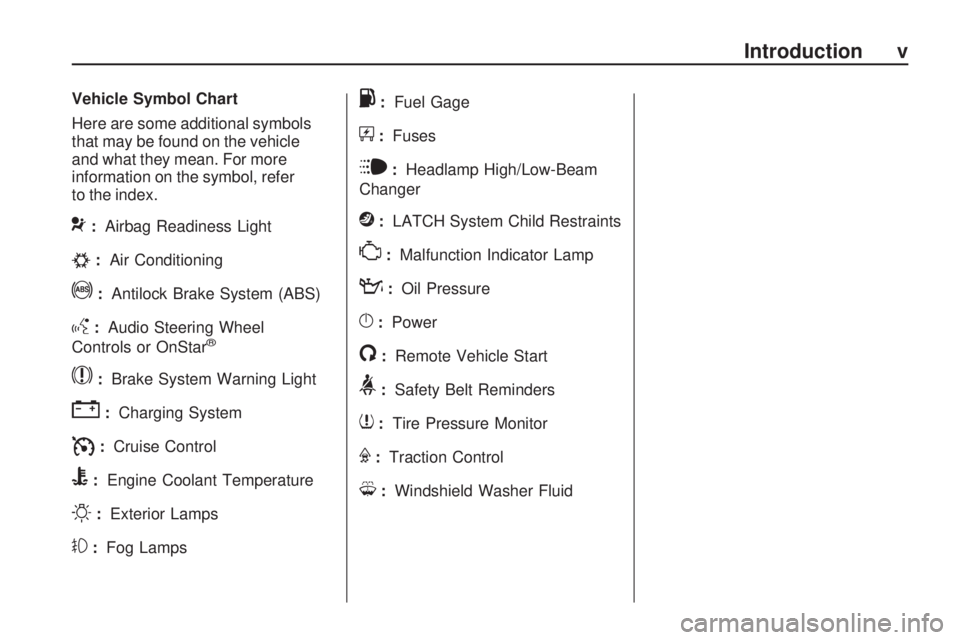
Vehicle Symbol Chart
Here are some additional symbols
that may be found on the vehicle
and what they mean. For more
information on the symbol, refer
to the index.
9:Airbag Readiness Light
#:Air Conditioning
!:Antilock Brake System (ABS)
g:Audio Steering Wheel
Controls or OnStar®
$: Brake System Warning Light
":Charging System
I:Cruise Control
B:Engine Coolant Temperature
O:Exterior Lamps
#:Fog Lamps
.:Fuel Gage
+:Fuses
i:Headlamp High/Low-Beam
Changer
j: LATCH System Child Restraints
*:Malfunction Indicator Lamp
::Oil Pressure
}:Power
/:Remote Vehicle Start
>:Safety Belt Reminders
7:Tire Pressure Monitor
F:Traction Control
M:Windshield Washer Fluid
Introduction v
Page 83 of 318

Instruments and
Controls
Instrument Panel OverviewInstrument Panel Overview.....4-2
ControlsSteering Wheel Adjustment.....4-4
Steering Wheel Controls .........4-4
Horn ...................................
.4-5
Windshield Wiper/Washer .......4-5
Rear Window Wiper/Washer . . . .4-6
Power Outlets (Accessory Power Outlets) ....................
.4-6
Power Outlets (115 Volt Alternating Current) .............
.4-7
Cigarette Lighter ..................
.4-8
Ashtrays .............................
.4-8
Warning Lights, Gages, and
Indicators
Warning Lights, Gages, and
Indicators ..........................
.4-8
Instrument Cluster ................
.4-9
Speedometer .....................
.4-10
Odometer ..........................
.4-10
Trip Odometer ....................
.4-10
Tachometer .......................
.4-10
Fuel Gage .........................
.4-10
Engine Coolant Temperature Gage .............4-11
Safety Belt Reminders ..........4-11
Airbag Readiness Light .........4-12
Passenger Airbag Status Indicator ..........................
.4-13
Charging System Light .........4-14
Malfunction Indicator Lamp .................
.4-14
Brake System Warning Light ...............................
.4-17
Antilock Brake System (ABS) Warning Light ...........4-17
Service All-Wheel Drive Light ...............................
.4-18Speed Sensitive Power
Steering (SSPS) Warning
Light ...............................
.4-18
StabiliTrak®Indicator Light . . . .4-18
Traction Control System (TCS) Warning Light ...........4-19
Tire Pressure Light .............
.4-19
Engine Oil Pressure Light .....4-19
Low Fuel Warning Light ........4-20
Security Light .....................
.4-20
High-Beam on Light .............4-20
Fog Lamp Light ..................
.4-20
Lamps on Reminder .............4-20
Taillamp Indicator Light .........4-21
Low Washer Fluid Warning Light ...............................
.4-21
Cruise Control Light .............4-21
Door Ajar Light ...................
.4-21
Vehicle PersonalizationVehicle Personalization .........4-21
OnStar SystemOnStar®System.................
.4-23
Instruments and Controls 4-1
Page 96 of 318
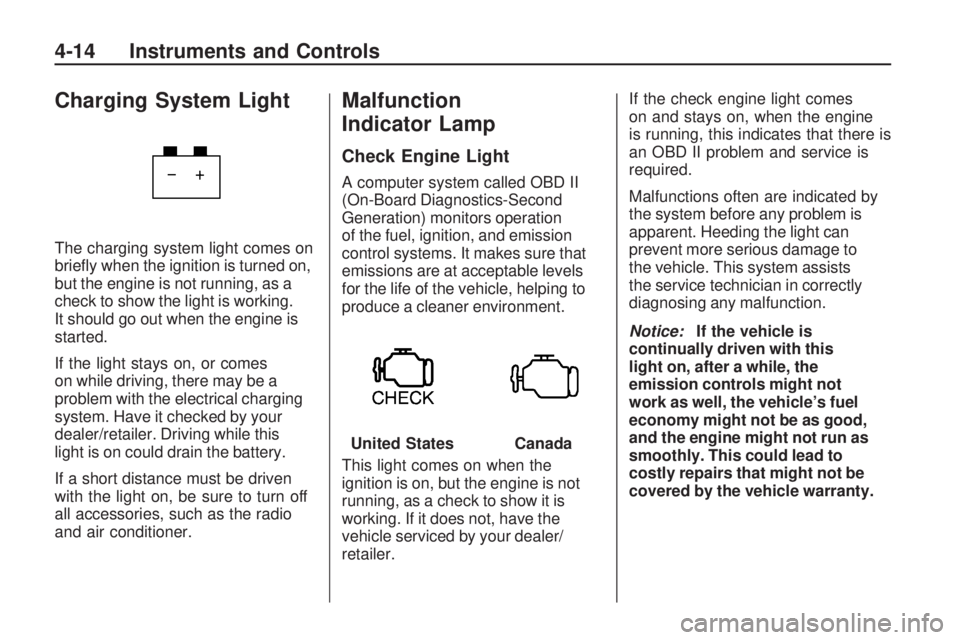
Charging System Light
The charging system light comes on
briefly when the ignition is turned on,
but the engine is not running, as a
check to show the light is working.
It should go out when the engine is
started.
If the light stays on, or comes
on while driving, there may be a
problem with the electrical charging
system. Have it checked by your
dealer/retailer. Driving while this
light is on could drain the battery.
If a short distance must be driven
with the light on, be sure to turn off
all accessories, such as the radio
and air conditioner.
Malfunction
Indicator Lamp
Check Engine Light
A computer system called OBD II
(On-Board Diagnostics-Second
Generation) monitors operation
of the fuel, ignition, and emission
control systems. It makes sure that
emissions are at acceptable levels
for the life of the vehicle, helping to
produce a cleaner environment.
This light comes on when the
ignition is on, but the engine is not
running, as a check to show it is
working. If it does not, have the
vehicle serviced by your dealer/
retailer.If the check engine light comes
on and stays on, when the engine
is running, this indicates that there is
an OBD II problem and service is
required.
Malfunctions often are indicated by
the system before any problem is
apparent. Heeding the light can
prevent more serious damage to
the vehicle. This system assists
the service technician in correctly
diagnosing any malfunction.
Notice:
If the vehicle is
continually driven with this
light on, after a while, the
emission controls might not
work as well, the vehicle’s fuel
economy might not be as good,
and the engine might not run as
smoothly. This could lead to
costly repairs that might not be
covered by the vehicle warranty.
United StatesCanada
4-14 Instruments and Controls
Page 122 of 318
Radio Reception
Frequency interference and static
can occur during normal radio
reception if items such as cell phone
chargers, vehicle convenience
accessories, and external electronic
devices are plugged into the
accessory power outlet. If there is
interference or static, unplug the item
from the accessory power outlet.
FM
FM signals only reach about 10 to
40 miles (16 to 65 km). Although the
radio has a built-in electronic circuit
that automatically works to reduce
interference, some static can occur,
especially around tall buildings or
hills, causing the sound to fade in
and out.
AM
The range for most AM stations is
greater than for FM, especially at
night. The longer range can cause
station frequencies to interfere
with each other. For better radio
reception, most AM radio stations
boost the power levels during the
day, and then reduce these levels
during the night. Static can also
occur when things like storms and
power lines interfere with radio
reception. When this happens, try
reducing the treble on the radio.
XM™ Satellite Radio Service
XM Satellite Radio Service
gives digital radio reception from
coast-to-coast in the 48 contiguous
United States, and in Canada. Just
as with FM, tall buildings or hills can
interfere with satellite radio signals,
causing the sound to fade in and out.
In addition, traveling or standing
under heavy foliage, bridges,
garages, or tunnels may cause loss
of the XM signal for a period of time.
Cellular Phone Usage
Cellular phone usage may cause
interference with the vehicle’s radio.
This interference may occur when
making or receiving phone calls,
charging the phone’s battery,
or simply having the phone on.
This interference can cause an
increased level of static while
listening to the radio. If static is
received while listening to the radio,
unplug the cellular phone and turn
it off.
Fixed Mast Antenna
The fixed mast antenna can
withstand most car washes without
being damaged as long as it is
securely attached to the base.
If the mast becomes slightly bent,
straighten it out by hand. If the mast
is badly bent, replace it.
Occasionally check to make sure
the antenna is tightened to its base.
If tightening is required, tighten
by hand.
6-8 Infotainment System
Page 156 of 318
Shifting Out of Park
This vehicle has an electronic shift
lock release system. The shift lock
release is designed to:
•Prevent ignition key removal
unless the shift lever is in
P (Park).
•Prevent movement of the shift
lever out of P (Park), unless the
ignition is in ON/RUN and the
brake pedal is applied.
The shift lock release is always
functional except in the case of an
uncharged or low voltage (less
than 9 volt) battery.
If the vehicle has an uncharged
battery or a battery with low voltage,
try charging or jump starting the
battery. See Shifting Out of Park on
page 8-22 for more information. To shift out of P (Park) use the
following:
1. Apply the brake pedal.
2. Move the shift lever to the
desired position.
If you still are unable to shift out of
P (Park):
1. Fully release the shift lever.
2. Hold the brake pedal down.
3. Move the shift lever to the desired position.
If you still cannot move the shift
lever from P (Park), consult
your dealer/retailer or a professional
towing service.
Parking
Before you get out of the vehicle,
move the shift lever into R (Reverse),
and firmly apply the parking brake.
Once the shift lever has been placed
into R (Reverse) with the clutch
pedal pressed in, you can turn the
ignition key to LOCK/OFF, remove
the key and release the clutch.
If you are parking on a hill, or if
the vehicle is pulling a trailer, see
Driving Characteristics and Towing
Tips on page 8-44.
8-22 Driving and Operating
Page 223 of 318
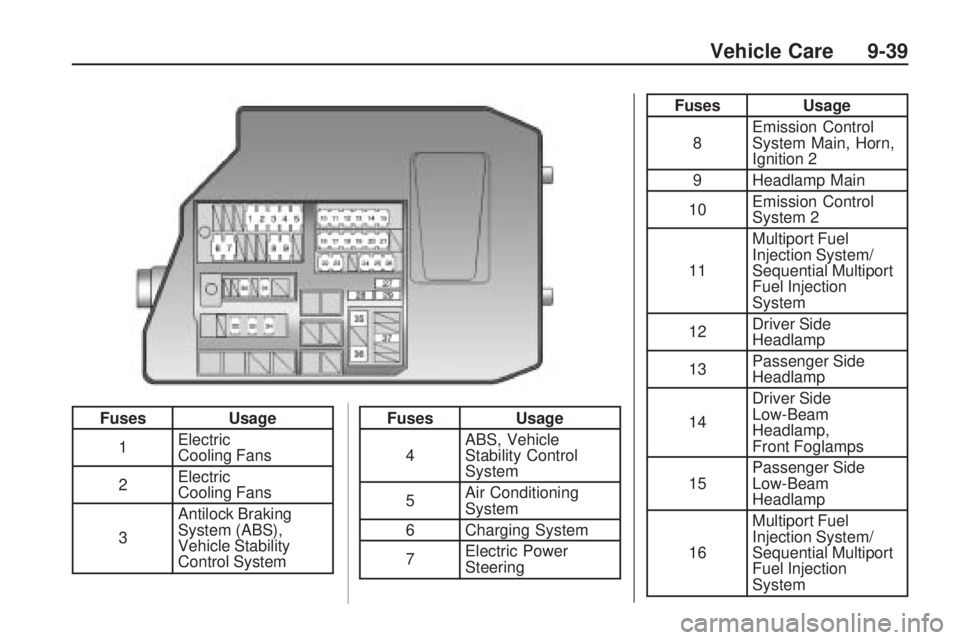
FusesUsage
1 Electric
Cooling Fans
2 Electric
Cooling Fans
3 Antilock Braking
System (ABS),
Vehicle Stability
Control SystemFuses
Usage
4 ABS, Vehicle
Stability Control
System
5 Air Conditioning
System
6 Charging System
7 Electric Power
Steering
Fuses
Usage
8 Emission Control
System Main, Horn,
Ignition 2
9 Headlamp Main
10 Emission Control
System 2
11 Multiport Fuel
Injection System/
Sequential Multiport
Fuel Injection
System
12 Driver Side
Headlamp
13 Passenger Side
Headlamp
14 Driver Side
Low-Beam
Headlamp,
Front Foglamps
15 Passenger Side
Low-Beam
Headlamp
16 Multiport Fuel
Injection System/
Sequential Multiport
Fuel Injection
System
Vehicle Care 9-39
Page 224 of 318
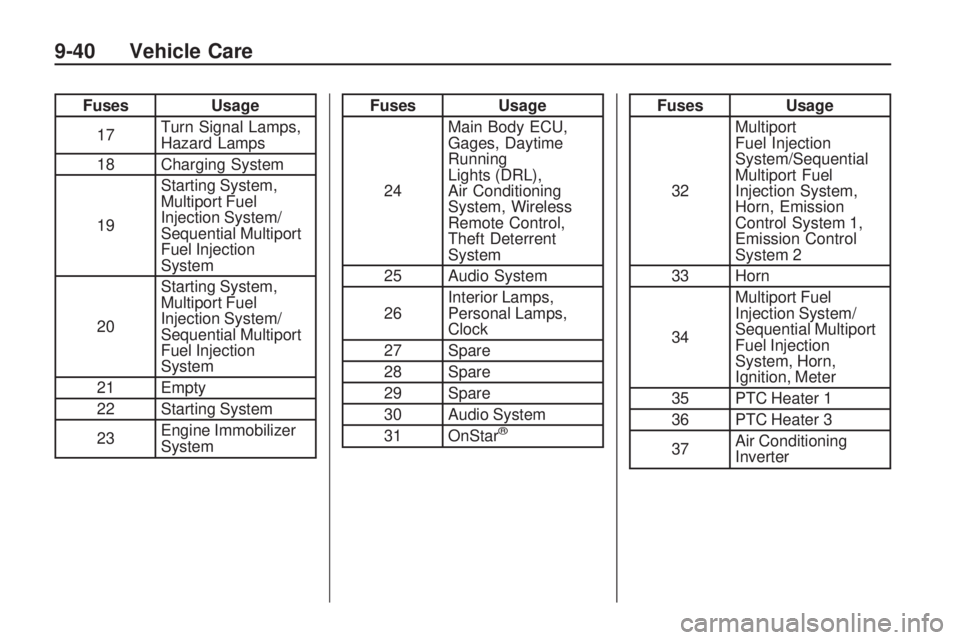
FusesUsage
17 Turn Signal Lamps,
Hazard Lamps
18 Charging System
19 Starting System,
Multiport Fuel
Injection System/
Sequential Multiport
Fuel Injection
System
20 Starting System,
Multiport Fuel
Injection System/
Sequential Multiport
Fuel Injection
System
21 Empty
22 Starting System
23 Engine Immobilizer
SystemFuses
Usage
24 Main Body ECU,
Gages, Daytime
Running
Lights (DRL),
Air Conditioning
System, Wireless
Remote Control,
Theft Deterrent
System
25 Audio System
26 Interior Lamps,
Personal Lamps,
Clock
27 Spare
28 Spare
29 Spare
30 Audio System
31 OnStar
®
Fuses Usage
32 Multiport
Fuel Injection
System/Sequential
Multiport Fuel
Injection System,
Horn, Emission
Control System 1,
Emission Control
System 2
33 Horn
34 Multiport Fuel
Injection System/
Sequential Multiport
Fuel Injection
System, Horn,
Ignition, Meter
35 PTC Heater 1
36 PTC Heater 3
37 Air Conditioning
Inverter
9-40 Vehicle Care
Page 226 of 318
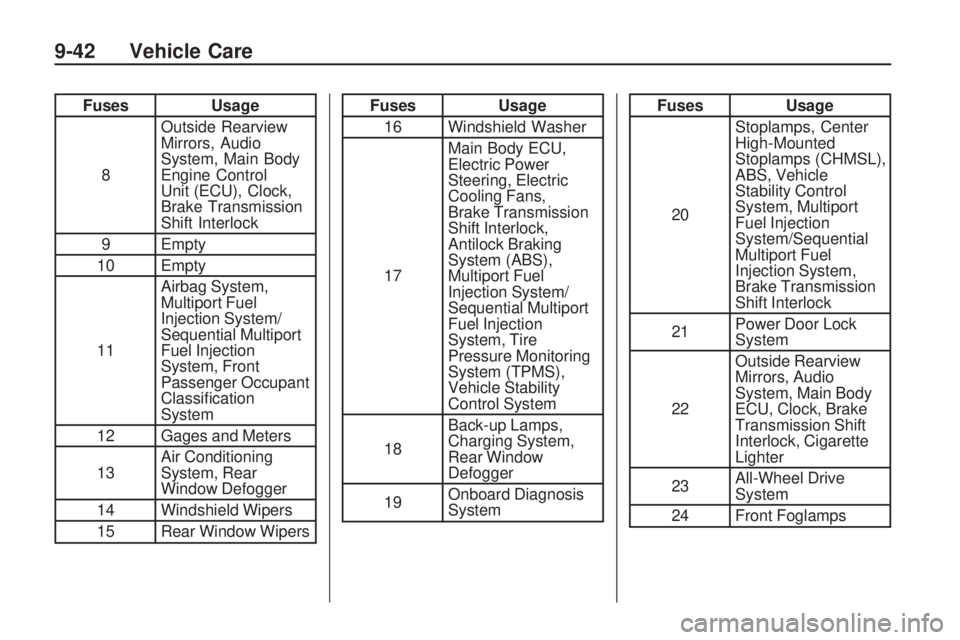
FusesUsage
8 Outside Rearview
Mirrors, Audio
System, Main Body
Engine Control
Unit (ECU), Clock,
Brake Transmission
Shift Interlock
9 Empty
10 Empty
11 Airbag System,
Multiport Fuel
Injection System/
Sequential Multiport
Fuel Injection
System, Front
Passenger Occupant
Classification
System
12 Gages and Meters
13 Air Conditioning
System, Rear
Window Defogger
14 Windshield Wipers
15 Rear Window WipersFuses Usage
16 Windshield Washer
17 Main Body ECU,
Electric Power
Steering, Electric
Cooling Fans,
Brake Transmission
Shift Interlock,
Antilock Braking
System (ABS),
Multiport Fuel
Injection System/
Sequential Multiport
Fuel Injection
System, Tire
Pressure Monitoring
System (TPMS),
Vehicle Stability
Control System
18 Back-up Lamps,
Charging System,
Rear Window
Defogger
19 Onboard Diagnosis
SystemFuses
Usage
20 Stoplamps, Center
High-Mounted
Stoplamps (CHMSL),
ABS, Vehicle
Stability Control
System, Multiport
Fuel Injection
System/Sequential
Multiport Fuel
Injection System,
Brake Transmission
Shift Interlock
21 Power Door Lock
System
22 Outside Rearview
Mirrors, Audio
System, Main Body
ECU, Clock, Brake
Transmission Shift
Interlock, Cigarette
Lighter
23 All-Wheel Drive
System
24 Front Foglamps
9-42 Vehicle Care
Page 310 of 318
B
Battery............................... 9-28
Jump Starting ................... 9-69
Power Protection ................ 5-5
Blade Replacement, Wiper ....9-30
Brakes ............................... 9-26
Antilock ........................... 8-32
Fluid ............................... 9-27
Parking ........................... 8-33
Braking ................................ 8-4
Break-In, New Vehicle ..........8-16
Bulb Replacement ................9-37
Fog Lamps ........................ 5-4
Halogen Bulbs ..................9-33
Headlamp Aiming ..............9-32
Headlamps ...................... 9-33
Headlamps and Parking Lamps ......................... 9-33
License Plate Lamps .........9-36
Taillamps ......................... 9-35
Buying New Tires .................9-56
C
California
Fuel Requirements ............8-39
Perchlorate Materials Requirements ................. 9-3
Warning ............................ 9-2
Canadian Vehicle Owners .......... ii
Capacities and Specifications ................... 11-2
Carbon Monoxide Engine Exhaust ................8-23
Liftgate ............................. 1-6
Winter Driving .................... 8-9
Cargo Cover ............................... 3-2
Management System .......... 3-4
Tie Downs ......................... 3-4
Cautions, Danger, and Warnings ............................. iii
CD Player ............................ 6-9
Center Console Storage ......... 3-2
Chains, Tire ........................ 9-61
Charging System Light ..........4-14
Check Engine Lamp .............4-14Child Restraints
Infants and YoungChildren ....................... 2-38
Lower Anchors and Tethers for Children .................. 2-45
Older Children ..................2-37
Securing .................. 2-51, 2-53
Systems .......................... 2-41
Where to Put the Restraint ...................... 2-43
Cigarette Lighter .................... 4-8
Circuit Breakers ...................9-38
Climate Control Systems ......... 7-1
Cluster, IP ............................ 4-9
Clutch, Hydraulic ..................9-15
Collision Damage Repair .....12-10
Compact Spare Tire .............9-68
Control of a Vehicle ............... 8-3
Coolant Engine ............................ 9-19
Engine Temperature Gage . . . 4-11
Cooling System ...................9-19
Courtesy Transportation Program .......................... 12-8
i-2 INDEX
Page 313 of 318
H
Halogen Bulbs..................... 9-33
Hazard Warning Flashers ........ 5-3
Head Restraints ..................... 2-2
Active ............................... 2-3
Headlamps Aiming ............................ 9-32
Automatic .......................... 5-3
Bulb Replacement .............9-33
Daytime Running Lamps (DRL) .................. 5-2
Flash-to-Pass ..................... 5-2
High-Beam On Light .........4-20
High/Low Beam Changer ..... 5-2
Lamps On Reminder .........4-20
Parking Lamps .................9-33
High-Beam On Light .............4-20
Highway Hypnosis ................. 8-8
Hill and Mountain Roads ......... 8-8
Hood ................................... 9-5
Hooks and Load Rails ............ 3-4
Horn .................................... 4-5
How to Wear Safety Belts Properly .......................... 2-12
Hydraulic Clutch ...................9-15
I
Ignition Positions ..................8-16
Illumination Control ................ 5-4
Immobilizer ........................... 1-9
Infants and Young Children, Restraints ........................ 2-38
Instrument Cluster .................. 4-9
Instrument Panel ................... 5-4
Interior Care ........................ 9-80
Introduction .............................. ii
J
Jump Starting ...................... 9-69
K
Keyless Entry System ............ 1-3
Keys .................................... 1-2
L
Labeling, Tire Sidewall ..........9-44
Lamps Daytime Running (DRL) ....... 5-2
Dome ............................... 5-4
Exterior Controls ................ 5-1 Lamps (cont.)
Headlamps and ParkingLamps ......................... 9-33
License Plate ................... 9-36
Malfunction Indicator .........4-14
On Reminder ................... 4-20
Reading ............................ 5-5
Taillamps ......................... 9-35
Lap-Shoulder Belt ................2-18
Latch, Lower Anchors and Tethers for Children ...........2-45
LATCH System Replacing Parts After aCrash .......................... 2-51
Liftgate Carbon Monoxide ............... 1-6
Lighter, Cigarette ................... 4-8
Lighting Entry ................................ 5-5
Lights Airbag Readiness .............4-12
Antilock Brake System (ABS) Warning ..............4-17
Charging System ..............4-14
Cruise Control ..................4-21
Door Ajar ......................... 4-21
INDEX i-5