fuel PORSCHE 911 2009 5.G Information Manual
[x] Cancel search | Manufacturer: PORSCHE, Model Year: 2009, Model line: 911, Model: PORSCHE 911 2009 5.GPages: 59, PDF Size: 5.74 MB
Page 20 of 59
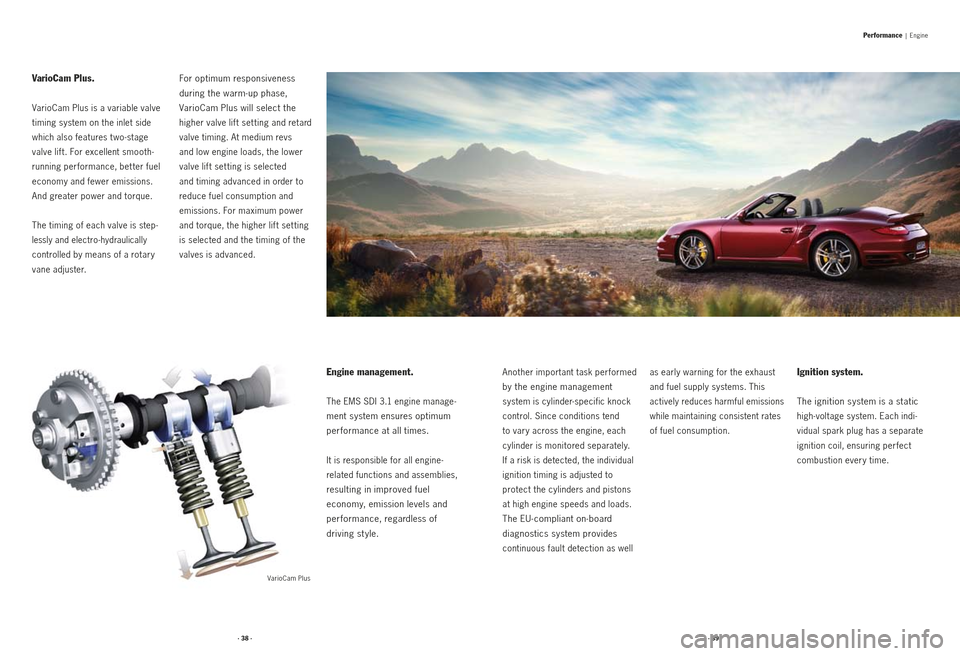
VarioCam Plus.
VarioCam Plus is a variable valve
timing system on the inlet side
which also features t wo -stage
valve lift. For excellent smooth-
running performance, bet ter fuel
economy and fewer emissions.
And greater power and torque.
The timing of each valve is step-
lessly and electro -hydraulically
controlled by means of a rotary
vane adjuster.
For optimum responsiveness
during the warm-up phase,
VarioCam Plus will select the
higher valve lif t set ting and retard
valve timing. At medium revs
and low engine loads, the lower
valve lif t set ting is selected
and timing advanced in order to
reduce fuel consumption and
emissions. For maximum power
and torque, the higher lif t set ting
is selected and the timing of the
valves is advanced.
Engine management.
The EMS SDI 3.1 engine manage -
ment system ensures optimum
performance at all times.
It is responsible for all engine-
related functions and assemblies,
resulting in improved fuel
economy, emission levels and
performance, regardless of
driving st yle.
Another important task performed
by the engine management
system is cylinder-specific knock
control. Since conditions tend
to vary across the engine, each
cylinder is monitored separately.
If a risk is detected, the individual
ignition timing is adjusted to
protect the cylinders and pistons
at high engine speeds and loads.
The EU-compliant on-board
diagnostics system provides
continuous fault detection as well as early warning for the exhaust
and fuel supply systems. This
actively reduces harmful emissions
while maintaining consistent rates
of fuel consumption.
Ignition system.
The ignition system is a static
high-voltage system. Each indi -
vidual spark plug has a separate
ignition coil, ensuring perfect
combustion every time.
Performance | Engine
VarioCam Plus
· 38 ·· 39 ·
Page 21 of 59
Expansion intake manifold.
More power for less fuel. What
sounds absurd is sometimes
quite simple. You just have to
have the nerve to question
prin ciples that are seemingly
writ ten in stone.
The 911 Turbo and 911 Turbo S
models have an innovative expan -
sion intake manifold that was
used for the first time on the latest
911 GT2. Its unique operating
principle is unlike any thing ever
featured on existing induction
systems. Our ‘expansion’ intake
manifold is a radical development
that is the polar opposite of the
resonance principle used on con -
ventional turbocharged engines.
A resonance manifold increases
engine output by forcing addi
tional
air into the combustion chambers.
To do this, the manifold is designed
in such a way that the air – which
vibrates due to the action of the
valves – is in a compression phase
as it passes through the inlet ports.
Unfortunately, compression not
only increases air volume, it
also increases air temperature
and this has a negative effect
on ignition.
Our expansion manifold simply
turns that principle around. The
internal geometry is radically
different from that on a resonance
intake system. Key modifications
include a longer distributor pipe,
with a smaller diameter, and
shorter intake pipes. As a result,
the air is in the expansion phase
as it enters the combustion
chambers. Since expansion always
cools, the air/fuel temperature is
lower and ignition is significantly
improved – thereby increasing
performance.
Of course, the amount of air that
enters the engine under expan -
sion is less than it would be under
compression. To compensate
for this, we’ve simply increased
the boost pressure. The resulting
increase in temperature – again
through compression – is immedi -
ately offset by the uprated inter -
coolers. Instead of hot compressed air
entering the combustion
chambers, we now have cooler
air generating more power and
torque. As a consequence, there
is a major improvement in engine
efficiency and therefore lower fuel
consumption even under heav y
loads and at high revs.
As we said, sometimes you just
have to question established
ideas.
Exhaust system.
The exhaust system is made
from stainless steel. Its cataly tic
converters are extremely heat-
resistant, yet quick to reach
temperature – and thus optimum
performance – when the engine
is started from cold.
Advanced exhaust gas technology
ensures compliance with stringent
emissions standards, e.g. Euro 5
in EU markets, LEV II/ LEV in the
USA.
Servicing.
The 911 Turbo and 911 Turbo S
models are designed for a long
life. A self-adjusting belt drives
the generator, power-steering
pump and air-conditioning com -
pressor. Valve clearances are
adjusted hydraulically, thus avoid -
ing the need for any adjustment
work. The camshafts are driven
by timing chains that require
no maintenance and the ignition
system, with the exception of
the spark plugs, is also mainte -
nance-free. The cars come with
a t wo -year unlimited mileage
w a r ra n t y.
The long service intervals (see
separate price list) keep costs
and labour times down and save
resources, since fewer service
products and consumable parts
are used.
Performance | Engine
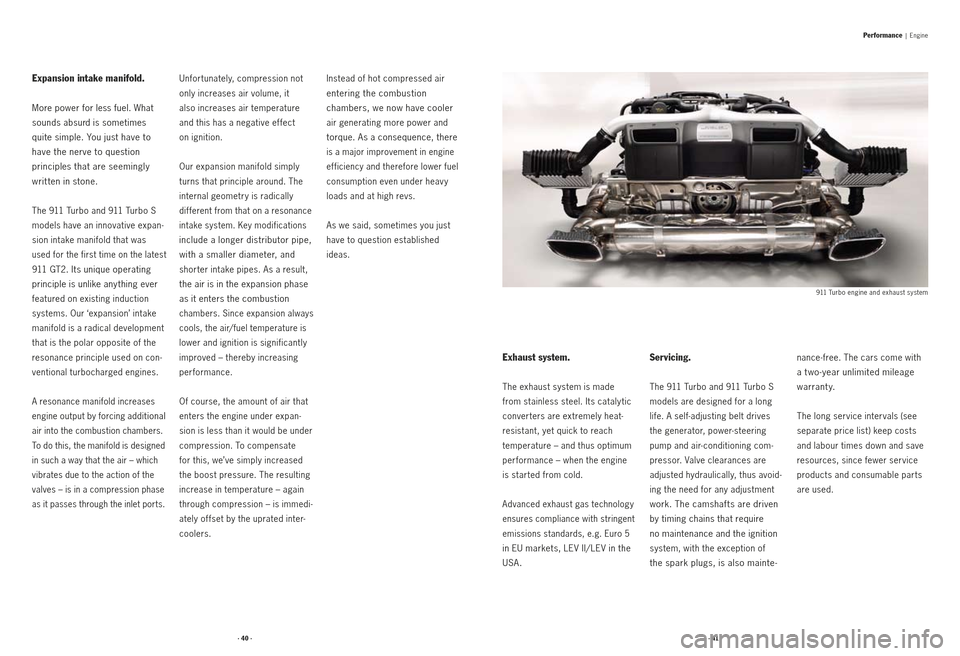
911 Turbo engine and exhaust system
· 40 ·· 41 ·
Page 22 of 59
Porsche Doppelkupplung (PDK).
Derived from motorsport, PDK,
which is standard for 911 Turbo S
models and optional for 911 Turbo
models, achieves one thing
above all else: it provides the
perfect balance bet ween uncom -
promisingly dynamic performance
and exceptional levels of comfort.
It ’s purely about point of view.
The driver’s especially.
PDK, with both a manual and an
automatic mode, enables
extremely fast gear changes with
no interruption in the power flow.
For improved acceleration and significantly lower fuel consump
-
tion – without having to dispense
with the advantages of an auto -
matic.
The driver experiences a sportier,
even more dynamic drive with
more agilit y. Depending on driving
st yle, gear changes range from
exceptionally comfortable to
exceptionally sport y.
Manual gear changes are per -
formed using PDK’s ergono-
mically
designed gear lever or
alternatively, on the 911 Turbo
models, using the switches on
the three-spoke sports steering
wheel: nudge forwards to change
up, pull back to change down.
Fit ted as standard on 911 Turbo S
models and available as an option
for 911 Turbo models is the three-
spoke sports steering wheel
with gearshif t paddles, which is
also capable of operating PDK.
With its motorsport-derived gear -
shif t logic, you pull the right-hand
paddle to shift up and pull the
left-hand paddle to shift down.
PDK has been specially tuned
to the characteristics of the
911
Turbo models and the new
911 Turbo S models. It has seven
gears at its disposal. Gears 1 to 6
have a sports ratio, with the top
speed being reached in 6th gear.
The 7th gear has a long ratio and
helps to reduce fuel consumption
even further.
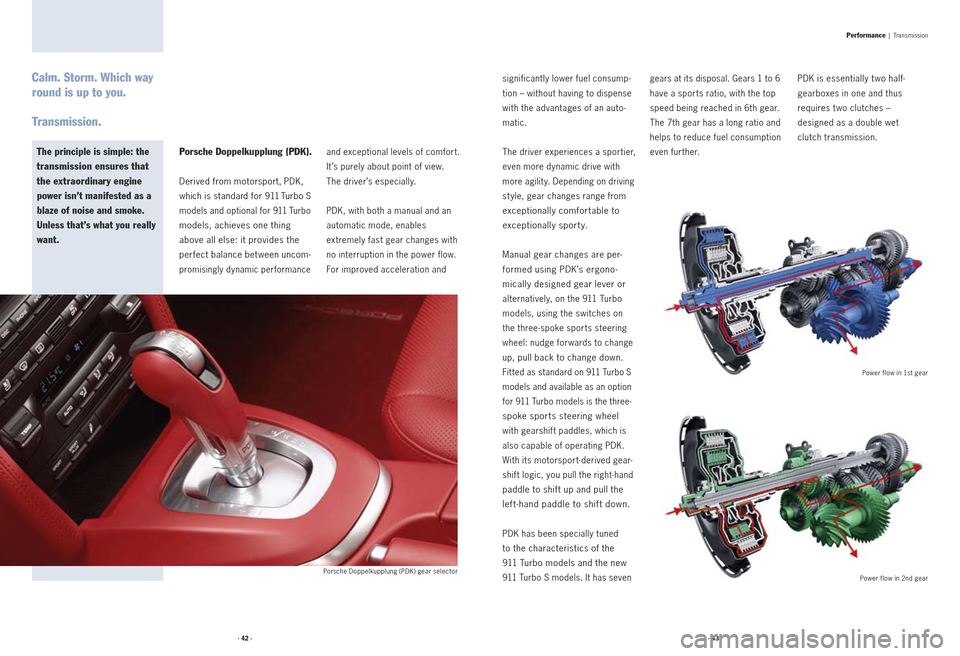
PDK is essentially t wo half-
gearboxes in one and thus
requires t wo clutches –
designed as a double wet
clutch transmission.
The principle is simple: the
transmission ensures that
the extraordinary engine
power isn’t manifested as a
blaze of noise and smoke.
Unless that’s what you really
want.
Calm. Storm. Which way
round is up to you.
Transmission.
Porsche Doppelkupplung (PDK) gear selector Power flow in 1st gear
Power flow in 2nd gear
Performance | Transmission
· 42 ·· 43 ·
Page 35 of 59
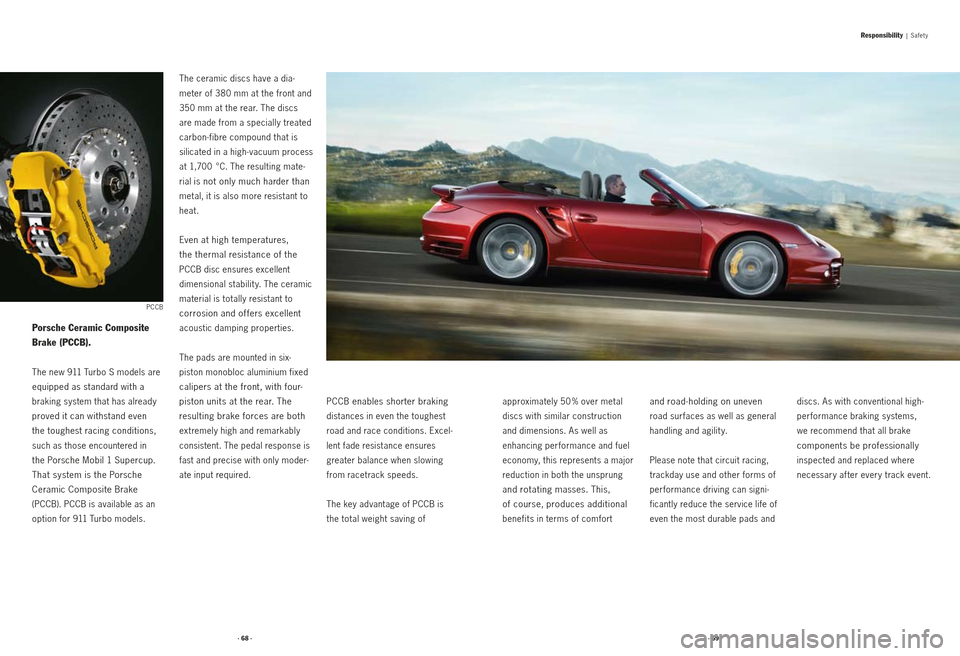
Porsche Ceramic Composite
Brake (PCCB).
The new 911 Turbo S models are
equipped as standard with a
braking system that has already
proved it can withstand even
the toughest racing conditions,
such as those encountered in
the Porsche Mobil 1 Supercup.
That system is the Porsche
Ceramic Composite Brake
(PCCB). PCCB is available as an
option for 911 Turbo models. The ceramic discs have a dia
-
meter of 380 mm at the front and
350 mm at the rear. The discs
are made from a specially treated
carbon -fibre compound that is
silicated in a high -vacuum process
at 1,700 °C. The resulting mate -
rial
is not only much harder than
metal, it is also more resistant to
heat.
Even at high temperatures,
the thermal resistance of the
PCCB disc ensures excellent
dimensional stabilit y. The ceramic
material is totally resistant to
corrosion and offers excellent
acoustic damping properties.
The pads are mounted in six-
piston monobloc aluminium fixed
calipers at the front, with four-
piston units at the rear. The
resulting brake forces are both
extremely high and remarkably
consistent. The pedal response is
fast and precise with only moder -
ate input required.
PCCB enables shorter braking
distances in even the toughest
road and race conditions. Excel -
lent fade resistance ensures
greater balance when slowing
from racetrack speeds.
The key advantage of PCCB is
the total weight saving of approximately 50
% over metal
discs with similar construction
and dimensions. As well as
enhancing performance and fuel
economy, this represents a major
reduction in both the unsprung
and rotating masses. This,
of course, produces additional
benefits in terms of comfort
and road-holding on uneven
road surfaces as well as general
handling and agilit y.
Please note that circuit racing,
trackday use and other forms of
performance driving can signi -
ficantly reduce the service life of
even the most durable pads and discs. As with conventional high-
performance braking systems,
we recommend that all brake
components be professionally
inspected and replaced where
necessary after every track event.
PCCB
Responsibility | Safet y
· 68 ·· 69 ·
Page 38 of 59
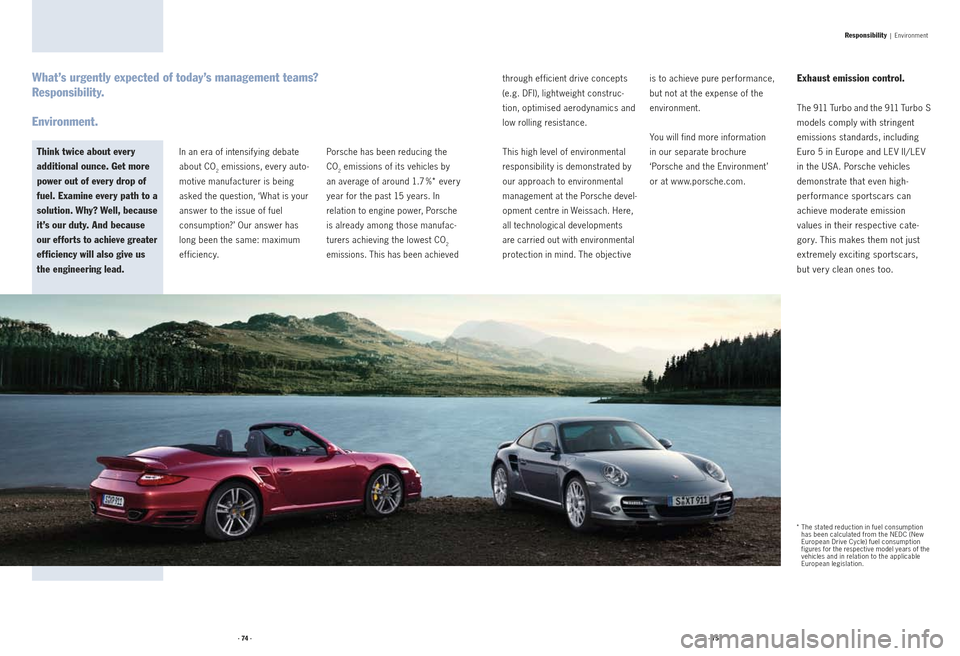
In an era of intensif ying debate
about CO
2 emissions, every auto-
motive manufacturer is being
asked the question, ‘What is your
answer to the issue of fuel
consumption?’ Our answer has
long been the same: maximum
efficiency. Porsche has been reducing the
CO2 emissions of its vehicles by
an average of around 1.7 %* every
year for the past 15 years. In
relation to engine power, Porsche
is already among those manufac -
turers achieving the lowest CO
2
emissions. This has been achieved through ef ficient drive concepts
(e.g. DFI), light weight construc
-
tion, optimised aerodynamics and
low rolling resistance.
This high level of environmental
responsibilit y is demonstrated by
our approach to environmental
management at the Porsche devel -
opment centre in Weissach. Here,
all technological developments
are carried out with environmental
protection in mind. The objective is to achieve pure performance,
but not at the expense of the
environment.
You will find more information
in our separate brochure
‘Porsche and the Environment ’
or at w w w.porsche.com.
Exhaust emission control.
The 911 Turbo and the 911 Turbo S
models comply with stringent
emissions standards, including
Euro 5 in Europe and LEV II/ LEV
in the USA. Porsche vehicles
demonstrate that even high-
performance sportscars can
achieve moderate emission
values in their respective cate -
gory. This makes them not just
extremely exciting sportscars,
but very clean ones too.
What’s urgently expected of today’s management teams?
Responsibility.
Environment.
Think twice about every
additional ounce. Get more
power out of every drop of
fuel. Examine every path to a
solution. Why? Well, because
it’s our duty. And because
our efforts to achieve greater
efficiency will also give us
the engineering lead.
Responsibility | Environment
* The stated reduction in fuel consumption
has been calculated from the NEDC (New
European Drive Cycle) fuel consumption
figures for the respective model years of the
vehicles and in relation to the applicable
European legislation.
· 74 ·· 75 ·
Page 39 of 59
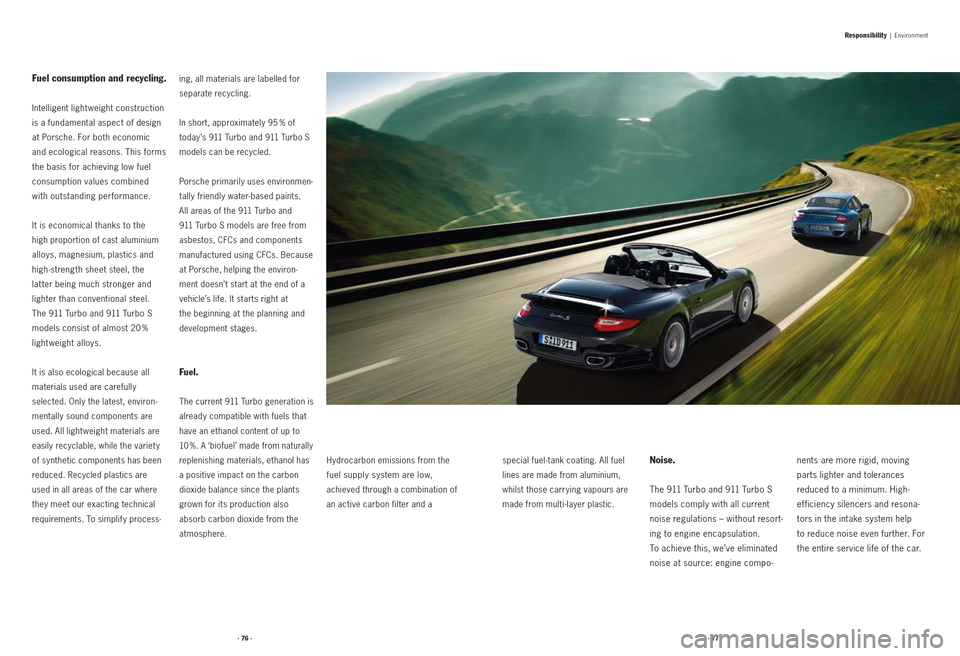
Fuel consumption and recycling.
Intelligent light weight construction
is a fundamental aspect of design
at Porsche. For both economic
and ecological reasons. This forms
the basis for achieving low fuel
consumption values combined
with outstanding performance.
It is economical thanks to the
high proportion of cast aluminium
alloys, magnesium, plastics and
high-strength sheet steel, the
lat ter being much stronger and
lighter than conventional steel.
The 911 Turbo and 911 Turbo S
models consist of almost 20 %
lightweight alloys.
It is also ecological because all
materials used are carefully
selected. Only the latest, environ -
mentally sound components are
used. All light weight materials are
easily recyclable, while the variet y
of synthetic components has been
reduced. Recycled plastics are
used in all areas of the car where
they meet our exacting technical
requirements. To simplify process -ing, all materials are labelled for
separate recycling.
In short, approximately 95
% of
today’s 911 Turbo and 911 Turbo S
models can be recycled.
Porsche primarily uses environmen -
tally friendly water-based paints.
All areas of the 911 Turbo and
911 Turbo S models are free from
asbestos, CFCs and components
manufactured using CFCs. Because
at Porsche, helping the environ -
ment doesn’t start at the end of a
vehicle’s life. It starts right at
the beginning at the planning and
development stages.Fuel.
The current 911 Turbo generation is
already compatible with fuels that
have an ethanol content of up to
10 %. A ‘biofuel’ made from naturally
replenishing materials, ethanol has
a positive impact on the carbon
dioxide balance since the plants
grown for its production also
absorb carbon dioxide from the
atmosphere. Hydrocarbon emissions from the
fuel supply system are low,
achieved through a combination of
an active carbon filter and a
special fuel-tank coating. All fuel
lines are made from aluminium,
whilst those carrying vapours are
made from multi-layer plastic.
Noise.
The 911 Turbo and 911 Turbo S
models comply with all current
noise regulations – without resort
-
ing to engine encapsulation.
To achieve this, we’ve eliminated
noise at source: engine compo -nents are more rigid, moving
parts lighter and tolerances
reduced to a minimum. High-
efficiency silencers and resona -
tors in the intake system help
to reduce noise even further. For
the entire service life of the car.
Responsibility | Environment
· 76 ·· 77 ·
Page 41 of 59
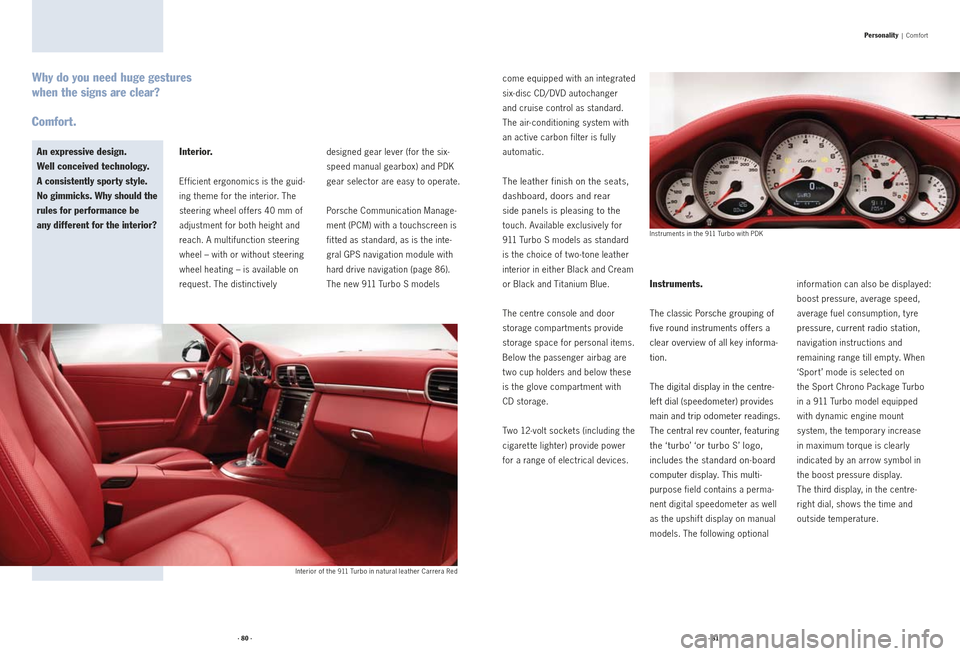
Interior.
Efficient ergonomics is the guid-
ing theme for the interior. The
steering wheel of fers 40 mm of
adjustment for both height and
reach. A multifunction steering
wheel – with or without steering
wheel heating – is available on
request. The distinctively designed gear lever (for the six-
speed manual gearbox) and PDK
gear selector are easy to operate.
Porsche Communication Manage
-
ment (PCM) with a touchscreen is
fit ted as standard, as is the inte -
gral GPS navigation module with
hard drive navigation (page 86).
The new 911 Turbo S models come equipped with an integrated
six- disc CD/ DVD autochanger
and cruise control as standard.
The air- conditioning system with
an active carbon filter is fully
automatic. The leather finish on the seats,
dashboard, doors and rear
side panels is pleasing to the
touch. Available exclusively for
911 Turbo S models as standard
is the choice of t wo -tone leather
interior in either Black and Cream
or Black and Titanium Blue.
The centre console and door
storage compartments provide
storage space for personal items.
Below the passenger airbag are
t wo cup holders and below these
is the glove compartment with
CD storage.
Two 12-volt sockets (including the
cigaret te lighter) provide power
for a range of electrical devices.
Instruments.
The classic Porsche grouping of
five round instruments offers a
clear overview of all key informa -
tion.
The digital display in the centre-
left dial (speedometer) provides
main and trip odometer readings.
The central rev counter, featuring
the ‘turbo’ ‘or turbo S’ logo,
includes the standard on-board
computer display. This multi -
pur
pose field contains a perma -
nent digital speedometer as well
as the upshif t display on manual
models. The following optional information can also be displayed:
boost pressure, average speed,
average fuel consumption, t yre
pressure, current radio station,
navigation instructions and
remaining range till empt y. When
‘Sport ’ mode is selected on
the Sport Chrono Package Turbo
in a 911 Turbo model equipped
with dynamic engine mount
system, the temporary increase
in maximum torque is clearly
indicated by an arrow symbol in
the boost pressure display.
The third display, in the centre-
right dial, shows the time and
outside temperature.
Why do you need huge gestures
when the signs are clear?
Comfort.
An expressive design.
Well conceived technology.
A consistently sporty style.
No gimmicks. Why should the
rules for performance be
any different for the interior?
Personality | Comfort
Instruments in the 911 Turbo with PDK
Interior of the 911 Turbo in natural leather Carrera Red
· 80 ·· 81 ·
Page 55 of 59
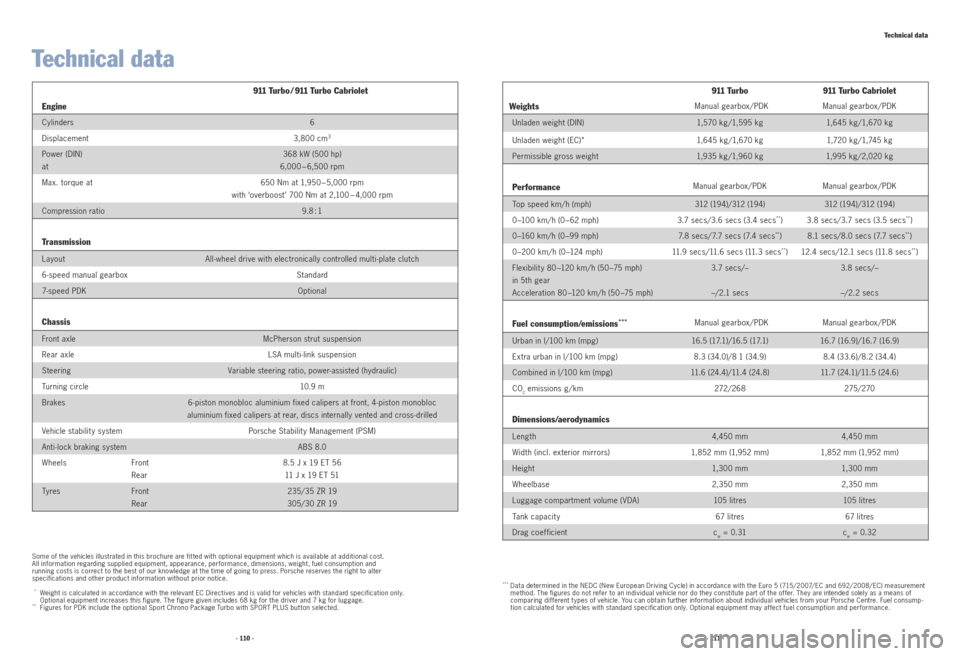
Technical data
911 Turbo / 911 Turbo Cabriolet
Engine
C y linders 6
Displacement 3,800 cm
3
Power (DIN)
at368 kW (500
hp)
6,000 – 6,500 rpm
Max. torque at 650 Nm at 1,950 – 5,000 rpm
with ‘overboost ’ 700 Nm at 2,100 – 4,000 rpm
Compression ratio 9 . 8 : 1
Transmission
Layout All-wheel drive with electronically controlled multi-plate clutch
6-speed manual gearbox Standard
7-speed PDK Optional
Chassis
Front axleMcPherson strut suspension
Rear axle LSA multi - link suspension
Steering Variable steering ratio, power-assisted (hydraulic)
Turning circle 10.9 m
Brakes 6 - piston monobloc aluminium fixed calipers at front, 4 - piston monobloc
aluminium fixed calipers at rear, discs internally vented and cross- drilled
Vehicle stabilit y system Porsche Stability Management (PSM)
Anti - lock braking system ABS 8.0
Wheels Front
Rear 8.5 J x 19 ET 56
11 J x 19 ET 51
Tyres Front
Rear 235/35 ZR 19
305/30 ZR 19
Technical data
911 Turbo 911 Turbo Cabriolet
Weights
Manual gearbox/PDK Manual gearbox / PDK
Unladen weight (DIN) 1,570 k g / 1,59 5 k g 1,6 4 5 k g / 1,670 k g
Unladen weight (EC)* 1,6 4 5 k g / 1,670 k g 1,72 0 k g / 1,74 5 k g
Permissible gross weight 1,93 5 k g / 1,9 6 0 k g 1,995 kg /2,020 kg
PerformanceManual gearbox/PDK Manual gearbox/PDK
Top speed km/ h (mph) 312 (19 4) / 312 (19 4)312 (194)/312 (194)
0 –100 km/ h (0 – 62 mph) 3.7 secs/3.6 secs (3.4 secs
**)3.8 secs/3.7 secs (3.5 secs**)
0 –160 km/ h (0 –99 mph) 7.8 secs/7.7 secs (7.4 secs
**)8.1 secs/8.0 secs (7.7 secs**)
0 –200 km/ h (0 –124 mph) 11.9 secs/11.6 secs (11.3 secs
**) 12.4 secs/12.1 secs (11.8 secs**)
Flexibilit y 80 –120 km/ h (50 –75 mph)
in 5th gear
Acceleration 80 –120 km/ h (50 –75 mph) 3.7
secs/–
–/2.1 secs 3.8
secs/–
–/2.2 secs
Fuel consumption/emissions***Manual gearbox/PDK Manual gearbox/PDK
Urban in l/100 km (mpg) 16.5 (17.1)/16.5 (17.1)16.7 (16.9)/16.7 (16.9)
Extra urban in l/100 km (mpg) 8.3 (34.0)/8 1 (34.9)8.4 (33.6)/8.2 (34.4)
Combined in l/100 km (mpg) 11. 6 ( 2 4 . 4 ) / 11. 4 ( 2 4 . 8 )11.7 (24.1)/11.5 (24.6)
CO
2 emissions g/km 272/268275/270
Dimensions/aerodynamics
Length 4,450 mm4,450 mm
Width (incl. exterior mirrors) 1,852 mm (1,952 mm)1,852 mm (1,952 mm)
Height 1,300 mm1,300 mm
Wheelbase 2,350 mm2,350 mm
Luggage compartment volume ( VDA) 10 5 l i t res10 5 l i t res
Tank capacity 67 litres67 litres
Drag coef ficient c
w = 0.31cw = 0.32
*** Data determined in the NEDC (New European Driving Cycle) in accordance with the Euro 5 (715/2007/ EC and 692/2008/ EC) measurement
method. The figures do not refer to an individual vehicle nor do they constitute part of the of fer. They are intended solely as a means of
comparing dif ferent t ypes of vehicle. You can obtain further information about individual vehicles from your Porsche Centre. Fuel consump -
tion calculated for vehicles with standard specification only. Optional equipment may af fect fuel consumption and per formance.
Some of the vehicles illustrated in this brochure are fit ted with optional equipment which is available at additional cost.
All information regarding supplied equipment, appearance, per formance, dimensions, weight, fuel consumption and
running costs is correct to the best of our knowledge at the time of going to press. Porsche reserves the right to alter
specifications and other product information without prior notice.* Weight is calculated in accordance with the relevant EC Directives and is valid for vehicles with standard specification only.
Optional equipment increases this figure. The figure given includes 68 kg for the driver and 7 kg for luggage.
** Figures for PDK include the optional Sport Chrono Package Turbo with SPORT PLUS but ton selected.
· 110 ·· 111 ·
Page 56 of 59
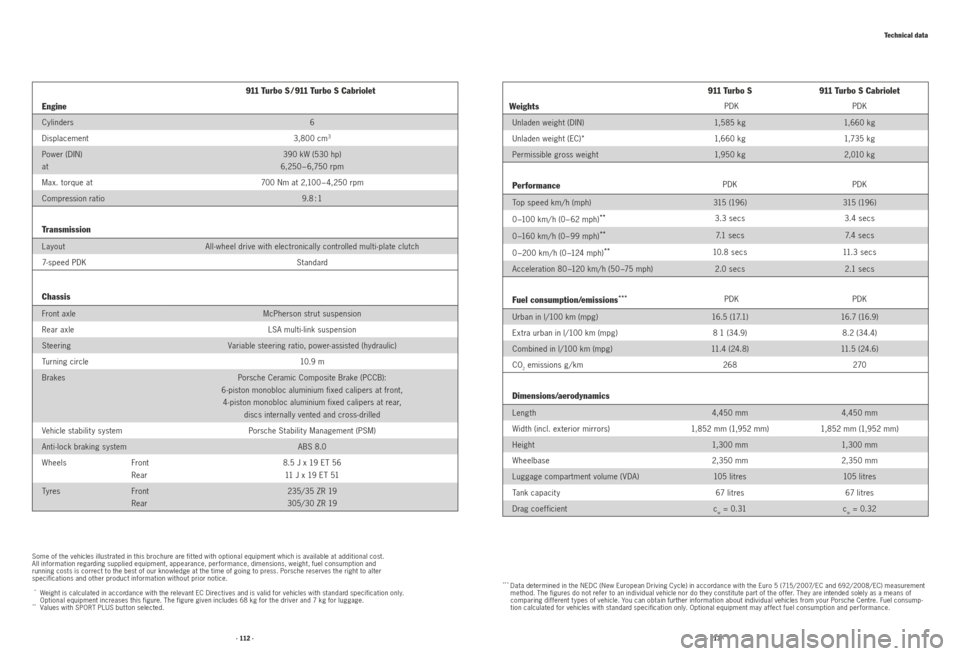
Technical data
** * Data determined in the NEDC (New European Driving Cycle) in accordance with the Euro 5 (715/2007/ EC and 692/2008/ EC) measurement
method. The figures do not refer to an individual vehicle nor do they constitute part of the of fer. They are intended solely as a means of
comparing dif ferent t ypes of vehicle. You can obtain further information about individual vehicles from your Porsche Centre. Fuel consump -
tion calculated for vehicles with standard specification only. Optional equipment may af fect fuel consumption and per formance.
Some of the vehicles illustrated in this brochure are fit ted with optional equipment which is available at additional cost.
All information regarding supplied equipment, appearance, per formance, dimensions, weight, fuel consumption and
running costs is correct to the best of our knowledge at the time of going to press. Porsche reserves the right to alter
specifications and other product information without prior notice. * Weight is calculated in accordance with the relevant EC Directives and is valid for vehicles with standard specification only.
Optional equipment increases this figure. The figure given includes 68 kg for the driver and 7 kg for luggage.
** Values with SPORT PLUS but ton selected.
911 Turbo S / 911 Turbo S Cabriolet
Engine
Cylinders 6
Displacement 3,800 cm
3
Power (DIN)
at 390 kW (530 hp)
6,250 – 6,750 rpm
Max. torque at 700 Nm at 2,100 – 4,250 rpm
Compression ratio 9 . 8 : 1
Transmission
Layout All -wheel drive with electronically controlled multi - plate clutch
7-speed PDK Standard
Chassis
Front axleMcPherson strut suspension
Rear axle LSA multi - link suspension
Steering Variable steering ratio, power-assisted (hydraulic)
Turning circle 10.9 m
Brakes Porsche Ceramic Composite Brake (PCCB):
6 - piston monobloc aluminium fixed calipers at front, 4 - piston monobloc aluminium fixed calipers at rear, discs internally vented and cross-drilled
Vehicle stabilit y system Porsche Stability Management (PSM)
Anti - lock braking system ABS 8.0
Wheels Front
Rear 8.5 J x 19 ET 56
11 J x 19 ET 51
Tyres Front
Rear 235/35 ZR 19
305/30 ZR 19
911 Turbo S 911 Turbo S Cabriolet
Weights
PDK PDK
Unladen weight (DIN) 1,5 8 5 k g 1,6 6 0 k g
Unladen weight (EC)* 1,6 6 0 k g 1,73 5 k g
Permissible gross weight 1,9 5 0 k g 2,010 k g
PerformancePDK PDK
Top speed km/ h (mph) 315 (19 6)315 (19 6)
0 –100 km/ h (0 – 62 mph)
**3.3 secs 3.4 secs
0 –160 km/ h (0 – 99 mph)
**7. 1 s e c s 7. 4 s e c s
0 –200 km/ h (0 –124 mph)
**10. 8 s e c s 11.3 secs
Acceleration 80 –120 km/ h (50 –75 mph) 2.0 secs 2.1 s e c s
Fuel consumption/emissions***PDK PDK
Urban in l/100 km (mpg) 16.5 (17.1)16.7 (16.9)
Extra urban in l/100 km (mpg) 8 1 (34.9)8.2 (34.4)
Combined in l/100 km (mpg) 11. 4 ( 2 4 . 8 )11.5 (24.6)
CO
2 emissions g/km 268270
Dimensions/aerodynamics
Length 4,450 mm4,450 mm
Width (incl. exterior mirrors) 1,852 mm (1,952 mm)1,852 mm (1,952 mm)
Height 1,300 mm1,300 mm
Wheelbase 2,350 mm2,350 mm
Luggage compartment volume ( VDA) 10 5 l i t res10 5 l i t res
Tank capacity 67 litres67 litres
Drag coef ficient c
w = 0.31cw = 0.32
· 112 ·· 113 ·
Page 57 of 59
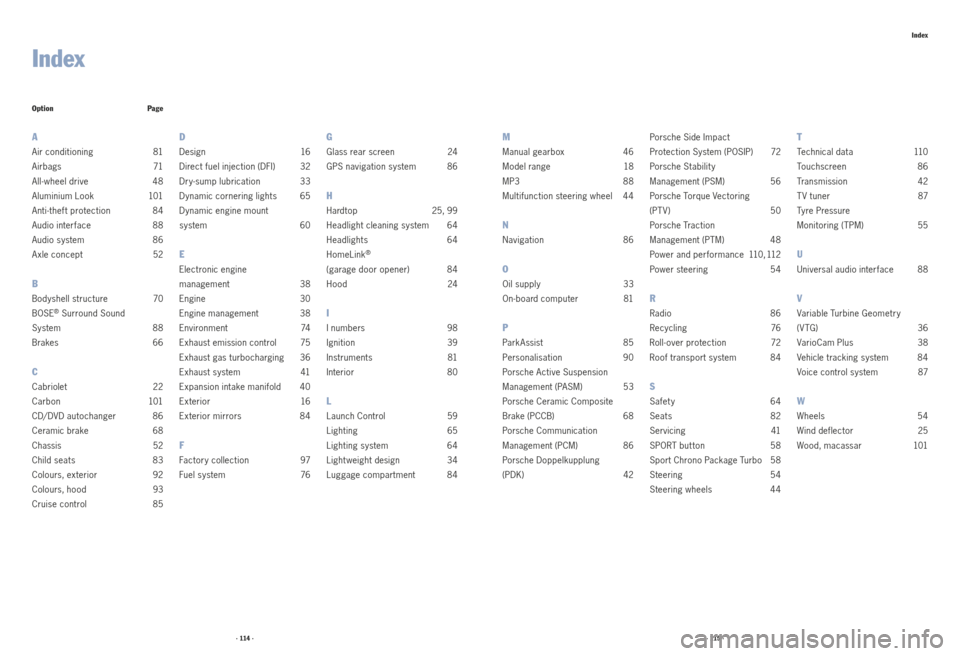
Index
Option Page
A
Air conditioning 81
A irbags 71
All-wheel drive 48
Aluminium Look 101
Anti-theft protection 84
Audio interface 88
Audio system 86
A xle concept 52
B
Bodyshell structure 70
BOSE
® Surround Sound
System 88
Brakes 66
C
Cabriolet 22
Carbon 101
CD/ DVD autochanger 86
Ceramic brake 68
Chassis 52
Child seats 83
Colours, exterior 92
Colours, hood 93
Cruise control 85
D
Design 16
Direct fuel injection (DFI) 32
Dry-sump lubrication 33
Dynamic cornering lights 65
Dynamic engine mount
system 60
E
Electronic engine
management 38
Engine 30
Engine management 38
Environment 74
Exhaust emission control 75
Exhaust gas turbocharging 36
Exhaust system 41
Expansion intake manifold 40
Exterior 16
Exterior mirrors 84
F
Factory collection 97
Fuel system 76
G
Glass rear screen 24
GPS navigation system 86
H
Hardtop 25, 99
Headlight cleaning system 64
Headlights 64
HomeLink
®
(garage door opener) 84
Hood 24
I
I numbers 98
Ignition 39
Instruments 81
Interior 80
L
Launch Control 59
Lighting 65
Lighting system 64
Light weight design 34
Luggage compartment 84
M
Manual gearbox 46
Model range 18
MP3 88
Multifunction steering wheel 44
N
Navigation 86
O
Oil supply 33
On-board computer 81
P
Pa rk A ssist 85
Personalisation 90
Porsche Active Suspension
Management (PASM) 53
Porsche Ceramic Composite
Brake (PCCB) 68
Porsche Communication
Management (PCM) 86
Porsche Doppelkupplung
(PDK) 42Porsche Side Impact
Protection System (POSIP) 72
Porsche Stabilit y
Management (PSM) 56
Porsche Torque Vectoring
(PT V) 50
Porsche Traction
Management (PTM) 48
Power and performance 110, 112
Power steering 54
R
Radio 86
Recycling 76
Roll-over protection 72
Roof transport system 84
S
Safet y 64
Seats 82
S e rv ic i n g 41
SPORT but ton 58
Sport Chrono Package Turbo 58
Steering 54
Steering wheels 44
T
Technical data 110
Touchscreen 86
Transmission 42
T V tuner 87
Tyre Pressure
Monitoring (TPM) 55
U
Universal audio interface 88
V
Variable Turbine Geometry
(V TG) 36
VarioCam Plus 38
Vehicle tracking system 84
Voice control system 87
W
Wheels 54
Wind deflector 25
Wood, macassar 101
Index
· 114 ·· 115 ·