wheel PORSCHE 911 2009 5.G Information Manual
[x] Cancel search | Manufacturer: PORSCHE, Model Year: 2009, Model line: 911, Model: PORSCHE 911 2009 5.GPages: 59, PDF Size: 5.74 MB
Page 25 of 59
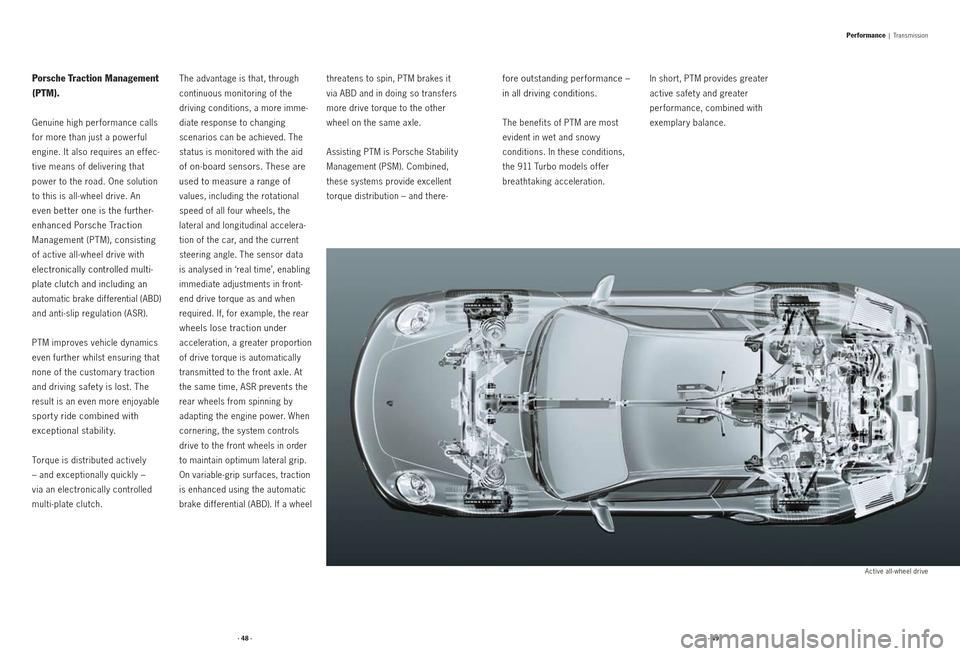
Porsche Traction Management
(P TM).
Genuine high per formance calls
for more than just a power ful
engine. It also requires an ef fec-
tive means of delivering that
power to the road. One solution
to this is all -wheel drive. An
even bet ter one is the further-
enhanced Porsche Traction
Management (PTM), consisting
of active all -wheel drive with
electronically controlled multi -
plate clutch and including an
automatic brake differential (ABD)
and anti -slip regulation (ASR).
PTM improves vehicle dynamics
even further whilst ensuring that
none of the customar y traction
and driving safet y is lost. The
result is an even more enjoyable
sport y ride combined with
exceptional stability.
Torque is distributed actively
– and exceptionally quickly –
via an electronically controlled
multi-plate clutch. The advantage is that, through
continuous monitoring of the
driving conditions, a more imme -
diate response to changing
scenarios can be achieved. The
status is monitored with the aid
of on-board sensors. These are
used to measure a range of
values, including the rotational
speed of all four wheels, the
lateral and longitudinal accelera -
tion of the car, and the current
steering angle. The sensor data
is analysed in ‘real time’, enabling
immediate adjustments in front-
end drive torque as and when
required. If, for example, the rear
wheels lose traction under
acceleration, a greater proportion
of drive torque is automatically
transmit ted to the front axle. At
the same time, ASR prevents the
rear wheels from spinning by
adapting the engine power. When
cornering, the system controls
drive to the front wheels in order
to maintain optimum lateral grip.
On variable-grip surfaces, traction
is enhanced using the automatic
brake dif ferential (ABD). If a wheel threatens to spin, PTM brakes it
via ABD and in doing so transfers
more drive torque to the other
wheel on the same axle.
Assisting PTM is Porsche Stabilit y
Management (PSM). Combined,
these systems provide excellent
torque distribution – and there
-
fore outstanding performance –
in all driving conditions.
The benefits of PTM are most
evident in wet and snow y
conditions. In these conditions,
the 911 Turbo models of fer
breathtaking acceleration. In short, PTM provides greater
active safet y and greater
performance, combined with
exemplary balance.
Performance | Transmission
Active all -wheel drive
· 48 ·· 49 ·
Page 26 of 59
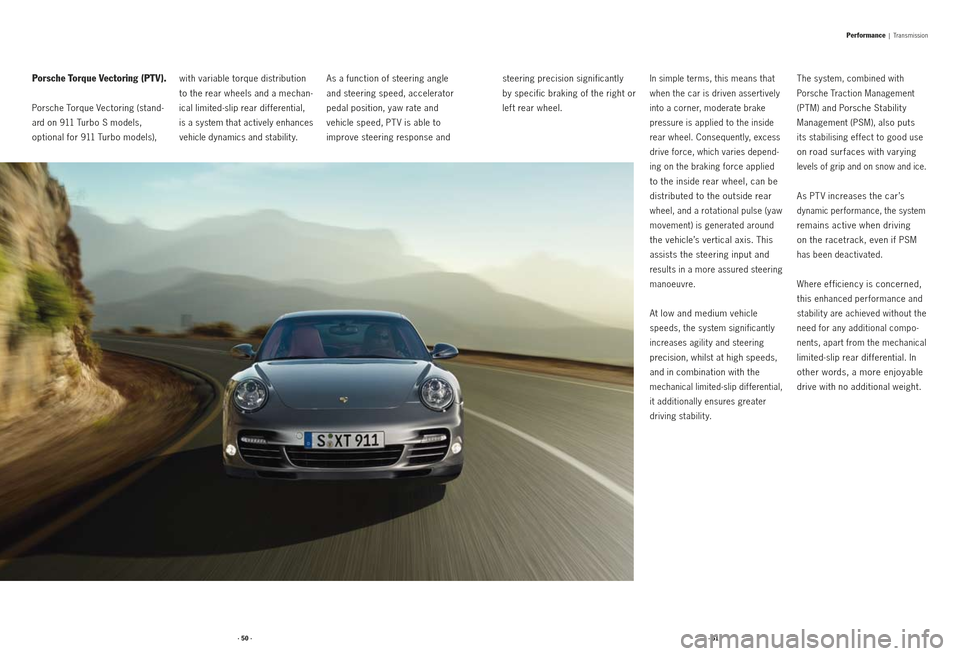
Porsche Torque Vectoring (PTV).
Porsche Torque Vectoring (stand-
ard on 911 Turbo S models,
optional for 911 Turbo models), with variable torque distribution
to the rear wheels and a mechan
-
ical limited-slip rear differential,
is a system that actively enhances
vehicle dynamics and stabilit y. As a function of steering angle
and steering speed, accelerator
pedal position, yaw rate and
vehicle speed, PT V is able to
improve steering response and steering precision significantly
by specific braking of the right or
left rear wheel.
In simple terms, this means that
when the car is driven assertively
into a corner, moderate brake
pressure is applied to the inside
rear wheel. Consequently, excess
drive force, which varies depend -
ing on the braking force applied
to the inside rear wheel, can be
distributed to the outside rear
wheel, and a rotational pulse (yaw
movement) is generated around
the vehicle’s vertical axis. This
assists the steering input and
results in a more assured steering
manoeuvre.
At low and medium vehicle
speeds, the system significantly
increases agilit y and steering
precision, whilst at high speeds,
and in combination with the
mechanical limited-slip differential,
it additionally ensures greater
driving stabilit y. The system, combined with
Porsche Traction Management
(PTM) and Porsche Stabilit y
Management (PSM), also puts
its stabilising ef fect to good use
on road surfaces with varying
levels of grip and on snow and ice.
As PT V increases the car’s
dynamic performance, the system
remains active when driving
on the racetrack, even if PSM
has been deactivated.
Where
efficien cy is concerned,
this
enhanced performance and
stabilit y are achieved without the
need for any additional compo -
nents, apart from the mechanical
limited-slip rear differential. In
other words, a more enjoyable
drive with no additional weight.
Performance | Transmission
· 50 ·· 51 ·
Page 27 of 59
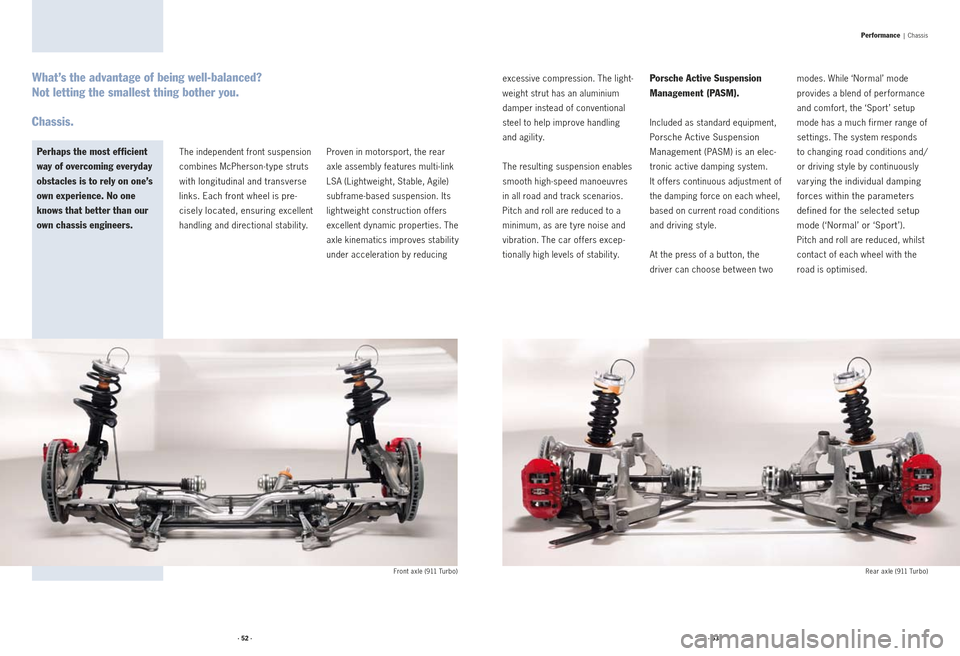
The independent front suspension
combines McPherson-type struts
with longitudinal and transverse
links. Each front wheel is pre-
cisely located, ensuring excellent
handling and directional stabilit y. Proven in motorsport, the rear
axle assembly features multi-link
LSA (Light weight, Stable, Agile)
subframe-based suspension. Its
light weight construction of fers
excellent dynamic properties. The
axle kinematics improves stabilit y
under acceleration by reducing excessive compression. The light
-
weight strut has an aluminium
damper instead of conventional
steel to help improve handling
and agility.
The resulting suspension enables
smooth high -speed manoeuvres
in all road and track scenarios.
Pitch and roll are reduced to a
minimum, as are t yre noise and
vibration. The car offers excep -
tionally high levels of stabilit y.
Porsche Active Suspension
Management (PASM).
Included as standard equipment,
Porsche Active Suspension
Management (PASM) is an elec -
tronic active damping system.
It of fers continuous adjustment of
the damping force on each wheel,
based on current road conditions
and driving st yle.
At the press of a but ton, the
driver can choose bet ween t wo modes. While ‘Normal’ mode
provides a blend of performance
and comfort, the ‘Sport ’ setup
mode has a much firmer range of
set tings. The system responds
to changing road conditions and/
or driving st yle by continuously
varying the individual damping
forces within the parameters
defined for the selected setup
mode (‘Normal’ or ‘Sport ’).
Pitch and roll are reduced, whilst
contact of each wheel with the
road is optimised.
What’s the advantage of being well-balanced?
Not letting the smallest thing bother you.
Chassis.
Perhaps the most efficient
way of overcoming everyday
obstacles is to rely on one’s
own experience. No one
knows that better than our
own chassis engineers.
Front axle (911 Turbo) Rear axle (911 Turbo)
Performance | Chassis
· 52 ·· 53 ·
Page 28 of 59
Steering.
Sensitive and direct, the power-
assisted steering also of fers
accurate feedback from the road.
For a sportscar, driver effort is
minimal. In short: all the precision
of a race- designed system, yet
perfect for everyday road use.
One of the key features of the
steering system is the variable-
ratio gearing. Around the
straight-ahead position, the ratio
is less direct, enabling smoother
manoeuvres on the motorway. It
also reduces the risk of excessive
steering inputs which could
destabilise the car at high speed.
Agilit y and feedback, however,
are maintained.
Turn the wheel harder and the
ratio becomes more direct,
enabling bet ter control through
low-speed corners as well as
easier parking manoeuvres.
The turning circle is a modest
10.9 metres.
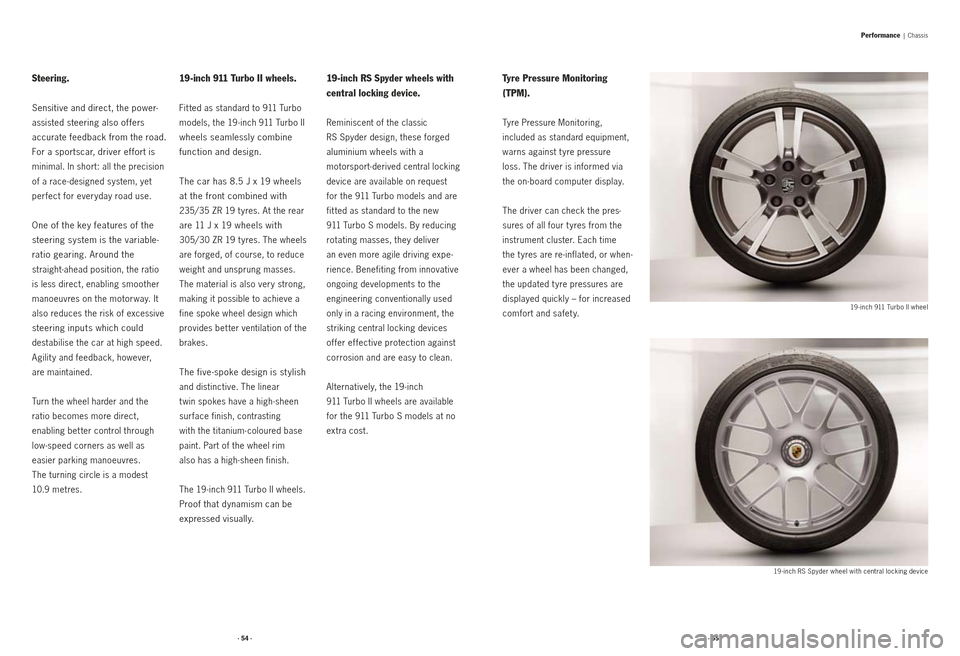
19-inch 911 Turbo II wheels.
Fit ted as standard to 911 Turbo
models, the 19 -inch 911 Turbo II
wheels seamlessly combine
function and design.
The car has 8.5 J x 19 wheels
at the front combined with
235/35 ZR 19 t yres. At the rear
are 11 J x 19 wheels with
305/30 ZR 19 t yres. The wheels
are forged, of course, to reduce
weight and unsprung masses.
The material is also very strong,
making it possible to achieve a
fine spoke wheel design which
provides bet ter ventilation of the
brakes.
The five-spoke design is st ylish
and distinctive. The linear
t win spokes have a high -sheen
surface finish, contrasting
with the titanium - coloured base
paint. Part of the wheel rim
also has a high -sheen finish.
The 19 -inch 911 Turbo II wheels.
Proof that dynamism can be
expressed visually.
19-inch RS Spyder wheels with
central locking device.
Reminiscent of the classic
RS Spyder design, these forged
aluminium wheels with a
motorsport-derived central locking
device are available on request
for the 911 Turbo models and are
fit ted as standard to the new
911 Turbo S models. By reducing
rotating masses, they deliver
an even more agile driving expe -
rience. Benefiting from innovative
ongoing developments to the
engineering conventionally used
only in a racing environment, the
striking central locking devices
of fer ef fective protection against
corrosion and are easy to clean.
Alternatively, the 19 -inch
911 Turbo II wheels are available
for the 911 Turbo S models at no
extra cost.
Tyre Pressure Monitoring
(TPM).
Tyre Pressure Monitoring,
included as standard equipment,
warns against t yre pressure
loss. The driver is informed via
the on -board computer display.
The driver can check the pres -
sures of all four t yres from the
instrument cluster. Each time
the t yres are re-inflated, or when -
ever a wheel has been changed,
the updated t yre pressures are
displayed quickly – for increased
comfort and safet y.
19 - inch 911 Turbo II wheel
19 - inch RS Spyder wheel with central locking device
Performance | Chassis
· 54 ·· 55 ·
Page 29 of 59
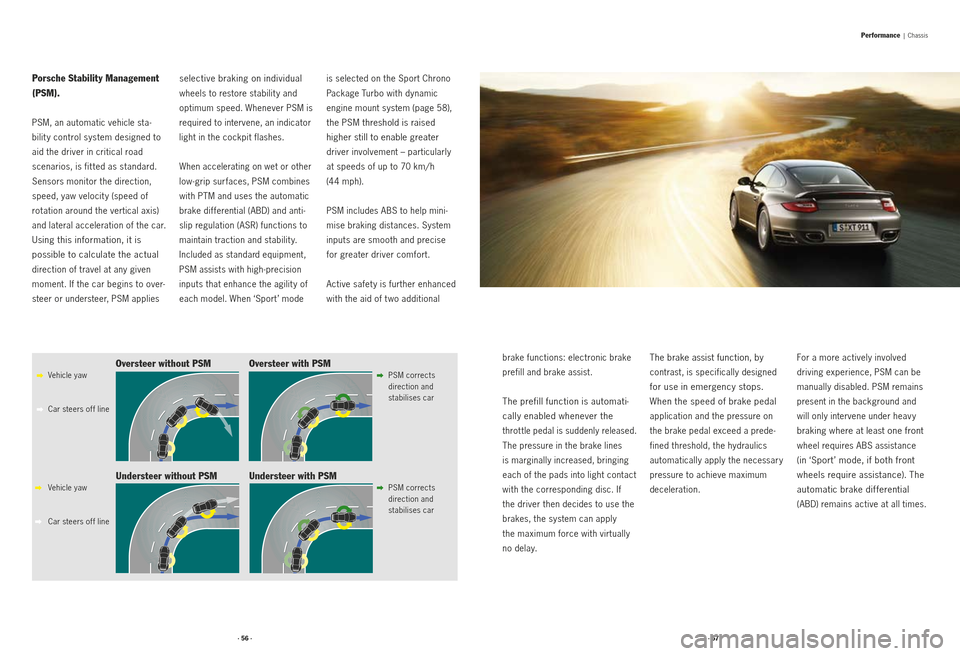
Porsche Stability Management
(PSM).
PSM, an automatic vehicle sta-
bilit y control system designed to
aid the driver in critical road
scenarios, is fit ted as standard.
Sensors monitor the direction,
speed, yaw velocit y (speed of
rotation around the vertical axis)
and lateral acceleration of the car.
Using this information, it is
possible to calculate the actual
direction of travel at any given
moment. If the car begins to over -
steer or understeer, PSM applies
selective braking on individual
wheels to restore stabilit y and
optimum speed. Whenever PSM is
required to intervene, an indicator
light in the cockpit flashes.
When accelerating on wet or other
low-grip surfaces, PSM combines
with PTM and uses the automatic
brake differential (ABD) and anti-
slip regulation (ASR) functions to
maintain traction and stabilit y.
Included as standard equipment,
PSM assists with high -precision
inputs that enhance the agilit y of
each model. When ‘Sport ’ mode is selected on the Sport Chrono
Package Turbo with dynamic
engine mount system (page 58),
the PSM threshold is raised
higher still to enable greater
driver involvement – particularly
at speeds of up to 70 km/ h
(44 mph).
PSM includes ABS to help mini -
mise braking distances. System
inputs are smooth and precise
for greater driver comfort.
Active safet y is further enhanced
with the aid of t wo additional
brake functions: electronic brake
prefill and brake assist.
The prefill function is automati-
cally enabled whenever the
throt tle pedal is suddenly released.
The pressure in the brake lines
is marginally increased, bringing
each of the pads into light contact
with the corresponding disc. If
the driver then decides to use the
brakes, the system can apply
the maximum force with virtually
no delay.
The brake assist function, by
contrast, is specifically designed
for use in emergency stops.
When the speed of brake pedal
application and the pressure on
the brake pedal exceed a prede -
fined threshold, the hydraulics
automatically apply the necessary
pressure to achieve maximum
deceleration. For a more actively involved
driving experience, PSM can be
manually disabled. PSM remains
present in the background and
will only intervene under heav y
braking where at least one front
wheel requires ABS assistance
(in ‘Sport ’ mode, if both front
wheels require assistance). The
automatic brake differential
(ABD) remains active at all times.
Vehicle yaw
Car steers of f line
Vehicle yaw
Car steers of f line PSM corrects
direction and
stabilises car
PSM corrects
direction and
stabilises carOversteer without PSM
Oversteer with PSM
Understeer with PSM
Understeer without PSM
Performance | Chassis
· 56 ·· 57 ·
Page 30 of 59
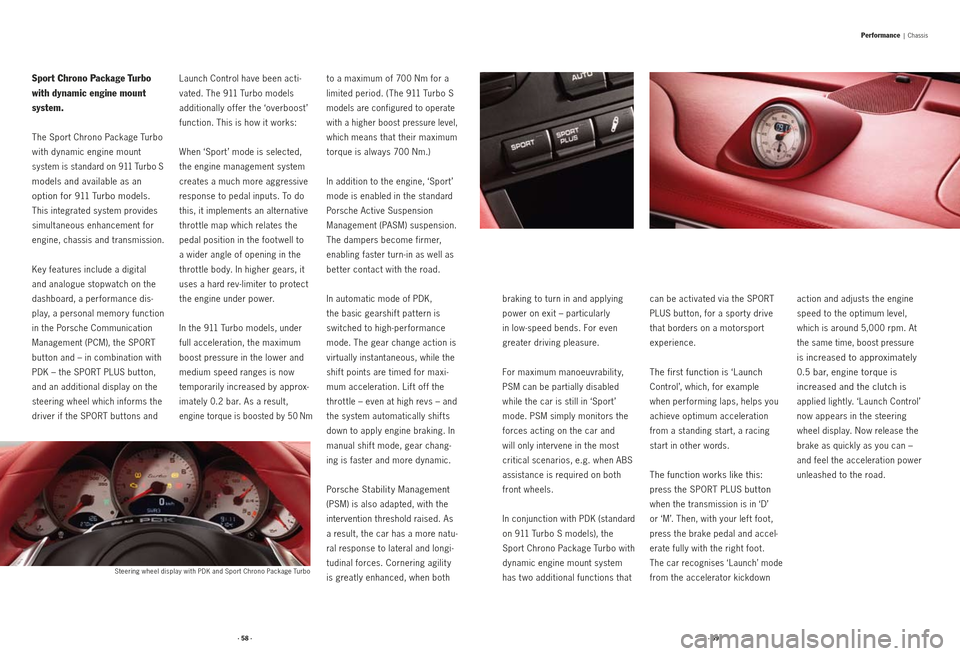
Sport Chrono Package Turbo
with dynamic engine mount
system.
The Sport Chrono Package Turbo
with dynamic engine mount
system is standard on 911 Turbo S
models and available as an
option for 911 Turbo models.
This integrated system provides
simultaneous enhancement for
engine, chassis and transmission.
Key features include a digital
and analogue stopwatch on the
dashboard, a performance dis -
play, a personal memor y function
in the Porsche Communication
Management (PCM), the SPORT
but ton and – in combination with
PDK – the SPORT PLUS but ton,
and an additional display on the
steering wheel which informs the
driver if the SPORT but tons and Launch Control have been acti
-
vated. The 911 Turbo models
additionally of fer the ‘overboost ’
function. This is how it works:
When ‘Sport ’ mode is selected,
the engine management system
creates a much more aggressive
response to pedal inputs. To do
this, it implements an alternative
throt tle map which relates the
pedal position in the foot well to
a wider angle of opening in the
throt tle body. In higher gears, it
uses a hard rev- limiter to protect
the engine under power.
In the 911 Turbo models, under
full acceleration, the maximum
boost pressure in the lower and
medium speed ranges is now
temporarily increased by approx -
imately 0.2 bar. As a result,
engine torque is boosted by 50 Nm to a maximum of 700 Nm for a
limited period. (The 911 Turbo S
models are configured to operate
with a higher boost pressure level,
which means that their maximum
torque is always 700 Nm.)
In addition to the engine, ‘Sport ’
mode is enabled in the standard
Porsche Active Suspension
Management (PASM) suspension.
The dampers become firmer,
enabling faster turn - in as well as
bet ter contact with the road.
In automatic mode of PDK,
the basic gearshif t pat tern is
switched to high-performance
mode. The gear change action is
virtually instantaneous, while the
shift points are timed for maxi -
mum acceleration. Lif t of f the
throt tle – even at high revs – and
the system automatically shif ts
down to apply engine braking. In
manual shif t mode, gear chang -
ing is faster and more dynamic.
Porsche Stabilit y Management
(PSM) is also adapted, with the
intervention threshold raised. As
a result, the car has a more natu -
ral response to lateral and longi -
tudinal forces. Cornering agilit y
is greatly enhanced, when both braking to turn in and applying
power on exit – particularly
in low-speed bends. For even
greater driving pleasure.
For maximum manoeuvrabilit y,
PSM can be partially disabled
while the car is still in ‘Sport ’
mode. PSM simply monitors the
forces acting on the car and
will only intervene in the most
critical scenarios, e.g. when ABS
assistance is required on both
front wheels.
In conjunction with PDK (standard
on 911 Turbo S models), the
Sport Chrono Package Turbo with
dynamic engine mount system
has t wo additional functions that can be activated via the SPORT
PLUS but ton, for a sport y drive
that borders on a motorsport
experience.
The first function is ‘Launch
Control’, which, for example
when per forming laps, helps you
achieve optimum acceleration
from a standing start, a racing
start in other words.
The function works like this:
press the SPORT PLUS but ton
when the transmission is in ‘D’
or ‘M’. Then, with your lef t foot,
press the brake pedal and accel -
erate fully with the right foot.
The car recognises ‘Launch’ mode
from the accelerator kickdown action and adjusts the engine
speed to the optimum level,
which is around 5,000 rpm. At
the same time, boost pressure
is increased to approximately
0.5 bar, engine torque is
increased and the clutch is
applied lightly. ‘Launch Control’
now appears in the steering
wheel display. Now release the
brake as quickly as you can –
and feel the acceleration power
unleashed to the road.
Steering wheel display with PDK and Sport Chrono Package Turbo
Performance | Chassis
· 58 ·· 59 ·
Page 41 of 59
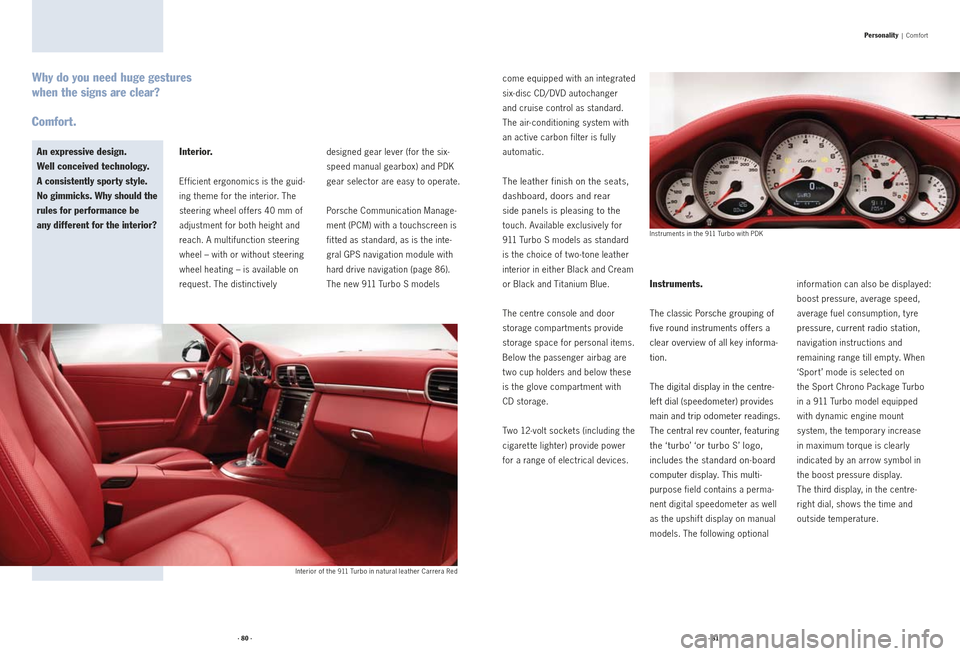
Interior.
Efficient ergonomics is the guid-
ing theme for the interior. The
steering wheel of fers 40 mm of
adjustment for both height and
reach. A multifunction steering
wheel – with or without steering
wheel heating – is available on
request. The distinctively designed gear lever (for the six-
speed manual gearbox) and PDK
gear selector are easy to operate.
Porsche Communication Manage
-
ment (PCM) with a touchscreen is
fit ted as standard, as is the inte -
gral GPS navigation module with
hard drive navigation (page 86).
The new 911 Turbo S models come equipped with an integrated
six- disc CD/ DVD autochanger
and cruise control as standard.
The air- conditioning system with
an active carbon filter is fully
automatic. The leather finish on the seats,
dashboard, doors and rear
side panels is pleasing to the
touch. Available exclusively for
911 Turbo S models as standard
is the choice of t wo -tone leather
interior in either Black and Cream
or Black and Titanium Blue.
The centre console and door
storage compartments provide
storage space for personal items.
Below the passenger airbag are
t wo cup holders and below these
is the glove compartment with
CD storage.
Two 12-volt sockets (including the
cigaret te lighter) provide power
for a range of electrical devices.
Instruments.
The classic Porsche grouping of
five round instruments offers a
clear overview of all key informa -
tion.
The digital display in the centre-
left dial (speedometer) provides
main and trip odometer readings.
The central rev counter, featuring
the ‘turbo’ ‘or turbo S’ logo,
includes the standard on-board
computer display. This multi -
pur
pose field contains a perma -
nent digital speedometer as well
as the upshif t display on manual
models. The following optional information can also be displayed:
boost pressure, average speed,
average fuel consumption, t yre
pressure, current radio station,
navigation instructions and
remaining range till empt y. When
‘Sport ’ mode is selected on
the Sport Chrono Package Turbo
in a 911 Turbo model equipped
with dynamic engine mount
system, the temporary increase
in maximum torque is clearly
indicated by an arrow symbol in
the boost pressure display.
The third display, in the centre-
right dial, shows the time and
outside temperature.
Why do you need huge gestures
when the signs are clear?
Comfort.
An expressive design.
Well conceived technology.
A consistently sporty style.
No gimmicks. Why should the
rules for performance be
any different for the interior?
Personality | Comfort
Instruments in the 911 Turbo with PDK
Interior of the 911 Turbo in natural leather Carrera Red
· 80 ·· 81 ·
Page 44 of 59
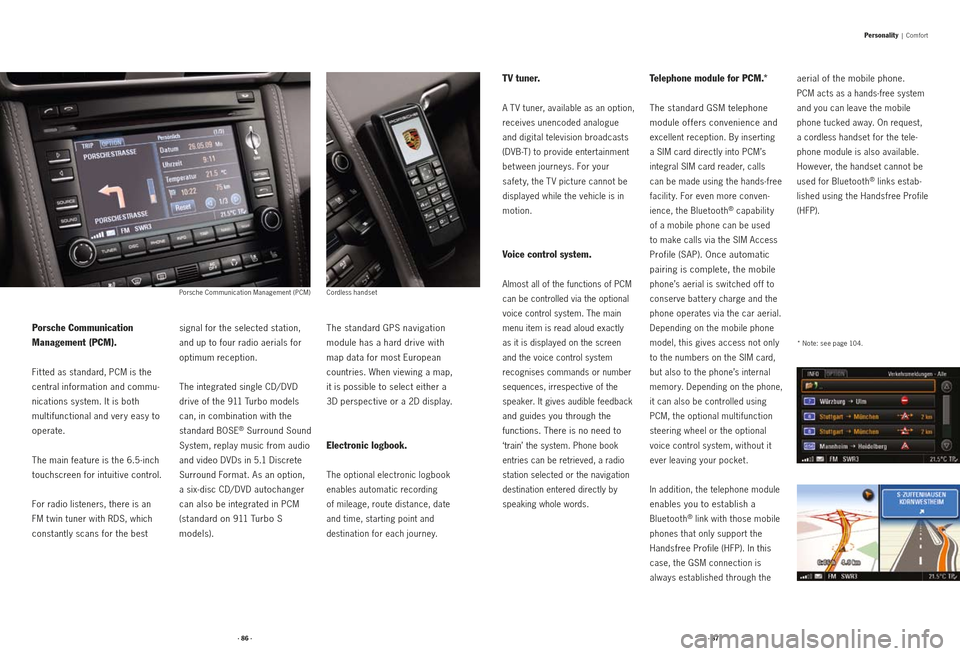
Porsche Communication
Management (PCM).
Fit ted as standard, PCM is the
central information and commu -
nications system. It is both
multifunctional and very easy to
operate.
The main feature is the 6.5-inch
touchscreen for intuitive control.
For radio listeners, there is an
FM t win tuner with RDS, which
constantly scans for the best signal for the selected station,
and up to four radio aerials for
optimum reception.
The integrated single CD/ DVD
drive of the 911 Turbo models
can, in combination with the
standard BOSE
® Surround Sound
System, replay music from audio
and video DVDs in 5.1 Discrete
Surround Format. As an option,
a six-disc CD/ DVD autochanger
can also be integrated in PCM
(standard on 911 Turbo S
models). The standard GPS navigation
module has a hard drive with
map data for most European
countries. When viewing a map,
it is possible to select either a
3D perspective or a 2D display.
Electronic logbook.
The optional electronic logbook
enables automatic recording
of mileage, route distance, date
and time, starting point and
destination for each journey.
TV tuner.
A T V tuner, available as an option,
receives unencoded analogue
and digital television broadcasts
(DVB-T) to provide entertainment
bet ween journeys. For your
safet y, the T V picture cannot be
displayed while the vehicle is in
motion.
Voice control system.
Almost all of the functions of PCM
can be controlled via the optional
voice control system. The main
menu item is read aloud exactly
as it is displayed on the screen
and the voice control system
recognises commands or number
sequences, irrespective of the
speaker. It gives audible feedback
and guides you through the
functions. There is no need to
‘train’
the system. Phone book
entries can be retrieved, a radio
station selected or the navigation
destination entered directly by
speaking whole words.
Telephone module for PCM.*
The standard GSM telephone
module offers convenience and
excellent reception. By inserting
a SIM card directly into PCM’s
integral SIM card reader, calls
can be made using the hands-free
facilit y. For even more conven -
ience, the Bluetooth
® capabilit y
of a mobile phone can be used
to make calls via the SIM Access
Profile (SAP). Once automatic
pairing is complete, the mobile
phone’s aerial is switched of f to
conserve bat tery charge and the
phone operates via the car aerial.
Depending on the mobile phone
model, this gives access not only
to the numbers on the SIM card,
but also to the phone’s internal
memory. Depending on the phone,
it can also be controlled using
PCM, the optional multifunction
steering wheel or the optional
voice control system, without it
ever leaving your pocket.
In addition, the telephone module
enables you to establish a
Bluetooth
® link with those mobile
phones that only support the
Handsfree Profile (HFP). In this
case, the GSM connection is
always established through the
aerial of the mobile phone.
PCM acts as a hands-free system
and you can leave the mobile
phone tucked away. On request,
a cordless handset for the tele -
phone module is also available.
However, the handset cannot be
used for Bluetooth
® links estab -
lished using the Handsfree Profile
(HFP).
Porsche Communication Management (PCM) Cordless handset
* Note: see page 104.
Personality | Comfort
· 86 ·· 87 ·
Page 45 of 59
12
3
34
5
6
6
7
7
5
Universal audio interface.
With this standard feature, the
storage compartment in the
centre console will contain three
connections: one for your iPod
®,
one for a USB stick/ MP3-player
and one as an AUX interface for
any chosen compatible audio
source. The iPod
® or USB stick
can be operated conveniently and
safely via PCM, the optional multi -
function steering wheel or the
optional voice control system.
BOSE® Surround Sound System.
The standard BOSE® Surround
Sound System is optimally
matched to the specific interior
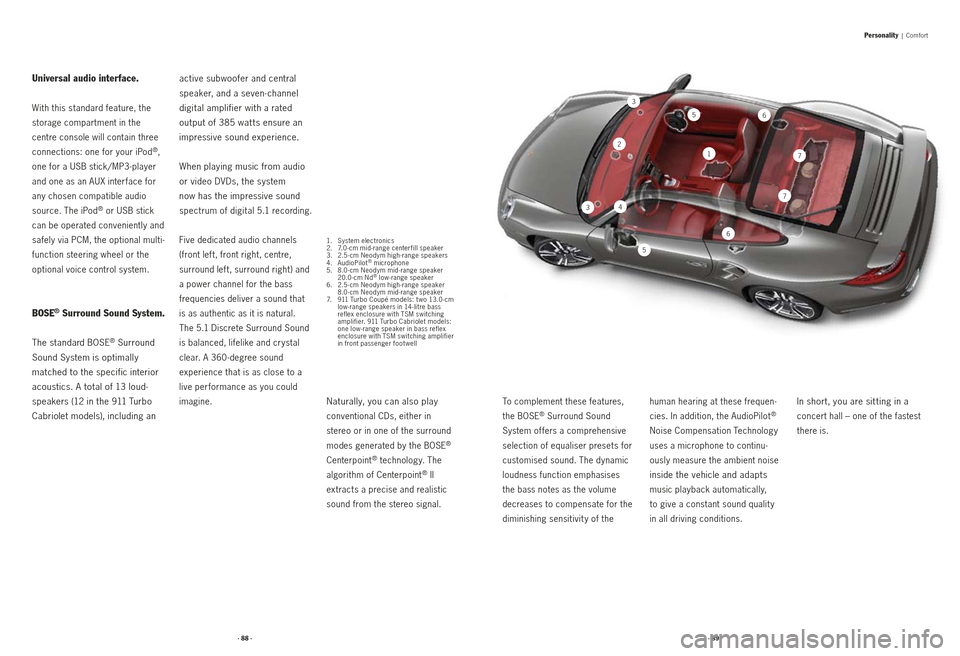
acoustics. A total of 13 loud -
speakers (12 in the 911 Turbo
Cabriolet models), including an active subwoofer and central
speaker, and a seven-channel
digital amplifier with a rated
output of 385 wat ts ensure an
impressive sound experience.
When playing music from audio
or video DVDs, the system
now has the impressive sound
spectrum of digital 5.1 recording.
Five dedicated audio channels
(front left, front right, centre,
surround lef t, surround right) and
a power channel for the bass
frequencies deliver a sound that
is as authentic as it is natural.
The 5.1 Discrete Surround Sound
is balanced, lifelike and crystal
clear. A 360 - degree sound
expe rience that is as close to a
live performance as you could
imagine.
Naturally, you can also play
conventional CDs, either in
stereo or in one of the surround
modes generated by the BOSE
®
Centerpoint
® technology. The
algorithm of Centerpoint
® II
extracts a precise and realistic
sound from the stereo signal. To complement these features,
the BOSE
® Surround Sound
System of fers a comprehensive
selection of equaliser presets for
customised sound. The dynamic
loudness function emphasises
the bass notes as the volume
decreases to compensate for the
diminishing sensitivit y of the human hearing at these frequen
-
cies. In addition, the AudioPilot®
Noise Compensation Technology
uses a microphone to continu -
ously measure the ambient noise
inside the vehicle and adapts
music playback automatically,
to give a constant sound qualit y
in all driving conditions.
In short, you are sit ting in a
concert hall – one of the fastest
there is.
Personality | Comfort
1. System electronics
2. 7.0 - cm mid - range center fill speaker
3. 2.5 - cm Neodym high - range speakers
4. AudioPilot
® microphone
5. 8.0 - cm Neodym mid - range speaker
20.0 - cm Nd
® low- range speaker
6. 2.5 - cm Neodym high - range speaker
8.0 - cm Neodym mid - range speaker
7. 911 Turbo Coupé models: t wo 13.0 - cm
low - range speakers in 14 - litre bass
reflex enclosure with TSM switching
amplifier. 911 Turbo Cabriolet models:
one low - range speaker in bass reflex
enclosure with TSM switching amplifier
in front passenger foot well
· 88 ·· 89 ·
Page 48 of 59
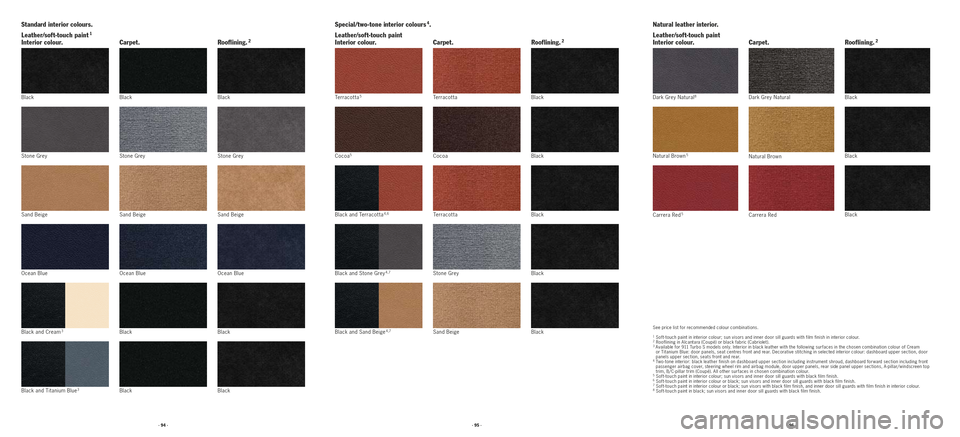
Standard interior colours.Special/two-tone interior colours 4.Natural leather interior.
Black
Stone GreyBlack
Black Terracotta 5TerracottaBlack
Stone Grey Stone Grey Cocoa
5CocoaBlack
Sand Beige Sand Beige Black and Terracotta
4 , 6TerracottaBlack
Sand Beige
Ocean BlueOcean Blue Black and Stone Grey
4 , 7Stone GreyBlack
Ocean Blue
Black and Sand Beige
4 , 7
Dark Grey Natural8
Natural Brown 5
Carrera Red 5
Sand Beige Dark Grey Natural
Natural Brown
Carrera Red
Black Black
Black
BlackSee price list for recommended colour combinations.
1
Sof t-touch paint in interior colour; sun visors and inner door sill guards with film finish in interior colour.2 Rooflining in Alcantara (Coupé) or black fabric (Cabriolet).3 Available for 911 Turbo S models only. Interior in black leather with the following sur faces in the chosen combination colour of Cream
or Titanium Blue: door panels, seat centres front and rear. Decorative stitching in selected interior colour: dashboard upper section, door
panels upper section, seats front and rear.
4 Two -tone interior: black leather finish on dashboard upper section including instrument shroud, dashboard for ward section including front
passenger airbag cover, steering wheel rim and airbag module, door upper panels, rear side panel upper sections, A - pillar/windscreen top
trim, B/C- pillar trim (Coupé). All other sur faces in chosen combination colour.
5 Sof t-touch paint in interior colour; sun visors and inner door sill guards with black film finish.6 Sof t-touch paint in interior colour or black; sun visors and inner door sill guards with black film finish.7 Sof t-touch paint in interior colour or black; sun visors with black film finish, and inner door sill guards with film finish in interior colour.8 Sof t-touch paint in black; sun visors and inner door sill guards with black film finish.
Black and Cream 3Black Black
Black and Titanium Blue
3Black Black
Leather/soft-touch paint 1
Interior colour. Leather/soft-touch paint
Interior colour. Leather/soft-touch paint
Interior colour.
Carpet. Rooflining. 2Carpet. Rooflining. 2Carpet. Rooflining. 2
· 94 · · 95 · · 96 ·