brake PORSCHE 911 2009 5.G Information Manual
[x] Cancel search | Manufacturer: PORSCHE, Model Year: 2009, Model line: 911, Model: PORSCHE 911 2009 5.GPages: 59, PDF Size: 5.74 MB
Page 6 of 59
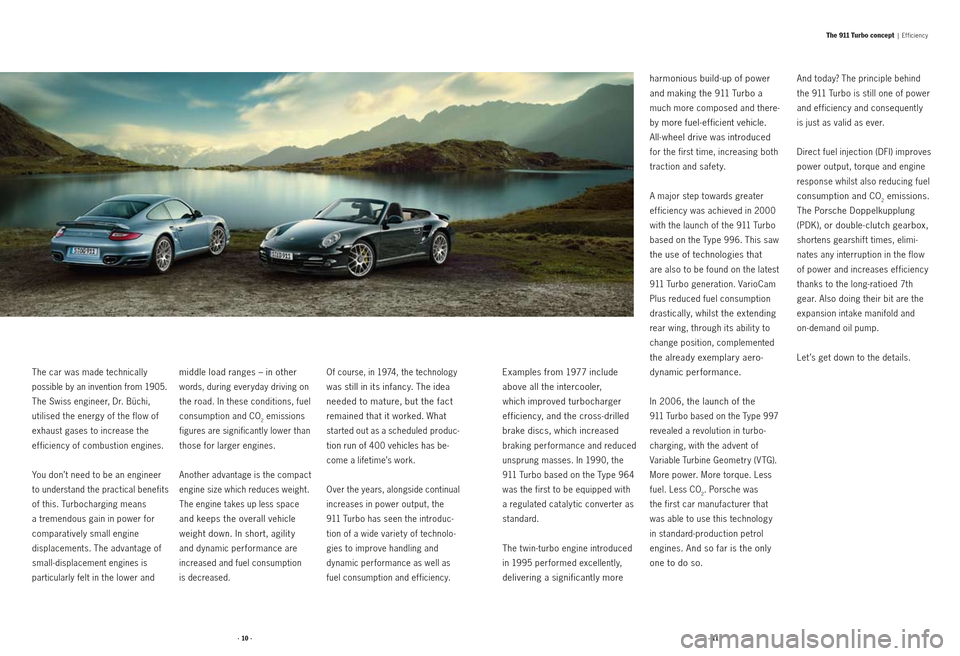
The car was made technically
possible by an invention from 1905.
The Swiss engineer, Dr. Büchi,
utilised the energy of the flow of
exhaust gases to increase the
ef ficiency of combustion engines.
You don’t need to be an engineer
to understand the practical benefits
of this. Turbocharging means
a tremendous gain in power for
comparatively small engine
displacements. The advantage of
small-
displacement engines is
particularly
felt in the lower and
middle load ranges – in other
words, during everyday driving on
the road. In these conditions, fuel
consumption and CO
2 emissions
figures are significantly lower than
those for larger engines.
Another advantage is the compact
engine size which reduces weight.
The engine takes up less space
and keeps the overall vehicle
weight down. In short, agilit y
and dynamic performance are
increased and fuel consumption
is decreased.
Of course, in 1974, the technology
was still in its infancy. The idea
needed to mature, but the fact
remained that it worked. What
started out as a scheduled produc -
tion run of 400 vehicles has b e -
come a lifetime’s work.
Over the years, alongside con tinual
increases in power output, the
911 Turbo has seen the introduc -
tion of a wide variet y of technolo -
gies to improve handling and
dynamic performance as well as
fuel consumption and efficiency.
Examples from 1977 include
above all the intercooler,
which improved turbocharger
efficiency, and the cross-drilled
brake discs, which increased
braking per formance and reduced
unsprung masses. In 1990, the
911 Turbo based on the Type 964
was the first to be equipped with
a regulated cataly tic converter as
st a n d a rd .
The t win -turbo engine introduced
in 1995 performed excellently,
delivering a significantly more
harmonious build-up of power
and making the 911 Turbo a
much more composed and there-
by more fuel-efficient vehicle.
All-wheel drive was introduced
for the first time, increasing both
traction and safet y.
A major step towards greater
ef ficiency was achieved in 2000
with the launch of the 911 Turbo
based on the Type 996. This saw
the use of technologies that
are also to be found on the latest
911 Turbo generation. VarioCam
Plus reduced fuel consumption
drastically, whilst the extending
rear wing, through its abilit y to
change position, complemented
the already exemplary aero -
dynamic performance.
In 2006, the launch of the
911 Turbo based on the Type 997
revealed a revolution in turbo -
charging, with the advent of
Variable Turbine Geometry (V TG).
More power. More torque. Less
fuel. Less CO
2. Porsche was
the first car manufacturer that
was able to use this technology
in standard-production petrol
engines. And so far is the only
one to do so.
And today? The principle behind
the 911 Turbo is still one of power
and ef ficiency and consequently
is just as valid as ever.
Direct fuel injection (DFI) improves
power output, torque and engine
response whilst also reducing fuel
consumption and CO2 em issio ns.
The Porsche Doppelkupplung
(PDK), or double-clutch gearbox,
shortens gearshift times, elimi -
nates any interruption in the flow
of power and increases ef ficiency
thanks to the long-ratioed 7th
gear. Also doing their bit are the
expansion intake manifold and
on - demand oil pump.
Let ’s get down to the details.
The 911 Turbo concept | Ef ficiency
· 10 ·· 11 ·
Page 8 of 59
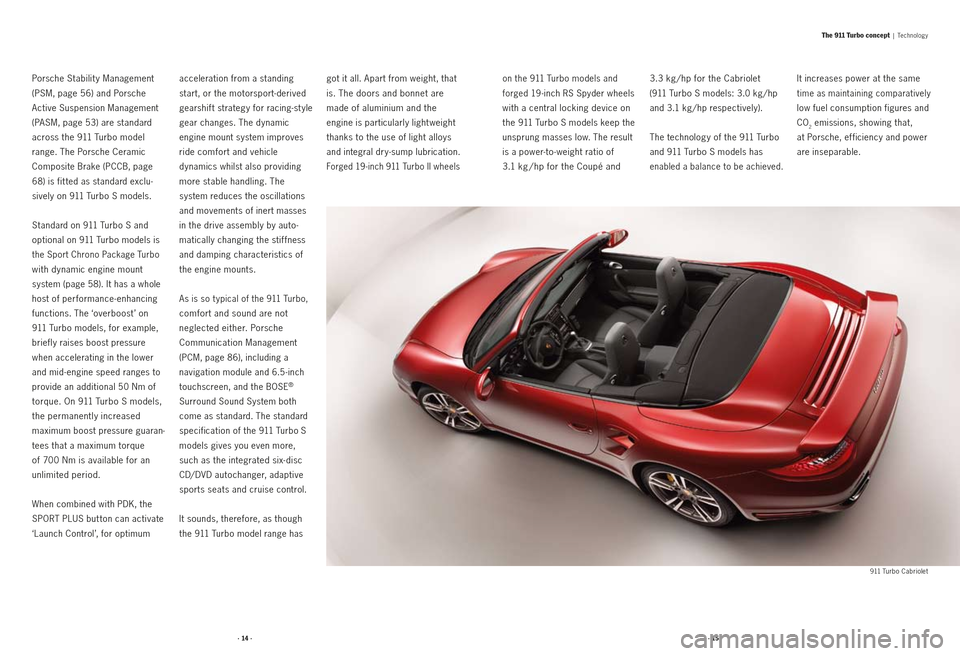
911 Turbo Cabriolet
Porsche Stabilit y Management
(PSM, page 56) and Porsche
Active Suspension Management
(PASM, page 53) are standard
across the 911 Turbo model
range. The Porsche Ceramic
Composite Brake (PCCB, page
68) is fit ted as standard exclu -
sively on 911 Turbo S models.
Standard on 911 Turbo S and
optional on 911 Turbo models is
the Sport Chrono Package Turbo
with dynamic engine mount
system (page 58). It has a whole
host of performance-enhancing
functions. The ‘overboost ’ on
911 Turbo models, for example,
briefly raises boost pressure
when accelerating in the lower
and mid-engine speed ranges to
provide an additional 50 Nm of
torque. On 911 Turbo S models,
the permanently increased
maximum boost pressure guaran-
tees that a maximum torque
of 700 Nm is available for an
unlimited period.
When combined with PDK, the
SPORT PLUS but ton can activate
‘Launch Control’, for optimum acceleration from a standing
start, or the motorsport- derived
gearshift strategy for racing-st yle
gear changes. The dynamic
engine mount system improves
ride comfort and vehicle
dynamics whilst also providing
more stable handling. The
system reduces the oscillations
and movements of inert masses
in the drive assembly by auto -
matically changing the stiffness
and damping characteristics of
the engine mounts.
As is so t ypical of the 911 Turbo,
comfort and sound are not
neglected either. Porsche
Communication Management
(PCM, page 86), including a
navigation module and 6.5-inch
touchscreen, and the BOSE
®
Surround Sound System both
come as standard. The standard
specification of the 911 Turbo S
models gives you even more,
such as the integrated six-disc
CD/ DVD autochanger, adaptive
sports seats and cruise control.
It sounds, therefore, as though
the 911 Turbo model range has got it all. Apart from weight, that
is. The doors and bonnet are
made of aluminium and the
engine is particularly light weight
thanks to the use of light alloys
and integral dry-sump lubrication.
Forged 19-inch 911 Turbo II wheels
on the 911 Turbo models and
forged
19-inch RS Spyder wheels
with
a central locking device on
the
911 Turbo S models keep the
unsprung masses low. The result
is a power-to -weight ratio of
3.1 kg / hp for the Coupé and
3.3 kg / hp for the Cabriolet
(911 Turbo S models: 3.0 kg / hp
and 3.1 kg / hp respectively).
The technology of the 911 Turbo
and 911 Turbo S models has
enabled a balance to be achieved. It increases power at the same
time as maintaining comparatively
low fuel consumption figures and
CO
2 emissions, showing that,
at Porsche, efficiency and power
are inseparable.
The 911 Turbo concept | Technology
· 14 ·· 15 ·
Page 9 of 59
Keeping the tried-and-tested
without ignoring innovation.
Another example of the
efficiency of the 911 Turbo.
It is precisely in turbulent times
when we need a place of calm.
Design.
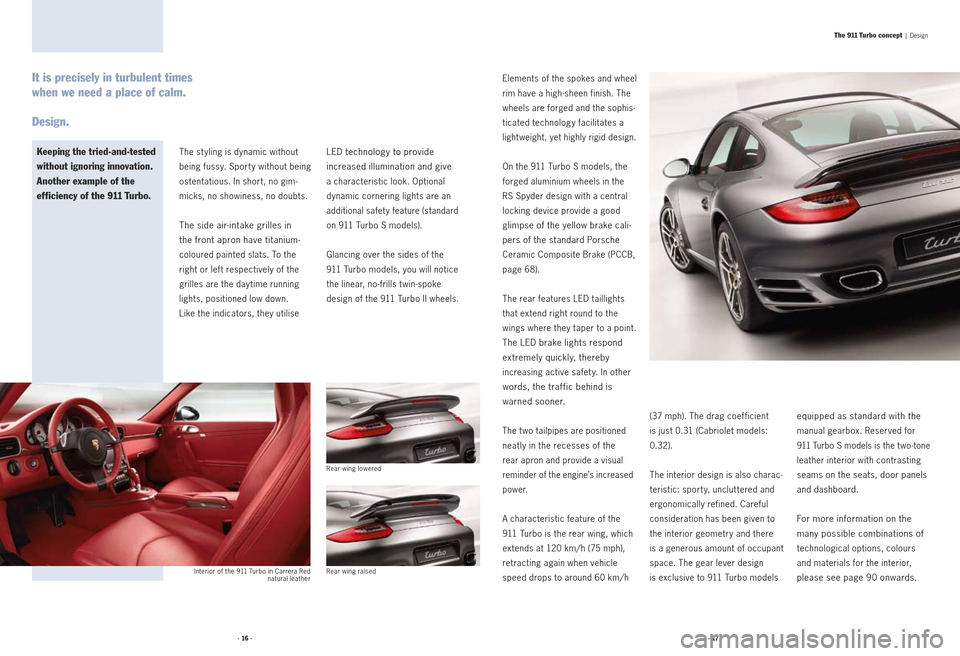
Rear wing raised
Interior of the 911 Turbo in Carrera Red
natural leatherRear wing lowered
The st yling is dynamic without
being fussy. Sport y without being
ostentatious. In short, no gim
-
micks, no showiness, no doubts.
The side air-intake grilles in
the front apron have titanium-
coloured painted slats. To the
right or lef t respectively of the
grilles are the day time running
lights, positioned low down.
Like the indicators, they utilise
LED technology to provide
increased illumination and give
a characteristic look. Optional
dynamic cornering lights are an
additional safet y feature (standard
on 911 Turbo S models).
Glancing over the sides of the
911 Turbo models, you will notice
the linear, no -frills t win -spoke
design of the 911 Turbo II wheels. Elements of the spokes and wheel
rim have a high -sheen finish. The
wheels are forged and the sophis
-
ticated technology facilitates a
light weight, yet highly rigid design.
On the 911 Turbo S models, the
forged aluminium wheels in the
RS Spyder design with a central
locking device provide a good
glimpse of the yellow brake cali -
pers of the standard Porsche
Ceramic Composite Brake (PCCB,
page 68).
The rear features LED taillights
that extend right round to the
wings where they taper to a point.
The LED brake lights respond
extremely quickly, thereby
increasing active safet y. In other
words, the traffic behind is
warned sooner.
The t wo tailpipes are positioned
neatly in the recesses of the
rear apron and provide a visual
reminder of the engine’s increased
power.
A characteristic feature of the
911 Turbo is the rear wing, which
extends at 120 km/ h (75 mph),
retracting again when vehicle
speed drops to around 60 km/ h (37 mph). The drag coefficient
is just 0.31 (Cabriolet models:
0.32).
The interior design is also charac -
teristic: sport y, unclut tered and
ergonomically refined. Careful
consideration has been given to
the interior geometry and there
is a generous amount of occupant
space. The gear lever design
is exclusive to 911 Turbo models
equipped as standard with the
manual gearbox. Reserved for
911 Turbo S models is the t wo -tone
leather interior with contrasting
seams on the seats, door panels
and dashboard.
For more information on the
many possible combinations of
technological options, colours
and materials for the interior,
please see page 90 onwards.
The 911 Turbo concept | Design
· 16 ·· 17 ·
Page 11 of 59
The new 911 Turbo S.
The new 911 Turbo S is perhaps
the embodiment of one of the
original Porsche principles: to
make do is not an option. To
stand still is inconceivable. We
move on, and more awaits around
the corner. Never anxious, always
cool and composed. Looking
forward at all times. This is why we
gave the 911 Turbo S even more. As a result of a modified valve
control system and an adaptation
of the engine management,
combined with an increase in
maximum boost pressure by
0.2 bar to 1.2 bar, the 3.8-litre
boxer engine develops 390 kW
(530 hp) bet ween 6,250 rpm and
6,750 rpm. The maximum torque
is an impressive 700 Nm bet ween
2,100 rpm and 4,250 rpm. This
means an extra 30 hp and 50 Nm
compared with the 911 Turbo. Yet, even though power output
has been increased, fuel consump
-
tion and CO2 emissions remain
at the same low level thanks to
the use of efficient technologies
such as DFI, Variable Turbine
Geometry (V TG), VarioCam Plus
and the expansion intake manifold.
Visually, the engine is distin -
guished by an air filter housing
with a carbon-weave finish and
the ‘turbo S’ logo.
The 911 Turbo S models represent
power in pure form, and they
have the performance figures
to prove it. With the standard
com bination of PDK and the Sport
Chrono Package Turbo with
dynamic engine mount system,
the 911 Turbo S storms through
the 100 km/ h (62 mph) mark from
a standing start in just 3.3 sec -
onds – the fastest ever achieved
by a Porsche production car.
0 to 200 km/ h (124 mph): 10.8
seconds. Top speed: 315 km/ h
(196 mph). It has even been pos -
sible to improve driving dynamics,
thanks not least to the standard-
fit ted Porsche Torque Vectoring
(PT V) including a mechanically
locking rear differential.
At Porsche, whenever we provide
more power as standard, we natu -
rally include extra safet y features
as standard, too. The track-proven
Porsche Ceramic Composite Brake
(PCCB) and the dynamic cornering
lights are t wo examples.
Also fit ted as standard are the
light weight, forged RS Spyder
wheels with a motorsport-derived
central locking device.
Inside, the three-spoke sports
steering wheel with gearshif t
paddles is pleasing to the eye,
and to the touch. The gearshif t
logic comes straight from the
racetrack: pull the right-hand
paddle to shift up, pull the left-
hand paddle to shift down.
Other standard features include
the adaptive sports seats, the
six- disc CD/ DVD autochanger
integrated into the PCM, cruise
control, the choice of t wo -tone
leather interior in Black and
Cream or Black and Titanium Blue
exclusive to the 911 Turbo S models,
and the windscreen
with a grey top-tint.
Visual cues that hint at the
enormous power within are the
‘ turbo S’ logos on the door sill
guards, rev counter, rear lid and
plaque on the upper section of
the air cleaner.
The new 911 Turbo S. The most
powerful interpretation of the
911 Turbo concept there has ever
been. Charged with a passion
to surpass past achievements.
Again and again.
The 911 Turbo concept | Model range
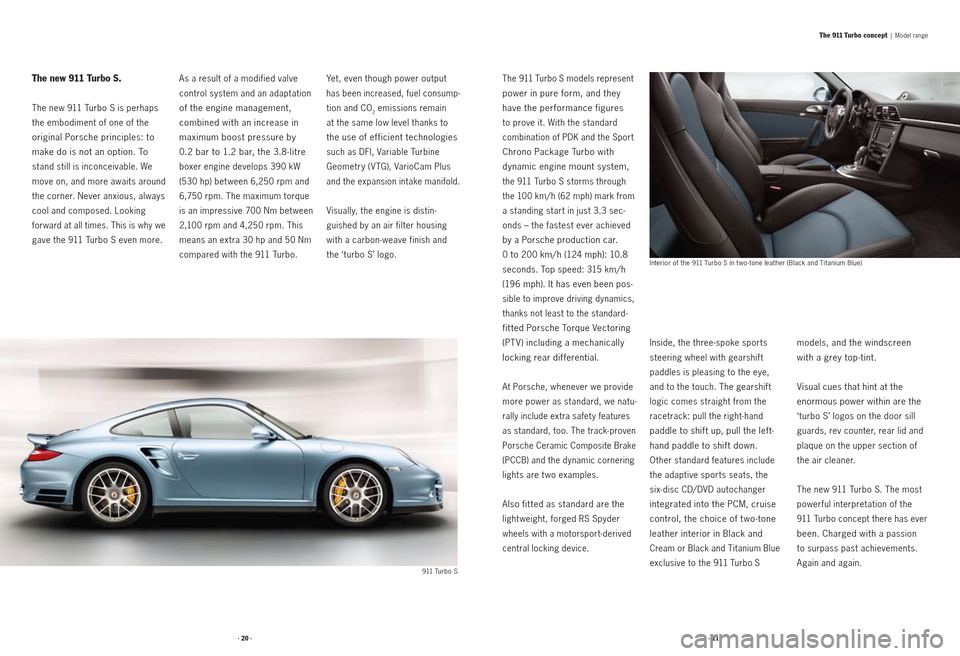
911 Turbo S Interior of the 911 Turbo S in t wo -tone leather (Black and Titanium Blue)
· 20 ·· 21 ·
Page 15 of 59
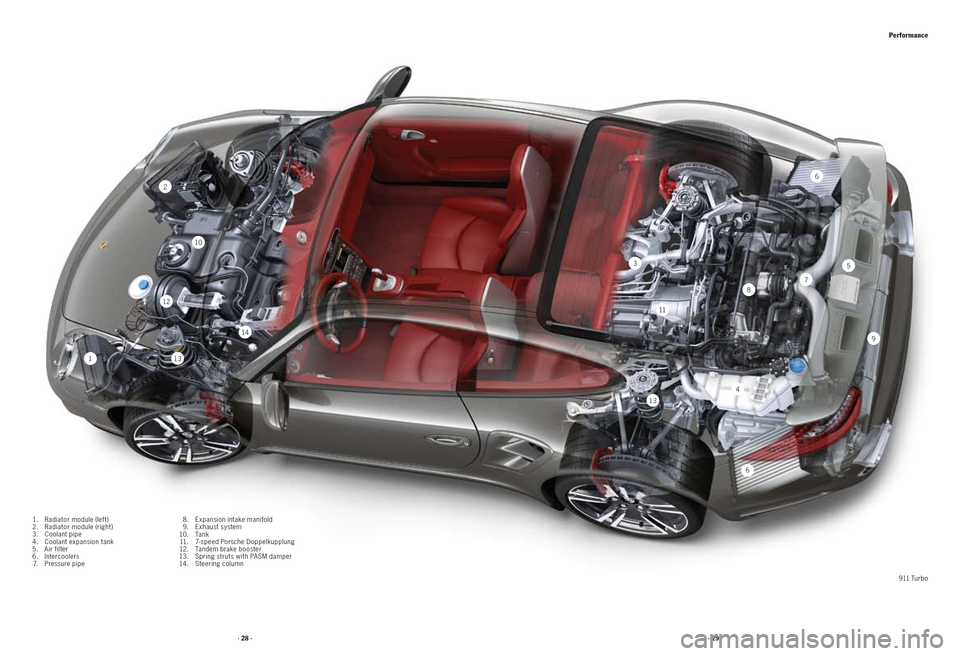
6
1
2
3
4
5
6
78
9
10
1112
13
13
14
8. Expansion intake manifold
9. Exhaust system
10. Ta n k
11. 7-speed Porsche Doppelkupplung
12. Tandem brake booster
13. Spring struts with PASM damper
14. Steering column
1. Radiator module (lef t)
2. Radiator module (right)
3. Coolant pipe
4. Coolant expansion tank
5. Air filter
6. Intercoolers
7. Pressure pipe
Performance
9 11 T u r b o
· 28 ·· 29 ·
Page 24 of 59
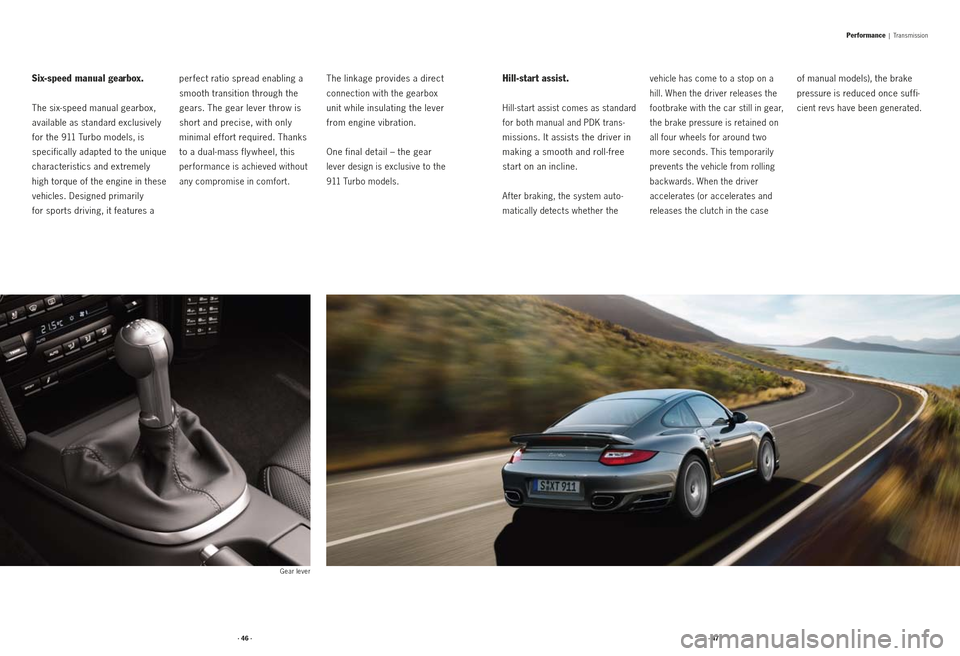
perfect ratio spread enabling a
smooth transition through the
gears. The gear lever throw is
short and precise, with only
minimal effort required. Thanks
to a dual-mass fly wheel, this
performance is achieved without
any compromise in comfort.
The linkage provides a direct
connection with the gearbox
unit while insulating the lever
from engine vibration.
One final detail – the gear
lever design is exclusive to the
911 Turbo models.
Six-speed manual gearbox.
The six-speed manual gearbox,
available as standard exclusively
for the 911 Turbo models, is
specifically adapted to the unique
characteristics and extremely
high torque of the engine in these
vehicles. Designed primarily
for sports driving, it features a
Hill-start assist.
Hill-start assist comes as standard
for both manual and PDK trans -
missions. It assists the driver in
making a smooth and roll-free
start on an incline.
After braking, the system auto-
matically detects whether the
of manual models), the brake
pressure is reduced once suffi -
cient revs have been generated.
Gear lever
vehicle has come to a stop on a
hill. When the driver releases the
footbrake with the car still in gear,
the brake pressure is retained on
all four wheels for around t wo
more seconds. This temporarily
prevents the vehicle from rolling
backwards. When the driver
accelerates (or accelerates and
releases the clutch in the case
Performance | Transmission
· 46 ·· 47 ·
Page 25 of 59
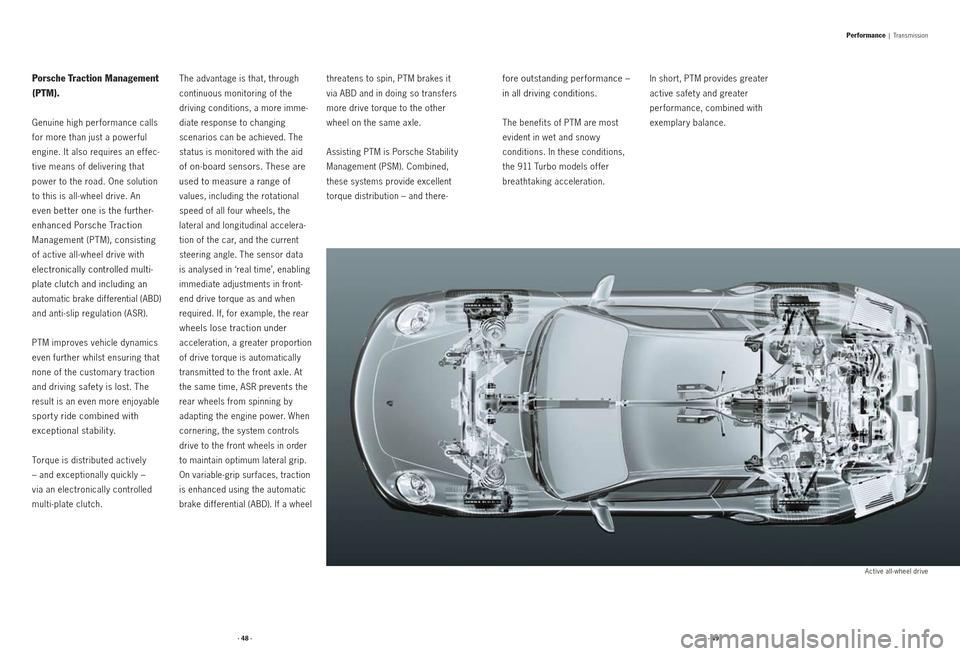
Porsche Traction Management
(P TM).
Genuine high per formance calls
for more than just a power ful
engine. It also requires an ef fec-
tive means of delivering that
power to the road. One solution
to this is all -wheel drive. An
even bet ter one is the further-
enhanced Porsche Traction
Management (PTM), consisting
of active all -wheel drive with
electronically controlled multi -
plate clutch and including an
automatic brake differential (ABD)
and anti -slip regulation (ASR).
PTM improves vehicle dynamics
even further whilst ensuring that
none of the customar y traction
and driving safet y is lost. The
result is an even more enjoyable
sport y ride combined with
exceptional stability.
Torque is distributed actively
– and exceptionally quickly –
via an electronically controlled
multi-plate clutch. The advantage is that, through
continuous monitoring of the
driving conditions, a more imme -
diate response to changing
scenarios can be achieved. The
status is monitored with the aid
of on-board sensors. These are
used to measure a range of
values, including the rotational
speed of all four wheels, the
lateral and longitudinal accelera -
tion of the car, and the current
steering angle. The sensor data
is analysed in ‘real time’, enabling
immediate adjustments in front-
end drive torque as and when
required. If, for example, the rear
wheels lose traction under
acceleration, a greater proportion
of drive torque is automatically
transmit ted to the front axle. At
the same time, ASR prevents the
rear wheels from spinning by
adapting the engine power. When
cornering, the system controls
drive to the front wheels in order
to maintain optimum lateral grip.
On variable-grip surfaces, traction
is enhanced using the automatic
brake dif ferential (ABD). If a wheel threatens to spin, PTM brakes it
via ABD and in doing so transfers
more drive torque to the other
wheel on the same axle.
Assisting PTM is Porsche Stabilit y
Management (PSM). Combined,
these systems provide excellent
torque distribution – and there
-
fore outstanding performance –
in all driving conditions.
The benefits of PTM are most
evident in wet and snow y
conditions. In these conditions,
the 911 Turbo models of fer
breathtaking acceleration. In short, PTM provides greater
active safet y and greater
performance, combined with
exemplary balance.
Performance | Transmission
Active all -wheel drive
· 48 ·· 49 ·
Page 26 of 59
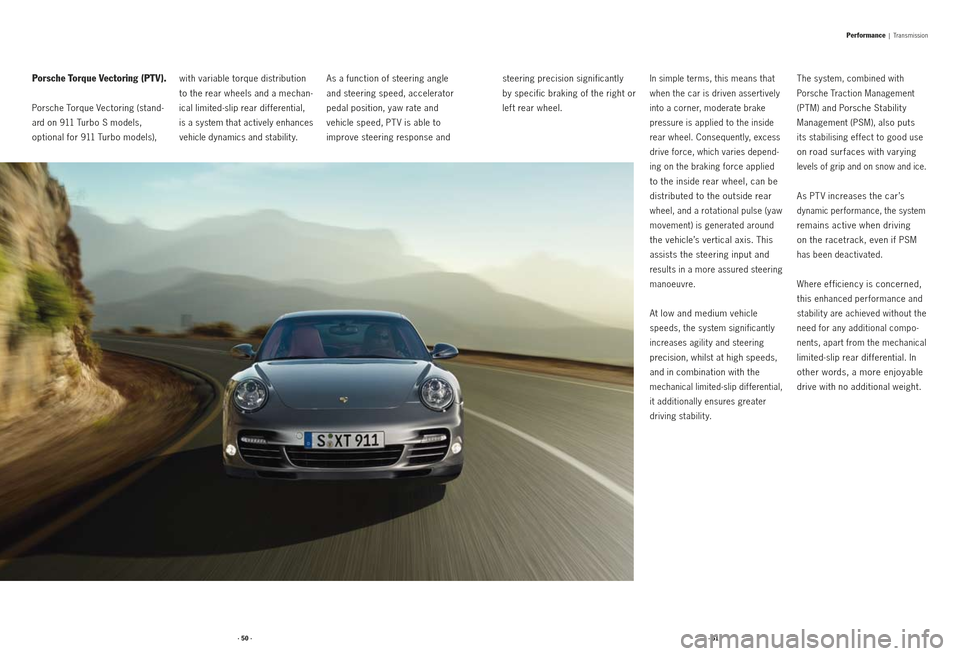
Porsche Torque Vectoring (PTV).
Porsche Torque Vectoring (stand-
ard on 911 Turbo S models,
optional for 911 Turbo models), with variable torque distribution
to the rear wheels and a mechan
-
ical limited-slip rear differential,
is a system that actively enhances
vehicle dynamics and stabilit y. As a function of steering angle
and steering speed, accelerator
pedal position, yaw rate and
vehicle speed, PT V is able to
improve steering response and steering precision significantly
by specific braking of the right or
left rear wheel.
In simple terms, this means that
when the car is driven assertively
into a corner, moderate brake
pressure is applied to the inside
rear wheel. Consequently, excess
drive force, which varies depend -
ing on the braking force applied
to the inside rear wheel, can be
distributed to the outside rear
wheel, and a rotational pulse (yaw
movement) is generated around
the vehicle’s vertical axis. This
assists the steering input and
results in a more assured steering
manoeuvre.
At low and medium vehicle
speeds, the system significantly
increases agilit y and steering
precision, whilst at high speeds,
and in combination with the
mechanical limited-slip differential,
it additionally ensures greater
driving stabilit y. The system, combined with
Porsche Traction Management
(PTM) and Porsche Stabilit y
Management (PSM), also puts
its stabilising ef fect to good use
on road surfaces with varying
levels of grip and on snow and ice.
As PT V increases the car’s
dynamic performance, the system
remains active when driving
on the racetrack, even if PSM
has been deactivated.
Where
efficien cy is concerned,
this
enhanced performance and
stabilit y are achieved without the
need for any additional compo -
nents, apart from the mechanical
limited-slip rear differential. In
other words, a more enjoyable
drive with no additional weight.
Performance | Transmission
· 50 ·· 51 ·
Page 28 of 59
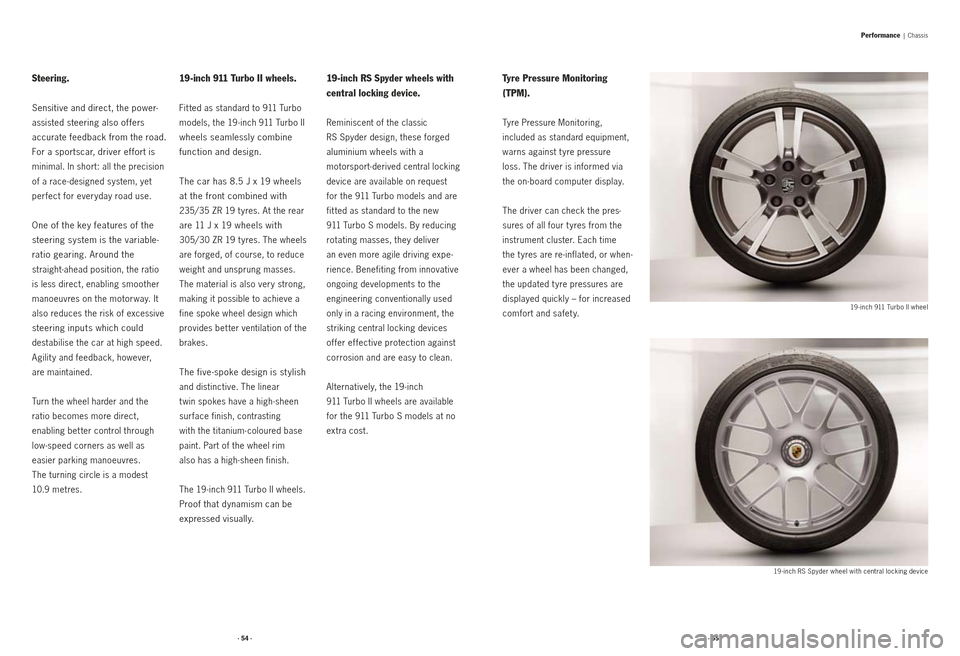
Steering.
Sensitive and direct, the power-
assisted steering also of fers
accurate feedback from the road.
For a sportscar, driver effort is
minimal. In short: all the precision
of a race- designed system, yet
perfect for everyday road use.
One of the key features of the
steering system is the variable-
ratio gearing. Around the
straight-ahead position, the ratio
is less direct, enabling smoother
manoeuvres on the motorway. It
also reduces the risk of excessive
steering inputs which could
destabilise the car at high speed.
Agilit y and feedback, however,
are maintained.
Turn the wheel harder and the
ratio becomes more direct,
enabling bet ter control through
low-speed corners as well as
easier parking manoeuvres.
The turning circle is a modest
10.9 metres.
19-inch 911 Turbo II wheels.
Fit ted as standard to 911 Turbo
models, the 19 -inch 911 Turbo II
wheels seamlessly combine
function and design.
The car has 8.5 J x 19 wheels
at the front combined with
235/35 ZR 19 t yres. At the rear
are 11 J x 19 wheels with
305/30 ZR 19 t yres. The wheels
are forged, of course, to reduce
weight and unsprung masses.
The material is also very strong,
making it possible to achieve a
fine spoke wheel design which
provides bet ter ventilation of the
brakes.
The five-spoke design is st ylish
and distinctive. The linear
t win spokes have a high -sheen
surface finish, contrasting
with the titanium - coloured base
paint. Part of the wheel rim
also has a high -sheen finish.
The 19 -inch 911 Turbo II wheels.
Proof that dynamism can be
expressed visually.
19-inch RS Spyder wheels with
central locking device.
Reminiscent of the classic
RS Spyder design, these forged
aluminium wheels with a
motorsport-derived central locking
device are available on request
for the 911 Turbo models and are
fit ted as standard to the new
911 Turbo S models. By reducing
rotating masses, they deliver
an even more agile driving expe -
rience. Benefiting from innovative
ongoing developments to the
engineering conventionally used
only in a racing environment, the
striking central locking devices
of fer ef fective protection against
corrosion and are easy to clean.
Alternatively, the 19 -inch
911 Turbo II wheels are available
for the 911 Turbo S models at no
extra cost.
Tyre Pressure Monitoring
(TPM).
Tyre Pressure Monitoring,
included as standard equipment,
warns against t yre pressure
loss. The driver is informed via
the on -board computer display.
The driver can check the pres -
sures of all four t yres from the
instrument cluster. Each time
the t yres are re-inflated, or when -
ever a wheel has been changed,
the updated t yre pressures are
displayed quickly – for increased
comfort and safet y.
19 - inch 911 Turbo II wheel
19 - inch RS Spyder wheel with central locking device
Performance | Chassis
· 54 ·· 55 ·
Page 29 of 59
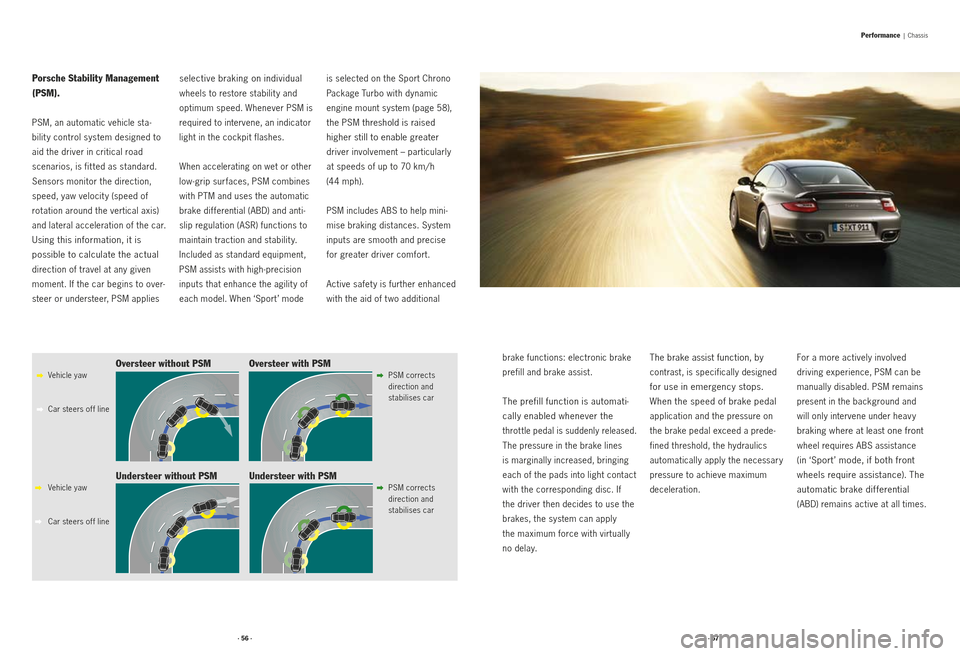
Porsche Stability Management
(PSM).
PSM, an automatic vehicle sta-
bilit y control system designed to
aid the driver in critical road
scenarios, is fit ted as standard.
Sensors monitor the direction,
speed, yaw velocit y (speed of
rotation around the vertical axis)
and lateral acceleration of the car.
Using this information, it is
possible to calculate the actual
direction of travel at any given
moment. If the car begins to over -
steer or understeer, PSM applies
selective braking on individual
wheels to restore stabilit y and
optimum speed. Whenever PSM is
required to intervene, an indicator
light in the cockpit flashes.
When accelerating on wet or other
low-grip surfaces, PSM combines
with PTM and uses the automatic
brake differential (ABD) and anti-
slip regulation (ASR) functions to
maintain traction and stabilit y.
Included as standard equipment,
PSM assists with high -precision
inputs that enhance the agilit y of
each model. When ‘Sport ’ mode is selected on the Sport Chrono
Package Turbo with dynamic
engine mount system (page 58),
the PSM threshold is raised
higher still to enable greater
driver involvement – particularly
at speeds of up to 70 km/ h
(44 mph).
PSM includes ABS to help mini -
mise braking distances. System
inputs are smooth and precise
for greater driver comfort.
Active safet y is further enhanced
with the aid of t wo additional
brake functions: electronic brake
prefill and brake assist.
The prefill function is automati-
cally enabled whenever the
throt tle pedal is suddenly released.
The pressure in the brake lines
is marginally increased, bringing
each of the pads into light contact
with the corresponding disc. If
the driver then decides to use the
brakes, the system can apply
the maximum force with virtually
no delay.
The brake assist function, by
contrast, is specifically designed
for use in emergency stops.
When the speed of brake pedal
application and the pressure on
the brake pedal exceed a prede -
fined threshold, the hydraulics
automatically apply the necessary
pressure to achieve maximum
deceleration. For a more actively involved
driving experience, PSM can be
manually disabled. PSM remains
present in the background and
will only intervene under heav y
braking where at least one front
wheel requires ABS assistance
(in ‘Sport ’ mode, if both front
wheels require assistance). The
automatic brake differential
(ABD) remains active at all times.
Vehicle yaw
Car steers of f line
Vehicle yaw
Car steers of f line PSM corrects
direction and
stabilises car
PSM corrects
direction and
stabilises carOversteer without PSM
Oversteer with PSM
Understeer with PSM
Understeer without PSM
Performance | Chassis
· 56 ·· 57 ·