four wheel drive PORSCHE 911 2009 5.G Information Manual
[x] Cancel search | Manufacturer: PORSCHE, Model Year: 2009, Model line: 911, Model: PORSCHE 911 2009 5.GPages: 59, PDF Size: 5.74 MB
Page 24 of 59
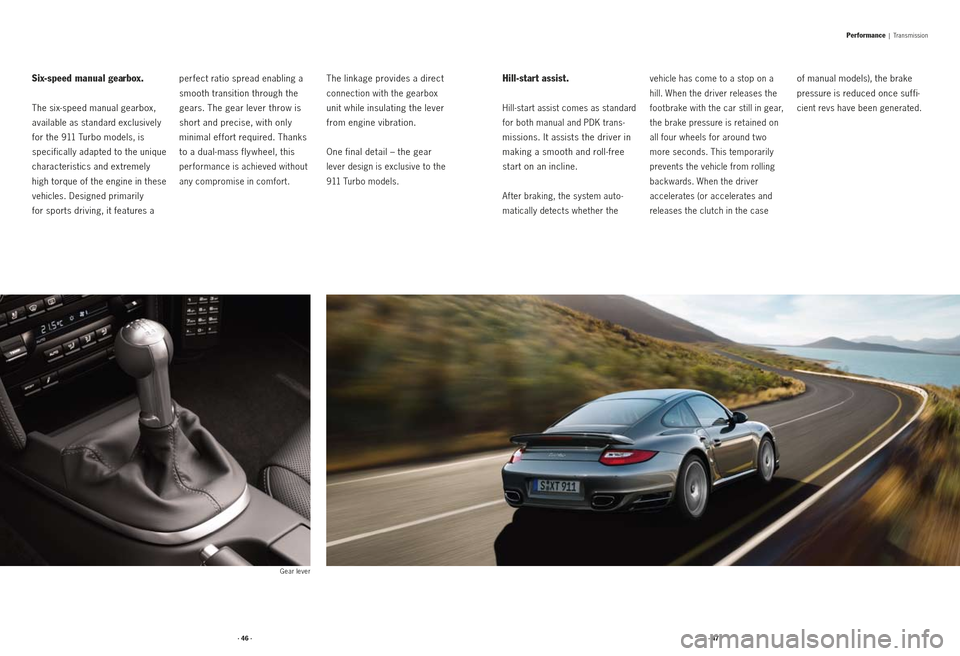
perfect ratio spread enabling a
smooth transition through the
gears. The gear lever throw is
short and precise, with only
minimal effort required. Thanks
to a dual-mass fly wheel, this
performance is achieved without
any compromise in comfort.
The linkage provides a direct
connection with the gearbox
unit while insulating the lever
from engine vibration.
One final detail – the gear
lever design is exclusive to the
911 Turbo models.
Six-speed manual gearbox.
The six-speed manual gearbox,
available as standard exclusively
for the 911 Turbo models, is
specifically adapted to the unique
characteristics and extremely
high torque of the engine in these
vehicles. Designed primarily
for sports driving, it features a
Hill-start assist.
Hill-start assist comes as standard
for both manual and PDK trans -
missions. It assists the driver in
making a smooth and roll-free
start on an incline.
After braking, the system auto-
matically detects whether the
of manual models), the brake
pressure is reduced once suffi -
cient revs have been generated.
Gear lever
vehicle has come to a stop on a
hill. When the driver releases the
footbrake with the car still in gear,
the brake pressure is retained on
all four wheels for around t wo
more seconds. This temporarily
prevents the vehicle from rolling
backwards. When the driver
accelerates (or accelerates and
releases the clutch in the case
Performance | Transmission
· 46 ·· 47 ·
Page 25 of 59
Porsche Traction Management
(P TM).
Genuine high per formance calls
for more than just a power ful
engine. It also requires an ef fec-
tive means of delivering that
power to the road. One solution
to this is all -wheel drive. An
even bet ter one is the further-
enhanced Porsche Traction
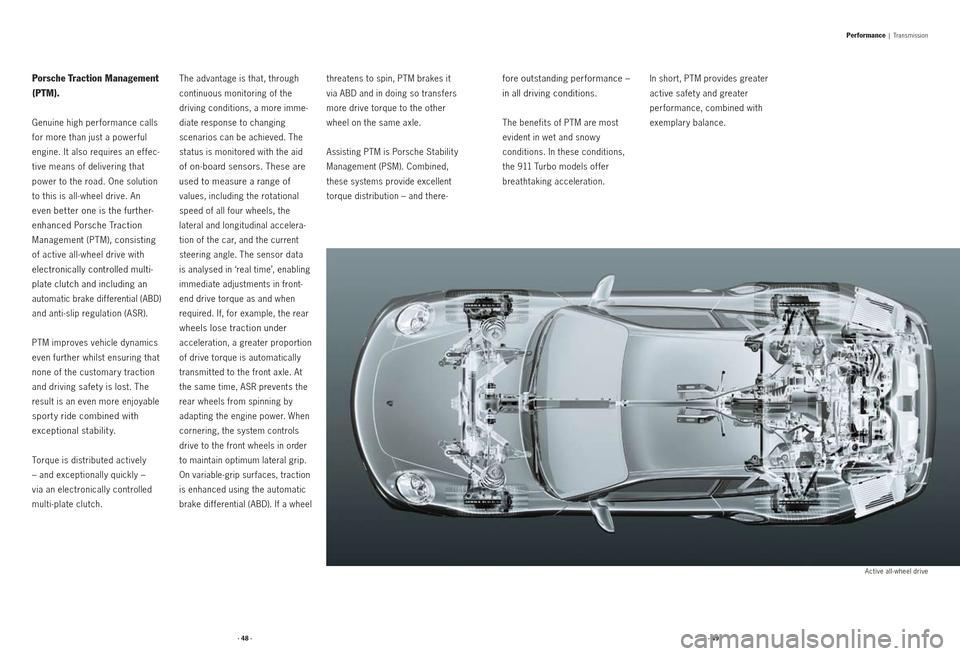
Management (PTM), consisting
of active all -wheel drive with
electronically controlled multi -
plate clutch and including an
automatic brake differential (ABD)
and anti -slip regulation (ASR).
PTM improves vehicle dynamics
even further whilst ensuring that
none of the customar y traction
and driving safet y is lost. The
result is an even more enjoyable
sport y ride combined with
exceptional stability.
Torque is distributed actively
– and exceptionally quickly –
via an electronically controlled
multi-plate clutch. The advantage is that, through
continuous monitoring of the
driving conditions, a more imme -
diate response to changing
scenarios can be achieved. The
status is monitored with the aid
of on-board sensors. These are
used to measure a range of
values, including the rotational
speed of all four wheels, the
lateral and longitudinal accelera -
tion of the car, and the current
steering angle. The sensor data
is analysed in ‘real time’, enabling
immediate adjustments in front-
end drive torque as and when
required. If, for example, the rear
wheels lose traction under
acceleration, a greater proportion
of drive torque is automatically
transmit ted to the front axle. At
the same time, ASR prevents the
rear wheels from spinning by
adapting the engine power. When
cornering, the system controls
drive to the front wheels in order
to maintain optimum lateral grip.
On variable-grip surfaces, traction
is enhanced using the automatic
brake dif ferential (ABD). If a wheel threatens to spin, PTM brakes it
via ABD and in doing so transfers
more drive torque to the other
wheel on the same axle.
Assisting PTM is Porsche Stabilit y
Management (PSM). Combined,
these systems provide excellent
torque distribution – and there
-
fore outstanding performance –
in all driving conditions.
The benefits of PTM are most
evident in wet and snow y
conditions. In these conditions,
the 911 Turbo models of fer
breathtaking acceleration. In short, PTM provides greater
active safet y and greater
performance, combined with
exemplary balance.
Performance | Transmission
Active all -wheel drive
· 48 ·· 49 ·
Page 28 of 59
Steering.
Sensitive and direct, the power-
assisted steering also of fers
accurate feedback from the road.
For a sportscar, driver effort is
minimal. In short: all the precision
of a race- designed system, yet
perfect for everyday road use.
One of the key features of the
steering system is the variable-
ratio gearing. Around the
straight-ahead position, the ratio
is less direct, enabling smoother
manoeuvres on the motorway. It
also reduces the risk of excessive
steering inputs which could
destabilise the car at high speed.
Agilit y and feedback, however,
are maintained.
Turn the wheel harder and the
ratio becomes more direct,
enabling bet ter control through
low-speed corners as well as
easier parking manoeuvres.
The turning circle is a modest
10.9 metres.
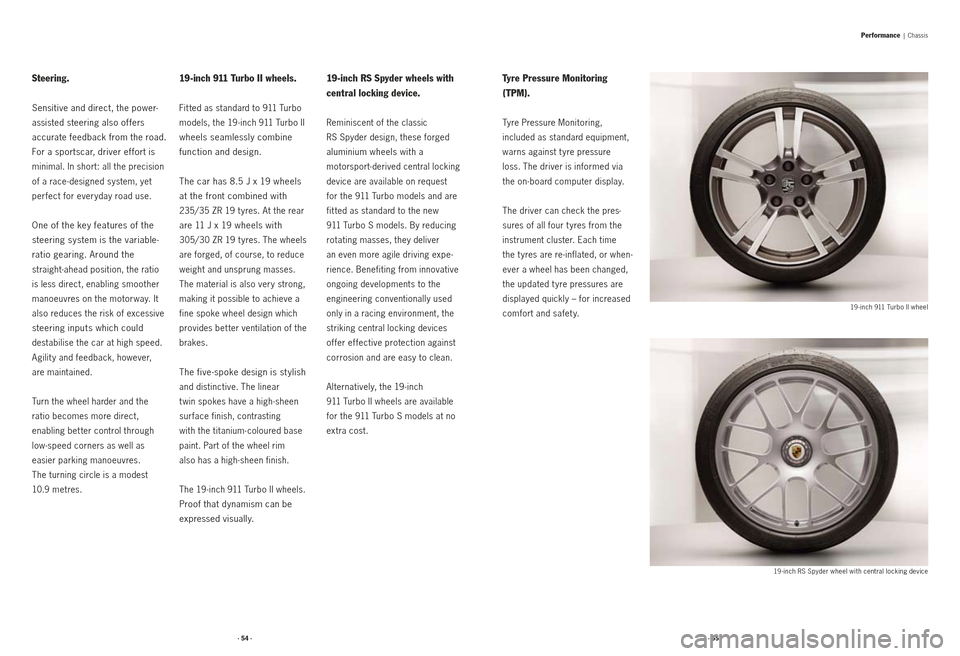
19-inch 911 Turbo II wheels.
Fit ted as standard to 911 Turbo
models, the 19 -inch 911 Turbo II
wheels seamlessly combine
function and design.
The car has 8.5 J x 19 wheels
at the front combined with
235/35 ZR 19 t yres. At the rear
are 11 J x 19 wheels with
305/30 ZR 19 t yres. The wheels
are forged, of course, to reduce
weight and unsprung masses.
The material is also very strong,
making it possible to achieve a
fine spoke wheel design which
provides bet ter ventilation of the
brakes.
The five-spoke design is st ylish
and distinctive. The linear
t win spokes have a high -sheen
surface finish, contrasting
with the titanium - coloured base
paint. Part of the wheel rim
also has a high -sheen finish.
The 19 -inch 911 Turbo II wheels.
Proof that dynamism can be
expressed visually.
19-inch RS Spyder wheels with
central locking device.
Reminiscent of the classic
RS Spyder design, these forged
aluminium wheels with a
motorsport-derived central locking
device are available on request
for the 911 Turbo models and are
fit ted as standard to the new
911 Turbo S models. By reducing
rotating masses, they deliver
an even more agile driving expe -
rience. Benefiting from innovative
ongoing developments to the
engineering conventionally used
only in a racing environment, the
striking central locking devices
of fer ef fective protection against
corrosion and are easy to clean.
Alternatively, the 19 -inch
911 Turbo II wheels are available
for the 911 Turbo S models at no
extra cost.
Tyre Pressure Monitoring
(TPM).
Tyre Pressure Monitoring,
included as standard equipment,
warns against t yre pressure
loss. The driver is informed via
the on -board computer display.
The driver can check the pres -
sures of all four t yres from the
instrument cluster. Each time
the t yres are re-inflated, or when -
ever a wheel has been changed,
the updated t yre pressures are
displayed quickly – for increased
comfort and safet y.
19 - inch 911 Turbo II wheel
19 - inch RS Spyder wheel with central locking device
Performance | Chassis
· 54 ·· 55 ·
Page 44 of 59
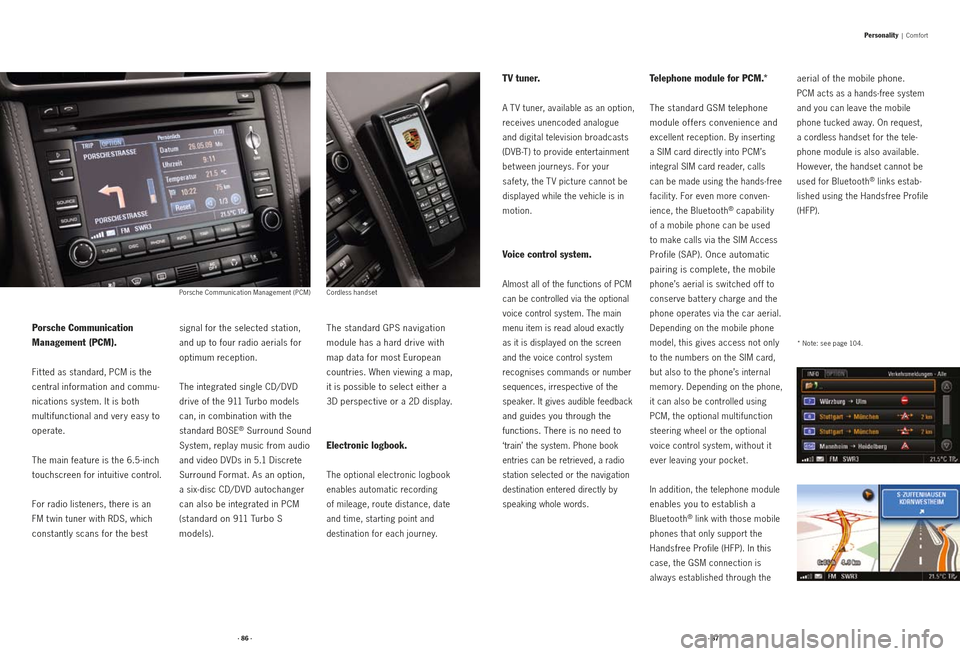
Porsche Communication
Management (PCM).
Fit ted as standard, PCM is the
central information and commu -
nications system. It is both
multifunctional and very easy to
operate.
The main feature is the 6.5-inch
touchscreen for intuitive control.
For radio listeners, there is an
FM t win tuner with RDS, which
constantly scans for the best signal for the selected station,
and up to four radio aerials for
optimum reception.
The integrated single CD/ DVD
drive of the 911 Turbo models
can, in combination with the
standard BOSE
® Surround Sound
System, replay music from audio
and video DVDs in 5.1 Discrete
Surround Format. As an option,
a six-disc CD/ DVD autochanger
can also be integrated in PCM
(standard on 911 Turbo S
models). The standard GPS navigation
module has a hard drive with
map data for most European
countries. When viewing a map,
it is possible to select either a
3D perspective or a 2D display.
Electronic logbook.
The optional electronic logbook
enables automatic recording
of mileage, route distance, date
and time, starting point and
destination for each journey.
TV tuner.
A T V tuner, available as an option,
receives unencoded analogue
and digital television broadcasts
(DVB-T) to provide entertainment
bet ween journeys. For your
safet y, the T V picture cannot be
displayed while the vehicle is in
motion.
Voice control system.
Almost all of the functions of PCM
can be controlled via the optional
voice control system. The main
menu item is read aloud exactly
as it is displayed on the screen
and the voice control system
recognises commands or number
sequences, irrespective of the
speaker. It gives audible feedback
and guides you through the
functions. There is no need to
‘train’
the system. Phone book
entries can be retrieved, a radio
station selected or the navigation
destination entered directly by
speaking whole words.
Telephone module for PCM.*
The standard GSM telephone
module offers convenience and
excellent reception. By inserting
a SIM card directly into PCM’s
integral SIM card reader, calls
can be made using the hands-free
facilit y. For even more conven -
ience, the Bluetooth
® capabilit y
of a mobile phone can be used
to make calls via the SIM Access
Profile (SAP). Once automatic
pairing is complete, the mobile
phone’s aerial is switched of f to
conserve bat tery charge and the
phone operates via the car aerial.
Depending on the mobile phone
model, this gives access not only
to the numbers on the SIM card,
but also to the phone’s internal
memory. Depending on the phone,
it can also be controlled using
PCM, the optional multifunction
steering wheel or the optional
voice control system, without it
ever leaving your pocket.
In addition, the telephone module
enables you to establish a
Bluetooth
® link with those mobile
phones that only support the
Handsfree Profile (HFP). In this
case, the GSM connection is
always established through the
aerial of the mobile phone.
PCM acts as a hands-free system
and you can leave the mobile
phone tucked away. On request,
a cordless handset for the tele -
phone module is also available.
However, the handset cannot be
used for Bluetooth
® links estab -
lished using the Handsfree Profile
(HFP).
Porsche Communication Management (PCM) Cordless handset
* Note: see page 104.
Personality | Comfort
· 86 ·· 87 ·