ABS PORSCHE 911 2009 5.G User Guide
[x] Cancel search | Manufacturer: PORSCHE, Model Year: 2009, Model line: 911, Model: PORSCHE 911 2009 5.GPages: 310, PDF Size: 3.39 MB
Page 136 of 310

134
Instruments, On-Board Computer, Warnings Note
You can recall phone calls, e.g. calls that arrived
during your absence, via the menu item “Missed
calls”.Example:
Selecting from the telephone book and
calling
fSelect “Phone book” with the operating lever.fPush operating lever forward.
fSelect a person to call and push the operating
lever forward.
The connection is established.
Page 164 of 310

162
Warnings
ABS failure Have the fault remedied at an authorized
Porsche dealer.
PSM off Porsche Stability Management has been
switched off.
PSM on Porsche Stability Management has been
switched on.
PSM failure Have the fault remedied at an authorized
Porsche dealer.
PSM
initialisationPlease observe the chapter “PUTTING VEHICLE
INTO OPERATION“.
PASM Normal/Sport Indicator for selected PASM mode
PASM failure Have the fault remedied at an authorized
Porsche dealer.
PASM indicator faulty Have the fault remedied at an authorized
Porsche dealer.
Sport mode failure Have the fault remedied at an authorized
Porsche dealer.
Airbag system fault Airbag is faulty.
Have the fault remedied at an authorized
Porsche dealer.
Check passenger’s seat setting Weight sensing is impaired on the front
passenger's seat (Advanced Airbag).
Correct the seating position, set the backrest
upright, do not support weight on the armrests,
or lift on the handles.
Instrument
panelOn-board
computerText display on on-board
computerMeaning/measure
Page 183 of 310

Mobile Roofs
181
Convertible Top Brief operating instructions can be found on the
back side of the driver’s sun visor.
fPlease see the chapter “CAR CARE INSTRUC-
TIONS” on Page 224.
Warning!
When opening or closing the convertible top,
serious personal injury may occur if a per-
son’s body parts are near or in the way of the
convertible top mechanism’s moving parts.
fMake absolutely sure that nobody can be in-
jured by the convertible-top mechanism or the convertible-top compartment lid.
Do not operate convertible top:
– At temperatures below 32 °F (0 °C).
– When one side of the car is on a curb, a hoist
or a jack.
– When items of luggage or other objects hinder
the convertible top movement.
– With the rollbars extended.fAvoid frequent operation of the convertible top
with the engine off; the vehicle battery would
be unintentionally discharged rapidly.
fDrive only with the convertible top fully open or
closed (end positions).
fWhen opening or closing the convertible top,
ensure there is sufficient clearance above the
convertible top (e.g. in the garage).
fTo prevent damp stains and abrasions, only
open the convertible top in a dry, clean state.
fPark your car in the shade whenever possible,
as the fabric, rubber material and color can be
harmed by long exposure to sunlight.
fThe convertible top may only be actuated dur-
ing driving on even surfaces.
fThe convertible top must not be used with
strong counter wind (over approx. 50 mph/
80 km/h).
Door windows and side windows The side windows are lowered automatically when
the convertible top is opened. The door windows
close automatically if convertible top operation is
not interrupted when the convertible top reaches
its final position.
When the door windows are closed, the rear side
windows can also be closed.
When opening the door windows, the rear win-
dows open automatically.
The side windows are lowered automatically when
the convertible top is closed. All windows close
automatically if convertible top operation is not in-
terrupted when the convertible top reaches its fi-
nal position.
Page 184 of 310
182
Mobile Roofs
Preconditions for operation of the
convertible top – The ignition must be switched on
(engine running or off),
– the engine compartment lid must be closed,
– the speed must be below approx. 30 mph
(50 km/h).
If this maximum speed is exceeded, the open-
ing/closing procedure of the convertible top
will be interrupted.
fReduce speed.
Press button again.
The opening/closing process is ended.
Warning!
Risk of injury and damage when operating
the convertible top.
fMake absolutely sure that nobody can be in-
jured by the convertible-top mechanism or the
convertible-top compartment lid.
fBefore opening the convertible top, make sure
that there are no objects behind the rear seats.
fKeep the lids of the make-up mirrors in the sun
visors closed when closing the convertible top.
fIn order to abort convertible top operation in
the event of danger, immediately release the switch.
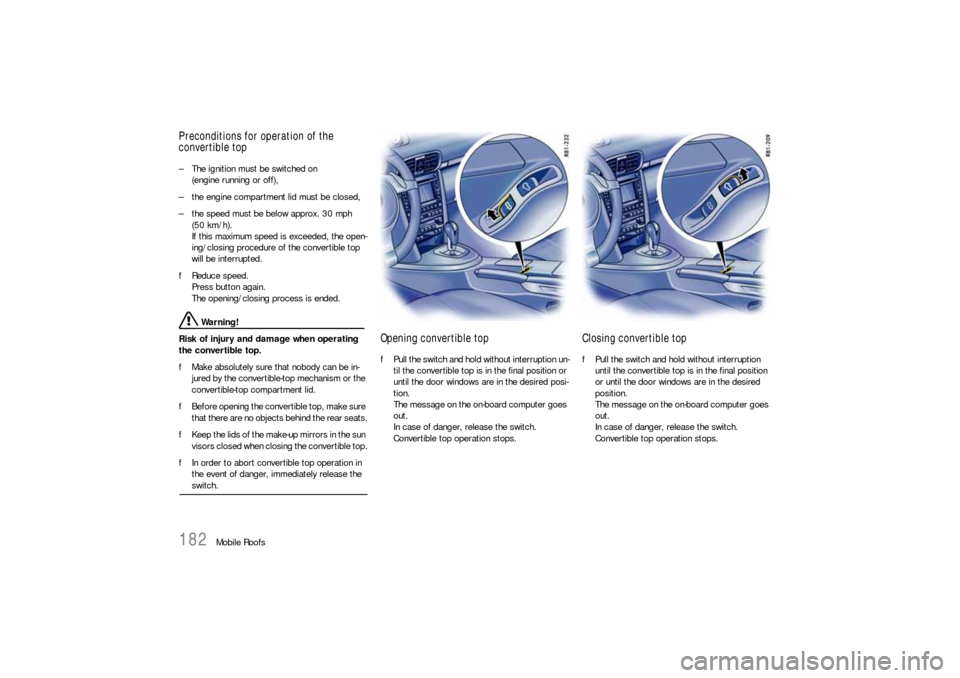
Opening convertible topfPull the switch and hold without interruption un-
til the convertible top is in the final position or
until the door windows are in the desired posi-
tion.
The message on the on-board computer goes
out.
In case of danger, release the switch.
Convertible top operation stops.
Closing convertible topfPull the switch and hold without interruption
until the convertible top is in the final position
or until the door windows are in the desired
position.
The message on the on-board computer goes
out.
In case of danger, release the switch.
Convertible top operation stops.
Page 194 of 310
192
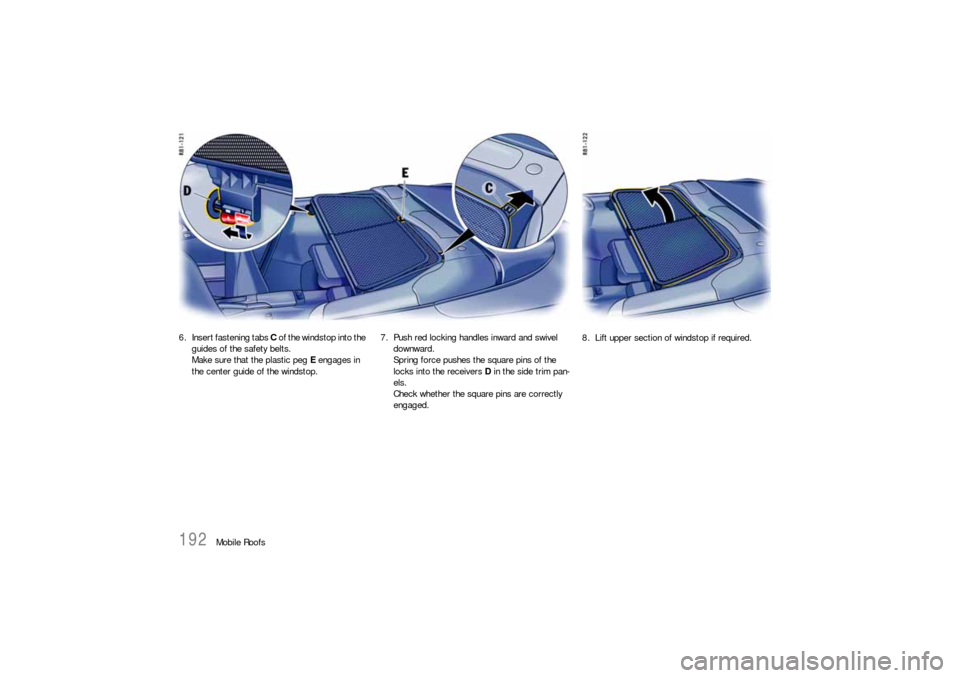
Mobile Roofs 6. Insert fastening tabs C of the windstop into the
guides of the safety belts.
Make sure that the plastic peg E engages in
the center guide of the windstop. 7. Push red locking handles inward and swivel
downward.
Spring force pushes the square pins of the
locks into the receivers D in the side trim pan-
els.
Check whether the square pins are correctly
engaged.
8. Lift upper section of windstop if required.
Page 196 of 310
194
Mobile Roofs
Hardtop Your authorized Porsche dealer will be glad to give
advice about correct hardtop storage.
Since the convertible top stays open for a long
time, it must be absolutely dry and clean before
being opened to install the hardtop.
This prevents damp stains and abrasion damage.
fMake sure that the hardtop is placed on a
clean, soft surface.
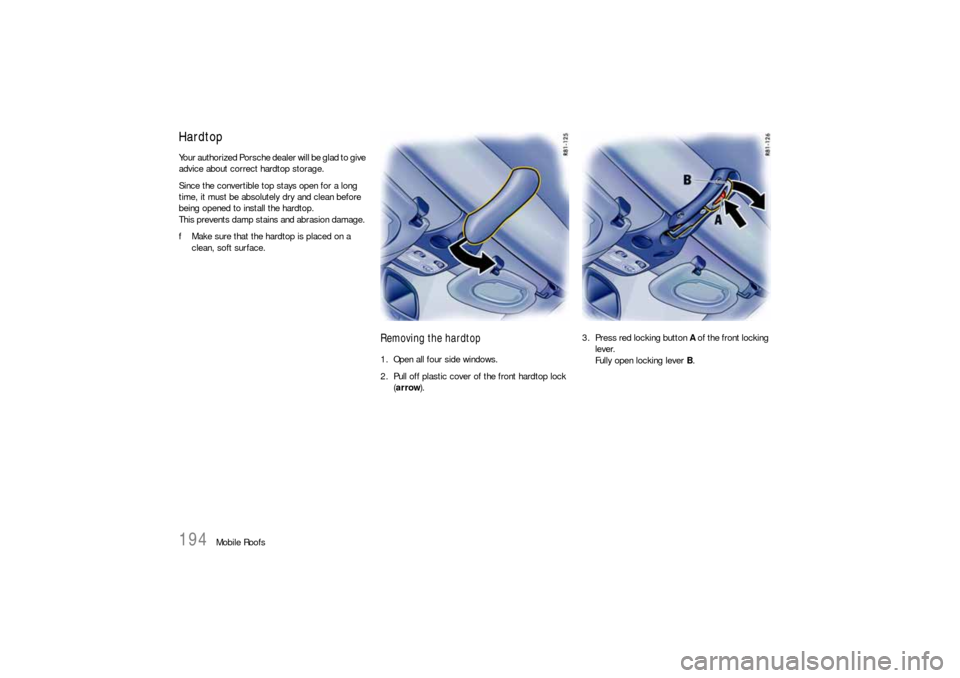
Removing the hardtop 1. Open all four side windows.
2. Pull off plastic cover of the front hardtop lock
(arrow).
3. Press red locking button A of the front locking
lever.
Fully open locking lever B.
Page 215 of 310

Maintenance, Car Care
213
Changing the brake fluid Brake fluid absorbs moisture from the air over
time. This accumulation of water lowers the boil-
ing point and, under certain operating conditions,
can affect the braking performance.
Therefore have the brake fluid changed in accord-
ance with the change intervals stated in the
brochure “Maintenance”. – The warning lights on the instrument panel and
on the on-board computer indicate an insuffi-
cient brake fluid level.
– If the warning light lights up on the instrument
panel and the warning message appears on
the on-board computer in combination with a
larger pedal travel, a brake circuit may have
failed.
If the warning lights should light up when
driving:
fStop immediately in a suitable place.
fDo not continue driving.
Consult an authorized Porsche dealer.
Warning light USA
Warning light Canada
Page 229 of 310

Maintenance, Car Care
227
Paint To protect the paint on your vehicle in the best
possible way against mechanical and chemical
damage, you should
– preserve it regularly,
– polish it if necessary,
– remove spots and stains, and
– repair damaged paintwork.
fDo not apply care products containing silicone
to the convertible top and windows.
General information
fNever rub a dusty vehicle with a dry cloth,
because the grains of dirt will damage the
paintwork.
fDo not treat matt-painted components with
preservatives or polishes, otherwise the matt
effect will be lost.
Preservation
The paint surface becomes dull over time due to
weathering.
fPreserve paint regularly.
fApply paint preservative after washing the
vehicle and polish it smooth to preserve the
paintwork.This keeps the paint shiny and elastic. Dirt is
prevented from adhering to the paint surface and
industrial dust is prevented from penetrating the
paint.
Polishing
Do not resort to using Porsche polish until it be-
comes evident that the normal preservatives no
longer produce the desired finish.
Spots and stains
fRemove tar stains, grease, oil spots and dead
insects as soon as possible with Insect Remov-
er. They can cause discoloration if allowed to
remain on the paintwork.
fWash the affected area immediately after treat-
ing it.
Minor paint damage
fHave minor paint damage, such as scratches,
scores or chips caused by flying stones, re-
paired immediately by your authorized
Porsche dealer before corrosion sets in.
However, if there are already traces of corrosion,
they must first be removed carefully and thorough-
ly. Coat the area with a rust-proofing primer and
finish off with a top coat. The paint code and color
number are found on the data bank in the Mainte-
nance booklet.
fPlease see the chapter “VEHICLE DATA BANK”
on Page 284.
Engine compartment The engine compartment and the surface of the
engine are treated with a corrosion-inhibitor at the
factory.
If degreasing solvents are used to clean the en-
gine compartment or the engine is washed down,
the process almost invariably removes the corro-
sion-inhibiting coating. It is then absolutely neces-
sary to have a durable preservative applied to all
surfaces, body seams, joints and assemblies in
the engine compartment. This also applies when
corrosion-inhibitor parts are replaced.
Caution!
Risk of damage to the alternator.
fDo not point the cleaning jet directly at the al-ternator, or cover the alternator.
Effective rust-proofing is particularly important
during the cold weather season. If the vehicle is
driven frequently in areas where salt has been
spread on the roads, the engine compartment
should be cleaned thoroughly and subsequently
sealed after the cold weather season to prevent
salt from causing any lasting damage.
Page 233 of 310

Maintenance, Car Care
231
Alcantara fDo not use a leather care product to clean
Alcantara.
For regular care it is sufficient to clean the cover
with a soft brush.
Heavy abrasion or rubbing when cleaning causes
a lasting change in the surface.
Cleaning when lightly soiled
fWet a soft cloth with water or a neutral soap
solution and wipe off the dirt.
Cleaning when heavily soiled
fWet a soft cloth with lukewarm water or
thinned white spirit and dab the dirt from the
outside in. Cleaning Safety belts fUse mild detergent to clean soiled belts.
fWhen drying, avoid direct sunlight.
fOnly use suitable cleaning agents.
fDo not tint or bleach the belts.
The belt fabric could be weakened, thus affec-
ting safety.
Storing your Porsche If you intend to store your Porsche for a prolonged
period, please consult your authorized Porsche
dealer. The staff will be glad to advise you on the
most suitable and necessary methods.
fClean your vehicle thoroughly inside and out-
side.
Clean the engine compartment.
The under carriage and chassis components
should be free of dirt and salt deposits.
fFill up the fuel tank.
fChange the oil and oil filter, and run the engine
for several minutes.
fIncrease the tire pressure to 50 psi (3.5 bar).
It is not recommended to lift the vehicle, due to
the possibility of corrosion on shock absorber
piston shafts.
The vehicle should be moved slightly, approxi-
mately every four weeks, to prevent flat spot
on the tires. Climate control
The air conditioning system should be in good
working condition and fully charged.
Windshield/Headlight washer
fCheck and correct antifreeze/cleaning solution
level as necessary.
Electrical system
fRemove the battery from the vehicle and store
it in a cool dry place, not on a cement floor.
When the battery is disconnected, the
alarm system is deactivated.
fRecharge the battery every 3 months. If the
battery remains in the vehicle with the cables
connected, it is necessary to check, remove
and recharge the battery every 2-3 weeks.
Do not fast charge the battery.
fPlease see the chapter “BATTERY” on
Page 261.
Vehicle interior
The interior must be dry, especially in the area of
the floor carpets. The use of drying agents (Silica-
Gel) is recommended in vehicles with leather inte-
rior and in areas with high humidity. The recom-
mended amount is 3 fabric bags of 1.1 lbs.
(500 grams) each placed on the floor carpets.
Windows, doors and lids must be closed. The air
vents should be opened.
Page 273 of 310
Practical Tips, Emergency Service
271
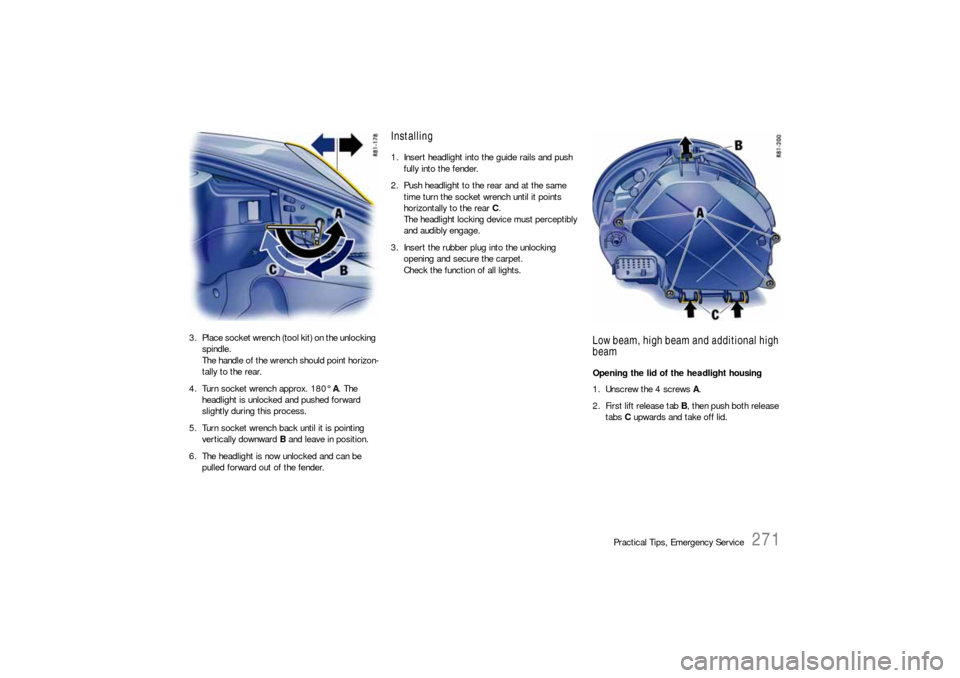
3. Place socket wrench (tool kit) on the unlocking
spindle.
The handle of the wrench should point horizon-
tally to the rear.
4. Turn socket wrench approx. 180° A. The
headlight is unlocked and pushed forward
slightly during this process.
5. Turn socket wrench back until it is pointing
vertically downward B and leave in position.
6. The headlight is now unlocked and can be
pulled forward out of the fender.
Installing1. Insert headlight into the guide rails and push
fully into the fender.
2. Push headlight to the rear and at the same
time turn the socket wrench until it points
horizontally to the rear C.
The headlight locking device must perceptibly
and audibly engage.
3. Insert the rubber plug into the unlocking
opening and secure the carpet.
Check the function of all lights.
Low beam, high beam and additional high
beamOpening the lid of the headlight housing
1. Unscrew the 4 screws A.
2. First lift release tab B, then push both release
tabs C upwards and take off lid.