Headlight PORSCHE 911 2009 5.G User Guide
[x] Cancel search | Manufacturer: PORSCHE, Model Year: 2009, Model line: 911, Model: PORSCHE 911 2009 5.GPages: 310, PDF Size: 3.39 MB
Page 121 of 310
Instruments, On-Board Computer, Warnings
119
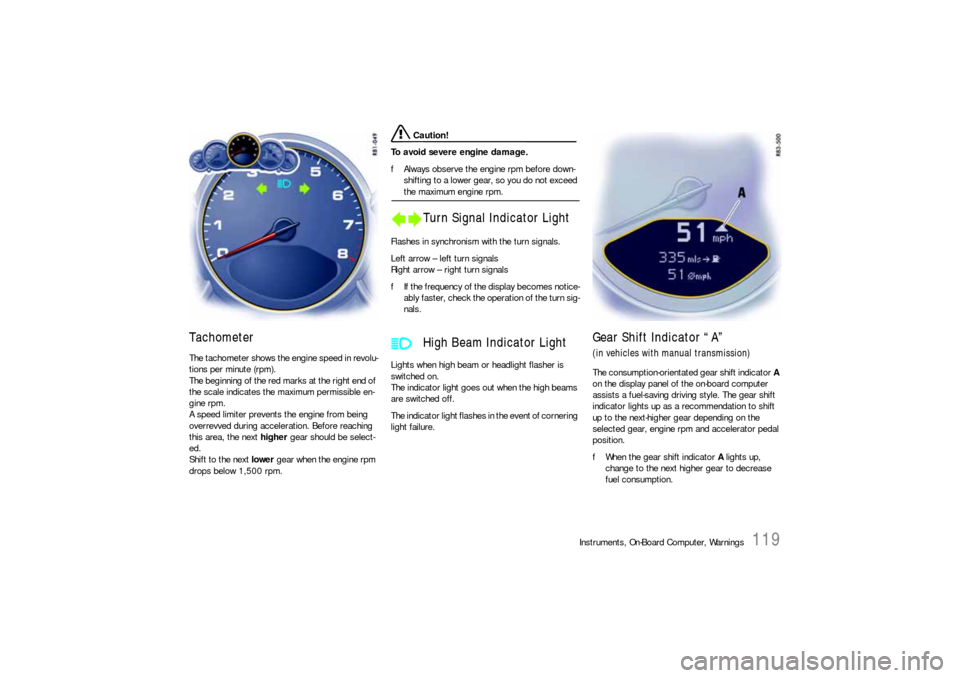
Tachometer The tachometer shows the engine speed in revolu-
tions per minute (rpm).
The beginning of the red marks at the right end of
the scale indicates the maximum permissible en-
gine rpm.
A speed limiter prevents the engine from being
overrevved during acceleration. Before reaching
this area, the next higher gear should be select-
ed.
Shift to the next lower gear when the engine rpm
drops below 1,500 rpm.
Caution!
To avoid severe engine damage.
fAlways observe the engine rpm before down-
shifting to a lower gear, so you do not exceed the maximum engine rpm.
Flashes in synchronism with the turn signals.
Left arrow – left turn signals
Right arrow – right turn signals
fIf the frequency of the display becomes notice-
ably faster, check the operation of the turn sig-
nals.
Lights when high beam or headlight flasher is
switched on.
The indicator light goes out when the high beams
are switched off.
The indicator light flashes in the event of cornering
light failure.
Gear Shift Indicator “A”(in vehicles with manual transmission)The consumption-orientated gear shift indicator A
on the display panel of the on-board computer
assists a fuel-saving driving style. The gear shift
indicator lights up as a recommendation to shift
up to the next-higher gear depending on the
selected gear, engine rpm and accelerator pedal
position.
fWhen the gear shift indicator A lights up,
change to the next higher gear to decrease
fuel consumption.
Turn Signal Indicator Light
High Beam Indicator Light
Page 161 of 310

Warnings
159
Check left/right dipped beam (low
beam)
also applies to:
direction indicator, high beam, side in-
dicator light, reversing light, side
markerThe reported light is faulty. Check bulb.
Have the fault remedied at an authorized
Porsche dealer.
Daytime
driving lights offDaytime driving lights switch off when the en-
gine is shut off. Switch on lights if necessary.
Headlight beam
adjustment faultyHave the fault remedied at an authorized
Porsche dealer.
Front lid not closed Close luggage compartment lid properly.
Rear lid not closed Close engine compartment lid properly.
Targa flap not closed Close glass rear hatch
Rain sensor faulty Have the fault remedied at an authorized
Porsche dealer.
Steering wheel heating
ONSteering wheel heating was switched on.
Steering wheel heating
OFFSteering wheel heating was switched off.
Launch
control
active
Drive Off Assistant
failureHave the fault remedied at an authorized
Porsche dealer.
Refill washer fluid
Instrument
panelOn-board
computerText display on on-board
computerMeaning/measure
Page 222 of 310
220
Maintenance, Car Care
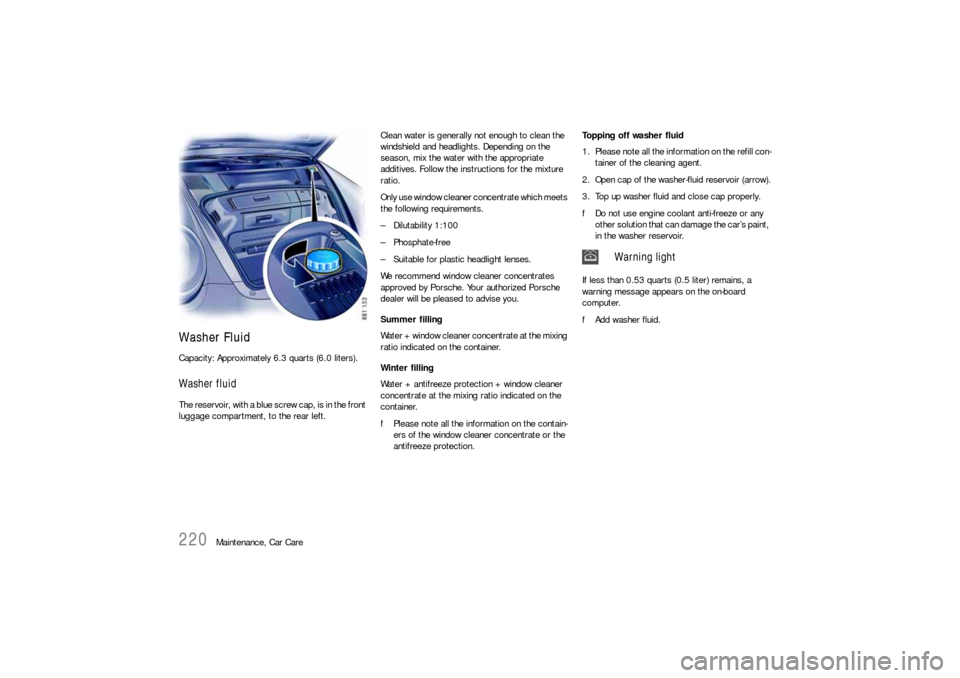
Washer FluidCapacity: Approximately 6.3 quarts (6.0 liters). Washer fluidThe reservoir, with a blue screw cap, is in the front
luggage compartment, to the rear left.Clean water is generally not enough to clean the
windshield and headlights. Depending on the
season, mix the water with the appropriate
additives. Follow the instructions for the mixture
ratio.
Only use window cleaner concentrate which meets
the following requirements.
– Dilutability 1:100
– Phosphate-free
– Suitable for plastic headlight lenses.
We recommend window cleaner concentrates
approved by Porsche. Your authorized Porsche
dealer will be pleased to advise you.
Summer filling
Water + window cleaner concentrate at the mixing
ratio indicated on the container.
Winter filling
Water + antifreeze protection + window cleaner
concentrate at the mixing ratio indicated on the
container.
fPlease note all the information on the contain-
ers of the window cleaner concentrate or the
antifreeze protection.Topping off washer fluid
1. Please note all the information on the refill con-
tainer of the cleaning agent.
2. Open cap of the washer-fluid reservoir (arrow).
3. Top up washer fluid and close cap properly.
fDo not use engine coolant anti-freeze or any
other solution that can damage the car’s paint,
in the washer reservoir.
If less than 0.53 quarts (0.5 liter) remains, a
warning message appears on the on-board
computer.
fAdd washer fluid.
Warning light
Page 231 of 310

Maintenance, Car Care
229
fAlways apply a fresh coating of suitable pre-
servative to unprotected areas after cleaning
the underside of the body, the transmission,
the engine or carrying out repairs to under-
body, engine or transmission components.
Effective rust-proofing is particularly important
during the cold weather season. If your car is driv-
en frequently in areas where salt has been spread
on the roads, the whole engine compartment
should be cleaned thoroughly after the winter to
prevent salt from causing any lasting damage. A
full under-body wash should also be performed at
the same time.Stainless steel exhaust tailpipesStainless steel exhaust tailpipes can discolor due
to soiling, strong heat, and combustion residues.
The original polish can be achieved again using
commercially available metal polishing paste or
metal polish.Light alloy wheels fPlease see the chapter “WASHING” on
Page 225.
Warning!
Danger of accident resulting in serious per-
sonal injury or death if cleaning agents (e.g.
wheel cleaning agents) come into contact
with the brake discs.The resulting film on the brake discs can im-
pair braking performance.
fMake sure that no cleaning agent comes into
contact with the brake discs.
fIf cleaning agent has come into contact with
the brake discs, thoroughly clean the brake
discs with a strong jet of water.
fPaying attention to any road users behind you,
dry the brake discs by applying the brakes at
short intervals.
Metal particles (such as brass or copper in brake
dust) must not remain too long on alloy wheels.
Contact corrosion can cause pitting.
Cleaners with an oxide-removing effect or the
wrong pH value, as are commonly used for other
metals, as well as mechanical tools and products,
will damage the oxide layer and are therefore
unsuitable.
fUse only cleaners for alloy wheels
(pH value 9.5). Products with the wrong
pH value can destroy the protective layer
on the wheels.
We recommend Porsche cleaner for alloy rims.
fIf possible, wash the wheels every two weeks
with a sponge or washing brush. If the wheels
are exposed to road salt, grit or industrial dust,
weekly cleaning is necessary.
Door, roof, lid and window seals
Caution!
The lubricant coating on the inner door
seals, convertible top and hardtop seals may
be damaged by unsuitable cleaning and care
agents.
fDo not use any chemical cleaning agents or
solvents.
fDo not use any preservative agents.
fWash dirt (e.g. abrasion, dust, road salt and
grit) from all seals regularly using warm soapy
water.
fIf there is a risk of frost, protect the outer door
seals and lid seals against freezing into place
with a suitable care product.Headlights, lights, interior and exterior
plastic parts, adhesive filmsUse only clean water and a little dishwashing
detergent to clean light lenses, plastic headlight
lenses, plastic parts and surfaces.
Do not clean when dry.
Use a soft sponge or a soft, lint-free cloth. Gently
wipe the surface without applying too much
pressure.
An interior window cleaner can also be used to
clean plastic surfaces (always read the cleaning
instructions on the container). We recommend
Porsche interior window cleaner.
Page 233 of 310

Maintenance, Car Care
231
Alcantara fDo not use a leather care product to clean
Alcantara.
For regular care it is sufficient to clean the cover
with a soft brush.
Heavy abrasion or rubbing when cleaning causes
a lasting change in the surface.
Cleaning when lightly soiled
fWet a soft cloth with water or a neutral soap
solution and wipe off the dirt.
Cleaning when heavily soiled
fWet a soft cloth with lukewarm water or
thinned white spirit and dab the dirt from the
outside in. Cleaning Safety belts fUse mild detergent to clean soiled belts.
fWhen drying, avoid direct sunlight.
fOnly use suitable cleaning agents.
fDo not tint or bleach the belts.
The belt fabric could be weakened, thus affec-
ting safety.
Storing your Porsche If you intend to store your Porsche for a prolonged
period, please consult your authorized Porsche
dealer. The staff will be glad to advise you on the
most suitable and necessary methods.
fClean your vehicle thoroughly inside and out-
side.
Clean the engine compartment.
The under carriage and chassis components
should be free of dirt and salt deposits.
fFill up the fuel tank.
fChange the oil and oil filter, and run the engine
for several minutes.
fIncrease the tire pressure to 50 psi (3.5 bar).
It is not recommended to lift the vehicle, due to
the possibility of corrosion on shock absorber
piston shafts.
The vehicle should be moved slightly, approxi-
mately every four weeks, to prevent flat spot
on the tires. Climate control
The air conditioning system should be in good
working condition and fully charged.
Windshield/Headlight washer
fCheck and correct antifreeze/cleaning solution
level as necessary.
Electrical system
fRemove the battery from the vehicle and store
it in a cool dry place, not on a cement floor.
When the battery is disconnected, the
alarm system is deactivated.
fRecharge the battery every 3 months. If the
battery remains in the vehicle with the cables
connected, it is necessary to check, remove
and recharge the battery every 2-3 weeks.
Do not fast charge the battery.
fPlease see the chapter “BATTERY” on
Page 261.
Vehicle interior
The interior must be dry, especially in the area of
the floor carpets. The use of drying agents (Silica-
Gel) is recommended in vehicles with leather inte-
rior and in areas with high humidity. The recom-
mended amount is 3 fabric bags of 1.1 lbs.
(500 grams) each placed on the floor carpets.
Windows, doors and lids must be closed. The air
vents should be opened.
Page 235 of 310
Practical Tips, Emergency Service
233 Practical Tips, Emergency Service
Exercise Extreme Caution when Working
on your Vehicle ......................................... 234
Tires/Wheels ............................................ 235
Loading Information................................... 246
Wheel Bolts .............................................. 248
Changing a wheel ...................................... 249
Flat Tire .................................................... 251
Lifting the Vehicle with a Lifting Platform or
Garage Lift ............................................... 254
Spacers 911 Carrera, 911 Carrera S ......... 255
Electrical System ...................................... 257
Battery ..................................................... 261
Replacing the remote-control battery .......... 266
Emergency Starting with Jumper Cables ..... 267
Bulb chart................................................. 269
Lights, Replacing Bulbs.............................. 269
Headlights ................................................ 270
Number Plate Light.................................... 277
Changing Light-Emitting Diodes and
Long-Life Bulbs ......................................... 277
Adjusting Headlights .................................. 278
Towing ..................................................... 280
Page 271 of 310

Practical Tips, Emergency Service
269
Bulb chart
Ty p e , r a t i n g
Low beam Philips, D2S 35W
Additional high beam without cornering light H11, 55W
Additional high beam with cornering light H7 LL, 55 W
Turn signal indicator light, side WY5W
License plate light C5W
Lights, Replacing Bulbs
Warning!
Risk of short circuit.
fAlways switch off the relevant consumer when
changing bulbs.
Risk of serious personal injury or death.
The Bi Xenon headlights are under high
voltage when installed.
fBe careful during all work in the area of the Bi
Xenon headlights.
Risk of damage. Bulbs of a higher wattage
can damage the lamp housing.
fOnly the bulbs shown in the chart may be used.
fNew bulbs must be clean and free from oil,
grease and fingerprints. Therefore, never
touch bulbs with your bare hands.
Use a cloth or soft paper while replacing bulbs.
Page 272 of 310
270
Practical Tips, Emergency Service
Headlights
Caution!
Risk of damage to headlights due to exces-
sive temperatures and abrasion.
fTo ensure optimum ventilation, do not cover
the gap between headlight and body
(e.g. “stone guards” or films).
fUse soapy water only to clean light lenses and
plastic headlight lenses.
In no case may chemical cleaners or other vol-
atile cleaning fluids be used.
fTo prevent scratches, do not rub with a dry or merely moist cloth, tissue or insect sponges.
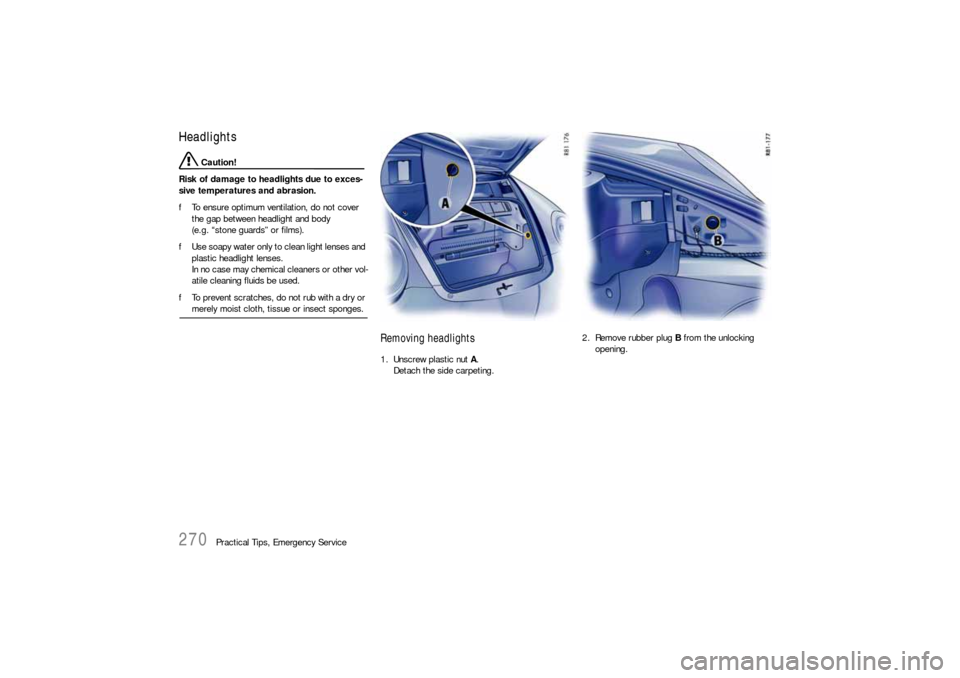
Removing headlights1. Unscrew plastic nut A.
Detach the side carpeting.2. Remove rubber plug B from the unlocking
opening.
Page 273 of 310
Practical Tips, Emergency Service
271
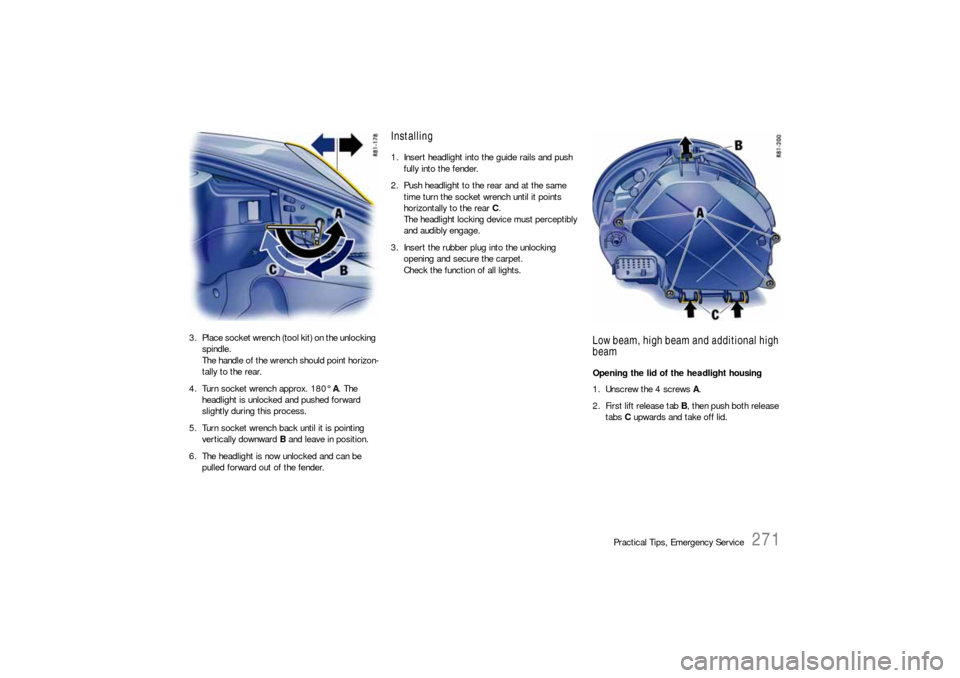
3. Place socket wrench (tool kit) on the unlocking
spindle.
The handle of the wrench should point horizon-
tally to the rear.
4. Turn socket wrench approx. 180° A. The
headlight is unlocked and pushed forward
slightly during this process.
5. Turn socket wrench back until it is pointing
vertically downward B and leave in position.
6. The headlight is now unlocked and can be
pulled forward out of the fender.
Installing1. Insert headlight into the guide rails and push
fully into the fender.
2. Push headlight to the rear and at the same
time turn the socket wrench until it points
horizontally to the rear C.
The headlight locking device must perceptibly
and audibly engage.
3. Insert the rubber plug into the unlocking
opening and secure the carpet.
Check the function of all lights.
Low beam, high beam and additional high
beamOpening the lid of the headlight housing
1. Unscrew the 4 screws A.
2. First lift release tab B, then push both release
tabs C upwards and take off lid.
Page 275 of 310
Practical Tips, Emergency Service
273
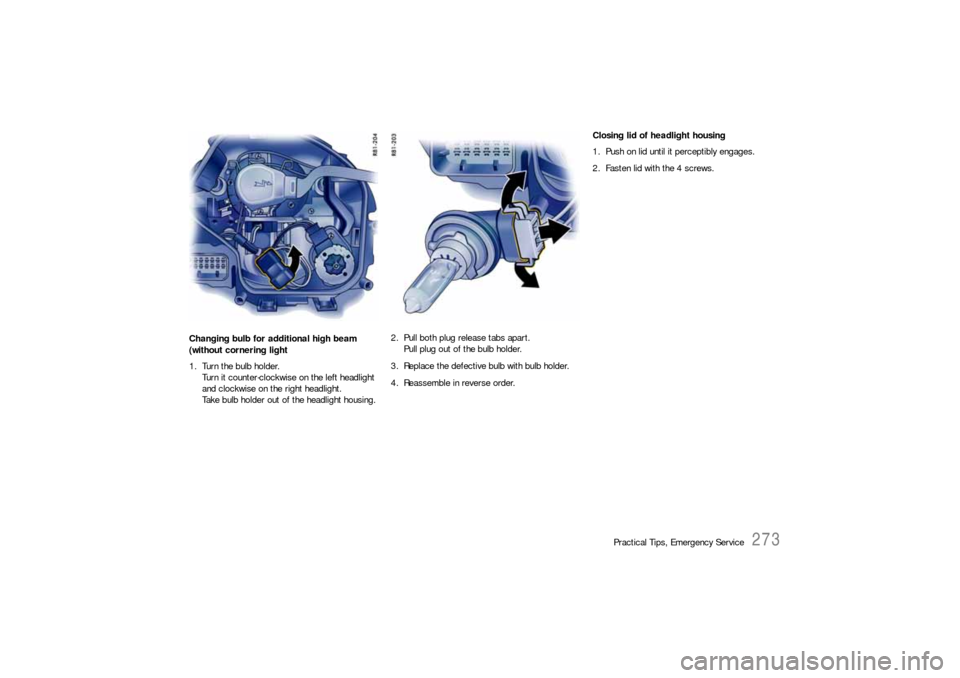
Changing bulb for additional high beam
(without cornering light
1. Turn the bulb holder.
Turn it counter-clockwise on the left headlight
and clockwise on the right headlight.
Take bulb holder out of the headlight housing.2. Pull both plug release tabs apart.
Pull plug out of the bulb holder.
3. Replace the defective bulb with bulb holder.
4. Reassemble in reverse order.Closing lid of headlight housing
1. Push on lid until it perceptibly engages.
2. Fasten lid with the 4 screws.