emergency PORSCHE 911 2009 5.G User Guide
[x] Cancel search | Manufacturer: PORSCHE, Model Year: 2009, Model line: 911, Model: PORSCHE 911 2009 5.GPages: 310, PDF Size: 3.39 MB
Page 63 of 310

Operation, Safety
61
ABS Brake System
(Antilock Brake System)The ABS system represents a major contribution
to the enhancement of active safety in your vehi-
cle. This system prevents the wheels from locking
in a panic stop on almost all road surfaces.
With the ABS system in your vehicle, the
following areas are enhanced:
Steering, vehicle remains steerable under all
braking forces when ABS is engaged.
Good directional control, no swerving caused
by locking of wheels under braking conditions.
Shorter stopping distance, stopping distances
are usually reduced because controlled braking is
maximized.
Prevention of wheel lock up, no brake- induced
sliding and thus no localized tire wear from emer-
gency braking.
The crucial advantage of the ABS system over a
conventional brake system is in the area of main-
taining directional control and maneuverability of
the car in emergency situations.
Warning!
The increased control that is provided should
not induce you to take greater risks with your
safety. The limits dictated by the laws of
physics cannot be overcome, even with ABS.
The risk of accidents due to inappropriate
speed cannot be reduced, even by the ABS.
The driver bears the responsibility for all
driving maneuvers.
fAdapt your driving style to the prevailing road
and weather conditions.
fObey all traffic laws.
Other vehicles not equipped with the ABS
system may not be able to maintain control,
especially on wet or poor road surfaces and
thus may be more likely to impact you from
behind.
fTo minimize that risk, use your ABS system to
increase your ability to maneuver to avoid dan-
gerous situations and not merely to try to stop in the shortest distance possible.
Operation of the ABS systemA wheel speed sensor is mounted to each of the
four wheels. If wheel lock-up of either of the front
wheels or the rear wheels is sensed during brak-
ing, the brake pressure is adjusted automatically
until the wheel no longer slips.
If braking forces approach the wheel lock-up point
for all wheels (panic braking) the ABS system will
intervene to provide a rapid rythmic braking. The
proper operation of ABS is perceived by the driver
as a pulsating brake pedal in conjunction with au-
dible noise and perhaps some vibration.
fIf you experience these sensations while driv-
ing or a road surface with questionable trac-
tion, reduce vehicle speed appropriate for the
prevailing road conditions.
fIf full braking should be necessary, press the
brake pedal all the way down throughout the
entire braking procedure, regardless of the pul-
sating pedal. Do not ease up on pressure ap-
plied to the pedal.
The functional readiness of all the main electrical
components of the ABS is checked by an
electronic monitoring system both before and
while you drive.
Page 66 of 310

64
Operation, Safety
Sport ModeA sportier car set-up is obtained when Sport mode
is switched on. Interventions by the Porsche
control systems are intentionally shifted towards
greater agility and driving performance:
– PASM (Porsche Active Suspension Manage-
ment) is automatically changed to Sport mode,
resulting in a stiffer suspension setup.
– When Sport mode is active, the PDK transmis-
sion switches to a sporty gear-changing map
and shortens the gear shifting times. Gear
changes take place faster, but fuel consump-
tion is also increased.
PSM (Porsche Stability Management) control
gives a sportier road-feel to the vehicle. PSM
interventions take place later than in Normal
mode. The driver can maneuver the vehicle
with greater agility at its performance limits,
without having to dispense with the assistance
of PSM in emergency situations. This helps to
achieve optimal lap times, particularly on race
circuits with a dry road surface.
– The electronic accelerator pedal reacts
sooner, and the engine is more responsive to
throttle inputs. When Sport mode is switched
on, this function is activated only after the
driver has floored the accelerator pedal or
released it briefly.– The rpm limiter characteristic is “harder”, i.e.
the engine is immediately throttled when the
performance limits are reached (only in manual
selection mode for vehicles with PDK transmis-
sion).
fPlease observe the chapters on PSM, PASM
and PDK.
Switching Sport mode on and offSwitching Sport mode on and off simultaneously
activates and deactivates the Sport mode in
PA S M .
If PASM Sport mode was activated with the PASM
button, PASM remains active.
After the ignition is switched off, Sport mode is
automatically reset to Normal mode.
SPORT button
fPress SPORT button A in the center console.
When Sport mode is switched on, the light-
emitting diode in the SPORT button is lit.
A sporty gear-changing map is enabled and the
gear shifting times are shortened for the PDK
transmission.
A sporty driving style is recognized more quickly
and the gear-changing speeds are adapted to
driving performance.
Deceleration downshifts are commenced earlier.
Downshifts are made during slight decelerations,
even at higher engine speeds.
fPlease see the chapter “SPORT MODE
(“SPORT” AND “SPORT PLUS” MODES)” on
Page 172.
Page 68 of 310

66
Operation, Safety
Porsche Stability Management
(PSM)PSM is an active control system for stabilization of
the vehicle approaching the performance limits of
driving maneuvers.
Warning!
Risk of an accident, resulting in serious per-
sonal injury or death.
The increased control that is provided should
not induce you to take greater risks with your
safety. The limits dictated by the laws of
physics cannot be overcome, even with PSM.
The risk of accidents due to inappropriate
speed cannot be reduced, even by PSM.
The driver bears the responsibility for all
driving maneuvers.
fAdapt your driving style to the prevailing road
and weather conditions.
fObey all traffic laws.
Sensors at the wheels, brakes, steering system
and engine continuously measure:
–Speed
– Direction of travel (steering angle)
– Lateral acceleration
– Rate of turn about the vertical axis
– Longitudinal accelerationPSM uses these values to determine the direction
of travel indicated by the driver.
PSM intervenes and helps to correct the course if
the actual direction of motion deviates from the
chosen course (steering-wheel position):
It brakes individual wheels as needed. In addition,
the engine power may be manipulated in order to
stabilize the vehicle.
The events below inform the driver of PSM control
operations and warn him/her to adapt his/her
driving style to the road conditions:
– The multifunctional information light on the
instrument panel flashes.
– Hydraulic noises can be heard.
– The vehicle decelerates and steering-wheel
forces are altered as the PSM controls the
brakes.
– Reduced engine power.
– The brake pedal pulsates and its position is
changed during braking.
In order to achieve full vehicle deceleration,
foot pressure must be increased after the
brake pedal has begun vibrating.
Examples of PSM control operations– If the front wheels of the vehicle drift on a
bend, the rear wheel on the inside of the bend
is braked and the engine power is reduced if
necessary.
– If the rear of the vehicle swings out on a bend,
the front wheel on the outside of the bend is
braked.Additional braking functions– Pre-filling the brake system:
The brake system is prepared for possible
subsequent emergency braking if the acceler-
ator pedal is released suddenly and quickly.
The brake system is prefilled and the brake
pads are already applied gently to the brake
discs.
– Brake booster:
In the event of an emergency braking operation
where the pedal force is insufficient, a brake
booster provides the braking pressure neces-
sary for maximum deceleration at all 4 wheels.Advantages of PSM– Best possible traction and lane-holding ability
in all driving situations – even on road surfaces
with varying friction.
Page 69 of 310
Operation, Safety
67
– The system compensates for undesired lateral
vehicle reactions when the driver releases the
accelerator pedal or brakes when cornering.
This compensation functions up to the
maximum lateral acceleration.
– PSM actively stabilizes the vehicle as required
during dynamic driving maneuvers (e.g. rapid
steering movements, during lane changes or
on alternating bends).
– Improved braking stability on bends and on
different or varying road surfaces.
– It improves braking function and shortens
stopping distance in the event of emergency
braking.Readiness for operationPSM is switched on automatically every time you
start the engine.
PSM should always be switched on during
“normal” driving.
However, it may be advantageous to switch off
PSM temporarily in exceptional situations, for
example:
– On a loose surface or in deep snow,
– When “rocking” the vehicle free and
– When using snow chains.
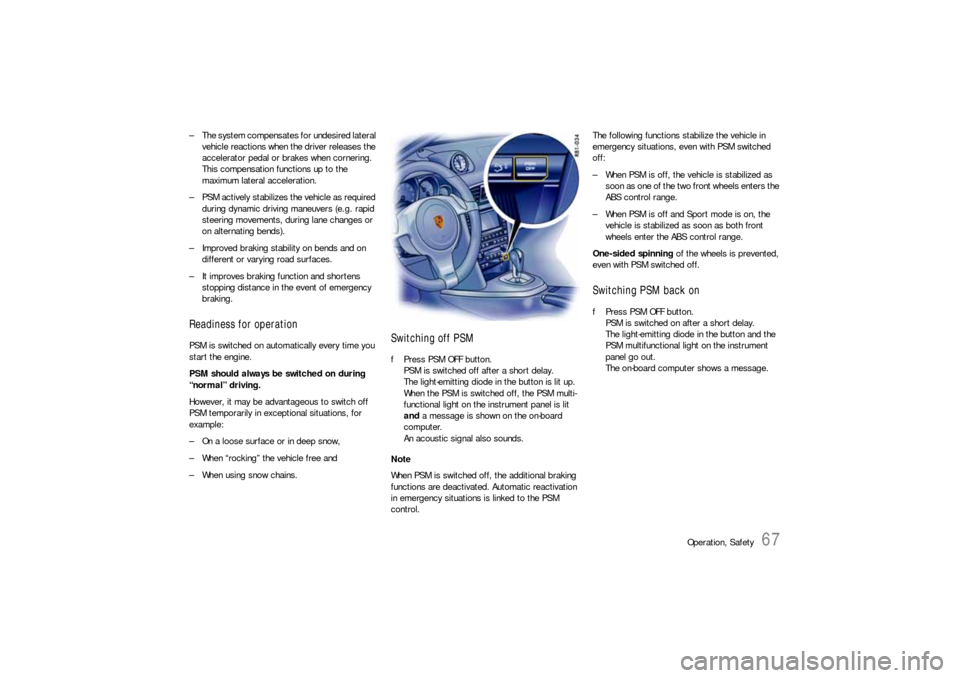
Switching off PSMfPress PSM OFF button.
PSM is switched off after a short delay.
The light-emitting diode in the button is lit up.
When the PSM is switched off, the PSM multi-
functional light on the instrument panel is lit
and a message is shown on the on-board
computer.
An acoustic signal also sounds.
Note
When PSM is switched off, the additional braking
functions are deactivated. Automatic reactivation
in emergency situations is linked to the PSM
control.The following functions stabilize the vehicle in
emergency situations, even with PSM switched
off:
– When PSM is off, the vehicle is stabilized as
soon as one of the two front wheels enters the
ABS control range.
– When PSM is off and Sport mode is on, the
vehicle is stabilized as soon as both front
wheels enter the ABS control range.
One-sided spinning of the wheels is prevented,
even with PSM switched off.
Switching PSM back onfPress PSM OFF button.
PSM is switched on after a short delay.
The light-emitting diode in the button and the
PSM multifunctional light on the instrument
panel go out.
The on-board computer shows a message.
Page 70 of 310

68
Operation, Safety
Sport modeA sportier car set-up is obtained when Sport or
Sport Plus mode is switched on.
PSM interventions are later than in Normal mode;
the vehicle can be maneuverd with greater agility
at its performance limits, without dispensing with
the assistance of PSM in emergency situations.
This helps to achieve optimal lap times, particu-
larly on race circuits and a dry road surface.
– The multifunctional light on the instrument
panel lights up for a lamp check when the
ignition is switched on.
– The light indicates a control operation by
flashing, including when PSM is switched off
(brake control in the event of one-sided wheel
spin).
– In conjunction with a message on the on-board
computer, the light indicates that PSM is
switched off.
An acoustic signal also sounds.
– The light indicates a fault in conjunction with a
message on the on-board computer.
PSM is out of order.fPlease have the fault remedied at an author-
ized Porsche dealer.
fPlease see the chapter “PUTTING VEHICLE
INTO OPERATION” on Page 263.
TowingfPlease see the chapter “TOWING” on
Page 280.Checks on test standsBrake tests
Brake tests must be performed only on plate-type
test stands or roller test stands.
The ignition must be switched off.
The following limit values must not be exceeded
on roller test stands:
– Testing speed 5 mph (8 km/h)
– Test duration 20 seconds
Handbrake tests
Handbrake tests on the roller test stand must be
performed only with the ignition switched off.
PSM multifunctional light
Page 77 of 310

Operation, Safety
75
Switch position 2Start engine
fTurn ignition key to ignition lock position 2.
fPlease see the chapter “STARTING PROCEDU-
RES” on Page 77.Switch position 3Ignition off
fTurn ignition key to ignition lock position 3.
Note on operation
The vehicle battery discharges if the ignition key is
left inserted.
If the vehicle battery is dead, the key can only be
pulled out of the ignition lock if the emergency
operation is performed:
fPlease see the chapter “EMERGENCY OPERA-
TION – PULLING OUT THE IGNITION KEY” on
Page 76.
Locking the steering columnAutomatic locking
The steering column is automatically locked when
the ignition key is withdrawn from the ignition lock.
Warning!
Risk of an accident, resulting in serious per-
sonal injury or death.
The steering wheel will lock and will cause
loss of steering.
fNever remove key from the ignition lock or turn
the key off while the vehicle is moving.
fAlways withdraw the ignition key when leaving the vehicle.Automatic unlocking
The steering column is unlocked when the vehicle
is unlocked with the radio remote control.
Note
fTo avoid discharging the battery, always re-
move the ignition key from the ignition lock.
Please see the chapter “BATTERY” on
Page 261.
Gong If you leave the key in the ignition/steering lock, a
gong will sound when the driver’s door is opened.
This is a reminder to remove the key.
Page 78 of 310
76
Operation, Safety
Emergency operation – pulling out the
ignition keyIf the vehicle battery is dead, the key can be pulled
out only if the emergency operation is performed.
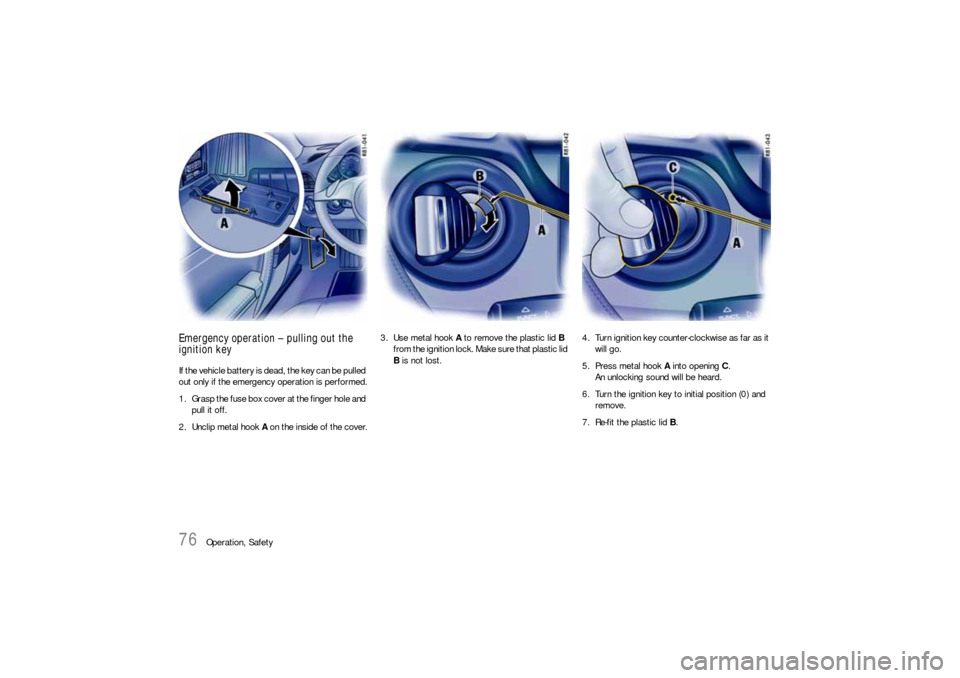
1. Grasp the fuse box cover at the finger hole and
pull it off.
2. Unclip metal hook A on the inside of the cover.3. Use metal hook A to remove the plastic lid B
from the ignition lock. Make sure that plastic lid
B is not lost.4. Turn ignition key counter-clockwise as far as it
will go.
5. Press metal hook A into opening C.
An unlocking sound will be heard.
6. Turn the ignition key to initial position (0) and
remove.
7. Re-fit the plastic lid B.
Page 81 of 310
Operation, Safety
79
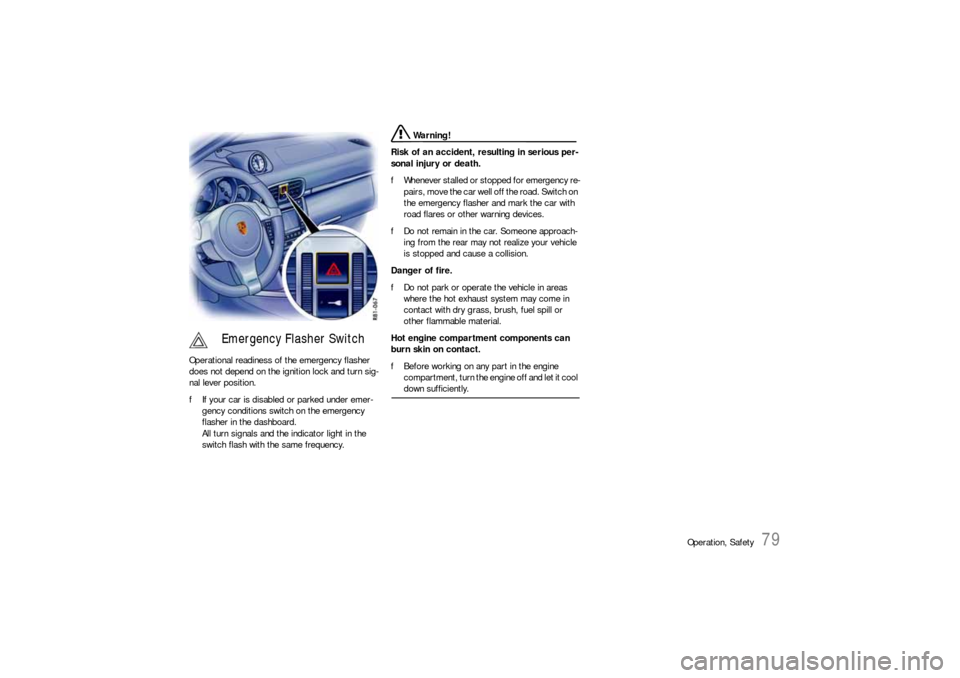
Operational readiness of the emergency flasher
does not depend on the ignition lock and turn sig-
nal lever position.
fIf your car is disabled or parked under emer-
gency conditions switch on the emergency
flasher in the dashboard.
All turn signals and the indicator light in the
switch flash with the same frequency.
Warning!
Risk of an accident, resulting in serious per-
sonal injury or death.
fWhenever stalled or stopped for emergency re-
pairs, move the car well off the road. Switch on
the emergency flasher and mark the car with
road flares or other warning devices.
fDo not remain in the car. Someone approach-
ing from the rear may not realize your vehicle
is stopped and cause a collision.
Danger of fire.
fDo not park or operate the vehicle in areas
where the hot exhaust system may come in
contact with dry grass, brush, fuel spill or
other flammable material.
Hot engine compartment components can
burn skin on contact.
fBefore working on any part in the engine
compartment, turn the engine off and let it cool down sufficiently.
Emergency Flasher Switch
Page 123 of 310
Instruments, On-Board Computer, Warnings
121
Porsche Doppelkupplung (PDK)Indicator for PDK selector lever position
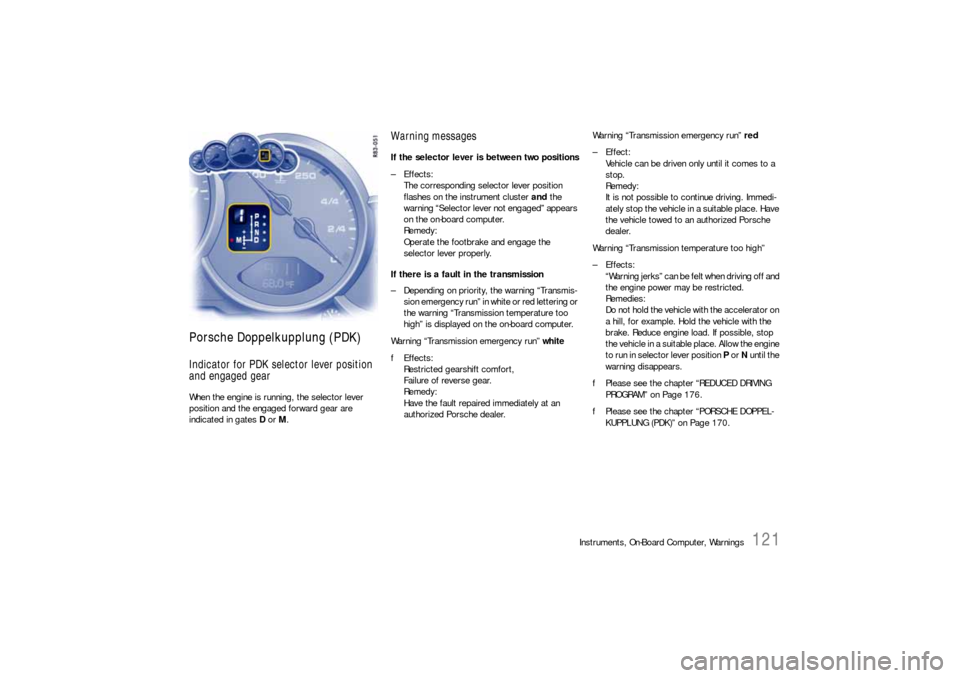
and engaged gearWhen the engine is running, the selector lever
position and the engaged forward gear are
indicated in gates D or M.
Warning messagesIf the selector lever is between two positions
–Effects:
The corresponding selector lever position
flashes on the instrument cluster and the
warning “Selector lever not engaged” appears
on the on-board computer.
Remedy:
Operate the footbrake and engage the
selector lever properly.
If there is a fault in the transmission
– Depending on priority, the warning “Transmis-
sion emergency run” in white or red lettering or
the warning “Transmission temperature too
high” is displayed on the on-board computer.
Warning “Transmission emergency run” white
fEffects:
Restricted gearshift comfort,
Failure of reverse gear.
Remedy:
Have the fault repaired immediately at an
authorized Porsche dealer.Warning “Transmission emergency run” red
– Effect:
Vehicle can be driven only until it comes to a
stop.
Remedy:
It is not possible to continue driving. Immedi-
ately stop the vehicle in a suitable place. Have
the vehicle towed to an authorized Porsche
dealer.
Warning “Transmission temperature too high”
–Effects:
“Warning jerks” can be felt when driving off and
the engine power may be restricted.
Remedies:
Do not hold the vehicle with the accelerator on
a hill, for example. Hold the vehicle with the
brake. Reduce engine load. If possible, stop
the vehicle in a suitable place. Allow the engine
to run in selector lever position P or N until the
warning disappears.
fPlease see the chapter “REDUCED DRIVING
PROGRAM” on Page 176.
fPlease see the chapter “PORSCHE DOPPEL-
KUPPLUNG (PDK)” on Page 170.
Page 145 of 310
Instruments, On-Board Computer, Warnings
143
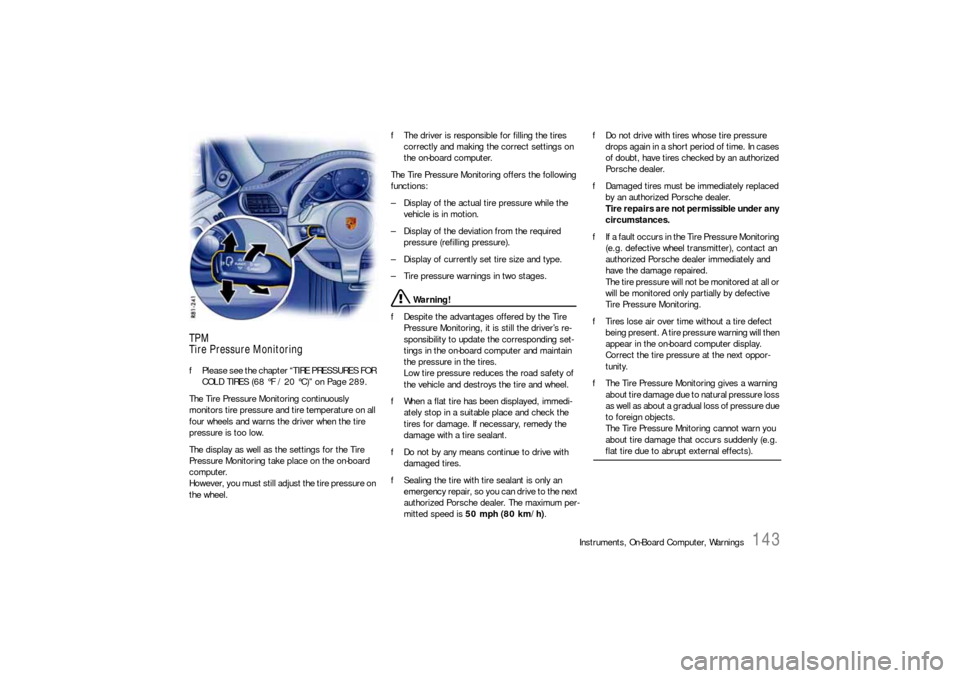
TPM
Tire Pressure MonitoringfPlease see the chapter “TIRE PRESSURES FOR
COLD TIRES (68 °F / 20 °C)” on Page 289.
The Tire Pressure Monitoring continuously
monitors tire pressure and tire temperature on all
four wheels and warns the driver when the tire
pressure is too low.
The display as well as the settings for the Tire
Pressure Monitoring take place on the on-board
computer.
However, you must still adjust the tire pressure on
the wheel.fThe driver is responsible for filling the tires
correctly and making the correct settings on
the on-board computer.
The Tire Pressure Monitoring offers the following
functions:
– Display of the actual tire pressure while the
vehicle is in motion.
– Display of the deviation from the required
pressure (refilling pressure).
– Display of currently set tire size and type.
– Tire pressure warnings in two stages.
Warning!
fDespite the advantages offered by the Tire
Pressure Monitoring, it is still the driver’s re-
sponsibility to update the corresponding set-
tings in the on-board computer and maintain
the pressure in the tires.
Low tire pressure reduces the road safety of
the vehicle and destroys the tire and wheel.
fWhen a flat tire has been displayed, immedi-
ately stop in a suitable place and check the
tires for damage. If necessary, remedy the
damage with a tire sealant.
fDo not by any means continue to drive with
damaged tires.
fSealing the tire with tire sealant is only an
emergency repair, so you can drive to the next
authorized Porsche dealer. The maximum per-
mitted speed is 50 mph (80 km/h).fDo not drive with tires whose tire pressure
drops again in a short period of time. In cases
of doubt, have tires checked by an authorized
Porsche dealer.
fDamaged tires must be immediately replaced
by an authorized Porsche dealer.
Tire repairs are not permissible under any
circumstances.
fIf a fault occurs in the Tire Pressure Monitoring
(e.g. defective wheel transmitter), contact an
authorized Porsche dealer immediately and
have the damage repaired.
The tire pressure will not be monitored at all or
will be monitored only partially by defective
Tire Pressure Monitoring.
fTires lose air over time without a tire defect
being present. A tire pressure warning will then
appear in the on-board computer display.
Correct the tire pressure at the next oppor-
tunity.
fThe Tire Pressure Monitoring gives a warning
about tire damage due to natural pressure loss
as well as about a gradual loss of pressure due
to foreign objects.
The Tire Pressure Mnitoring cannot warn you
about tire damage that occurs suddenly (e.g.
flat tire due to abrupt external effects).