manual transmission PORSCHE 911 2009 5.G User Guide
[x] Cancel search | Manufacturer: PORSCHE, Model Year: 2009, Model line: 911, Model: PORSCHE 911 2009 5.GPages: 310, PDF Size: 3.39 MB
Page 116 of 310
114
Instruments, On-Board Computer, Warnings
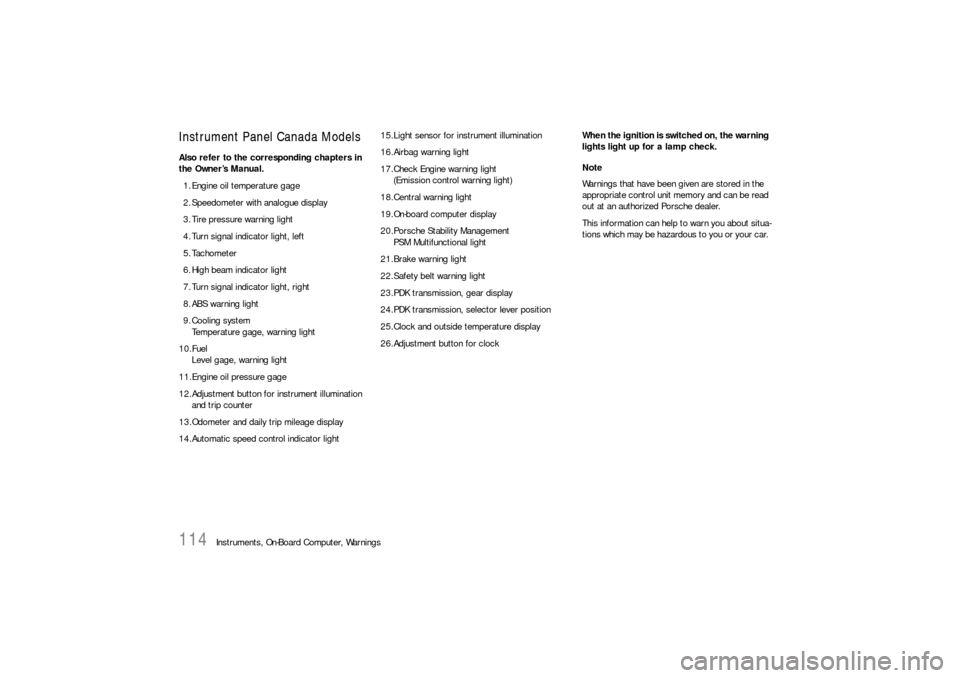
Instrument Panel Canada Models Also refer to the corresponding chapters in
the Owner’s Manual.
1. Engine oil temperature gage
2. Speedometer with analogue display
3. Tire pressure warning light
4. Turn signal indicator light, left
5. Tachometer
6. High beam indicator light
7. Turn signal indicator light, right
8. ABS warning light
9. Cooling system
Temperature gage, warning light
10.Fuel
Level gage, warning light
11.Engine oil pressure gage
12.Adjustment button for instrument illumination
and trip counter
13.Odometer and daily trip mileage display
14.Automatic speed control indicator light15.Light sensor for instrument illumination
16.Airbag warning light
17.Check Engine warning light
(Emission control warning light)
18.Central warning light
19.On-board computer display
20.Porsche Stability Management
PSM Multifunctional light
21.Brake warning light
22.Safety belt warning light
23.PDK transmission, gear display
24.PDK transmission, selector lever position
25.Clock and outside temperature display
26.Adjustment button for clockWhen the ignition is switched on, the warning
lights light up for a lamp check.
Note
Warnings that have been given are stored in the
appropriate control unit memory and can be read
out at an authorized Porsche dealer.
This information can help to warn you about situa-
tions which may be hazardous to you or your car.
Page 121 of 310
Instruments, On-Board Computer, Warnings
119
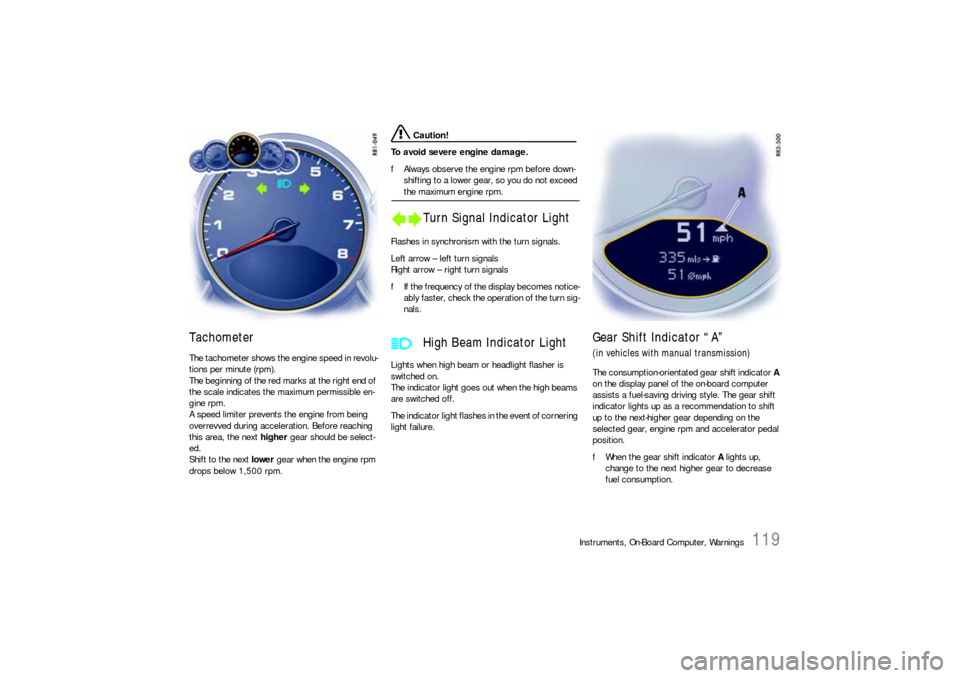
Tachometer The tachometer shows the engine speed in revolu-
tions per minute (rpm).
The beginning of the red marks at the right end of
the scale indicates the maximum permissible en-
gine rpm.
A speed limiter prevents the engine from being
overrevved during acceleration. Before reaching
this area, the next higher gear should be select-
ed.
Shift to the next lower gear when the engine rpm
drops below 1,500 rpm.
Caution!
To avoid severe engine damage.
fAlways observe the engine rpm before down-
shifting to a lower gear, so you do not exceed the maximum engine rpm.
Flashes in synchronism with the turn signals.
Left arrow – left turn signals
Right arrow – right turn signals
fIf the frequency of the display becomes notice-
ably faster, check the operation of the turn sig-
nals.
Lights when high beam or headlight flasher is
switched on.
The indicator light goes out when the high beams
are switched off.
The indicator light flashes in the event of cornering
light failure.
Gear Shift Indicator “A”(in vehicles with manual transmission)The consumption-orientated gear shift indicator A
on the display panel of the on-board computer
assists a fuel-saving driving style. The gear shift
indicator lights up as a recommendation to shift
up to the next-higher gear depending on the
selected gear, engine rpm and accelerator pedal
position.
fWhen the gear shift indicator A lights up,
change to the next higher gear to decrease
fuel consumption.
Turn Signal Indicator Light
High Beam Indicator Light
Page 165 of 310

Warnings
163
Failure spoiler control Driving stability is impaired.
Adjust your driving style. Reduce speed.
Have the fault remedied at an authorized
Porsche dealer.
Display of
selector lever posi-
tion flashesSelector lever is not engaged Porsche Doppelkupplung:
Selector lever can be between two positions.
Engage the selector lever correctly.
Move selector lever to P Porsche Doppelkupplung:
Move selector lever to position P before with-
drawing key from ignition lock.
Apply brake Porsche Doppelkupplung:
Apply the brake when starting.
Depress clutch pedal Manual transmission:
Depress clutch pedal when starting.
Move selector lever
to position P or NPorsche Doppelkupplung:
The vehicle can be started only in the selector
lever position P or N.
Text display in white:
Transmission
emergency runRestricted gearshift comfort,
failure of reverse gear.
Have the fault remedied at an authorized
Porsche dealer.
Text display in red:
Transmission
emergency runNo selector lever position is displayed on the
instrument cluster.
Vehicle can be driven only until it comes to a
stop.
It is not possible to continue driving. Immedi-
ately stop the vehicle in a suitable place. Have
the vehicle towed to an authorized Porsche
dealer.
Instrument
panelOn-board
computerText display on on-board
computerMeaning/measure
Page 169 of 310

Shifting Gears
167 Shifting Gears
Manual Transmission, Clutch ...................... 168
Drive-Off Assistant ..................................... 169
Porsche Doppelkupplung (PDK) .................. 170
Page 170 of 310
168
Shifting Gears
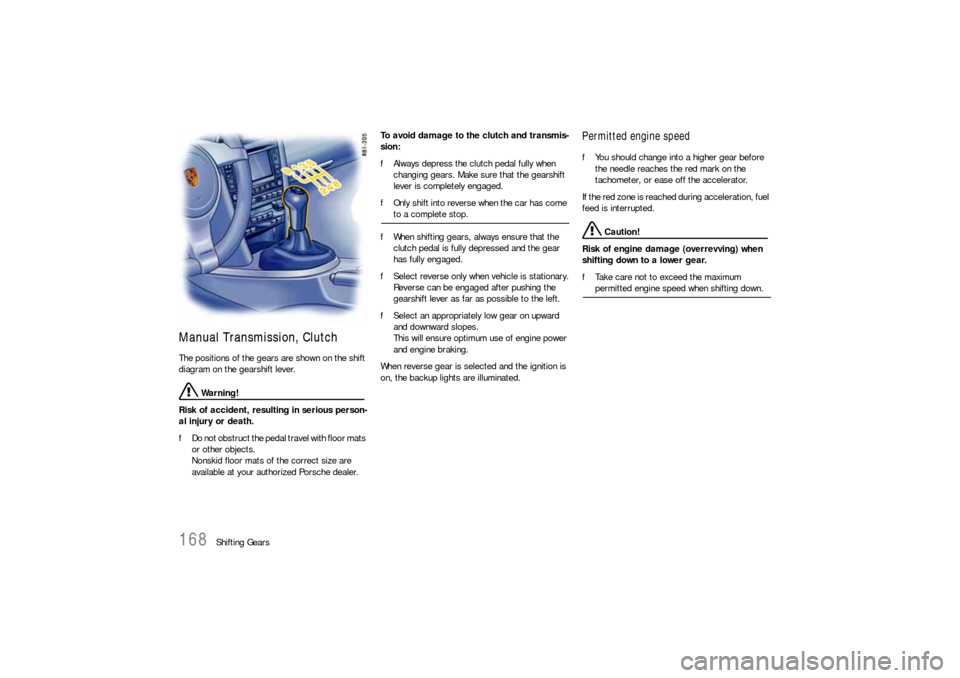
Manual Transmission, ClutchThe positions of the gears are shown on the shift
diagram on the gearshift lever.
Warning!
Risk of accident, resulting in serious person-
al injury or death.
fDo not obstruct the pedal travel with floor mats
or other objects.
Nonskid floor mats of the correct size are
available at your authorized Porsche dealer.To avoid damage to the clutch and transmis-
sion:
fAlways depress the clutch pedal fully when
changing gears. Make sure that the gearshift
lever is completely engaged.
fOnly shift into reverse when the car has come
to a complete stop.
fWhen shifting gears, always ensure that the
clutch pedal is fully depressed and the gear
has fully engaged.
fSelect reverse only when vehicle is stationary.
Reverse can be engaged after pushing the
gearshift lever as far as possible to the left.
fSelect an appropriately low gear on upward
and downward slopes.
This will ensure optimum use of engine power
and engine braking.
When reverse gear is selected and the ignition is
on, the backup lights are illuminated.
Permitted engine speedfYou should change into a higher gear before
the needle reaches the red mark on the
tachometer, or ease off the accelerator.
If the red zone is reached during acceleration, fuel
feed is interrupted.
Caution!
Risk of engine damage (overrevving) when
shifting down to a lower gear.
fTake care not to exceed the maximum permitted engine speed when shifting down.
Page 171 of 310
Shifting Gears
169
Drive-Off AssistantThe Drive-Off Assistant assists the driver when
moving off on hills.
The vehicle must have sufficient road contact.
The Drive-Off Assistant is available on gradients as
from around 5%.
Danger!
Risk of accident.
Assistance by the Drive-Off Assistant is not
guaranteed when moving off on a slippery
surface (e.g. on icy or loose surfaces). In this
case, the vehicle could slip.
The limits dictated by the laws of physics
cannot be overcome, even with the Drive-Off
Assistant. The responsibility for moving off
on upward slopes is still the driver’s, despite
the Drive-Off Assistant.
fAlways adjust your driving style to the driving
conditions and vehicle load, use the brake
pedal if necessary.
Risk of accident.
If the Drive-Off Assistant is not functioning,
the driver cannot be assisted when moving
off on hills.
fHold the vehicle with the brake pedal.Driving off with the Drive-Off Assistant
(vehicles with manual transmission)
1. Hold the vehicle securely on the slope with the
brake pedal.
The engine must be running.
2. Fully depress the clutch pedal.
3. Engage a gear corresponding to the direction
of travel up the slope (1st gear or reverse
gear).
4. Fully release the parking brake.
5. While keeping the clutch pedal depressed,
release the brake pedal.
The vehicle is held on the slope for a short time
in order to allow driving off directly after the
brake is released.
6. Move off as usual.
Note on operation
The Drive-Off Assistant is not active:
– If the clutch is not depressed.
– If the vehicle is not stationary.
– If the engine is not running.
– On gradients of less than 5%.
– If the pressure on the brake pedal is too low.Driving off with the Drive-Off Assistant
(vehicles with PDK transmission)
1. Hold the vehicle securely on the slope with the
brake pedal.
The engine must be running.
2. Select a gear corresponding to the direction
of travel up the slope (selector lever position
Dor R).
3. Fully release the parking brake.
4. Release the brake pedal.
The vehicle is held on the slope for a short time
in order to allow driving off directly after the
brake is released.
5. Move off as usual.
Note on operation
The Drive-Off Assistant is not active:
– In the event of shift to neutral.
– If the vehicle is not stationary.
– If the engine is not running.
– On gradients of less than 5%.
– If the pressure on the brake pedal is too low.
Page 172 of 310
170
Shifting Gears
Porsche Doppelkupplung (PDK)The Porsche Doppelkupplung (PDK) is a seven-
speed transmission with an “automatic” and a
“manual” selection mode.
In automatic selection mode (selector lever
position D), gear changing is automatic.
You can change temporarily from automatic to
manual mode using the shift buttons on the
steering wheel.
In manual selection mode (selector lever
position M), you change gear using the shift
buttons on the steering wheel or with the PDK
selector lever.
You can change between selector lever position D
and M as you wish while driving.
Note
fTake care not to operate the shift buttons on
the steering wheel inadvertently in either
automatic or manual mode, thereby triggering
undesired gear changes.
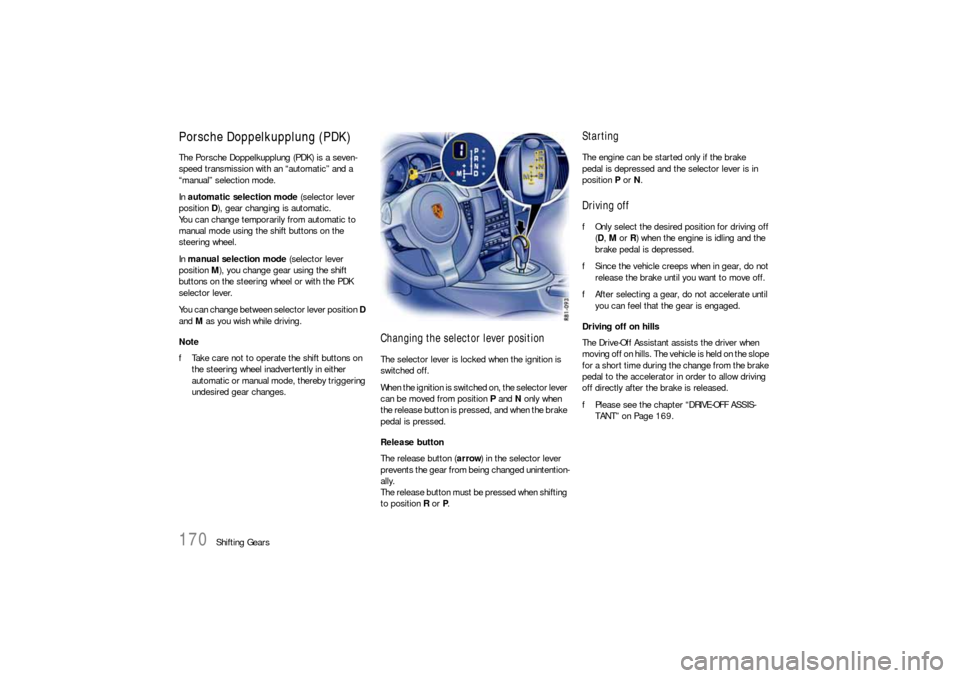
Changing the selector lever positionThe selector lever is locked when the ignition is
switched off.
When the ignition is switched on, the selector lever
can be moved from position P and N only when
the release button is pressed, and when the brake
pedal is pressed.
Release button
The release button (arrow) in the selector lever
prevents the gear from being changed unintention-
ally.
The release button must be pressed when shifting
to position R or P.
StartingThe engine can be started only if the brake
pedal is depressed and the selector lever is in
position P or N.Driving offfOnly select the desired position for driving off
(D, M or R) when the engine is idling and the
brake pedal is depressed.
fSince the vehicle creeps when in gear, do not
release the brake until you want to move off.
fAfter selecting a gear, do not accelerate until
you can feel that the gear is engaged.
Driving off on hills
The Drive-Off Assistant assists the driver when
moving off on hills. The vehicle is held on the slope
for a short time during the change from the brake
pedal to the accelerator in order to allow driving
off directly after the brake is released.
fPlease see the chapter “DRIVE-OFF ASSIS-
TANT” on Page 169.
Page 175 of 310

Shifting Gears
173
“Sport Plus” mode activated:
In “Sport Plus” mode, the PDK transmission
changes to a shift program designed for driving
on race circuits. 7th gear is not selected.
The gear-changing performance is enhanced
significantly again compared with “Sport” mode.
fPlease see the chapter “SPORT MODE” on
Page 64.
Driving with Launch Control
Driving with Launch Control allows you to achieve
maximum acceleration from a standing start. It is
intended to provide you with a unique enjoyment of
your vehicle under controlled circumstances and
is not intended to be used in any location where it
could be a nuisance to other persons.
Warning!
There is a risk of endangering other road
users if you use this Control in an improper
location or in a situation where other persons
might need to take evasive action due to the
rapid acceleration that this technology
permits.
fLaunch Control is designed to be used in a
controlled environment on closed circuit
driving courses where no vehicle cross traffic
or pedestrian traffic is present.
fUse Launch Control only if conditions permit it
to be applied in a safe manner. fDo not use Launch Control if there is a possibi-
lity it could endanger other persons. Such a
possibility exists if you cannot see that you
have a clear road with no possibility of cross
traffic in your intended direction of driving. Caution!
Stress on components increases dramatically
when starting with maximum acceleration in
comparison with normal driving off. Use of
Launch Control will inevitably reduce the life
of the engaged engine and transmission
components.
Preconditions:
– Launch Control should only be used when the
engine has reached operating temperature.
– “Sport Plus” mode must be switched on (light-
emitting diode in button is on and “SPORT
PLUS” is displayed on the on-board computer).
1. Press the brake with your left foot.
2. Quickly press down the accelerator fully
(kickdown activated) and hold.
The engine speed will flatten out at around
6500 rpm.
“Launch Control active” is displayed on the
on-board computer.3. Release the brake within a few seconds.
Remaining stationary for a long time with
“Launch Control active” can lead to overload-
ing of the transmission.
In order to protect the transmission, the engine
power is then reduced and the “Launch Control
active” process is cancelled.
Shifting gears on the steering wheel
With the shift buttons on the steering wheel, you
can change temporarily from automatic selection
mode D to manual mode M.
For example:
– Shifting down before bends and on entering
built-up areas.
– Shifting down on downward slopes
(engine braking).
– Shifting down for brief spurts of acceleration.
Manual selection mode remains engaged:
– for cornering (depending on the lateral acceler-
ation) and overrunning,
– when the vehicle is stationary (e.g. at a
junction).
The system leaves manual selection mode:
– automatically after approx. 8 seconds (unless
cornering or overrunning),
– after driving off.
Page 176 of 310
174
Shifting Gears Kickdown
The kickdown function is active in selector lever
positions D and M.
fFor optimum acceleration, e.g. when
overtaking, depress the accelerator pedal
beyond the full-throttle point (kickdown).
The transmission shifts down depending on the
speed of travel and engine speed.
Upward shifts occur at the highest possible engine
speeds.
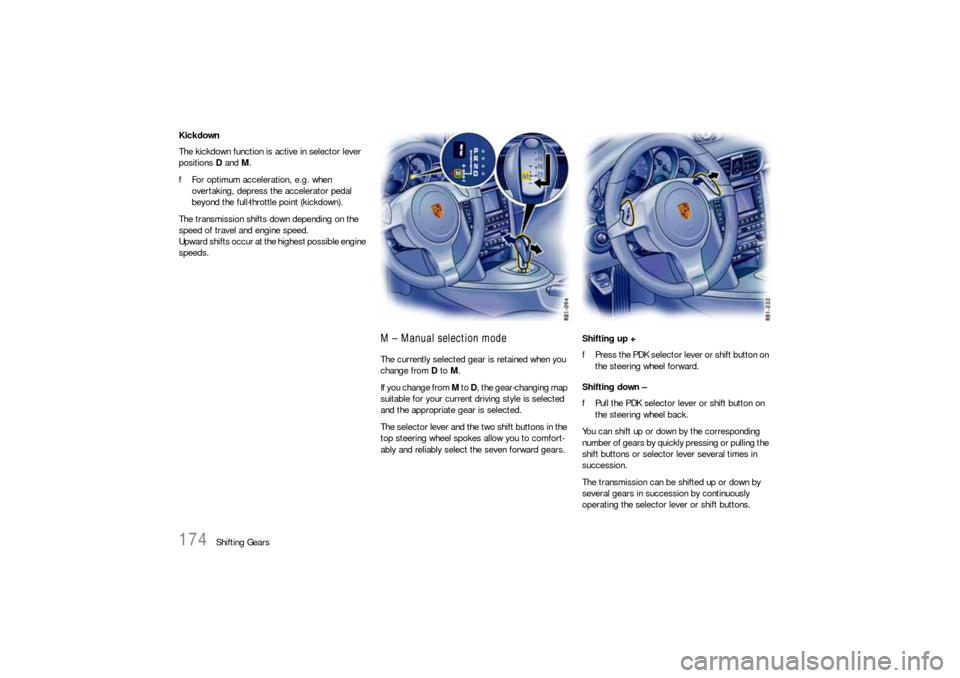
M – Manual selection modeThe currently selected gear is retained when you
change from D to M.
If you change from M to D, the gear-changing map
suitable for your current driving style is selected
and the appropriate gear is selected.
The selector lever and the two shift buttons in the
top steering wheel spokes allow you to comfort-
ably and reliably select the seven forward gears.Shifting up +
fPress the PDK selector lever or shift button on
the steering wheel forward.
Shifting down –
fPull the PDK selector lever or shift button on
the steering wheel back.
You can shift up or down by the corresponding
number of gears by quickly pressing or pulling the
shift buttons or selector lever several times in
succession.
The transmission can be shifted up or down by
several gears in succession by continuously
operating the selector lever or shift buttons.
Page 177 of 310

Shifting Gears
175
Depending on driving speed and engine speed,
you can shift up or down at any time.
Gear changes which would exceed the upper or
lower engine speed limit are not executed by the
controller.
There is no automatic upshift at the upper engine
speed limit in selector lever position M. Upshift
suppression can be cancelled by kickdown opera-
tion. If, for example, the engine speed limit is
reached during overtaking and the automatic
upshift does not occur, the transmission in this
case shifts up as a result of kickdown operation.
fSelect an appropriately low gear on upward
and downward slopes.
This will ensure optimum use of engine power
and engine braking.
In order to shift up automatically at the upper
engine speed limit:
fDepress the accelerator pedal beyond the full-
throttle point (kickdown).Failure of the selector lever display on the
instrument cluster
The warning “Transmission emergency run” is
displayed in red on the on-board computer.
–Effect:
No selector lever position is displayed on the
instrument cluster.
Vehicle can be driven only until it comes to a
stop.
Remedy:
It is not possible to continue driving. Immedi-
ately stop the vehicle in a suitable place. Have
the vehicle towed to an authorized Porsche
dealer.
StoppingfFor a brief stop (e.g. at a traffic light), leave the
selector lever in drive position and hold the
vehicle with the brake pedal.
fDo not hold the car on a slope using the
accelerator. Use the brake pedal or the
handbrake instead.
fBefore leaving the vehicle, always apply the
handbrake and move the selector lever to
position P.ParkingfGo easy on the accelerator!
fWhen parking or manoeuvring in a small
space, control the speed by careful use of the
footbrake.Driving in winterIn wintry road conditions it is advisable to take
steep inclines in manual mode. This prevents gear
changes occurring that could cause wheelspin.Tow-starting, towingfPlease see the chapter “TOWING” on
Page 280.