change time PORSCHE 911 2009 5.G Owner's Manual
[x] Cancel search | Manufacturer: PORSCHE, Model Year: 2009, Model line: 911, Model: PORSCHE 911 2009 5.GPages: 310, PDF Size: 3.39 MB
Page 174 of 310

172
Shifting Gears
Selector lever positionsP – Parking lockfEngage parking lock only when vehicle is
stationary.
If selector lever position P is flashing in the
instrument cluster, the parking lock is not
engaged. The vehicle can roll away.
Engage selector lever position P again by
moving the selector lever out of R.
fEngage parking lock after applying the
handbrake and release it before releasing the
handbrake.
The ignition key can be withdrawn only in
selector lever position P.R – Reverse gearfSelect only if car is stationary and the brake is
applied.N – NeutralSelector lever position N must be selected for
towing or in car washes, for example.
fOnly select the desired position for driving off
(D, M or R) when the engine is idling and the
brake pedal is depressed.
D - Automatic selection modeSelect position D for “normal” driving. The gears
are shifted automatically according to the acceler-
ator position and speed.
Depending on the way the vehicle is driven
(economical, comfortable or sporty driving style)
and on the resistance (e.g. uphill), the gear-
changing points are shifted towards higher or
lower engine-speed ranges.
The accelerator position, driving speed, engine
speed, longitudinal and lateral acceleration and
the road profile all have an influence on the gear-
changing characteristic.
Unwanted upward shifts, e.g. before bends, are
prevented by swiftly releasing the accelerator
pedal.
Depending on lateral acceleration, upward
changes on bends are not made until the engine-
speed limit is reached.
Under braking, and depending on the amount of
deceleration, the PDK transmission changes down
earlier.
For subsequent cornering, the right gear is
engaged when pressure is applied to the brakes
before the bend. The bend is taken in the right
gear, and when you accelerate out of the bend you
do not have to change down.With a sporty driving style, downshifts are already
initiated when the brake pedal is touched lightly.
This further enhances a dynamic driving style.
The PDK transmission temporarily changes to the
sportiest gear-changing map, i.e. to the highest
possible gear-changing points, if the accelerator
pedal is pressed quickly. The transmission accord-
ingly shifts down immediately by one or two gears
(temporary change-down).
The transmission no longer selects 7th gear at
high driving speeds.
Sport mode
(“Sport” and “Sport Plus” modes)
“Sport” mode activated:
The PDK transmission switches to a sporty gear-
changing map and shortens the gear shifting
times.
A sporty driving style is recognised more quickly
and the gear-changing speeds are adapted to
driving performance.
Deceleration downshifts are commenced earlier.
Downshifts are already carried out in the case of
slight decelerations, even at higher engine
speeds.
Page 175 of 310

Shifting Gears
173
“Sport Plus” mode activated:
In “Sport Plus” mode, the PDK transmission
changes to a shift program designed for driving
on race circuits. 7th gear is not selected.
The gear-changing performance is enhanced
significantly again compared with “Sport” mode.
fPlease see the chapter “SPORT MODE” on
Page 64.
Driving with Launch Control
Driving with Launch Control allows you to achieve
maximum acceleration from a standing start. It is
intended to provide you with a unique enjoyment of
your vehicle under controlled circumstances and
is not intended to be used in any location where it
could be a nuisance to other persons.
Warning!
There is a risk of endangering other road
users if you use this Control in an improper
location or in a situation where other persons
might need to take evasive action due to the
rapid acceleration that this technology
permits.
fLaunch Control is designed to be used in a
controlled environment on closed circuit
driving courses where no vehicle cross traffic
or pedestrian traffic is present.
fUse Launch Control only if conditions permit it
to be applied in a safe manner. fDo not use Launch Control if there is a possibi-
lity it could endanger other persons. Such a
possibility exists if you cannot see that you
have a clear road with no possibility of cross
traffic in your intended direction of driving. Caution!
Stress on components increases dramatically
when starting with maximum acceleration in
comparison with normal driving off. Use of
Launch Control will inevitably reduce the life
of the engaged engine and transmission
components.
Preconditions:
– Launch Control should only be used when the
engine has reached operating temperature.
– “Sport Plus” mode must be switched on (light-
emitting diode in button is on and “SPORT
PLUS” is displayed on the on-board computer).
1. Press the brake with your left foot.
2. Quickly press down the accelerator fully
(kickdown activated) and hold.
The engine speed will flatten out at around
6500 rpm.
“Launch Control active” is displayed on the
on-board computer.3. Release the brake within a few seconds.
Remaining stationary for a long time with
“Launch Control active” can lead to overload-
ing of the transmission.
In order to protect the transmission, the engine
power is then reduced and the “Launch Control
active” process is cancelled.
Shifting gears on the steering wheel
With the shift buttons on the steering wheel, you
can change temporarily from automatic selection
mode D to manual mode M.
For example:
– Shifting down before bends and on entering
built-up areas.
– Shifting down on downward slopes
(engine braking).
– Shifting down for brief spurts of acceleration.
Manual selection mode remains engaged:
– for cornering (depending on the lateral acceler-
ation) and overrunning,
– when the vehicle is stationary (e.g. at a
junction).
The system leaves manual selection mode:
– automatically after approx. 8 seconds (unless
cornering or overrunning),
– after driving off.
Page 176 of 310
174
Shifting Gears Kickdown
The kickdown function is active in selector lever
positions D and M.
fFor optimum acceleration, e.g. when
overtaking, depress the accelerator pedal
beyond the full-throttle point (kickdown).
The transmission shifts down depending on the
speed of travel and engine speed.
Upward shifts occur at the highest possible engine
speeds.
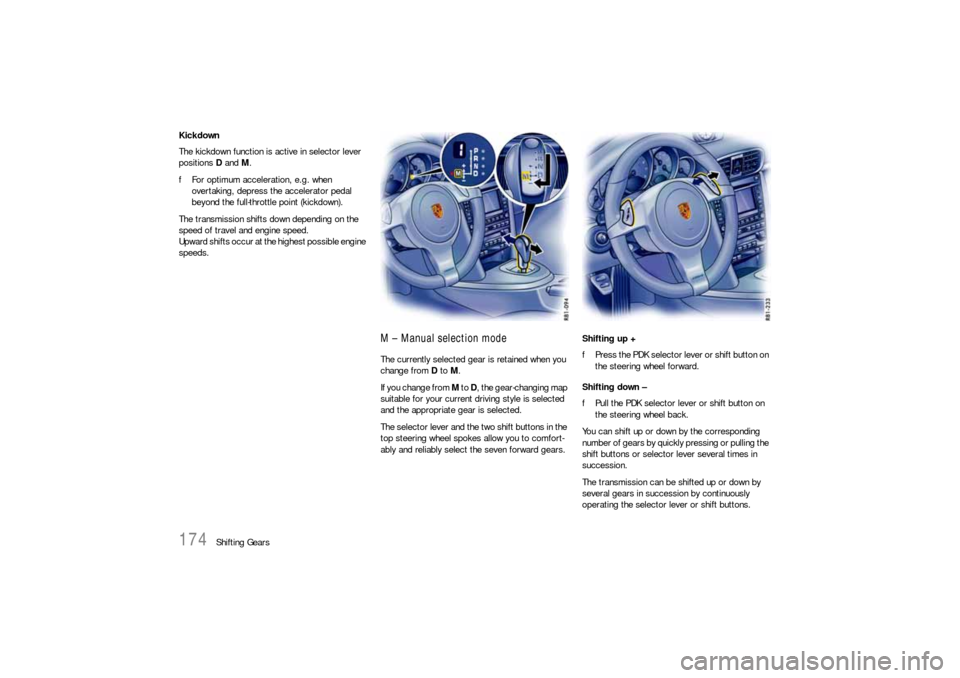
M – Manual selection modeThe currently selected gear is retained when you
change from D to M.
If you change from M to D, the gear-changing map
suitable for your current driving style is selected
and the appropriate gear is selected.
The selector lever and the two shift buttons in the
top steering wheel spokes allow you to comfort-
ably and reliably select the seven forward gears.Shifting up +
fPress the PDK selector lever or shift button on
the steering wheel forward.
Shifting down –
fPull the PDK selector lever or shift button on
the steering wheel back.
You can shift up or down by the corresponding
number of gears by quickly pressing or pulling the
shift buttons or selector lever several times in
succession.
The transmission can be shifted up or down by
several gears in succession by continuously
operating the selector lever or shift buttons.
Page 177 of 310

Shifting Gears
175
Depending on driving speed and engine speed,
you can shift up or down at any time.
Gear changes which would exceed the upper or
lower engine speed limit are not executed by the
controller.
There is no automatic upshift at the upper engine
speed limit in selector lever position M. Upshift
suppression can be cancelled by kickdown opera-
tion. If, for example, the engine speed limit is
reached during overtaking and the automatic
upshift does not occur, the transmission in this
case shifts up as a result of kickdown operation.
fSelect an appropriately low gear on upward
and downward slopes.
This will ensure optimum use of engine power
and engine braking.
In order to shift up automatically at the upper
engine speed limit:
fDepress the accelerator pedal beyond the full-
throttle point (kickdown).Failure of the selector lever display on the
instrument cluster
The warning “Transmission emergency run” is
displayed in red on the on-board computer.
–Effect:
No selector lever position is displayed on the
instrument cluster.
Vehicle can be driven only until it comes to a
stop.
Remedy:
It is not possible to continue driving. Immedi-
ately stop the vehicle in a suitable place. Have
the vehicle towed to an authorized Porsche
dealer.
StoppingfFor a brief stop (e.g. at a traffic light), leave the
selector lever in drive position and hold the
vehicle with the brake pedal.
fDo not hold the car on a slope using the
accelerator. Use the brake pedal or the
handbrake instead.
fBefore leaving the vehicle, always apply the
handbrake and move the selector lever to
position P.ParkingfGo easy on the accelerator!
fWhen parking or manoeuvring in a small
space, control the speed by careful use of the
footbrake.Driving in winterIn wintry road conditions it is advisable to take
steep inclines in manual mode. This prevents gear
changes occurring that could cause wheelspin.Tow-starting, towingfPlease see the chapter “TOWING” on
Page 280.
Page 215 of 310

Maintenance, Car Care
213
Changing the brake fluid Brake fluid absorbs moisture from the air over
time. This accumulation of water lowers the boil-
ing point and, under certain operating conditions,
can affect the braking performance.
Therefore have the brake fluid changed in accord-
ance with the change intervals stated in the
brochure “Maintenance”. – The warning lights on the instrument panel and
on the on-board computer indicate an insuffi-
cient brake fluid level.
– If the warning light lights up on the instrument
panel and the warning message appears on
the on-board computer in combination with a
larger pedal travel, a brake circuit may have
failed.
If the warning lights should light up when
driving:
fStop immediately in a suitable place.
fDo not continue driving.
Consult an authorized Porsche dealer.
Warning light USA
Warning light Canada
Page 242 of 310

240
Practical Tips, Emergency Service
Danger!
Risk of serious personal injury or death.
Driving the vehicle with low tire pressure
increases risk of a tire failure and resulting
loss of control. Furthermore, low tire pres-
sure increases rate of wear of the affected
tires.
fCheck tires – including sidewalls – regularly for
foreign bodies, nicks, cuts, cracks and bulges.
fAfter driving off road, examine tires for signs
of damage such as cuts, tears, bulges or for-
eign objects stuck in the tread. Replace a dam-
aged tire if necessary.
fCross curb edges slowly and at right angles if
possible.
Avoid driving over steep or sharp curbs.
fIn cases of doubt, have the wheel (particularly
the inner side) checked by an authorized Porsche dealer.
Tire replacements If in doubt, contact your Porsche dealer.
Use only tire makes and types approved by
Porsche.
If you do not use a Porsche recommended
replacement tire, make sure that you
purchase your new tires from a reputable tire
dealer and that the dealer complies with all
manufacturers warnings for those tires.
Only tires with the same make and with the
same specification code (e.g. “N0”, “N1”...)
can be mounted.
Before mounting new tires, check with your
Porsche dealer about the current release
status.
Use tires with “ZR” quality standards. There
are currently no standards concerning tire
strength at speeds above 150 mph (240 km/h).
Tires should be replaced no less than on one axle
at the time.
Only tires of the same make and type must be
used. Mixed tires are not permissible.
Initially, new tires do not have their full traction.
You should therefore drive at moderate speeds
during the first 60 - 120 miles (100 - 200 km). If new tires are installed only on one axle, a notice-
able change in handling occurs due to the different
tread depth of the other tires.
This happens especially if only rear tires are re-
placed. However, this condition disappears as the
new tires are broken in.
fPlease adjust your driving style accordingly.
Installation of new tires should only be done by a
qualified tire technician.
Valves
Rubber valve stems must be replaced every time
a tire is replaced.
For metal valves, the installation and replacement
instructions must be observed.
fUse only genuine Porsche metal valves.
fProtect the valve inserts against soiling with
valve caps.
Soiled valve inserts can cause a gradual loss
of air.
fUse only plastic valve caps.
Page 260 of 310

258
Practical Tips, Emergency Service
Alarm system, central lockingThe status of the central locking and alarm system
is not changed by disconnecting the battery.
When the battery is disconnected, the alarm
system ceases to function.Central locking overload protectionIf the central locking system is operated more
than ten times within a minute, further operation is
blocked for 30 seconds.
Load switch-off after 2 hours or 7 daysIf the ignition key is removed, loads which are
switched on or are in standby mode (such as the
luggage compartment light, interior light) are
automatically switched off after approx. 2hours.
The Radio/PCM is automatically switched off after
approx. 10 minutes.
If the vehicle is not started or unlocked with the
remote control within 7days, the remote control
standby function is switched off (to save the
vehicle battery).
1. In this case, unlock the driver’s door with the
key at the door lock.
Leave the door closed in order to prevent the
alarm system from being triggered.
2. Press button 1 on the remote control.
The remote control is now activated again.
Page 306 of 310
304
Index HomeLink................................................... 103
Hoods.................................................... 93, 94
Horn ................................................ 12, 19, 21
Hot exhaust pipes ........................................... 5
IIgnition key................................................... 74
Emergency operation ............................ 76
Ignition lock.................................................. 74
Withdrawing ignition key,
PDK transmission................................ 172
Immobilizer .................................................. 15
Indicator lights.................................... 112, 114
INFO Warning messages ............................. 132
Instrument
Illumination ......................................... 116
Lights .................................................. 80
Panel ................................. 112, 114, 158
Interior lights ................................................ 71
Interior mirror ............................................... 28JJumper cables ............................................ 267KKey codes .................................................... 15
Key-operated airbag deactivation device ......... 49
Keys ...................................................... 15, 16LLATCH System ............................................. 54
Launch Control ........................................... 173
Leather care .............................................. 230License plate light ......................................... 80
Lids ............................................................. 94
Emergency unlocking .......................... 260
Lifting vehicle ............................................. 254
Lifting/sliding roof....................................... 178
Light
Daytime driving ..................................... 80
Flasher ................................... 80, 82, 119
Low beam ...................................... 80, 82
Sensor for instrument illumination. 112, 114
Switch ............................................ 80, 82
Light alloy wheels
Inscription .......................................... 245
Lights
Care .................................................. 229
Headlight beam adjustment.................... 81
LIMIT Acoustic warning signal for speed limit. 129
Load switch-off ........................................... 258
Loading information .................................... 246
Locking ........................................................ 19
Conditions ............................................ 21
Locking retractor .......................................... 53
Low beam .................................................... 82
Lowering ...................................................... 56
Luggage carrier .................................. 291, 292
Luggage compartment ............................ 95, 97
Lid ....................................................... 93
Lid warning light.................................... 93
Unlocking lid ......................................... 16
Luggage compartment/
engine compartment lid, warning lights ........... 93
Luggage rack ............................................. 204
MMaintenance ...............................................206
Make-up mirror .............................................40
Maximum permitted engine speeds ................10
Manual transmission............................168
Mirror
Folding in ..............................................28
Heating ........................................29, 110
Inside ...................................................27
Mirrors ...................................................27, 73
Anti-glare ..............................................28
Multi-functional steering wheel ........................39NNavigation ....................................................98
Selection field, on-board computer .......142
Notes on
Car care .............................................224
Maintenance .......................................206
Number plate light.................................80, 277OOctane rating ......................................216, 217
Odometer ...................................................117
Off delay ......................................................81
Oil..............................................................208
Change...............................................210
Checking level.....................................153
Consumption.........................................10
Level checks.......................................208
Level indicator ....................................153
Pressure.............................................124
Recommendation ................................210