brake PORSCHE 911 2009 5.G Workshop Manual
[x] Cancel search | Manufacturer: PORSCHE, Model Year: 2009, Model line: 911, Model: PORSCHE 911 2009 5.GPages: 310, PDF Size: 3.39 MB
Page 237 of 310

Practical Tips, Emergency Service
235
Tires/Wheels The original equipment tires and wheel rims on
your Porsche comply with all applicable Federal
Motor Vehicle Safety Standards.
For your safety remember the following:
– Wheel rims and wheel bolts are matched to fit
your Porsche.
– If you intend to use other than original equip-
ment wheels, be sure that they conform to
Porsche specifications for your model.
Only tires with the same make and with the
same specification code (e.g. “N0”, “N1”...)
can be mounted.
– The use of wheel rims and wheel bolts that do
not meet specifications of the original factory
installed equipment will affect the safe opera-
tion of your vehicle.
– Before you plan on exchanging wheels, or
snow tires already mounted on the wheel rims,
consult your authorized Porsche dealer. Your
dealer has the technical information necessary
to advise you which wheel rims and wheel bolts
are compatible with the original factory instal-
lations.
Danger!
Risk of loss of control and serious personal
injury or death.
fIf while driving, your vehicle experiences a sud-
den vibration or ride disturbance, and/or you
suspect that possible damage to your tires or
vehicle has occurred, you should immediately
reduce your speed without excessive use of
the brakes.
fStop the vehicle as soon as possible, and in-
spect the tires.
If you cannot determine the cause for the dis-
turbance, have your vehicle towed to the near-
est Porsche or tire dealer to have your vehicle
or tire(s) inspected.
fContinuing to operate the vehicle without cor-
rection could result in a loss of control and serious personal injury.
ExampleUniform Tire Quality GradingQuality grades can be found where applicable on
the tire sidewall between tread shoulder and max-
imum section width.
All passenger car tires must conform to Federal
Safety Requirements in addition to these grades.
Tr e a d w e a r
The treadwear grade is a comparative rating
based on the wear rate of the tire when tested
under controlled conditions on a specific govern-
ment test course.
For example, a tire graded 150 would wear one
Page 241 of 310

Practical Tips, Emergency Service
239
Danger!
Driving on worn tires can result in loss of con-
trol of the vehicle and could cause serious
personal injuries or death.
fDo not drive with worn tires or tires showing
cuts or bruises as they may lead to sudden
deflation and loss of control which could cause
severe personal injury.
fSpecialized high performance tires on high
performance sports cars exhibit more wear
than those on a family sedan, or even a high
performance sedan.
Therefore, it is important to check your tire
pressure and condition at least every two weeks.
If you notice that tires are wearing unevenly, con-
sult your Porsche dealer.
Uneven wear may not always be due to improper
wheel alignment. It can be the result of individual
driving habits such as cornering at high speeds. If
the tire pressure is not checked and adjusted
regularly, abnormal tire wear can also occur.
Tire care fAvoid damaging tires and wheel rims.
fIf you must drive over a curb or other obstacle,
drive slowly and at an obtuse angle.
fCheck tires for uneven wear and damage
before driving off.
fRemove imbedded material.
fReplace worn or damaged tires immediately.
fKeep oil, fuel, brake fluid, etc. away from tires.
fReplace missing valve stem caps.
fKeep tires inflated correctly.
fWash tires when washing the vehicle. Also
clean inner side of wheels.
fDo not use abrasive cleaners when washing
the wheels.
fCheck wheel rims for corrosion.
fRemove road salt, if driving in winter.
Tire damage, puncture High-pressure cleaning units can damage the
tires.
fPlease see the chapter “HIGH-PRESSURE
CLEANING UNITS, STEAM CLEANERS” on
Page 224.
fCheck tires for imbedded material, cuts, punc-
tures, cracks and bulges (side wall) before driv-
ing off.
In case of tire damage, where it is uncertain wheth-
er there is a break in the ply with all its conse-
quences or tire damage caused by thermal or me-
chanical overloading due to loss of pressure or
any other prior damage, we recommend that the
tire be replaced for safety reasons.
If one faulty tire is replaced it should be noted that
the difference in tread depth on one axle must not
exceed 30%.
Handling inconsistencies may result.
fPerform a visual inspection if necessary.
Page 245 of 310

Practical Tips, Emergency Service
243
Snow chains
Caution!
Risk of damage to body, axle or brake com-
ponents.
fFit snow chains only to the rear wheels, and
only with the tire/rim combination listed in the
Technical Data.
To ensure adequate clearance between chain
and body, Porsche recommends only the use
of fine-link chains such as those approved by
Porsche.
fFollow instructions issued by the supplier of the chains.
Different states and countries have varying statu-
tory requirements regarding maximum speed.
Check with local authorities for possible restric-
tions.
fRemove chains as soon as the roads are free
of ice and snow. 911 Carrera, 911 Carrera S
Fitting snow chains
The use of snow chains is not permitted when
5 mm spacers are mounted.
Caution!
Risk of damage to the wheel housings if the
5 mm spacers are not removed before fitting
snow chains.
fTo permit the fitting of snow chains, have the 5 mm spacers removed on all 4 wheels.
fTo fit/remove the spacers:
Please consult an authorized Porsche dealer.
fPlease see the chapter “SPACERS 911
CARRERA, 911 CARRERA S” on Page 255.
Tire designations Due to new speed and load ratings for radial tires,
new designations have come into force for snow
tires for your Porsche.
The designation to be used for ZR tires is e.g.,
265/40 ZR 18 (Z = code letter for radial tires for
speeds above 150 mph / 240 km/h).
Page 251 of 310

Practical Tips, Emergency Service
249
Changing a wheel
Warning!
Risk of serious personal injury or death. The
car may slip off the jack.
fMake sure that no one is in the vehicle when
jacking up and changing a wheel.
fAlways place the car on stable supports if work
has to be carried out under the car.
Risk of damage to the brake discs of the
Porsche Ceramic Composite Brake (PCCB).
fAlways screw in both assembly aids when changing a wheel.
Note
The tools required for changing a wheel (e.g. jack,
wheel bolt wrench, assembly aids) are not sup-
plied with the car.
Your authorized Porsche dealer will be pleased to
advise you.1. Apply the handbrake fully and engage 1st gear
or PDK selector-lever position P and remove
the ignition key.
2. Switch on the hazard warning lights if neces-
sary.
3. Secure the car against rolling away, e.g. by
means of wedges under the wheels on the op-
posite side.
This is particularly important on slopes.
4. Slightly slacken the wheel bolts of the wheel to
be changed.
5. Lift the car only at the specified jacking points.
6. Raise the car until the wheel lifts off the
ground.
Please see the chapter “LIFTING THE VEHICLE
WITH A LIFTING PLATFORM OR GARAGE LIFT”
on Page 254.
7. Remove 1 or 2 wheel bolts (see respective
illustration).
8. Screw in assembly aids instead of the wheel
bolts.
Screw in assembly aid for vehicles without Porsche
Ceramic Composite Brake9. Remove the remaining wheel bolts.
Note on operation
fTo remove or mount the spacers:
Please see the chapter “SPACERS 911
CARRERA, 911 CARRERA S” on Page 255.
Page 252 of 310
250
Practical Tips, Emergency Service
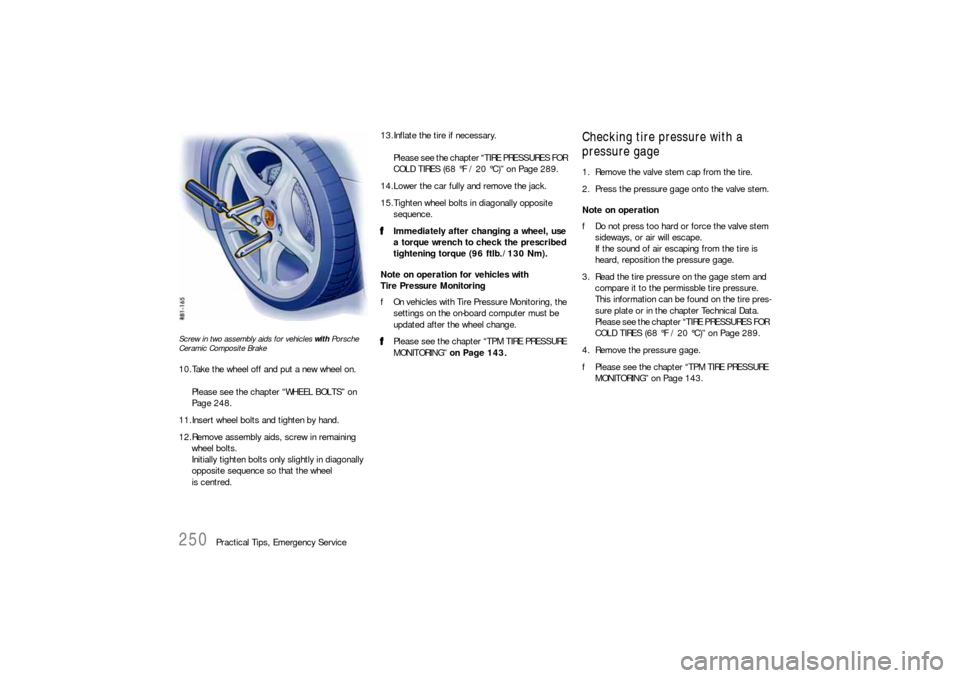
Screw in two assembly aids for vehicles with Porsche
Ceramic Composite Brake10.Take the wheel off and put a new wheel on.
Please see the chapter “WHEEL BOLTS” on
Page 248.
11.Insert wheel bolts and tighten by hand.
12.Remove assembly aids, screw in remaining
wheel bolts.
Initially tighten bolts only slightly in diagonally
opposite sequence so that the wheel
is centred.13.Inflate the tire if necessary.
Please see the chapter “TIRE PRESSURES FOR
COLD TIRES (68 °F / 20 °C)” on Page 289.
14.Lower the car fully and remove the jack.
15.Tighten wheel bolts in diagonally opposite
sequence.
fImmediately after changing a wheel, use
a torque wrench to check the prescribed
tightening torque (96 ftlb./130 Nm).
Note on operation for vehicles with
Tire Pressure Monitoring
fOn vehicles with Tire Pressure Monitoring, the
settings on the on-board computer must be
updated after the wheel change.
fPlease see the chapter “TPM TIRE PRESSURE
MONITORING” on Page 143.
Checking tire pressure with a
pressure gage1. Remove the valve stem cap from the tire.
2. Press the pressure gage onto the valve stem.
Note on operation
fDo not press too hard or force the valve stem
sideways, or air will escape.
If the sound of air escaping from the tire is
heard, reposition the pressure gage.
3. Read the tire pressure on the gage stem and
compare it to the permissble tire pressure.
This information can be found on the tire pres-
sure plate or in the chapter Technical Data.
Please see the chapter “TIRE PRESSURES FOR
COLD TIRES (68 °F / 20 °C)” on Page 289.
4. Remove the pressure gage.
fPlease see the chapter “TPM TIRE PRESSURE
MONITORING” on Page 143.
Page 253 of 310

Practical Tips, Emergency Service
251
Flat Tire
Warning!
Failure to follow these instructions may result
in serious personal injury to you or to by-
standers.
fIf you have a flat tire, move a safe distance off
the road. Turn the emergency flasher on and
use other warning devices to alert other motor-
ists. Set the parking brake.
fDo not park your vehicle where it may contact
dry grass, brush or other flammable materials.
The hot parts of the exhaust system could set
such materials on fire, thereby causing both
property damage and serious personal injury or death.
A tire sealant and compressor with pressure
tester are located in the luggage compartment.
fPlease observe the safety and operating in-
structions on the special sealant bottle with a
special Porsche part number and on the com-
pressor – these are essential.Important note
Sealing the tire with the tire repair kit is only
an emergency repair. Even with the tire air-
tight, it may be used only for short journeys
in an emergency.
The maximum permitted speed is 50 mph
(80 km/h).
fDo not use commercially available sealant or
tire inflating bottles.
Use only the tire sealant located in the luggage
compartment.
Warning!
Risk of accident, resulting in serious
personal injury or death.
fHave tires replaced by a specialist workshop
as soon as possible.
fAvoid hard acceleration and high cornering speeds.
Page 257 of 310

Practical Tips, Emergency Service
255
Spacers911 Carrera, 911 Carrera SfUse the spacers only together with wheels and
fastening parts approved by Porsche.
Before having spacers fitted, find out about the
current approval status.
Mounting an emergency spare wheel
If 5 mm spacers are mounted, these must not be
removed to mount an emergency spare wheel.
Fitting snow chains
The use of snow chains is not permitted when
5 mm spacers are mounted.
Caution!
Risk of damage to the wheel housings if the
5 mm spacers are not removed before fitting
snow chains.
fTo permit the fitting of snow chains, have the 5 mm spacers removed on all 4 wheels.Note on operation
fTo fit/remove the spacers:
Please consult an authorized Porsche dealer.
fPlease see the chapter “CHANGING A WHEEL”
on Page 249.
Removing the spacers
1. Unscrew both countersunk screws (M6x16) on
the wheel hub.
2. Remove the spacer.
3. Fasten the brake disc with the short M6x12
countersunk screws, part No.:
900.269.047.09.
Tightening torque 7.5 ftlb. (10 Nm).
4. For wheel mounting without a spacer, 5 mm
shorter wheel bolts (part No.:
997.361.203.01) must be used.
Tightening torque: 96 ftlb. (130 Nm).
Mounting the spacers
Page 279 of 310
Practical Tips, Emergency Service
277
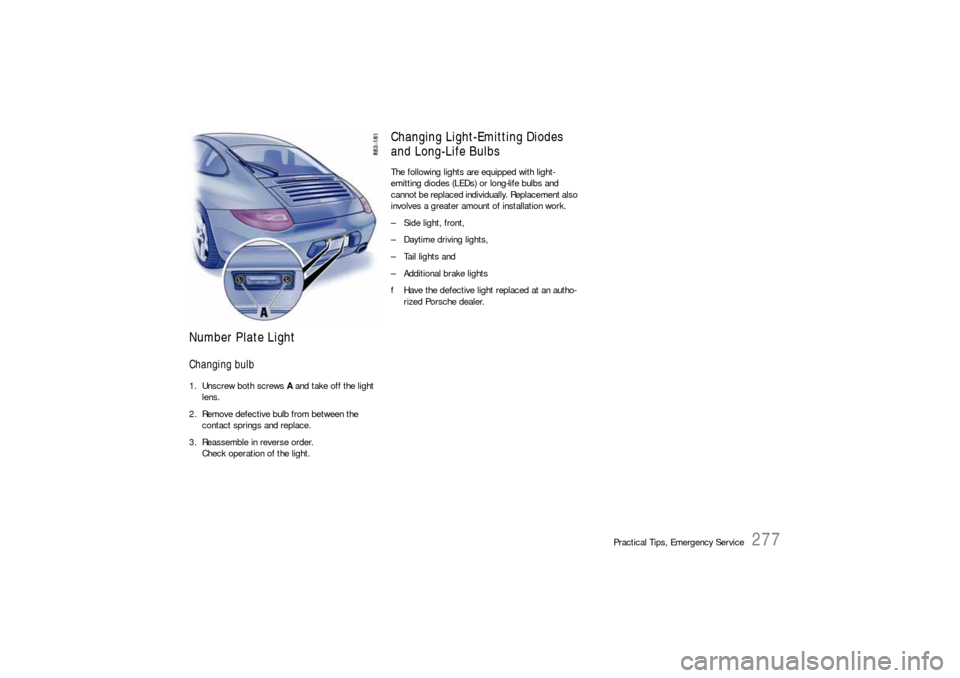
Number Plate LightChanging bulb1. Unscrew both screws A and take off the light
lens.
2. Remove defective bulb from between the
contact springs and replace.
3. Reassemble in reverse order.
Check operation of the light.
Changing Light-Emitting Diodes
and Long-Life BulbsThe following lights are equipped with light-
emitting diodes (LEDs) or long-life bulbs and
cannot be replaced individually. Replacement also
involves a greater amount of installation work.
– Side light, front,
– Daytime driving lights,
– Tail lights and
– Additional brake lights
fHave the defective light replaced at an autho-
rized Porsche dealer.
Page 284 of 310

282
Practical Tips, Emergency Service
Pulling vehicle onto flat bed 1. Position wooden ramps at the base of the flat
bed to reduce the angle of the pull.
2. Reel in the hoist cable and check the underside
of the vehicle for any interference.
Tieing down vehicle on flat bed 1. Carefully feed towing straps through the open-
ing in the rear wheels.
Make sure metal parts of straps do not dam-
age rim.
Make sure the strap is flat over the rim bead.
Make sure brake backing plate is not dam-
aged.
2. Secure straps to rear of flat bed.
3. Reel in hoist cable only far enough to tension
tie-down straps. 4. Carefully feed towing straps through the open-
ing in the front wheels.
Make sure metal parts of straps do not dam-
age rim.
Make sure the strap is flat over the rim bead.
Make sure brake backing plate is not dam-
aged.
5. Secure straps to front of flat bed.
6. Release tension on hoist cable, but do not dis-
connect.
Use hoist cable as a safety cable.
Page 292 of 310

290
Technical Data
CapacitiesUse only fluids and fuels authorized by Porsche. Your authorized Porsche dealer will gladly advise you.
Your Porsche has been designed so that it is not necessary to mix any additives with oils or fuels.
EngineOil change quantity with oil filter approx. 7.9 quarts / 7.5 liters
Please see the chapter “ENGINE OIL” on Page 208.
Coolantapprox. 7.63 - 8.32 U.S. gallons / 28.9 - 31.5 liters
Manual transmission
and differential
approx. 3.17 quarts / 3.0 liters transmission oil Mobilube PTX Formula A (SAE 75W-90) GL 4.5
Porsche Doppelkupplung
Wheel setapprox. 3.12 quarts / 2.95 liters ATF transmission oil Mobilube PTX Formula A (SAE 75W-90) GL 4.5
Porsche Doppelkupplung
Clutch/hydraulic fluidapprox. 5.49 quarts / 5.2 liters Pentosin Gear Oil FFL 3
Fuel tank 911 Carrera, 911 Carrera S: approx. 16.9 U.S. gallons / 64 liters
911 Carrera 4, 911 Carrera 4S, 911 Targa 4, 911 Targa 4S: approx. 17.7 U.S. gallons / 67 liters
Fuel qualityYour engine is designed to provide optimum performance and fuel economy using
unleaded premium fuel with an octane rating of 98 RON (93 CLC or AKI).
Porsche therefore recommends the use of these fuels in your vehicle.
Porsche also recognizes that these fuels may not always be available. Be assured that your vehicle
will operate properly on unleaded premium fuels with octane numbers of at least 95 RON (90 CLC or AKI),
since the engine’s “Electronic Oktane™ knock control” will adapt the ignition timing, if necessary.
Power steeringapprox. 1.35 quarts / 1.27 liters hydraulic fluid Pentosin CHF 11 S
® or Pentosin CHF 202
®
Brake fluid0.48 quarts / 0.45 liters; use only Original Porsche brake fluid
Windshield washerapprox. 6.3 quarts / 6 liters with headlight washer