oil pressure PORSCHE 911 2009 5.G Owners Manual
[x] Cancel search | Manufacturer: PORSCHE, Model Year: 2009, Model line: 911, Model: PORSCHE 911 2009 5.GPages: 310, PDF Size: 3.39 MB
Page 9 of 310
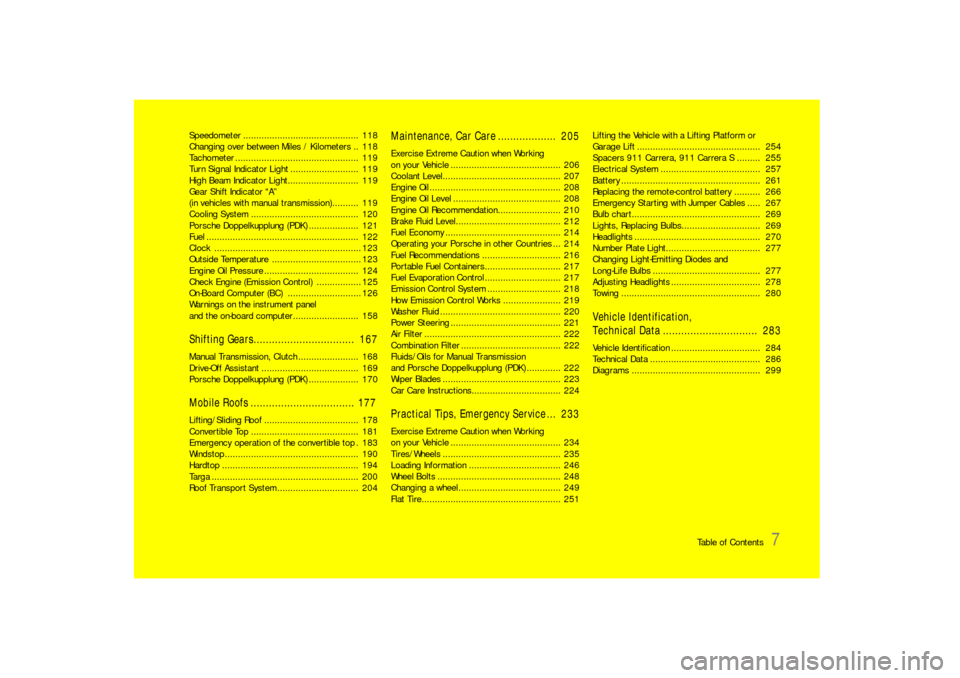
Table of Contents
7
Speedometer ............................................ 118
Changing over between Miles / Kilometers .. 118
Tachometer ............................................... 119
Turn Signal Indicator Light .......................... 119
High Beam Indicator Light........................... 119
Gear Shift Indicator “A”
(in vehicles with manual transmission).......... 119
Cooling System ......................................... 120
Porsche Doppelkupplung (PDK) ................... 121
Fuel .......................................................... 122
Clock ........................................................ 123
Outside Temperature .................................. 123
Engine Oil Pressure .................................... 124
Check Engine (Emission Control) ................. 125
On-Board Computer (BC) ............................ 126
Warnings on the instrument panel
and the on-board computer......................... 158Shifting Gears................................. 167Manual Transmission, Clutch ....................... 168
Drive-Off Assistant ..................................... 169
Porsche Doppelkupplung (PDK) ................... 170Mobile Roofs .................................. 177 Lifting/Sliding Roof .................................... 178
Convertible Top ......................................... 181
Emergency operation of the convertible top . 183
Windstop................................................... 190
Hardtop .................................................... 194
Targa ........................................................ 200
Roof Transport System............................... 204
Maintenance, Car Care ................... 205Exercise Extreme Caution when Working
on your Vehicle .......................................... 206
Coolant Level............................................. 207
Engine Oil .................................................. 208
Engine Oil Level ......................................... 208
Engine Oil Recommendation........................ 210
Brake Fluid Level........................................ 212
Fuel Economy ............................................ 214
Operating your Porsche in other Countries ... 214
Fuel Recommendations .............................. 216
Portable Fuel Containers............................. 217
Fuel Evaporation Control ............................. 217
Emission Control System ............................ 218
How Emission Control Works ...................... 219
Washer Fluid .............................................. 220
Power Steering .......................................... 221
Air Filter .................................................... 222
Combination Filter ...................................... 222
Fluids/Oils for Manual Transmission
and Porsche Doppelkupplung (PDK) ............. 222
Wiper Blades ............................................. 223
Car Care Instructions.................................. 224Practical Tips, Emergency Service ... 233Exercise Extreme Caution when Working
on your Vehicle .......................................... 234
Tires/Wheels ............................................. 235
Loading Information ................................... 246
Wheel Bolts ............................................... 248
Changing a wheel....................................... 249
Flat Tire..................................................... 251Lifting the Vehicle with a Lifting Platform or
Garage Lift ............................................... 254
Spacers 911 Carrera, 911 Carrera S ......... 255
Electrical System ...................................... 257
Battery ..................................................... 261
Replacing the remote-control battery .......... 266
Emergency Starting with Jumper Cables ..... 267
Bulb chart................................................. 269
Lights, Replacing Bulbs.............................. 269
Headlights ................................................ 270
Number Plate Light.................................... 277
Changing Light-Emitting Diodes and
Long-Life Bulbs ......................................... 277
Adjusting Headlights .................................. 278
Towing ..................................................... 280
Vehicle Identification,
Technical Data ............................... 283Vehicle Identification.................................. 284
Technical Data .......................................... 286
Diagrams ................................................. 299
Page 113 of 310

Instruments, On-Board Computer, Warnings
111 Instruments, On-Board Computer, Warnings
Instrument Panel USA Models..................... 112
Instrument Panel Canada Models ................ 114
Engine Oil Temperature .............................. 116
Automatic Speed Control Indicator light ...... 116
Instrument Illumination............................... 116
Trip Odometer........................................... 117
Speedometer ............................................ 118
Changing over between Miles / Kilometers .. 118
Tachometer .............................................. 119
Turn Signal Indicator Light.......................... 119
High Beam Indicator Light .......................... 119
Gear Shift Indicator “A”
(in vehicles with manual transmission) ......... 119
Cooling System ......................................... 120
Porsche Doppelkupplung (PDK) .................. 121
Fuel.......................................................... 122
Clock ....................................................... 123
Outside Temperature ................................. 123
Engine Oil Pressure ................................... 124
Check Engine (Emission Control) ................ 125
On-Board Computer (BC) ............................ 126
Warnings on the instrument panel
and the on-board computer ........................ 158
Page 114 of 310

112
Instruments, On-Board Computer, Warnings
Instrument Panel USA Models Also refer to the corresponding chapters in
the Owner’s Manual.
1. Engine oil temperature gage
2. Speedometer with analogue display
3. Tire pressure warning light
4. Turn signal indicator light, left
5. Tachometer
6. High beam indicator light
7. Turn signal indicator light, right
8. ABS warning light
9. Cooling system
Temperature gage, warning light
10.Fuel
Level gage, warning light
11.Engine oil pressure gage
12.Adjustment button for instrument illumination
and trip counter
13.Odometer and daily trip mileage display
14.Automatic speed control indicator light15.Light sensor for instrument illumination
16.Airbag warning light
17.Check Engine warning light
(Emission control warning light)
18.Central warning light
19.On-board computer display
20.Porsche Stability Management
PSM Multifunctional light
21.Brake warning light
22.Safety belt warning light
23.PDK transmission, gear display
24.PDK transmission, selector lever position
25.Clock and outside temperature display
26.Adjustment button for clockWhen the ignition is switched on, the warning
lights light up for a lamp check.
Note
Warnings that have been given are stored in the
appropriate control unit memory and can be read
out at an authorized Porsche dealer.
This information can help to warn you about situa-
tions which may be hazardous to you or your car.
Page 116 of 310

114
Instruments, On-Board Computer, Warnings
Instrument Panel Canada Models Also refer to the corresponding chapters in
the Owner’s Manual.
1. Engine oil temperature gage
2. Speedometer with analogue display
3. Tire pressure warning light
4. Turn signal indicator light, left
5. Tachometer
6. High beam indicator light
7. Turn signal indicator light, right
8. ABS warning light
9. Cooling system
Temperature gage, warning light
10.Fuel
Level gage, warning light
11.Engine oil pressure gage
12.Adjustment button for instrument illumination
and trip counter
13.Odometer and daily trip mileage display
14.Automatic speed control indicator light15.Light sensor for instrument illumination
16.Airbag warning light
17.Check Engine warning light
(Emission control warning light)
18.Central warning light
19.On-board computer display
20.Porsche Stability Management
PSM Multifunctional light
21.Brake warning light
22.Safety belt warning light
23.PDK transmission, gear display
24.PDK transmission, selector lever position
25.Clock and outside temperature display
26.Adjustment button for clockWhen the ignition is switched on, the warning
lights light up for a lamp check.
Note
Warnings that have been given are stored in the
appropriate control unit memory and can be read
out at an authorized Porsche dealer.
This information can help to warn you about situa-
tions which may be hazardous to you or your car.
Page 126 of 310

124
Instruments, On-Board Computer, Warnings The oil pressure is controlled as required and
should be at least 3.5 bar at an engine speed of
5000 rpm.
The engine oil pressure varies depending on the
engine speed, engine load and engine tempera-
ture.If oil pressure drops abruptly and a message
is displayed on the on-board computer when
the engine is running on or when driving:
fStop immediately in a suitable place.
fSwitch off the engine.
fCheck whether there is an obvious oil leak on
or under the car.
fIf no oil leak can be detected: With the engine
idling, measure the oil level with the on-board
computer.
fPlease see the chapter “OIL DISPLAY AND
MEASUREMENT OF THE ENGINE OIL LEVEL”
on Page 153.
fPlease see the chapter “ENGINE OIL LEVEL”
on Page 208.
fAdd engine oil if necessary.
Caution!
Risk of engine damage.
fDo not continue driving if there is an obvious oil
leak.
fDo not continue driving if the warning lights
come on even though oil level is correct.
fHave the fault remedied at the nearest authorized Porsche dealer.If the battery voltage drops abruptly, a warning
message will be displayed by the on-board compu-
ter.
If the warning is displayed by the on-board
computer while the engine is running or while
driving:
fStop the car in a safe place and stop the
engine.
Possible causes
– Defect in the battery charging system.
– Broken drive belt.
Warning!
Risk of engine damage with resultant loss of
control and accident, leading to serious per-
sonal injury or death.
A broken drive belt means there is no power
assistance to the steering (more effort is re-
quired to steer) and coolant pump function
will stop.
fDo not continue driving.
fHave the fault remedied at the nearest author-ized Porsche dealer.
Engine Oil Pressure
Battery
Page 162 of 310

160
Warnings
LIMIT
Cannot be accepted
with vehicle stoppedThe current speed can only b e a c c e p t e d f o r t h e
acoustic warning signal when the vehicle is in
motion.
LIMIT
30Selected speed limit (e.g. 30 mph) for the
acoustic warning signal has been exceeded.
Adjust your speed if necessary.
Fuel gage warning
lightConsider remaining range Refuel at next opportunity.
Check engine oil level Start engine oil level measurement in the
on-board computer.
Engine oil pressure too low Stop immediately at a suitable place, measure
oil level with the on-board computer and, if nec-
essary, add engine oil.
Warning light
Temperature gageEngine temperature too high Switch engine off and let it cool.
Check coolant level and, if necessary,
add coolant.
Temperature gage
warning light flash-
esCheck coolant level Switch engine off and let it cool.
Check coolant level and, if necessary, add cool-
ant.
Engine diagnostics – workshop Stop immediately at a suitale place and check
tank cap for proper fastening. If the tank cap
was fastened correctly, consult your authorized
Porsche dealer.
Reduced engine power Consult your authorized Porsche dealer.
Temperature gage
warning light flash-
esFailure of
engine compartment blowerConsult your authorized Porsche dealer.
Instrument
panelOn-board
computerText display on on-board
computerMeaning/measure
Page 163 of 310

Warnings
161
Warning Battery/generator Stop at a safe place and switch the engine off.
Do not continue driving.
Have the fault remedied at an authorized
Porsche dealer.
Oil pressure gage faulty Have the fault remedied at an authorized
Porsche dealer.
Oil level display faulty Have the fault remedied at an authorized
Porsche dealer.
Oil temperature gage faulty Have the fault remedied at an authorized
Porsche dealer.
Oil temperature
too highSwitch engine off and let it cool. Check oil level
and, if necessary, add oil.
Please observe the chapter “OIL DISPLAY AND
MEASUREMENT OF THE ENGINE OIL LEVEL“.
Indicator faulty Coolant indicator failed.
Have the fault remedied at an authorized
Porsche dealer.
Brake pad wear Have the brake pads changed immediately at an
authorized Porsche dealer.
Warning – Brake fluid level Stop immediately in a suitable place.
Do not continue driving. Have the fault remedied
at an authorized Porsche dealer.
Warning – Brake circuit division Stop immediately in a suitable place.
Do not continue driving. Have the fault remedied
at an authorized Porsche dealer.
Instrument
panelOn-board
computerText display on on-board
computerMeaning/measure
Page 210 of 310

208
Maintenance, Car Care
Engine-compartment blower,
radiator fan The radiator and radiator fans are in the front of
the car.
The engine-compartment blower is mounted on
the engine compartment lid.
Warning!
Risk of injury.
After the engine is switched off, the engine-
compartment temperature is monitored for
approx. 30 minutes.
During this period, and depending on tem-
perature, the engine-compartment blower
may continue to run or start to run.
fCarry out work in these areas only with the en-
gine off, the ignition off, and exercise extreme
caution.
Risk of injury. The radiator fans in the front
end of the car may be operating or
unexpectedly start operating when the
engine is switched on.
fCarry out work in these areas only with the en-gine switched off.
Engine Oil It is important to perform oil changes regularly in
accordance with the intervals specified in the
“Maintenance” booklet.
Engine oil consumption
It is normal for your engine to consume oil.
The rate of oil consumption depends on the quality
and viscosity of oil, the speed at which the engine
is operated, the climate, road conditions as well
as the amount of dilution and oxidation of the
lubricant.
If the vehicle is used for repeated short trips, and
consumes a normal amount of oil, the engine oil
measurement may not show any drop in the oil
level at all, even after 600 miles (1,000 km) or
more. This is because the oil is gradually becom-
ing diluted with fuel or moisture, making it appear
that the oil level has not changed.
The diluting ingredients evaporate out when the
vehicle is driven at high speeds, as on an express-
way, making it then appear that oil is excessively
consumed after driving at high speeds.
If the conditions you drive your vehicle in are
dusty, humid, or hot, the frequency of the oil
change intervals should be greater. If the vehicle is driven at a high rate of speed,
climatic conditions are warm, and the load is high,
the oil should be checked more frequently, as
driving conditions will determine the rate of oil
consumption.
– The engine in your vehicle depends on oil to
lubricate and cool all of its moving parts.
Therefore, the engine oil should be checked
regularly and kept at the required level.
– Make it a habit to have the engine oil level
checked at every fuel filling.
– The oil pressure warning light is not an oil level
indicator.
The oil pressure warning light indicates serious
engine damage may be occuring when lit, if en-
gine rpm is above idle speed.
Engine Oil Level fPlease see the chapter “EXERCISE EXTREME
CAUTION WHEN WORKING ON YOUR VEHICLE”
on Page 206.
fRegularly check the oil level using the on-board
computer after the vehicle is refuelled.
Please see the chapter “OIL DISPLAY AND
MEASUREMENT OF THE ENGINE OIL LEVEL”
on Page 153.
The difference between the minimum and maxi-
mum marks on the segment display is approx.
1.3 quarts (1.25 liters).
Each segment of the display corresponds to ap-
prox. 0.42 quart (0.4 liter).
Page 227 of 310

Maintenance, Car Care
225
Washing The best method of protecting your car from the
damaging effects of the environment is frequent
washing and the application of a preservative. The
underside of your vehicle should also be thorough-
ly washed for cinders, salt or sanding at winter’s
end.
The longer salt, road dust and industrial dust,
dead insects, bird droppings or substances from
trees (resin, pollen) are allowed to remain on the
bodywork, the more serious is their harmful ef-
fect.
New cars should be washed carefully with plenty
of clear water to protect the new paint work. Dark
paint finishes show up the smallest of surface
damage (e.g., scratches) more readily than lighter
colors.
Dark colors are also more susceptible to scratch-
ing because of the composition of their pigments
and require particularly careful paint care.
fDo not wash your car in bright sunlight or while
the bodywork is still hot.
fWhen washing by hand, use abundant water, a
soft sponge or wash brush, and Porsche car
shampoo.
fBegin by spraying the body thoroughly with wa-
ter to rinse away loose dirt.fAfter washing, rinse the car with plenty of wa-
ter and then dry with a chamois leather.
Do not use the same chamois leather for dry-
ing as you use for cleaning the windshield and
windows.
Warning!
Moisture which gets on to the brakes during
a car wash can reduce braking efficiency or
make the brakes pull unevenly which could
increase the danger of an accident, causing
serious personal injuries or death.
fAfter washing the car, test the brakes and
steering and briefly brake the discs dry.
When doing this, take care not to hamper other
road users behind you (traffic conditions per-mitting).
Automatic car washes
fPlease see the chapter “WIPER BLADES” on
Page 223.
Optional add-on parts or parts which project be-
yond the contours of the vehicle may be damaged
by design features (e.g. brushes) of automatic car
washes.The following parts are particularly
susceptible to damage:
– Convertible top (hot wax treatment cannot be
used, as the wax attacks the convertible top
material)
– Windshield wipers (always switch them off to
prevent them wiping unintentionally in intermit-
tent or sensor operation)
– External antennas (always unscrew)
– Roof Transport System (always remove com-
pletely)
– Rear spoiler
– Wheels (the wider the rim and the lower the tire
height, the greater the risk of damage)
– High-gloss wheels (to prevent these from get-
ting scratched, do not clean with the wheel-
cleaning brushes of the car wash).
fPlease consult the operator before using auto-
matic car washes.
fWash and dry by hand all points not reached by
a car wash, such as door and lid seams or
door sills.
Note
Automatic car washes spray water at odd angles
and high pressures, which are not seen in normal
driving. Therefore, water can sometimes find its
way into the passengers compartment during or
shortly after the car wash.
Page 231 of 310

Maintenance, Car Care
229
fAlways apply a fresh coating of suitable pre-
servative to unprotected areas after cleaning
the underside of the body, the transmission,
the engine or carrying out repairs to under-
body, engine or transmission components.
Effective rust-proofing is particularly important
during the cold weather season. If your car is driv-
en frequently in areas where salt has been spread
on the roads, the whole engine compartment
should be cleaned thoroughly after the winter to
prevent salt from causing any lasting damage. A
full under-body wash should also be performed at
the same time.Stainless steel exhaust tailpipesStainless steel exhaust tailpipes can discolor due
to soiling, strong heat, and combustion residues.
The original polish can be achieved again using
commercially available metal polishing paste or
metal polish.Light alloy wheels fPlease see the chapter “WASHING” on
Page 225.
Warning!
Danger of accident resulting in serious per-
sonal injury or death if cleaning agents (e.g.
wheel cleaning agents) come into contact
with the brake discs.The resulting film on the brake discs can im-
pair braking performance.
fMake sure that no cleaning agent comes into
contact with the brake discs.
fIf cleaning agent has come into contact with
the brake discs, thoroughly clean the brake
discs with a strong jet of water.
fPaying attention to any road users behind you,
dry the brake discs by applying the brakes at
short intervals.
Metal particles (such as brass or copper in brake
dust) must not remain too long on alloy wheels.
Contact corrosion can cause pitting.
Cleaners with an oxide-removing effect or the
wrong pH value, as are commonly used for other
metals, as well as mechanical tools and products,
will damage the oxide layer and are therefore
unsuitable.
fUse only cleaners for alloy wheels
(pH value 9.5). Products with the wrong
pH value can destroy the protective layer
on the wheels.
We recommend Porsche cleaner for alloy rims.
fIf possible, wash the wheels every two weeks
with a sponge or washing brush. If the wheels
are exposed to road salt, grit or industrial dust,
weekly cleaning is necessary.
Door, roof, lid and window seals
Caution!
The lubricant coating on the inner door
seals, convertible top and hardtop seals may
be damaged by unsuitable cleaning and care
agents.
fDo not use any chemical cleaning agents or
solvents.
fDo not use any preservative agents.
fWash dirt (e.g. abrasion, dust, road salt and
grit) from all seals regularly using warm soapy
water.
fIf there is a risk of frost, protect the outer door
seals and lid seals against freezing into place
with a suitable care product.Headlights, lights, interior and exterior
plastic parts, adhesive filmsUse only clean water and a little dishwashing
detergent to clean light lenses, plastic headlight
lenses, plastic parts and surfaces.
Do not clean when dry.
Use a soft sponge or a soft, lint-free cloth. Gently
wipe the surface without applying too much
pressure.
An interior window cleaner can also be used to
clean plastic surfaces (always read the cleaning
instructions on the container). We recommend
Porsche interior window cleaner.