wheel PORSCHE 911 2014 6.G Information Manual
[x] Cancel search | Manufacturer: PORSCHE, Model Year: 2014, Model line: 911, Model: PORSCHE 911 2014 6.GPages: 75, PDF Size: 11.41 MB
Page 16 of 75
3031
which displays superlative performance.
The 0 to 100 km/ h sprint is completed
in 5.1 seconds, for example. And it boasts
a top speed of 282 km/ h.
When it comes to traction, however,
composure and reason prevail in
the form of the Porsche Traction
Management (PTM) active all-wheel-
drive system. Working together with
Porsche Stability Management (PSM),
PTM ensures excellent levels of stability
and safet y. So you can give free rein to
your emotions. Even in the wet and snow.
It may come as a surprise to you, but our
engineers are very emotional people.
And clear thinkers. There is no conflict
bet ween these t wo traits. On the contrary,
they are ideal qualifications for those
tasked with the development of a
cabriolet that is more than just a fair-
weather car: the 911 Carrera 4 Cabriolet.
Entirely without contradiction, it
combines the thrills of open-top driving
with outstanding roadholding.
May we now appeal to your emotions?
Here goes. The 911 Carrera 4 Cabriolet is
powered by a 3.4-litre boxer engine
developing 257 kW (350 hp) at 7,400 rpm,
S trength | The 911 Carrera 4 Cabriolet
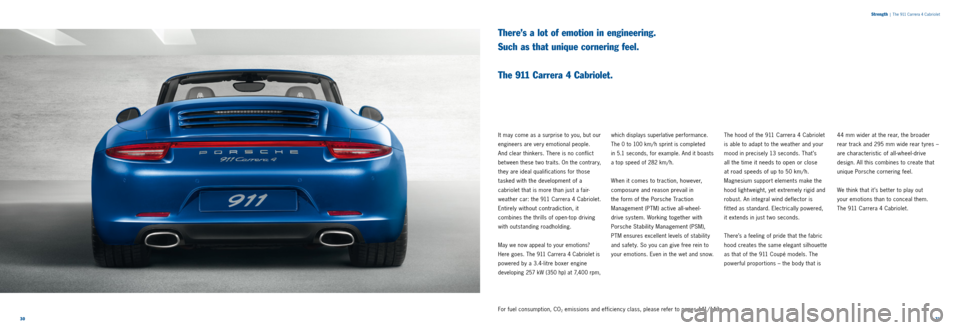
There’s a lot of emotion in engineering.
Such as that unique cornering feel.
The 911 Carrera 4 Cabriolet.
The hood of the 911 Carrera 4 Cabriolet
is able to adapt to the weather and your
mood in precisely 13 seconds. That ’s
all the time it needs to open or close
at road speeds of up to 50 km/ h.
Magnesium support elements make the
hood light weight, yet extremely rigid and
robust. An integral wind deflector is
fit ted as standard. Electrically powered,
it extends in just t wo seconds.
There’s a feeling of pride that the fabric
hood creates the same elegant silhouet te
as that of the 911 Coupé models. The
powerful proportions – the body that is 44 mm wider at the rear, the broader
rear track and 295 mm wide rear t yres –
are characteristic of all-wheel-drive
design. All this combines to create that
unique Porsche cornering feel.
We think that it ’s bet ter to play out
your emotions than to conceal them.
The 911 Carrera 4 Cabriolet.
For fuel consumption, CO
2 emissions and efficiency class, please refer to pages 141/143.
Page 17 of 75
3233
Which vital ingredients do you need to
experience moments of true happiness?
It ’s our conviction, at least, that you need
impressive roadholding. Plus safety,
reliabilit y and faith in technology that won’t
let you down when you need it most.
Because only when we have peace of
mind are we truly free.
All these ingredients have been brought
together in the 911 Carrera 4S Cabriolet.
The car, powered by a 3.8-litre direct fuel
injection (DFI) engine with a maximum
output of 294 kW (400 hp) at 7,400 rpm,
sprints from 0 to 100 km / h in
4.7 seconds and boasts a top speed of
296 km/ h.
Strength | The 911 Carrera 4S Cabriolet
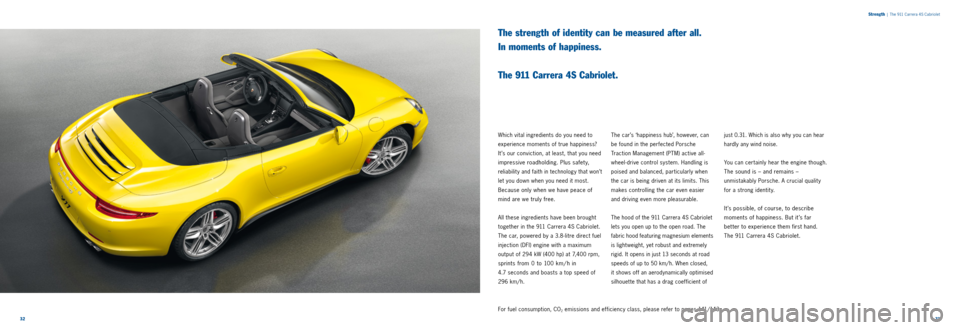
The strength of identity can be measured after all.
In moments of happiness.
The 911 Carrera 4S Cabriolet.
The car’s ‘happiness hub’, however, can
be found in the perfected Porsche
Traction Management (PTM) active all-
wheel-drive control system. Handling is
poised and balanced, particularly when
the car is being driven at its limits. This
makes controlling the car even easier
and driving even more pleasurable.
The hood of the 911 Carrera 4S Cabriolet
lets you open up to the open road. The
fabric hood featuring magnesium elements
is light weight, yet robust and extremely
rigid. It opens in just 13 seconds at road
speeds of up to 50 km/ h. When closed,
it shows off an aerodynamically optimised
silhouet te that has a drag coefficient of just 0.31. Which is also why you can hear
hardly any wind noise.
You can certainly hear the engine though.
The sound is – and remains –
unmistakably Porsche. A crucial quality
for a strong identit y.
It’s possible, of course, to describe
moments of happiness. But it’s far
bet ter to experience them first hand.
The 911
Carrera 4S Cabriolet.
For fuel consumption, CO2 emissions and efficiency class, please refer to pages 141/143.
Page 20 of 75
1
2
3
4
5
6
7
89
10
11
12
13
14
15
16
17
18
19
20
21
22
23
2425
26
27
28
29
30
31
3839
T
emperament
| Engine
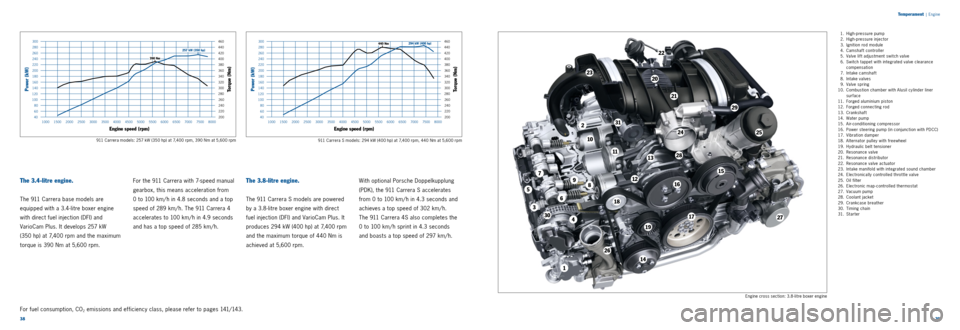
Engine cross section: 3.8
-litre boxer engine
911 Carrera S models: 294 kW (400 hp) at 7,400 rpm, 440 Nm at 5,600 rpm
1. High - pressure pump
2. High - pressure injector
3. Ignition rod module
4. Camshaf t controller
5. Valve lif t adjustment switch valve
6. Switch tappet with integrated valve clearance
compensation
7. Intake camshaf t
8. Intake valves
9. Valve spring
10. Combustion chamber with Alusil cylinder liner
surface
11. Forged aluminium piston
12. Forged connecting rod
13. Crankshaf t
14. Water pump
15. Air-conditioning compressor
16. Power steering pump (in conjunction with PDCC)
17. Vibration damper
18. Alternator pulley with freewheel
19. Hydraulic belt tensioner
20. Resonance valve
21. Resonance distributor
22. Resonance valve actuator
23. Intake manifold with integrated sound chamber
24. Electronically controlled throt tle valve
25. Oil filter
26. Electronic map -controlled thermostat
27. Vacuum pump
28. Coolant jacket
29. Crankcase breather
30. Timing chain
31. Star ter
911 Carrera models: 257 kW (350 hp) at 7,400 rpm, 390 Nm at 5,600 rpm
The 3.4-litre engine.
The 911 Carrera base models are
equipped with a 3.4-litre boxer engine
with direct fuel injection (DFI) and
VarioCam Plus. It develops 257 kW
(350 hp) at 7,400 rpm and the maximum
torque is 390 Nm at 5,600 rpm.
For the 911 Carrera with 7-speed manual
gearbox, this means acceleration from
0 to 100 km/ h in 4.8 seconds and a top
speed of 289
km/ h. The 911 Carrera 4
accelerates to 100 km/ h in 4.9 seconds
and has a top speed of 285
km/ h.
For fuel consumption, CO
2 emissions and efficiency class, please refer to pages 141/143.
The 3.8-litre engine.
The 911 Carrera S models are powered
by a 3.8-litre boxer engine with direct
fuel injection (DFI) and VarioCam Plus. It
produces 294 kW (400 hp) at 7,400 rpm
and the maximum torque of 440 Nm is
achieved at 5,600 rpm. With optional Porsche Doppelkupplung
(PDK), the 911 Carrera S accelerates
from 0 to 100 km/ h in 4.3 seconds and
achieves a top speed of 302
km/ h.
T h e 911
Carrera 4S also completes the
0 to 100
km/ h sprint in 4.3 seconds
and boasts a top speed of 297
km/ h.
40 60 80
100
120 140 160 180 200 220 240 260
1500 75008000
2000 2500300035004000450050005500600065007000
1000
294 kW (400 hp)440 Nm
300
280
Power (kW)
T orque (Nm)
Engine speed (rpm)
200
280 300 320 340 360 380 400 420
220 240 260
460
44040
60 80
100
120 140 160 180 200 220 240 260
1500 75008000
2000 2500300035004000450050005500600065007000
1000
300
280
Power (kW)
T orque (Nm)
Engine speed (rpm)
200
280 300 320 340 360 380 400 420
220 240 260
460
440
257 kW (350 hp)
390 Nm
Page 26 of 75
5051
It is possible to have a lot of power yet not
be able to use it. Only by using your power
intelligently will you truly progress – and
with consummate ease.
Porsche Traction
Management (PTM) is
standard on all 911 Carrera all-wheel-drive
models. It is an active all-wheel- drive
system with an electronically variable
map-controlled multi-plate clutch,
automatic brake differential (ABD) and
anti-slip regulation (ASR). Drive power is distributed bet ween the
permanently driven rear axle and the
front axle by means of the electronically
variable multi
-plate clutch.
The status of the vehicle is continuously
monitored so that it is possible to respond
to different driving situations. Sensors
are used to collect a range of data, includ -
ing the rotational speed of all four wheels,
the lateral and longitudinal acceleration
of the car and the current steering angle. If, for example, the rear wheels begin
to lose traction under acceleration, a
greater proportion of the drive power
is automatically transmit ted to the front
axle by a more positive engagement of
the multi-
plate clutch. In addition, ASR
prevents wheel spin by adapting the
engine’s power output. During cornering,
the optimal level of drive power is
dis
tributed to the front wheels to ensure
excellent lateral stability. In conjunction with Porsche Stability
Management (PSM), PTM helps to ensure
the perfect distribution of drive power for
optimum traction in most road scenarios,
whether on long straights, through tight
corners, or on surfaces with different
friction coefficients.
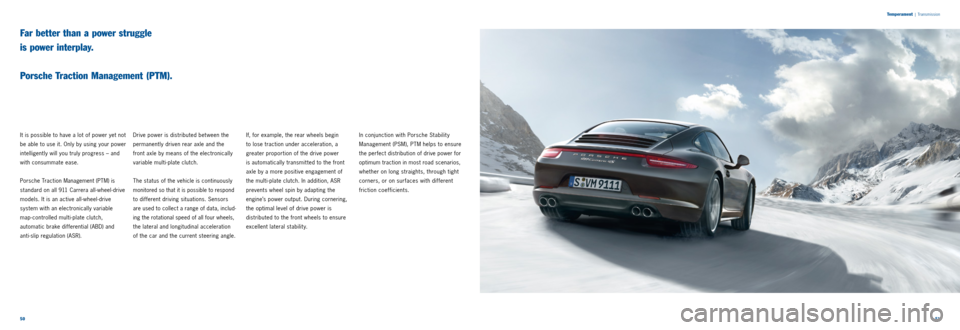
Far better than a power struggle
is power interplay.
Porsche Traction Management (PTM).
T
emperament | Transmission
Page 27 of 75
5253
T
emperament
| Chassis and body
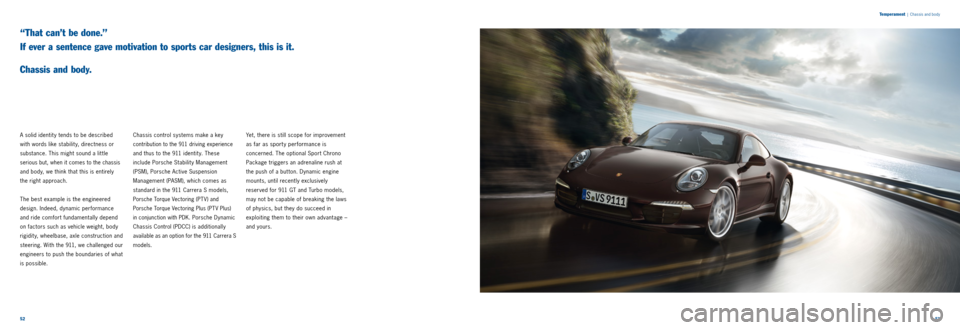
“That can’t be done.”
If ever a sentence gave motivation to sports car designers, this is it.
Chassis and body.
A solid identit y tends to be described
with words like stability, directness or
substance. This might sound a lit tle
serious but, when it comes to the chassis
and body, we think that this is entirely
the right approach.
The best example is the engineered
design. Indeed, dynamic performance
and ride comfort fundamentally depend
on factors such as vehicle weight, body
rigidity, wheelbase, axle construction and
steering. With the 911, we challenged our
engineers to push the boundaries of what
is possible. Chassis control systems make a key
contribution to the 911 driving experience
and thus to the 911 identit y. These
include Porsche Stability Management
(PSM), Porsche Active Suspension
Management (PASM), which comes as
standard in the 911 Carrera S models,
Porsche Torque Vectoring (PT V) and
Porsche Torque Vectoring Plus (PT V Plus)
in conjunction with PDK. Porsche Dynamic
Chassis Control (PDCC) is additionally
available as an option for the 911 Carrera S
models.
Yet, there is still scope for improvement
as far as sport y performance is
concerned. The optional Sport Chrono
Package triggers an adrenaline rush at
the push of a but ton. Dynamic engine
mounts, until recently exclusively
reserved for 911
GT and Turbo models,
may not be capable of breaking the laws
of physics, but they do succeed in
exploiting them to their own advantage –
and yours.
Page 28 of 75
5455
T
emperament
| Chassis and body
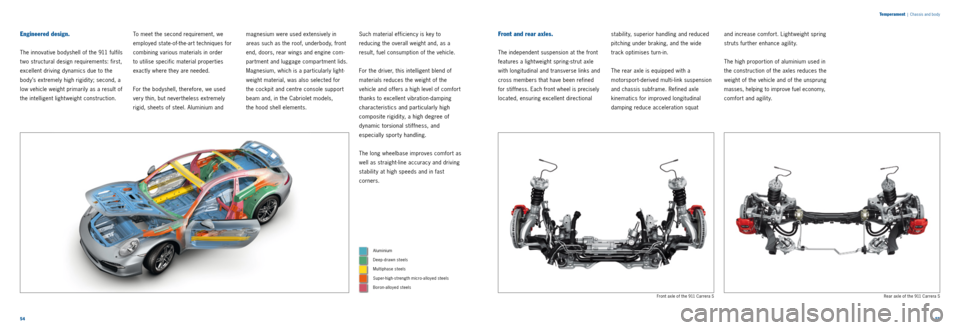
Aluminium
Deep -drawn steels
Multiphase steels
Super- high -strength micro -alloyed steels
Boron- alloyed steels
Front and rear axles.
The independent suspension at the front
features a light weight spring-strut axle
with longitudinal and transverse links and
cross members that have been refined
for stiffness. Each front wheel is precisely
located, ensuring excellent directional stability, superior handling and reduced
pitching under braking, and the wide
track optimises turn-
in.
The rear axle is equipped with a
motorsport- derived multi -link suspension
and chassis subframe. Refined axle
kinematics for improved longitudinal
damping reduce acceleration squat and increase comfort. Light weight spring
struts further enhance agilit y.
The high proportion of aluminium used in
the construction of the axles reduces the
weight of the vehicle and of the unsprung masses, helping to improve fuel economy,
comfort and agility.
Rear axle of the 911 Carrera S
Front axle of the 911 Carrera S
Engineered design.
The innovative bodyshell of the 911 fulfils
t wo structural design requirements: first,
excellent driving dynamics due to the
body’s extremely high rigidit y; second, a
low vehicle weight primarily as a result of
the intelligent lightweight construction.
To meet the second requirement, we
employed state -of -the- art techniques for
combining various materials in order
to utilise specific material properties
exactly where they are needed.
For the bodyshell, therefore, we used
very thin, but nevertheless extremely
rigid, sheets of steel. Aluminium and magnesium were used extensively in
areas such as the roof, underbody, front
end, doors, rear wings and engine com
-
partment and luggage compartment lids.
Magnesium, which is a particularly light -
weight material, was also selected for
the cockpit and centre console support
beam and, in the Cabriolet models,
the hood shell elements. Such material efficiency is key to
reducing the overall weight and, as a
result, fuel consumption of the vehicle.
For the driver, this intelligent blend of
materials reduces the weight of the
vehicle and offers a high level of comfort
thanks to excellent vibration-damping
characteristics and particularly high
composite rigidit y, a high degree of
dynamic torsional stiffness, and
especially sporty handling.
The long wheelbase improves comfort as
well as straight-line accuracy and driving
stabilit y at high speeds and in fast
corners.
Page 31 of 75
6061
T
emperament
| Chassis and body
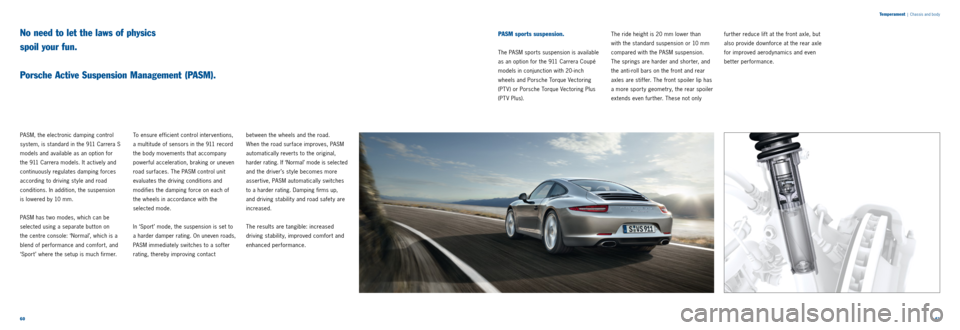
PASM, the electronic damping control
system, is standard in the 911 Carrera S
models and available as an option for
the 911 Carrera models. It actively and
continuously regulates damping forces
according to driving st yle and road
conditions. In addition, the suspension
is lowered by 10 mm.
PASM has t wo modes, which can be
selected using a separate but ton on
the centre console: ‘Normal’, which is a
blend of performance and comfort, and
‘Sport ’ where the setup is much firmer. To ensure efficient control interventions,
a multitude of sensors in the 911 record
the body movements that accompany
powerful acceleration, braking or uneven
road surfaces. The PASM control unit
evaluates the driving conditions and
modifies the damping force on each of
the wheels in accordance with the
selected mode.
In ‘Sport ’ mode, the suspension is set to
a harder damper rating. On uneven roads,
PASM immediately switches to a softer
rating, thereby improving contact bet ween the wheels and the road.
When the road surface improves, PASM
automatically reverts to the original,
harder rating. If ‘Normal’ mode is selected
and the driver’s st yle becomes more
assertive, PASM automatically switches
to a harder rating. Damping firms up,
and driving stabilit y and road safet y are
increased.
The results are tangible: increased
driving stability, improved comfort and
enhanced performance.
No need to let the laws of physics
spoil your fun.
Porsche Active Suspension Management (PASM).PASM sports suspension.
The PASM sports suspension is available
as an option for the 911 Carrera Coupé
models in conjunction with 20-inch
wheels and Porsche Torque Vectoring
(PT V) or Porsche Torque Vectoring Plus
(PTV Plus). The ride height is 20 mm lower than
with the standard suspension or 10 mm
compared with the PASM suspension.
The springs are harder and shorter, and
the anti-roll bars on the front and rear
axles are stiffer. The front spoiler lip has
a more sport y geometry, the rear spoiler
extends even further. These not only further reduce lift at the front axle, but
also provide downforce at the rear axle
for improved aerodynamics and even
better performance.
Page 32 of 75
6263
T
emperament
| Chassis and body
With the optional Porsche Dynamic
Chassis Control (PDCC) for the S models
of the 911 Carrera, these characteristics
can be further accentuated: the vehicle
holds the road even bet ter and delivers
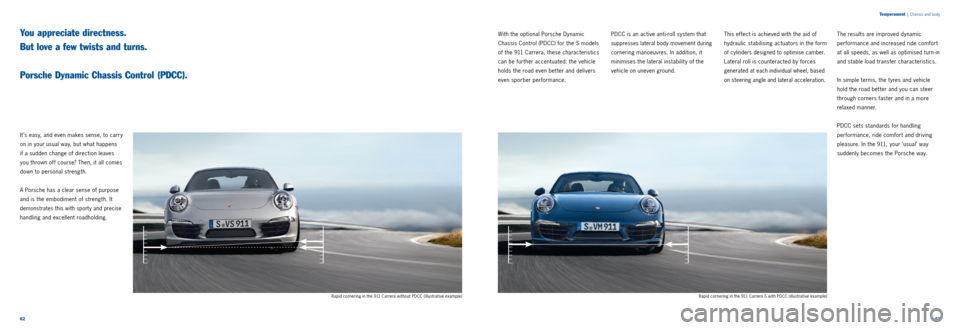
even sportier performance. PDCC is an active anti-
roll system that
suppresses lateral body movement during
cornering manoeuvres. In addition, it
minimises the lateral instability of the
vehicle on uneven ground. This effect is achieved with the aid of
hydraulic stabilising actuators in the form
of cylinders designed to optimise camber.
Lateral roll is counteracted by forces
generated at each individual wheel, based
on steering angle and lateral acceleration.
Rapid cornering in the 911 Carrera without PDCC (illustrative example) Rapid cornering in the 911 Carrera S with PDCC (illustrative example)
The results are improved dynamic
performance and increased ride comfort
at all speeds, as well as optimised turn-in
and stable load transfer characteristics.
In simple terms, the t yres and vehicle
hold the road bet ter and you can steer
through corners faster and in a more
relaxed manner.
PDCC sets standards for handling
performance, ride comfort and driving
pleasure. In the 911, your ‘usual’ way
suddenly becomes the Porsche way.
It ’s easy, and even makes sense, to carry
on in your usual way, but what happens
if a sudden change of direction leaves
you thrown off course? Then, it all comes
down to personal strength.
A Porsche has a clear sense of purpose
and is the embodiment of strength. It
demonstrates this with sport y and precise
handling and excellent roadholding.
You appreciate directness.
But love a few twists and turns.
Porsche Dynamic Chassis Control (PDCC).
Page 33 of 75
6465
T
emperament
| Chassis and body
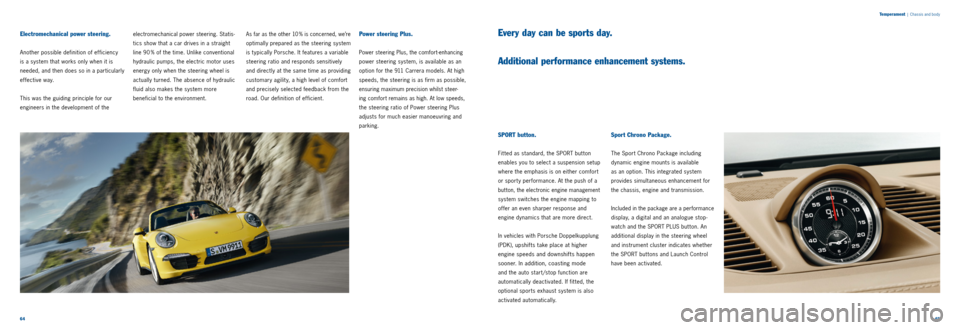
SPORT button.
Fit ted as standard, the SPORT but ton
enables you to select a suspension setup
where the emphasis is on either comfort
or sport y performance. At the push of a
button, the electronic engine management
system switches the engine mapping to
offer an even sharper response and
engine dynamics that are more direct.
In vehicles with Porsche Doppelkupplung
(PDK), upshifts take place at higher
engine speeds and downshifts happen
sooner. In addition, coasting mode
and the auto start/stop function are
automatically deactivated. If fitted, the
optional sports exhaust system is also
activated automatically.
Sport Chrono Package.
The Sport Chrono Package including
dynamic engine mounts is available
as an option. This integrated system
provides simultaneous enhancement for
the chassis, engine and transmission.
Included in the package are a performance
display, a digital and an analogue stop -
watch and the SPORT PLUS but ton. An
additional display in the steering wheel
and instrument cluster indicates whether
the SPORT but tons and Launch Control
have been activated.
Every day can be sports day.
Additional performance enhancement systems.Electromechanical power steering.
Another possible definition of efficiency
is a system that works only when it is
needed, and then does so in a particularly
effective way.
This was the guiding principle for our
engineers in the development of the electromechanical power steering. Statis-
tics show that a car drives in a straight
line 90 % of the time. Unlike conventional
hydraulic pumps, the electric motor uses
energy only when the steering wheel is
actually turned. The absence of hydraulic
fluid also makes the system more
bene ficial to the environment.
As far as the other 10 % is concerned, we’re
optimally prepared as the steering system
is t ypically Porsche. It features a variable
steering ratio and responds sensitively
and directly at the same time as providing
customary agilit y, a high level of comfort
and precisely selected feedback from the
road. Our definition of efficient.
Power steering Plus.
Power steering Plus, the comfort-enhancing
power steering system, is available as an
option for the 911 Carrera models. At high
speeds, the steering is as firm as possible,
ensuring maximum precision whilst steer-
ing comfort remains as high. At low speeds,
the steering ratio of Power steering Plus
adjusts for much easier manoeuvring and
parking.
Page 34 of 75
6667
T
emperament
| Chassis and body
On activation of SPORT PLUS mode,
Porsche Active Suspension Management
(PASM) and, in the 911 Carrera S models,
optional Porsche Dynamic Chassis
Control (PDCC) switch to a harder
damping set ting and offer more direct
steering and, therefore, better
roadholding. In SPORT PLUS mode, the trigger
threshold for PSM is raised. Agilit y is
perceptibly enhanced when braking for
corners with PSM, allowing sportier
braking and exit acceleration. For even
greater dexterit y, PSM can be set to
standby while the car is still in
SPORT PLUS mode. For safet y, it is
set to intervene automatically only
when ABS assistance is required on both
the front wheels.
In combination with PDK, the Sport
Chrono Package has t wo additional
functions for a sport y drive that borders
on a motorsport experience. The first is ‘Launch Control’, which can be used
on the track to achieve the best
possible standing start – a racing start.
The second function is the ‘motorsport-
derived gearshift strategy’. Using this,
Porsche Doppelkupplung (PDK) is geared
up for extremely short shift times and optimum shift points for the maximum
acceleration available. This combination
of uncompromising and involving perfor-
mance is ideal for the racetrack.
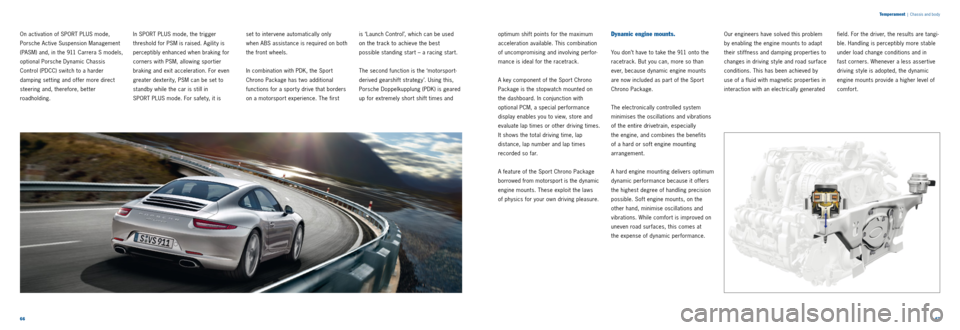
A key component of the Sport Chrono
Package is the stopwatch mounted on
the dashboard. In conjunction with
optional PCM, a special performance
display enables you to view, store and
evaluate lap times or other driving times.
It shows the total driving time, lap
distance, lap number and lap times
recorded so far.
A feature of the Sport Chrono Package
borrowed from motorsport is the dynamic
engine mounts. These exploit the laws
of physics for your own driving pleasure.
Dynamic engine mounts.
You don’t have to take the 911 onto the
racetrack. But you can, more so than
ever, because dynamic engine mounts
are now included as part of the Sport
Chrono Package.
The electronically controlled system
minimises the oscillations and vibrations
of the entire drivetrain, especially
the engine, and combines the benefits
of a hard or soft engine mounting
arrangement.
A hard engine mounting delivers optimum
dynamic performance because it offers
the highest degree of handling precision
possible. Soft engine mounts, on the
other hand, minimise oscillations and
vibrations. While comfort is improved on
uneven road surfaces, this comes at
the expense of dynamic performance. Our engineers have solved this problem
by enabling the engine mounts to adapt
their stiffness and damping properties to
changes in driving st yle and road surface
conditions. This has been achieved by
use of a fluid with magnetic properties in
interaction with an electrically generated
field. For the driver, the results are tangi-
ble. Handling is perceptibly more stable
under load change conditions and in
fast corners. Whenever a less assertive
driving st yle is adopted, the dynamic
engine mounts provide a higher level of
comfor t.