ESP PORSCHE 911 CARRERA 2005 5.G Owners Manual
[x] Cancel search | Manufacturer: PORSCHE, Model Year: 2005, Model line: 911 CARRERA, Model: PORSCHE 911 CARRERA 2005 5.GPages: 282, PDF Size: 4.34 MB
Page 4 of 282

4Fuel QualityYour engine is designed to provide optimum performance and fuel economy using
unleaded premium fuel with an octane rating of 98 RON (93 CLC or AKI).
Porsche therefore recommends the use of these fuels in your vehicle.
Porsche also recognizes that these fuels may not always be available. Be assured that your vehicle will operate
properly on unleaded premium fuels with octane numbers of at least 95 RON (90 CLC or AKI),
since the engine’s ”Electronic Oktane™ knock control“ will adapt the ignition timing, if necessary.Fuels containing alcohol and etherSome areas of the U.S. require oxygenated fuels during certain portions of the year.
Oxygenated fuels are fuels which contain alcohols (such as methanol or ethanol) or ether (such as MTBE).
Under normal conditions, the amount of these compounds in the fuel will not affect driveability.
You may use oxygenated fuels in your Porsche, provided the octane requirements for your vehicle are met.
We recommend, however, to change to a different fuel or station if any of the following problems occur with your vehicle:
– Deterioration of driveability and performance.
– Substantially reduced fuel economy.
– Vapor lock and non-start problems, especially at high altitude or at high temperature.
– Engine malfunction or stalling.Fuels containing MMTSome North American fuels contain an octane enhancing additive called methylcyclopentadienyl manganese tricarbonyl (MMT).
If such fuels are used, your emission control system performance may be negatively affected.
The check engine warning lights on your instrument panel may turn on.
If this occurs, Porsche recommends you stop using fuels containing MMT.
Page 15 of 282

Controls, Instruments
15
In the driver’s seat... fCheck operation of the horn.
fPosition seat for easy reach of foot pedals and
controls.
To reduce the possibility of injury from the
airbag deployment, you should always sit back
as far from the steering wheel as is practical,
while still maintaining full vehicle control.
fAdjust the inside and outside rear view mirrors.
fBuckle your safety belts.
fCheck operation of the foot and parking brake.
fCheck all warning and indicator lights with
ignition on and engine not running.
fStart engine and check all warning displays for
warning symbols.
fNever leave an idling car unattended.
fLock doors from inside, especially with chil-
dren in the car to prevent inadvertent opening
of doors from inside or outside.
Drive with doors locked.
On the road... fNever drive after you have consumed alcohol
or drugs.
fAlways have your safety belt fastened.
fAlways drive defensively.
Expect the unexpected.
fUse signals to indicate turns and lane changes.
fTurn on headlights at dusk or when the driving
conditions warrant it.
fAlways keep a safe distance from the vehicle in
front of you, depending on traffic, road and
weather conditions.
fReduce speed at night and during inclement
weather.
Driving in wet weather requires caution and re-
duced speeds, particularly on roads with
standing water, as the handling characteristics
of the vehicle may be impaired due to hydro-
planing of the tires.
fAlways observe speed limits and obey road
signs and traffic laws.
fWhen tired, get well off the road, stop and take
a rest. Turn the engine off. Do not sit in the ve-
hicle with engine idling.
Please observe the chapter “ENGINE EX-
HAUST” on Page 9.fWhen parked, always set the parking brake.
Move the Tiptronic selector lever to ”P“ or the
gearshift lever to reverse or first gear.
On hills also turn the front wheels toward the
curb.
fWhen emergency repairs become necessary,
move the vehicle well off the road. Turn on the
emergency flasher and use other warning de-
vices to alert other motorists. Do not park or
operate the vehicle in areas where the hot ex-
haust system may come in contact with dry
grass, brush, fuel spill or other flammable ma-
terial.
fMake it a habit to have the engine oil checked
after every fuel filling.
Page 16 of 282

16
Controls, Instruments
Break in hints for the first
2,000 miles/3,000 kilometers The following tips will be helpful in obtaining opti-
mum performance from your new Porsche.
Despite the most modern, high-precision manufac-
turing methods, it cannot be completely avoided
that the moving parts have to wear in with each
other. This wearing-in occurs mainly in the first
2,000 miles/3,000 km. Therefore: fPreferably take longer trips.
fAvoid frequent cold starts with short-distance
driving whenever possible.
fAvoid full throttle starts and abrupt stops.
fDo not exceed maximum engine speed of
4,200 rpm (revolutions per minute).
fDo not run a cold engine at high rpm either in
Neutral or in gear.
fDo not let the engine labor, especially when
driving uphill. Shift to the next lower gear in
time (use the most favorable rpm range).
fNever lug the engine in high gear at low
speeds. This rule applies at all times, not just
during the break-in period. fDo not participate in motor racing events,
sports driving schools, etc. during the first
2,000 miles/3,000 kilometers.
There may be a slight stiffness in the steering,
gear-shifting or other controls during the break-in
period which will gradually disappear.
Break in brake pads and brake discsNew brake pads and discs have to be “broken in”,
and therefore only attain optimal friction when the
car has covered several hundred miles or km.
The slightly reduced braking ability must be com-
pensated for by pressing the brake pedal harder.
This also applies whenever the brake pads and
brake discs are replaced. New tires New tires do not have maximum traction. They
tend to be slippery.
fBreak in new tires by driving at moderate
speeds during the first 60 to 120 miles/100 to
200 km. Longer braking distances must be an-
ticipated.
Engine oil consumption During the break-in period oil consumption may be
higher than normal.
As always, the rate of oil consumption depends on
the quality and viscosity of oil, the speed at which
the engine is operated, the climate and road con-
ditions, as well as the amount of dilution and oxi-
dation of the lubricant.
fMake a habit of checking engine oil with every
fuel filling, add if necessary.
Page 18 of 282

18
Controls, Instruments
Never invite car theft! An unlocked car with the key in the ignition lock
invites car theft.
A steering wheel lock and a gong alarm are
standard equipment in your Porsche.
The gong alarm will sound if you open the driver’s
door while the key is still in the ignition lock. It is
your reminder to pull the key out of the ignition
lock and to lock the doors.
Warning!
Any uncontrolled movement of the vehicle
may result in serious personal injury and
property damage.
Never leave your vehicle unattended with the
key in the ignition lock, especially if children
and/or pets are left unattended in the vehi-
cle. They can operate power windows and
other controls. If the engine is left running,
they may accidentally engage the shift lever.
fAlways remove the ignition key.
fAlways set the parking brake.
fLock the doors with the remote control.
Warning!
Risk of a serious accident.
The steering column will lock when you re-
move the key while you are driving or as the
car is rolling to a stop. You will not be able to
steer the car.
fNever remove the key from the steering lock while you are driving. To protect your vehicle and your possessions
from theft, you should always proceed as
follows when leaving your vehicle:
fClose windows.
fClose lifting/sliding roof
fClose convertible top (with the convertible top
open, the passenger compartment monitoring
system is always switched off)
fRemove ignition key.
fEngage steering lock.
fLock glove compartment.
fRemove valuables (e.g. car documents, tele-
phone, house keys) from the car.
fLock doors.
Page 22 of 282

22
Controls, Instruments
Central Locking This device complies with:
Part 15 of the FCC Rules
RSS-210 of Industry Canada.
Operation is subject to the following two condi-
tions:
1. This device may not cause harmful interfer-
ence, and
2. this device must accept any interference re-
ceived, including interference that may cause
undesired operation.
Note
The manufacturer is not responsible for any radio
or TV interference caused by unauthorized modifi-
cations to this equipment.
Such modification could void the user’s authority
to operate the equipment.
Warning!
Any changes or modifications not expressly ap-
proved by Porsche could void the user’s authority
to operate this equipment.
fPlease observe the chapter “LOAD SWITCH-
OFF AFTER 2 HOURS OR 7 DAYS” on
Page 233.
fPlease observe the chapter “SEAT MEMORY”
on Page 36.Both car doors and the filler flap can be centrally
unlocked or locked with the remote control.
The vehicle cannot be locked if the driver’s door is
not completely closed.
A short signal from the alarm horn will draw
your attention to the fact that the following
components are not completely closed when you
try to lock the vehicle:
– Passenger’s door
– Luggage compartment lid
– Engine compartment lid
– Glove compartment
Unlocking the vehicle by using the key in the door
lock and opening the door may activate the alarm
system within 10 seconds.
Note
On vehicles with the Sport Chrono package, the
PCM can be used to activate automatic door
locking.
Please observe the chapter “Individual Memory” in
the separate PCM operating instructions.
Automatic relocking If the car is unlocked by remote control and none
of the car doors is opened within approx.
60 seconds, automatic relocking takes place.
This relocking time can be adapted to your individ-
ual requirements (10 - 100 seconds) by an author-
ized Porsche dealer.
Page 24 of 282
24
Controls, Instruments
Indication by emergency flasher and
alarm horn If the remote control is used for unlocking or
locking, a response is provided by the emergency
flasher:
– Unlocking – single flash.
– Locking – double flash.
– Locking twice – continuous illumination for ap-
prox. 2 seconds. Fault indication A double horn signal during locking indicates a
defect in the central locking or alarm system.
Have the defect remedied at an authorized
Porsche dealer. Overload protectionIf the central locking system is operated more
than ten times within a minute, further operation is
blocked for 30 seconds.
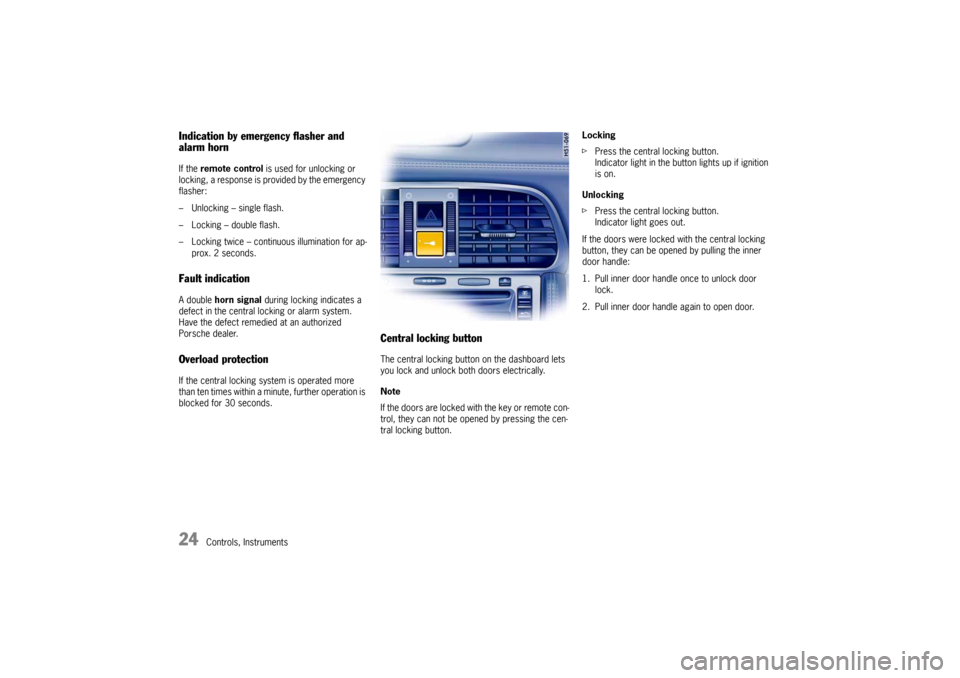
Central locking buttonThe central locking button on the dashboard lets
you lock and unlock both doors electrically.
Note
If the doors are locked with the key or remote con-
trol, they can not be opened by pressing the cen-
tral locking button.Locking
fPress the central locking button.
Indicator light in the button lights up if ignition
is on.
Unlocking
fPress the central locking button.
Indicator light goes out.
If the doors were locked with the central locking
button, they can be opened by pulling the inner
door handle:
1. Pull inner door handle once to unlock door
lock.
2. Pull inner door handle again to open door.
Page 26 of 282
26
Controls, Instruments
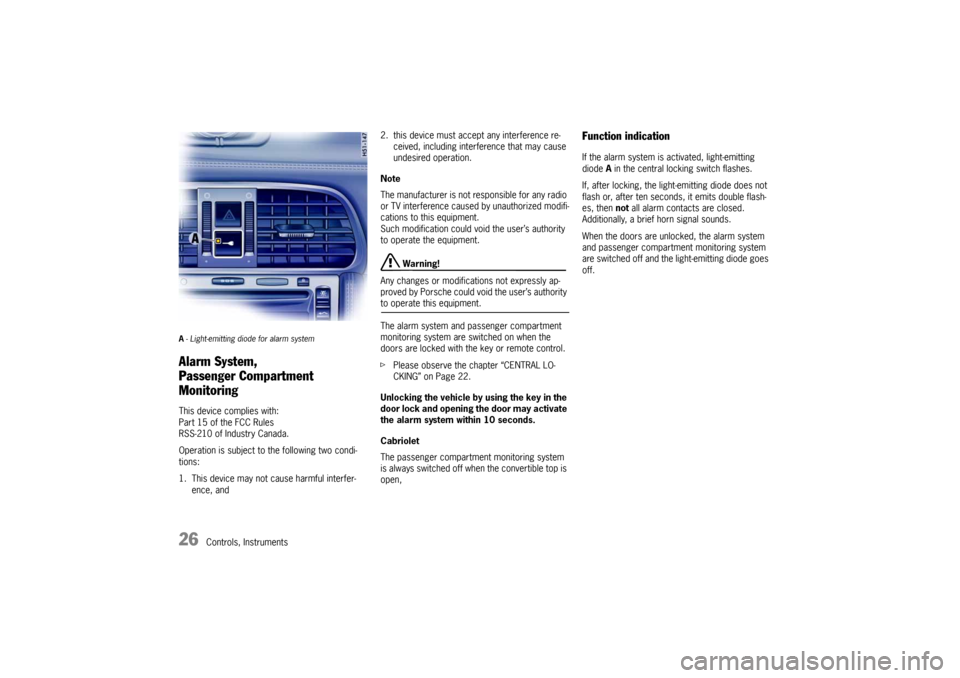
A- Light-emitting diode for alarm systemAlarm System,
Passenger Compartment
MonitoringThis device complies with:
Part 15 of the FCC Rules
RSS-210 of Industry Canada.
Operation is subject to the following two condi-
tions:
1. This device may not cause harmful interfer-
ence, and2. this device must accept any interference re-
ceived, including interference that may cause
undesired operation.
Note
The manufacturer is not responsible for any radio
or TV interference caused by unauthorized modifi-
cations to this equipment.
Such modification could void the user’s authority
to operate the equipment.
Warning!
Any changes or modifications not expressly ap-
proved by Porsche could void the user’s authority
to operate this equipment.
The alarm system and passenger compartment
monitoring system are switched on when the
doors are locked with the key or remote control.
fPlease observe the chapter “CENTRAL LO-
CKING” on Page 22.
Unlocking the vehicle by using the key in the
door lock and opening the door may activate
the alarm system within 10 seconds.
Cabriolet
The passenger compartment monitoring system
is always switched off when the convertible top is
open,
Function indication If the alarm system is activated, light-emitting
diode A in the central locking switch flashes.
If, after locking, the light-emitting diode does not
flash or, after ten seconds, it emits double flash-
es, then not all alarm contacts are closed.
Additionally, a brief horn signal sounds.
When the doors are unlocked, the alarm system
and passenger compartment monitoring system
are switched off and the light-emitting diode goes
off.
Page 28 of 282
28
Controls, Instruments
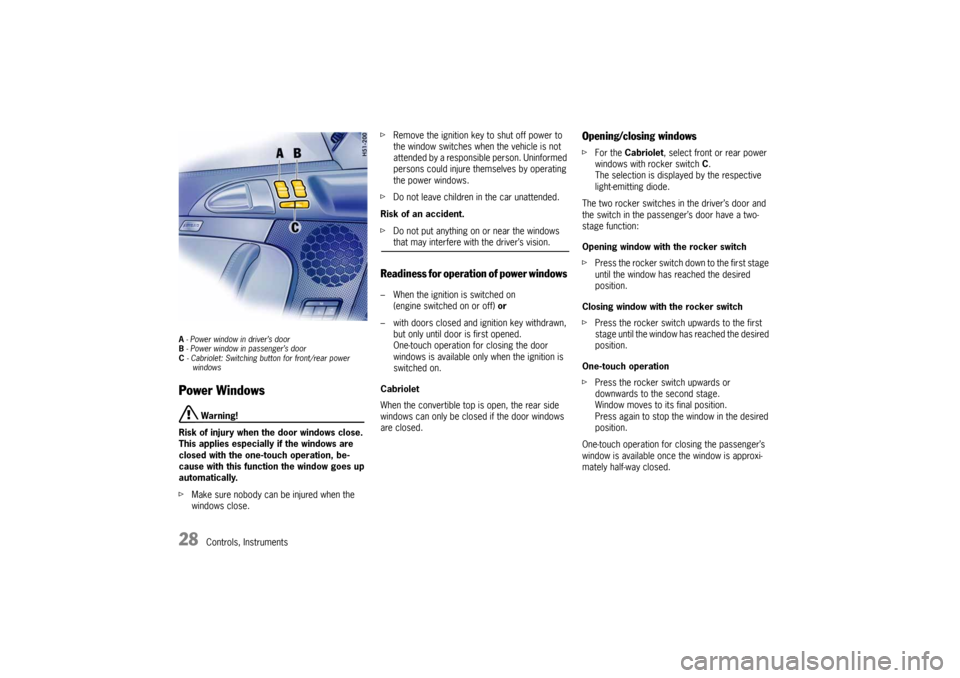
A - Power window in driver’s door
B - Power window in passenger’s door
C - Cabriolet: Switching button for front/rear power
windowsPower Windows
Warning!
Risk of injury when the door windows close.
This applies especially if the windows are
closed with the one-touch operation, be-
cause with this function the window goes up
automatically.
fMake sure nobody can be injured when the
windows close. fRemove the ignition key to shut off power to
the window switches when the vehicle is not
attended by a responsible person. Uninformed
persons could injure themselves by operating
the power windows.
fDo not leave children in the car unattended.
Risk of an accident.
fDo not put anything on or near the windows
that may interfere with the driver’s vision.
Readiness for operation of power windows – When the ignition is switched on
(engine switched on or off) or
– with doors closed and ignition key withdrawn,
but only until door is first opened.
One-touch operation for closing the door
windows is available only when the ignition is
switched on.
Cabriolet
When the convertible top is open, the rear side
windows can only be closed if the door windows
are closed.
Opening/closing windowsfFor the Cabriolet, select front or rear power
windows with rocker switch C.
The selection is displayed by the respective
light-emitting diode.
The two rocker switches in the driver’s door and
the switch in the passenger’s door have a two-
stage function:
Opening window with the rocker switch
fPress the rocker switch down to the first stage
until the window has reached the desired
position.
Closing window with the rocker switch
fPress the rocker switch upwards to the first
stage until the window has reached the desired
position.
One-touch operation
fPress the rocker switch upwards or
downwards to the second stage.
Window moves to its final position.
Press again to stop the window in the desired
position.
One-touch operation for closing the passenger’s
window is available once the window is approxi-
mately half-way closed.
Page 37 of 282

Controls, Instruments
37
Operating with the remote control of the
vehicle keyEach remote control (up to six) can be assigned an
individual seat and door mirror position.
The stored seat and door mirror position is set au-
tomatically when the vehicle is unlocked using the
corresponding remote control.
Storing seat position
1. Apply the handbrake.
2. Switch the ignition on with the desired vehicle
key.
Reverse gear must not be engaged.
3. Set the desired seat and door-mirror positions.
4. Keep memory button M depressed and
additionally press key button 1.
The individual setting is now assigned to this
remote control and to the key button.Storing individual lowered position of the
passenger’s door mirror as a parking aid
Once the driver's seat setting has been stored, an
individual lowered position of the passenger's
door mirror may be stored for driving in reverse:
1. Apply the handbrake.
2. Switch the ignition on with the desired vehicle
key.
3. Engage reverse gear.
4. Select passenger side with mirror switch.
The passenger’s mirror swivels downwards.
5. Set passenger’s door mirror to desired final
position.
6. Keep memory button M depressed and
additionally press key button 1.
The individual setting is now assigned to this
remote control and to the key button.Recalling seat position
fUnlock the locked vehicle or the luggage
compartment with the remote control.
The stored seat position is automatically set.
The seat position assigned to a remote control
can also be recalled with the key button 1 if the
corresponding key was used to switch on the
ignition.
If no seat position has been assigned to a remote
control, the key button will not work.
Note on operation
Automatic seat adjustment can be interrupted
immediately:
– by switching on the ignition,
– by pressing the central locking button,
– by pressing any memory or seat adjustment
button.
Clearing the stored seat position
1. Switch the ignition on with the desired vehicle
key.
2. Press memory button twice and key button 1
once consecutively.
Page 50 of 282

50
Controls, Instruments
Airbag SystemsThe airbags in combination with the safety belts
make up a safety system which offers the driver
and the passenger the greatest known protection
from injuries in case of an accident.
Even though your vehicle is equipped with airbags,
the safety belts are your primary protection
and must be worn at all times.
The airbags can only help protect you where the
impact is of sufficient severity and from a speci-
fied direction.
Therefore, all persons within the vehicle
must always wear safety belts (in many states,
state law requires the use of safety belts).
fPlease observe the chapter “SAFETY BELTS”
on Page 42.
The front airbags are located behind the padded
steering wheel panel on the driver’s side and on
the passenger’s side in the dashboard.
The side airbags are installed in the side of the
seat backrests.
The head airbags are installed in the door linings.
Function Depending on the force and angle of impact, the
corresponding airbags can be triggered.
The inflation process generates the amount of gas
required to fill the airbags at the necessary pres-
sure in fractions of a second. Because of the pos-
sibility of injuries from airbag deployment, airbags
are designed to deploy only when the occupants
would receive substantial additional injuries if the
airbags did not deploy.
Airbags protect the face and upper body, while
simultaneously damping the motion of the driver
and passenger in the impact direction in the event
of a frontal impact or side impact.
Your vehicle is equipped with a crash sensing and
diagnostic module. This module will record the
use of the safety belt restraint system by the driv-
er and front passenger when the side airbags and
head airbags are inflated.
Danger!
To provide optimal occupant protection, air-
bags must inflate at very high speed.
If you are not wearing your safety belt or are
too close to the airbag when its deployed, in-
flating airbags can result in serious personal
injury or death.
fMake sure there are no people, animals or ob-
jects between the driver or passenger and the
area into which the airbag inflates.
fS i t b a c k a s f a r f ro m t h e d a s h b o a rd o r s t e e r i n g
wheel as is practical, while still maintaining full
vehicle control.
fDo not lean against the inside of the doors.
fAlways leave feet in the footwell when driving.
Do not put feet on the dashboard or the seat
cushion.
fAlways hold the steering wheel by the outer
rim.
Never rest your hands on the airbag panel.
fNever transport heavy or sharp objects on or
in front of the passenger seat.
fAlways keep the lid of the door storage com-
partment closed. Objects must not protrude
out of the door storage compartment.
fGive your passenger all of the information in
this chapter.
fNo changes must be made to the wiring or
components of the airbag system.