heating PORSCHE 911 CARRERA 2005 5.G Owners Manual
[x] Cancel search | Manufacturer: PORSCHE, Model Year: 2005, Model line: 911 CARRERA, Model: PORSCHE 911 CARRERA 2005 5.GPages: 282, PDF Size: 4.34 MB
Page 13 of 282

Controls, Instruments
13 Controls, Instruments
Before driving off ......................................... 14
Break in hints .............................................. 16
Keys ........................................................... 19
Security Wheel Bolts.................................... 19
Doors ......................................................... 21
Central Lockin ............................................. 22
Alarm System,
Passenger Compartment Monitorin ............... 26
Power Windows ........................................... 28
Inside mirror ................................................ 30
Door Mirrors................................................ 30
Rear Window Defogger,
Door Mirror Heating ..................................... 33
Seat Adjustment .......................................... 34
Seat Memory ............................................... 36
Heated Seats .............................................. 38
Rear Seat Backrests.................................... 39
Steering Wheel Adjustment ........................... 39
Multi-Functional Steering Wheel ..................... 40
Sun Visors................................................... 41
Safety Belts................................................. 42
Child Restraint Anchorages ........................... 45
Child Restraint Systems ............................... 46
LATCH System
Child seat bracket on the passenger’s seat .... 48
Key-operated airbag deactivation device ........ 49
Airbag Systems ........................................... 50
Rollover Protection System........................... 52
Parking Aids ................................................ 53
Retractable Rear Spoiler............................... 56
Clutch Pedal ................................................ 58
Parking Brake .............................................. 58Brakes ........................................................ 59
ABS Brake System
(Antilock Brake System)................................ 62
Sport Mode ................................................. 64
Porsche Stability Management (PSM)............. 65
Porsche Active Suspension
Management (PASM) .................................... 68
Interior Lights .............................................. 69
Operation, Instruments ................................. 70
Ignition/Starter Switch with anti-theft
Steering Lock .............................................. 72
Starting Procedures ..................................... 74
Stopping Engine .......................................... 75
Instrument Panel USA Models ....................... 76
Instrument Panel Canada Models................... 78
Engine oil temperature ................................. 80
Automatic Speed Control Indicator light ......... 80
Instrument Illumination.................................. 80
Trip Odometer ............................................. 81
Speedometer .............................................. 82
Changing over between
Miles / Kilometers........................................ 82
Tachometer................................................. 83
Turn Signal Indicator Light ............................ 83
High Beam .................................................. 83
Cooling System ........................................... 84
Tiptronic ..................................................... 85
Fuel ............................................................ 86
Clock .......................................................... 87
Outside temperature .................................... 87
Engine Oil Pressure ...................................... 88
Check Engine Warning Light.......................... 89On-Board Computer (BC).............................. 90
Emergency Flasher Switch .......................... 112
Light Switch .............................................. 113
Welcome Home Lighting............................. 113
Automatic Headlight Beam Adjustment......... 114
Turn Signal / Headlight Dimmer /
Parking light / Flasher Lever ....................... 114
Windshield Wiper / Washer Lever ................ 115
Automatic Speed Control ............................ 118
Automatic Air Conditioning System .............. 120
Central and Side Vents ............................... 123
Fresh-air Intake .......................................... 123
Ashtray ..................................................... 124
Cigarette Lighter ........................................ 125
Cupholder ................................................. 126
Storage in the Passenger Compartment ...... 128
Luggage Compartment Lid and
Engine Compartment Lid ............................ 130
Luggage Compartment............................... 132
Trunk Entrapment ....................................... 133
Fire Extinguisher ........................................ 135
HomeLink .................................................. 136
Porsche Communication
Management (PCM) .................................... 139
Car Telephone and Aftermarket Alarms........ 142
Page 33 of 282
Controls, Instruments
33
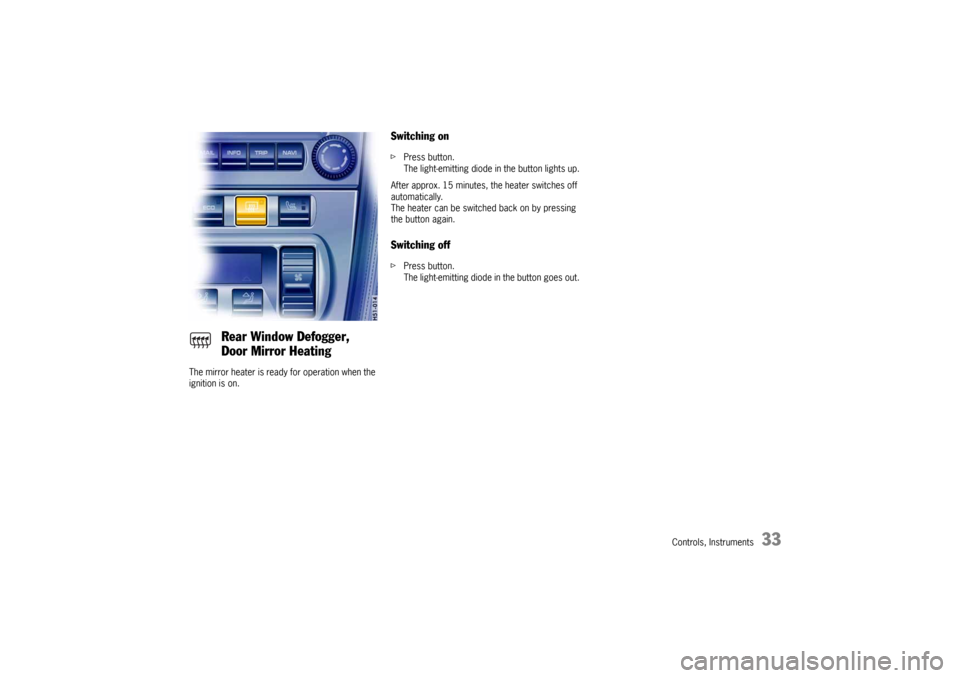
The mirror heater is ready for operation when the
ignition is on.
Switching on fPress button.
The light-emitting diode in the button lights up.
After approx. 15 minutes, the heater switches off
automatically.
The heater can be switched back on by pressing
the button again.Switching off fPress button.
The light-emitting diode in the button goes out.
Rear Window Defogger,
Door Mirror Heating
Page 38 of 282
38
Controls, Instruments
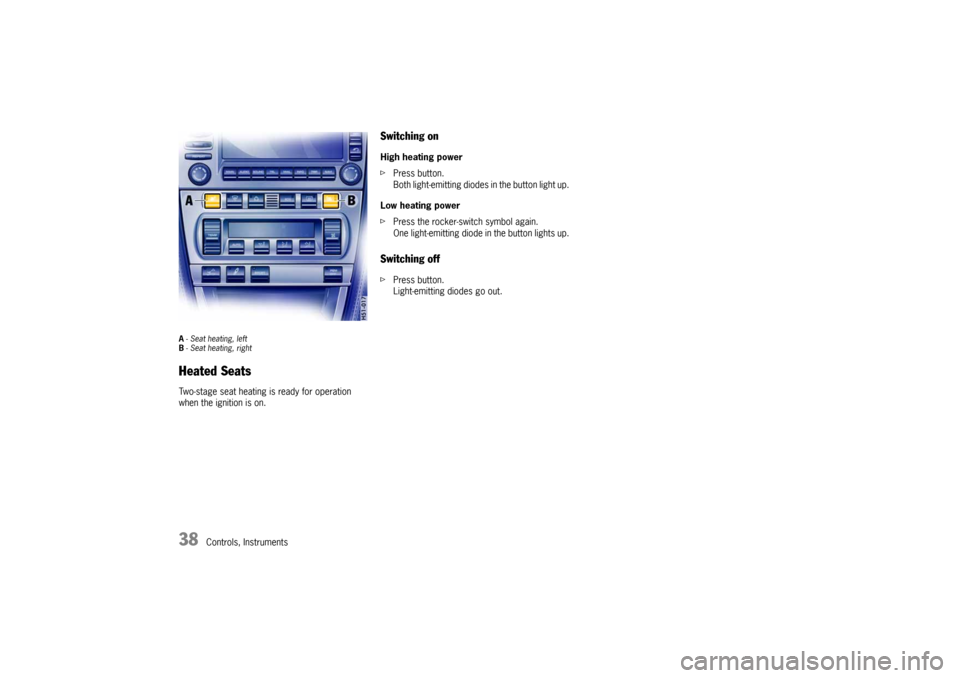
A- Seat heating, left
B- Seat heating, rightHeated SeatsTwo-stage seat heating is ready for operation
when the ignition is on.
Switching onHigh heating power
fPress button.
Both light-emitting diodes in the button light up.
Low heating power
fPress the rocker-switch symbol again.
One light-emitting diode in the button lights up.Switching offfPress button.
Light-emitting diodes go out.
Page 60 of 282

60
Controls, Instruments If the warning lights in the instrument panel and on-
board computer go on while driving, the brake flu-
id level may be too low, or (if the brake pedal travel
has increased) one of the two brake circuits may
have failed.
A greater braking pressure will be required, stop-
ping distances will be longer and the braking be-
havior will change, particularly in curves.
With correctly adjusted brakes, and a correctly
working brake system, the pedal travel to the
point of brake actuation should be 1-3/16 in. to
1-9/16 in. or 30 to 40 mm.
Whenever the brake pedal travel exceeds this dis-
tance, have the brake system checked.
Brake pedal
Warning!
Risk of an accident.
Any obstruction of the brake pedal could
increase the stopping distance.
fAlways check the movement of the brake pedal
before driving and make sure that it is not ob-
structed by a floor mat or any other object.
fSecure the floor mat to prevent it from sliding
into positions that could interfere with the safe
operation of your vehicle.
Your Porsche dealer will be glad to offer you nonskid floor mats of the correct size.
Note
In case one of the two brake circuits fails, in-
creased pedal travel is required to bring your
vehicle to a full stop.
Warning!
To avoid overheating and premature wear of
the brakes:
fBefore descending a steep grade, reduce
speed and shift the transmission into a lower
gear or driving position to control speed.
fDo not “ride the brakes” by resting your foot on
the pedal when not intending to apply brake
pressure.
fDo not hold the pedal down too long or too
often.
This could cause the brakes to get hot and not function properly.
Brake warning light USA
Brake warning light Canada
Page 70 of 282

70
Controls, Instruments
Operation, Instruments 1. Ignition lock/steering lock
2. Turn signals/high beam/headlight flasher stalk
3. Hands-free microphone for telephone
4. Horn
5. Wiper/washer stalk, rear window wiper
6. Button for seat heating, left
7. Interior temperature sensor/GPS antenna
8. Stopwatch
9. Emergency flasher switch
10.Central locking button, readiness display for
alarm system
11.Porsche Communication Management (PCM)12.Button for seat heating, right
13.Cupholder
14.Light switch
15.Operating lever for on-board computer
16.Locking lever for steering-wheel adjustment
17.Operating lever for automatic speed control
18.Operating panel for air conditioning
19 Buttons for rear spoiler,
Porsche Active Suspension Management
(PASM),
Sport mode, Porsche Stability Management
(PSM)
Page 120 of 282
120
Controls, Instruments
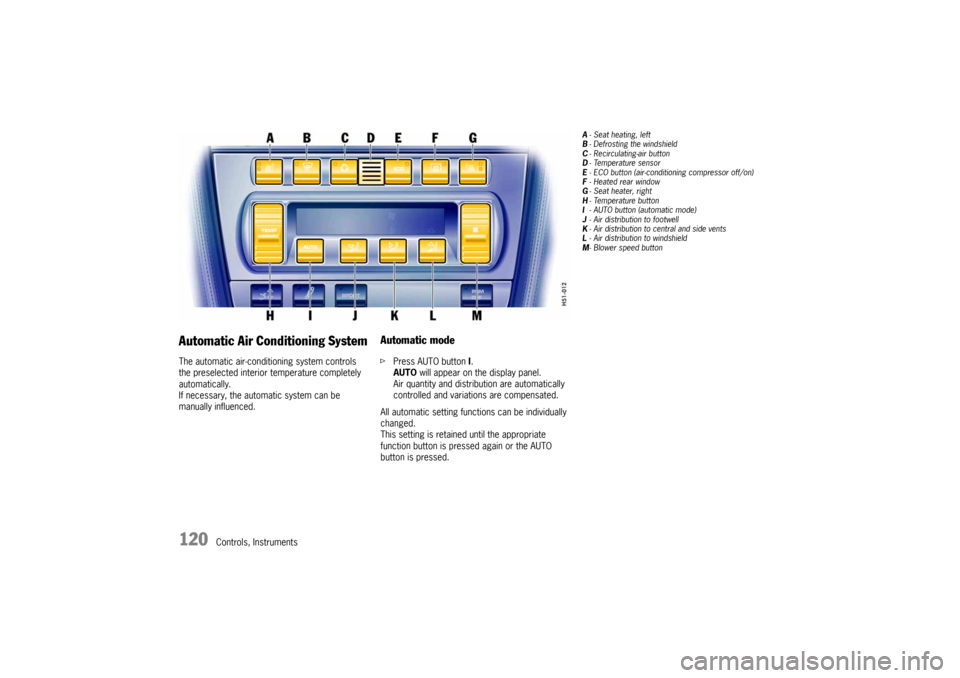
Automatic Air Conditioning SystemThe automatic air-conditioning system controls
the preselected interior temperature completely
automatically.
If necessary, the automatic system can be
manually influenced.
Automatic modefPress AUTO button I.
AUTO will appear on the display panel.
Air quantity and distribution are automatically
controlled and variations are compensated.
All automatic setting functions can be individually
changed.
This setting is retained until the appropriate
function button is pressed again or the AUTO
button is pressed.
A- Seat heating, left
B- Defrosting the windshield
C- Recirculating-air button
D-Temperature sensor
E- ECO button (air-conditioning compressor off/on)
F-Heated rear window
G- Seat heater, right
H- Temperature button
I- AUTO button (automatic mode)
J- Air distribution to footwell
K- Air distribution to central and side vents
L- Air distribution to windshield
M-Blower speed button
Page 121 of 282

Controls, Instruments
121
Setting temperaturefPress button H upwards or downwards
respectively.
To suit personal comfort, the interior temperature
can be adjusted between 61°F and 85°F/16 and
29.5°C.
Recommendation: 72°F/22°C.
If “LO” or “HI” appears on the display, the system
is operating at maximum cooling or heating pow-
er.
Automatic control is no longer active.
Note
If the preselected temperature is changed, the
blower speed can increase automatically in auto-
matic mode.
The desired temperature is reached more quickly
this way.
Sensors
To avoid affecting the performance of the air-con-
ditioning system:
fDo not cover the sun sensor on the instrument
panel or the temperature sensor D.fPress button B (switch on or off).
The windshield is defogged or defrosted as
quickly as possible.
Air flows to the windshield only.
The light-emitting diode in the button lights up.
ECO – switching compressor for air-
conditioning system on and offThe air-conditioning compressor switches off
automatically at temperatures below approx.
37°F/3°C and cannot be switched on, even
manually.
Whenever outside temperatures exceed approx.
37°F/3°C, the air-conditioning compressor is
always switched on in automatic mode.
The compressor can be switched off to save fuel,
but control comfort is then limited:
fPress ECO button E.
The compressor is switched off.
The light-emitting diode in the button lights up.
fIf the interior temperature is too high, switch
compressor back on or press AUTO button.
To dry incoming air in damp weather, do not
switch off the air-conditioning compressor.
This prevents fogging of windows.
Defrosting the windshield
fPress button M upwards or downwards
respectively.
The preset blower speed is increased or
decreased.
The speed stages are indicated by a bar display.
If the button is pressed downwards at the lowest
blower stage, the blower and automatic control
are switched off. “OFF” will appear on the display
field.
Pressing the button upwards or pressing the
AUTO button switches the blower and automatic
control back on again.
Warning!
Risk of accident due to impaired vision.
In recirculating-air setting, the windows may
fog up.
fOnly select recirculating-air setting for short
periods.
fIf the windows fog up, switch recirculating-air
setting off immediately by pressing the
circulating-air button again and select the “Defrost windshield” function.
f f f
Adjusting blower speed
Recirculating-air setting
Page 124 of 282

124
Controls, Instruments The heated rear window/door mirror heating is
ready for operation when the ignition is on.
Switching onfPress button.
The light-emitting diode in the button lights up.
After approx. 15 minutes, the heating switches off
automatically.
The heater can be switched back on by pressing
the button again.Switching offfPress button.
The light-emitting diode in the button goes out.
Ashtray Opening fOpen ashtray lid.
Heated Rear Window/Door Mirror
Heating
Page 125 of 282

Controls, Instruments
125
Emptying fOpen ashtray and carefully pull out ash insert.
fLeave ashtray lid open.
Push in ash insert.
Warning!
Danger of fire.
fNever use ashtray for waste paper disposal, as it could pose a fire hazard.
Warning!
Danger of fire and burning.
The cigarette lighter is ready for use, regard-
less of the ignition lock position.
fNever leave unsupervised children in the car.
fNever touch the heating element or sides of
the lighter.
fHold the lighter by the knob only.
Heating lighter fOpen ashtray lid.
fPush in knob of the cigarette lighter.
When ready for use, the lighter will snap back.
Note on operation
The lighter receptacle is not to be used for
electrical accessories (except for the tire filling
compressor).
Maximum power consumption: 150 W
fPlease observe the chapter “SOCKETS” on
Page 232.
Cigarette Lighter
Page 192 of 282

192
Maintenance, Car Care
How Emission Control Works When an automobile engine is running, it uses en-
ergy generated through the combustion of a mix-
ture of air and fuel. Depending on whether a car is
driven fast or slowly or whether the engine is cold
or hot, some of the fuel (hydrocarbons) may not
be burned completely, but may be discharged into
the engine crankcase or exhaust system. Additon-
al hydrocarbons may enter the atmosphere
through evaporation of fuel from the fuel tank.
These hydrocarbons (HC), when released into the
air, contribute to undesirable pollution.
In addition, carbon monoxide (CO) and oxides of
nitrogen (NOx) contribute to engine emissions.
They, too, are formed during the combustion proc-
ess and discharged into the exhaust system.
To reduce these pollutants, your Porsche is
equipped with a precisely calibrated fuel injection
system to assure a finely balanced air/fuel mixture
under all operating conditions.
Oxygen sensor The oxygen sensor, installed in the exhaust pipe
continuously senses the oxygen content of the
exhaust and signals the information to an electron-
ic control unit. The control unit corrects the air/
fuel ratio, so the engine always receives an accu-
rately metered air/fuel mixture. Crankcase ventilation Through crankcase ventilation, undesirable emis-
sions from the engine crankcase are not permit-
ted to reach the outside atmosphere. These emis-
sions are recirculated from the crankcase to the
air intake system. From here the emissions mix
with the intake air and are later burned in the en-
gine. Catalytic converters The catalytic converters are efficient “clean-up”
devices built into the exhaust system of the vehi-
cle. The catalytic converters burn the undesirable
pollutants in the exhaust gas before it is released
into the atmosphere.
The exclusive use of unleaded fuel is critical-
ly important for the life of the catalytic con-
verters. Therefore, only unleaded fuel must
be used. The catalytic converters will be damaged by:
– push or tow starting the vehicle
– misfiring of the engine
– turning off the ignition while the vehicle is mov-
ing or
– driving until the fuel tank is completely empty
– by other unusual operating conditions.
fDo not continue to operate your vehicle under
these conditions, since raw fuel might reach
the catalytic converters. This could result in
overheating of the converters. Federal law pro-
hibits use of leaded fuel in this car.