engine PORSCHE 911 CARRERA 2006 5.G Owners Manual
[x] Cancel search | Manufacturer: PORSCHE, Model Year: 2006, Model line: 911 CARRERA, Model: PORSCHE 911 CARRERA 2006 5.GPages: 308, PDF Size: 3.69 MB
Page 264 of 308
264
Practical Tips, Emergency Service
Emergency Starting with Jumper
Cables If the battery is discharged, e.g. in winter or after
the car has been parked for a long time, the bat-
tery of another car can be used for starting with
the help of jumper cables.
Make sure the voltage of both batteries is the
same. Both batteries must be 12 volt types.
The capacity (Ampere hours, Ah) of the booster
battery must not be substantially less than that of
the discharged battery.
The discharged battery must be correctly con-
nected to the vehicle’s electrical system.
fPlease observe the chapter “BATTERY” on
Page 258.
fPlease observe the chapter “EMERGENCY UN-
LOCKING OF THE LUGGAGE COMPARTMENT
LID” on Page 257.
Note
fDo not try to start the car by pushing or tow-
ing. Damage to the catalytic converters and
other components of the car may result.
Warning!
Risk of damage and serious personal injury
due to short circuit.
fUse only jumper cables of adequate diameter
cross-section and fitted with completely insu-
lated alligator clips.
fFollow all warnings and instructions of the
jumper cable manufacturer.
fWhen connecting jumper cables, make sure
that they cannot get caught in any moving
parts in the engine compartment.
The jumper cables must be long enough so
that neither vehicles nor cables touch another.
fThe vehicles must not be in contact, otherwise
current might flow as soon as the positive ter-
minals are connected.
fThe cable clamps must not be allowed to con-
tact each other when one end of the jumper ca-
bles are connected to a battery.
fEnsure that tools or conductive jewelery (rings,
chains, watch straps) do not come into contact
with the positive jumper cable or the positive
battery post.
fImproper hook-up of jumper cables can ruin
the alternator. Danger of caustic burns.
fDo not lean over the battery.
Danger of gas explosion.
fImproper use of booster battery to start a
vehicle may cause an explosion, resulting in
severe personal injuries.
fKeep sources of ignition away from the bat-
tery, e.g. open flame, burning cigarettes or
sparking due to cable contact or welding work.
fA discharged battery can freeze even at
23°F/–5°C.
Before connecting jumper cables, a frozen bat-
tery must be thawed out.
Page 265 of 308

Practical Tips, Emergency Service
265
Connect jumper cables in the following
sequence:
Always observe the sequence below:
1. Connect the positive lead (red) to the
positive terminal of the discharged battery
first, then connect it to the positive terminal of
the donor battery.
2. First connect the negative cable (black) to
the negative terminal of the donor battery, then
connect it to a suitable grounding point on the
vehicle with the discharged battery.
This grounding point must lie as far as possible
from the battery.
For example, a solid metal part or the engine
block are suitable grounding points.
If no suitable grounding points are to be found
on either vehicle, the negative cable must
carefully be connected directly to the negative
terminal of the battery.
If a suitable grounding point is to be found only
on the donor vehicle, the negative cable must
first be connected to the terminal of the
discharged battery, then to the grounding point
of the donor vehicle.
3. Run the engine of the donor car at a higher
speed.4. Start the engine.
An attempted start using jumper cables should
not last more than 15 seconds. Then allow a
waiting period of at least one minute.
Note
Before disconnecting the jumper cables, electrical
loads such as the heated rear window and the
heating fan blower should be switched on (the ve-
hicle’s lights must not be switched on). This reduc-
es voltage peaks which may occur when discon-
necting the jumper cables.
With the engine running, remove both jumper ca-
bles in reverse order.
Page 267 of 308

Practical Tips, Emergency Service
267
Bulb chart
Ty p e , r a t i n g
Halogen low beam H7, 55W
Low beam with Bi-Xenon headlight Philips, D2S 35W
Halogen high beam H9, 65W
Additional high beam with Bi-Xenon headlight H11, 55W
Fog light H8, 35W
Tail light, rear fog light P21/4W
Brake light/tail light P21/4W
Tail light, reflector P21/5W
Make-up mirror light K3W
Reversing light P21
Trun signal indicator light, front and rear PY21W
Turn signal indicator light, side WY5W
Side marker light W3W
Door guard/Curb light W5W
Parking light W5W Blue-Vision
License plate light C5W
Luggage compartment/engine compartment
light, interior lightK10W
Reading light 6W Xenon
Page 276 of 308
276
Practical Tips, Emergency Service
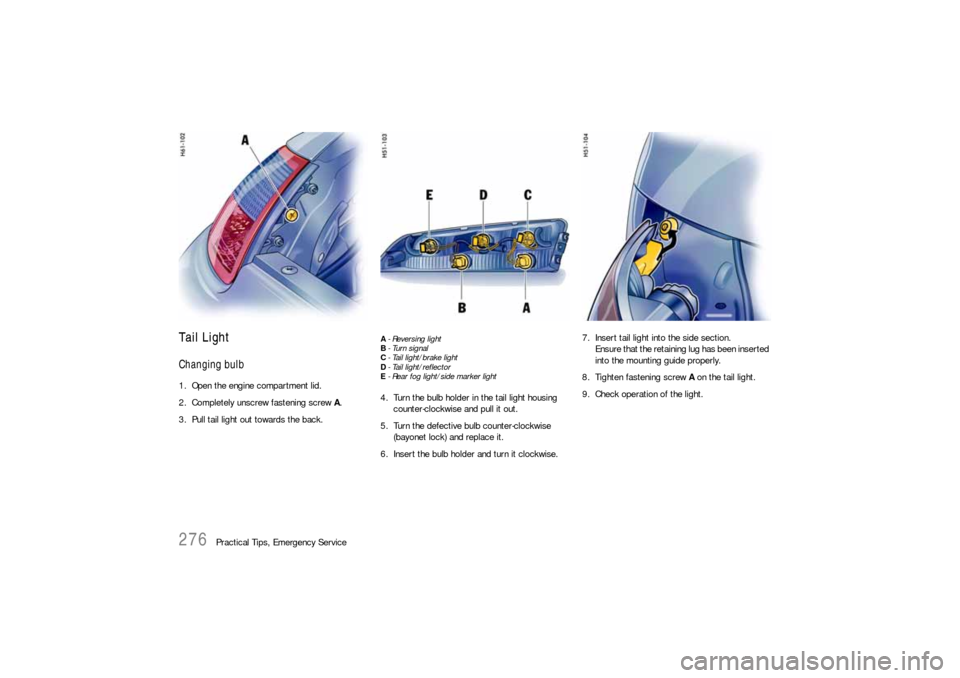
Tail LightChanging bulb1. Open the engine compartment lid.
2. Completely unscrew fastening screw A.
3. Pull tail light out towards the back.
A- Reversing light
B-Turn signal
C- Tail light/brake light
D- Tail light/reflector
E- Rear fog light/side marker light4. Turn the bulb holder in the tail light housing
counter-clockwise and pull it out.
5. Turn the defective bulb counter-clockwise
(bayonet lock) and replace it.
6. Insert the bulb holder and turn it clockwise.7. Insert tail light into the side section.
Ensure that the retaining lug has been inserted
into the mounting guide properly.
8. Tighten fastening screw A on the tail light.
9. Check operation of the light.
Page 277 of 308
Practical Tips, Emergency Service
277
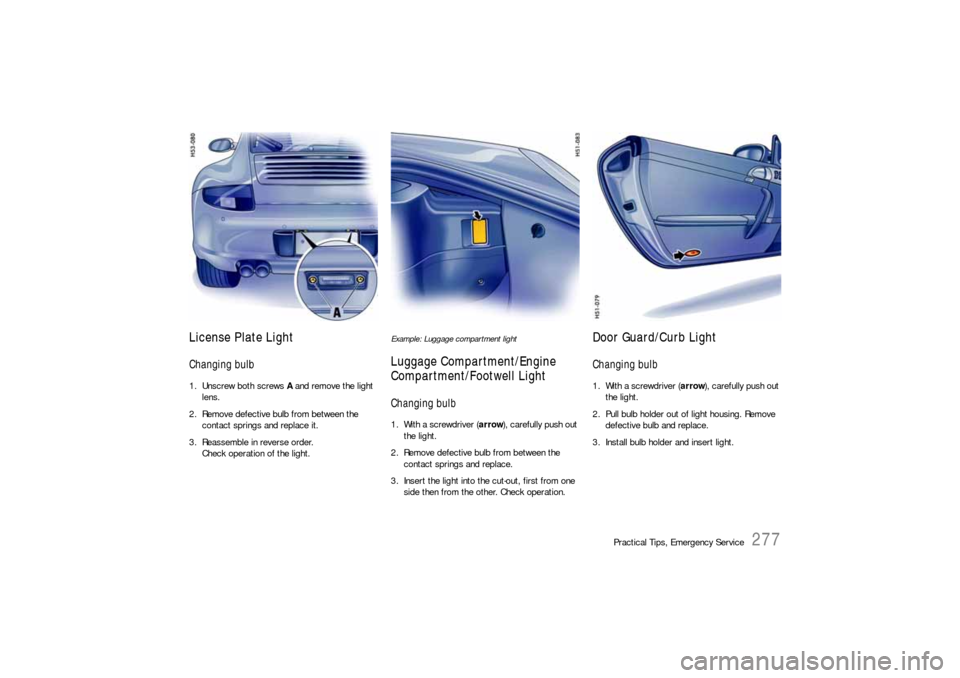
License Plate LightChanging bulb1. Unscrew both screws A and remove the light
lens.
2. Remove defective bulb from between the
contact springs and replace it.
3. Reassemble in reverse order.
Check operation of the light.
Example: Luggage compartment lightLuggage Compartment/Engine
Compartment/Footwell LightChanging bulb1. With a screwdriver (arrow), carefully push out
the light.
2. Remove defective bulb from between the
contact springs and replace.
3. Insert the light into the cut-out, first from one
side then from the other. Check operation.
Door Guard/Curb LightChanging bulb1. With a screwdriver (arrow), carefully push out
the light.
2. Pull bulb holder out of light housing. Remove
defective bulb and replace.
3. Install bulb holder and insert light.
Page 284 of 308
284
Vehicle Identification, Technical Data
Vehicle Identification When ordering spare parts or making inquiries,
please always quote the vehicle identification
number. Vehicle data bankThe vehicle data bank is attached to the inside of
the “Maintenance” booklet.
It contains all important data about your vehicle.
Note
This data bank cannot be re-ordered if it is lost or
damaged.
This label contains the following information:
1. Vehicle Identification No.
2. Type/Type description
3. Engine code/Transmission code
4. Paint No./Interior
5. Optional equipment
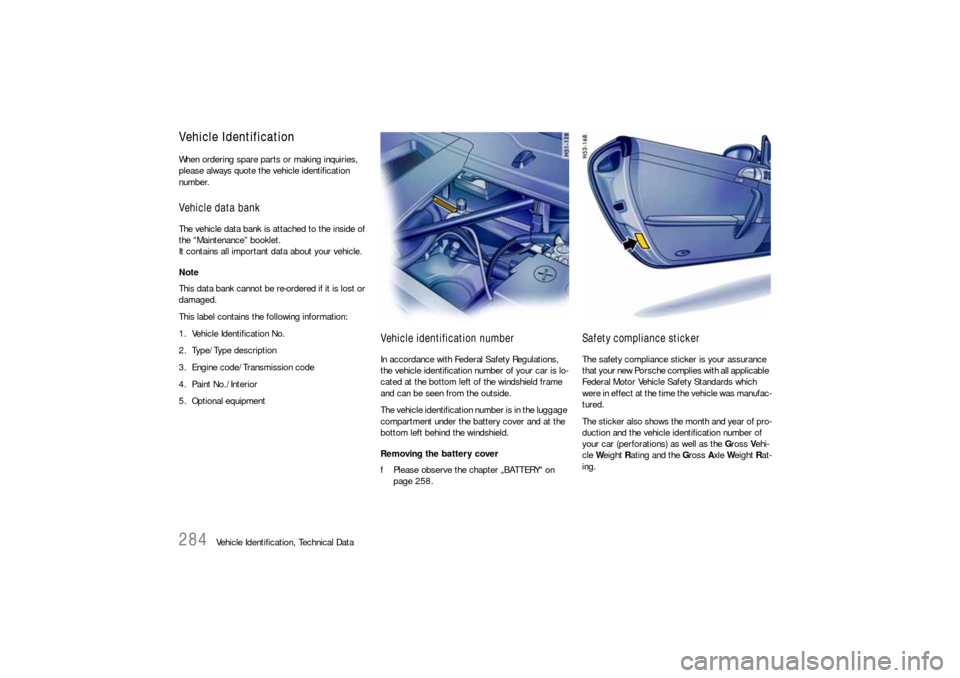
Vehicle identification number In accordance with Federal Safety Regulations,
the vehicle identification number of your car is lo-
cated at the bottom left of the windshield frame
and can be seen from the outside.
The vehicle identification number is in the luggage
compartment under the battery cover and at the
bottom left behind the windshield.
Removing the battery cover
fPlease observe the chapter „BATTERY“ on
page 258.
Safety compliance stickerThe safety compliance sticker is your assurance
that your new Porsche complies with all applicable
Federal Motor Vehicle Safety Standards which
were in effect at the time the vehicle was manufac-
tured.
The sticker also shows the month and year of pro-
duction and the vehicle identification number of
your car (perforations) as well as the Gross Vehi-
cle Weight Rating and the Gross Axle Weight Rat-
ing.
Page 285 of 308
Vehicle Identification, Technical Data
285
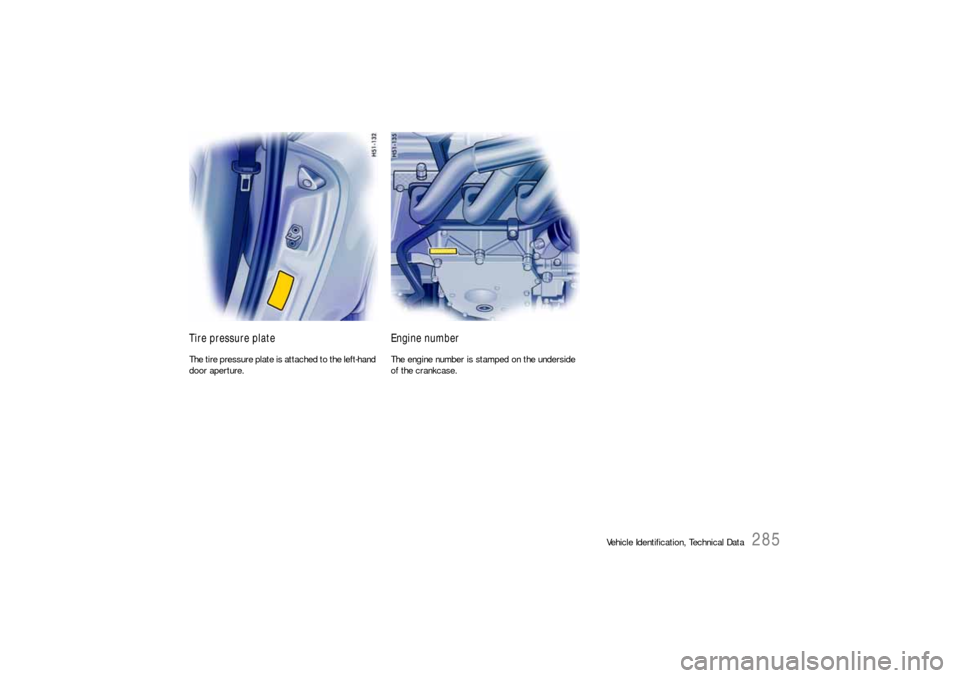
Tire pressure plateThe tire pressure plate is attached to the left-hand
door aperture.
Engine number The engine number is stamped on the underside
of the crankcase.
Page 286 of 308

286
Technical Data
Technical DataEngine data
911 Carrera, 911 Carrera 4 911 Carrera S, 911 Carrera 4S 911 Carrera S, 911 Carrera 4S
(increased performance version)
Type M 96/05 M 97/01 M 97/01S
Horizontally opposed engine,
liquid cooledHorizontally opposed engine,
liquid cooledHorizontally opposed engine,
liquid cooled
Number of cylinders 6 6 6
Bore 3.78 in./96 mm 3.90 in./99 mm 3.90 in./99 mm
Stroke 3.26 in./82.8 mm 3.26 in./82.8 mm 3.26 in./82.8 mm
Cubic capacity 219.4 cu. in./3596 cm
3 233.3 cu. in./3824 cm
3
233.3 cu. in./3824 cm
3
Net-horsepower, SAE J 1349 325 hp/239 kW 355 hp/261 kW 381 hp/280 kW
at crankshaft speed 6800 rpm 6600 rpm 7200 rpm
Net torque, SAE J 1349 273 ft. lb./370 Nm 295 ft. lb./400 Nm 307 ft. lb./415 Nm
at crankshaft speed 4250 rpm 4600 rpm 5500 rpm
Engine control Stationary high-voltage distribution, sequential injection,
cylinder-selective knock-control, stereo oxygen sensor closed-loop control, diagnostic system,
4 overhead camshafts, Porsche VarioCam Plus, hydraulic valve clearance compensation
Page 291 of 308

Technical Data
291
CapacitiesUse only fluids and fuels authorized by Porsche. Your authorized Porsche dealer will gladly advise you.
Your Porsche has been designed so that it is not necessary to mix any additives with oils or fuels.
Engine 911 Carrera, 911 Carrera 4: Oil change quantity without oil filter approx. 8.5 quarts / 8.0 liters
911 Carrera, 911 Carrera 4: Oil change quantity with oil filter approx. 8.7 quarts / 8.25 liters
911 Carrera S, 911 Carrera 4S: Oil change quantity without oil filter approx. 8.7 quarts / 8.25 liters
911 Carrera S, 911 Carrera 4S: Oil change quantity with oil filter approx. 9 quarts / 8.5 liters
Please observe the chapter “ENGINE OIL” on Page 201.
Coolant approx. 8.45 U.S. gallons / 32 liters
Manual transmission
and differential approx. 3.1 quarts / 2.9 liters transmission oil
Tiptronic S approx. 9.5 quarts / 9 liters ATF
Differential for Tiptronic S approx. 1.3 quarts / 1.2 liter
Fuel tank 911 Carrera, 911 Carrera S: approx. 16.9 U.S. gallons / 64 liters
911 Carrera 4, 911 Carrera 4S: approx. 17.7 U.S. gallons / 67 liters
Fuel quality Your engine is designed to provide optimum performance and fuel economy using
unleaded premium fuel with an octane rating of 98 RON (93 CLC or AKI).
Porsche therefore recommends the use of these fuels in your vehicle.
Porsche also recognizes that these fuels may not al ways be available. Be assured that your vehicle
will operate properly on unleaded premium fuels with octane numbers of at least 95 RON (90 CLC or AKI),
since the engine’s “Electronic Oktane™ knock contr ol” will adapt the ignition timing, if necessary.
Power steering approx. 1.35 quarts / 1.27 liter hydraulic fluid Pentosin CHF 11 S
® or Pentosin CHF 202
®
Brake fluid 0.48 quarts / 0.45 liters; use on
ly Original Porsche brake fluid.
Windshield washer approx. 2.6 quarts / 2,5 liters without headlight washer
approx. 6.3 quarts / 6 liters with headlight washer
Page 299 of 308
Technical Data
299
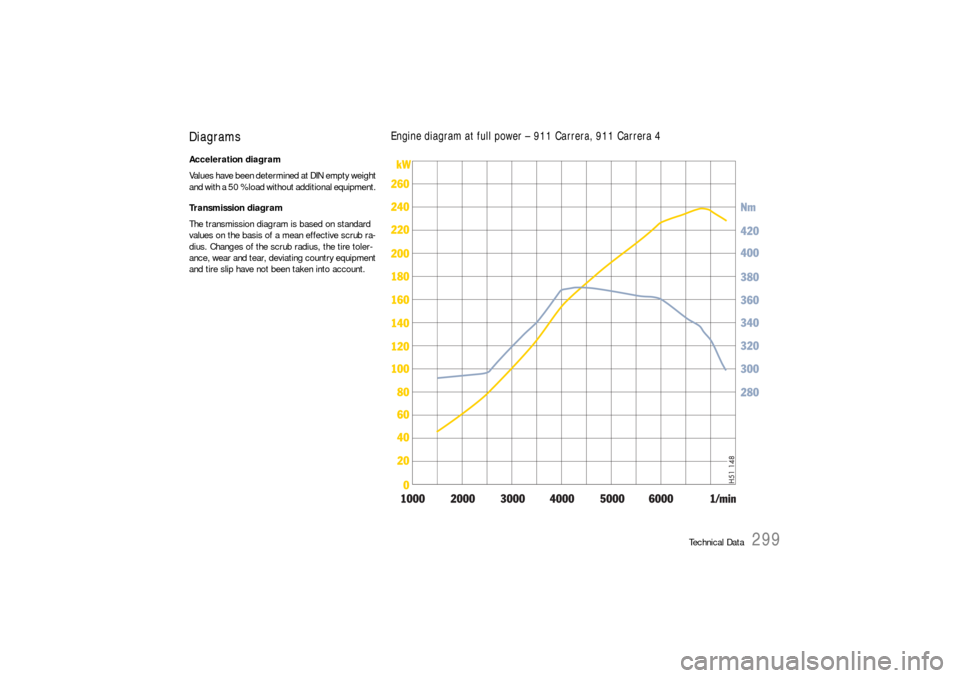
Diagrams Acceleration diagram
Values have been determined at DIN empty weight
and with a 50 % load without additional equipment.
Transmission diagram
The transmission diagram is based on standard
values on the basis of a mean effective scrub ra-
dius. Changes of the scrub radius, the tire toler-
ance, wear and tear, deviating country equipment
and tire slip have not been taken into account.
Engine diagram at full power – 911 Carrera, 911 Carrera 4