reverse PORSCHE 911 CARRERA 2006 5.G User Guide
[x] Cancel search | Manufacturer: PORSCHE, Model Year: 2006, Model line: 911 CARRERA, Model: PORSCHE 911 CARRERA 2006 5.GPages: 308, PDF Size: 3.69 MB
Page 167 of 308

Shifting Gears
167
Selector Lever PositionsP – Parking lockfEngage parking lock only when vehicle is sta-
tionary.
fEngage parking lock after applying the hand-
brake and release it before releasing the hand-
brake.
The ignition key can be withdrawn only in selec-
tor lever position P.R – Reverse gearfSelect only if car is stationary and the brake is
applied.N – NeutralSelector lever position N must be selected for
towing or in car washes, for example.
fOnly select the desired position for moving off
(D, M or R) when the engine is idling and the
brake pedal is depressed.
D - Automatic selection modeSelect position D for “normal” driving. The gears
are shifted automatically according to the acceler-
ator position and speed.
Depending on the way the vehicle is driven and on
the resistance (e.g. uphill), the gear-changing
points are shifted towards higher or lower engine-
speed ranges.
The accelerator position, driving speed, engine
speed, longitudinal and lateral acceleration and
the road profile all have an influence on the gear-
changing characteristic.
Unwanted upward shifts, e.g. before bends, are
prevented by swiftly releasing the accelerator ped-
al.
Depending on lateral acceleration, upward chang-
es on bends are not made until the engine-speed
limit is reached.
Under braking, and depending on the amount of
deceleration, the Tiptronic changes down earlier.
For subsequent cornering, the right gear is en-
gaged when pressure is applied to the brakes be-
fore the bend. The bend is taken in the right gear,
and when you accelerate out of the bend you do
not have to shift down.Sport mode switched on
fPlease observe the chapter “SPORT MODE” on
Page 71.
If the Sport mode program is switched on,
Tiptronic switches to a sporty gear-changing map
and shortens the shifting periods.
Deceleration downshifts are commenced earlier.
Downshifts are already carried out in the case of
slight decelerations, even at higher engine
speeds.
Driving off
In 2nd gear, the vehicle moves off with the throt-
tle only slightly open.
Move off in 1st gear with the throttle open wider
or when the engine is cold.
Page 170 of 308

170
Shifting Gears
StoppingfFor a brief stop (e.g. at a traffic light), leave the
selector lever in drive position and hold the ve-
hicle with the brake pedal.
fFor a longer stop with the engine running, se-
lect position N (neutral) and hold vehicle in po-
sition with the foot brake.
Select lever position D only when the foot
brake pedal is depressed.
fDo not hold the car on a slope using the
accelerator. Use the brake pedal or the hand-
brake instead.
fBefore leaving the vehicle, always apply the
handbrake and move the selector lever to po-
sition P.
ParkingfGo easy on the accelerator!
fWhen parking or maneuvering in a small
space, control the speed by careful use of the
footbrake.Driving in winterIn wintry road conditions it is advisable to take
steep inclines in manual mode. This prevents the
occurrence of gear changes that could cause
wheelspin.Tow-starting, towingfPlease observe the chapter “TOWING” on
Page 281.Reduced driving programA transmission fault is indicated by the following
symptoms:
–The 4th gear display on the instrument clus-
ter flashes.
– The warning “Tiptronic emergency run” ap-
pears on the on-board computer.
– The transmission no longer shifts.
Warning!
Reverse gear lock monitoring is disabled in
the emergency running program.
Damage to the vehicle may result as well as
loss of control, if the vehicle is moving for-
ward fast enough to cause rear wheel lockup.
fDo not shift into R while the vehicle is moving forward.
Proceed as follows in the event of a transmission
fault:
1. Stop in a safe place.
2. Move selector lever to position P, switch the ig-
nition off and wait for 10 seconds.
3. Start the engine.
2nd gear in selector position D and reverse
gear R are now available.
4. Have the fault seen to immediately at an au-
thorized Porsche dealer.
Page 225 of 308

Maintenance, Car Care
225
Leather Characteristics and special features
The natural surface markings of leather, e.g.
creases, healed scars, insect sting marks, struc-
tural differences and slight variations in shade and
grain add to the attractiveness of the natural leath-
er product.
A special mention must be made here of natural
leather.
For natural leather, carefully selected hides of the
highest quality are used. It is not covered com-
pletely with dye on production.
“Nature’s signature” is therefore easily recogniza-
ble.
This fine material is distinguished by an outstand-
ing seating comfort, special suppleness and a typ-
ical patina. Leather care and treatment
fClean all types of leather regularly to remove
fine dust using a soft, damp, white woollen
cloth or a commercially available microfibre
cloth.
fRemove heavy contamination with Porsche
leather cleaner.
Please always follow the instructions for use
given on the containers.
Caustic cleaners and hard cleaning objects
must not be used.
Perforated leather must under no circum-
stances get wet on its reverse side.
Once cleaned, leather (particularly the heavily
stressed leather seats) must be treated only with
Porsche leather care liquid.
Fabric, upholstery, carpets and
floor-mats fUse only a vacuum cleaner or a medium stiff
brush.
fRemove stains and spots with Porsche stain
remover.
The Porsche range of accessories includes non-
skid floor-mats to protect the carpets in summer
and winter.
Warning!
Risk of an accident.
fAlways check the movement of the pedals be-
fore driving and make sure that they are not ob-
structed by a floor-mat or any other object.
fSecure the floor-mat to prevent it from sliding
into positions that could interfere with the safe
operation of your vehicle - do not install them
loosely in the vehicle.
Your Porsche dealer will be glad to offer you nonskid floor-mats of the correct size.
Page 265 of 308

Practical Tips, Emergency Service
265
Connect jumper cables in the following
sequence:
Always observe the sequence below:
1. Connect the positive lead (red) to the
positive terminal of the discharged battery
first, then connect it to the positive terminal of
the donor battery.
2. First connect the negative cable (black) to
the negative terminal of the donor battery, then
connect it to a suitable grounding point on the
vehicle with the discharged battery.
This grounding point must lie as far as possible
from the battery.
For example, a solid metal part or the engine
block are suitable grounding points.
If no suitable grounding points are to be found
on either vehicle, the negative cable must
carefully be connected directly to the negative
terminal of the battery.
If a suitable grounding point is to be found only
on the donor vehicle, the negative cable must
first be connected to the terminal of the
discharged battery, then to the grounding point
of the donor vehicle.
3. Run the engine of the donor car at a higher
speed.4. Start the engine.
An attempted start using jumper cables should
not last more than 15 seconds. Then allow a
waiting period of at least one minute.
Note
Before disconnecting the jumper cables, electrical
loads such as the heated rear window and the
heating fan blower should be switched on (the ve-
hicle’s lights must not be switched on). This reduc-
es voltage peaks which may occur when discon-
necting the jumper cables.
With the engine running, remove both jumper ca-
bles in reverse order.
Page 270 of 308
270
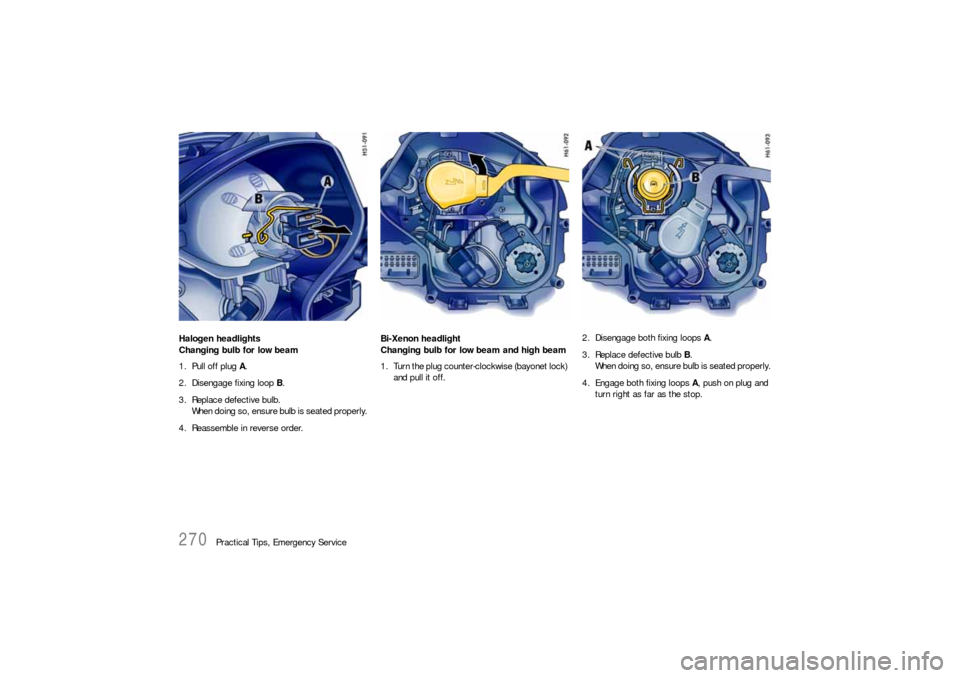
Practical Tips, Emergency Service Halogen headlights
Changing bulb for low beam
1. Pull off plug A.
2. Disengage fixing loop B.
3. Replace defective bulb.
When doing so, ensure bulb is seated properly.
4. Reassemble in reverse order.Bi-Xenon headlight
Changing bulb for low beam and high beam
1. Turn the plug counter-clockwise (bayonet lock)
and pull it off.2. Disengage both fixing loops A.
3. Replace defective bulb B.
When doing so, ensure bulb is seated properly.
4. Engage both fixing loops A, push on plug and
turn right as far as the stop.
Page 271 of 308
Practical Tips, Emergency Service
271
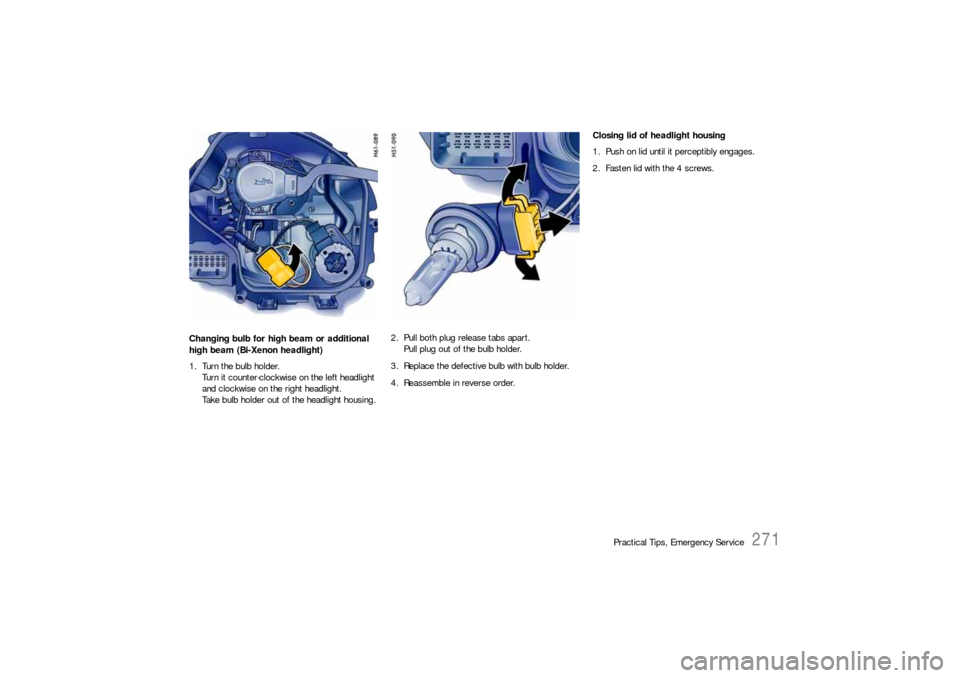
Changing bulb for high beam or additional
high beam (Bi-Xenon headlight)
1. Turn the bulb holder.
Turn it counter-clockwise on the left headlight
and clockwise on the right headlight.
Take bulb holder out of the headlight housing.2. Pull both plug release tabs apart.
Pull plug out of the bulb holder.
3. Replace the defective bulb with bulb holder.
4. Reassemble in reverse order.Closing lid of headlight housing
1. Push on lid until it perceptibly engages.
2. Fasten lid with the 4 screws.
Page 277 of 308
Practical Tips, Emergency Service
277
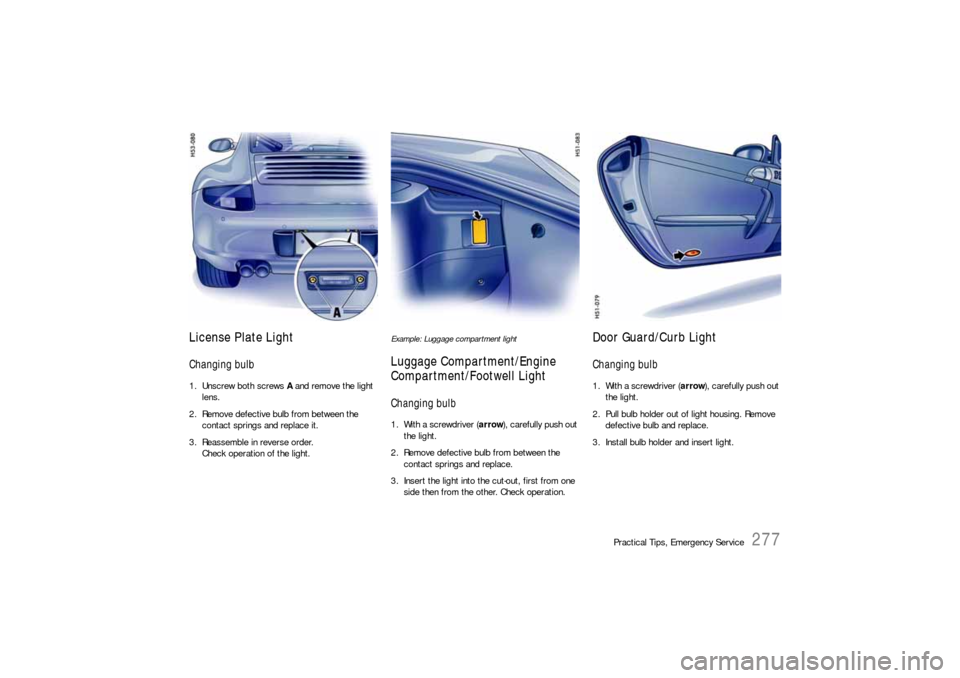
License Plate LightChanging bulb1. Unscrew both screws A and remove the light
lens.
2. Remove defective bulb from between the
contact springs and replace it.
3. Reassemble in reverse order.
Check operation of the light.
Example: Luggage compartment lightLuggage Compartment/Engine
Compartment/Footwell LightChanging bulb1. With a screwdriver (arrow), carefully push out
the light.
2. Remove defective bulb from between the
contact springs and replace.
3. Insert the light into the cut-out, first from one
side then from the other. Check operation.
Door Guard/Curb LightChanging bulb1. With a screwdriver (arrow), carefully push out
the light.
2. Pull bulb holder out of light housing. Remove
defective bulb and replace.
3. Install bulb holder and insert light.
Page 287 of 308

Technical Data
287
Transmission
Manual transmission Tiptronic S
1st gear 3.91 3.60
2nd gear 2.32 2.19
3rd gear 1.61 1.41
4th gear 1.28 1.00
5th gear 1.08 0.83
6th gear 0.88
Reverse 1st gear 3.59 3.17
2nd gear 1.93
Final drive ratio 3.44 3.56