Battery PORSCHE 911 CARRERA 2006 5.G Owner's Manual
[x] Cancel search | Manufacturer: PORSCHE, Model Year: 2006, Model line: 911 CARRERA, Model: PORSCHE 911 CARRERA 2006 5.GPages: 308, PDF Size: 3.69 MB
Page 228 of 308

228
Practical Tips, Emergency Service
Exercise Extreme Caution when
Working on your Vehicle
Danger!
Ignoring the following instructions may
cause serious personal injury or death.
fThe engine compartment of any motor vehicle
is a potentially hazardous area. If you are not
fully familiar with proper repair procedures, do
not attempt the adjustments described on the
following pages.
This caution also applies to the entire vehicle.
fO n l y w o r k o n y o u r v e h i c l e o u t d o o r s o r i n a w e l l
ventilated area.
fEnsure that there are no open flames in the
area of your vehicle at any time when fuel
fumes might be present. Be especially cau-
tious of such devices such as hot water heat-
ers which ignite a flame intermittently.
fBefore working on any part in the engine com-
partment, turn the engine off and let it cool
down sufficiently. Hot engine compartment
components can burn skin on contact.
fBe alert and cautious around engine at all
times while the engine is running.
If work has to be performed with the engine
running, always set the parking brake, and
make sure the shift lever is in neutral position
or the selector lever in position P.fIn particular, be very careful to ensure that
items of clothing (ties, shirt, sleeves etc.), jew-
elry, long hair, hand or fingers cannot get
caught in the engine-compartment blower, fan,
belts or other moving parts.
The radiator and radiator fans are in the front
of the car.
The engine-compartment blower is mounted
on the engine-compartment lid.
The engine-compartment blower can start or
continue running as a function of temperature,
even with the engine switched off.
Carry out work in these areas only with the en-
gine off, the ignition switched off, and exercise
extreme caution.
fYour Porsche is equipped with an electronic ig-
nition system. When the ignition is on, high volt-
age is present in all wires connected with the
ignition system; therefore, exercise extreme
caution when working on any part of the engine
while the ignition is on or the engine is running.
fAlways support your car with safety stands if it
is necessary to work under the car.
fWhen working under the car without safety
stands but with the wheels on the ground,
make sure the car is on level ground, the
wheels are blocked, and that the engine
cannot be started.
Remove the ignition key.fDo not smoke or allow an open flame around
the battery or fuel.
Keep a fire extinguisher in close reach.
fIncomplete or improper servicing may cause
problems in the operation of the car. If in doubt
about any servicing, have it done by your au-
thorized Porsche dealer.
Improper maintenance during the warranty pe-
riod may affect your Porsche warranty cover-
age.
fSupplies of fluids, e.g. engine oil, brake fluid or
coolant, are hazardous to your health.
Keep these fluids out of children’s reach and
dispose of them in accordance with the appro-
priate regulations.
fSome countries require additional tools and
special spare parts to be carried.
Please make enquiries before driving abroad.
Page 254 of 308
254
Practical Tips, Emergency Service
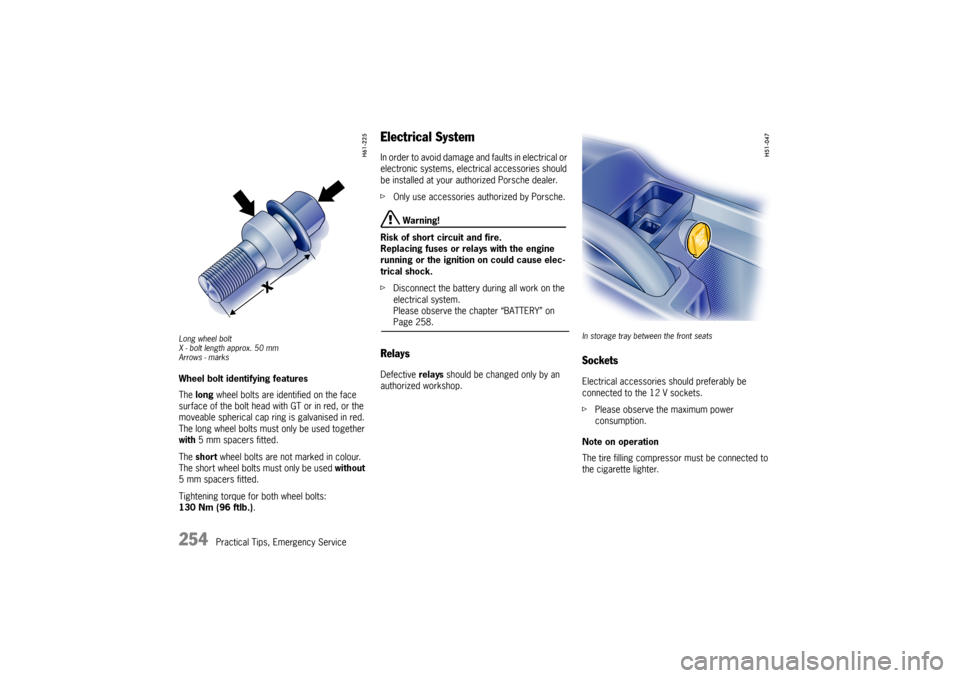
Long wheel bolt
X - bolt length approx. 50 mm
Arrows - marksWheel bolt identifying features
The long wheel bolts are identified on the face
surface of the bolt head with GT or in red, or the
moveable spherical cap ring is galvanised in red.
The long wheel bolts must only be used together
with 5 mm spacers fitted.
The short wheel bolts are not marked in colour.
The short wheel bolts must only be used without
5 mm spacers fitted.
Tightening torque for both wheel bolts:
130 Nm (96 ftlb.).
Electrical System In order to avoid damage and faults in electrical or
electronic systems, electrical accessories should
be installed at your authorized Porsche dealer.
fOnly use accessories authorized by Porsche.
Warning!
Risk of short circuit and fire.
Replacing fuses or relays with the engine
running or the ignition on could cause elec-
trical shock.
fDisconnect the battery during all work on the
electrical system.
Please observe the chapter “BATTERY” on Page 258.
Relays Defective relays should be changed only by an
authorized workshop.
In storage tray between the front seatsSocketsElectrical accessories should preferably be
connected to the 12 V sockets.
fPlease observe the maximum power
consumption.
Note on operation
The tire filling compressor must be connected to
the cigarette lighter.
Page 255 of 308
Practical Tips, Emergency Service
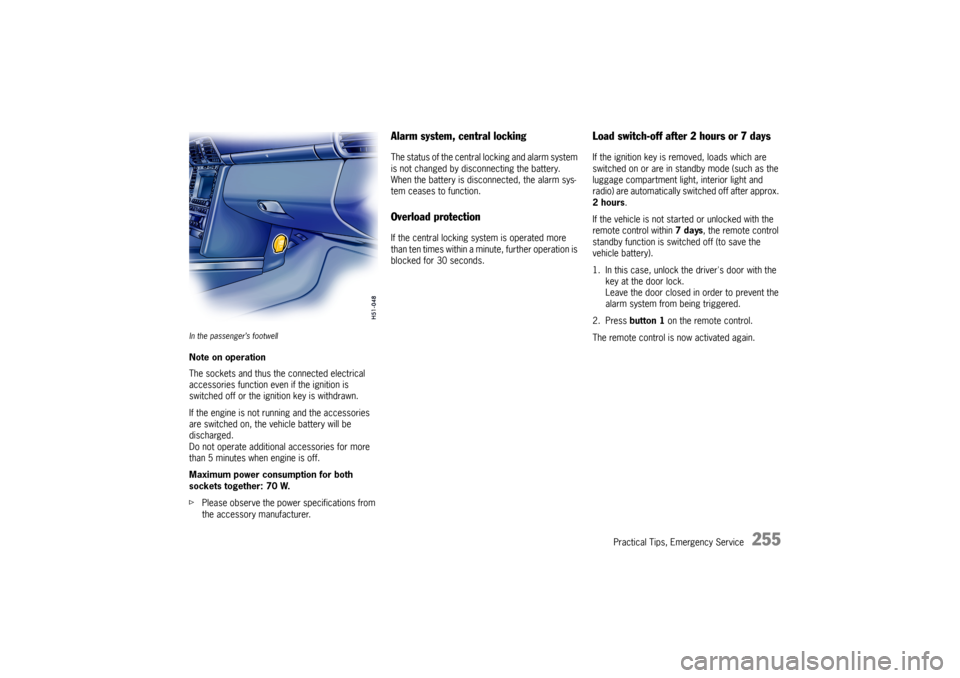
255
In the passenger’s footwellNote on operation
The sockets and thus the connected electrical
accessories function even if the ignition is
switched off or the ignition key is withdrawn.
If the engine is not running and the accessories
are switched on, the vehicle battery will be
discharged.
Do not operate additional accessories for more
than 5 minutes when engine is off.
Maximum power consumption for both
sockets together: 70 W.
fPlease observe the power specifications from
the accessory manufacturer.
Alarm system, central lockingThe status of the central locking and alarm system
is not changed by disconnecting the battery.
When the battery is disconnected, the alarm sys-
tem ceases to function. Overload protectionIf the central locking system is operated more
than ten times within a minute, further operation is
blocked for 30 seconds.
Load switch-off after 2 hours or 7 daysIf the ignition key is removed, loads which are
switched on or are in standby mode (such as the
luggage compartment light, interior light and
radio) are automatically switched off after approx.
2hours.
If the vehicle is not started or unlocked with the
remote control within 7days, the remote control
standby function is switched off (to save the
vehicle battery).
1. In this case, unlock the driver's door with the
key at the door lock.
Leave the door closed in order to prevent the
alarm system from being triggered.
2. Press button 1 on the remote control.
The remote control is now activated again.
Page 257 of 308
Practical Tips, Emergency Service
257
Emergency unlocking of the luggage
compartment lidIf the battery is discharged, the lid can be opened
only with the aid of a donor battery.
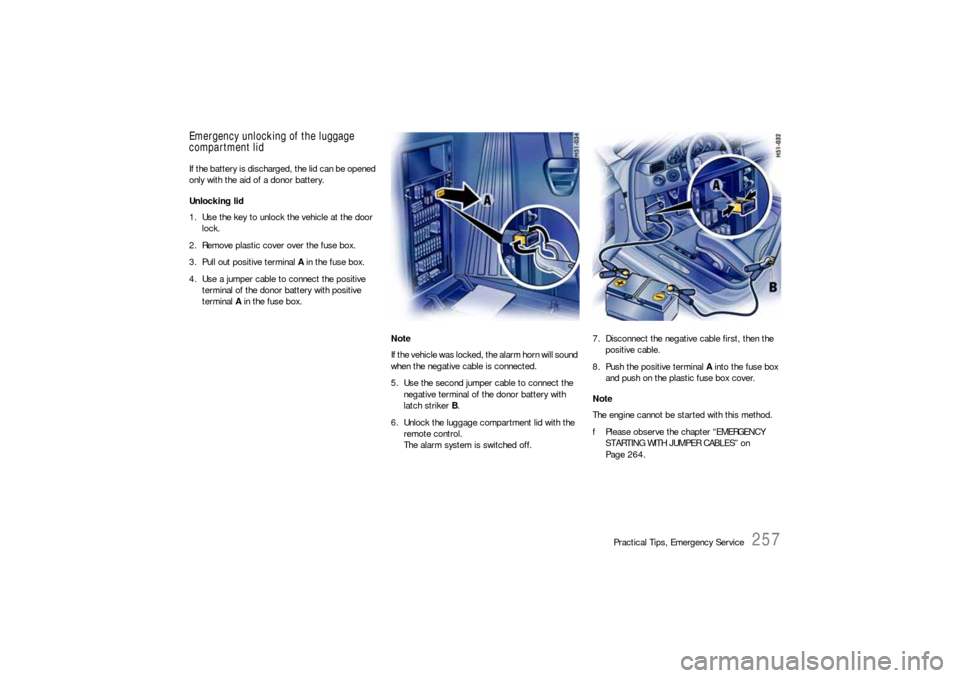
Unlocking lid
1. Use the key to unlock the vehicle at the door
lock.
2. Remove plastic cover over the fuse box.
3. Pull out positive terminal A in the fuse box.
4. Use a jumper cable to connect the positive
terminal of the donor battery with positive
terminal A in the fuse box.
Note
If the vehicle was locked, the alarm horn will sound
when the negative cable is connected.
5. Use the second jumper cable to connect the
negative terminal of the donor battery with
latch striker B.
6. Unlock the luggage compartment lid with the
remote control.
The alarm system is switched off.7. Disconnect the negative cable first, then the
positive cable.
8. Push the positive terminal A into the fuse box
and push on the plastic fuse box cover.
Note
The engine cannot be started with this method.
fPlease observe the chapter “EMERGENCY
STARTING WITH JUMPER CABLES” on
Page 264.
Page 258 of 308

258
Practical Tips, Emergency Service
Battery
Warning!
Risk of short circuit and fire.
fObserve all warning notes on the battery.
fDisconnect the battery during all work on the
electrical system.
fDo not lay tools or other metal objects on the
battery as they could cause a short circuit
across the battery terminal.
Hydrogen gas generated by the battery
could cause an explosion, resulting in severe
personal injuries.
fDo not expose the battery to an open flame,
electrical spark or a lit cigarette.
fDo not wipe battery with a dry cloth.
Risk of severe personal injury and damage to
the fabric, metal or paint.
fWear eye protection.
fDo not allow battery acid to come in contact
with your skin, eyes, fabric or painted surfac-
es. fIf you get electrolyte, which is an acid, in your
eyes or on your skin, immediately rinse with
cold water for several minutes and call a doc-
tor.
fSpilled electrolyte must be rinsed off at once
with a solution of baking soda and water to
neutralize the acid.
Battery posts, terminals and related acces-
sories contain lead and lead compounds,
chemicals known to the State of California to
cause cancer and reproductive harm.
fAlways protect your skin by washing thorough-
ly with soap and water.
Risk of explosion as a result of static charge.
fDo not wipe the battery with a dry cloth.
fEliminate potential electrostatic charge by
touching the vehicle before touching the bat-
tery.
Charge state A well charged battery will not only prevent start-
ing problems but will also last longer.
In order to avoid discharging the battery
unintentionally:
fSwitch off unnecessary electrical loads in city
traffic, on short trips or in a line or traffic.
fAlways remove the ignition key from the igni-
tion switch when leaving the car.
fAvoid frequent operation of the convertible top
and operation of the Porsche Communication
Management system when the engine is not
running.
Page 259 of 308

Practical Tips, Emergency Service
259
Battery care fEnsure that battery is securely mounted.
fKeep terminals and connections clean and
properly tightened.
Corrosion can be prevented by coating the ter-
minals and connections with petroleum jelly or
silicone spray.
fEnsure that vent caps are securely tightened to
prevent spillage. Checking the electrolyte fluid level
Generally, the electrolyte level must be checked
more often in summer than in the winter, and more
often when driving long distances.
fWhen adding water, use only clean containers.
In no case may alcohol (e.g. window cleaner
residues) be permitted to enter the battery.
fUnscrew and open the filler vent caps of each
cell.
With the car on a level surface, the fluid level
should meet the indicator mark in each cell.
fIf necessary, top up with distilled water.
Do not use acid.
Only fill up to the mark, otherwise the electro-
lyte will overflow when the battery is being
charged and cause damage. Battery charging
Automotive batteries loose their efficiency when
not in use.
The charge available in your battery can be meas-
ured with a battery hydrometer.
We recommend that the battery voltage be tested
by your Porsche dealer who has the appropriate
equipment.
If the car is not driven for prolonged periods, the
battery must be charged at least every 6 weeks.
A discharged battery allows rapid formation of sul-
fates, leading to premature deterioration of the
plates.
f f f
Page 260 of 308

260
Practical Tips, Emergency Service
Warning!
Hydrogen gas generated by the battery
could cause an explosion, resulting in severe
personal injuries.
fCharge battery in a well ventilated area.
fNever charge a frozen battery. It may explode
because of gas trapped in the ice. Allow a fro-
zen battery to thaw out first.
fIf you get electrolyte, which is an acid, in your
eyes or on your skin, immediately rinse with
cold water for several minutes and call a doc-tor. Slow battery charging
1. Pay attention to all warnings and follow instruc-
tions that come with your battery charger.
2. When charging, ensure adequate ventilation.
3. Remove battery.
Please observe the chapter “REMOVING THE
BATTERY” on Page 262.
4. All vent caps should be open.
The fluid level should meet the indicator mark
in each cell.
5. Ensure that charger is switched off – danger of
short circuit!
6. Connect charger cables.
Charger cables must be connected
POSITIVE (+) to POSITIVE (+) and
NEGATIVE (–) to NEGATIVE (–).
7. Switch on charger.
Normally, a battery should be charged at no
more than 10 percent of its rated capacity.
Rated capacity of the battery in your vehicle is
listed on the battery housing.
8. After charging, turn off charger and disconnect
charger cables.
9. Tighten the vent caps and reinstall battery.
Please observe the chapter “INSTALLING THE
BATTERY” on Page 263.
Winter operation The capacity and ability of the battery to store
power decreases at low outside temperatures.
Additionally, more power is consumed while start-
ing, and the headlights, heater, rear window de-
fogger, etc., are used more frequently.
fLet your Porsche dealer test the battery’s
capacity before winter sets in.
The battery will discharge more quickly if your ve-
hicle is not driven on a daily basis over a distance
of several miles. The more often you drive your ve-
hicle, and the longer the distance driven on each
trip, the more opportunity the vehicle’s charging
system will have to recharge the batteries.
Page 261 of 308

Practical Tips, Emergency Service
261
Replacing battery The service life of the battery is subject to normal
wear; it depends greatly on care, climatic condi-
tions, and driving conditions (distances, loads).
fOnly use an original Porsche battery, with the
correct part number, as a replacement.
fPlease observe the disposal instructions for
batteries.
Putting vehicle into operationAfter the battery is connected or after an exhaus-
tively discharged battery is charged, the multi-
functional PSM light lights up on the instrument
panel and a message appears on the on-board
computer to indicate a fault.
This fault can be remedied with a few simple
steps:
1. Start the engine.
2. With the vehicle stationary, perform a few
steering movements to the left and right and
then drive a short distance in a straight line
until the multifunctinal PSM light goes out and
the message on the on-board computer
disappears.
3. If the warnings do not disappear, then:
Drive carefully to the nearest authorized
Porsche dealer.
Have the fault remedied.
4. After the warnings disappear:
Stop the vehicle in a suitable place.
fPerform adaptation of the power windows:
Please observe the chapter “STORING END
POSITION OF THE WINDOWS” on Page 29.Ignition key/ignition lock
fDo not insert the ignition key into the ignition
lock if the vehicle battery is discharged.
The ignition key can no longer be removed.
The key cannot be removed until the vehicle elec-
trical system is supplied with power again.
fPlease observe the chapter “EMERGENCY UN-
LOCKING OF THE LUGGAGE COMPARTMENT
LID” on Page 257.
fPlease observe the chapter “EMERGENCY
STARTING WITH JUMPER CABLES” on
Page 264.
f f f
Page 262 of 308
262
Practical Tips, Emergency Service
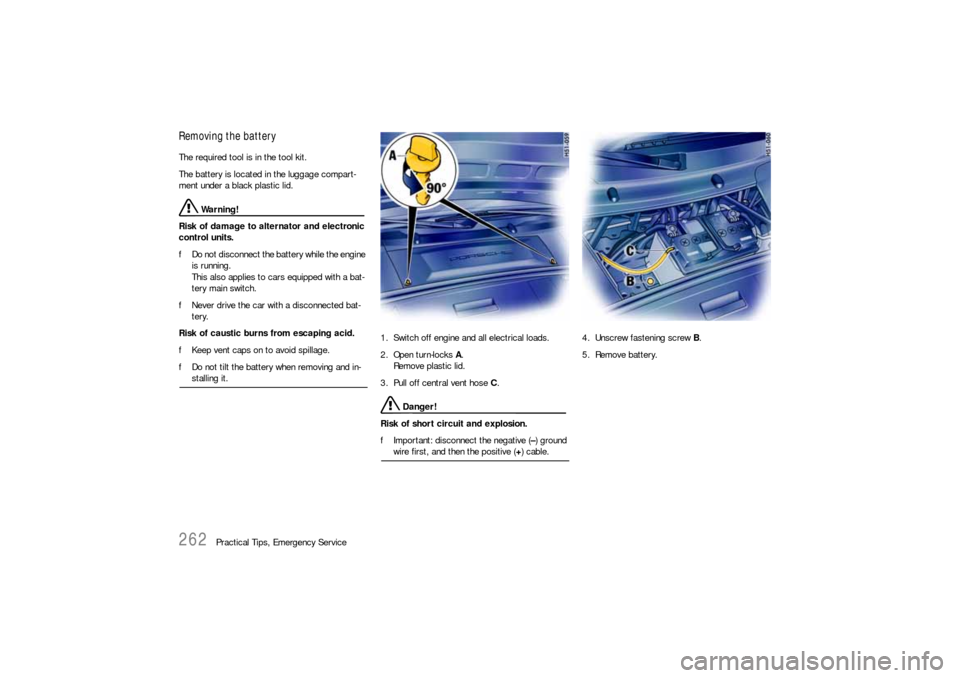
Removing the battery The required tool is in the tool kit.
The battery is located in the luggage compart-
ment under a black plastic lid.
Warning!
Risk of damage to alternator and electronic
control units.
fDo not disconnect the battery while the engine
is running.
This also applies to cars equipped with a bat-
tery main switch.
fNever drive the car with a disconnected bat-
tery.
Risk of caustic burns from escaping acid.
fKeep vent caps on to avoid spillage.
fDo not tilt the battery when removing and in-stalling it. 1. Switch off engine and all electrical loads.
2. Open turn-locks A.
Remove plastic lid.
3. Pull off central vent hose C.
Danger!
Risk of short circuit and explosion.
fImportant: disconnect the negative (–) ground wire first, and then the positive (+) cable.4. Unscrew fastening screw B.
5. Remove battery.
Page 263 of 308
Practical Tips, Emergency Service
263
Installing the battery 1. Put battery in and push it all the way to the
stop.
2. Screw in fastening screw B.
Danger!
Risk of short circuit and explosion.
fImportant: connect the positive (+) cable first, and then the negative (–) ground wire.
3. Push on central vent hose C.
4. Fit plastic lid. Lock turn-locks A.
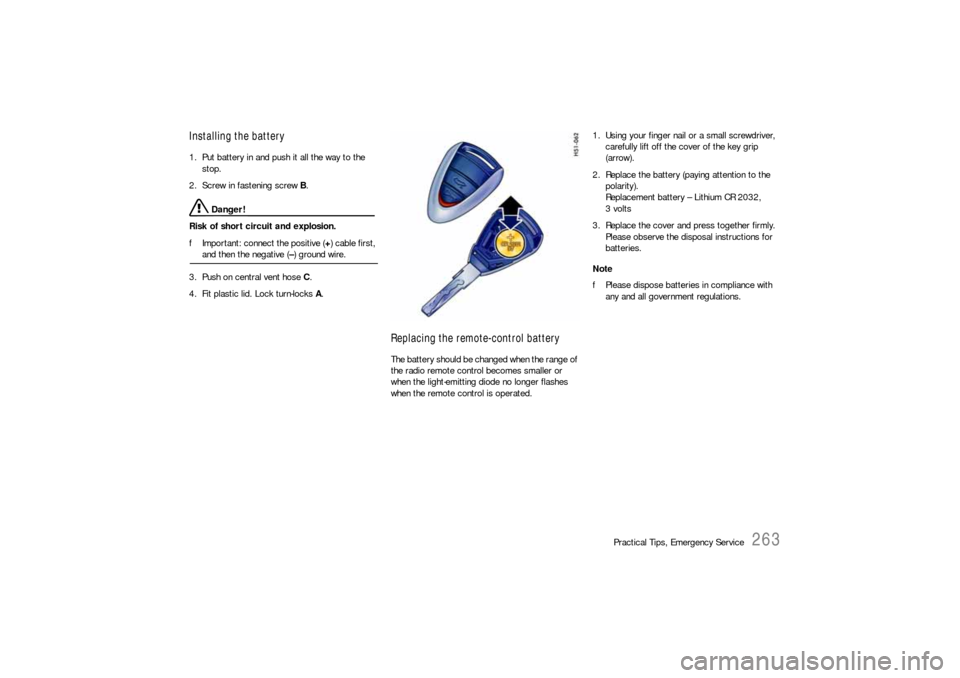
Replacing the remote-control battery The battery should be changed when the range of
the radio remote control becomes smaller or
when the light-emitting diode no longer flashes
when the remote control is operated.1. Using your finger nail or a small screwdriver,
carefully lift off the cover of the key grip
(arrow).
2. Replace the battery (paying attention to the
polarity).
Replacement battery – Lithium CR 2032,
3volts
3. Replace the cover and press together firmly.
Please observe the disposal instructions for
batteries.
Note
fPlease dispose batteries in compliance with
any and all government regulations.