ECU PORSCHE 911 CARRERA 2006 5.G Owner's Manual
[x] Cancel search | Manufacturer: PORSCHE, Model Year: 2006, Model line: 911 CARRERA, Model: PORSCHE 911 CARRERA 2006 5.GPages: 308, PDF Size: 3.69 MB
Page 217 of 308
Maintenance, Car Care
217
5. Insert new wiper blade until you feel it engage.
Ensure that the new wiper blade is inserted
into the wiper arm in the same position:
– direction of the spoiler on the driver side,
– curvature on the passenger side.
6. Carefully fold wiper arm back onto the wind-
shield.
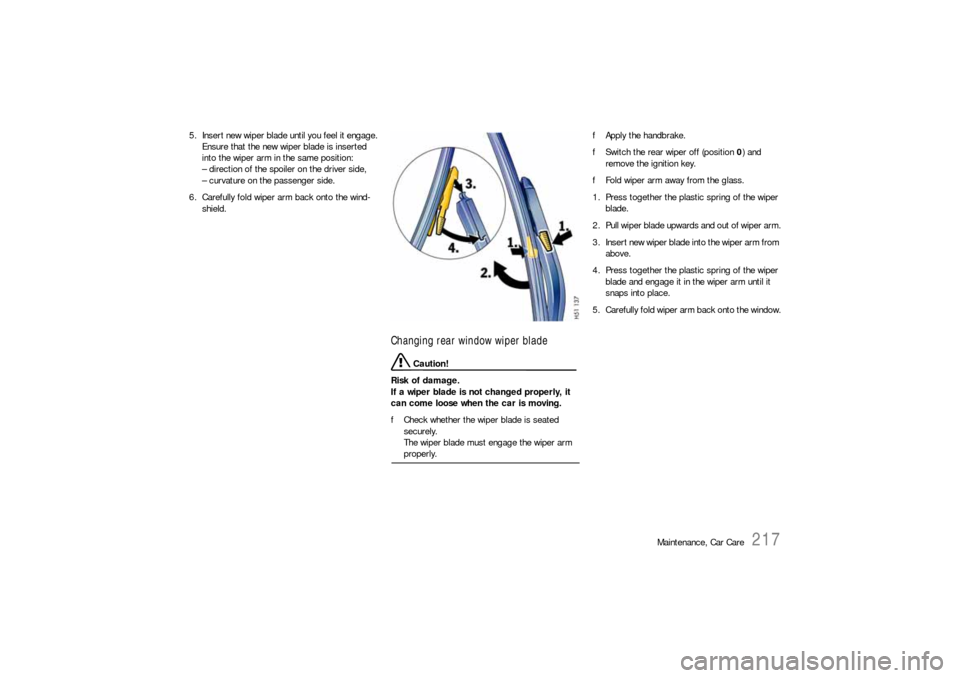
Changing rear window wiper blade
Caution!
Risk of damage.
If a wiper blade is not changed properly, it
can come loose when the car is moving.
fCheck whether the wiper blade is seated
securely.
The wiper blade must engage the wiper arm properly.fApply the handbrake.
fSwitch the rear wiper off (position 0) and
remove the ignition key.
fFold wiper arm away from the glass.
1. Press together the plastic spring of the wiper
blade.
2. Pull wiper blade upwards and out of wiper arm.
3. Insert new wiper blade into the wiper arm from
above.
4. Press together the plastic spring of the wiper
blade and engage it in the wiper arm until it
snaps into place.
5. Carefully fold wiper arm back onto the window.
Page 225 of 308

Maintenance, Car Care
225
Leather Characteristics and special features
The natural surface markings of leather, e.g.
creases, healed scars, insect sting marks, struc-
tural differences and slight variations in shade and
grain add to the attractiveness of the natural leath-
er product.
A special mention must be made here of natural
leather.
For natural leather, carefully selected hides of the
highest quality are used. It is not covered com-
pletely with dye on production.
“Nature’s signature” is therefore easily recogniza-
ble.
This fine material is distinguished by an outstand-
ing seating comfort, special suppleness and a typ-
ical patina. Leather care and treatment
fClean all types of leather regularly to remove
fine dust using a soft, damp, white woollen
cloth or a commercially available microfibre
cloth.
fRemove heavy contamination with Porsche
leather cleaner.
Please always follow the instructions for use
given on the containers.
Caustic cleaners and hard cleaning objects
must not be used.
Perforated leather must under no circum-
stances get wet on its reverse side.
Once cleaned, leather (particularly the heavily
stressed leather seats) must be treated only with
Porsche leather care liquid.
Fabric, upholstery, carpets and
floor-mats fUse only a vacuum cleaner or a medium stiff
brush.
fRemove stains and spots with Porsche stain
remover.
The Porsche range of accessories includes non-
skid floor-mats to protect the carpets in summer
and winter.
Warning!
Risk of an accident.
fAlways check the movement of the pedals be-
fore driving and make sure that they are not ob-
structed by a floor-mat or any other object.
fSecure the floor-mat to prevent it from sliding
into positions that could interfere with the safe
operation of your vehicle - do not install them
loosely in the vehicle.
Your Porsche dealer will be glad to offer you nonskid floor-mats of the correct size.
Page 248 of 308
248
Practical Tips, Emergency Service
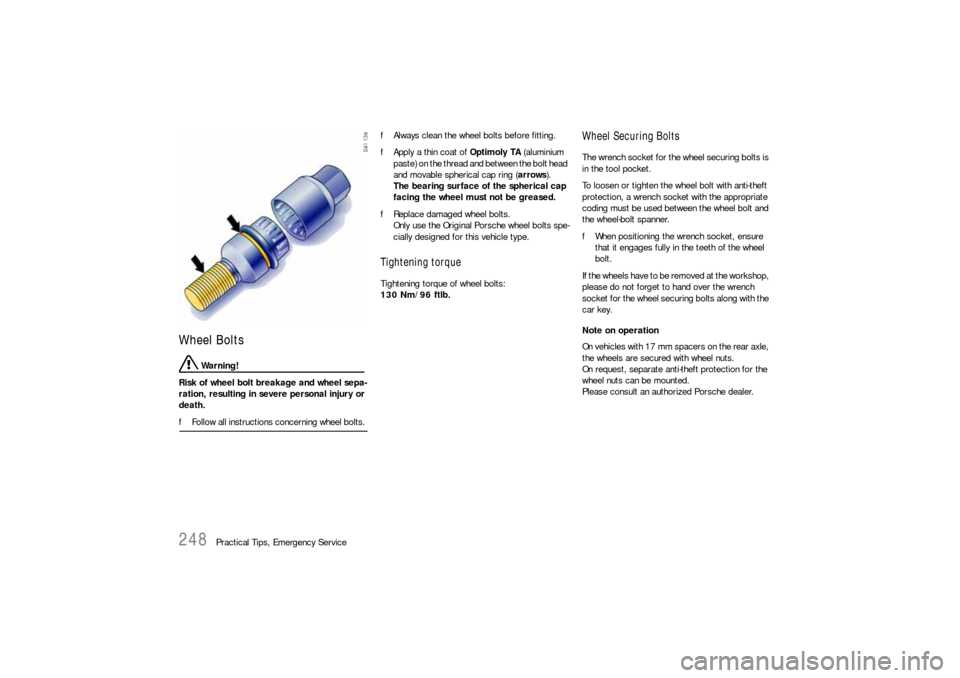
Wheel Bolts
Warning!
Risk of wheel bolt breakage and wheel sepa-
ration, resulting in severe personal injury or
death.
fFollow all instructions concerning wheel bolts. fAlways clean the wheel bolts before fitting.
fApply a thin coat of Optimoly TA (aluminium
paste) on the thread and between the bolt head
and movable spherical cap ring (arrows).
The bearing surface of the spherical cap
facing the wheel must not be greased.
fReplace damaged wheel bolts.
Only use the Original Porsche wheel bolts spe-
cially designed for this vehicle type.
Tightening torque Tightening torque of wheel bolts:
130 Nm/96 ftlb.
Wheel Securing Bolts The wrench socket for the wheel securing bolts is
in the tool pocket.
To loosen or tighten the wheel bolt with anti-theft
protection, a wrench socket with the appropriate
coding must be used between the wheel bolt and
the wheel-bolt spanner.
fWhen positioning the wrench socket, ensure
that it engages fully in the teeth of the wheel
bolt.
If the wheels have to be removed at the workshop,
please do not forget to hand over the wrench
socket for the wheel securing bolts along with the
car key.
Note on operation
On vehicles with 17 mm spacers on the rear axle,
the wheels are secured with wheel nuts.
On request, separate anti-theft protection for the
wheel nuts can be mounted.
Please consult an authorized Porsche dealer.
Page 250 of 308
250
Practical Tips, Emergency Service
Changing a wheel
Warning!
Risk of injury. The car may slip off the jack.
fMake sure that no one is in the vehicle when
jacking up and changing a wheel.
fAlways place the car on stable supports if work
has to be carried out under the car.
Risk of damage to the brake discs of the
Porsche Ceramic Composite Brake (PCCB).
fAlways screw in both assembly aids when changing a wheel.
Note
The tools required for changing a wheel (e.g. jack,
wheel bolt wrench, assembly aids) are not sup-
plied with the car.
Your authorized Porsche dealer will be pleased to
advise you.1. Fully apply the handbrake, engage 1st gear or
select position P and withdraw the ignition key.
2. Secure the car against rolling away, e.g. by
means of wedges under the wheels on the op-
posite side.
This is particularly important on slopes.
3. Slightly slacken the wheel bolts of the wheel to
be changed.
4. Raise the car until the wheel lifts off the
ground.
fPlease observe the chapter “LIFTING THE VE-
HICLE WITH A LIFTING PLATFORM OR GARAGE
LIFT” on Page 244.
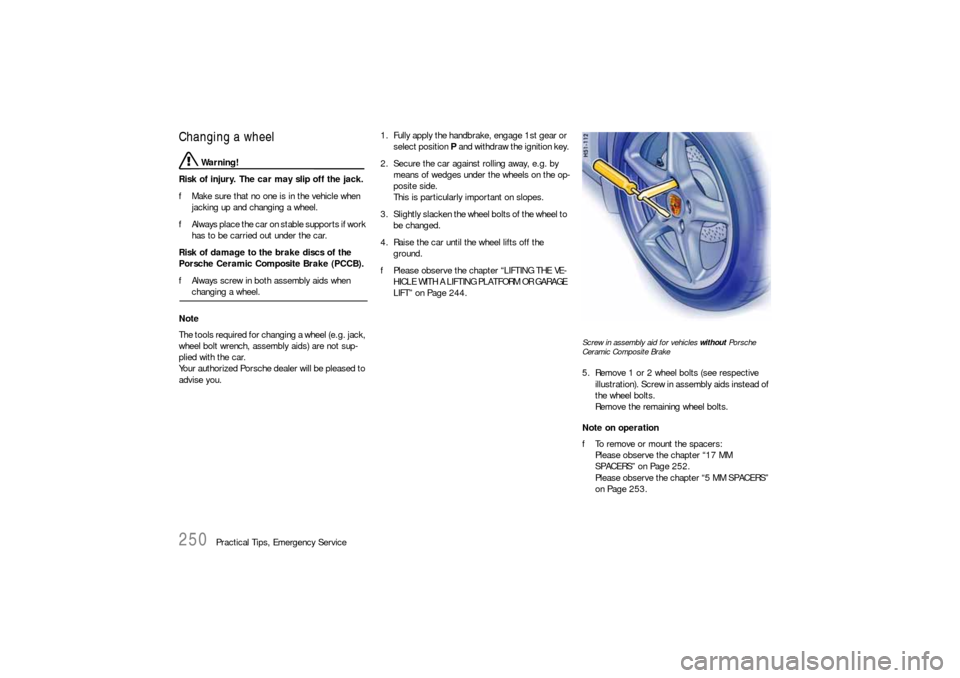
Screw in assembly aid for vehicles without Porsche
Ceramic Composite Brake5. Remove 1 or 2 wheel bolts (see respective
illustration). Screw in assembly aids instead of
the wheel bolts.
Remove the remaining wheel bolts.
Note on operation
fTo remove or mount the spacers:
Please observe the chapter “17 MM
SPACERS” on Page 252.
Please observe the chapter “5 MM SPACERS”
on Page 253.
Page 259 of 308

Practical Tips, Emergency Service
259
Battery care fEnsure that battery is securely mounted.
fKeep terminals and connections clean and
properly tightened.
Corrosion can be prevented by coating the ter-
minals and connections with petroleum jelly or
silicone spray.
fEnsure that vent caps are securely tightened to
prevent spillage. Checking the electrolyte fluid level
Generally, the electrolyte level must be checked
more often in summer than in the winter, and more
often when driving long distances.
fWhen adding water, use only clean containers.
In no case may alcohol (e.g. window cleaner
residues) be permitted to enter the battery.
fUnscrew and open the filler vent caps of each
cell.
With the car on a level surface, the fluid level
should meet the indicator mark in each cell.
fIf necessary, top up with distilled water.
Do not use acid.
Only fill up to the mark, otherwise the electro-
lyte will overflow when the battery is being
charged and cause damage. Battery charging
Automotive batteries loose their efficiency when
not in use.
The charge available in your battery can be meas-
ured with a battery hydrometer.
We recommend that the battery voltage be tested
by your Porsche dealer who has the appropriate
equipment.
If the car is not driven for prolonged periods, the
battery must be charged at least every 6 weeks.
A discharged battery allows rapid formation of sul-
fates, leading to premature deterioration of the
plates.
f f f
Page 269 of 308
Practical Tips, Emergency Service
269
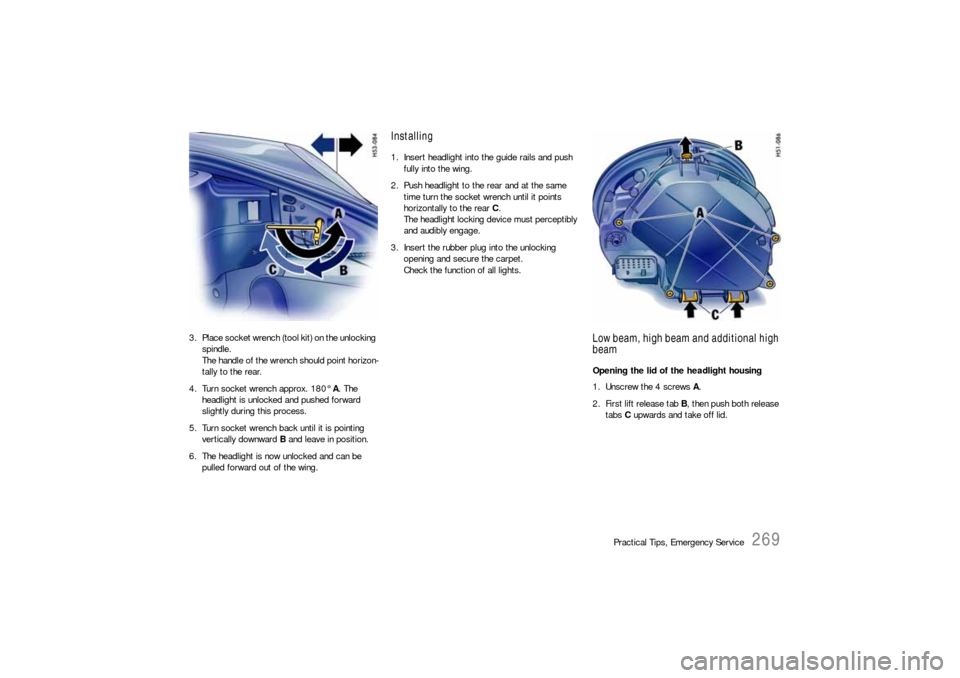
3. Place socket wrench (tool kit) on the unlocking
spindle.
The handle of the wrench should point horizon-
tally to the rear.
4. Turn socket wrench approx. 180° A. The
headlight is unlocked and pushed forward
slightly during this process.
5. Turn socket wrench back until it is pointing
vertically downward B and leave in position.
6. The headlight is now unlocked and can be
pulled forward out of the wing.
Installing1. Insert headlight into the guide rails and push
fully into the wing.
2. Push headlight to the rear and at the same
time turn the socket wrench until it points
horizontally to the rear C.
The headlight locking device must perceptibly
and audibly engage.
3. Insert the rubber plug into the unlocking
opening and secure the carpet.
Check the function of all lights.
Low beam, high beam and additional high
beamOpening the lid of the headlight housing
1. Unscrew the 4 screws A.
2. First lift release tab B, then push both release
tabs C upwards and take off lid.
Page 275 of 308
Practical Tips, Emergency Service
275
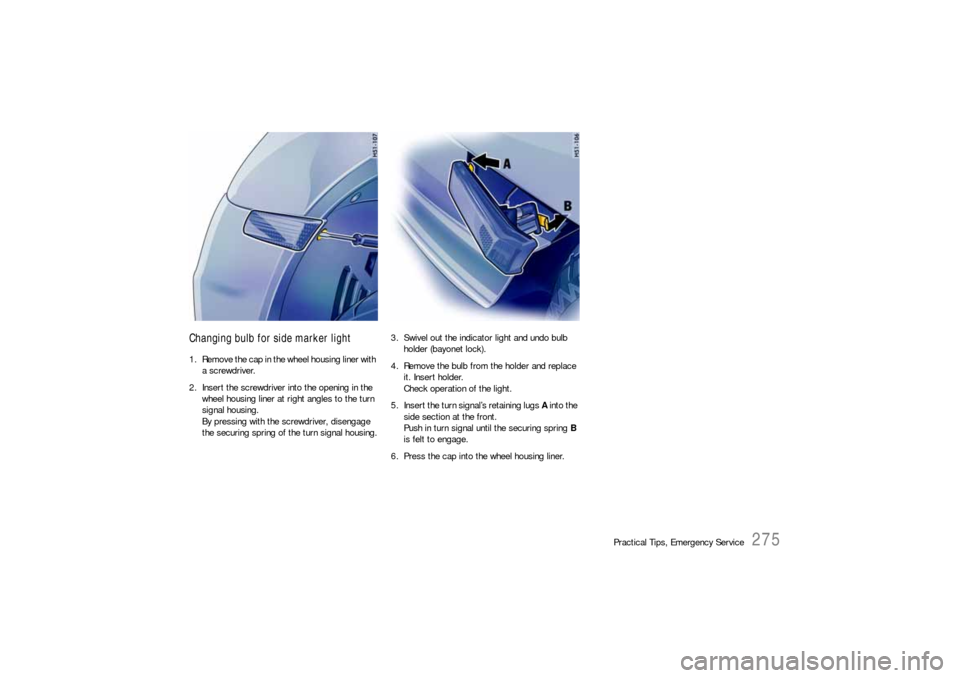
Changing bulb for side marker light1. Remove the cap in the wheel housing liner with
a screwdriver.
2. Insert the screwdriver into the opening in the
wheel housing liner at right angles to the turn
signal housing.
By pressing with the screwdriver, disengage
the securing spring of the turn signal housing.3. Swivel out the indicator light and undo bulb
holder (bayonet lock).
4. Remove the bulb from the holder and replace
it. Insert holder.
Check operation of the light.
5. Insert the turn signal’s retaining lugs A into the
side section at the front.
Push in turn signal until the securing spring B
is felt to engage.
6. Press the cap into the wheel housing liner.
Page 281 of 308
Practical Tips, Emergency Service
281
Towing Certain state statutes and local ordinances prohib-
it towing with a chain, rope or even a tow bar.
In addition, damage to your vehicle may result
from improper procedures.
Consult your authorized Porsche dealer for de-
tails. Vehicle towing Flat bed towing is the preferred type of towing to
be used on Porsche vehicles.
Under certain circumstances, wheel lifts may be
used when the vehicle will not roll.
The vehicle must be towed with all four
wheels off the ground, otherwise damage to
the vehicle may result. Towing hook The towing hook is contained in the tool kit.
Caution!
Risk of damage to the vehicle.
fUse the towing hook only for an emergency to
remove the vehicle off the road. The towing
hook is to be used only to pull the vehicle onto
the flat bed, tractor or towing aparatus if the
vehicle will roll freely. Under no circumstances
is the vehicle to be secured using the towing
hook. fNever use the towing hook to tow this or any
other vehicle.
fBear in mind the limited ground clearance of
your car on uneven surfaces.
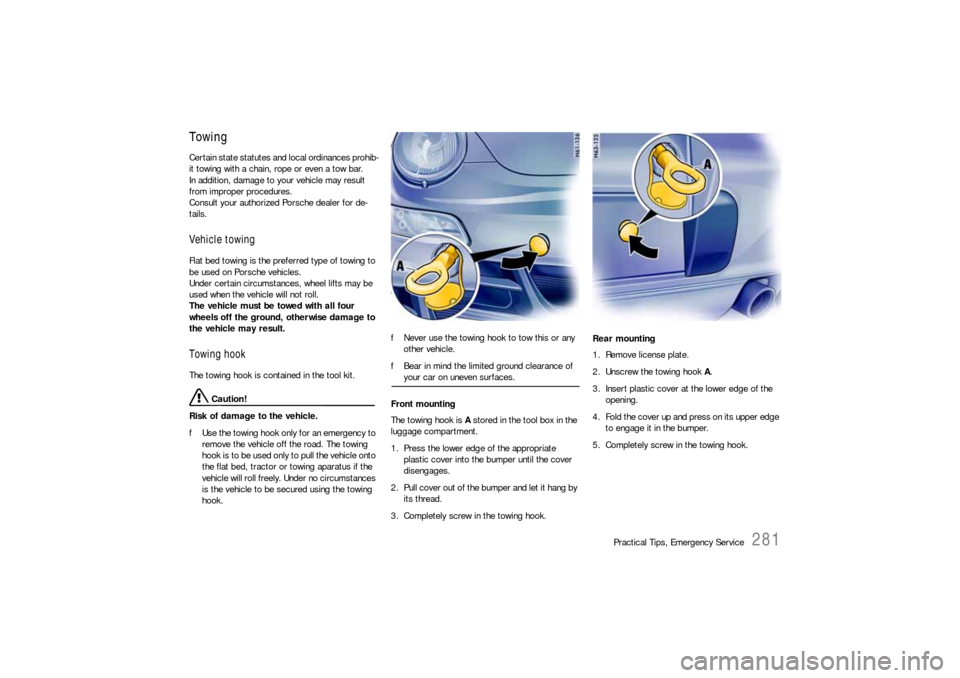
Front mounting
The towing hook is A stored in the tool box in the
luggage compartment.
1. Press the lower edge of the appropriate
plastic cover into the bumper until the cover
disengages.
2. Pull cover out of the bumper and let it hang by
its thread.
3. Completely screw in the towing hook.Rear mounting
1. Remove license plate.
2. Unscrew the towing hook A.
3. Insert plastic cover at the lower edge of the
opening.
4. Fold the cover up and press on its upper edge
to engage it in the bumper.
5. Completely screw in the towing hook.
Page 282 of 308
282
Practical Tips, Emergency Service
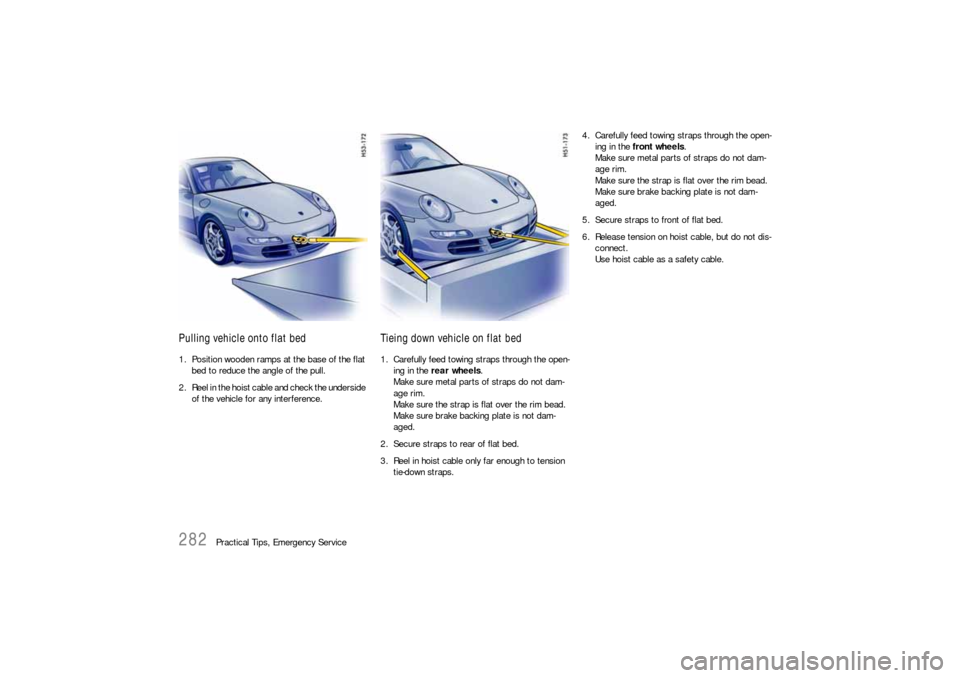
Pulling vehicle onto flat bed 1. Position wooden ramps at the base of the flat
bed to reduce the angle of the pull.
2. Reel in the hoist cable and check the underside
of the vehicle for any interference.
Tieing down vehicle on flat bed 1. Carefully feed towing straps through the open-
ing in the rear wheels.
Make sure metal parts of straps do not dam-
age rim.
Make sure the strap is flat over the rim bead.
Make sure brake backing plate is not dam-
aged.
2. Secure straps to rear of flat bed.
3. Reel in hoist cable only far enough to tension
tie-down straps. 4. Carefully feed towing straps through the open-
ing in the front wheels.
Make sure metal parts of straps do not dam-
age rim.
Make sure the strap is flat over the rim bead.
Make sure brake backing plate is not dam-
aged.
5. Secure straps to front of flat bed.
6. Release tension on hoist cable, but do not dis-
connect.
Use hoist cable as a safety cable.
Page 308 of 308

308
Index
TTachometer .................................................. 91
Tank ......................................... 208
, 209
, 291
Ventilation system ............................... 213
Technical data ............................................ 286
Telephone .................................................. 161
Temperature setting .................................... 138
Temperature, outside indicator....................... 95
Test stand, measurements ............................ 74
Theft protection ............................................ 18
Tightening torque for wheel bolts ................. 252
Tiptronic .................................................... 165
Indicator............................................... 93
Tire pressure monitoring ............................. 109
Tires ................................... 16
, 229
, 288
, 289
Care .................................................. 229
Checking pressure .............................. 251
Inscription .......................................... 240
Loading information............................ 242
Pressure ............................... 5
, 232
, 290
Pressure monitoring............................ 109
Pressure plate .................................... 285
Sealant ......................................245, 246
Sidewall ............................................. 240
Size ................................................... 240
Tool kit....................................................... 151
Tools .................................................150, 151
Towing ...................................... 170
, 281
, 282
Towing lug .................................................. 151
Tow-starting ............................................... 170
Tracks ...............................................288, 289
Transmission ......................................164, 287
Fluid...........................................215, 291
Trunk entrapment ....................................... 152Turn signals ......................................... 91
, 132
Tyre pressure
Compressor ....................................... 151
Ty re s
Sealant............................................... 151
UUndercoating ..................................... 211
, 223
VValves ........................................................ 236
Vanity mirror ................................................. 41
Vehicle
Care .................................................. 218
Data................................................... 284
Identification label ............................... 284
Identification number ........................... 284
Putting into operation .......................... 261
Washing ............................................. 219
Ventilation .................................................. 138
Vents ................................................ 138
, 141
Viscosity, engine oil..................................... 204
WWarning lights and messages....................... 122
Washer
Fluid .......................................... 213
, 291
Lever ................................................. 133
Washing ..................................................... 219
Weights ............................................. 292, 293
Welcome Home Function ............................. 131
Wheel.......................... 16
, 224
, 229
, 288
, 289Bolts ..................................................248
Care...................................................229
Changing ............................................245
Checking pressure ..............................251
Inscription...........................................240
Loading information .............................242
Securing wheel bolts .............................19
Security wheel bolts ............................151
Sidewall ..............................................240
Size ...................................................240
Tire pressure ......................... 5
, 232
, 290
Tire pressure plate..............................285
Tire sealant................................ 245, 246
Windows...................................... 28
, 176
, 223
Washer nozzles ...................................133
Washer system .................. 133
, 213
, 291
Windshield wiper/washer lever .....................133
Windshield wipers .............................. 133, 216
Replacing ...........................................216
Windstop ....................................................185
Winter operation
Battery ...............................................260
Coolant ..............................................199
Engine oil............................................200
Jumper cables ........................... 264, 265
Locks .................................................221
Seals..................................................224
Snow chains .......................................239
Tires ................................. 238
, 288
, 289
Washer fluid ........................................213
Wiper blades .......................................216
Wiper
Blades ................................................216
Rear ...................................................134