Psm PORSCHE 911 CARRERA 2006 5.G Owners Manual
[x] Cancel search | Manufacturer: PORSCHE, Model Year: 2006, Model line: 911 CARRERA, Model: PORSCHE 911 CARRERA 2006 5.GPages: 308, PDF Size: 3.69 MB
Page 13 of 308

Controls, Instruments
13 Controls, Instruments
Before driving off ......................................... 14
Break in hints for the first
2,000 miles/3,000 kilometers ...................... 16
Keys ........................................................... 19
Security Wheel Bolts.................................... 19
Doors ......................................................... 21
Central Locking ........................................... 22
Alarm System,
Passenger Compartment Monitoring ............. 26
Power Windows ........................................... 28
Inside mirror ................................................ 30
Door Mirrors................................................ 30
Rear Window Defogger,
Door Mirror Heating ..................................... 33
Seat Adjustment .......................................... 34
Seat Memory ............................................... 36
Heated Seats .............................................. 38
Rear Seat Backrests.................................... 39
Steering Wheel Adjustment ........................... 39
Multi-Functional Steering Wheel ..................... 40
Sun Visors................................................... 41
Safety Belts................................................. 42
Airbag Systems ........................................... 45
Child Restraint Systems ............................... 51
LATCH System
Child seat bracket on the passenger’s seat .... 55
Child Restraint Anchorages ........................... 56
Rollover Protection System........................... 57
Parking Aids ................................................ 58
Four-Wheel Drive .......................................... 61
Retractable Rear Spoiler............................... 63
Clutch Pedal ................................................ 65Parking Brake .............................................. 65
Brakes ........................................................ 66
ABS Brake System
(Antilock Brake System)................................ 69
Sport Mode ................................................. 71
Porsche Stability Management (PSM)............. 72
Porsche Active Suspension
Management (PASM) .................................... 75
Interior Lights .............................................. 76
Operation, Instruments ................................. 78
Ignition/Starter Switch with anti-theft
Steering Lock .............................................. 80
Starting Procedures ..................................... 82
Stopping Engine .......................................... 83
Instrument Panel USA Models ....................... 84
Instrument Panel Canada Models................... 86
Engine oil temperature ................................. 88
Automatic Speed Control Indicator light ......... 88
Instrument Illumination.................................. 88
Trip Odometer ............................................. 89
Speedometer .............................................. 90
Changing over between
Miles / Kilometers........................................ 90
Tachometer................................................. 91
Turn Signal Indicator Light ............................ 91
High Beam .................................................. 91
Cooling System ........................................... 92
Tiptronic ...................................................... 93
Fuel ............................................................ 94
Clock .......................................................... 95
Outside temperature .................................... 95
Engine Oil Pressure ...................................... 96Check Engine
Warning Light .............................................. 97
On-Board Computer (BC).............................. 98
Emergency Flasher Switch .......................... 130
Light Switch .............................................. 131
Welcome Home Lighting............................. 131
Automatic Headlight Beam Adjustment......... 132
Turn Signal / Headlight Dimmer /
Parking light / Flasher Lever ....................... 132
Windshield Wiper / Washer Lever ................ 133
Automatic Speed Control ............................ 136
Automatic Air Conditioning System .............. 138
Central and Side Vents ............................... 141
Fresh-air Intake .......................................... 141
Ashtray ..................................................... 142
Cigarette Lighter ........................................ 143
Cupholder ................................................. 144
Storage in the Passenger Compartment ...... 146
Luggage Compartment Lid and Engine
Compartment Lid ....................................... 148
Luggage Compartment
(911 Carrera, 911 Carrera S) ..................... 150
Luggage Compartment
(911 Carrera 4, 911 Carrera 4S) ................ 151
Trunk Entrapment ...................................... 152
Fire Extinguisher ........................................ 154
HomeLink .................................................. 155
Porsche Communication
Management (PCM) .................................... 158
Car Telephone and
Aftermarket Alarms .................................... 161
Page 17 of 308
Controls, Instruments
17
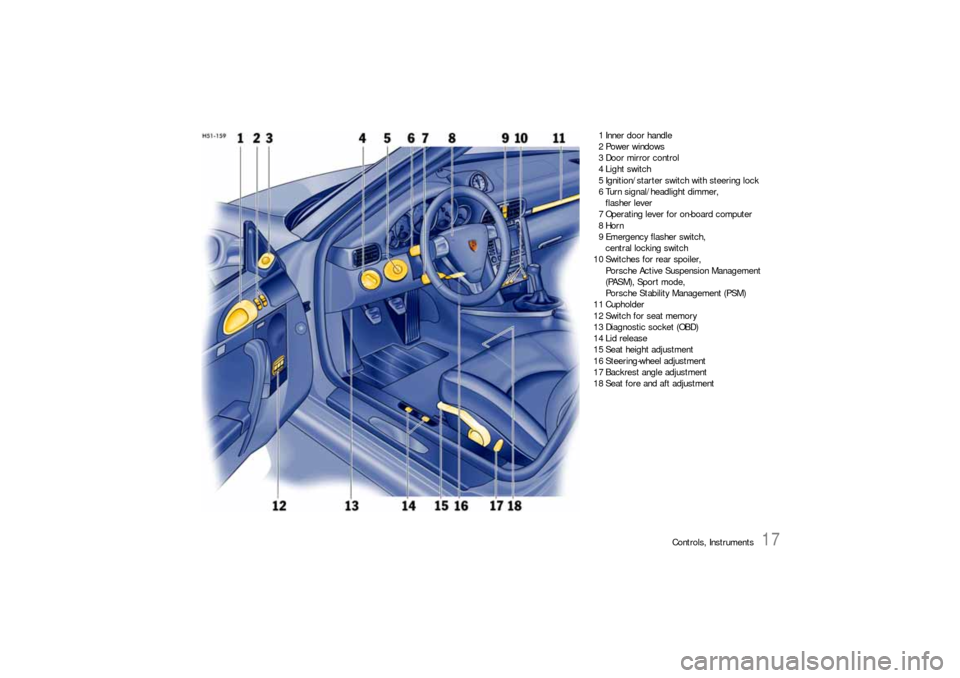
1 Inner door handle
2 Power windows
3 Door mirror control
4 Light switch
5 Ignition/starter switch with steering lock
6 Turn signal/headlight dimmer,
flasher lever
7 Operating lever for on-board computer
8Horn
9 Emergency flasher switch,
central locking switch
10 Switches for rear spoiler,
Porsche Active Suspension Management
(PASM), Sport mode,
Porsche Stability Management (PSM)
11 Cupholder
12 Switch for seat memory
13 Diagnostic socket (OBD)
14 Lid release
15 Seat height adjustment
16 Steering-wheel adjustment
17 Backrest angle adjustment
18 Seat fore and aft adjustment
Page 61 of 308
Controls, Instruments
61
Four-Wheel Drive With the four-wheel drive of the 911 Carrera 4 and
911 Carrera 4S, the engine power is variably dis-
tributed to the front and rear wheels.
Power distribution and wheel speed compensation
between the front and rear axles is realised with a
viscous multiple-disc clutch.
Distribution of the engine power is dependent
upon the wheel speed difference between the two
axles.
The viscous multiple-disc clutch always delivers
sufficient drive power to the front wheels (approx.
5% to 40%) to ensure optimum traction even on a
poor road surface.
In combination with the Porsche Stability Manage-
ment (PSM), four-wheel drive improves handling
and increases driving stability.
Warning!
The increased control that is provided should
not induce you to take greater risks with your
safety. The limits dictated by the laws of phy-
sics cannot be overcome, even with four-
wheel drive.
The risk of accidents due to inappropriate
speed cannot be reduced, even by four-
wheel drive.
The driver bears the responsibility for all dri-
ving maneuvers.
fAdapt your driving style to the prevailing road
and weather conditions.
fObey all traffic laws.
Dynamometer testing procedure Some U.S. states and Canadian provinces con-
duct emissions inspection/maintenance testing in-
volving the use of two-wheel dynamometer.
A two-wheeled dynamometer is a treadmill type
device upon which a single axle of the car, the dri-
ving axle of the vehicle, rotates to simulate vehicle
operation on the road while the vehicle remains
stationary.
Your 911 Carrera 4 or 911 Carrera 4S has a full-
time four-wheel drive system which cannot be
disabled. Severe damage to the powertrain can
result if tested on a two-wheel dynamometer.
Warning!
To avoid severe powertrain damage and a
possible unexpected movement of the vehic-
le.
fYour 911 Carrera 4 or 911 Carrera 4S vehicle
must never be tested on a two-wheel dynamo-
meter.
fAdvise the emission station of this warning be-fore testing the vehicle.
Power measurement
Power measurements on dynamometers are not
approved by Porsche.
Page 68 of 308
68
Controls, Instruments
Brake booster The brake booster assists braking only when
the engine is running.
When the car is moving while the engine is not run-
ning, or if the brake booster is defective, more
pressure on the brake pedal is required to bring
the car to a stop.
If this happens, ABS and PSM will also not oper-
ate.
Moisture or road salt on brakes affects braking.
When the vehicle is driven on salted roads for ex-
tended periods, the brakes should be washed
down thoroughly about every 2 weeks. An auto-
matic carwash facility cannot do this job properly.
Brakes will dry after a few cautious brake applica-
tions.
Warning!
Driving through water may reduce the trac-
tion.
Moisture on brakes from road water, car
wash, or coating of road salt may affect
braking efficiency.
fCautiously apply brakes to test brakes after being exposed.
Brake wear Your car has excellent brakes, but they are still
subject to wear. The rate at which they wear de-
pends on how the brakes are used.
fHave the brake system inspected at the
intervals recommended in your Maintenance
Booklet.
If the warning lights in the instrument panel and on-
board computer stay on when the engine is run-
ning or come on while driving, the brake pads are
worn, excessively.
fDo not continue to operate the vehicle.
Have your authorized Porsche dealer inspect
or replace the brake pads.
Brake pads Wear on the brake pads and brake discs depends
to a great extent on the driving style and the con-
ditions of use and therefore cannot be expressed
in actual miles on the road.
The high-performance brake system is designed
for optimal braking effect at all speeds and tem-
peratures.
Certain speeds, braking forces and ambient
conditions (such as temperature and humidity)
therefore might cause “brake noises”.
New brake pads or linings
New brake pads and brake discs have to be “bro-
ken in”, and therefore only attain optimal friction
when the car has covered several hundred miles
or km.
The slightly reduced braking ability must be com-
pensated for by pressing the brake pedal harder.
This also applies whenever the brake pads and
brake discs are replaced.
Warning light USA
Warning light Canada
Page 71 of 308
Controls, Instruments
71
Sport ModeA sportier car set-up is obtained when Sport mode
is switched on. Interventions by the Porsche
control systems are intentionally shifted towards
greater agility and driving performance.
– PASM (Porsche Active Suspension Manage-
ment) is automatically changed to Sport mode,
resulting in a stiffer suspension setup.
– The Tiptronic S switches to a sporty gear-
changing map and shortens the gear shifting
periods. Gear changes take place faster.
– PSM (Porsche Stability Management) control is
sporty. PSM interventions take place later than
in Normal mode. The driver can maneuver the
vehicle with greater agility at its performance
limits, without having to dispense with the
assistance of PSM in emergency situations.
– The electronic accelerator pedal reacts
sooner, and the engine is more responsive to
throttle inputs. When Sport mode is switched
on, this function is activated only after the
driver has floored the accelerator pedal or
released it briefly.
– The rpm limiter characteristic is “harder”, i.e.
the engine is immediately throttled when the
performance limits are reached (only in manual
selection mode for vehicles with Tiptronic S).
fPlease observe the appropriate chapters of
this Manual.
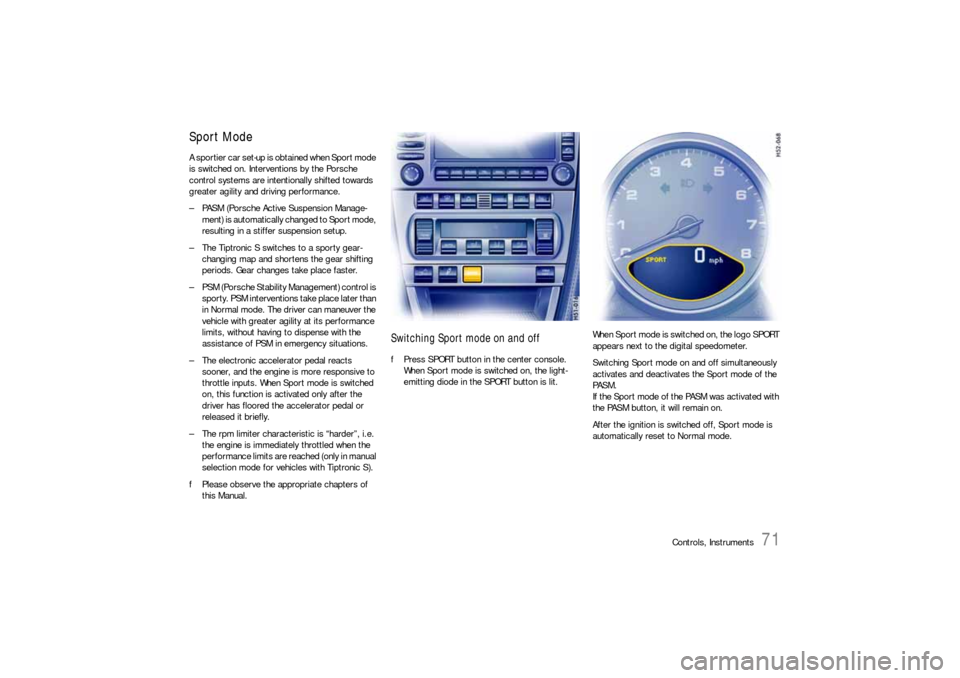
Switching Sport mode on and offfPress SPORT button in the center console.
When Sport mode is switched on, the light-
emitting diode in the SPORT button is lit.When Sport mode is switched on, the logo SPORT
appears next to the digital speedometer.
Switching Sport mode on and off simultaneously
activates and deactivates the Sport mode of the
PA S M .
If the Sport mode of the PASM was activated with
the PASM button, it will remain on.
After the ignition is switched off, Sport mode is
automatically reset to Normal mode.
Page 72 of 308

72
Controls, Instruments
Porsche Stability Management
(PSM)PSM is an active control system for stabilization of
the vehicle during extreme driving manoeuvres.
The most recent version of PSM (only on vehicles
with four-wheel drive) improves the brake system
functionality.
Warning!
The increased control that is provided should
not induce you to take greater risks with your
safety. The limits dictated by the laws of
physics cannot be overcome, even with PSM.
The risk of accidents due to inappropriate
speed cannot be reduced, even by PSM.
The driver bears the responsibility for all
driving maneuvers.
fAdapt your driving style to the prevailing road
and weather conditions.
fObey all traffic laws. Advantages of PSM – Superior traction and lane-holding ability in all
driving situations – even on road surfaces with
varying friction.
– PSM actively stabilizes the vehicle during dy-
namic driving maneuvers (e.g. rapid steering
movements, during lane changes or on alter-
nating curves). – Improved braking stability in curves and on dif-
ferent or varying road surfaces.
– It improves the braking functions and shortens
the stopping distance if emergency braking is
needed (only vehicles with four-wheel drive).
Readiness for operationPSM is switched on automatically every time you
start the engine.FunctionSensors at the wheels, brakes, steering system
and engine continuously measure:
– Speed
– Steering angle
– Lateral acceleration
– Rate of turn about the vertical axis
– Brake pressure
PSM uses these values to determine the direction
of travel desired by the driver.
PSM intervenes and corrects the course if the
actual direction of motion deviates from the
desired course (steering-wheel position):
It brakes individual wheels as needed. In addition,
the engine power may be manipulated in order to
stabilize the vehicle.The events below inform the driver of PSM control
operations and warn him to adapt his driving style
to the road conditions:
– The multi-functional information light on the
instrument panel lights up.
– Hydraulic noises can be heard.
– The vehicle decelerates and steering-wheel
forces are altered as the PSM controls the
brakes.
– Reduced engine power.
– The brake pedal pulsates and its position is
changed during braking.
In order to achieve full vehicle deceleration,
foot pressure must be increased after begin-
ning of the brake pedal pulsing.
Page 73 of 308
Controls, Instruments
73
Examples of PSM control operations
– If the front wheels of the vehicle drift on a
bend, the rear wheel on the inside of the bend
is braked and the engine power is reduced if
necessary.
– If the rear of the vehicle swings out on a bend,
the front wheel on the outside of the bend is
braked.
Additional functions for vehicles with
four-wheel drive
– Pre-filling the brake system:
If you suddenly and quickly take your foot off
the accelerator pedal, the brake system gets
prepared for possible emergency braking. The
brake system is pre-filled which lightly presses
the brake pads on the brake discs.
Brake boost:
If emergency braking does not have sufficient
pedal pressure, the brake boost produces
the brake pressure necessary for maximum decel-
eration on all 4 wheels.The PSM should always be switched on
during “normal” driving.
However, it may be advantageous to switch off
PSM temporarily in exceptional situations, for
example:
– On a loose surface or in deep snow,
– When “rocking the vehicle free” and
– When using snow chains.
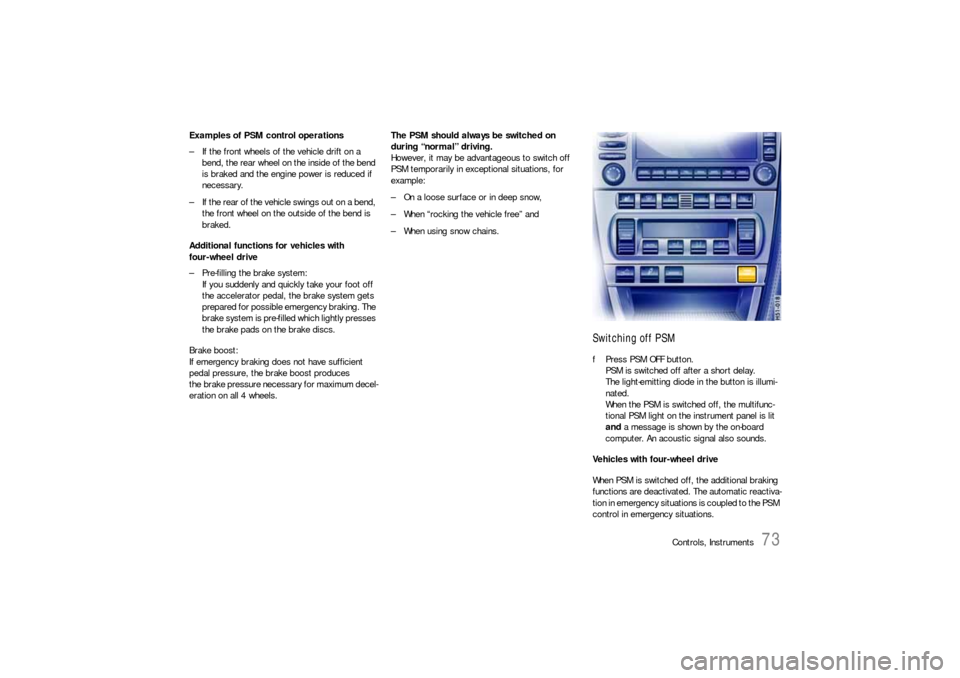
Switching off PSMfPress PSM OFF button.
PSM is switched off after a short delay.
The light-emitting diode in the button is illumi-
nated.
When the PSM is switched off, the multifunc-
tional PSM light on the instrument panel is lit
and a message is shown by the on-board
computer. An acoustic signal also sounds.
Vehicles with four-wheel drive
When PSM is switched off, the additional braking
functions are deactivated. The automatic reactiva-
tion in emergency situations is coupled to the PSM
control in emergency situations.
Page 74 of 308

74
Controls, Instruments The following functions stabilize the vehicle in
emergency situations, even with PSM switched
off:
– When PSM is off, the vehicle is stabilized as
soon as one of the two front wheels enters the
ABS control range.
– When PSM is off and Sport mode is on, the
vehicle is stabilized as soon as both front
wheels enter the ABS control range.
One-sided spinning of the wheels is prevented,
even with PSM switched off.
Switching PSM back onfPress PSM OFF button.
PSM is switched on after a short delay.
The light-emitting diode in the button and the
multifunctional PSM light go out.
The on-board computer shows a message.Sport modeA sportier car set-up is obtained when Sport mode
is switched on. PSM interventions are later than in
Normal mode; the vehicle can be manoeuvred
with greater agility at its performance limits,
without the need to dispense with the assistance
of PSM in emergency situations. This helps to
achieve optimal lap times, particularly on race
circuits and a dry road surface.– The multifunctional light on the instrument
panel lights up for a lamp check when the
ignition is switched on.
– The light indicates a control operation by
flashing, including when PSM is switched off
(brake control in the event of one-sided wheel
spin).
– In conjunction with a message on the on-board
computer, the light indicates that PSM is
switched off.
An acoustic signal also sounds.
– Faults are displayed by the light in conjunction
with a message on the on-board computer.
PSM is out of order.
fPlease consult an authorized Porsche dealer.
fPlease observe the chapter “PUTTING
VEHICLE INTO OPERATION” on Page 261.
fPlease observe the chapter “WARNINGS ON
THE INSTRUMENT PANEL AND THE ON-
BOARD COMPUTER” on Page 122.
TowingfPlease observe the chapter “VEHICLE
TOWING” on Page 281.Checks on test standsBrake tests
Brake tests must be performed only on plate-type
test stands or roller test stands.
The following limit values must not be exceeded
on roller test stands:
– Testing speed 5 mph (8 km/h)
– Test duration 20 seconds
Handbrake tests
Handbrake tests on the roller test stand must be
performed only with the ignition switched off.
Multifunctional PSM light
Page 78 of 308

78
Controls, Instruments
Operation, Instruments 1. Ignition lock/steering lock
2. Turn signals/high beam/headlight flasher stalk
3. Hands-free microphone for telephone
4. Horn
5. Wiper/washer stalk, rear window wiper
6. Button for seat heating, left
7. Interior temperature sensor/GPS antenna
8. Stopwatch
9. Emergency flasher switch
10.Central locking button, readiness display for
alarm system
11.Porsche Communication Management (PCM)12.Button for seat heating, right
13.Cupholder
14.Light switch
15.Operating lever for on-board computer
16.Locking lever for steering-wheel adjustment
17.Operating lever for automatic speed control
18.Operating panel for air conditioning
19 Buttons for rear spoiler,
Porsche Active Suspension Management
(PASM),
Sport mode, Porsche Stability Management
(PSM)
Page 84 of 308

84
Controls, Instruments
Instrument Panel USA Models Also refer to the corresponding chapters in
the Owner’s Manual.
1. Engine oil temperature gauge
2. Speedometer with analogue display
3. Tire pressure warning light
4. Turn signal indicator light, left
5. Tachometer
6. High beam indicator light
7. Turn signal indicator light, right
8. ABS warning light
9. Cooling system
Temperature gauge, warning light
10.Fuel
Level gauge, warning light
11.Engine oil pressure gauge
12.Adjustment button for instrument illumination
and trip counter
13.Odometer and daily trip mileage display
14.Automatic speed control indicator light15.Light sensor for instrument illumination
16.Airbag warning light
17.Emission control warning light
(Check Engine)
18.Central warning light
19.On-board computer display
20.Porsche Stability Management
Multifunctional PSM light
21.Brake warning light
22.Safety belt warning light
23.Tiptronic indicator
24.Clock and outside temperature display
25 Adjustment button for clockWhen the ignition is switched on, the warning
lights light up for a lamp check.
Note
Warnings that have been given are stored in the
appropriate control unit memory and can be read
out at an authorized Porsche dealer.
This information can help to warn you about situa-
tions which may be hazardous to you or your car.