fuse PORSCHE 911 CARRERA 2010 5.G Owner's Manual
[x] Cancel search | Manufacturer: PORSCHE, Model Year: 2010, Model line: 911 CARRERA, Model: PORSCHE 911 CARRERA 2010 5.GPages: 310, PDF Size: 3.39 MB
Page 242 of 310

240
Practical Tips, Emergency Service
Danger!
Risk of serious personal injury or death.
Driving the vehicle with low tire pressure
increases risk of a tire failure and resulting
loss of control. Furthermore, low tire pres-
sure increases rate of wear of the affected
tires.
fCheck tires – including sidewalls – regularly for
foreign bodies, nicks, cuts, cracks and bulges.
fAfter driving off road, examine tires for signs
of damage such as cuts, tears, bulges or for-
eign objects stuck in the tread. Replace a dam-
aged tire if necessary.
fCross curb edges slowly and at right angles if
possible.
Avoid driving over steep or sharp curbs.
fIn cases of doubt, have the wheel (particularly
the inner side) checked by an authorized Porsche dealer.
Tire replacements If in doubt, contact your Porsche dealer.
Use only tire makes and types approved by
Porsche.
If you do not use a Porsche recommended
replacement tire, make sure that you
purchase your new tires from a reputable tire
dealer and that the dealer complies with all
manufacturers warnings for those tires.
Only tires with the same make and with the
same specification code (e.g. “N0”, “N1”...)
can be mounted.
Before mounting new tires, check with your
Porsche dealer about the current release
status.
Use tires with “ZR” quality standards. There
are currently no standards concerning tire
strength at speeds above 150 mph (240 km/h).
Tires should be replaced no less than on one axle
at the time.
Only tires of the same make and type must be
used. Mixed tires are not permissible.
Initially, new tires do not have their full traction.
You should therefore drive at moderate speeds
during the first 60 - 120 miles (100 - 200 km). If new tires are installed only on one axle, a notice-
able change in handling occurs due to the different
tread depth of the other tires.
This happens especially if only rear tires are re-
placed. However, this condition disappears as the
new tires are broken in.
fPlease adjust your driving style accordingly.
Installation of new tires should only be done by a
qualified tire technician.
Valves
Rubber valve stems must be replaced every time
a tire is replaced.
For metal valves, the installation and replacement
instructions must be observed.
fUse only genuine Porsche metal valves.
fProtect the valve inserts against soiling with
valve caps.
Soiled valve inserts can cause a gradual loss
of air.
fUse only plastic valve caps.
Page 254 of 310
252
Practical Tips, Emergency Service
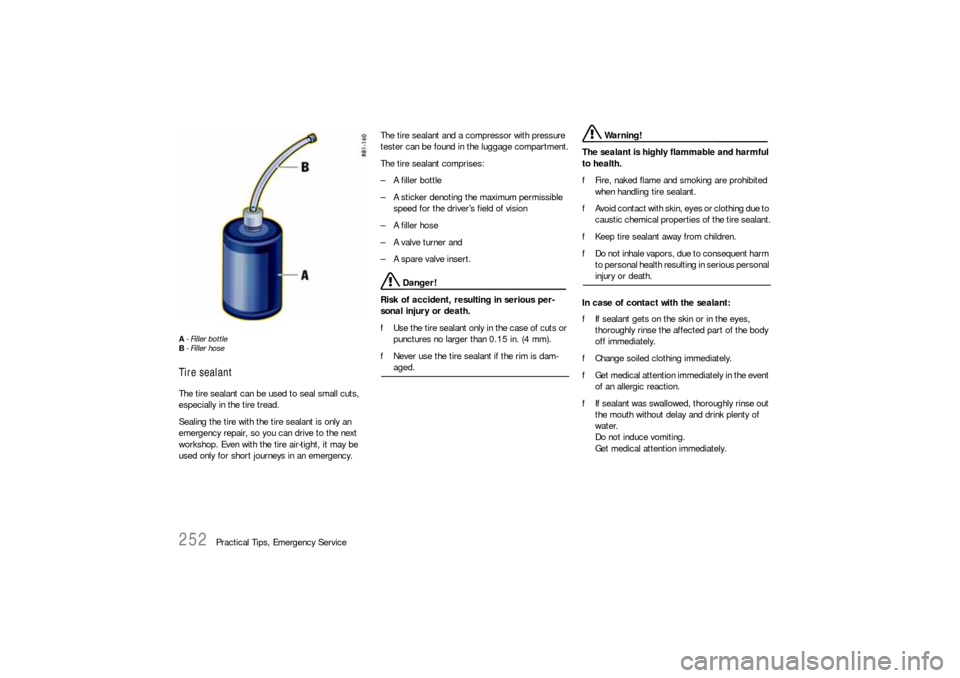
A- Filler bottle
B- Filler hoseTire sealantThe tire sealant can be used to seal small cuts,
especially in the tire tread.
Sealing the tire with the tire sealant is only an
emergency repair, so you can drive to the next
workshop. Even with the tire air-tight, it may be
used only for short journeys in an emergency.The tire sealant and a compressor with pressure
tester can be found in the luggage compartment.
The tire sealant comprises:
– A filler bottle
– A sticker denoting the maximum permissible
speed for the driver’s field of vision
– A filler hose
– A valve turner and
– A spare valve insert.
Danger!
Risk of accident, resulting in serious per-
sonal injury or death.
fUse the tire sealant only in the case of cuts or
punctures no larger than 0.15 in. (4 mm).
fNever use the tire sealant if the rim is dam-aged.
Warning!
The sealant is highly flammable and harmful
to health.
fFire, naked flame and smoking are prohibited
when handling tire sealant.
fAvoid contact with skin, eyes or clothing due to
caustic chemical properties of the tire sealant.
fKeep tire sealant away from children.
fDo not inhale vapors, due to consequent harm
to personal health resulting in serious personal injury or death.
In case of contact with the sealant:
fIf sealant gets on the skin or in the eyes,
thoroughly rinse the affected part of the body
off immediately.
fChange soiled clothing immediately.
fGet medical attention immediately in the event
of an allergic reaction.
fIf sealant was swallowed, thoroughly rinse out
the mouth without delay and drink plenty of
water.
Do not induce vomiting.
Get medical attention immediately.
Page 257 of 310
Practical Tips, Emergency Service
255
Spacers911 Carrera, 911 Carrera SfUse the spacers only together with wheels and
fastening parts approved by Porsche.
Before having spacers fitted, find out about the
current approval status.
Mounting an emergency spare wheel
If 5 mm spacers are mounted, these must not be
removed to mount an emergency spare wheel.
Fitting snow chains
The use of snow chains is not permitted when
5 mm spacers are mounted.
Caution!
Risk of damage to the wheel housings if the
5 mm spacers are not removed before fitting
snow chains.
fTo permit the fitting of snow chains, have the 5 mm spacers removed on all 4 wheels.Note on operation
fTo fit/remove the spacers:
Please consult an authorized Porsche dealer.
fPlease see the chapter “CHANGING A WHEEL”
on Page 249.
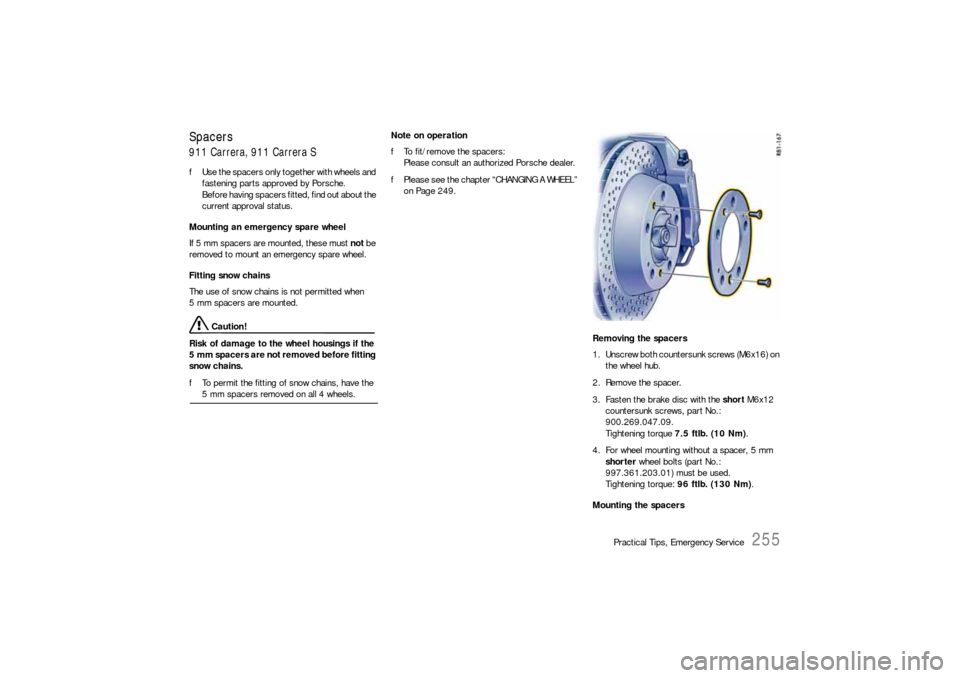
Removing the spacers
1. Unscrew both countersunk screws (M6x16) on
the wheel hub.
2. Remove the spacer.
3. Fasten the brake disc with the short M6x12
countersunk screws, part No.:
900.269.047.09.
Tightening torque 7.5 ftlb. (10 Nm).
4. For wheel mounting without a spacer, 5 mm
shorter wheel bolts (part No.:
997.361.203.01) must be used.
Tightening torque: 96 ftlb. (130 Nm).
Mounting the spacers
Page 259 of 310
Practical Tips, Emergency Service
257
Electrical System In order to avoid damage and faults in electrical or
electronic systems, electrical accessories should
be installed at your authorized Porsche dealer.
fOnly use accessories authorized by Porsche.
Warning!
Risk of short circuit and fire, resulting in
serious personal injury or death.
Replacing fuses or relays with the engine
running or the ignition on could cause elec-
trical shock.
fDisconnect the negative terminal on the
battery during all work on the electrical
system.
Please see the chapter “BATTERY” on Page 261.
RelaysDefective relays should be changed only by an
authorized workshop.
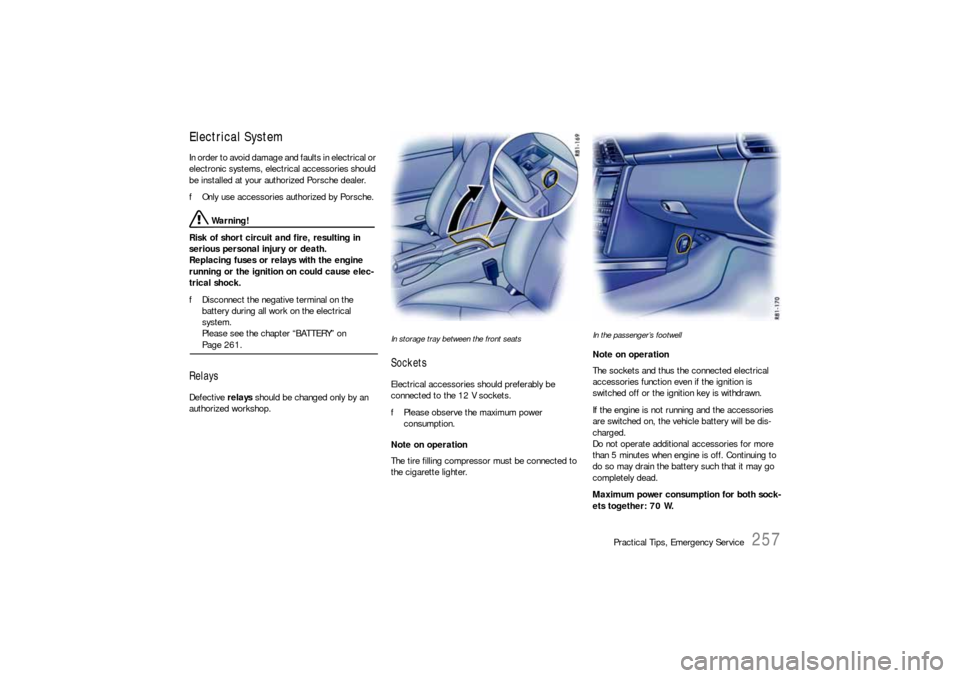
In storage tray between the front seatsSocketsElectrical accessories should preferably be
connected to the 12 V sockets.
fPlease observe the maximum power
consumption.
Note on operation
The tire filling compressor must be connected to
the cigarette lighter.
In the passenger’s footwellNote on operation
The sockets and thus the connected electrical
accessories function even if the ignition is
switched off or the ignition key is withdrawn.
If the engine is not running and the accessories
are switched on, the vehicle battery will be dis-
charged.
Do not operate additional accessories for more
than 5 minutes when engine is off. Continuing to
do so may drain the battery such that it may go
completely dead.
Maximum power consumption for both sock-
ets together: 70 W.
Page 261 of 310
Practical Tips, Emergency Service
259
Replacing fuses In order to prevent damage to the electrical sys-
tem due to short circuits and overloads, the indi-
vidual circuits are protected by fuses.
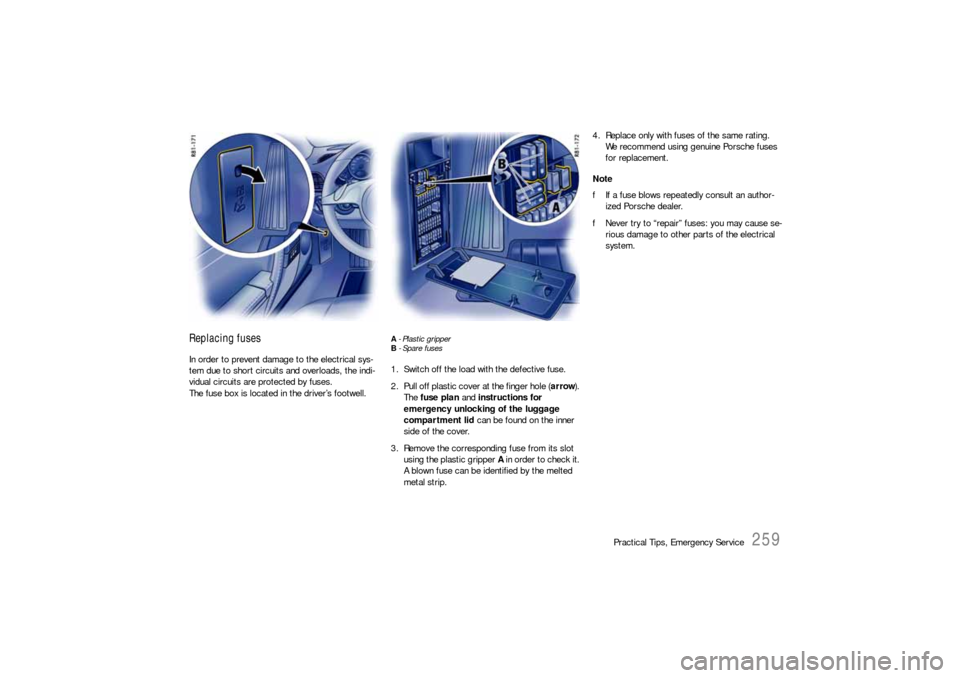
The fuse box is located in the driver’s footwell.
A - Plastic gripper
B - Spare fuses 1. Switch off the load with the defective fuse.
2. Pull off plastic cover at the finger hole (arrow).
The fuse plan and instructions for
emergency unlocking of the luggage
compartment lid can be found on the inner
side of the cover.
3. Remove the corresponding fuse from its slot
using the plastic gripper A in order to check it.
A blown fuse can be identified by the melted
metal strip.4. Replace only with fuses of the same rating.
We recommend using genuine Porsche fuses
for replacement.
Note
fIf a fuse blows repeatedly consult an author-
ized Porsche dealer.
fNever try to “repair” fuses: you may cause se-
rious damage to other parts of the electrical
system.
Page 262 of 310
260
Practical Tips, Emergency Service
Emergency unlocking of the luggage
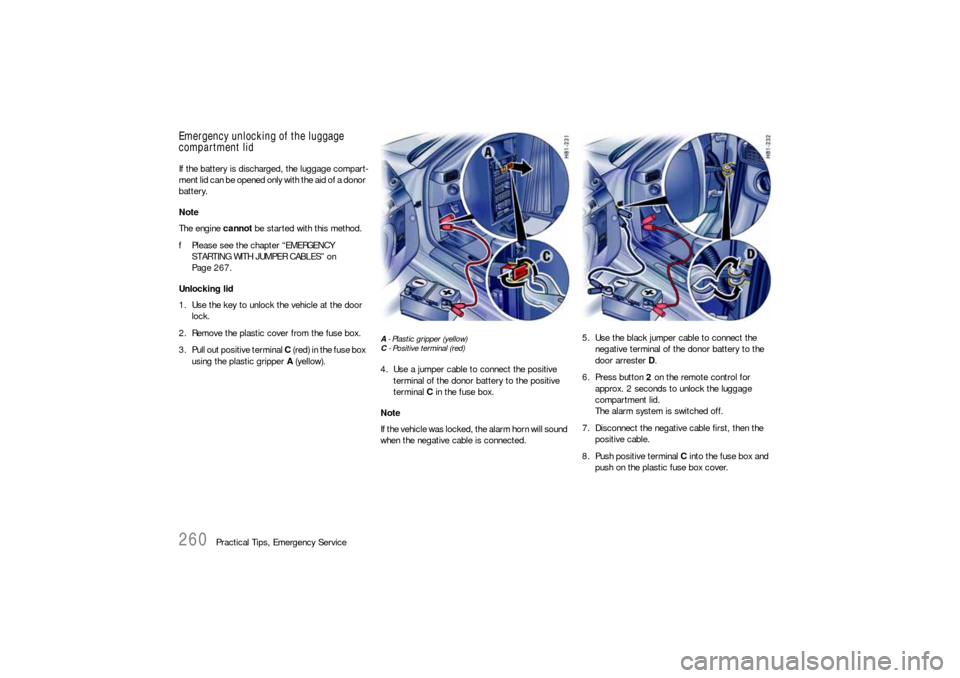
compartment lidIf the battery is discharged, the luggage compart-
ment lid can be opened only with the aid of a donor
battery.
Note
The engine cannot be started with this method.
fPlease see the chapter “EMERGENCY
STARTING WITH JUMPER CABLES” on
Page 267.
Unlocking lid
1. Use the key to unlock the vehicle at the door
lock.
2. Remove the plastic cover from the fuse box.
3. Pull out positive terminal C (red) in the fuse box
using the plastic gripper A (yellow).
A - Plastic gripper (yellow)
C - Positive terminal (red)4. Use a jumper cable to connect the positive
terminal of the donor battery to the positive
terminal C in the fuse box.
Note
If the vehicle was locked, the alarm horn will sound
when the negative cable is connected.
5. Use the black jumper cable to connect the
negative terminal of the donor battery to the
door arrester D.
6. Press button 2 on the remote control for
approx. 2 seconds to unlock the luggage
compartment lid.
The alarm system is switched off.
7. Disconnect the negative cable first, then the
positive cable.
8. Push positive terminal C into the fuse box and
push on the plastic fuse box cover.
Page 269 of 310

Practical Tips, Emergency Service
267
Emergency Starting with Jumper
Cables If the battery is discharged, e.g. in winter or after
the car has been parked for a long time, the bat-
tery of another car can be used for starting with
the help of jumper cables.
Make sure the voltage of both batteries is the
same. Both batteries must be 12 volt types.
The capacity (Ampere hours, Ah) of the booster
battery must not be substantially less than that of
the discharged battery.
The discharged battery must be correctly con-
nected to the vehicle’s electrical system.
fPlease see the chapter “BATTERY” on
Page 261.
fPlease see the chapter “EMERGENCY UNLO-
CKING OF THE LUGGAGE COMPARTMENT LID”
on Page 260.
Note
fDo not try to start the car by pushing or tow-
ing. Damage to the catalytic converters and
other components of the car may result.
Warning!
Risk of short circuit, damage and explosion,
resulting in serious personal injury or death.
fUse only jumper cables of adequate diameter
cross-section and fitted with completely insu-
lated alligator clips.
fFollow all warnings and instructions of the
jumper cable manufacturer.
fWhen connecting jumper cables, make sure
that they cannot get caught in any moving
parts in the engine compartment.
The jumper cables must be long enough so
that neither vehicles nor cables touch another.
fThe vehicles must not be in contact, otherwise
current might flow as soon as the positive ter-
minals are connected.
fThe cable clamps must not be allowed to con-
tact each other when one end of the jumper ca-
bles are connected to a battery.
fEnsure that tools or conductive jewelery (rings,
chains, watch straps) do not come into contact
with the positive jumper cable or the positive
battery post.
fImproper hook-up of jumper cables can ruin
the alternator. Danger of caustic burns from escaping acid.
fDo not lean over the battery.
Danger of gas explosion.
fImproper use of booster battery to start a
vehicle may cause an explosion, resulting in
serious personal injury or death.
fKeep sources of ignition away from the bat-
tery, e.g. open flame, burning cigarettes or
sparking due to cable contact or welding work.
fA discharged battery can freeze even at 23 °F/
–5 °C.
Before connecting jumper cables, a frozen
battery must be thawed out.
Page 272 of 310
270
Practical Tips, Emergency Service
Headlights
Caution!
Risk of damage to headlights due to exces-
sive temperatures and abrasion.
fTo ensure optimum ventilation, do not cover
the gap between headlight and body
(e.g. “stone guards” or films).
fUse soapy water only to clean light lenses and
plastic headlight lenses.
In no case may chemical cleaners or other vol-
atile cleaning fluids be used.
fTo prevent scratches, do not rub with a dry or merely moist cloth, tissue or insect sponges.
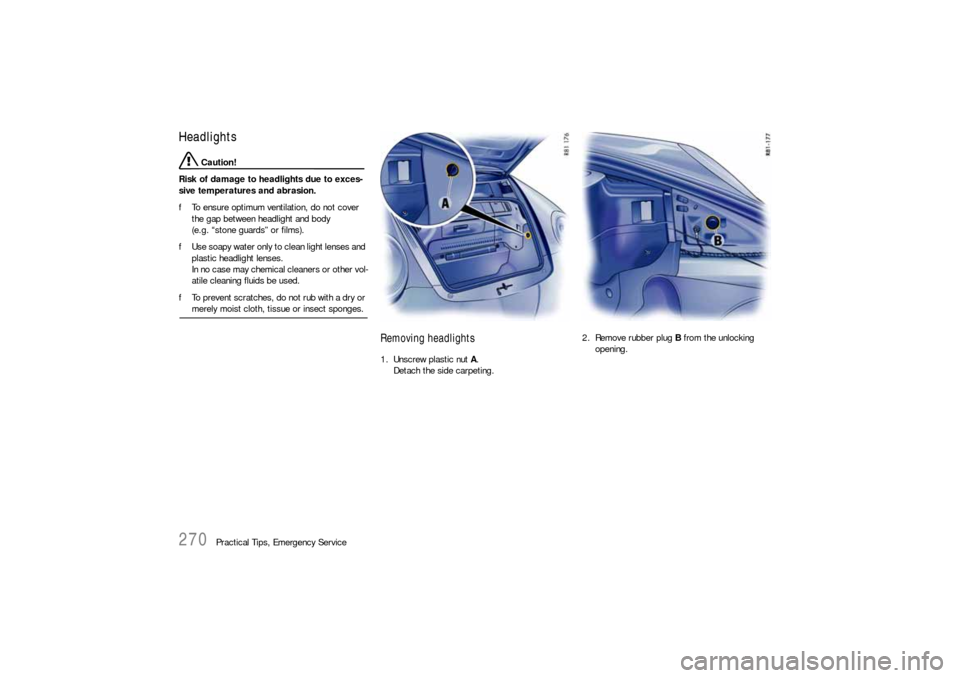
Removing headlights1. Unscrew plastic nut A.
Detach the side carpeting.2. Remove rubber plug B from the unlocking
opening.
Page 282 of 310
280
Practical Tips, Emergency Service
Towing Certain state statutes and local ordinances prohib-
it towing with a chain, rope or even a tow bar.
In addition, damage to your vehicle may result
from improper procedures.
Consult your authorized Porsche dealer for de-
tails. Vehicle towing Flat bed towing is the preferred type of towing to
be used on Porsche vehicles.
Under certain circumstances, wheel lifts may be
used when the vehicle will not roll.
The vehicle must be towed with all four
wheels off the ground, otherwise damage to
the vehicle may result.
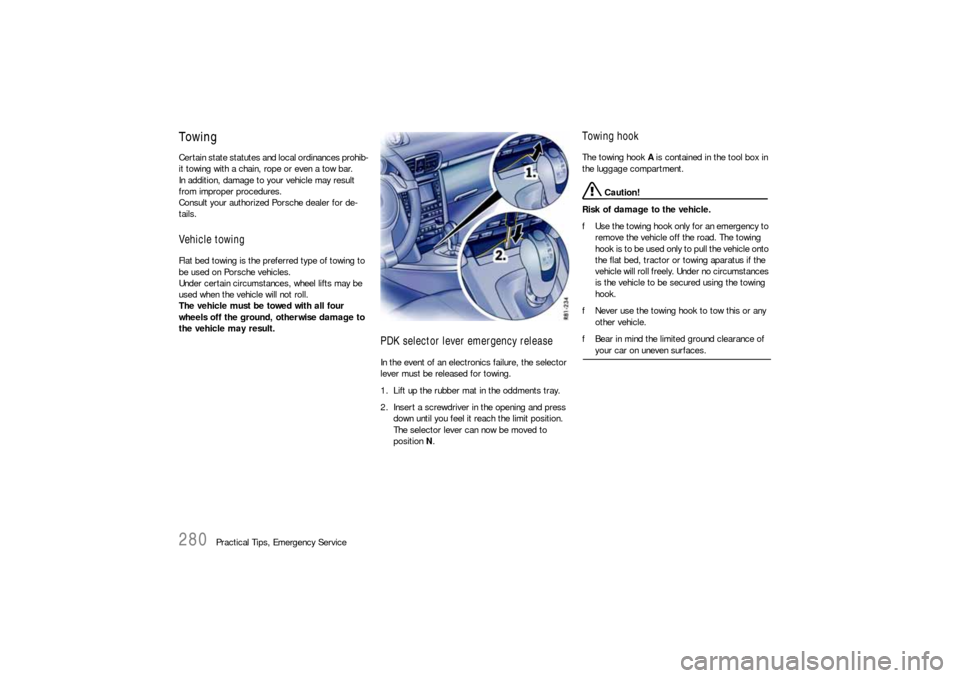
PDK selector lever emergency releaseIn the event of an electronics failure, the selector
lever must be released for towing.
1. Lift up the rubber mat in the oddments tray.
2. Insert a screwdriver in the opening and press
down until you feel it reach the limit position.
The selector lever can now be moved to
position N.
Towing hook The towing hook A is contained in the tool box in
the luggage compartment.
Caution!
Risk of damage to the vehicle.
fUse the towing hook only for an emergency to
remove the vehicle off the road. The towing
hook is to be used only to pull the vehicle onto
the flat bed, tractor or towing aparatus if the
vehicle will roll freely. Under no circumstances
is the vehicle to be secured using the towing
hook.
fNever use the towing hook to tow this or any
other vehicle.
fBear in mind the limited ground clearance of your car on uneven surfaces.
Page 305 of 310
Index
303
Lids ................................................... 260
Lifting/Sliding roof.............................. 179
Tank flap ............................................ 215
Emergency service ..................................... 234
Emergency starting with
jumper cables..................................... 267, 268
Emission control system ............. 125, 218, 219
Engine
Checking the oil level........................... 153
Diagram ............................................. 299
Exhaust .................................................. 5
Number .............................................. 285
Oil consumption ............................ 10, 208
Oil level .............................................. 208
Oil level indicator................................ 153
Oil pressure ........................................ 124
Oil temperature................................... 116
Oils ............................................ 208, 290
Speeds ................................................ 10
Starting ................................................ 77
Stopping .............................................. 78
Engine compartment
Blower ......................................... 78, 120
Blower fan .......................................... 120
Care .................................................. 227
Lid ................................................. 93, 94
Lid warning light.................................... 93
Engine oil
Change .............................................. 210
Consumption ........................................ 10
Performance class .............................. 211
Recommendation ................................ 210
Topping off ......................................... 209
Viscosity ............................................ 211Exhaust
Pipes .....................................................5
System.................................................57
Tailpipes, stainless steel ......................229
External antenna .........................................100
FFabric linings ..............................................230
Filler flap ....................................................215
Filling pressure, tire.....................................289
Fire extinguisher .........................................102
Flat tire ......................................................251
Floor mats ..................................................230
Fluids .........................................................222
Fluids and fuels ...........................................290
FM reception ................................................98
Fog light, rear ...............................................80
Footbrake.....................................................58
Four-wheel drive ............................................63
Fresh air intake ...........................................109
Front lid .................................................93, 94
Fuel ................................................... 122, 215
Containers ......................................5, 217
Economy ............................................214
Evaporation control.............................217
Fuels containing ethanol.......................217
Level gage .........................................122
Level warning light..............................122
Recommendation ........................216, 217
Recommendations ..............................216
Tank ..................................................216
Function keys ...............................................39
Fuses, replacing .........................................259
GGarage
Door ................................................... 78
Door opener ...................................... 103
Lift .................................................... 254
Gear display ...................................... 112, 114
Gear shift indicator ..................................... 119
Glass rear hatch......................................... 200
Glass rear hatch (Targa)
Unlocking ............................................ 16
Glass roof.................................................. 200
Glove compartment ...................................... 92
Gong ....................................... 14, 75, 80, 129
Ground clearance ........................................... 5HHandbrake ................................................... 57
Hardtop ..................................................... 194
Putting on .......................................... 196
Removing .......................................... 194
Head restraints ............................................ 30
Headlights ................................................. 270
Adjusting ................................... 278, 279
Beam adjustment ................................. 81
Cleaning system ........................... 83, 220
Flasher ................................................ 82
Heated rear window..................................... 29
Heated rear window/Door mirror heating ..... 110
Heater ....................................................... 106
High beam
Indicator light ..................................... 119
Lever................................................... 80
High-pressure cleaning units........................ 224
Home mode................................................. 81