ESP PORSCHE 911 GT3 2004 5.G User Guide
[x] Cancel search | Manufacturer: PORSCHE, Model Year: 2004, Model line: 911 GT3, Model: PORSCHE 911 GT3 2004 5.GPages: 195, PDF Size: 16.94 MB
Page 39 of 195
AirbagSystems
The Airbags incombination withthesafety belts
makes upasafety system whichoffers thedriver
and thepassenger thegreatest knownprotection
from injuries incase ofaccident.
Even ifyour vehicle isequipped withairbags,
the
safety beltsmust beworn atall times,
be-
cause thefront airbag system isonly actuated by
frontal collisions withanimpact ofsufficient sever-
ity.
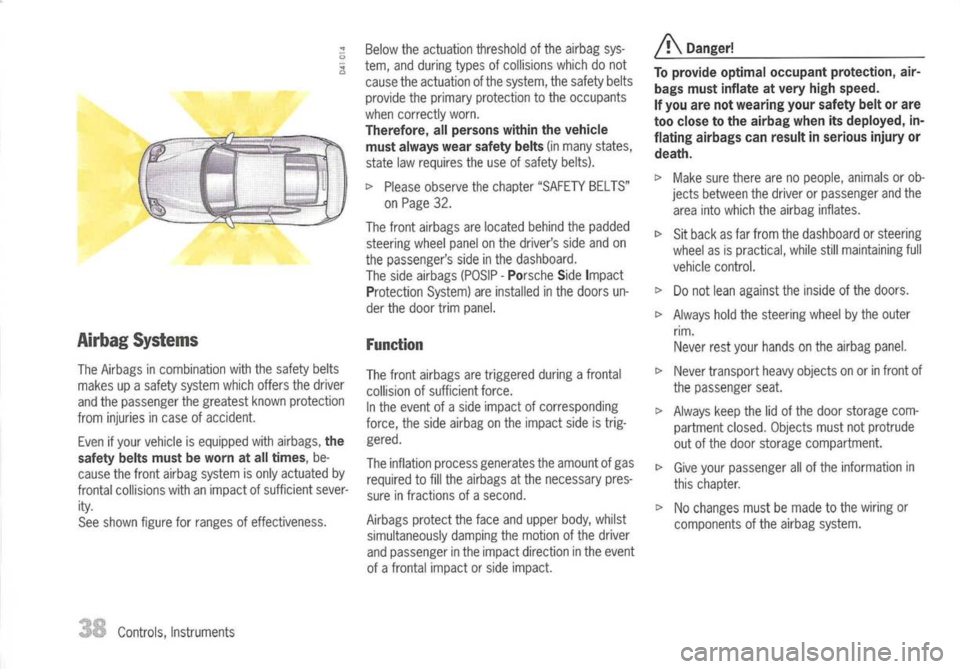
See shown figureforranges ofeffectiveness.
Controls, Instruments Below
theactuation threshold ofthe airbag sys-
tem, andduring typesofcollisions whichdonot
cause theactuation ofthe system, thesafety belts
provide theprimary protection tothe occupants
when correctly worn.
Therefore, allpersons withinthevehicle
must always wearsafety belts
(inmany states,
state lawrequires theuse ofsafety belts).
I>
Please observe thechapter "SAFETY BELTS"
on Page 32.
The front airbags arelocated behindthepadded
steering wheelpanelonthe driver's sideandon
the passenger's sideinthe dashboard.
The side airbags (POSIP-Porsche SideImpact
Protection System)areinstalled inthe doors un-
der the door trimpanel.
Function
The front airbags aretriggered duringafrontal
collision ofsufficient force.
In the event ofaside impact ofcorresponding
force, theside airbag onthe impact sideistrig-
gered.
The inflation process generates theamount ofgas
required tofill the airbags atthe necessary pres-
sure infractions ofasecond.
Airbags protecttheface andupper body,whilst
simultaneously dampingthemotion ofthe driver
and passenger inthe impact direction inthe event
of afrontal impact orside impact.
A
Danger!
To provide optimal occupant protection, air-
bags must inflate atvery highspeed.
If you arenotwearing yoursafety beltorare
too close tothe airbag whenitsdeployed, in-
flating airbags canresult inserious injuryor
death.
I>
Make surethere arenopeople, animals orob-
jects between thedriver orpassenger andthe
area intowhich theairbag inflates.
I>
Sitback asfar from thedashboard orsteering
wheel asispractical, whilestillmaintaining full
vehicle control.
I>
Donot lean against theinside ofthe doors.
I>
Always holdthesteering wheelbythe outer
rim. Never restyour hands onthe airbag panel.
I>
Never transport heavyobjects onorinfront of
the passenger seat.
I>
Always keepthelidofthe door storage com-
partment closed.Objects mustnotprotrude
out ofthe door storage compartment.
I>
Give your passenger allofthe information in
this chapter.
I>
Nochanges mustbemade tothe wiring or
components ofthe airbag system.
Page 45 of 195
ABSBrake System
(Antilock BrakeSystem)
The ABS system represents amajor contribution
to the enhancement ofactive safety inyour vehi-
cle. This system prevents thewheels fromlocking
in apanic stoponalmost allroad surfaces.
Controls, Instruments
With
theASS system inyour vehicle, the
following areasareenhanced:
Steering,
vehicleremains steerable underall
braking forceswhenABSisengaged.
Good directional control,
noswerving caused
by locking ofwheels underbraking conditions.
Shorter stopping distance,
stoppingdistances
are usually reduced because controlled brakingis
maximized.
Prevention of
wheel lock
up,
nobrake- induced
sliding andthus nolocalized tirewear fromemer-
gency braking.
The crucial advantage ofthe ABS system overa
conventional brakesystem isinthe area ofmain-
taining directional controlandmaneuverability of
the car inemergency situationsduringnormal
driving, including panicbraking inturns.
A
Warning!
The increased controlthatisprovided should
not induce youtotake greater riskswithyour
safety. Thelimits dictated bythe laws of
physics cannotbeovercome, evenwithASS.
The riskofaccidents duetoinappropriate
speed cannot bereduced, evenbythe ASS.
The driver bearstheresponsibility forall
driving maneuvers.
t>
Adapt yourdriving styletothe prevailing road
and weather conditions.
t> Obey alltraffic laws.
Other vehicles notequipped withtheASS
system maynotbeable tomaintain control,
especially onwet orpoor roadsurfaces and
thus maybemore likelytoimpact youfrom
behind.
t>
Tominimize thatrisk, useyour ABSsystem to
increase yourability tomaneuver toavoid dan-
gerous situations andnotmerely totry tostop
in the shortest distance possible.
Page 46 of 195
Operation ofthe ABS system
A wheel speed sensor ismounted toeach ofthe
four wheels. Ifwheel lock-up ofeither ofthe front
wheels orthe rear wheels issensed duringbrak-
ing, thebrake pressure isadjusted automatically
until thewheel nolonger slips.Thebrake pressure
is regulated foreach frontwheel individually and
for both ofthe rear wheels together.
On aroad surface whichisslippery ononly one
side, therear wheel whichisbraking onthe slip-
pery surface determines thebrake pressure which
will beapplied equallytoboth rearwheels. Thisen-
sures thatdirectional stabilityismaintained. How-
ever, ifbraking forcesapproach thewheel lock-up
point forallwheels (panicbraking) theABS system
will intervene toprovide arapid rythmic braking.
The proper operation ofABS isperceived bythe
driver asapulsating brakepedalinconjunction
with audible noiseandperhaps somevibration.
I>
Ifyou experience thesesensations whiledriv-
ing oraroad surface withquestionable trac-
tion, reduce vehicle speedappropriate forthe
prevailing roadconditions.
The functional readinessofall the main electrical
components ofthe ABS ischecked byan
electronic monitoring systembothbefore and
while youdrive. •
Warning lightUSA
• Warning lightCanada
When theignition isswitched onthe ABS warning
light willlight upwhile thesystem iselectronically
interrogated andgoes outwhen theengine is
started ifthe check isnot yetcomplete.
If the ABS warning lampfailstogo out, thisindi-
cates thatABS hasbeen deactivated duetoa
fault. Ifthe warning lightsinthe instrument panel
and on-board computer lightupwhile youaredriv-
ing, this indicates thatafault hasoccurred. Inboth
cases, normal braking, asinvehicles withoutABS,
is still retained.
The ABS system should,however, beexamined at
an authorized Porschedealerimmediately topre-
vent theoccurrence offurther faults.
I>
Ifthe ABS system becomes inoperative, take
your vehicle toyour authorized Porschedealer
immediately.
A
Warning!
The control unitofthe ABS brake system is
set forstandard tiresize. Ifnon-standard
tires areinstalled, thecontrol unitmay mis-
interpret thespeed ofthe vehicle, because of
the variant dataitreceives fromthesensors
on the axles.
I>
Use only tiremakes andtypes tested by
Porsche.
Controls,Instruments
Page 55 of 195
Instrument PanelUSAModels
Also refer tothe corresponding chaptersin
the Owner's Manual.
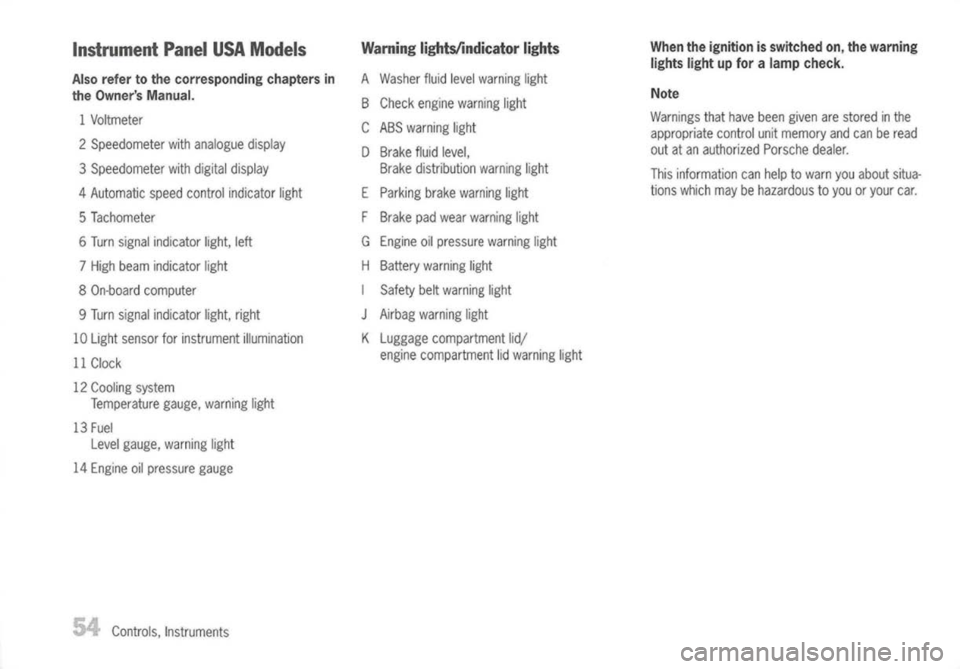
1 Voltmeter
2 Speedometer withanalogue display
3 Speedometer withdigital display
4 Automatic speedcontrol indicator light
5 Tachometer
6 Turn signal indicator light,left
7 High beam indicator light
8 On-board computer
9 Turn signal indicator light,right
10 Light sensor forinstrument illumination
11 Clock
12 Cooling system
Temperature gauge,warning light
13 Fuel
Level gauge, warning light
14 Engine oilpressure gauge
Controls, Instruments
Warning
lightslindicator lights
A Washer fluidlevel warning light
B Check engine warning light
CABS warning light
D Brake fluidlevel,
Brake distribution warninglight
E Parking brakewarning light
F Brake padwear warning light
G Engine oilpressure warninglight
H Battery warning light
I Safety beltwarning light
J
Airbag warning light
K Luggage compartment lid/
engine compartment lidwarning light
When
theignition isswitched on,the warning
lights lightupfor alamp check.
Note
Warnings thathave been given arestored inthe
appropriate controlunitmemory andcanberead
out atan authorized Porschedealer.
This information canhelp towarn youabout situa-
tions which maybehazardous toyou oryour car.
Page 57 of 195
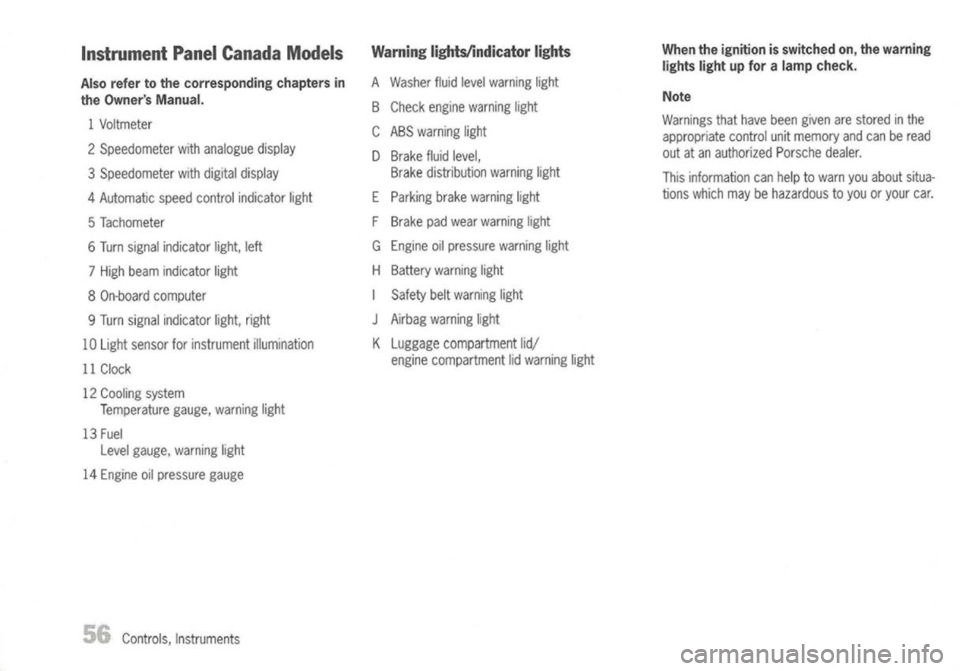
Instrument PanelCanada Models
Also refer tothe corresponding chaptersin
the Owner's Manual.
1 Voltmeter
2 Speedometer withanalogue display
3 Speedometer withdigital display
4 Automatic speedcontrol indicator light
5 Tachometer
6 Turn signal indicator light,left
7 High beam indicator light
8 On-board computer
9 Turn signal indicator light,right
10 Light sensor forinstrument illumination
11 Clock
12 Cooling system
Temperature gauge,warning light
13 Fuel
Level gauge, warning light
14 Engine oilpressure gauge
Controls, Instruments
Warning
Iights/indicator lights
A Washer fluidlevel warning light
B Check engine warning light
CABS warning light
o
Brake fluidlevel,
Brake distribution warninglight
E Parking brakewarning light
F Brake padwear warning light
G Engine oilpressure warninglight
H Battery warning light
I Safety beltwarning light
J
Airbag warning light
K Luggage compartment lid/
engine compartment lidwarning light
When
theignition isswitched on,the warning
lights lightupfor alamp check.
Note
Warnings thathave been given arestored inthe
appropriate controlunitmemory andcanberead
out atan authorized Porschedealer.
This information canhelp towarn youabout situa-
tions which maybehazardous toyou oryour car.
Page 69 of 195
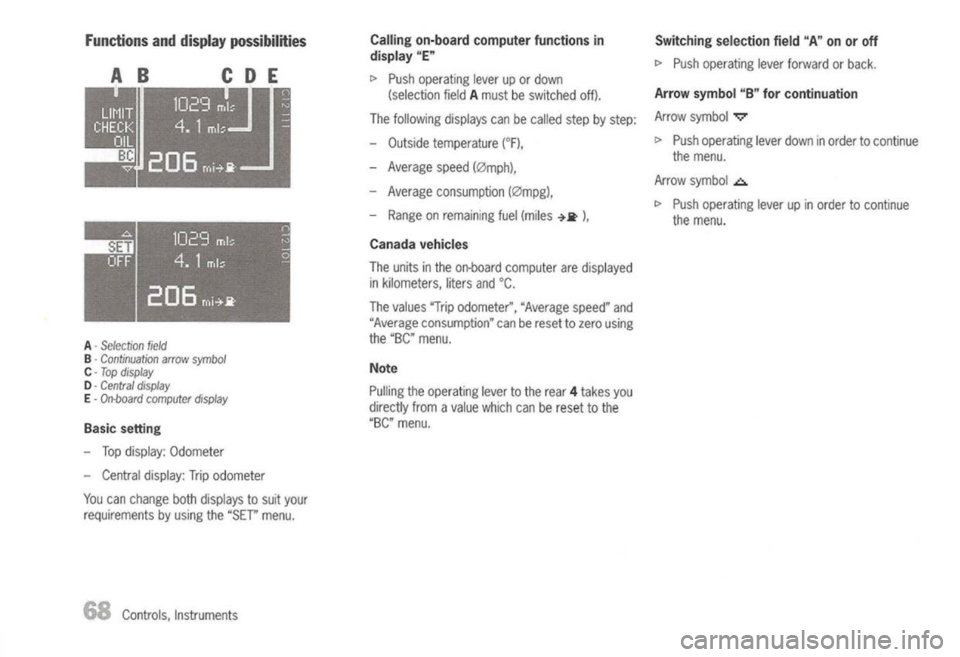
Functionsanddisplay possibilities
A .Selection
field
B .
Continuation arrowsymbol
C .
Top display
D·
Central display
E .
On·board computer display
Basic setting
- Top display: Odometer
- Central display: Tripodometer
You canchange bothdisplays tosuit your
requirements byusing the"SET" menu.
Controls, Instruments
Calling
on-board computer functionsin
display "E"
I>
Push operating leverupordown
(selection fieldAmust beswitched off).
The following displayscanbecalled stepbystep:
- Outside temperature
(OF),
- Average speed(0mph),
- Average consumption (0mpg),
- Range onremaining fuel(miles
-:>.il'),
Canada vehicles
The units inthe on·board computer aredisplayed
in kilometers, litersandDC.
The values "Tripodometer", "Averagespeed"and
"Average consumption" canbereset tozero using
the "BC" menu.
Note
Pulling theoperating levertothe rear 4takes you
directly fromavalue which canbereset tothe
"BC" menu.
Switching
selectionfield"A"onoroff
I>
Push operating leverforward orback.
Arrow symbol "B"forcontinuation
Arrow symbol
"V
I>
Push operating leverdown inorder tocontinue
the menu.
Arrow symbol..:::..
I>
Push operating leverupinorder tocontinue
the menu.
Page 70 of 195
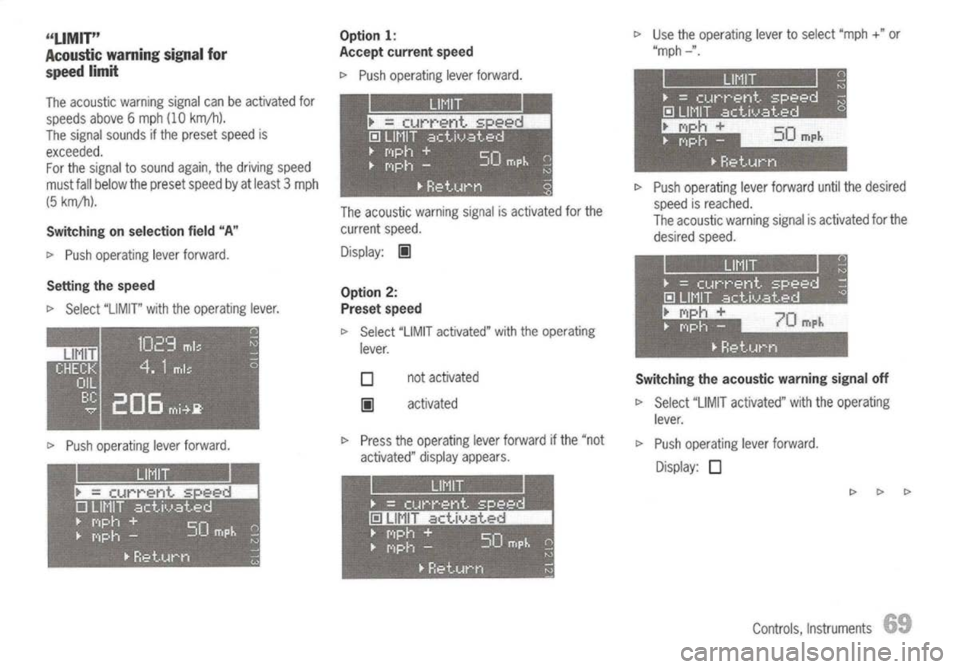
Switchingtheacoustic warningsignaloff
~ Select "LIMITactivated" withtheoperating
lever.
~ Push operating leverforward.
Display:
D
~~~
I>
Push operating leverforward untilthedesired
speed isreached.
The acoustic warningsignalisactivated forthe
desired speed.
~
Use theoperating levertoselect "mph
+"
or
"mph -".
not activated
activated
D
I!I
I>
Press theoperating leverforward ifthe "not
activated" displayappears.
Option
2:
Preset speed
~ Select "LIMITactivated" withtheoperating
lever.
The
acoustic warningsignalisactivated forthe
current speed.
Display:
I!I
Option
1:
Accept current speed
~ Push operating leverforward.
Switching onselection field"A"
~ Push operating leverforward.
The
acoustic warningsignalcanbeactivated for
speeds above6mph (10km/h).
The signal sounds ifthe preset speedis
exceeded. For the signal tosound again,thedriving speed
must fallbelow thepreset speedbyatleast 3mph
(5 km/h).
~ Push operating leverforward.
Setting
thespeed
~ Select "LIMIT" withtheoperating lever.
"LIMIT"
Acoustic warningsignalfor
speed limit
Controls,Instruments
Page 72 of 195

"OIL"
Display andmeasurement ofthe engine
oil level
/!\
Caution!
Risk ofengine damage.
I>
Regularly checktheoillevel before refuelling.
I>
Donot allow theoillevel tofall below themini-
mum mark.
Conditions formeasuring theoillevel
1. Engine idling.
2. Engine isat operating temperature.
3. Vehicle islevel.
4. Vehicle stationary.
Switching onselection field"A"
I>
Push operating leverforward.
Initiating
oillevel
measurement
I>
Select "OIL"withtheoperating lever.
I>
Push operating leverforward.
I>
Push operating leverforward.
Measurement isstarted.
The waiting timeforoillevel measurement isindi-
cated byatime display and"cycling" segments of
the oillevel display. Once
themeasurement hasbeen completed, you
can read offthe engine oillevel onthe segment
display. If the oillevel hasfallen below themin. mark, the
segment belowthemin. mark flashes.
The difference betweenthemin. andmax. marks
on the segment displayisapprox. 1.5 liters
0.6 quarts).
One segment ofthe display corresponds toa
quantity ofapprox.
0.25
liters
(0.26
quart).
I>
Top upengine oil.
Never addmore engine oilthan required
to reach themax. mark.
I>
Please observe thechapter "ENGINE OILLEV-
EL" onPage 115.
Info
The "Info" function allowsyoutocall theprerequi-
sites foroillevel measurement.
Failure
A failure ofthe oillevel display isindicated bya
warning message inthe on-board computer.
I> I>I>
Controls, Instruments
1
Page 76 of 195
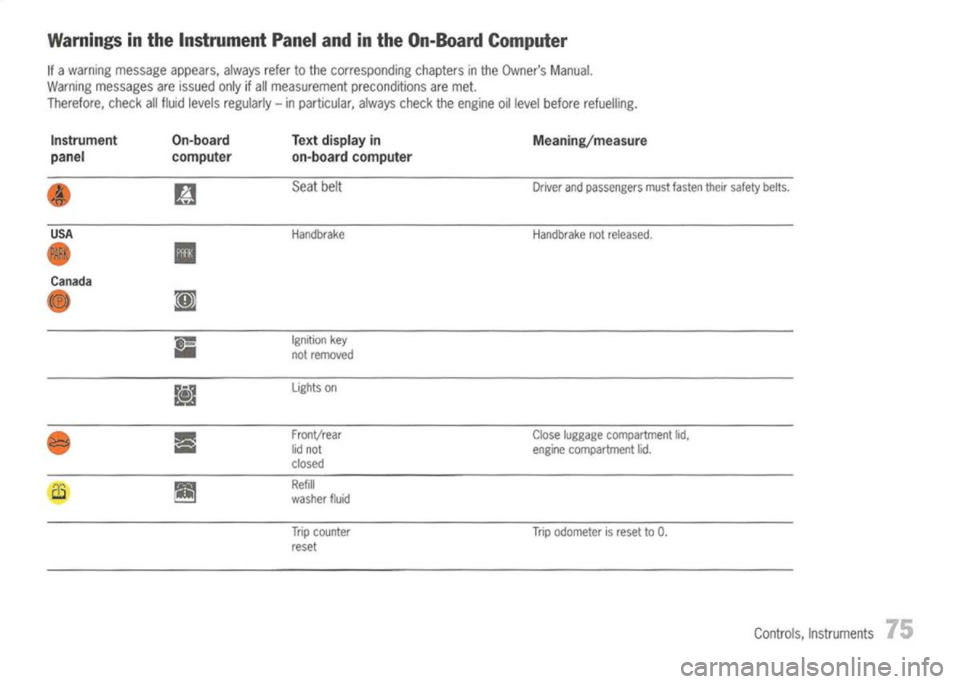
Warnings inthe Instrument Panelandinthe On-Board Computer
If
awarning message appears,alwaysrefertothe corresponding chaptersinthe Owner's Manual.
Warning messages areissued only
if
all measurement preconditionsaremet.
Therefore, checkallfluid levels regularly -in particular, alwayschecktheengine oillevel before refuelling.
Instrument
panel
USA
On-board
computer Text
display in
on-board computer
Seat belt
Handbrake
Meaning/measure
Driver andpassengers mustfasten theirsafety belts.
Handbrake notreleased.
Canada
p
:iJ
i'!!
Ignition
key
•••
not
removed
ri]
lights
on
III
FronVrear
•••
lid
not
closed
~
Refill
washer fluid
Trip counter
reset Close
luggage compartment lid,
engine compartment lid.
Trip odometer isreset to
O.
Controls,Instruments
75
Page 87 of 195
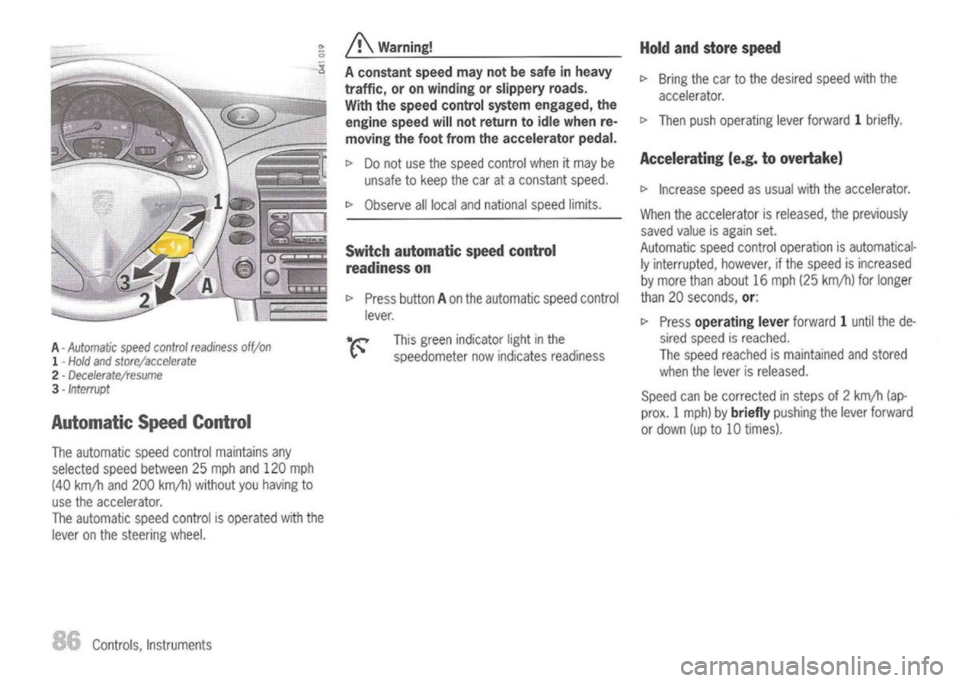
A-
Automatic speedcontrol readiness off/on
1 -
Hold andstore/accelerate
2 -
Decelerate/resume
3 -
Interrupt
Automatic SpeedControl
The automatic speedcontrol maintains any
selected speedbetween 25mph and120 mph
(40 km/h and200 km/h) without youhaving to
use theaccelerator.
The automatic speedcontrol isoperated withthe
lever onthe steering wheel.
Controls, Instruments
/!\
Warning!
A constant speedmaynotbesafe inheavy
traffic, oron winding orslippery roads.
With thespeed control systemengaged, the
engine speedwillnotreturn toidle when re-
moving thefoot from theaccelerator pedal.
~ Donot use thespeed control whenitmay be
unsafe tokeep thecar ataconstant speed.
~ Observe alllocal andnational speedlimits.
Switch automatic speedcontrol
readiness on
~ Press button Aon the automatic speedcontrol
lever.
Thisgreen indicator lightinthe
speedometer nowindicates readiness
Hold
andstore speed
~ Bring thecartothe desired speedwiththe
accelerator.
~ Then pushoperating leverforward 1briefly.
Accelerating (e.g.toovertake)
~ Increase speedasusual withtheaccelerator.
When theaccelerator isreleased, thepreviously
saved valueisagain set.
Automatic speedcontrol operation isautomatical-
ly interrupted, however,ifthe speed isincreased
by more thanabout 16mph (25km/h) forlonger
than 20seconds,
or:
~ Press
operating lever
forward 1until thede-
sired speed isreached.
The speed reached ismaintained andstored
when thelever isreleased.
Speed canbecorrected insteps of2km/h (ap-
prox. 1mph) by
briefly
pushing thelever forward
or down (upto10 times).