lock PORSCHE 911 GT3 2004 5.G Owner's Manual
[x] Cancel search | Manufacturer: PORSCHE, Model Year: 2004, Model line: 911 GT3, Model: PORSCHE 911 GT3 2004 5.GPages: 195, PDF Size: 16.94 MB
Page 36 of 195
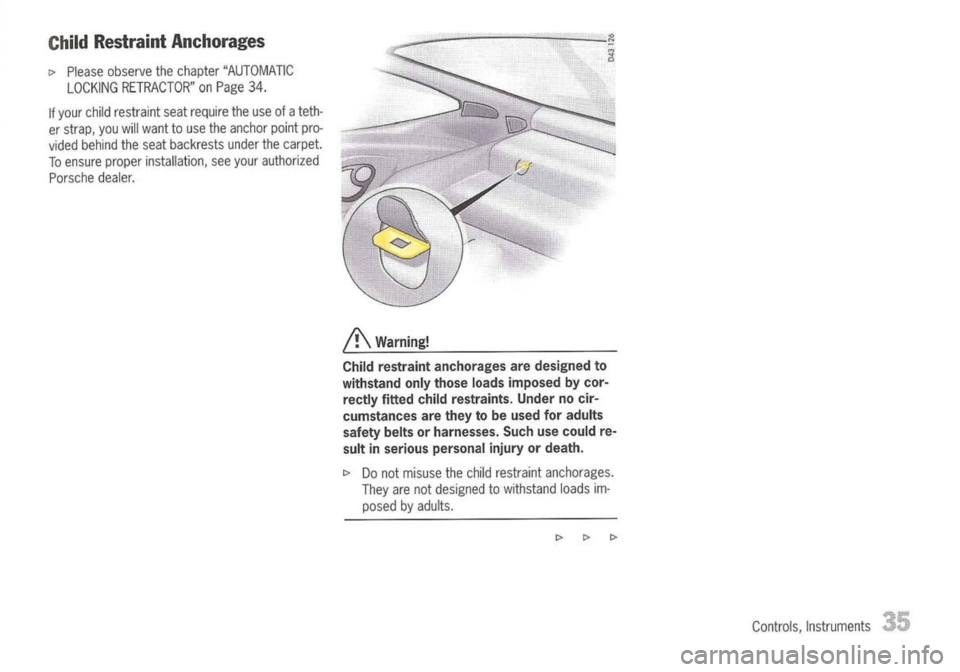
ChildRestraint Anchorages
~ Please observe thechapter "AUTOMATIC
LOCKING RETRACTOR" onPage 34.
If your child restraint seatrequire theuse ofateth-
er strap, youwillwant touse theanchor pointpro-
vided behind theseat backrests underthecarpet.
To ensure properinstallation, seeyour authorized
Porsche dealer.
A
Warning!
Child restraint anchorages aredesigned to
withstand onlythose loadsimposed bycor-
rectly fittedchildrestraints. Undernocir-
cumstances arethey tobe used foradults
safety beltsorharnesses. Suchusecould re-
sult inserious personal injuryordeath.
~ Donot misuse thechild restraint anchorages.
They arenotdesigned towithstand loadsim-
posed byadults.
Controls,Instruments
Page 45 of 195
ABSBrake System
(Antilock BrakeSystem)
The ABS system represents amajor contribution
to the enhancement ofactive safety inyour vehi-
cle. This system prevents thewheels fromlocking
in apanic stoponalmost allroad surfaces.
Controls, Instruments
With
theASS system inyour vehicle, the
following areasareenhanced:
Steering,
vehicleremains steerable underall
braking forceswhenABSisengaged.
Good directional control,
noswerving caused
by locking ofwheels underbraking conditions.
Shorter stopping distance,
stoppingdistances
are usually reduced because controlled brakingis
maximized.
Prevention of
wheel lock
up,
nobrake- induced
sliding andthus nolocalized tirewear fromemer-
gency braking.
The crucial advantage ofthe ABS system overa
conventional brakesystem isinthe area ofmain-
taining directional controlandmaneuverability of
the car inemergency situationsduringnormal
driving, including panicbraking inturns.
A
Warning!
The increased controlthatisprovided should
not induce youtotake greater riskswithyour
safety. Thelimits dictated bythe laws of
physics cannotbeovercome, evenwithASS.
The riskofaccidents duetoinappropriate
speed cannot bereduced, evenbythe ASS.
The driver bearstheresponsibility forall
driving maneuvers.
t>
Adapt yourdriving styletothe prevailing road
and weather conditions.
t> Obey alltraffic laws.
Other vehicles notequipped withtheASS
system maynotbeable tomaintain control,
especially onwet orpoor roadsurfaces and
thus maybemore likelytoimpact youfrom
behind.
t>
Tominimize thatrisk, useyour ABSsystem to
increase yourability tomaneuver toavoid dan-
gerous situations andnotmerely totry tostop
in the shortest distance possible.
Page 46 of 195
Operation ofthe ABS system
A wheel speed sensor ismounted toeach ofthe
four wheels. Ifwheel lock-up ofeither ofthe front
wheels orthe rear wheels issensed duringbrak-
ing, thebrake pressure isadjusted automatically
until thewheel nolonger slips.Thebrake pressure
is regulated foreach frontwheel individually and
for both ofthe rear wheels together.
On aroad surface whichisslippery ononly one
side, therear wheel whichisbraking onthe slip-
pery surface determines thebrake pressure which
will beapplied equallytoboth rearwheels. Thisen-
sures thatdirectional stabilityismaintained. How-
ever, ifbraking forcesapproach thewheel lock-up
point forallwheels (panicbraking) theABS system
will intervene toprovide arapid rythmic braking.
The proper operation ofABS isperceived bythe
driver asapulsating brakepedalinconjunction
with audible noiseandperhaps somevibration.
I>
Ifyou experience thesesensations whiledriv-
ing oraroad surface withquestionable trac-
tion, reduce vehicle speedappropriate forthe
prevailing roadconditions.
The functional readinessofall the main electrical
components ofthe ABS ischecked byan
electronic monitoring systembothbefore and
while youdrive. •
Warning lightUSA
• Warning lightCanada
When theignition isswitched onthe ABS warning
light willlight upwhile thesystem iselectronically
interrogated andgoes outwhen theengine is
started ifthe check isnot yetcomplete.
If the ABS warning lampfailstogo out, thisindi-
cates thatABS hasbeen deactivated duetoa
fault. Ifthe warning lightsinthe instrument panel
and on-board computer lightupwhile youaredriv-
ing, this indicates thatafault hasoccurred. Inboth
cases, normal braking, asinvehicles withoutABS,
is still retained.
The ABS system should,however, beexamined at
an authorized Porschedealerimmediately topre-
vent theoccurrence offurther faults.
I>
Ifthe ABS system becomes inoperative, take
your vehicle toyour authorized Porschedealer
immediately.
A
Warning!
The control unitofthe ABS brake system is
set forstandard tiresize. Ifnon-standard
tires areinstalled, thecontrol unitmay mis-
interpret thespeed ofthe vehicle, because of
the variant dataitreceives fromthesensors
on the axles.
I>
Use only tiremakes andtypes tested by
Porsche.
Controls,Instruments
Page 47 of 195
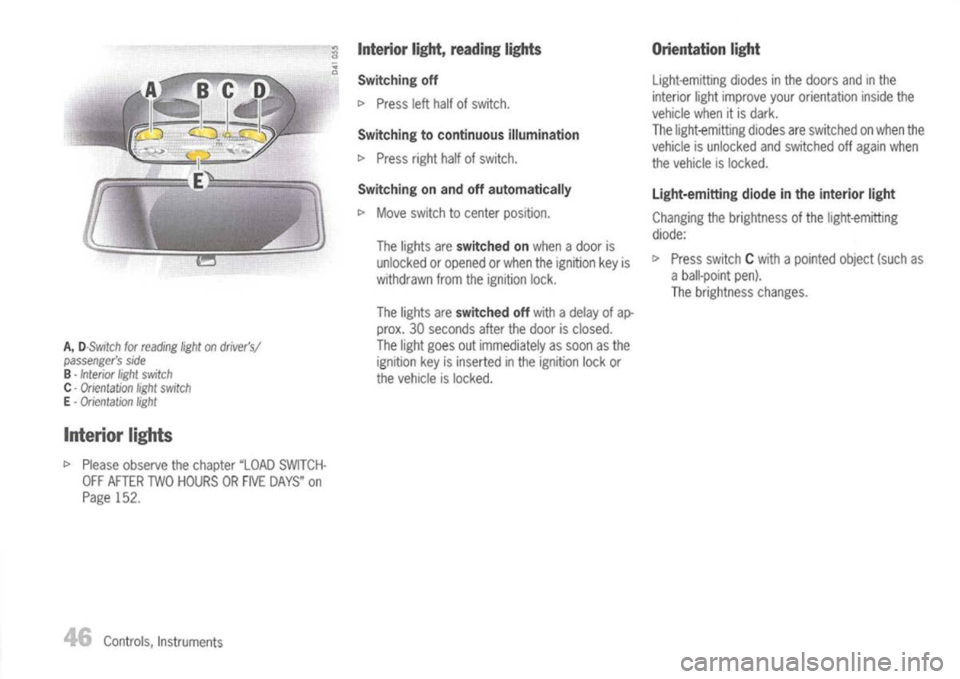
A,
D-$witch forreading light
on
driver's/
passenger's side
B -
Interior lightswitch
C -
Orientation lightswitch
E -
Orientation light
Interior lights
l>
Please observe thechapter "LOADSWITCH-
OFF AFTER TWOHOURS ORFIVE DAYS" on
Page 152.
46
Controls, Instruments
Interior
light,reading lights
Switching off
l>
Press lefthalf ofswitch.
Switching tocontinuous illumination
l>
Press righthalfofswitch_
Switching onand offautomatically
l>
Move switch tocenter position.
The lights are
switched on
when adoor is
unlocked oropened orwhen theignition keyis
withdrawn fromtheignition lock.
The lights are
switched off
with adelay ofap-
prox. 30seconds afterthedoor isclosed.
The light goes outimmediately assoon asthe
ignition keyisinserted inthe ignition lockor
the vehicle islocked.
Orientation
light
Light-emitting diodesinthe doors andinthe
interior lightimprove yourorientation insidethe
vehicle whenitis dark.
The light-emitting diodesareswitched onwhen the
vehicle isunlocked andswitched offagain when
the vehicle islocked.
Light-emitting diodeinthe interior light
Changing thebrightness ofthe light-emitting
diode:
l>
Press switch Cwith apointed object(suchas
a ball-point pen).
The brightness changes.
Page 49 of 195
Operation, Instruments
1 Side vent
2 Ignition/starter switchwithsteering lock
3 Space forhands-free microphone for
telephone
4 Turn signals/
headlight dimmer/flasher lever
5 Instrument panel
6 Horn
7 Windshield wiper/washer lever
8 Emergency flasherswitch
9 Rocker switches forfootwelilight
10 Readiness displayforalarm system
11 Central vent
12 Cupholder
13 Control panelforheating, ventilation,
air conditioning
14 Rocker switches for
central locking,
rear window anddoor mirror heating
48
Controls, Instruments 15
Speaker
16 Light switch
17 Operating leverforon-board computer
18 Locking leverforsteering-wheel adjustment
19 Operating leverforautomatic speedcontrol
20 Wipe interval control
21 Radio
22 Cigarette lighter
23 Glove compartment
24 Interior temperature sensor
Page 51 of 195
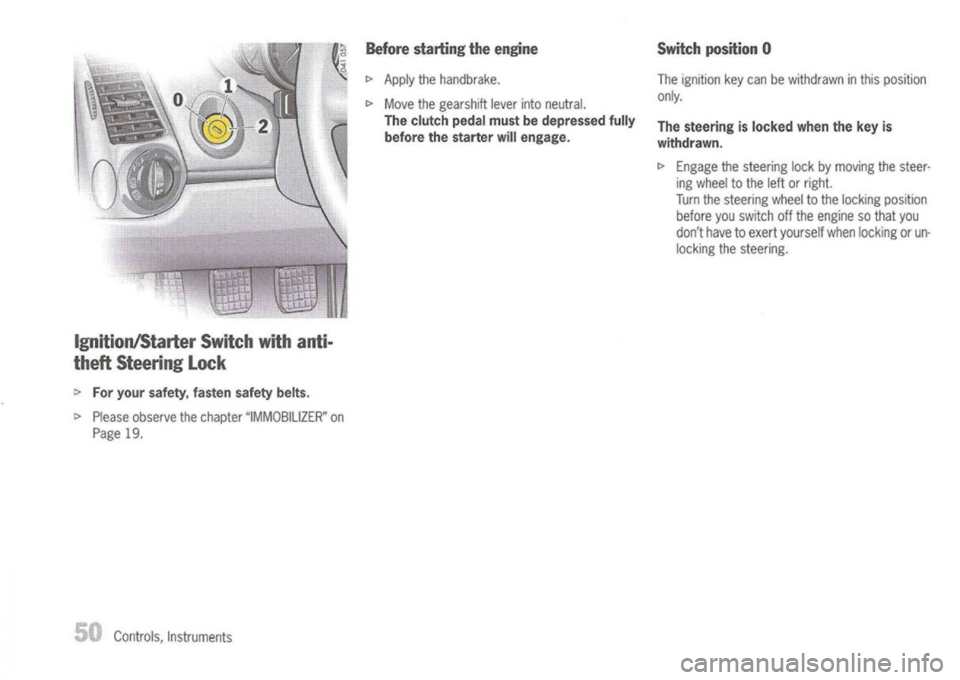
Ignition/Starter Switchwithanti-
theft Steering Lock
I>
For your safety, fastensafetybelts.
I>
Please observe thechapter "IMMOBILIZER" on
Page 19.
Controls, Instruments
Before
starting theengine
I>
Apply thehandbrake.
I>
Move thegearshift leverintoneutral.
The clutch pedalmustbedepressed fully
before thestarter willengage.
Switch
position 0
The ignition keycan bewithdrawn inthis position
only.
The steering islocked whenthekey is
withdrawn.
I>
Engage thesteering lockbymoving thesteer-
ing wheel tothe leftorright.
Turn thesteering wheeltothe locking position
before youswitch offthe engine sothat you
don't havetoexert yourself whenlocking orun-
locking thesteering.
Page 52 of 195
Switchposition 1
Ignition ison.
All electrical equipment canbeswitched on.
The warning lightslightupfor alamp check.
Please notethedescription ofthe individual warn-
ing lights.
I>
When turning thekey toposition 1,relieve the
steering lockwith aslight steering movement.
Note
To conserve batterypoweratlow rpm (traffic
jams, towndriving etc.),switch offallelectrical
consumers whicharenotneeded atthat moment.
Switch
position 2
Starting theengine
I>
Turn thekey from position 1to position 2.
The clutch pedalmustbedepressed fully
before thestarter willengage.
The first operation ofthe starter isended automat-
ically when theengine starts.
If the engine doesnotstart, subsequent starter
operations willnotbeended automatically.
If the engine doesnotstart atthe first time or
stalls atany time, thekey must bereturned to
position O.
When theengine isrunning, thewarning lights
should gooff. Ifa light does notgooff, take
appropriate actionasindicated inthis manual.
Switching
engineoff
I>
Turn theignition keyfrom position 1to
position O.
/!\
Warning!
Risk ofan accident.
The steering wheel
willlock
andwillcause
loss ofsteering.
I>
Never remove keyfrom theignition lockorturn
the key offwhile thevehicle ismoving.
I>
Toavoid battery run-down, alwaysremove the
ignition keyfrom theignition lock.
Please observe thechapter "SATTERY" on
Page 155.
I>
Turn thesteering wheeluntilthesteering lock
is engaged.
Gong
If you leave thekey inthe ignition/steering lock,a
gong willsound whenthedriver's doorisopened.
This isareminder toremove thekey.
Controls, Instruments
51
Page 54 of 195
Stopping Engine
I>
Turn keyback toposition
O.
I>
Donot stop engine immediately afterhardor
extended driving.
Keep engine running atincreased idlefor
about twominutes toprevent excessive heat
build-up beforeturning offengine.
I>
Toavoid battery run-down, alwaysremove the
ignition keyfrom theignition lock.
I>
Make surethatwhen youleave thecar, even
briefly, youhave withdrawn theignition key.
I>
Engage thesteering lockbymoving thesteer-
ing wheel tothe leftorright.
Turn thesteering wheeltothe locking position
before youswitch offthe engine sothat you
don't havetoexert yourself whenlocking or
unlocking thesteering.
A
Warning!
Hot engine compartment componentscan
burn skinoncontact.
I>
Before working onany part inthe engine com-
partment, turntheengine offand letitcool
down sufficiently.
Engine-compartment
blower,
radiator fan
The radiator andradiator fansareinthe front of
the car.
The engine-compartment blowerismounted on
the engine compartment lid.
A
Warning!
Risk ofinjury.
After theengine isswitched off,theengine-
compartment andcoolant temperatures are
monitored forapprox. 20minutes.
During thisperiod, anddepending ontem-
perature, theengine-compartment blower
and radiator fansmaycontinue torun or
start torun.
I>
Carry outwork inthese areasonlywith theen-
gine off,theignition off,and exercise extreme
caution.
Automatic
garagedoor
The ignition systeminyour Porsche mayinterfere
with your electronically operatedgaragedoor.
I>
Tocheck this,drive yourPorsche closetothe
garage door.Make surenottointerfere with
the operating rangeofthe door.
I>
Run theengine atdifferent speeds.
If the garage dooropens orcloses without youop-
erating thegarage doorunitinyour car,contact
the dealer whoinstalled theautomatic garage
door tohave thefrequency and/orcodingofthe
garage doorsignal changed ormodified.
Controls, Instruments
Page 55 of 195
Instrument PanelUSAModels
Also refer tothe corresponding chaptersin
the Owner's Manual.
1 Voltmeter
2 Speedometer withanalogue display
3 Speedometer withdigital display
4 Automatic speedcontrol indicator light
5 Tachometer
6 Turn signal indicator light,left
7 High beam indicator light
8 On-board computer
9 Turn signal indicator light,right
10 Light sensor forinstrument illumination
11 Clock
12 Cooling system
Temperature gauge,warning light
13 Fuel
Level gauge, warning light
14 Engine oilpressure gauge
Controls, Instruments
Warning
lightslindicator lights
A Washer fluidlevel warning light
B Check engine warning light
CABS warning light
D Brake fluidlevel,
Brake distribution warninglight
E Parking brakewarning light
F Brake padwear warning light
G Engine oilpressure warninglight
H Battery warning light
I Safety beltwarning light
J
Airbag warning light
K Luggage compartment lid/
engine compartment lidwarning light
When
theignition isswitched on,the warning
lights lightupfor alamp check.
Note
Warnings thathave been given arestored inthe
appropriate controlunitmemory andcanberead
out atan authorized Porschedealer.
This information canhelp towarn youabout situa-
tions which maybehazardous toyou oryour car.
Page 57 of 195
Instrument PanelCanada Models
Also refer tothe corresponding chaptersin
the Owner's Manual.
1 Voltmeter
2 Speedometer withanalogue display
3 Speedometer withdigital display
4 Automatic speedcontrol indicator light
5 Tachometer
6 Turn signal indicator light,left
7 High beam indicator light
8 On-board computer
9 Turn signal indicator light,right
10 Light sensor forinstrument illumination
11 Clock
12 Cooling system
Temperature gauge,warning light
13 Fuel
Level gauge, warning light
14 Engine oilpressure gauge
Controls, Instruments
Warning
Iights/indicator lights
A Washer fluidlevel warning light
B Check engine warning light
CABS warning light
o
Brake fluidlevel,
Brake distribution warninglight
E Parking brakewarning light
F Brake padwear warning light
G Engine oilpressure warninglight
H Battery warning light
I Safety beltwarning light
J
Airbag warning light
K Luggage compartment lid/
engine compartment lidwarning light
When
theignition isswitched on,the warning
lights lightupfor alamp check.
Note
Warnings thathave been given arestored inthe
appropriate controlunitmemory andcanberead
out atan authorized Porschedealer.
This information canhelp towarn youabout situa-
tions which maybehazardous toyou oryour car.