belt PORSCHE 911 GT3 2004 5.G Owners Manual
[x] Cancel search | Manufacturer: PORSCHE, Model Year: 2004, Model line: 911 GT3, Model: PORSCHE 911 GT3 2004 5.GPages: 195, PDF Size: 16.94 MB
Page 3 of 195
DearOwner,
We would liketothank youforyour purchase ofa
Porsche Sportscar.
Judging bythe caryou have chosen, youareamo-
torist ofaspecial breed,andyou areprobably no
novice whenitcomes toautomobiles.
Remember however,aswith anyvehicle, you
should taketime tofamiliarize yourselfwithyour
Porsche anditsperformance characteristics. Al-
ways drivewithin yourownunique capabilities as
a driver andyour levelofexperience withyour
Porsche. Ensurethatanyone elsedriving your
Porsche doesthesame. Toprevent orminimize
injury, always useyour safety belts.Never con-
sume alcohol ordrugs before orduring theoper-
ation ofyour vehicle.
This Owner's Manualcontains ahost ofuseful in-
formation. Pleasetakethetime toread thismanu-
al before youdrive yournewPorsche. Becomefa-
miliar withtheoperation ofyour Porsche carfor
maximum safetyandoperating pleasure.Thebet-
ter you know yourPorsche, themore pleasure you
will experience drivingyournewcar.
Always keepyourOwner's Manualinthe car, and
give itto the new owner ifyou ever sellyour
Porsche.
2 A
separate Maintenance Booklet
explainshow
you cankeep yourPorsche intop driving condition
by having itserviced regularly.
A separate Warranty andCustomer Informa-
tion Booklet
containsdetailedinformation about
the warranties coveringyourPorsche.
For U.S. only:
If you believe thatyour vehicle hasafault which
could cause acrash, injuryordeath, youshould
immediately informtheNational Highway Traffic
Safety Administration (NHTSA)inaddition to
notifying PorscheCarsNorth America, Inc.
(Porsche CarsN.AJ
If NHTSA receives similarcomplaints, itmay open
an investigation, andifitfinds thatasafety prob-
lem exists inagroup ofvehicles, itmay order are-
call and remedy campaign. However,NHTSAcan-
not become involvedinindividual problems be-
tween youandyour dealer, orPorsche CarsN.A..
To contact NHTSA, youmay either calltheAuto
Safety Hotline toll-free at1-(800)-424-9393
(or 366-0123 inWashington, D.C.area) orwrite
to: NHTSA, U.S.Department ofTransportation,
Washington, D.C.20590. Youcanalso obtain oth-
er information aboutmotor vehicle safetyfromthe
Hotline. Your
carhas thousands ofparts andcomponents
which havebeen designed andmanufactured in
accordance withPorsche's highstandards ofen-
gineering qualityandsafety.
Any alteration ofthe vehicle maynegate or
interfere withthose safety features builtinto
the vehicle.
Your Porsche isintended tobe used inasafe man-
ner obeying thelocal lawsandinthe light ofdriv-
ing conditions facedbyyou, andinaccordance
with theinstructions providedinthis Owner's Man-
ual.
Do not misuse yourPorsche byignoring
those lawsanddriving conditions, orby
ignoring theinstructions inthis manual.
Any alteration ormisuse ofthe vehicle can
lead toaccidents andsevere orfatal
personal injuries.
Regularly checkyourvehicle forsigns of
damage.
Damaged ormissing aerodynamic
components suchasspoilers orunderside
panels affectthedriving behavior and
therefore mustbereplaced immediately.
Page 14 of 195
Beforedrivingoff.. 14
Break inhints forthe first
1,000 miles/1,600 kilometers 16
Keys 19
Security WheelBolts 19
Doors 21
Central Locking 22
Alarm System, InfraredPassenger
Compartment Monitoring 24
Power Windows 26
Inside mirror 28
Rear View Mirrors 28
Rear Window Defogger,
Door Mirror Heating 29
Seat Adjustment 30
Steering WheelAdjustment.. 31
Safety Belts 32
Child Restraint Anchorages 35
Child Restraint Systems 36
Airbag Systems 38
Clutch Pedal 40
Parking Brake 40
Brakes 41
ABS Brake System
(Antilock BrakeSystem) 44
Interior lights 46
Footwell Lights 47
Operation, Instruments 48
Ignition/Starter Switchwith
anti-theft SteeringLock 50
Starting Procedures 52
Stopping Engine 53Instrument
PanelUSAModels 54
Instrument PanelCanada Models 56
Voltmeter 58
Automatic SpeedControl 58
Instrument Illumination 59
Trip Odometer 59
Speedometer 60
Changing overbetween
Miles /Kilometers 60
Tachometer 61
Turn Signal Indicator Light 61
High Beam 61
Cooling System 62
Fuel 63
C~k ~
Engine OilPressure 65
Check Engine
Warning Light 66
On-Board Computer (BC) 67
Warnings inthe Instrument Panelandinthe On-
Board Computer 75
Emergency FlasherSwitch 81
Light Switch 82
Automatic HeadlightBeamAdjustment 82
Turn Signal /
Headlight Dimmer/Flasher Lever 83
Windshield Wiper/Washer Lever 84
Automatic SpeedControl 86
Heating andVentilation 88
Automatic AirConditioning 90
Central andSide Vents 93
Fresh-air Intake 93Controls,
Instruments
Ashtray 94
Cigarette Lighter 94
Cupholder 95
Storage inthe Passenger Compartment 96
Luggage Compartment Lidand
Engine Compartment Lid 98
Luggage Compartment.. 100
Trunk Entrapment 101
Sun Visors 103
Spoiler, SideMember Panels 104
Car Audio Operation/Tips 105
Car Telephone and
Aftermarket Alarms 107
Roof Transport System 108
Gearshifting 109
Controls, Instruments
Page 16 of 195
Inthe driver's seat...
c>
Check operation ofthe horn.
c>
Position seatforeasy reach offoot pedals and
controls.
To reduce thepossibility ofinjury fromthe
airbag deployment, youshould always sitback
as far from thesteering wheelasispractical,
while stillmaintaining fullvehicle control.
c>
Adjustthe insideandoutside rearview mirrors.
c>
Buckle yoursafety belts.
C>
Check operation ofthe foot andparking brake.
C>
Check allwarning andindicator lightswith
ignition onand engine notrunning.
C>
Start engine andcheck allwarning displays for
warning symbols.
C>
Never leaveanidling carunattended.
C>
Lock doors frominside, especially withchil-
dren inthe cartoprevent inadvertent opening
of doors frominside oroutside.
Drive withdoors locked.
On
the road ...
C>
Never driveafteryouhave consumed alcohol
or drugs.
C>
Always haveyoursafety beltfastened.
C>
Always drivedefensively.
Expect theunexpected.
C>
Use signals toindicate turnsandlane changes.
C>
Turn onheadlights atdusk orwhen thedriving
conditions warrantit.
C>
Always keepasafe distance fromthevehicle
in front ofyou, depending ontraffic, roadand
weather conditions.
C>
Reduce speedatnight andduring inclement
weather. Driving inwet weather requirescautionandre-
duced speeds, particularly onroads with
standing water,asthe handling characteristics
of the vehicle maybeimpaired duetohydro-
planing ofthe tires.
C>
Always observe speedlimitsandobey road
signs andtraffic laws.
C>
When tired,getwell offthe road, stopandtake
a rest. Turntheengine off.Donot sitinthe ve-
hicle withengine idling.
Please observe thechapter "ENGINE EX-
HAUST" onPage 10.
C>
When parked, alwayssetthe parking brake.
Move thegearshift levertoreverse orfirst
gear.
On hills also turnthefront wheels towardthe
curb.
C>
When emergency repairsbecome necessary,
move thevehicle welloffthe road. Turnonthe
emergency flasheranduseother warning de-
vices toalert other motorists. Donot park or
operate thevehicle inareas where thehotex-
haust system maycome incontact withdry
grass, brush,fuelspill orother flammable ma-
terial.
C>
Make itahabit tohave theengine oilchecked
with every fuelfilling.
Controls, Instruments
Page 31 of 195

SeatAdjustment
/!\
Warning!
The seat may move unexpectedly ifyou
attempt toadjust whiledriving. Thiscould
cause sudden lossofcontrol orpersonal in-
jury.
~ Donot adjust seatswhilethevehicle isin mo-
tion.
The backrest locksmustbeengaged atall
times whilethevehicle isinmotion.
Safety beltsonlyoffer protection whenthe
backrest isupright andthebelts areproperly
positioned onthe body.
Improperly positionedsafetybeltscancause
serious personal injuryinan accident.
~ Donot operate thecarwith thedriver orpas-
senger backrests excessively reclined
(see "Seat position").
Controls, Instruments
Seat
position
A correct sittingposition isimportant forsafe and
fatigue-free driving.
We recommend thefollowing procedure for
adjusting thedriver's seattosuit individual
requirements:
1. Adjust theseat height togive yourself enough
headroom andagood overview ofthe vehicle.
2. Adjust theseat until, withtheaccelerator pedal
fully depressed, yourlegisstraight butyour
entire footstillrests onthe accelerator pedal.
3. Grip thetop half ofthe steering wheel.
Set thebackrest angleandsteering-wheel
position sothat your arms arealmost
outstretched. However,yourshoulders must
still rest onthe backrest.
4. Ifnecessary, correcttheseat fore-and-aft
adjustment.
A
-
Seat height adjustment
~ Raise locking lever.
~ Set thedesired seatheight byshifting your
body weight.
~ Release thelever.
Page 33 of 195

SafetyBelts
/!\
Warning!
Always makesureyour andyour passenger's
safety beltsareproperly fastened whilethe
vehicle isin motion.
Failure tofollow safety beltwarnings mayre-
sult inserious personal injury.
I>
For your andyour passenger's protection,use
safety beltsatall times whilethevehicle isin
motion.
I>
Use appropriate childrestraint systemsforall
small children.
Proper wearing ofsafety belts
I>
Safety beltsmust bepositioned onthe body as
to restrain theupper bodyandlapfrom sliding
forward. Improperly positionedsafetybelts
can cause serious personal injuryincase ofan
accident.
I>
The shoulder beltshould always restonyour
upper body.Theshoulder beltshould neverbe
worn behind yourback orunder yourarm.
I>
For maximum effectiveness, thelapbelt
should beworn lowacross thehips.
I>
Pregnant womenshouldposition thebelt as
low aspossible acrossthepelvis. Makesureit
is not pressing againsttheabdomen.
Controls, Instruments
I>
Belts should notbeworn twisted.
I>
Donot wear beltsoverrigidorbreakable ob-
jects inor on your clothing, suchaseye glass-
es, pens, keys,etc.asthese maycause injury.
I>
Several layersofheavy clothing mayinterfere
with proper positioning ofbelts.
I>
Belts mustnotrub against sharpobjects or
damage mayoccur tothe belt.
I>
Two occupants shouldneversharethesame
belt atthe same time.
Care andmaintenance
I>
Keep beltbuckles freeofany obstruction that
may prevent asecure locking.
I>
Belts thathave been subjected toexcessive
stretch forcesinan accident mustbeinspect-
ed orreplaced toensure theircontinued effec-
tiveness inrestraining you.
The same applies tobelt tensioner systems
which havebeen triggered.
In addition, theanchor pointsofthe belts
should bechecked.
I>
Ifsafety beltsdonot work properly, seeyour
authorized Porschedealerimmediately.
I>
Ifthe belts show damage towebbing, bindings,
buckles orretractors, theyshould bereplaced
to ensure safeoperation.
I>
Donot modify ordisassemble thesafety belts
in your vehicle.
I>
The belts must bekept clean orthe retractors
may notwork properly
Please observe thechapter "CARCARE IN-
STRUCTIONS" onPage 130.
I>
Never bleach ordye safety belts.
I>
Donot allow safety beltstoretract untilthey
are completely dryafter cleaning orthis may
cause damage tothe belt.
Belt tensioner
Depending onthe force ofan impact, fastened
seat belts aretightened inan accident.
The belttensioners aretriggered in:
- Frant andrear impacts
The belttensioners arenottriggered in:
- Side impacts
- Vehicle overturning
Note
The belttensioner systemcanbetriggered only
once; thesystem mustbereplaced afterward.
Work maybeperformed onthe belt-tensioner sys-
tem only byanauthorized Porschedealer.
Smoke isreleased whenthebelt tensioners are
triggered. Thisdoes notindicate afire inthe
vehicle.
Page 34 of 195
o
SafetyBeltWarning System
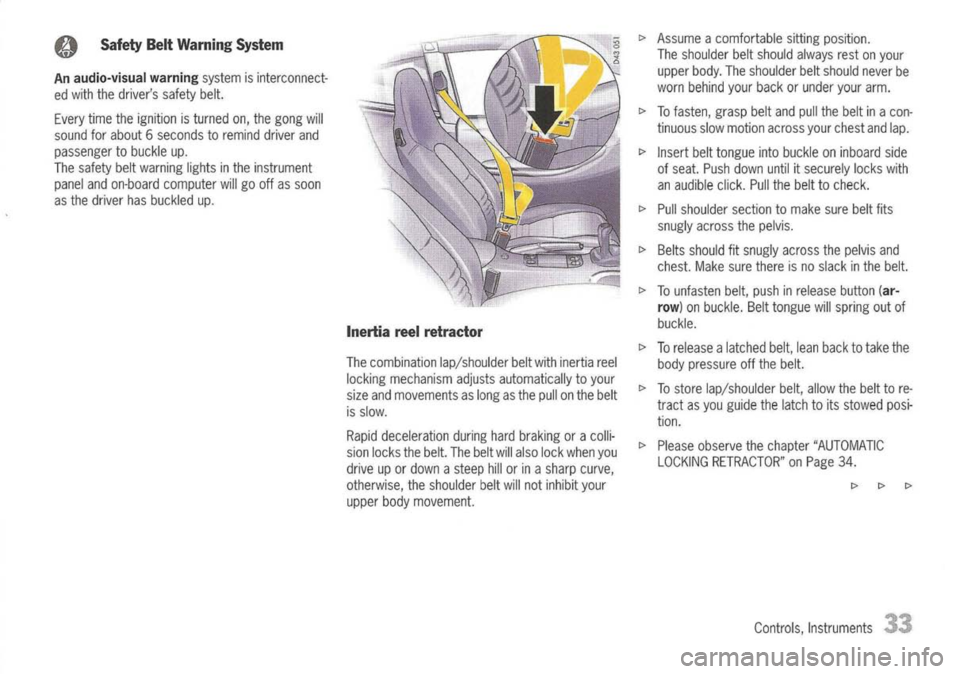
An audio-visual warning
systemisinterconnect-
ed with thedriver's safetybelt.
Every timetheignition isturned on,the gong will
sound forabout 6seconds toremind driverand
passenger tobuckle up.
The safety beltwarning lightsinthe instrument
panel andon-board computer willgooffassoon
as the driver hasbuckled up.
Inertiareelretractor
The combination lap/shoulder beltwith inertia reel
locking mechanism adjustsautomatically toyour
size andmovements aslong asthe pull onthe belt
is slow.
Rapid deceleration duringhardbraking oracolli-
sion locks thebelt. Thebeltwillalso lockwhen you
drive upordown asteep hillorinasharp curve,
otherwise, theshoulder beltwillnotinhibit your
upper bodymovement. ~
Assume acomfortable sittingposition.
The shoulder beltshould always restonyour
upper body.Theshoulder beltshould neverbe
worn behind yourback orunder yourarm.
~ Tofasten, graspbeltandpullthebelt inacon-
tinuous slowmotion acrossyourchest andlap.
~ Insert belttongue intobuckle oninboard side
of seat. Pushdown until
it
securely lockswith
an audible click.Pullthebelt tocheck.
~ Pull shoulder sectiontomake surebeltfits
snugly across thepelvis.
~ Belts should fitsnugly across thepelvis and
chest. Makesurethere isno slack inthe belt.
~ Tounfasten belt,push inrelease button
(ar-
row)
onbuckle. Belttongue willspring outof
buckle.
~ Torelease alatched belt,leanback totake the
body pressure offthe belt.
~ Tostore lap/shoulder belt,allow thebelt tore-
tract asyou guide thelatch toits stowed posi-
tion.
~ Please observe thechapter "AUTOMATIC
LOCKING RETRACTOR" onPage 34.
~ ~~
Controls, Instruments
Page 35 of 195
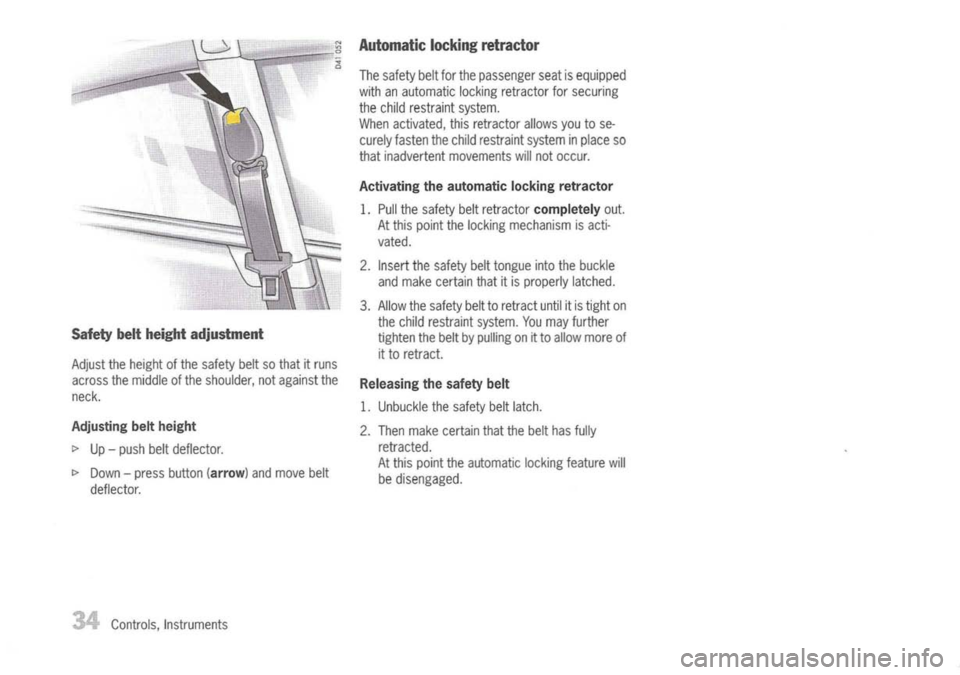
Safetybeltheight adjustment
Adjust theheight ofthe safety beltsothat itruns
across themiddle ofthe shoulder, notagainst the
neck.
Adjusting beltheight
I>
Up-push beltdeflector.
I>
Down -press button
(arrow)
andmove belt
deflector.
34
Controls, Instruments
Automatic
lockingretractor
The safety beltforthe passenger seatisequipped
with anautomatic lockingretractor forsecuring
the child restraint system.
When activated, thisretractor allowsyoutose-
curely fasten thechild restraint systeminplace so
that inadvertent movements willnot occur.
Activating theautomatic lockingretractor
1. Pull thesafety beltretractor
completely
out.
At this point thelocking mechanism isacti-
vated.
2. Insert thesafety belttongue intothebuckle
and make certain thatitis properly latched.
3. Allow thesafety belttoretract untilitis tight on
the child restraint system.Youmay further
tighten thebelt bypulling onitto allow more of
it to retract.
Releasing thesafety belt
1. Unbuckle thesafety beltlatch.
2. Then make certain thatthebelt hasfully
retracted.
At this point theautomatic lockingfeature will
be disengaged.
Page 36 of 195
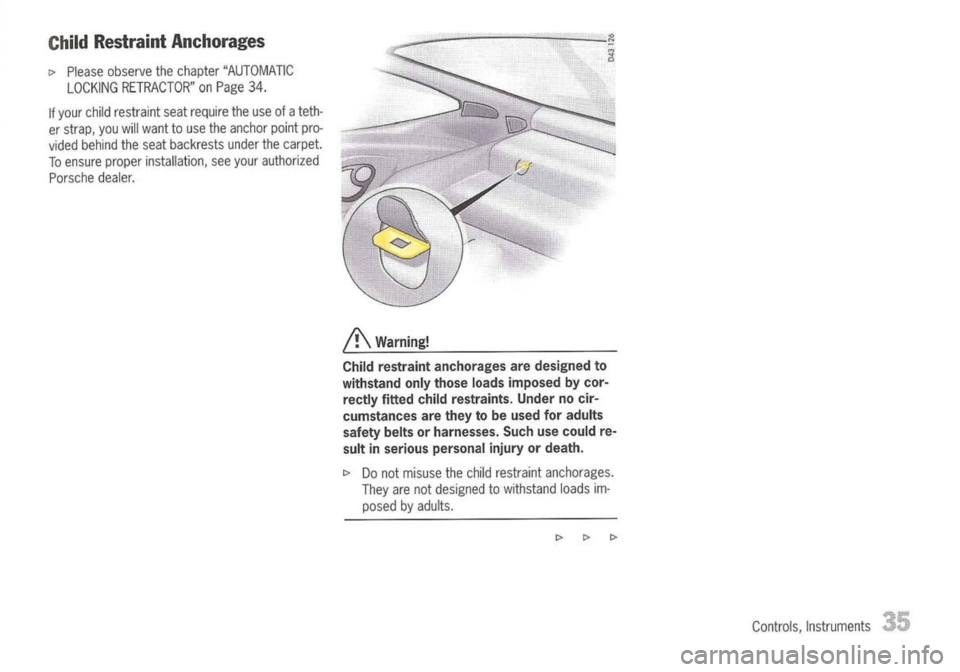
ChildRestraint Anchorages
~ Please observe thechapter "AUTOMATIC
LOCKING RETRACTOR" onPage 34.
If your child restraint seatrequire theuse ofateth-
er strap, youwillwant touse theanchor pointpro-
vided behind theseat backrests underthecarpet.
To ensure properinstallation, seeyour authorized
Porsche dealer.
A
Warning!
Child restraint anchorages aredesigned to
withstand onlythose loadsimposed bycor-
rectly fittedchildrestraints. Undernocir-
cumstances arethey tobe used foradults
safety beltsorharnesses. Suchusecould re-
sult inserious personal injuryordeath.
~ Donot misuse thechild restraint anchorages.
They arenotdesigned towithstand loadsim-
posed byadults.
Controls,Instruments
Page 37 of 195
ChildRestraint Systems
Porsche recommends thatallinfants andchildren
be restrained inchild restraint systemsatall times
while thevehicle isinmotion inaccordance with
applicable laws.
The useofinfant orchild restraints isrequired by
law inall 50 states andtheCanadian provinces.
The child restraint systemshouldbeone that com-
plies withU.S. Federal/Canadian MotorVehicle
Safety Standards 213andshould besecured by
a lap belt orlap belt portion ofalap-shoulder belt.
A statement bythe seat manufacturer ofcompli-
ance withthisstandard canbefound onthe in-
struction labelonthe restraint andinthe instruc-
tion manual provided withtherestraint.
Controls, Instruments
/!\
Danger!
Risk ofserious personal injuryordeath tothe
child.
r> Follow allchild restraint instructions andwarn-
ings inthis manual.
- When usinganinfant orchild restraint system,
be sure tofollow allmanufacturer's instruc-
tions oninstallation anduse.
- Infants andsmall children shouldneverbeheld
on the lap, norshould theyshare asafety belt
with another occupant whilethevehicle isin
motion.
- Children toobigforchild restraint systems
should useregular safetybelts.Ashoulder belt
can beused providing itdoes notcross the
face orthe neck ofthe child.
The airbag deactivation deviceinstallation
requires specialprogramming availableonly
from yourauthorized Porschedealer.
Your authorized Porschedealerwillbeglad
to advise youabout theinstallation possibility
for aPorsche childrestraint systemwhich
allows deactivation ofthe passenger's
airbags.
/!\
Danger!
The useofachild restraint systeminthe pas-
senger seatwithout airbagdeactivation can
result inserious personal injuryordeath to
the child from anairbag deployment.
To reduce riskofinjury fromaninflating
airbag inan accident, Porschestronglyrec-
ommends:
r> Donot use achild restraint systeminthe pas-
senger seatunless thepassenger airbagsare
deactivated.
Page 38 of 195
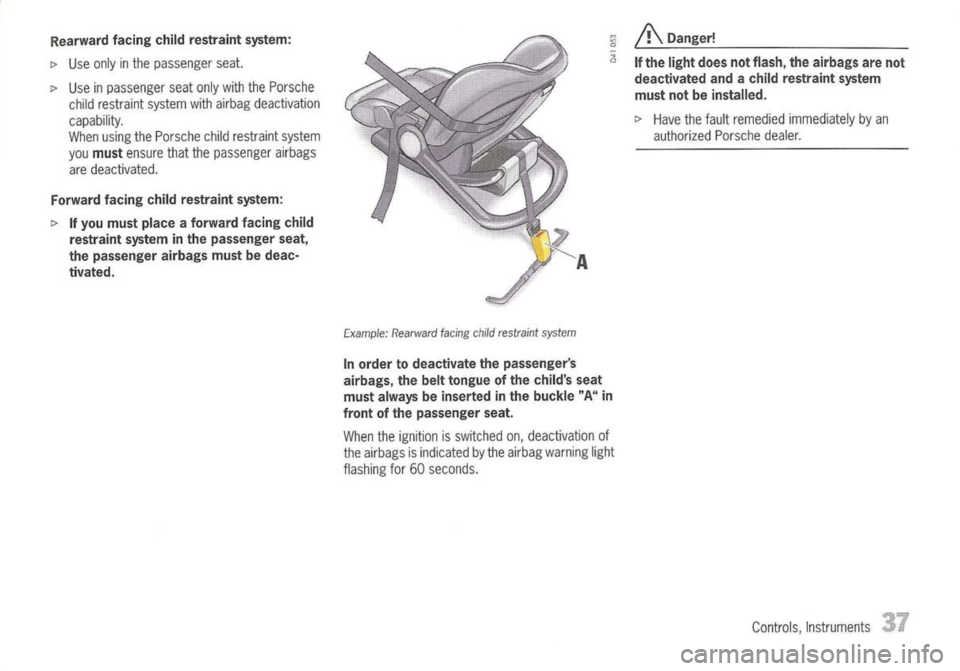
Rearward facingchildrestraint system:
I>
Use only inthe passenger seat.
I>
Use inpassenger seatonlywiththePorsche
child restraint systemwithairbag deactivation
capability.
When usingthePorsche childrestraint system
you
must
ensure thatthepassenger airbags
are deactivated.
Forward facingchildrestraint system:
I>
Ifyou must place aforward facingchild
restraint systeminthe passenger seat,
the passenger airbagsmustbedeac-
tivated.
Example:Rearward facingchildrestraint system
In order todeactivate thepassenger's
airbags, thebelt tongue ofthe child's seat
must always beinserted inthe buckle
"AU
in
front ofthe passenger seat.
When theignition isswitched on,deactivation of
the airbags isindicated bythe airbag warning light
flashing for60seconds.
/!\
Danger!
If the light does notflash, theairbags arenot
deactivated andachild restraint system
must notbeinstalled.
I>
Have thefault remedied immediately byan
authorized Porschedealer.
Controls, Instruments