engine PORSCHE 911 GT3 2010 5.G User Guide
[x] Cancel search | Manufacturer: PORSCHE, Model Year: 2010, Model line: 911 GT3, Model: PORSCHE 911 GT3 2010 5.GPages: 251, PDF Size: 14.33 MB
Page 18 of 251

Operation, Safety
17
Never invite car theft! An unlocked car with the key in the ignition lock
invites car theft.
A steering wheel lock and a gong alarm are
standard equipment in your Porsche.
The gong alarm will sound if you open the driver’s
door while the key is still in the ignition lock. It is
your reminder to pull the key out of the ignition
lock and to lock the doors.
Warning!
Any uncontrolled movement of the vehicle
may result in property damage, serious
personal injury or death.
Never leave your vehicle unattended with the
key in the ignition lock, especially if children
and/or pets are left unattended in the
vehicle. They can operate power windows
and other controls. If the engine is left
running, they may accidentally engage the
shift lever. Serious personal injury or death
could result from loss of control of the
vehicle.
fAlways remove the ignition key.
fAlways set the parking brake.
fLock the doors with the remote control.
Warning!
Risk of a serious accident.
The steering column will lock when you
remove the key while you are driving or as
the car is rolling to a stop. You will not be
able to steer the car.
Serious personal injury or death could result
from loss of control of the vehicle.
fNever remove the key from the steering lock while you are driving. To protect your vehicle and your possessions
from theft, you should always proceed as
follows when leaving your vehicle:
fClose windows.
fRemove ignition key.
fEngage steering lock.
fLock glove compartment.
fRemove valuables (e.g. car documents, cell
phones, house keys) from the car.
fLock doors.
10_GT3_21.book Seite 17 Donnerstag, 4. Juni 2009 12:48 12
Page 19 of 251

18
Operation, Safety
Keys fPlease see the chapter “ALARM SYSTEM,
PASSENGER COMPARTMENT MONITORING”
on Page 26.
fPlease see the chapter “CENTRAL LOCKING”
on Page 22.
Two car keys are supplied with your Porsche.
These keys operate all the locks on your vehicle.
fBe careful with your car keys: do not part with
them except under exceptional circumstances.
fTo avoid battery run-down, always remove the
ignition key from the ignition lock. Emergency operationfPlease see the chapter “EMERGENCY OPERA-
TION – PULLING OUT THE IGNITION KEY” on
Page 69.
Replacement keys Replacement car keys can be obtained only from
your authorized Porsche dealer, and this can
sometimes be very time-consuming.
You should therefore always keep a spare key on
your person.
Keep it in a safe place (e.g. wallet), but under no
circumstances in or on the vehicle.
The key codes of new keys have to be “reported”
to the car control unit by your authorized Porsche
dealer.
A total of 6 car keys can be reported to the control
unit.
Disabling key codes
If a key is lost, the key codes can be disabled by
an authorized Porsche dealer.
All the remaining car keys are required for this
purpose.
Disabling the code ensures that the car can be
started only using authorized keys.
Note
fPlease note that the other locks can still be
opened with the disabled key.
Immobilizer There is a transponder (an electronic component)
in the key grip, containing a stored code.
When the ignition is switched on, the ignition lock
checks the code.
The immobilizer can be deactivated and the
engine started only using an authorized ignition
key.
Switching off the immobilizer
fInsert the ignition key into the ignition lock.
If the ignition is left on for more than 2 minutes
without the engine being started, the immobilizer
is switched on again.
fIf this happens, turn the ignition key back to
position 3 (ignition off) before starting the
engine. The immobilizer is deactivated again,
and the engine can be started.
fPlease see the chapter “IGNITION/STARTER
SWITCH WITH ANTI-THEFT STEERING LOCK”
on Page 67.
Switching on the immobilizer
fRemove ignition key.
10_GT3_21.book Seite 18 Donnerstag, 4. Juni 2009 12:48 12
Page 23 of 251

22
Operation, Safety
Central Locking This device complies with:
Part 15 of the FCC Rules
RSS-210 of Industry Canada.
Operation is subject to the following two condi-
tions:
1. This device may not cause harmful interfe-
rence, and
2. this device must accept any interference
received, including interference that may
cause undesired operation.
Note
The manufacturer is not responsible for any radio
or TV interference caused by unauthorized modifi-
cations to this equipment.
Such modification could void the user’s authority
to operate the equipment.
Warning!
Any changes or modifications not expressly
approved by Porsche could void the user’s autho-
rity to operate this equipment.
fPlease see the chapter “LOAD SWITCH-OFF
AFTER 2 HOURS OR 7 DAYS” on Page 208.Both car doors and the filler flap can be centrally
unlocked or locked with the remote control.
The vehicle cannot be locked if the driver’s door is
not completely closed.
A short signal from the alarm horn will draw
your attention to the fact that the following
components are not completely closed when you
try to lock the vehicle:
– Passenger’s door
– Luggage compartment lid
– Engine compartment lid
– Glove compartment
Unlocking the vehicle by using the key in the door
lock and opening the door may activate the alarm
system within 10 seconds.
Note
fOn vehicles with the Sport Chrono Package
Plus, the PCM can be used to activate
automatic door locking.
Please see the chapter “Individual Memory” in
the separate PCM Owner’s Manual.
Automatic relocking If the car is unlocked by remote control and none
of the car doors is opened within approx.
60 seconds, automatic relocking takes place.
This relocking time can be adapted to your indivi-
dual requirements (10 - 100 seconds) by an autho-
rized Porsche dealer.
10_GT3_21.book Seite 22 Donnerstag, 4. Juni 2009 12:48 12
Page 26 of 251

Operation, Safety
25
Automatic door locking Your authorized Porsche dealer can program
diverse types of automatic door locking in the
control unit of the central locking system:
Ty p e 1
Doors lock automatically when the ignition is
switched on.
Ty p e 2
Doors lock automatically when a speed of
3 - 6 mph (5 - 10 km/h) is exceeded. Ty p e 3
Doors lock automatically when the ignition is
switched on. If doors are opened with the engine
running, they lock again automatically when a
speed of 3 - 6 mph (5 - 10 km/h) is exceeded.
Ty p e 4
The doors do not lock automatically.
Note
Automatically locked doors can be unlocked with
the central locking button or opened by pulling on
the inside door handle twice.
fOn vehicles with the Sport Chrono Package
Plus, the PCM can be used to activate
automatic door locking.
Please see the chapter “Individual Memory” in
the separate PCM Owner’s Manual.
Warning!
In an emergency situation where you need to
exit the car through an automatically locked
door, remember the following procedure to
open the door.
fUnlock the doors by pressing the central
locking button or
fpull the inside door handle twice to open the door.
10_GT3_21.book Seite 25 Donnerstag, 4. Juni 2009 12:48 12
Page 28 of 251

Operation, Safety
27
When the alarm is armed, the following
areas are monitored –Doors
– Luggage compartment lid
– Engine compartment lid
– Glove compartment
– Passenger compartment
If one of these alarm contacts is interrupted, the
alarm horn sounds for approximately 3 minutes.
Additionally, the emergency flasher flashes and
the passenger compartment light lightes for
approximately five minutes.
When the alarm is triggered, the light-emitting
diode changes over to double flashes.
In order not to limit the action range of the
passenger compartment monitoring system:
fDo not fold the front seat backrests forward.
Deactivating the passenger compartment
monitoring system for one locking
processIf a person or animal remains in the car while it is
locked, the passenger compartment monitoring
system must be switched off.
fQuickly lock car twice.
The doors are locked but can be opened from
the inside:
1. Pull inner door handle once to unlock door
lock.
2. Pull inner door handle again to open door.
Note
fInform any person remaining in the car that the
alarm system will be triggered if the door is
opened.
Fault indication A double horn signal during locking indicates a
defect in the central locking or alarm system.
fHave the defect remedied at an authorized
Porsche dealer.
10_GT3_21.book Seite 27 Donnerstag, 4. Juni 2009 12:48 12
Page 29 of 251
28
Operation, Safety
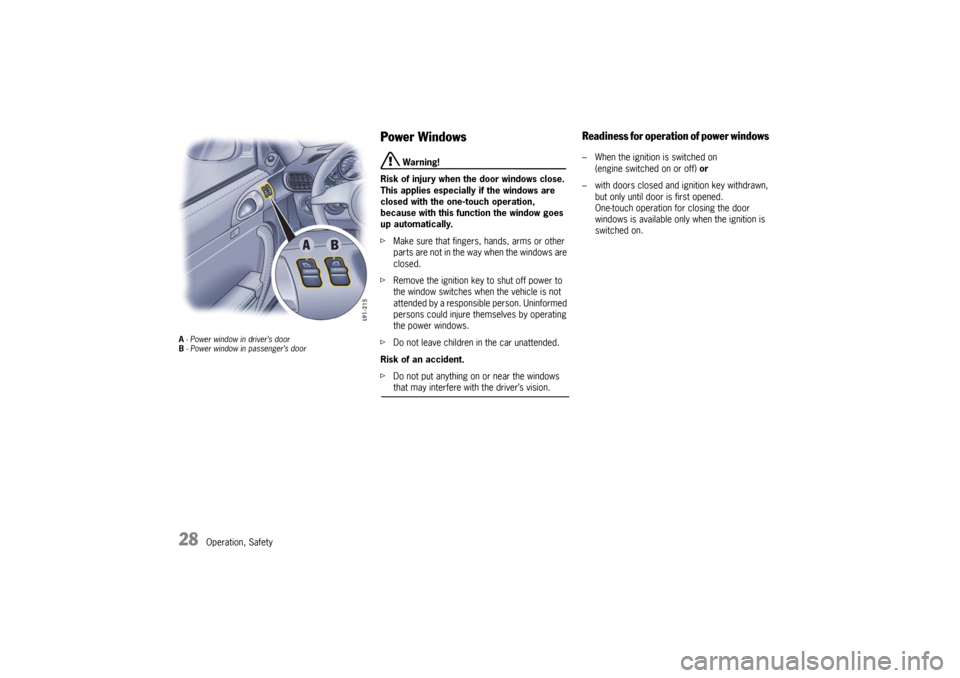
A - Power window in driver’s door
B - Power window in passenger’s door
Power Windows
Warning!
Risk of injury when the door windows close.
This applies especially if the windows are
closed with the one-touch operation,
because with this function the window goes
up automatically.
fMake sure that fingers, hands, arms or other
parts are not in the way when the windows are
closed.
fRemove the ignition key to shut off power to
the window switches when the vehicle is not
attended by a responsible person. Uninformed
persons could injure themselves by operating
the power windows.
fDo not leave children in the car unattended.
Risk of an accident.
fDo not put anything on or near the windows that may interfere with the driver’s vision.
Readiness for operation of power windows – When the ignition is switched on
(engine switched on or off) or
– with doors closed and ignition key withdrawn,
but only until door is first opened.
One-touch operation for closing the door
windows is available only when the ignition is
switched on.
10_GT3_21.book Seite 28 Donnerstag, 4. Juni 2009 12:48 12
Page 37 of 251
36
Operation, Safety
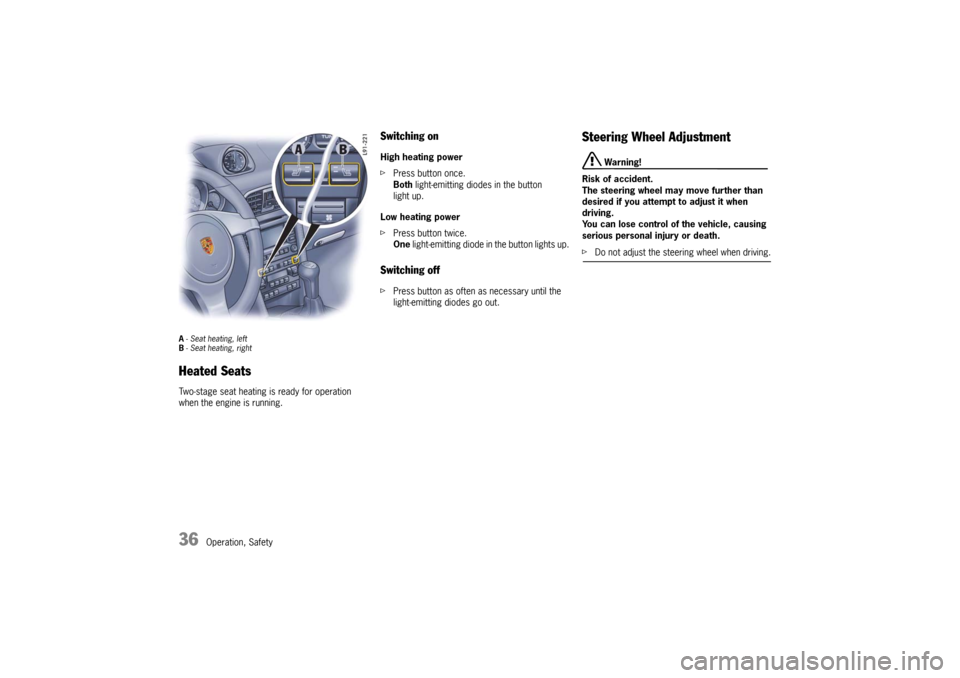
A- Seat heating, left
B- Seat heating, rightHeated SeatsTwo-stage seat heating is ready for operation
when the engine is running.
Switching onHigh heating power
fPress button once.
Both light-emitting diodes in the button
light up.
Low heating power
fPress button twice.
One light-emitting diode in the button lights up.Switching offfPress button as often as necessary until the
light-emitting diodes go out.
Steering Wheel Adjustment
Warning!
Risk of accident.
The steering wheel may move further than
desired if you attempt to adjust it when
driving.
You can lose control of the vehicle, causing
serious personal injury or death.
fDo not adjust the steering wheel when driving.
10_GT3_21.book Seite 36 Donnerstag, 4. Juni 2009 12:48 12
Page 44 of 251

Operation, Safety
43
Seat adjustment for the passenger's seat
Danger!
Safety belts only offer protection when the
backrest is upright and the belts are properly
positioned on the body. Improperly positi-
oned safety belts can cause serious personal
injury or death in an accident.
fDo not operate the car with the driver or
passenger backrests excessively reclined.
fPorsche recommends the use of L.A.T.C.H.
(Lower Anchorage and Tether for Children)
equipped Porsche child seat.
Do not install a child restraint system in
the Sports bucket seat.
The Sports bucket seat cannot be equipped with the LATCH system.
If the seat is in an extreme position (e.g., the
backrest is in contact with the engine compart-
ment wall), the backrest can warp. Warping of the
backrest can lead to malfunctions.
fCorrect the seat adjustment.
Ensure that the seat is not jammed and is self-
supporting.
Ensure that the backrest is in the upright
position.fDo not transport a load and objects behind and
under the passenger's seat.
If the load or objects are under the seat, it can
cause malfunctions.
If the weight on the passenger's seat is reduced
significantly, e.g., by supporting weight on the
armrest, the passenger's airbag can be switched
off.
fSelect an upright seat position, and do not
support weight on the armrests or lean out of
the window.
Always keep feet in the footwell while driving.
Do not put feet on the dashboard or the seat
area. Do not lean against the inside of the door
or outside the window while the vehicle is
moving.
If the passenger's seat is warped significantly, a
message is displayed on the on-board computer:
fCorrect the seat adjustment.
fPlease see the chapter “WARNINGS ON THE
INSTRUMENT PANEL AND THE ON-BOARD
COMPUTER” on Page 148.
Vehicle modifications to accommodate
persons with disabilities
Because modifications to your vehicle could
compromise your advanced airbag system,
please call 1-800-PORSCHE prior to having your
vehicle modified.Automatic deactivation of the front
passenger’s airbags
Danger!
The use of a child restraint system in the
passenger’s seat can result in serious
personal injury or death to the child from an
airbag deployment.
fPlease see the chapter “PASSENGER AIRBAG
OFF INDICATOR LAMP DOES NOT LIGHT UP”
on Page 44.
fBefore transporting a child on the passenger’s
seat:
Please see the chapter “CHILD RESTRAINT
SYSTEMS” on Page 47.
fDo not install a child restraint system in the Sports bucket seat.
– When an up to one-year old child is seated
in the child restraint system, the front airbag is
automatically deactivated on the passenger’s
side.
– When an adult is seated in the front seat, the
front airbag remains active on the passenger‘s
side.
10_GT3_21.book Seite 43 Donnerstag, 4. Juni 2009 12:48 12
Page 46 of 251

Operation, Safety
45
Note
The key switch for switching off the passenger’s
airbag in combination with the LATCH attachment
bracket are not installed at the factory. They can
be retrofitted.
fPlease see your authorized Porsche dealer.
Faults are indicated by a warning light in the instru-
ment panel and a message on the on-board
computer.
fPlease see the chapter “WARNINGS ON THE
INSTRUMENT PANEL AND THE ON-BOARD
COMPUTER” on Page 148.
fIn the following cases you should immedi-
ately consult an authorized Porsche
dealer in order to assure the airbag
system is functioning properly:
– If the warning light does not light up when the
ignition key is inserted or
– If the warning light does not go out once the
engine is running or
– If the warning light appears while driving.
Airbag maintenanceIn order to ensure long-term functioning, the
airbag system must be inspected by an authorized
Porsche dealer at the intervals recommended in
your Maintenance Booklet.
Important information
If you sell your Porsche, notify the purchaser that
the vehicle is equipped with airbags, and refer
them to the chapter, “Airbag Systems“, in the
Owner's Manual (safety and disposal rules).
Further information on the airbag system can be
found on stickers attached to the sun visors.
For special recommendations on the use of child
restraints:
fPlease see the chapter “CHILD RESTRAINT
SYSTEMS” on Page 47.
Warning light and warning
message
10_GT3_21.book Seite 45 Donnerstag, 4. Juni 2009 12:48 12
Page 57 of 251

56
Operation, Safety
Brake booster The brake booster assists braking only when
the engine is running.
When the car is moving while the engine is not
running, or if the brake booster is defective, more
pressure on the brake pedal is required to bring
the car to a stop.
If this happens, ABS and PSM will also not
operate.
Moisture or road salt on brakes affects braking.
Brakes will dry after a few cautious brake applica-
tions.
Warning!
Risk of an accident, resulting in serious
personal injury or death.
Driving through water may reduce the
traction.
Moisture on brakes from road water, car
wash, or coating of road salt may affect
braking efficiency.
fCautiously apply brakes to test brakes after exposure to road water, etc.
Brake wear Your car has excellent brakes, but they are still
subject to wear. The rate at which they wear
depends on how the brakes are used.
fHave the brake system inspected at the
intervals recommended in your Maintenance
Booklet.
Brake system warning light
You can check the functionality of the brake
system warning light by switching the ignition to
the “On” position and verifying that the warning
light illuminates.
If the warning lights in the instrument panel and on-
board computer stay on when the engine is
running or come on while driving, the brake pads
are worn excessively.
fDo not continue to operate the vehicle.
Have your authorized Porsche dealer inspect
or replace the brake pads.
Brake pads Wear on the brake pads and brake discs depends
to a great extent on the driving style and the condi-
tions of use and therefore cannot be expressed in
actual miles on the road.
The high-performance brake system is designed
for optimal braking effect at all speeds and tempe-
ratures.
Certain speeds, braking forces and ambient
conditions (such as temperature and humidity)
therefore might cause “brake noises”. This also
applies after completion of the breaking-in period
required for the new brake components.
New brake pads or linings
New brake pads and brake discs have to be
“broken in”, and therefore only attain optimal
friction when the car has covered several hundred
miles or km.
The slightly reduced braking ability must be
compensated for by pressing the brake pedal
harder. This also applies whenever the brake pads
and brake discs are replaced.
Warning light USA
Warning light Canada
10_GT3_21.book Seite 56 Donnerstag, 4. Juni 2009 12:48 12