oil change PORSCHE 911 GT3 2010 5.G User Guide
[x] Cancel search | Manufacturer: PORSCHE, Model Year: 2010, Model line: 911 GT3, Model: PORSCHE 911 GT3 2010 5.GPages: 251, PDF Size: 14.33 MB
Page 181 of 251
180
Maintenance, Car Care
Cleaning airbags covers
Danger!
Risk of danger of serious personal injury or
death if the airbag system is impaired by
improper cleaning work.
fDo not make any modifications whatsoever on
individual components such as the padded
covers of the steering wheel, passenger side
instrument panel, the front seats and the door
linings.
fLet your authorized Porsche dealer clean these components.
Fabric, upholstery, carpets and
floor-mats fUse only a vacuum cleaner or a medium stiff
brush.
fRemove stains and spots with Porsche stain
remover.
The Porsche range of accessories includes
nonskid floor-mats to protect the carpets in
summer and winter.
Warning!
Risk of an accident resulting in serious
personal injury or death.
fAlways check the movement of the pedals
before driving and make sure that they are not
obstructed by a floor-mat or any other object.
fSecure the floor-mat to prevent it from sliding
into positions that could interfere with the safe
operation of your vehicle - do not install them
loosely in the vehicle.
Your Porsche dealer will be glad to offer you nonskid floor-mats of the correct size.
Alcantara fDo not use a leather care product to clean
Alcantara.
For regular care it is sufficient to clean the cover
with a soft brush.
Heavy abrasion or rubbing when cleaning causes
a lasting change in the surface.
Cleaning when lightly soiled
fWet a soft cloth with water or a neutral soap
solution and wipe off the dirt.
Cleaning when heavily soiled
fWet a soft cloth with lukewarm water or
thinned white spirit and dab the dirt from the
outside in. Safety belts If it becomes necessary to clean the belts, you
can use any mild washing agent.
Allow the belts to dry prior to retracting, but avoid
direct sunlight.
fOnly use suitable cleaners.
If unsuitable cleaners are used or any attempt
is made to dye or bleach the belts, the
webbing may be weakened and thus constitute
a safety risk.
10_GT3_21.book Seite 180 Donnerstag, 4. Juni 2009 12:48 12
Page 182 of 251
Maintenance, Car Care
181
Storing your Porsche If you intend to store your Porsche for a prolonged
period, please consult your authorized Porsche
dealer. The staff will be glad to advise you on the
most suitable and necessary methods.
fClean your vehicle thoroughly inside and
outside.
Clean the engine compartment.
The under carriage and chassis components
should be free of dirt and salt deposits.
fFill up the fuel tank.
fChange the oil and oil filter, and run the engine
for several minutes.
fIncrease the tire pressure to 58 psi (4 bar).
It is not recommended to lift the vehicle, due to
the possibility of corrosion on shock absorber
piston shafts.
The vehicle should be moved slightly, approxi-
mately every four weeks, to prevent flat spot
on the tires. Climate control
The air conditioning system should be in good
working condition and fully charged.
Windshield/Headlight washer
fCheck and correct antifreeze/cleaning solution
level as necessary.
Electrical system
fRemove the battery from the vehicle and store
it in a cool dry place, not on a cement floor.
When the battery is disconnected, the
alarm system is deactivated.
fRecharge the battery every 3 months. If the
battery remains in the vehicle with the cables
connected, it is necessary to check, remove
and recharge the battery every 2-3 weeks.
Do not fast charge the battery.
fPlease see the chapter “BATTERY” on
Page 211.Vehicle interior
The interior must be dry, especially in the area of
the floor carpets. The use of drying agents (Silica-
Gel) is recommended in vehicles with leather
interior and in areas with high humidity. The
recommended amount is 3 fabric bags of 1.1 lbs.
(500 grams) each placed on the floor carpets.
Windows, doors and lids must be closed. The air
vents should be opened.
10_GT3_21.book Seite 181 Donnerstag, 4. Juni 2009 12:48 12
Page 190 of 251
Practical Tips, Emergency Service
189
Danger!
Risk of serious personal injury or death.
Driving the vehicle with low tire pressure
increases risk of a tire failure and resulting
loss of control. Furthermore, low tire
pressure increases rate of wear of the
affected tires.
fCheck tires – including sidewalls – regularly for
foreign bodies, nicks, cuts, cracks and bulges.
fAfter driving off road, examine tires for signs
of damage such as cuts, tears, bulges or
foreign objects stuck in the tread. Replace a
damaged tire if necessary.
fCross curb edges slowly and at right angles if
possible.
Avoid driving over steep or sharp curbs.
fIn cases of doubt, have the wheel (particularly
the inner side) checked by an authorized Porsche dealer.
Tire replacements If in doubt, contact your authorized Porsche
dealer.
Use only tire makes and types approved by
Porsche.
If you do not use a Porsche recommended
replacement tire, make sure that you
purchase your new tires from a reputable tire
dealer and that the dealer complies with all
manufacturers warnings for those tires.
Only tires with the same make and with the
same specification code (e.g. “N0”, “N1”...)
can be mounted.
Before mounting new tires, check with your
Porsche dealer about the current release
status.
Use tires with “ZR” quality standards. There
are currently no standards concerning tire
strength at speeds above 150 mph (240 km/h).
Tires should be replaced no less than on one axle
at the time.
Only tires of the same make and type must be
used. Mixed tires are not permissible.
Initially, new tires do not have their full traction.
You should therefore drive at moderate speeds
during the first 60 - 120 miles (100 - 200 km). If new tires are installed only on one axle, a notice-
able change in handling occurs due to the different
tread depth of the other tires.
This happens especially if only rear tires are
replaced. However, this condition disappears as
the new tires are broken in.
fPlease adjust your driving style accordingly.
Installation of new tires should only be done by a
qualified tire technician.
Valves
Please observe the installation and replacement
instructions for valves.
fUse only genuine Porsche metal valves.
fProtect the valve inserts against soiling with
valve caps.
Soiled valve inserts can cause a gradual loss
of air.
fUse only plastic valve caps.
10_GT3_21.book Seite 189 Donnerstag, 4. Juni 2009 12:48 12
Page 205 of 251
204
Practical Tips, Emergency Service
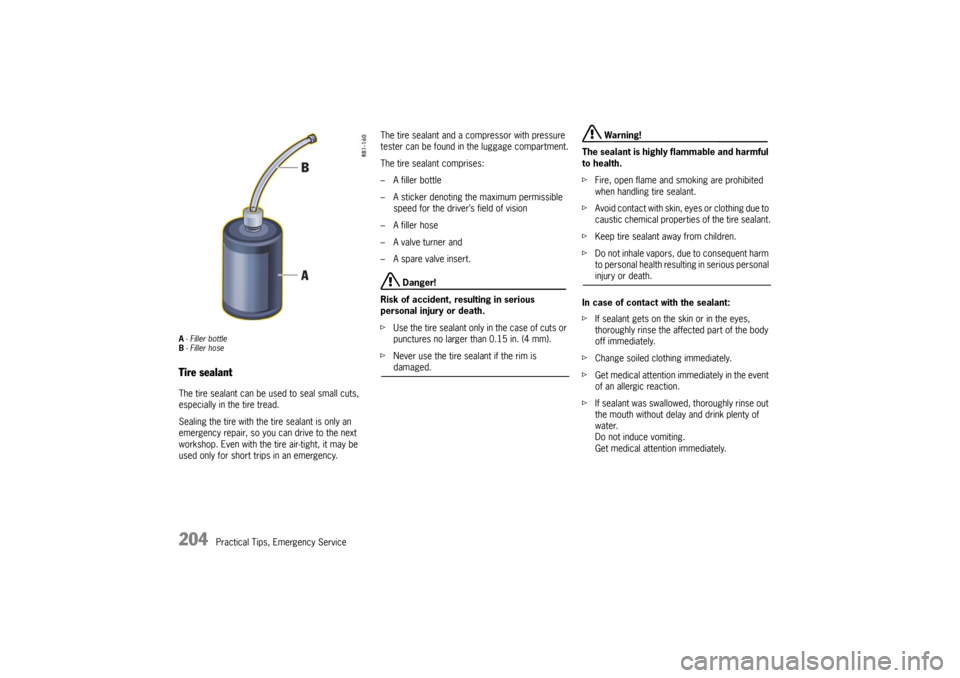
A- Filler bottle
B- Filler hoseTire sealantThe tire sealant can be used to seal small cuts,
especially in the tire tread.
Sealing the tire with the tire sealant is only an
emergency repair, so you can drive to the next
workshop. Even with the tire air-tight, it may be
used only for short trips in an emergency.The tire sealant and a compressor with pressure
tester can be found in the luggage compartment.
The tire sealant comprises:
– A filler bottle
– A sticker denoting the maximum permissible
speed for the driver’s field of vision
– A filler hose
– A valve turner and
– A spare valve insert.
Danger!
Risk of accident, resulting in serious
personal injury or death.
fUse the tire sealant only in the case of cuts or
punctures no larger than 0.15 in. (4 mm).
fNever use the tire sealant if the rim is damaged.
Warning!
The sealant is highly flammable and harmful
to health.
fFire, open flame and smoking are prohibited
when handling tire sealant.
fAvoid contact with skin, eyes or clothing due to
caustic chemical properties of the tire sealant.
fKeep tire sealant away from children.
fDo not inhale vapors, due to consequent harm
to personal health resulting in serious personal injury or death.
In case of contact with the sealant:
fIf sealant gets on the skin or in the eyes,
thoroughly rinse the affected part of the body
off immediately.
fChange soiled clothing immediately.
fGet medical attention immediately in the event
of an allergic reaction.
fIf sealant was swallowed, thoroughly rinse out
the mouth without delay and drink plenty of
water.
Do not induce vomiting.
Get medical attention immediately.
10_GT3_21.book Seite 204 Donnerstag, 4. Juni 2009 12:48 12
Page 240 of 251

Technical Data
239
CapacitiesUse only fluids and fuels authorized by Porsche. Your authorized Porsche dealer will gladly advise you.
Your Porsche has been designed so that it is not necessary to mix any additives with oils or fuels.
EngineOil change quantity without oil filter approx. 9.25 quarts / 8.75 liters
Oil change quantity with oil filter approx. 9.5 quarts / 9 liters
Please see the chapter “ENGINE OIL” on Page 159.
Coolantapprox. 7.9 U.S. gallons / 30 liters
Manual transmission
and differential
approx. 3.5 quarts / 3.3 liters transmission oil SAE 75W-90, Mobilube PTX
Fuel tank approx. 17.7 U.S. gallons / 67 liters
Fuel qualityYour engine is designed to provide optimum performance and fuel economy using
unleaded premium fuel with an octane rating of 98 RON (93 CLC or AKI).
Porsche therefore recommends the use of these fuels in your vehicle.
Porsche also recognizes that these fuels may not always be available. Be assured that your vehicle
will operate properly on unleaded premium fuels with octane numbers of at least 95 RON (90 CLC or AKI),
since the engine’s “Electronic Octane™ knock control” will adapt the ignition timing, if necessary.
Power steeringapprox. 1.35 quarts / 1.27 liter hydraulic fluid Pentosin CHF 11 S
® or Pentosin CHF 202
®
Brake fluid0.67 quarts / 0.63 liters; use only Original Porsche brake fluid.
Windshield washerapprox. 2.6 quarts / 2,5 liters without headlight washer
approx. 6.3 quarts / 6 liters with headlight washer
10_GT3_21.book Seite 239 Donnerstag, 4. Juni 2009 12:48 12